Lutheran
Practical Lutheranism: Luther on the 5th Commandment and Refugees

A Public Domain image of Syrian Refugees. Accessible: https://commons.wikimedia.org/wiki/File:Syrian_refugee_of_the_Syrian_civil_war.jpg
I have been reading through the Book of Concord, which is a collection of the Lutheran Confessions. I think it is vitally important for one who, like me, claiming to be Lutheran to be familiar with these documents. They are, after all, what we believe and confess. I decided to start a series of posts as I’m reading through the Book of Concord to highlight various areas I think are important.
The Fifth Commandment and Refugees
There is much fear in the world today over the question of Syrian Refugees. I’ve been reading through the Book of Concord and I ran into the section on the Fifth Commandment. I was taken back by how lucid Luther’s interpretation is there, and it has some serious application for today:
Therefore it is God’s ultimate purpose that we suffer harm to befall no [hu]man, but show [them] all good and love; and, as we have said, it is specially directed toward those who are our enemies. For to do good to our friends is but an ordinary heathen virtue, as Christ says Matt. 5:46.
One can see these same thoughts echoed in the discussion of the seventh commandment:
…we are commanded to promote and further our neighbors’ interests, and when they suffer any want, we are to help, share, and lend to both friends and foes (251-252)
What is particularly uncomfortable about these words is the word of law that is contained within them: “both friends and foes” are included in these commands. We ought to further their interests, “help, share, and lend to” them “when they suffer any want,” and show them “all good and love.” Luther is abundantly clear on this point: “it is specially directed toward those who are our enemies.”
Could more prophetic words have been written by Luther? Surely, the times in which we fear our enemies and wish to do nothing but avoid them are legion. Today is but one example of human injustice to fellow humans. But the words of the Commandments brook no argument, and Luther’s interpretation makes this abundantly clear: “to do good to our friends is but an ordinary heathen virtue…” and we are given a higher calling.
Those objections that would point to individual instances of violence, those who would alleged terrorists sneaking into our borders, and the like: the word of the law is spoken, and it is a powerful one: Christ’s calling is higher. When they suffer–even when our enemies suffer–we ought help them. If that means letting in the Syrian refugee fleeing from the violence in their homeland, if that means the “illegal immigrant” running from poverty and destitution, then so be it. There is no question here. There is no exception for fear that they will “steal our jobs” or that they speak a different language or have a different skin color or a different religion or anything of the sort. The words Luther writes here are clear: “it is God’s ultimate purpose that we suffer harm to befall no” one.
Source
Robert Kolb and Timothy J. Wengert, eds. The Book of Concord: The Confessions of the Evangelical Lutheran Church (Minneapolis, MN: Fortress, 2000).
Links
Be sure to check out the page for this site on Facebook and Twitter for discussion of posts, links to other pages of interest, random talk about theology/philosophy/apologetics/movies and more!
Adhering to the Book of Concord “In So Far As” or “Because” it Agrees with Scripture?– I argue that Lutherans must hold the position that we adhere to the Book of Concord In So Far As it Agrees with Scripture.
Eclectic Theist– Check out my other blog for posts on Star Trek, science fiction, fantasy, books, sports, food, and more!
SDG.
——
The preceding post is the property of J.W. Wartick (apart from quotations, which are the property of their respective owners, and works of art as credited; images are often freely available to the public and J.W. Wartick makes no claims of owning rights to the images unless he makes that explicit) and should not be reproduced in part or in whole without the expressed consent of the author. All content on this site is the property of J.W. Wartick and is made available for individual and personal usage. If you cite from these documents, whether for personal or professional purposes, please give appropriate citation with both the name of the author (J.W. Wartick) and a link to the original URL. If you’d like to repost a post, you may do so, provided you show less than half of the original post on your own site and link to the original post for the rest. You must also appropriately cite the post as noted above. This blog is protected by Creative Commons licensing. By viewing any part of this site, you are agreeing to this usage policy.
Bonhoeffer’s Troubling Theology? – A response to an article on Dietrich Bonhoeffer’s theological perspectives

Recently, Richard Weikart wrote an article entitled “The Troubling Truth About Bonhoeffer’s Theology.” Not surprisingly, this article called attention to some aspects of Dietrich Bonhoeffer’s theology which would be considered, well, troubling to evangelicals.
The article has much to commend it: it shows that we ought not to make any theologian into an idol or endorse everything anyone writes. Indeed, the conclusion of the article has little to question in it: “What then should we make of Bonhoeffer? While recognizing his many admirable traits—compassion, courage, commitment, and integrity—we should be wary of many elements of his theology.” I think this kind of critical perspective is something evangelicals–and Christians generally–ought to take to heart. We should always test theologians by what Scripture teaches us.
All of that said, there are some aspects I wanted to respond to in the article, particularly to give some more context for Bonhoeffer as well as his Lutheran theology. I’m sure Weikart is more studied on Bonhoeffer than I am, and I don’t claim to be an expert on Bonhoeffer’s thought. What I do know, however, is a good amount about Lutheran theology, and what I have read of and about Bonhoeffer. And all of that, I think, is enough to allow me to offer some areas of criticism regarding the article.
The Bible and Apologetics
There is no question that Bonhoeffer’s view of the Bible was heavily influenced by Karl Barth. Weikart is correct to note that this means that, for Bonhoeffer, Scripture is not inerrant. Indeed, he believes the Bible scientifically silly at points (see his Creation and Fall, for example). Scripture was, for both Barth and Bonhoeffer, important more for conveying truths about Christ than it is for being verbally inspired. Scripture conveys the revelation of Christ, rather than itself being revelation, according to both. This is, indeed, a weakness in their theology.
Later, Weikart critiques Bonhoeffer for his view of apologetics: “[Bonhoeffer] thought that the historical accuracy of Scripture was irrelevant. Barth (and Bonhoeffer) considered apologetics misguided, because it transgressed the boundaries separating the empirical and religious realms.”
I’m not sure about the first part of this claim. If, by “historical accuracy,” Weikart means the individual details of how events happened, or specific views of creationism and the like, then the statement is true. But the brush seems to be a bit too broad here; given Bonhoeffer’s view of the importance of Christ, the cross, and the Resurrection, to broadly say that none of these were seen as historical or were in fact irrelevant is to speak too strongly. Did Bonhoeffer think things like the length of creation days, the exact words spoken by the serpent at the Fall, and the like were historically irrelevant? Yes, pretty much. But that doesn’t mean he thought there was nothing of historical value therein, nor does it mean he rejected the usefulness of Scripture. This is a common error evangelicals make regarding the views of Christians who do not affirm inerrancy. Admittedly, it’s one I have made at times. Just because someone doesn’t affirm a form of verbal inspiration does not entail they think everything in the Bible is false or questionable.
Regarding the second part of the claim, it is easy to assume someone like Barth or Bonhoeffer completely rejected apologetics, and indeed each makes statements to that effect; but what they mean by apologetics largely means a kind of apologetics that puts humanity in judgment of God. Barth and Bonhoeffer would not completely reject any form of defense of the faith, but they would reject those that rely on natural theology and the like. Bowman and Boa’s book, Faith Has Its Reasons categorizes Barth as a “fideist” apologist. Delving into those issues would take too long, but it is safe to say that Bonhoeffer would not have been completely against any form of apologetics whatsoever. His own apologetic would have been personal and existential, and apologists ought not to dismiss this aspect of a holistic view of Christianity.
“Conversion Experience”?
Weikart writes, “Though he experienced some kind of conversion around 1931, he hardly ever mentioned it. Later he expressed distaste for Christians talking or writing about their conversions.” Later, he makes his aversion to Bonhoeffer’s Lutheranism plain: “Aside from his faulty view of Scripture, Bonhoeffer’s doctrine of salvation was also problematic. As a Lutheran he embraced baptismal regeneration.”
The multiple mentions about Bonhoeffer’s “conversion” reveal more about the author of the article than about Dietrich Bonhoeffer. Bonhoeffer was, like myself, a Lutheran and ought to be evaluated as such. Unless Weikart wants to dismiss all Lutherans as unsaved heretics–or at least as affirming “troubling” theology–he cannot simply dismiss Bonhoeffer’s view because he didn’t talk about his “conversion experience.”
The fact that Weikart continues to emphasize this makes me wonder just how inclusive his definition of “evangelical” is supposed to be. Lutherans do not have an emphasis on finding some specific event, date, or time that signify we converted to Christianity. Because of the emphasis in Lutheran theology on predestination and baptism, such language seems to us to imply a kind of work of conversion being done by the individual rather than by God. Indeed, for many Lutherans, if pressed to pick a moment of conversion, that would be whatever time they were baptized as an infant. This is not the place to delve into the debate over baptism, infant baptism, and the like. Instead, I’m giving context to Bonhoeffer’s theology and experience. Martin Luther himself affirmed vehemently that infants can have faith, and however absurd this might seem to many non-Lutherans, the reason is because faith is the act of the Holy Spirit–it is pure grace, not tied to some specific synergistic act or affirmation by a human. To critique Bonhoeffer because he wasn’t speaking to the expectations of whatever brand of evangelicalism Weikart subscribes to is to decontextualize his theology and, indeed, to effectively dismiss Lutheran confessions of faith.
Weikart most likely does disagree with much of the Lutheran Confessions, but this does not mean it is acceptable to critique someone like Bonhoeffer as though he is some kind of mainstream evangelical instead of being a Lutheran.
“Religionless Christianity”
Weikart quotes the somewhat infamous passage Bonhoeffer wrote of his resistance to “everything ‘religious.'” Such words tend to rile those who adhere to a narrative of a “culture war” between Christianity and… everything else. But, like Kierkegaard, who gets lumped in by Weikart along with other apparently “troubling” theologians, Bonhoeffer’s comments on religion must be read contextually. Eric Metaxas writes about this very same quote in his lengthy biography (and sometimes controversial) on Bonhoeffer, Bonhoeffer: Pastor, Martyr, Prophet, Spy:
The most tortured interpretations [of Bonhoeffer] have fixed on his reference to “religionless Christianity”… [Bonhoeffer] saw a situation so bleak… that he was rethinking some basic things and wondered whether modern man had moved beyond religion. What Bonhoeffer meant by “religion” was not true Christianity, but the ersatz and abbreviated Christianity that he spent his life working against. This “religious” Christianity had failed Germany and the West during this great time of crisis…. and he wondered whether it wasn’t finally time for the lordship of Jesus Christ to move past Sunday mornings and churches and into the whole world. (466-467, cited below)
The crisis, of course, was Germany in World War II–the same Nazi Germany which executed Bonhoeffer shortly before the end of the war. Weikart’s warnings about Bonhoeffer’s comments on “religion,” it seems, fall into the same trap that many fall into when discussing Kierkegaard–failing to take the historical context and particular usage of the term seriously. Though some have objected to Metaxas’ portrayal of Bonhoeffer, the historical context provided here can hardly be questioned, because it is exactly what Bonhoeffer was rejecting against.
Evangelical Lutheran Hero?
Did Bonhoeffer have some aspects of his theology that evangelicals will find troubling? Absolutely, and Weikart does a good job highlighting some of these. But the point I’m trying to make is that none of this means that Bonhoeffer needs to be rejected or thrown out as an evangelical (and/or Lutheran) hero. Indeed, for the Lutheran in particular, Bonhoeffer’s theology shows us how true it is that we are all but sinner-saints. Though chosen by God and saved by grace alone, that does not mean we will be perfect now, and it means that we may have ideas that will be mistaken throughout our lives.
Many of the greatest theologians of all time have aspects of their theology that evangelicals will find troubling. Obvious examples would include Calvin (who would be troubling to Arminians) and Arminius (whose theology is troubling to Calvinists). But, alas, no human is perfect, and even greats like Augustine, Aquinas, Mother Theresa, and the like will not withstand scrutiny to determine whether they were perfect or affirmed a perfect theology.
Conclusion
Go ahead, enjoy Bonhoeffer’s works, note how he was a hero, and talk about his legacy. But read his works as you would any others: with a critical eye. As far as this article is concerned, as a Lutheran I found it somewhat troubling myself. Does Weikart genuinely mean to imply that all Lutherans must be excluded from the fold of evangelicalism? I’m not sure, but at least some of his criticism leveled at Bonhoeffer would just as easily be applied to Lutheran theology, generally speaking. And that, as I said above, seems to reveal more about the author than about Bonhoeffer.
Sources
Richard Weikart, The Troubling Truth about Bonhoeffer’s Theology (http://www.equip.org/article/troubling-truth-bonhoeffers-theology/) accessed 1/24/16.
Eric Metaxas, Bonhoeffer: Pastor, Martyrd, Prophet, Spy (Nashville: Thomas Nelson, 2010).
Links
Be sure to check out the page for this site on Facebook and Twitter for discussion of posts, links to other pages of interest, random talk about theology/philosophy/apologetics/movies and more!
Eclectic Theist– Check out my other blog for my writings on science fiction, history, fantasy movies, and more!
SDG.
——
The preceding post is the property of J.W. Wartick (apart from quotations, which are the property of their respective owners, and works of art as credited; images are often freely available to the public and J.W. Wartick makes no claims of owning rights to the images unless he makes that explicit) and should not be reproduced in part or in whole without the expressed consent of the author. All content on this site is the property of J.W. Wartick and is made available for individual and personal usage. If you cite from these documents, whether for personal or professional purposes, please give appropriate citation with both the name of the author (J.W. Wartick) and a link to the original URL. If you’d like to repost a post, you may do so, provided you show less than half of the original post on your own site and link to the original post for the rest. You must also appropriately cite the post as noted above. This blog is protected by Creative Commons licensing. By viewing any part of this site, you are agreeing to this usage policy.
Another Problem for Book of Concord Inerrantists
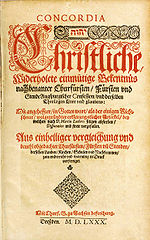
A title page of the Book of Concord
I have argued before that the stance of “confessional” Lutherans of having 100% agreement with the book of concord is unable to be maintained in the face of the evidence within the Book of Concord itself. That is, I believe that one must adhere to the Book of Concord “in so far as” it agrees with the Bible as opposed to “because” it agrees with the Bible. See my post on the topic for in-depth discussion of this distinction and its importance. I argued there, also, that the “because” position largely leads to a kind of inerrancy of the Book of Concord. After all, if the Book of Concord is to be agreed with because it agrees with the Bible, and the Bible is inerrant, it follows that anything that agrees with Scriptures 100% of the time will be without error.
Another example of defining Lutheranism according to strict adherence to the Book of Concord may be found in a recent post by Christopher Maronde entitled “What does the name ‘Lutheran’ mean?”:
Its meaning is simple: The name Lutheran refers to a person, congregation, or church body who unconditionally holds to the teachings contained within the Book of Concord, first published in 1580. A Lutheran is someone who declares that these specific documents rightly confess the truth of the Scriptures. It’s that simple; if you want to know what a Lutheran believes, if you want to know what that label means, you go to the Book of Concord. If you want to know if someone is using the label properly, you evaluate what they believe, teach, and confess according to the Book of Concord. (here)
These positions are generally considered to have a monopoly on the term “Confessional Lutheran” because they teach 100% affirmation of the Book of Concord and restrict any notion of Lutheran to that same adherence. My position, however, is that such a position cannot be maintained, nor should it have a monopoly on the term “Confessional Lutheran.”
Maronde’s definition above seems to provide a small loophole: it states that the Lutheran is to “unconditionally [hold] to the teachings contained within the book of Concord.” The key term here is “teachings.” At this point, if we grant this definition, one could argue that some purported errors in the Book of Concord may not be what the Book of Concord is teaching. However, later in the same quote, we see Maronde writes, “[I]f you want to know what that label means, you go to the Book of Concord…” which once again implies adherence to the totality, word-for-word truth of the Book of Concord. Yet the fact is the Book of Concord is not 100% true in every word-for-word instance.
I ran across another example of this in my readings the other day. In the Large Catechism, Martin Luther wrote,
This, I think, is why we Germans from ancient times have called God by a name more elegant and worthy than found in any other language, a name derived from the word ‘good,’ because he is an eternal fountain who overflows with pure goodness… [The Large Catechism, Part I, 25]
As Kolb and Wengert, editors of the critical edition of the Book of Concord published by Fortress Press note, the words for God and good in German (Gott and gut) are not derived from the same etymological root after all- “German: gut. This derivation is etymologically incorrect. The words for ‘God’… and ‘good’.. are not related in either Gothic or in Middle High German” (footnote 41 on page 389, cited below). Thus, within the very text of the Book of Concord, we have a clear error. Indeed, one that cannot be skirted around by arguing it is not something being taught therein; instead, it is clear that Luther is trying to teach about the meaning of God from an etymological derivation which is non-existent.
Therefore, it seems to me that the position of so-called “Confessional Lutheranism” and those who, like them, define Lutheranism narrowly to mean 100% adherence to the Book of Concord is clearly and demonstrably mistaken. The burden falls upon them to demonstrate that their position is actually viable in light of real, taught errors within the Book of Concord itself.
What does this mean for Lutherans–and indeed, Lutheranism? It certainly doesn’t mean we should all go chuck our Book of Concord editions in the trash. What it means is that, like any book, we should read the Book of Concord with a critical eye, checking it against God’s Word as found in the Scriptures and against the facts that we can discover in other studies as well. The Book of Concord is not inerrant, but that doesn’t mean a Lutheran cannot confess agreement with it so far as it agrees with Scripture, and, in doing so, remain a Confessional Lutheran.
Source
Robert Kolb and Timothy J. Wengert, eds. The Book of Concord: The Confessions of the Evangelical Lutheran Church (Minneapolis, MN: Fortress, 2000).
Links
Be sure to check out the page for this site on Facebook and Twitter for discussion of posts, links to other pages of interest, random talk about theology/philosophy/apologetics/movies and more!
Adhering to the Book of Concord “In So Far As” or “Because” it Agrees with Scripture?– I argue that Lutherans must hold the position that we adhere to the Book of Concord In So Far As it Agrees with Scripture.
Eclectic Theist– Check out my other blog for posts on Star Trek, science fiction, fantasy, books, sports, food, and more!
SDG.
——
The preceding post is the property of J.W. Wartick (apart from quotations, which are the property of their respective owners, and works of art as credited; images are often freely available to the public and J.W. Wartick makes no claims of owning rights to the images unless he makes that explicit) and should not be reproduced in part or in whole without the expressed consent of the author. All content on this site is the property of J.W. Wartick and is made available for individual and personal usage. If you cite from these documents, whether for personal or professional purposes, please give appropriate citation with both the name of the author (J.W. Wartick) and a link to the original URL. If you’d like to repost a post, you may do so, provided you show less than half of the original post on your own site and link to the original post for the rest. You must also appropriately cite the post as noted above. This blog is protected by Creative Commons licensing. By viewing any part of this site, you are agreeing to this usage policy.
Adhering to the Book of Concord: “In So Far As” or “Because” it agrees with Scripture?
A title page of the Book of Concord
Lutheran theology is derived from and reflective upon not just Martin Luther but also the Lutheran Confessions, as found in the Book of Concord. Within Lutheranism, there is much debate over exactly how tightly one must adhere to the Book of Concord. On one side, there are those who insist we must affirm the Book of Concord “because” it agrees with the Bible. On the other side, others maintain we should affirm it “in so far as” it agrees with the Bible.
Because it Agrees
Representative of the view that one must agree with the Book of Concord because it teaches what the Bible teaches is the following:
Authentically Lutheran churches insist on a subscription to the Confessions [The Lutheran Confessions/Book of Concord are used interchangeably] because they agree with the Bible, not merely in so far as they agree with Scripture. Otherwise, there would be no objective way to make sure that there is faithful teaching and preaching of God’s Word. Everything would depend on each pastor’s private opinions, subjective interpretations, and personal feelings, rather than on objective truth as set forth in the Lutheran Confessions. (Book of Concord (.org) FAQ)
Note some important aspects in this quote. First, the Book of Concord just does agree with the Bible. That is insisted upon. Second, the Book of Concord is said to be “objective truth” as opposed to the “subjective interpretations” of the individual. These considerations frame what I’d like to comment on regarding those who hold to the view that we must agree with the book of Concord “because…”
Because?
I’ll start with the second aspect noted above. There are, of course, all kinds of increasingly detailed issues people on either side of the debate might raise here. For example, how are “objective” and “subjective” being here defined? I’m going to set that kind of issue mostly aside and focus on a few difficulties I see.
The first is that one cannot simply read the words off the pages of the Book of Concord without going through the necessary step of interpreting them. That is, I as a reader of the Book of Concord must try to make sense of the words I am reading, and thus I am participating in the act of interpreting the Book of Concord. If, as the quote above states, the problem is the individual’s subjective nature, then the problem is completely unavoidable. Indeed, even if we grant that the Book of Concord is “objective truth” in its entirety, all we’ve done is moved the problem of subjective interpretation one step back. Now the reader must interpret the Book of Concord in order to get to the objective truth about Scripture found therein.
Another difficulty with this objective/subjective distinction is that it assumes the writers of the Lutheran Confessions were themselves either not subjective (which seems impossible) or explicitly guided by the Spirit to write out objective truth only. I would not dispute that the Holy Spirit could bring about a completely faultless writing, but the question is whether those who affirm the “because” position would like to argue this. The first thing we should do if they do want to argue this would be to see whether the writers of the Book of Concord assert the Holy Spirit did bring about such a completely objective, 100% correct work.
In the Preface to the Book of Concord, we can read:
Finally, with invocation of God Almighty and to his praise and glory and with careful deliberation and meticulous diligence through the particular grace of the Holy Spirit, they wrote down in good order and brought together into one book everything that pertains to and is necessary for this purpose. (Preface, 12)
Later, the Preface makes clear (15) that this Book was “the correct, Christian understanding of the Augsburg Confession…” In the closing of the Preface, we read (23) that those who signed on to it that they “are minded not to manufacture anything new… nor to depart in either substance or expression… from the divine truth… by the grace of the Holy Spirit we intend to persist and remain unanimously in this truth and regulate all religious controversies and their explanations according to it.”
These are all strong statements, and they clearly called upon God the Holy Spirit for guidance in the composition of the various works that make up the Book of Concord. But does it follow that they were explicitly, inerrantly inspired and guided by the Spirit to never once get a single thing wrong in this book? Those who affirm the “because” position must answer yes. There is no wiggle room.
But a close reading of the Preface seems to suggest that although the writers certainly believed everything in the Book of Concord to be without theological error (otherwise they would not have it regulate all controversies, etc.), I have yet to find anywhere that a claim could be made that the book is explicitly inerrant. It would have to be, however, for the “because” position to be true. This human composition would have to be 100% correct in every single minute detail down to the last proof text cited in order for it to be acceptable to affirm that we must agree with it “because” it agrees with Scripture.
Among other things, what follows from that is that anyone who subscribes to the Book of Concord “because” position must have read the entirety, looked up every citation, and assured themselves that every single interpretation, doctrinal position, and the like is 100% correct, lest they be saying that it is a human-made book without error on God’s Word without actually knowing every detail it contains.
The first issue raised above will be addressed in the section named “A Case Study,” below.
In So Far As
A supporting argument for the “In So Far As” position is that we should always only affirm that which is true. If we can agree that the Bible is true in all it teaches, then we should only agree with other writings about the Bible so far as they agree with the Bible. This seems like an obvious conclusion, but the whole debate centers on whether this argument is sound. It is difficult for me to figure out how to support this argument, not because I think it is a poor argument, but because it seems just intuitively clear.
It may help to use an analogy. Historians have debated how to write history and whether writers of history can ever fully get at the “true” history as it happened. Yet very few would deny that there is such a thing as a “true” history. There must be some absolutely correct sequence in which events occurred such that if we had a complete set of writings that simply reported those events, that would be the “true” history. Thus, there is an objectively true history, against which historians can be measured. Granting some of the hand waving involved in this thought experiment, suppose we had a book, The True History of the World, and we looked up the John F. Kennedy assassination therein. We would then have the objectively true report of that hotly-debated historical event as it really did happen. Now suppose I wanted to write a book about the JFK assassination based upon The True History of the World. However careful a historian I am, however excellent and detailed my mind is, however much guidance I may have had, would it be reasonable to say that you agree with my book, The Objective JFK Assassination “because” it agrees with The True History of the World or “in so far as” it does? It seems that the reasonable conclusion would be “in so far as” it does, because we know that The True History of the World is objectively true.
Though imperfect, this analogy gets at the argument written above. We can agree the Bible is inerrant. Thus, if I were to write a book entitled The Objective Bible, I think we can agree that we should only agree with my book so far as it agrees with the Bible, right? No matter how detailed I am, no matter how meticulous, no matter how large a group of thoughtful interpreters I got together to vet my work, it would be entirely reasonable to only affirm agreement with my book so far as it is biblical. Then why would such a standard not also apply to the Book of Concord? I see no reason why that standard would not.
Indeed, to argue against those who affirm the Book of Concord only “in so far as” it agrees with the Bible would mean that one would have to assert that the caution and respect for God’s word implicit in that position–that I would not want to affirm anything, even by mistake, as biblical if it is even possibly in error anywhere–are mistaken. That the care and caution necessary to say “I will only agree with any book in so far as it agrees with the Word of God” is mistaken, and that that the Book of Concord must also be included under the umbrella of books against which all others must be judged.
For the “because” position ultimately, unswervingly leads to the conclusion that we should only affirm any other book “in so far as” it agrees with the Book of Concord. After all, if it is true that the Book of Concord is affirmed because it agrees with Scripture, then it follows that the authority of the Bible is effectively equivalent to the authority of the Book of Concord. The Bible is God’s word, and the Book of Concord is the objective teaching of God’s word without even possible error. That is not simply rhetoric; it is what must follow from the “because” position. Any interpretation of the Bible must be judged against the Book of Concord; hence, any reading of the Bible must also be judged against it.
A Case Study
Finally, we are in position to ask whether the Book of Concord does indeed have any error therein. That is a crucial question, of course, and one not easily resolved by those who remain faithful Lutherans. If, however, there is even one incorrect use of a proof text in the Book of Concord, the “because” position fails.
In the Apology of the Augsburg Confession, Article XXIII (XI) on the Marriage of Priests, section 25, we read:
Therefore this law concerning perpetual celibacy is peculiar to this new pontifical despotism. Nor is it without a reason. For Daniel 11:37, ascribes to the kingdom of Antichrist this mark, namely, the contempt of women.
Daniel 11:37 reads (ESV) “He shall pay no attention to the gods of his fathers, or to the one beloved by women. He shall not pay attention to any other god, for he shall magnify himself above all.”
The whole passage is difficult to interpret given its prophetic message about the Kings of the North and the South. I’m not going to enter into whether this is specifically referencing “Antichrist” or “the kingdom of Antichrist” or anything of the sort. Instead, the issue is with the reading as “contempt of women.” The Reformers were obviously not using the ESV or anything in English. But older English editions like the KJV might support this text as a proof for contempt of women: “Neither shall he regard the God of his fathers, nor the desire of women, nor regard any god: for he shall magnify himself above all.”
But the problem is that critical editions of the Old Testament don’t support a reading as contempt of women. Without going into depths of detail, and because I’m not a Hebrew scholar by any measure, I would just point out that the Hebrew does seem to clearly state “the one desired by women.” So if we are to read 11:37 as a proof text for contempt of women, it doesn’t seem to be a right reading. It’s a minor difficulty, but one nevertheless. Did the citation above from the Book of Concord properly exegete the Bible? I would assert that the use of this proof text is mistaken. If we are to take “paying no attention” as “contempt”–itself a move that could be disputed, then the subject remains “the one desired by women” not “women.”
Now, if the Book of Concord should be agreed with because it agrees with the Bible, then how are we to take this? I don’t know. It seems to me that this is more an example of the way people read the Bible at the time and used proof texts–often stripped of context–in defense of their positions. A single dispute over a citation is not a paradigm shift; indeed, I think that the authors of the Apology were correct on this notion about the marriage of priests. But that doesn’t mean everything they wrote is correct.
Conclusion
I agree with and affirm the Book of Concord in so far as it agrees with Scripture. I think it is correct on a huge amount of the things it teaches. I am currently re-reading it (slowly) and checking citations as I go. I have found it to be edifying and a source of profound theological insight. But it is not the Bible, and I do not think that to be Lutheran–or even a confessing Lutheran–I need to affirm that the Book of Concord is without possible error.
Source
Robert Kolb and Timothy J. Wengert, eds. with Charles P. Arand, translator, The Book of Concord.
Links
Be sure to check out the page for this site on Facebook and Twitter for discussion of posts, links to other pages of interest, random talk about theology/philosophy/apologetics/movies and more!
SDG.
——
The preceding post is the property of J.W. Wartick (apart from quotations, which are the property of their respective owners, and works of art as credited; images are often freely available to the public and J.W. Wartick makes no claims of owning rights to the images unless he makes that explicit) and should not be reproduced in part or in whole without the expressed consent of the author. All content on this site is the property of J.W. Wartick and is made available for individual and personal usage. If you cite from these documents, whether for personal or professional purposes, please give appropriate citation with both the name of the author (J.W. Wartick) and a link to the original URL. If you’d like to repost a post, you may do so, provided you show less than half of the original post on your own site and link to the original post for the rest. You must also appropriately cite the post as noted above. This blog is protected by Creative Commons licensing. By viewing any part of this site, you are agreeing to this usage policy.
Book Review: “Luther on the Christian Life” by Carl Trueman
 Carl Trueman’s Luther on the Christian Life
Understanding Luther, argues Trueman, means at least in part to understand his own life and the pressures that exerted on his thought. Thus, in the first chapter (and throughout), readers get a picture of what Luther’s own Christian life was like and how that impacted his thought. Then, Trueman traces Luther’s theology of Christian life through various themes including theology of the Word, Sacraments, righteousness, government, family, and more.
The insights into Luther’s life and theology abound throughout the book, and the way that Trueman skillfully weave the two together is impressive. This is a highly readable and, yes, entertaining book. There is much to learn, but it is a joy to read. Luther’s doctrine of the Christian life is intertwined not only with his own life, but also with his sacramental theology. Trueman draws this out in extended fashion, showing how these ideas are related to readers who may not be familiar with such a way of thinking about the world.
Trueman puts forward a tremendous effort to be sympathetic in his reading of Luther. The sacramental theology of Luther is put forward as part of his understanding of the Christian life without any efforts to undermine or thwart the power of that same message. Trueman is Presbyterian (or so I gather from his Introduction), and admits to serious disagreements with Luther on sacraments and other areas. But he presents in this book Luther’s view, not his own critique, and he does so generously with a spirit of trying to understand and convey Luther’s meaning. This is exactly the kind of Christ-like attitude towards those with whom we disagree that we should all have as Christians, and as a Lutheran I was taken aback by how well Trueman accomplished it.
Luther on the Christian Life
The Good
+Surprisingly sympathetic reading of Luther from a non-Lutheran
+Many insights into Luther’s broader patterns of thought
+Focus on Christian life in Luther’s work is highly interesting
+Constantly brings up strong insights
The Bad
-Not really anything to put in this category
Conclusion
Luther on the Christian Life
I received a review copy of the book from Crossway. I was not required to give any kind of review whatsoever. My thanks to the publisher for the book.
Links
Be sure to check out the page for this site on Facebook and Twitter for discussion of posts, links to other pages of interest, random talk about theology/philosophy/apologetics/movies and more!
Book Reviews– There are plenty more book reviews to read! Read like crazy! (Scroll down for more, and click at bottom for even more!)
Source
Carl Trueman, Luther on the Christian Life
SDG.
——
The preceding post is the property of J.W. Wartick (apart from quotations, which are the property of their respective owners, and works of art as credited; images are often freely available to the public and J.W. Wartick makes no claims of owning rights to the images unless he makes that explicit) and should not be reproduced in part or in whole without the expressed consent of the author. All content on this site is the property of J.W. Wartick and is made available for individual and personal usage. If you cite from these documents, whether for personal or professional purposes, please give appropriate citation with both the name of the author (J.W. Wartick) and a link to the original URL. If you’d like to repost a post, you may do so, provided you show less than half of the original post on your own site and link to the original post for the rest. You must also appropriately cite the post as noted above. This blog is protected by Creative Commons licensing. By viewing any part of this site, you are agreeing to this usage policy.
Sunday Quote!- Bonhoeffer on the Abuse of Grace
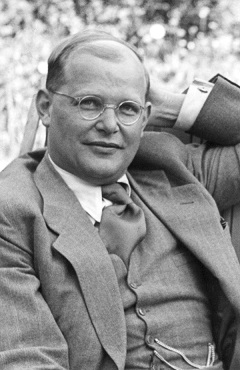 Every Sunday, I will share a quote from something I’ve been reading. The hope is for you, dear reader, to share your thoughts on the quote and related issues and perhaps pick up some reading material along the way!
The Abuse of Grace
The life of a Christian is not easy, and many pitfalls remain in our path as we walk along the narrow way. One difficulty that is particularly acute is the problem of falling into taking grace for granted. Dietrich Bonhoeffer, a Lutheran minister martyred by the Nazis in World War II, has powerful words about this:
Is there a more diabolical abuse of grace than to sin and rely on the grace which God has given? (52, cited below)
As Christians, we need always be aware of the danger of thinking we can sin freely because of God’s grace. Bonhoeffer was of course aware of Luther’s oft-abused and taken out of context phrase, “Sin Boldly.” He commented:
For Luther, “sin boldly” could only be his very last refuge, the consolation for one whose attempts to follow Christ had taught him that he can never become sinless, who in his fear of sin despairs of the grace of God. (ibid)
Knowing that God is graceful, we can be confident that our stumbles will not condemn us; however, we must always be wary lest we begin to blaspheme against God’s grace by taking it for granted. Bonhoeffer’s work, The Cost of Discipleship, is as powerful as ever. I suggest you read it.
Links
Be sure to check out the page for this site on Facebook and Twitter for discussion of posts, links to other pages of interest, random talk about theology/philosophy/apologetics/movies and more!
Sunday Quote– If you want to read more Sunday Quotes and join the discussion, check them out! (Scroll down for more)
Source
Dietrich Bonhoeffer, The Cost of Discipleship (New York: Simon & Schuster, 1995). First edition 1959 published by SCM Press, Ltd.
SDG.
How much doctrine is enough?
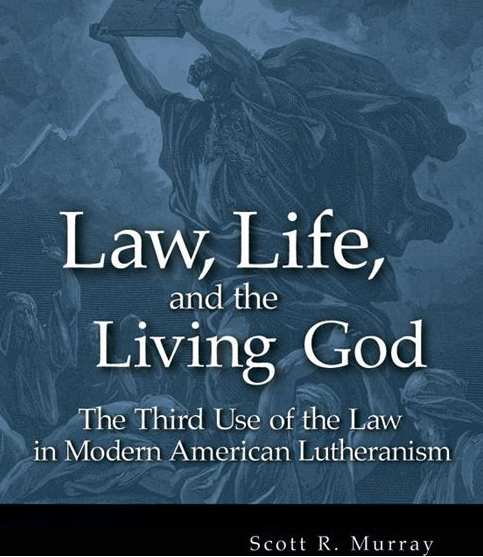 I have been reading through a book on the “Third Use of the Law”–a doctrine with its origin in Lutheranism (for explanation see the * below)–Law, Life, and the Living God by Scott Murray. One of the theologians examined in the work, William Hordern, was critical of this doctrine largely because he held to an existentialist view of theology. For the purpose of this post, there is little of import other than part of Murray’s summary of Hordern’s position:
Hordern held an existentialistic view of faith and the Christian life. He made a sharp distinction between faith as trust and faith as belief in correct doctrine. He criticized the Protestant penchant for reducing salvation to ‘correct belief.’ (Murray, 119, cited below).
The criticism is one I have seen echoed in various places: the notion that evangelicals in particular care more about doctrinal purity than in actual evangelization. The accusation is actually on point in some cases, so far as I am concerned. Endless division over non-essential doctrines causes needless strife in the church. However, Murray’s critique of Hordern’s position also raises a valid point:
The question might legitimately be asked, ‘Trust in what?’ While it is true that faith is not merely assent to true propositions, faith as trust must repose in the promises of God. There is a specific doctrinal content to the preaching of the Gospel, which engenders and calls forth trust in the heart… (Murray, 122).
It seems to me that Murray’s response is compelling. If one wishes to reduce the Christian faith merely to trust in God; one may fairly ask which God one is trusting in. It seems that at least some doctrinal content is necessary for saving faith. The question may then be asked: how much doctrine is enough?
My own answer to such difficult questions would be to fall back upon the grace of God. We do not know for certainty who shall be saved. But what we do know is that God is a just and loving God and will act according to God’s nature. It seems to me, moreover, that there is great importance also in what one hears and rejects.
What are your thoughts on these tough questions? Let me know in the comments, below!
*The third use of the Law may be defined as: that which “gives direction for the impulses of the Christian to do good works” (Murray, 14, cited below).
Links
Be sure to check out the page for this site on Facebook and Twitter for discussion of posts, links to other pages of interest, random talk about theology/philosophy/apologetics/movies and more!
Source
Scott Murray, Law, Life, and the Living God: The Third Use of Law in Modern American Lutheranism
SDG.
——
The preceding post is the property of J.W. Wartick (apart from quotations, which are the property of their respective owners, and works of art as credited; images are often freely available to the public and J.W. Wartick makes no claims of owning rights to the images unless he makes that explicit) and should not be reproduced in part or in whole without the expressed consent of the author. All content on this site is the property of J.W. Wartick and is made available for individual and personal usage. If you cite from these documents, whether for personal or professional purposes, please give appropriate citation with both the name of the author (J.W. Wartick) and a link to the original URL. If you’d like to repost a post, you may do so, provided you show less than half of the original post on your own site and link to the original post for the rest. You must also appropriately cite the post as noted above. This blog is protected by Creative Commons licensing. By viewing any part of this site, you are agreeing to this usage policy.
“Pastrix: The Cranky, Beautiful Faith of a Sinner and Saint” by Nadia Bolz-Weber: Book Review
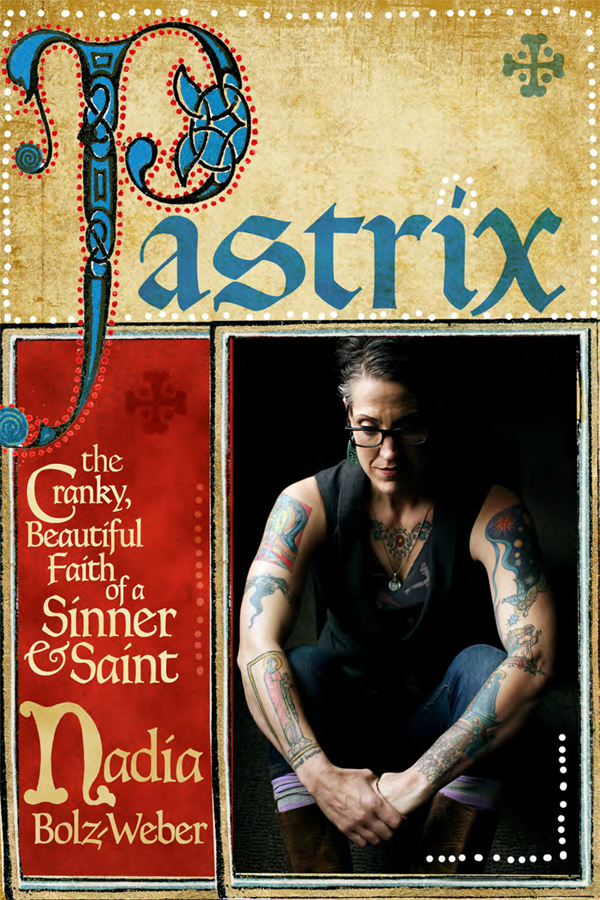 Nadia Bolz-Weber is an edgy, hard-hitting, and often witty pastor in the Evangelical Lutheran Church in America (ELCA). Her latest book is filled with autobiographical stories and a number of anecdotes which focus around the subtitle: they are often cranky, sometimes beautiful, and they reflect a sinner-saint.
The book traces Bolz-Weber’s path towards the ministry through her years in recovery from alcoholism to her starting a church: “House For All Sinners and Saints” and the struggles and triumphs she experienced throughout these events. I’ll not summarize the entire contents of the book but rather I have selected one story to give a brief sample of how the book flows.
The most poignant story in the entire book, in my opinion, is that of Bolz-Weber’s relationship with Chris Rosebrough from Pirate Christian Radio, a very conservative Lutheran (from the Lutheran Church–Missouri Synod [LCMS]) who runs a very conservative radio show. He is, in many ways, all that Bolz-Weber would oppose. And Rosebrough often criticized Bolz-Weber on his show. Then, one day, they had a chance to meet and they talked through the core of Lutheran theology: salvation by grace. Bolz-Weber wrote, “[The other people witnessing their meeting] saw us share a thirty-minute public dialogue about our own brokenness and need for confession and absolution, why we need the Gospel, and what happens in the Eucharist… God made my enemy my friend that day” (113).
Later, Bolz-Weber experienced criticism from her “own side”–liberals [her word, I’m not trying to use it in a derogatory fashion]–and talked with Rosebrough [who is, again, staunchly conservative] about it. They didn’t have to agree on the issues to carry on a conversation about God. “Chris [Rosebrough] doesn’t agree with me [about various issues]… But the one phone call I got in the middle of being attacked by my own tribe was from someone who is on the other side of the issue entirely… [H]e knew what it felt like… [He] said that he loved me and would pray for me. His enemy” (119-120).
Awesome, heart-stopping stories like this are scattered throughout the book. But they are in-between stories that will surely polarize readers. One is a story about a transgender girl turned boy and how Bolz-Weber helped hold a ceremony to help recognize “Asher”‘s new name and identity as a boy. Another story is about her time away from Christianity in which she worshiped a “goddess” instead.
Pastrix ends on a note about Bolz-Weber’s vision of church. Mary Magdalene becomes her foil as she reflects upon the meaning and purpose of church. She wrote, “Like Mary Magdalene, the reason we can stand up and weep and listen for Jesus is because we, like Mary, are bearers of resurrection, we are made new” (201).
Evaluation
There are no words minced in this book. The f-word is sprinkled throughout (and even featured twice in one chapter title). Bolz-Weber continually describes situations or feelings as “s***.” She is completely unapologetic in her approach in this regard.
This raised red flags for me. What does the Bible tell us about the Christian life, and does it say anything about the requirements for teacher, overseer, elder, and deacon? How might Bolz-Weber apply these to her life as a pastor? No, I’m not saying that as a woman she shouldn’t be a pastor–I’m firmly egalitarian. But I wonder about how she would take a passage like James 3 (specifically 3:1-2; 9-10):
Not many of you should become teachers, my fellow believers, because you know that we who teach will be judged more strictly. We all stumble in many ways. Anyone who is never at fault in what they say is perfect, able to keep their whole body in check… With the tongue we praise our Lord and Father, and with it we curse human beings, who have been made in God’s likeness. Out of the same mouth come praise and cursing. My brothers and sisters, this should not be.
Teachers are called to a higher standard. James noted that obviously people stumble, but that does not mean that we should give up or simply embrace whatever wrong behavior we are engaged in. “This should not be!” I wish Bolz-Weber had engaged with this issue in her book.
Another huge issue with the book for me is Bolz-Weber’s exegesis. It seems to me her preconceptions about what the text should mean often shape how she reads it. Specifically, this relates to the question of sanctification. Are Christians really in the process of being made new? If so, how does she reconcile this with the way she seems to conceive of “sinner-saint”–a valid concept–by which she seems to simply mean that one does not even have to try to change? She wrote:
Repentance in Greek means something much closer to ‘thinking differently afterward’ than it does ‘changing your cheating ways.’ Of course repentance can look like a prostitute becoming a librarian, but it can also look like a prostitute simply saying, “OK, I’m a sex worker and I don’t know how to change that, but I can come here and receive bread and wine and I can hold onto the love of God without being deemed worthy of it by anyone but God.”
It seems her primary point in this passage is that God’s grace is firm and sure and we, as sinners, can hold onto that. But I can’t help but feeling Bolz-Weber misses the mark at an astonishing margin in that she never discusses the need to go beyond that. Paul discussed various types of sins in 1 Corinthians 6, and then he went on to say “And that is what some of you were. But you were washed, you were sanctified, you were justified in the name of the Lord Jesus Christ and by the Spirit of our God.” That is, God’s work does not simply end with justification, it continues on into sanctification. We are sinner-saints in the sense that we are yet sinners but God has saved us; but also, we are being made saints by the work of the Holy Spirit. We are to flee from sin, not ignore it.
Bolz-Weber’s entire autobiographical account does speak to the way that the powerful message of grace changes someone, but she never draws this point into the open. Moreover, when she speaks about the life of others, sin is often treated lightly or even entirely ignored. It seems that she is fully willing and able to apply the Law to her own life, but she does not universalize it; she does not make the Law applicable to everyone. Thus, it seems to me she fails to properly preach Law and Gospel.
Pastrix, was a book I really wanted to love. But… I didn’t. There are a number of great insights and anecdotes scattered through the pages, but ultimately readers have to slog through gobs of unnecessary cursing, shock-value stories, and more to find them. One moment, it had me cheering along with Bolz-Weber; the next, I found myself confused about what she was trying to communicate. Ultimately, the book left me wondering who, exactly, the intended audience was supposed to be. It’s not the type of book I’d hand to someone to try to convince them of Bolz-Weber’s view. Nor is it the type of book that I, as someone who agrees in part with her, particularly enjoyed. It seems to me the audience is ultimately those who already agree with her on basically everything. That isn’t a problem, as it is perfectly acceptable to write books that preach to the choir, but I am left confused as to why Bolz-Weber actually did write Pastrix.
Throughout the book it seemed that she was trying to convince me of something, but it never really became clear what that message was. There are times when I really did “get it.” It was like she grabbed that which is Lutheran in me and just played it for all it was worth. But then she failed to make it universal; it applied to her, but she never made Law and Gospel universal. She would discuss intense need for grace which is free and abundant and ever-flowing. She would point out how we need not do works to access this. But then, so often, it seemed she would conflate this with the notion that Christians are not all called to move away from sinner and towards saint. There seemed to be no sanctification in the work. It was all about the initial call to grace; but little about the enduring, sanctifying work of the Spirit.
SDG.
——
The preceding post is the property of J.W. Wartick (apart from quotations, which are the property of their respective owners, and works of art as credited; images are often freely available to the public and J.W. Wartick makes no claims of owning rights to the images unless he makes that explicit) and should not be reproduced in part or in whole without the expressed consent of the author. All content on this site is the property of J.W. Wartick and is made available for individual and personal usage. If you cite from these documents, whether for personal or professional purposes, please give appropriate citation with both the name of the author (J.W. Wartick) and a link to the original URL. If you’d like to repost a post, you may do so, provided you show less than half of the original post on your own site and link to the original post for the rest. You must also appropriately cite the post as noted above. This blog is protected by Creative Commons licensing. By viewing any part of this site, you are agreeing to this usage policy.
Responding to “Nine Questions for the Old Earth Creationist”
 One of the podcasts I enjoy listening to is “Issues, Etc.,” a conservative Lutheran radio program that addresses a number of different views. As is the case with anything, however, once you talk to someone or listen to something long enough, you find things with which you disagree. Recently, I heard a podcast which was discussing Christianity and Science. During this podcast, the guest alleged that the Bible contradicts things like the Big Bang theory or any interpretation of millions or billions of years. As that is an area of great interest for me, I did a little more digging and found that Pastor Todd Wilken, one of the primary speakers on the radio program, had written a series of questions for Old Earth Creationists in an article titled “Nine Questions for Old Earth ‘Creationists.‘” [Note that he uses scare quotes around the word “Creationists.”]
Here, I shall respond to the Nine Questions asked of Old Earth Creationists. Before I dive in, I want to offer one major disclaimer: these topics are far more complex than one blog post can cover. I fully realize I am leaving objections unanswered and some questions unasked. Feel free to comment to clarify. Second major disclaimer: I realize that there is diversity within old earth creationism. However, I have striven to answer the questions in as broad a manner as possible.
I will be leaving the questions from Todd Wilken in bold and italic font and my answers in this standard font. The questions are direct quotes from his article, and I take no credit for their wording.
1. What in the text of Genesis 1 requires or suggests an old Earth?
I admit that I know of no Old Earth Creationist (hereafter OEC/OECs) who holds that Genesis 1 requires an old earth. I think the question is mistaken to even use that word, but I would be happy to be corrected should someone find an OEC who does allege that the text requires an old earth. Thus, the question must be what is it that suggests an old earth? Well, as readers of this blog may know already, I think this question itself is mistaken. The text is not referring to the age of the universe at all, anywhere. On this view, although an old earth may be permissible according to the text, it is not suggested; nor is a young earth suggested. The text just isn’t talking about the age of the universe.
Now, many OECs do hold that the text suggests an old earth. Hints of this, they argue, can be found in the fact that evening and morning occurs before there is a sun. Moreover, it is not until the fourth day that days may even be measured. Others hold that the terminology in Genesis 1:1, “In the beginning God created the heavens and the earth” suggests that the creation occurred in that verse, and that the rest of the chapter (and chapter 2) narrow the focus to earth or even the Garden of Eden.
2. What are the referents of the words “morning” and “evening” in Genesis 1?
I find it extremely telling that Wilken decided to switch the order of these words around. It absolutely must be noted that the text says “evening” and morning.” Why is this? Well, if the first day is really the first 24 hour period in the history of all that exists apart from God, how is it possible for evening to come before morning? [One insightful reader noted that the Hebrews saw evening as the beginning of the day anyway… but my point is that the fact there is an evening implies there is a sun to set… which isn’t created until later.] That is a question with which the literalistic young earth creationists must contend. If they choose to read the Bible literal[istical]ly, they must be consistent. The fact that they cannot when it comes to things such as evening coming first shows that their reading is self-referentially inconsistent.
Now, to answer the actual question, that really depends on which OEC you are referring to. I would tentatively suggest that most OECs hold that the referents are simply ways to mark the beginning and ends of creation periods.
3. What in the text of Genesis 1:26-27 requires or suggests the creation of man over millions of years?
I admit that this was where I really started to wonder whether Wilken understands the distinctions between OECs and other views of creation. In asking this question of OECs, Wilken betrays an apparent ignorance of the views of major proponents of OEC.
Representative is Hugh Ross, the founder of Reasons to Believe, which is itself the largest Old Earth Creationist organization. In his work, More Than a Theory, he writes regarding human origins: “God created humans in a deliberate, miraculous act” (182, cited below). In other words, Ross (and this is the position of the entire organization, along with every other OEC I know of) holds that humankind was specially created by God in a single miraculous act. “Ah, but wait!” one might cry. “That doesn’t deny millions of years for the creation of humanity.”
Very well, a very small amount of digging shows Hugh Ross again writing, this time with Fazale Rana (also of Reasons to Believe and another Old Earth Creationist) in their work Who Was Adam? “God created the first humans… both physically and spiritually through direct intervention… All humanity came from Adam and Eve… God created Adam and Eve relatively recently, between 10,000 and 100,000 years ago” (44-45, cited below).
Therefore, it seems this question is nonsensical. OECs hold that humankind was created specially by God and not over the course of millions of years. I admit that I think just about any OEC would be scratching their head trying to figure out why this question is even being asked because it is so far off the mark of the actual views of OECs. It is particularly remarkable because this feature is one of the very things which distinguishes Old Earth Creationism from other, non-creationist models. Gerald Rau notes this distinction: “Although differing in the timing, both [Young- and Old- Earth creationists] believe God created two humans… without progenitor. This, of course, is a radically different perspective from the evolutionary models” (147, cited below). Note his wording: “of course”; “radically different.” Frankly, anyone who has done even a cursory study of varying Christian views about the timing and means of creation would know this.
4. Where in the text of the Genesis 2 and following is the transition from epoch-long days to 24-hour days?
This question seems to be a bit strange. The word “day” is only used in Genesis 2:2, 3, 4, and 17. In verse 4 even Young Earth Creationists (YEC) have to admit that the word is being used as more than one day (the text says “These are the generations of the heavens and the earth when they were created, in the day that the LORD God made the earth and the heavens” (ESV).
Verse 17 is also of great interest because it says, “…’but of the tree of the knowledge of good and evil you shall not eat, for in the day that you eat of it you shall surely die'” (ESV).
Did Adam die on the 24-hour day he ate of that tree? No. In fact, he and Eve went on to have children and raise them to some point. So again, we find that “day” is not referring to a 24 hour period.
But where is the transition? I don’t know. I think the question itself is confused because the word is used four times in the chapter, two of which cannot be 24-hour days.
5. What creative actions described in Genesis 1 require more than six 24-hour days to accomplish for a God Who creates ex nihilo?
The use of the word “require” is again extremely problematic. Of course any OEC would agree that God could create in any time period God wanted. God certainly could have created anything God wanted in any amount of time in which God wanted to. So no OEC that I know of would say that God required more time.
However, some OECs do argue that Adam may have needed more time to accomplish everything it is said he accomplished in the allotted times. Naming all the animals, given the untold thousands of species which exist, would have taken quite a bit of time. (Genesis 2:19 is still part of the sixth day because God is still creating and has not yet made woman.)
But, again, I do not think any OEC would say that the text “requires” God to use more than 24 hours.
 6. Where else in Scripture is the word “day” used to designate billions of years?
Here we find yet another question that is just so incredibly off base that it is remarkable. Of course, the Bible does use the word “day” to denote that such a period, for the LORD, is like a thousand years. And the meaning of “like a thousand years” is debatable, but surely it is a long period of time [and much longer than 24 hours]. But the question of “billions of years” is just the wrong question. Again, the text is not trying to tell us how old the earth is.
If Wilken desires to dispute this, I would gladly ask him to present me with a verse in the Bible which sets the date of creation.
7. How are we to understand the connection between the six epoch-days of creation and the sanctification of a literal seventh day in Genesis 2:1-3 and Exodus 20:11?
I am often confused when YECs bring up this argument. Yes, Exodus 20:11 parallels Genesis 1-2 by having 7 days and denoting the seventh as a day of rest. Now, what about that somehow entails that they are exactly the same? I mean think about the Biblical categories of typology. Very often things correspond to each other but are not exactly the same. One might think of the use of Hosea 11:1 to Matthew 2:15. The passage in Hosea is clearly discussing the nation of Israel. In Matthew 2:15 it is applied to an individual, the Son of God. Does this automatically mean that in Hosea we must assume that “son” is being used in the same sense as “Son of God”? Obviously not. Then why ignore typological categories in other texts?
Okay, but how would an OEC answer this objection? By pointing out that the words “day” and “Sabbath” are used variably in the Pentateuch, so a direct 1 to 1 correlation is off-base. Sabbath, for example, may refer to the span of an entire year as opposed to just one day (Leviticus 25:4). Day may refer to a thousand years (Psalm 90:4).
8. Are there considerations outside the text of Genesis that require an old Earth?
I’m not sure if Wilken means to express the question of other texts, or whether he wishes to address the issue of extra-Biblical evidence.
Regarding the first possible meaning, again the answer would be “No.” I will continue to maintain that I know of no OEC who holds the Bible requires an old earth. Many would follow my own reasoning and note that the Bible isn’t trying to discuss time periods. That just isn’t a concern of the text.
9. According to the Old-Earth theory, what is the relationship between death and human sin? When did death enter the world?
Frankly, at this point it should be abundantly clear that Wilken has not interacted very much with the works of Old Earth Creationists. As was noted in the answer to question 3, many OECs hold to the special creation of Adam and Eve. Therefore, this question is similarly extremely easy to answer: human death entered the world because of sin.
A Major Issue
I think one of the main problems with Wilken’s comments are that he doesn’t seem to distinguish between Old Earth Creationists, Theistic Evolutionists, and the various varieties of design theorists. This leads him to a few confused questions which he directs towards OECs that make no sense when directed towards them. I admit that the series of questions here leads me to wonder whether Wilken is simply unaware of the distinctions between these groups or just over-simplifying and obfuscating. I suspect the former.*
Conclusion
I have endeavored to provide brief answers for the Nine Questions Wilken asks of Old Earth Creationists. I believe that some of the questions he asks demonstrate confusion about the actual category of Old Earth Creationism. Moreover, the questions that are on target have been answered repeatedly by various OECs. Whether these answers are taken as convincing is another story.
*It should be noted that Wilken’s article was published in 2002, which is prior to the works cited here. Therefore, Wilken could not have known about the works I have cited to show some of the difficulties with his paper. However, I cited these works specifically to show how mistaken these questions are. If one is going to attempt to educate concerned Christians about a topic like this, it is vastly important to be aware of the distinctions to be found within each group, and Wilken fails to show awareness of these distinctions. Moreover, we will explore Wilken’s very recent article next week, in which he continues to make these errors.
Sources
Hugh Ross, More Than a Theory (Grand Rapids, MI: Baker Books, 2009).
Hugh Ross and Fazale Rana, Who Was Adam? (Grand Rapids, MI: Baker, 2005).
Gerald Rau, Mapping the Origins Debate (Downers Grove, IL: InterVarsity Press, 2012).
Todd Wilken, “Nine Questions for the Old Earth ‘Creationist,'” 2002.
SDG.
——
The preceding post is the property of J.W. Wartick (apart from citations, which are the property of their respective owners, and works of art as credited) and should not be reproduced in part or in whole without the expressed consent of the author. All content on this site is the property of J.W. Wartick and is made available for individual and personal usage. If you cite from these documents, whether for personal or professional purposes, please give appropriate citation with both the name of the author (J.W. Wartick) and a link to the original URL. If you’d like to repost a post, you may do so, provided you show less than half of the original post on your own site and link to the original post for the rest. You must also appropriately cite the post as noted above. This blog is protected by Creative Commons licensing. By viewing any part of this site, you are agreeing to this usage policy.
The Law Always Condemns, The Gospel Always Saves. Or, why I’m a Lutheran.
Comparing Holy Scripture with other writings, we observe that no book is apparently so full of contradictions as the Bible, and that, not only in minor points, but in the principal matter, in the doctrine how we may come to God and be saved… This riddle is solved when we reflect that there are in Scriptures two entirely different doctrines, the doctrine of the Law and the doctrine of the Gospel. C.F.W. Walther, The Proper Distinction Between Law and Gospel
, 6 (cited fully below)

How are Christians to view the relationship between Law and Gospel? The issue has generated countless views and debates. One recent work which illustrates the breadth of views on this topic is Five Views on Law and Gospel
C.F.W. Walther’s work, The Proper Distinction Between Law and Gospel
Law and Gospel
The most central point of all–that is, the point that I hope readers remember if nothing else–is this: The Law always condemns, the Gospel always saves. This point is emphasized throughout Lutheran theology. What does it mean? Simply put: it means that these two doctrines, found throughout Scripture, have entirely distinct meanings and usages. One cannot intermingle law and gospel while remaining true to either doctrine. Wherever the Gospel is presented as if it had requirements attached to it, there the Gospel is not rightly preached. Whenever the Law is preached as if it offered some kind of free gift, it is not rightly preached.
Law only has power to condemn. It cannot save. That is because none can keep God’s Law. All sin, and all fall short of the glory of God (Romans 3:23). The Law shows what God requires of us. It “issues only commands and demands” (Walther, Proper Distinction…, 9).
In contrast, the Gospel only gives offers without requirements attached (ibid). The Gospel shows us God’s promises and offer of grace.
At first face, one examines the whole of the Bible and finds these teachings throughout. The teachings seem so at odds with one another that one might suspect a contradiction throughout the Biblical teaching. However, the fact is that both doctrines are “equally necessary. Without the Law the Gospel is not understood; without the Gospel the Law benefits us nothing” (Ibid, 8). The reason this is so important is because Law and Gospel are not opposites working against each other. Instead, both “have their final aim [human] salvation” (Ibid, 7). They work together to present a full picture of how salvation comes unto men.
The Law, as we have noted, cannot bring salvation because none but God can fulfill it. That is, it gives the requirements for salvation but no one can meet these requirements! We would all be lost if this were the whole of Biblical teaching. Yet there is more to the story, for the Gospel offers only its promises. God has promised to save. He is mighty to save. God has accomplished our salvation. And this salvation does not come with requirements attached. Such is our hope.
Most simply put then, the purpose of the Law is to show our need for the Gospel because we cannot meet the requirements of the Law. The purpose of the Gospel is to show that God has already met these requirements for us in Jesus Christ and to offer us that fulfillment through Christ’s atoning work. So the Gospel, without the Law, would be empty promises. What need have we for Gospel if we are not sinners? Yet without the Gospel, the Law is only a terror which tells us that all are condemned.
 Some Distortions
A number of objections have been raised against this understanding of Law and Gospel. For example: “[The notion t]hat the law must be viewed as a single entity is one of the most common of all objections made against the Christian use of the Law” (Walter Kaiser, Jr., “The Law as God’s Guidance for the Promotion of Holiness,” 188, cited below). Kaiser then argues against viewing the Law as a single entity. He makes distinctions between Civil, Ceremonial, and Moral laws. I agree that we can make these distinctions, but they do not somehow mean it is impossible to refer to the “Law” as a whole entity with all of the commands God has issued.
Another common objection is that of dispensational thought. It is often charged that because we live in a new dispensation, the teachings of the Mosaic Law, for example, no longer apply to us. Without commenting on the plausibility of dispensationalism, I would simply answer that it seems extremely hard to reconcile the notion that the Mosaic Law has no applicability in our own context with Jesus’ words about the Law: “For truly I tell you, until heaven and earth disappear, not the smallest letter, not the least stroke of a pen, will by any means disappear from the Law until everything is accomplished” (Matthew 5:18). Note that this verse also shows Christ using the “Law” as a single, coherent entity.
Yet does this mean that everything recorded in the Mosaic Law has applicability exactly as written? No. A further discussion along this line of thought would take me too far afield, but I think that the Bible does clearly teach there is some discontinuity between the application of Mosaic Law to the Jew and the New Covenant with Christians (for example, the dietary laws do not apply to Christians). This hints back at the divisions Kaiser was keen to make within the Law, and I think the application to the Christian life can be viewed within the categories he discusses.
Conclusion
There is so much more worth saying about Law and Gospel, but in the interest of keeping this post at a readable length, I have had to set some aside. Interested readers should see the annotated sources below.
We have seen that the Law and Gospel must be properly divided in order to properly understand the whole of the Bible’s teaching. Why do I say that this is why I’m a Lutheran? I hope, at least, that other branches of Christianity teach these distinctions between Law and Gospel. But I have to admit that I have not seen it so consistently done as it is within the Lutheran perspective. Martin Luther was right to focus directly upon this teaching, and I believe it is central to the Reformation[s]. It touches upon soteriology, sanctification, the atonement, and more. Thus, I think it is vitally important to get this doctrine correct. In my studies, I have found no teaching so close to the Biblical truth as the Lutheran teaching on Law and Gospel. I’m not saying that everyone should go and become Lutherans. Instead, I think that everyone should benefit from learning the proper distinction between Law and Gospel and apply it to their lives.
The Law always condemns, the Gospel always saves.
Appendix: The Modified Lutheran View?
I think it is important to note that the view put forth as “The Modified Lutheran View” in Five Views on Law and Gospel
Those who have stuck with me this long should be able to immediately see how this is utterly different from the Lutheran view I proposed above. The distinction between law and gospel is not a temporal distinction whatsoever. The Law is still with us. Walther himself makes this explicit: “[W]e find both teachings in the Old as well as in the New Testament” (Proper Distinction… 62). There is no temporal dividing line between Old and New such that some new reality has dawned on Law and Gospel. Instead, the Law continues to condemn, while the Gospel continues to save.
Yet Moo goes so far as to say this is a point which needs to be “corrected” within the Lutheran view (ibid). He seems to think that Lutherans would deny that Jesus was able to speak law, while also mistakenly painting the Sermon on the Mount as being a preaching entirely of the Law. Indeed, Moo’s view seems to affirm many of the basic tenants the Lutheran view explicitly denies, such as mixing the uses of Law and Gospel.
I thus would say that Moo’s position is not at all the Lutheran view. It is not a modified Lutheran view at all. Instead, it seems to violate a number of the primary distortions noted above. That said, Moo does admirably to defend the notion of the Law as a coherent, cohesive whole. There is much to commend Moo’s essay, but it ultimately fails, I think, to provide a properly Lutheran view of Law and Gospel.
Links
Like this page on Facebook: J.W. Wartick – “Always Have a Reason.” I often ask questions for readers and give links related to interests on this site.
Annotated Sources
C.F.W. Walther, The Proper Distinction Between Law and Gospel
For a more succinct summary of what Walther argues in the above, see God’s No and God’s Yes: The Proper Distinction Between Law and Gospel
Five Views on Law and Gospel, ed. Stanley Gundry (Grand Rapids: MI: Zondervan 1999) – I specifically used the following essays: Walter Kaiser, Jr., “The Law as God’s Guidance for the Promotion of Holiness” in Five Views on Law and Gospel, ed. Stanley Gundry, 177-199, (Grand Rapids, MI: Zondervan, 1999); Douglas Moo, “The Law of Christ as the Fulfillment of the Law of Moses” in Five Views on Law and Gospel, ed. Stanley Gundry, 319-376, (Grand Rapids, MI: Zondervan, 1999). I found this book to be very helpful in outlining various views, but was disappointed with the “modified Lutheran view” (see my appendix here).
SDG.
——
The preceding post is the property of J.W. Wartick (apart from citations, which are the property of their respective owners, and works of art as credited) and should not be reproduced in part or in whole without the expressed consent of the author. All content on this site is the property of J.W. Wartick and is made available for individual and personal usage. If you cite from these documents, whether for personal or professional purposes, please give appropriate citation with both the name of the author (J.W. Wartick) and a link to the original URL. If you’d like to repost a post, you may do so, provided you show less than half of the original post on your own site and link to the original post for the rest. You must also appropriately cite the post as noted above. This blog is protected by Creative Commons licensing. By viewing any part of this site, you are agreeing to this usage policy.

 J.W. Wartick - Reconstructing Faith
