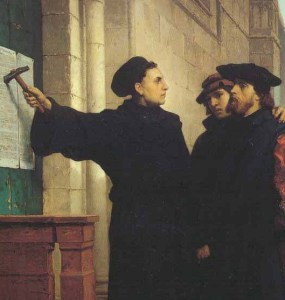
Martin Luther
Really Recommended Posts 1/20/17- deism, geology, and more!
 Hello dear readers! Sorry for the long absence from Really Recommended Posts. It’s been insanely busy, and with a baby due any day now, I may not have another of these for a bit. So enjoy the posts I have compiled here!
Young Earth Creationists arguing in circles– I’ve seen the claim made time and again: the fossils date the rocks, and the rocks date the fossils–it’s a circle! Young Earth Creationists frequently make this claim. Here is a look at one such instance of the claim and the facts behind the tools of geology.
Lies about Relics– An interesting look at the proliferation of relics in the Middle Ages, what Martin Luther had to say about them, and the meaning and usage of the term. I highly recommend readers subscribe to the Christian History magazine. It is free (donations encouraged) and excellent.
John Leland– John Leland was a pastor who wrote extensively on the deist controversy in the 17th and 18th centuries. He wrote a two-volume work that surveys the entire field, offering both exposition and refutation of the works of basically every major player in the controversy. Read more about him and his work here.
Herodotus, Osiris, Dionysus, and the Jesus Myth– A brief look at the historical method of those who claim Jesus is a myth, with a specific look at Herodotus and his discussion of Osiris and Dionysus.
Practical Lutheranism: What is Sabbath?
 I have been reading through the Book of Concord. I think it is vitally important for one who, like me, claiming to be Lutheran to be familiar with the Lutheran Confessions. That is, after all, what we believe and confess. I have been writing a series of posts on Practical Lutheranism based on the Book of Concord. These teachings remain viable and valuable today.
What is Sabbath?
One of the debates that has raged within Christianity (with different levels of flame behind this raging, whether it be a mere flickering candle or a roaring fire) has been the meaning of “Sabbath” and how it is integrated into the Christian life. Volumes have been written, multi-view books published, denominations split or created, and the like on this topic.
Luther’s Large Catechism offered a way forward in this debate, offering an understanding of keeping the day holy that could be lived by the Christian. He wrote:
Accordingly, when you are asked what “You are to hallow the day of rest” means, answer: “Hallowing the day of rest means to keep it holy.” What is meant by “keeping it holy”? Nothing else than devoting it to holy words, holy works, and holy living… [The Sabbath Day] becomes holy or unholy on your account, depending on whether you spend it doing something holy or unholy. How does such sanctifying take place? Not when we sit behind the stove and refrain from hard work, or place a garland on our head and dress up in our best clothes, but… when we make use of God’s Word and exercise ourselves in it. [The Large Catechism, Part I, 87-88, cited below]
Yet Luther, as is so often the case for Luther (and Lutherans), was not content to leave it there. In the spirit of the Lutheran both/and, he expanded this notion of making holy to the whole of Christian life:
Truly, we Christians ought to make every day such a holy day and devote ourselves only to holy things, that is, to occupy ourselves daily with God’s Word and carry it in our hearts and on our lips… For non-Christians can spend a day in rest and idleness, too… but without keeping a single day holy, because they neither preach nor practice God’s Word… [Large Catechism, I:89-90]
Thus, for Luther, we ought to remember Christ’s words: we were not made for Sabbath, but Sabbath for us. Moreover, Sabbath is part of the overall Christian life instead of being relegated to merely one part of the week. Making the day holy is something we ought always be doing: reflecting on God’s Word, singing Psalms, and praying.
Source
Robert Kolb and Timothy J. Wengert, eds. The Book of Concord: The Confessions of the Evangelical Lutheran Church (Minneapolis, MN: Fortress, 2000).
Links
Be sure to check out the page for this site on Facebook and Twitter for discussion of posts, links to other pages of interest, random talk about theology/philosophy/apologetics/movies and more!
Adhering to the Book of Concord “In So Far As” or “Because” it Agrees with Scripture?– I argue that Lutherans must hold the position that we adhere to the Book of Concord In So Far As it Agrees with Scripture.
Eclectic Theist– Check out my other blog for posts on Star Trek, science fiction, fantasy, books, sports, food, and more!
SDG.
——
The preceding post is the property of J.W. Wartick (apart from quotations, which are the property of their respective owners, and works of art as credited; images are often freely available to the public and J.W. Wartick makes no claims of owning rights to the images unless he makes that explicit) and should not be reproduced in part or in whole without the expressed consent of the author. All content on this site is the property of J.W. Wartick and is made available for individual and personal usage. If you cite from these documents, whether for personal or professional purposes, please give appropriate citation with both the name of the author (J.W. Wartick) and a link to the original URL. If you’d like to repost a post, you may do so, provided you show less than half of the original post on your own site and link to the original post for the rest. You must also appropriately cite the post as noted above. This blog is protected by Creative Commons licensing. By viewing any part of this site, you are agreeing to this usage policy.
Book Review: “The Great Divide: A Lutheran Evaluation of Reformed Theology” by Jordan Cooper
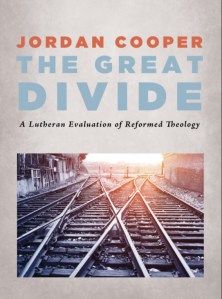 The Great Divide: A Lutheran Evaluation of Reformed Theology presents a broad-spectrum look at Reformed theology from a Lutheran perspective.* Cooper breaks this analysis up into three parts: Predestination and Free Will, Worship and the Sacraments, and Salvation. These parts are intended to show the greatest dividing lines between Reformed and Lutheran thought.
It is really quite exciting to see how well-read Cooper is on both Reformed and Lutheran thought. On the Reformed side, he frequently cites Calvin (of course), Bavinck, Edwards, Piper, Grudem, and more. On the Lutheran side, he draws from Luther, Chemnitz, Melanchthon, Kolb, and more. This thorough use of sources on both sides helps shield against bias, as Cooper continually cites the words of prominent theologians of each tradition.
Cooper provides in each chapter a presentation of Reformed thought on the topic, drawing extensively from prominent Reformed thinkers past and present, as well as various Reformed Confessions. Then, he provides a look at the Lutheran perspective, often quoting the Lutheran Confessions as well as prominent Lutheran thinkers. After providing this comparison, Cooper argues for the Lutheran position, noting the points of divergence along the way. At many points, this analysis is fairly robust. However, at other points Cooper does swiftly move from one point to another before providing enough to establish each point.
One of the things that comes to the front most clearly in the book is just how close Reformed and Lutheran thought are on a number of issues. Unfortunately, as close as the two traditions come on many areas, the chasm between the two remains vast. This is particularly clear in regards to the Sacraments and Predestination. I was also pretty surprised to see how different the Reformed and Lutheran view regarding worship is. The regulative principle within Reformed thought–that whatever is not commanded in Scripture ought not to be done in worship–was something that startled me. I hadn’t considered such a position, but Cooper showed the arguments for and against this position, coming down on the side of Lutheranism (again, he’s coming from that perspective), which sees worship as something that God allows for more leeway in than do Reformed thinkers.
It is truly amazing how much information Cooper manages to convey in just 200 pages. Readers are introduced to both Lutheran and Reformed perspectives on a number of important theological topics, treated to both exposition of those views and offered critique of the Reformed position all in a very clear style and form.
There are two minor critiques I’d offer of the book. The first is the continued use of the archaic “man” to refer to all people. There were, in fact, a few places in which I had to work to discern whether Cooper meant all people or just men when it came to what he was writing. A second critique is that because of the books relatively short length, some of the arguments on either the Reformed or Lutheran side seem extremely brief, leaving some of the arguments inconclusively demonstrated.
Jordan Cooper’s The Great Divide: A Lutheran Evaluation of Reformed Theology is a vast trove of information and analysis. Extensively researched and well-reasoned, it will provide readers unfamiliar with either Reformed or Lutheran theology (or both) an introduction to each tradition as well as a look at how they may interact with one another.
The Good
+Engages with prominent theologians from each group
+Historically informed
+Treats Reformed thought fairly
+Vast wealth of information
The Bad
-Continued use of archaic “man” etc. as inclusive
-Some points are breezed through very quickly
*It is worth noting my own bias here: I am a Lutheran who was raised Lutheran and, though I wandered a little bit, have become quite convinced of Lutheran theology in recent years.
Disclaimer: I was provided with a copy of the book for review by the publisher. I was not required to provide any specific kind of feedback whatsoever.
Source
Jordan Cooper The Great Divide: A Lutheran Evaluation of Reformed Theology (Eugene, OR: Wipf & Stock, 2015).
Links
Be sure to check out the page for this site on Facebook and Twitter for discussion of posts, links to other pages of interest, random talk about theology/philosophy/apologetics/movies and more!
Book Reviews– There are plenty more book reviews to read! Read like crazy! (Scroll down for more, and click at bottom for even more!)
Eclectic Theist– Check out my other blog for my writings on science fiction, history, fantasy movies, and more!
SDG.
——
The preceding post is the property of J.W. Wartick (apart from quotations, which are the property of their respective owners, and works of art as credited; images are often freely available to the public and J.W. Wartick makes no claims of owning rights to the images unless he makes that explicit) and should not be reproduced in part or in whole without the expressed consent of the author. All content on this site is the property of J.W. Wartick and is made available for individual and personal usage. If you cite from these documents, whether for personal or professional purposes, please give appropriate citation with both the name of the author (J.W. Wartick) and a link to the original URL. If you’d like to repost a post, you may do so, provided you show less than half of the original post on your own site and link to the original post for the rest. You must also appropriately cite the post as noted above. This blog is protected by Creative Commons licensing. By viewing any part of this site, you are agreeing to this usage policy.
Book Review: “Representing Christ: A Vision for the Priesthood of All Believers” by Uche Anizor and Hank Voss
 The doctrine of the “priesthood of all believers” is one that is easily misunderstood but joyfully affirmed by a number of Christian groups across denominational lines. Uche Anizor and Hank Voss’ book, Representing Christ: A Priesthood of All Believers is an attempt to hash out the particulars of this challenging, freeing doctrine.
The authors note the potential pitfalls of the doctrine while also showing the ways that the notion of the priesthood of all believers can be applied to many different situations. After some excellent introductory remarks–including a look at how priesthood is viewed in different theological traditions–they dive into chapters on the Scriptural basis for the doctrine, Martin Luther’s contribution to recovering the doctrine, the Trinity and our priesthood, the practices of the priesthood of all, and the overall implications and applications of the doctrine.
The doctrine of the “priesthood of all believers” has long been credited to Martin Luther, though he did not use the specific phrase and some Luther scholars (cited by Anizor and Voss) dispute that this doctrine can be derived from his writings. Despite these apparent challenges, the authors demonstrate not only the roots of the teaching in Luther’s writings, but also the fruit that such a doctrine bore for him. As a Lutheran myself, it was refreshing to see Luther’s contribution highlighted rather than ignored. Indeed, Luther’s notion of the functions of the believer–preaching and teaching the word, baptizing, administering the Lord’s Supper, binding and loosing sins, prayer, sacrifice, judging doctrine–is used as a basis for the ongoing discussion.
These 7 points are developed later in the book and serve as a great, applicable portion of the book. The authors rightly note the importance for the church of both baptism and the Lord’s Supper, and do so in ways that show how their importance comes in part from the way they create a fellowship of believers. The other aspects of this priesthood of all believers are equally insightful. Something like “binding and loosing sins” may seem quite abstract, but Anizor and Voss manage to make such a notion relevant and practical.
Highlighting the life of the Trinity and Christ’s role as great high priest was another strong point of the book. However, in this section there was a continued emphasis on the notion that it is “especially appropriate” to worship the Father in the name of Jesus by the power of the Spirit (100, cited below). Now I’ll not dispute that this is indeed one way that we ought to direct worship- praise to the Father in the name of Christ by the power of the Holy Spirit. But the authors belabored this point so much that I wondered why this was the case. After all, they clear agree that it is appropriate to worship the Son and the Spirit. If that is the case, then what basis is there for the claim of “especial” appropriateness regarding worship of the Father? We need to be careful in Trinitarian doctrine to not establish a hierarchy within the Trinity, and indeed the ancient Athanasian Creed states, “And in the Trinity none is before or after another; none is greater or less than another, but all three Persons are co-eternal together and co-equal. So that in all things, as is aforesaid, the Unity in Trinity and the Trinity in Unity is to be worshiped.” This creedal statement which has historically been defining for the whole Christian church makes it clear that all three persons are to be worshiped in unity, and although the formula Anizor and Voss put forward is Trinitarian, I wonder why the emphasis is on worship being directed to the Father. No person of the Trinity is more worthy of worship than any either, and our worship ought to be directed towards the Triune God, not “especially” towards one person.
One aspect missing from the discussion in the book is the notion of both men and women in this role as priests. Indeed, the point where this could have most easily been highlighted is in the Garden of Eden, where Voss and Anizor note the way the Garden of Eden is like a type of temple (28) and Adam is a kind of priest-king in the Garden (26ff). Someone is notably absent in this discussion: Eve. Eve was placed alongside Adam in Eden and also given the charge to have dominion over it; why should she be excluded from the discussion of priestly act in the Garden? It seems it would have been quite appropriate to include such a discussion here, and I wonder whether the lack of her inclusion is an attempt to restrict the priesthood of all believers after all. There remain many church bodies who exclude women from the role of representing Christ, and often this teaching is reinforced by keeping some parts of Scripture silent on the topic. In Representing Christ, we see no explicit mention of Eve as serving alongside Adam in these functions, despite reference to sections in which she appears. The priesthood of all believers is an explosive doctrine that frees both men and women, and to ignore this aspect of the doctrine does it disservice.
Representing Christ is an important look at a doctrine that is too often misunderstood or abused. The priesthood of all believers is a freeing doctrine, but not one that throws any kind of order in the church out the window. The authors do a fair job of pointing this out, but I cannot help but wonder why they didn’t go even farther and show how this priesthood of believers can free not only “us” in the general sense, but also, to take from a well-informed author, show that “there is neither Jew nor Greek, slave nor free, no male and female, for we are one in Christ” (Galatians 3:28).
The Good
+Highlights importance of Luther’s contributions
+Provides Scriptural basis for the doctrine
+Gives practical examples for applying content
The Bad
-Where’s Eve?
-Avoids some of the apparent implications of the doctrine regarding women
-Awkward wording of some Trinitarian discussion
Disclaimer: I was provided with a copy of this book for review by the publisher. I was not obligated to provide any specific kind of feedback whatsoever.
Source
Uche Anizor and Hank Voss, Representing Christ: A Vision for the Priesthood of All Believers (Downers Grove, IL: InterVarsity, 2016).
Links
Be sure to check out the page for this site on Facebook and Twitter for discussion of posts, links to other pages of interest, random talk about theology/philosophy/apologetics/movies and more!
Book Reviews– There are plenty more book reviews to read! Read like crazy! (Scroll down for more, and click at bottom for even more!)
Eclectic Theist– Check out my other blog for my writings on science fiction, history, fantasy movies, and more!
SDG.
——
The preceding post is the property of J.W. Wartick (apart from quotations, which are the property of their respective owners, and works of art as credited; images are often freely available to the public and J.W. Wartick makes no claims of owning rights to the images unless he makes that explicit) and should not be reproduced in part or in whole without the expressed consent of the author. All content on this site is the property of J.W. Wartick and is made available for individual and personal usage. If you cite from these documents, whether for personal or professional purposes, please give appropriate citation with both the name of the author (J.W. Wartick) and a link to the original URL. If you’d like to repost a post, you may do so, provided you show less than half of the original post on your own site and link to the original post for the rest. You must also appropriately cite the post as noted above. This blog is protected by Creative Commons licensing. By viewing any part of this site, you are agreeing to this usage policy.
Book Review: “Political Church” by Jonathan Leeman
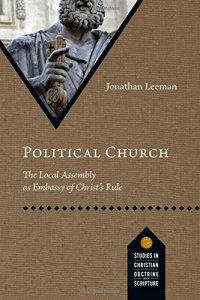
Jonathan Leeman’s Political Church: The Local Assembly as Embassy of Christ’s Rule is a detailed study of the interaction between Christianity and the public sphere. Leeman’s central thesis is that the church, as the local assembly, acts as an embassy–a political place in which Christ’s rule on earth is present.
The book is broken up into 6 lengthy chapters, each building on the last, as Leeman argues for his thesis. The first two chapters address the questions “What is politics?” and “What is an Institution?” From there, Leeman builds on politics of creation, the Fall, the New Covenant, and the Kingdom.
One of the most critical areas of the book is that there is no such thing as a totally neutral ground from which to build a political system. There is no religiously neutral political philosophy. To make the case for this central point, Leeman draws extensively from people like William Cavanaugh and Stanely Hauerwas. Essentially, the point is that because one’s religious beliefs (or alleged lack thereof) govern, effectively, all areas of one’s thought, one cannot excise them without effectively abandoning those beliefs, thus going against them. There is much more to this argument, but it is one of the many fascinating areas Leeman highlights.
Exactly how does the church act as an embassy for Christ? The sixth chapter, “The Politics of the Kingdom,” presents a number of fascinating insights into this question. Leeman takes a deep look at the notion of the “Keys of the Kingdom,” drawn from Matthew 16 (334ff). This discussion draws from multiple commentaries and spans questions from “what is the church?” to “how ought we perform church discipline?” to whether the church ought to function as a kind of civil magistrate. These kind of deep questions permeate the pages of Political Church such that readers will want to spend a great deal of time poring over the text and reflecting on the points therein.
There are a few areas worth critiquing in the book. First, much discussion time is spent on the notion of how exactly God’s covenant went from old to new covenant, but this all plays out on a kind of amorphous theological backdrop such that it is difficult to determine exactly what Leeman is saying. Is he pushing a kind of dispensational theology? At points it seems so, but other times it does not. Because the theological point here is not central to his book, Leeman doesn’t give readers enough to see where he’s coming from, particularly in chapter four’s (The Politics of the Fall) discussion of different covenants.
Another difficulty is, admittedly, drawn from a minor point in the book. Leeman states explicitly that, “if membership in the new covenant requires both the activity of the Spirit and the assent of the individual to God… then membership in… the church… should… be restricted to those who give their assent. To place infants born into a ‘Christian’ nation onto church roles misidentifies God’s presence, reputation, righteousness and justice…” (272). On the one hand, his notion that membership in the church requires both the Spirit and assent is explicitly tied to his understanding of the body of the church as a political one. On the other hand, although he stresses that exact point, it is never clear exactly what that means in terms of justification. This takes us away from the purpose of his book, but given statements like these it seems clear that justification is at least some part of what he is referring to. Justification is the work of the spirit, saving people who are dead slaves to sin who cannot free themselves. But if that’s the case, then his objection to infants being placed on church rolls seems to fall apart, for although infants cannot express consent, that does not seem to be required for the doctrine of justification. As a Lutheran particularly, I affirm that infants may have faith, because faith is a gift of the Spirit rather than an act of humans. Yet even here, Leeman might object noting that he is speaking in political terms rather than in the terms I am using.
A final difficulty is with Leeman’s reading of Luther’s Two Kingdoms model. Although he does avoid the most egregious misinterpretations of Luther on this point, Leeman argues that Luther’s model turns God’s people/not-God’s-people into church/state or Word/state. Then, he argues that the Bible and the church have words for those who are not God’s people as well and the state rules over God’s people (274-275, for example). But this is not what Luther’s model entails. It’s not that church/state on Luther’s model never interact; indeed, Leeman’s own conception seems to be extremely close to the core of what Luther was getting at in his doctrine of Two Kingdoms. He constructs it around the idea that there are two ages rather than two kingdoms, and that there are two kinds of life- secular and eternal (275). Yet even this speaking of two ages ultimately comes back to noting that there is “present simultaneity of the ages,” leading one to wonder how far from “two kingdoms” that exist simultaneously Leeman’s own argument truly is. This does go beyond Luther, but I think it’s the direction Luther’s own teaching was aiming towards, and it is interesting that Luther draws frequent mention as being close, but mistaken (29-31; 177; 275; etc.).
These minor points, though I have labored over them, do little to take away from the monumental importance of this work. Leeman has done a tremendous service to those interested in delving deeply into a theological vision of church and state. Each chapter brings together exegesis, philosophy, and sociology in informative, often surprising ways.
Political Church: The Local Assembly as Embassy of Christ’s Rule is an important work that is sure to influence all who read it, whether they agree with the contents or not. It is essential reading for those curious about the interplay between Christianity and politics. I highly recomend it.
The Good
+Engages with multiple voices throughout church history
+Generally offers balanced, ecumenical perspective
+Blends exegesis, systematics, sociology, and more
+Extensive interaction with experts in related fields
The Bad
-Wrongfully excludes children and infants from Christ’s Kingdom
-Somewhat vague on some theological points
Source
Jonathan Leeman, Political Church: The Local Assembly as Embassy of Christ’s Rule (Downers Grove, IL: InterVarsity, 2016).
Links
Be sure to check out the page for this site on Facebook and Twitter for discussion of posts, links to other pages of interest, random talk about theology/philosophy/apologetics/movies and more!
Book Reviews– There are plenty more book reviews to read! Read like crazy! (Scroll down for more, and click at bottom for even more!)
Eclectic Theist– Check out my other blog for my writings on science fiction, history, fantasy movies, and more!
SDG.
——
The preceding post is the property of J.W. Wartick (apart from quotations, which are the property of their respective owners, and works of art as credited; images are often freely available to the public and J.W. Wartick makes no claims of owning rights to the images unless he makes that explicit) and should not be reproduced in part or in whole without the expressed consent of the author. All content on this site is the property of J.W. Wartick and is made available for individual and personal usage. If you cite from these documents, whether for personal or professional purposes, please give appropriate citation with both the name of the author (J.W. Wartick) and a link to the original URL. If you’d like to repost a post, you may do so, provided you show less than half of the original post on your own site and link to the original post for the rest. You must also appropriately cite the post as noted above. This blog is protected by Creative Commons licensing. By viewing any part of this site, you are agreeing to this usage policy.
Practical Lutheranism: Luther on the 5th Commandment and Refugees

A Public Domain image of Syrian Refugees. Accessible: https://commons.wikimedia.org/wiki/File:Syrian_refugee_of_the_Syrian_civil_war.jpg
I have been reading through the Book of Concord, which is a collection of the Lutheran Confessions. I think it is vitally important for one who, like me, claiming to be Lutheran to be familiar with these documents. They are, after all, what we believe and confess. I decided to start a series of posts as I’m reading through the Book of Concord to highlight various areas I think are important.
The Fifth Commandment and Refugees
There is much fear in the world today over the question of Syrian Refugees. I’ve been reading through the Book of Concord and I ran into the section on the Fifth Commandment. I was taken back by how lucid Luther’s interpretation is there, and it has some serious application for today:
Therefore it is God’s ultimate purpose that we suffer harm to befall no [hu]man, but show [them] all good and love; and, as we have said, it is specially directed toward those who are our enemies. For to do good to our friends is but an ordinary heathen virtue, as Christ says Matt. 5:46.
One can see these same thoughts echoed in the discussion of the seventh commandment:
…we are commanded to promote and further our neighbors’ interests, and when they suffer any want, we are to help, share, and lend to both friends and foes (251-252)
What is particularly uncomfortable about these words is the word of law that is contained within them: “both friends and foes” are included in these commands. We ought to further their interests, “help, share, and lend to” them “when they suffer any want,” and show them “all good and love.” Luther is abundantly clear on this point: “it is specially directed toward those who are our enemies.”
Could more prophetic words have been written by Luther? Surely, the times in which we fear our enemies and wish to do nothing but avoid them are legion. Today is but one example of human injustice to fellow humans. But the words of the Commandments brook no argument, and Luther’s interpretation makes this abundantly clear: “to do good to our friends is but an ordinary heathen virtue…” and we are given a higher calling.
Those objections that would point to individual instances of violence, those who would alleged terrorists sneaking into our borders, and the like: the word of the law is spoken, and it is a powerful one: Christ’s calling is higher. When they suffer–even when our enemies suffer–we ought help them. If that means letting in the Syrian refugee fleeing from the violence in their homeland, if that means the “illegal immigrant” running from poverty and destitution, then so be it. There is no question here. There is no exception for fear that they will “steal our jobs” or that they speak a different language or have a different skin color or a different religion or anything of the sort. The words Luther writes here are clear: “it is God’s ultimate purpose that we suffer harm to befall no” one.
Source
Robert Kolb and Timothy J. Wengert, eds. The Book of Concord: The Confessions of the Evangelical Lutheran Church (Minneapolis, MN: Fortress, 2000).
Links
Be sure to check out the page for this site on Facebook and Twitter for discussion of posts, links to other pages of interest, random talk about theology/philosophy/apologetics/movies and more!
Adhering to the Book of Concord “In So Far As” or “Because” it Agrees with Scripture?– I argue that Lutherans must hold the position that we adhere to the Book of Concord In So Far As it Agrees with Scripture.
Eclectic Theist– Check out my other blog for posts on Star Trek, science fiction, fantasy, books, sports, food, and more!
SDG.
——
The preceding post is the property of J.W. Wartick (apart from quotations, which are the property of their respective owners, and works of art as credited; images are often freely available to the public and J.W. Wartick makes no claims of owning rights to the images unless he makes that explicit) and should not be reproduced in part or in whole without the expressed consent of the author. All content on this site is the property of J.W. Wartick and is made available for individual and personal usage. If you cite from these documents, whether for personal or professional purposes, please give appropriate citation with both the name of the author (J.W. Wartick) and a link to the original URL. If you’d like to repost a post, you may do so, provided you show less than half of the original post on your own site and link to the original post for the rest. You must also appropriately cite the post as noted above. This blog is protected by Creative Commons licensing. By viewing any part of this site, you are agreeing to this usage policy.
Another Problem for Book of Concord Inerrantists
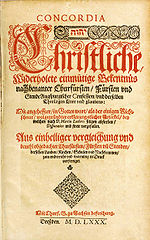
A title page of the Book of Concord
I have argued before that the stance of “confessional” Lutherans of having 100% agreement with the book of concord is unable to be maintained in the face of the evidence within the Book of Concord itself. That is, I believe that one must adhere to the Book of Concord “in so far as” it agrees with the Bible as opposed to “because” it agrees with the Bible. See my post on the topic for in-depth discussion of this distinction and its importance. I argued there, also, that the “because” position largely leads to a kind of inerrancy of the Book of Concord. After all, if the Book of Concord is to be agreed with because it agrees with the Bible, and the Bible is inerrant, it follows that anything that agrees with Scriptures 100% of the time will be without error.
Another example of defining Lutheranism according to strict adherence to the Book of Concord may be found in a recent post by Christopher Maronde entitled “What does the name ‘Lutheran’ mean?”:
Its meaning is simple: The name Lutheran refers to a person, congregation, or church body who unconditionally holds to the teachings contained within the Book of Concord, first published in 1580. A Lutheran is someone who declares that these specific documents rightly confess the truth of the Scriptures. It’s that simple; if you want to know what a Lutheran believes, if you want to know what that label means, you go to the Book of Concord. If you want to know if someone is using the label properly, you evaluate what they believe, teach, and confess according to the Book of Concord. (here)
These positions are generally considered to have a monopoly on the term “Confessional Lutheran” because they teach 100% affirmation of the Book of Concord and restrict any notion of Lutheran to that same adherence. My position, however, is that such a position cannot be maintained, nor should it have a monopoly on the term “Confessional Lutheran.”
Maronde’s definition above seems to provide a small loophole: it states that the Lutheran is to “unconditionally [hold] to the teachings contained within the book of Concord.” The key term here is “teachings.” At this point, if we grant this definition, one could argue that some purported errors in the Book of Concord may not be what the Book of Concord is teaching. However, later in the same quote, we see Maronde writes, “[I]f you want to know what that label means, you go to the Book of Concord…” which once again implies adherence to the totality, word-for-word truth of the Book of Concord. Yet the fact is the Book of Concord is not 100% true in every word-for-word instance.
I ran across another example of this in my readings the other day. In the Large Catechism, Martin Luther wrote,
This, I think, is why we Germans from ancient times have called God by a name more elegant and worthy than found in any other language, a name derived from the word ‘good,’ because he is an eternal fountain who overflows with pure goodness… [The Large Catechism, Part I, 25]
As Kolb and Wengert, editors of the critical edition of the Book of Concord published by Fortress Press note, the words for God and good in German (Gott and gut) are not derived from the same etymological root after all- “German: gut. This derivation is etymologically incorrect. The words for ‘God’… and ‘good’.. are not related in either Gothic or in Middle High German” (footnote 41 on page 389, cited below). Thus, within the very text of the Book of Concord, we have a clear error. Indeed, one that cannot be skirted around by arguing it is not something being taught therein; instead, it is clear that Luther is trying to teach about the meaning of God from an etymological derivation which is non-existent.
Therefore, it seems to me that the position of so-called “Confessional Lutheranism” and those who, like them, define Lutheranism narrowly to mean 100% adherence to the Book of Concord is clearly and demonstrably mistaken. The burden falls upon them to demonstrate that their position is actually viable in light of real, taught errors within the Book of Concord itself.
What does this mean for Lutherans–and indeed, Lutheranism? It certainly doesn’t mean we should all go chuck our Book of Concord editions in the trash. What it means is that, like any book, we should read the Book of Concord with a critical eye, checking it against God’s Word as found in the Scriptures and against the facts that we can discover in other studies as well. The Book of Concord is not inerrant, but that doesn’t mean a Lutheran cannot confess agreement with it so far as it agrees with Scripture, and, in doing so, remain a Confessional Lutheran.
Source
Robert Kolb and Timothy J. Wengert, eds. The Book of Concord: The Confessions of the Evangelical Lutheran Church (Minneapolis, MN: Fortress, 2000).
Links
Be sure to check out the page for this site on Facebook and Twitter for discussion of posts, links to other pages of interest, random talk about theology/philosophy/apologetics/movies and more!
Adhering to the Book of Concord “In So Far As” or “Because” it Agrees with Scripture?– I argue that Lutherans must hold the position that we adhere to the Book of Concord In So Far As it Agrees with Scripture.
Eclectic Theist– Check out my other blog for posts on Star Trek, science fiction, fantasy, books, sports, food, and more!
SDG.
——
The preceding post is the property of J.W. Wartick (apart from quotations, which are the property of their respective owners, and works of art as credited; images are often freely available to the public and J.W. Wartick makes no claims of owning rights to the images unless he makes that explicit) and should not be reproduced in part or in whole without the expressed consent of the author. All content on this site is the property of J.W. Wartick and is made available for individual and personal usage. If you cite from these documents, whether for personal or professional purposes, please give appropriate citation with both the name of the author (J.W. Wartick) and a link to the original URL. If you’d like to repost a post, you may do so, provided you show less than half of the original post on your own site and link to the original post for the rest. You must also appropriately cite the post as noted above. This blog is protected by Creative Commons licensing. By viewing any part of this site, you are agreeing to this usage policy.
Book Review: “Reformation Readings of Paul” edited by Michael Allen and Jonathan A. Linebaugh
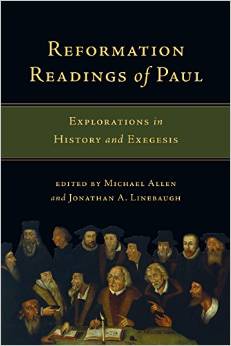 Reformation Readings of Paul is a collection of essays that surveys how various Reformers read Paul. Each Reformer has a pair of essays dedicated to their thought on a specific aspect of the Pauline corpus. The first essay is generally focused on simply expositing what the Reformer thought, while the second essay is generally focused more upon the analysis of that Reformer’s thoughts on the letter(s) they were commenting upon. This gives a rather robust groundwork for further research as readers are exposed to a mass of commentary from the Reformers themselves alongside various works critiquing or expounding on that same body of work.
The Reformers and books covered are Martin Luther (Galatians), Philipp Melanchthon (Romans), Martin Bucer (Ephesians), John Calvin (1 & 2 Corinthians), and Thomas Cranmer (Letters). The selections were well-chosen, for they pair theologians either with books for which they are particularly well known (Luther and Galatians), or help draw out lesser-known insights (Calvin and Corinthians). I was particularly pleased to see Melanchthon among the choices, as he is often, it seems, overlooked in favor of others like Zwingli.
The essays are each of great value, even for those who may disagree with the theological conclusions of the specific Reformers. The reason is because these are not merely reporting what the Reformer believed, but also subjecting them to a fresh look, analyzing the Reformers’ readings of Paul with the very latest theological resources, whether this comes from updated (and more accurate) Greek texts or from the specific insights into the historical-cultural background of the texts themselves. Each essay calls on the readers to not only think about how that specific Reformer read Paul, but also to think about how they themselves have read (and possibly misread) Paul. They call to readers to be aware not just of the Reformers’ cultural blinders, but also of our own–the ways that we have simply assumed meanings within the text which may not be there.
Another great value of the work is that it critically interacts with the Reformers’ readings. These are not (merely) criticism, but they also show how modern scholars have sometimes ignored the genuine insight these Reformers can provide into the text. The essays on Bucer were particularly excellent in this regard. The application of critique is not, however, danced around. Corrections are made where necessary, and, as David Fink notes in his essay on Luther (see my Sunday Quote on this), the Reformers themselves would have endorsed such correction.
The main downside to the book, in my opinion, is that because two essays are dedicated to each Reformer, fewer Reformers are put forward. Those included make quite a bit of sense, but it would have been nice to be able to access an even wider swath of Reformation Readings of Paul. Regular readers of my blog know that I am a Christian feminist, and I can’t help but wonder whether at least one female author could have been found to contribute to this work. It’s not a substantive critique, but it would be nice to give ear to a broader range of voices in a collection like this.
It is rare to find collections of essays in which not a single one seems off beat, but Reformation Readings of Paul is such a collection. Each essay has much of value, and readers of all levels of familiarity with the Reformers will benefit. It is highly recommended.
The Good
+Representative looks at some major figures of the Reformation
+Challenges readers to understand their own biases
+Interacts with most current scholarship
+Applies modern insights to the Reformers, and vice versa
+Consistently excellent essays
The Bad
-Could have used wider selection of Reformers
-Little background given to each individual Reformer
Disclaimer: I was provided with a review copy of this work. I was not required to provide any specific kind of feedback whatsoever.
Links
Be sure to check out the page for this site on Facebook and Twitter for discussion of posts, links to other pages of interest, random talk about theology/philosophy/apologetics/movies and more!
Book Reviews– There are plenty more book reviews to read! Read like crazy! (Scroll down for more, and click at bottom for even more!)
Source
Michael Allen and Jonathan A. Linebaugh, editors, Reformation Readings of Paul (Downers Grove, IL: InterVarsity, 2015).
SDG.
——
The preceding post is the property of J.W. Wartick (apart from quotations, which are the property of their respective owners, and works of art as credited; images are often freely available to the public and J.W. Wartick makes no claims of owning rights to the images unless he makes that explicit) and should not be reproduced in part or in whole without the expressed consent of the author. All content on this site is the property of J.W. Wartick and is made available for individual and personal usage. If you cite from these documents, whether for personal or professional purposes, please give appropriate citation with both the name of the author (J.W. Wartick) and a link to the original URL. If you’d like to repost a post, you may do so, provided you show less than half of the original post on your own site and link to the original post for the rest. You must also appropriately cite the post as noted above. This blog is protected by Creative Commons licensing. By viewing any part of this site, you are agreeing to this usage policy.
Sunday Quote!- Setting aside Luther?
Every Sunday, I will share a quote from something I’ve been reading. The hope is for you, dear reader, to share your thoughts on the quote and related issues and perhaps pick up some reading material along the way!
Setting aside Luther?
During October each year, I read some books about the Reformation to inform myself about that vastly important time in church history. October 31st is Reformation Day, of course, and so I thought I’d share a quote this Reformation Sunday from one of the books I’ve been reading. This year, Reformation Readings of Paul was high on my list, and I received a review copy from InterVarsity Press to devour.
There is a danger in the Protestant Church to enshrine the interpretations and methods of the Reformers such that the way they read the Bible becomes a new authority or at least lens through which Scripture must be read in order to be rightly understood. There is a fine line between referencing, respecting, and gleaning insight those who have come before as opposed to mechanically sticking to them. David C. Fink points out that even Reformers like Luther would have advised against this:
Luther showed no hesitation in setting aside the views of Jerome, Erasmus, or even Augustine. If we take him at his word, there is no reason to think he would not expect the same handling from modern exegetes today. (33-34, cited below)
Luther referenced these church fathers but did not see them as the authority on exegesis or interpretation of the biblical text. Similarly, Fink notes, we should not be afraid to set aside Luther if we should find that his interpretation of a passage is mistaken.
Links
Be sure to check out the page for this site on Facebook and Twitter for discussion of posts, links to other pages of interest, random talk about theology/philosophy/apologetics/movies and more!
Sunday Quote– If you want to read more Sunday Quotes and join the discussion, check them out! (Scroll down for more)
Reformation Theology- Check out my other posts on the Reformation and its theology (scroll down for more)
Source
David C. Fink “Martin Luther’s Reading of Galatians” in Reformation Readings of Paul eds. Michael Allen and Jonathan A. Linebaugh (Downers Grove, IL: InterVarsity, 2015).
SDG.
Sunday Quote!- Martin Luther on the Eighth Commandment
Every Sunday, I will share a quote from something I’ve been reading. The hope is for you, dear reader, to share your thoughts on the quote and related issues and perhaps pick up some reading material along the way!
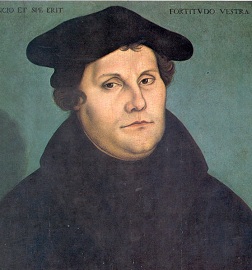
Martin Luther on the Eighth Commandment
I’ve always thought Martin Luther’s thoughts on the Eighth Commandment are an excellent guide for Christian living. Here’s his very brief comments from the Small Catechism:
The Eighth Commandment.
Thou shalt not bear false witness against thy neighbor.
What does this mean?–Answer:
We should fear and love God that we may not deceitfully belie, betray, slander, or defame our neighbor, but defend him, [think and] speak well of him, and put the best construction on everything.
Note that it is not enough simply to not lie to our neighbors. We must also defend the neighbor and also think and speak well of them. In the Large Catechism, Luther expands on these thoughts quite a bit. We should be generous in our interpretations of others’ intentions and acts.
Too often, even in Christian circles, I see people labeling others as “compromiser” or “fundy” or “liberal” without any consideration of the actual motivations, arguments, and positions of those with whom disagreement exists. Doing this is breaking the Eighth Commandment. Even in disagreement, we should think and speak well of our neighbor.
I pray that I may take this to heart and adapt it to my life.
Links
Be sure to check out the page for this site on Facebook and Twitter for discussion of posts, links to other pages of interest, random talk about theology/philosophy/apologetics/movies and more!
Sunday Quote– If you want to read more Sunday Quotes and join the discussion, check them out! (Scroll down for more)
SDG.

 J.W. Wartick - Reconstructing Faith
