Michael Haykin
Book Review: “Owen on the Christian Life” by Matthew Barrett and Michael Haykin
 Owen on the Christian Life provides a broad-spectrum approach to John Owen’s theological insights into the Christian life. It is part of the “Theologians on the Christian Life” series from Crossway (see my other reviews in this series here).
John Owen was a Puritan. Yes, one of “those people.” The word “puritan” has something of a bad connotation nowadays, but the theological movement was actually remarkably broad. Moreover, many insights can be gleaned from reading through the works of these theologians who emphasized a Christian life lived.
The authors outline Owen’s theology through a number of chapters that build on each other, including chapters on the Trinity, penal substitution, justification, and more. Readers also learn about Owen’s transition towards congregationalism, discussions about church and state, and more.
Central to Owen’s theology are the Trinitarian relations, which can help us to learn about divine-human and human-relations as well. Owen emphasized the importance of religious experience for the Christian life. This experience was never taken to trump the authority of the Bible–far from it. Instead, it was taken to be a bulwark in times of doubt and need. Justification in Owen’s view provides a way to be assured of one’s salvation, for God completes that which God has set out to do. Sanctification is where I believe Owen’s main contributions might be found, though I will outline that more below.
The primary critique I have of the book is that it doesn’t seem to focus on Owen’s specific views of the Christian life as the other works in the series have. As I outlined above, there are chapters emphasizing various aspects of Owen’s theology, but these only get tied into the Christian life in what seems like offhand fashion at times. This makes the book read more like an exposition of Owen’s broader (largely Calvinistic) theology than a specific look at his doctrine of the Christian life. Particularly surprising to me was how Owen’s insights on sanctification and overcoming sin and temptation were lumped in with discussions of the power of prayer and the indwelling Spirit. Perhaps this is at least partially my own bias, having been edified greatly by his works on sin and temptation, but I think that more space dedicated to his work in this area would have been on point in a book on the Christian life.
That said, the authors do a good job summarizing Owen’s approach to overcoming sin and putting it to death in our lives. Owen argues for several steps a Christian can take to battle sin and temptation in their lives. This is a proactive approach which views the Christian life as a Spirit-empowered battle against the temptations we face. Steps Owen describes include the envisioning of the consequences of sin, reflection on the Bible, and realizing the fact of the suffering our sin causes Christ.
Owen on the Christian Life provides insight into the whole of Owen’s theology, with a focus on his theology of Christian living. It’s not necessarily as focused on the topic at hand as some other books in the series, but it is a worthy read that provides an introduction into the thought of this theological giant.
The Good
+Excellent insights into the Christian life
+Provides broad overview of Owen’s work
+Great insights into doctrine of the Holy Spirit, sanctification, and more
The Bad
-Doesn’t seem to focus entirely on the Christian Life
Links
Be sure to check out the page for this site on Facebook and Twitter for discussion of posts, links to other pages of interest, random talk about theology/philosophy/apologetics/movies and more!
Book Reviews– There are plenty more book reviews to read! Read like crazy! (Scroll down for more, and click at bottom for even more!)
Book Review: “Overcoming Sin and Temptation” by John Owen– I review a book from John Owen which has positively impacted my spiritual life in many ways.
Source
Matthew Barrett and Michael Haykin Owen on the Christian Life (Wheaton, IL: Crossway, 2015).
SDG.
——
The preceding post is the property of J.W. Wartick (apart from quotations, which are the property of their respective owners, and works of art as credited; images are often freely available to the public and J.W. Wartick makes no claims of owning rights to the images unless he makes that explicit) and should not be reproduced in part or in whole without the expressed consent of the author. All content on this site is the property of J.W. Wartick and is made available for individual and personal usage. If you cite from these documents, whether for personal or professional purposes, please give appropriate citation with both the name of the author (J.W. Wartick) and a link to the original URL. If you’d like to repost a post, you may do so, provided you show less than half of the original post on your own site and link to the original post for the rest. You must also appropriately cite the post as noted above. This blog is protected by Creative Commons licensing. By viewing any part of this site, you are agreeing to this usage policy.
Book Review: “To the Ends of the Earth” by Michael Haykin and C. Jeffrey Robinson Sr.
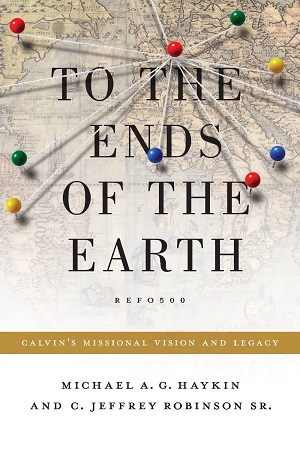 The question of “Why evangelize?” is one which is often leveled against Calvinism. After all, it is reasoned, if people are fore-ordained to be elect or one of the damned, then why bother to go out and evangelize them? Interestingly, this is a charge which I think may be leveled against virtually any view of foreknowledge, so the Calvinist answers given in To the Ends of the Earth: Calvin’s Missional Vision and Legacy
Contents
The book begins with a survey of the arguments made to suggest that Calvinism would not endorse evangelism or makes evangelism pointless. Clearly, the charge has come from many fronts throughout the history of the church. Then, Haykin and Robinson introduce the primary reason for others’ concerns about Calvinism’s evangelical prospects: that Calvin believed God had ordained some to be elect, and others to be damned, before the foundations of the world.
The authors defend the doctrine, taking on many of the key “all” passages which some argue make explicit the openness of salvation to all individual people. Calvin is brought to his own defense alongside a number of modern Calvinist theologians, ably presenting the Calvinist case for exegesis of these key passages, which basically is that when “all” or “world” is used, it is referring to the breaking open of salvation for all tribes and nations as opposed to merely the chosen people of Israel. The book goes beyond these basics and also outlines how other passages might be understood in this context.
Next, the authors turn to an exposition of Calvin’s theology of missions. Part of this theology was the notion that a Christian life lived was a profound witness to the Gospel. Word and deed were central to Calvin’s missions theology. This missional activity was to be for all people (Kindle location 993). Prayer was also central to Calvin’s theology, as he believed that it might be used by God to bring about change in persons (rather than change in God).
Historical Reformed missions are surveyed in the next sections. Calvin taught many going into France and certain torture and death if discovered, and even made significant efforts towards (ultimately failing) missions into Brazil. These efforts showed that through his actions, Calvin himself valued global missions.
Later Calvinist traditions and persons also demonstrated the urge to missions that the Reformer’s theology compelled. The Puritans sought to evangelize and frequently prayed for the same, though they may not have had the success of other contemporaries. Calvinist Baptists in England feverishly evangelized and planted churches, while also demonstrating concern for global evangelism (Kindle loc. 1420ff). Jonathan Edwards, contrary to some opinions, was also focused on missions by developing his own missional theology and also going on a mission to Native Americans himself.
The book closes with thoughts on “developing missional passion” through observations about Samuel Pearce, a theologian known in his time for fervent prayer and love of missions. Central to Pearce’s theology was the cross; Christ crucified was “his darling theme from first to last”; while the other primary theme of his life was a “passion for the salvation of his fellow human beings” (Kindle loc. 1978).
Evaluation
To the Ends of the Earth is a great, pithy read on a topic that should be of interest to many from a diverse array of backgrounds. It has appeal which goes beyond Calvinism in the way it demonstrates missions ought to be of central importance and also in its justification of missions even in light of the notion that there really do exist an elect people. Of course, the thrust of the book is to demonstrate that Calvinist theology does not undermine the need or motivation for missions. Those interested in that topic will find the most to benefit from the book. Regardless of one’s level of interest, however, the book generates its own avenues for exploration by introducing several little-known figures and historical events for further reading. It is short enough to enjoy in a single afternoon (as I did), yet deep enough to keep one’s mind occupied for some time afterwards.
Perhaps the greatest weakness of the book, however, is its length in that there is little ultimate exposition of the counter-arguments to those who would fault Calvinism with lack of evangelical fervor. That is, readers are often left to tie the arguments off themselves instead of having them drawn out and defended. This, however, is a minor fault in what is an otherwise excellent book, regardless of one’s position on the arguments made therein. It was well worth the read, in my humble opinion.
Links
Be sure to check out the page for this site on Facebook and Twitter for discussion of posts, links to other pages of interest, random talk about theology/philosophy/apologetics/movies and more!
Source
Michael Haykin and C. Jeffrey Robinson, Sr., To the Ends of the Earth: Calvin’s Missional Vision and Legacy
Disclaimer: I received a review copy of the book through Crossway. I was not obligated by the publisher to give any specific type of feedback whatsoever.
SDG.
——
The preceding post is the property of J.W. Wartick (apart from quotations, which are the property of their respective owners, and works of art as credited; images are often freely available to the public and J.W. Wartick makes no claims of owning rights to the images unless he makes that explicit) and should not be reproduced in part or in whole without the expressed consent of the author. All content on this site is the property of J.W. Wartick and is made available for individual and personal usage. If you cite from these documents, whether for personal or professional purposes, please give appropriate citation with both the name of the author (J.W. Wartick) and a link to the original URL. If you’d like to repost a post, you may do so, provided you show less than half of the original post on your own site and link to the original post for the rest. You must also appropriately cite the post as noted above. This blog is protected by Creative Commons licensing. By viewing any part of this site, you are agreeing to this usage policy.

 J.W. Wartick - Reconstructing Faith