modernism
“The Journey of Modern Theology: From Reconstruction to Deconstruction” by Roger E. Olson – An epochal work of theological history
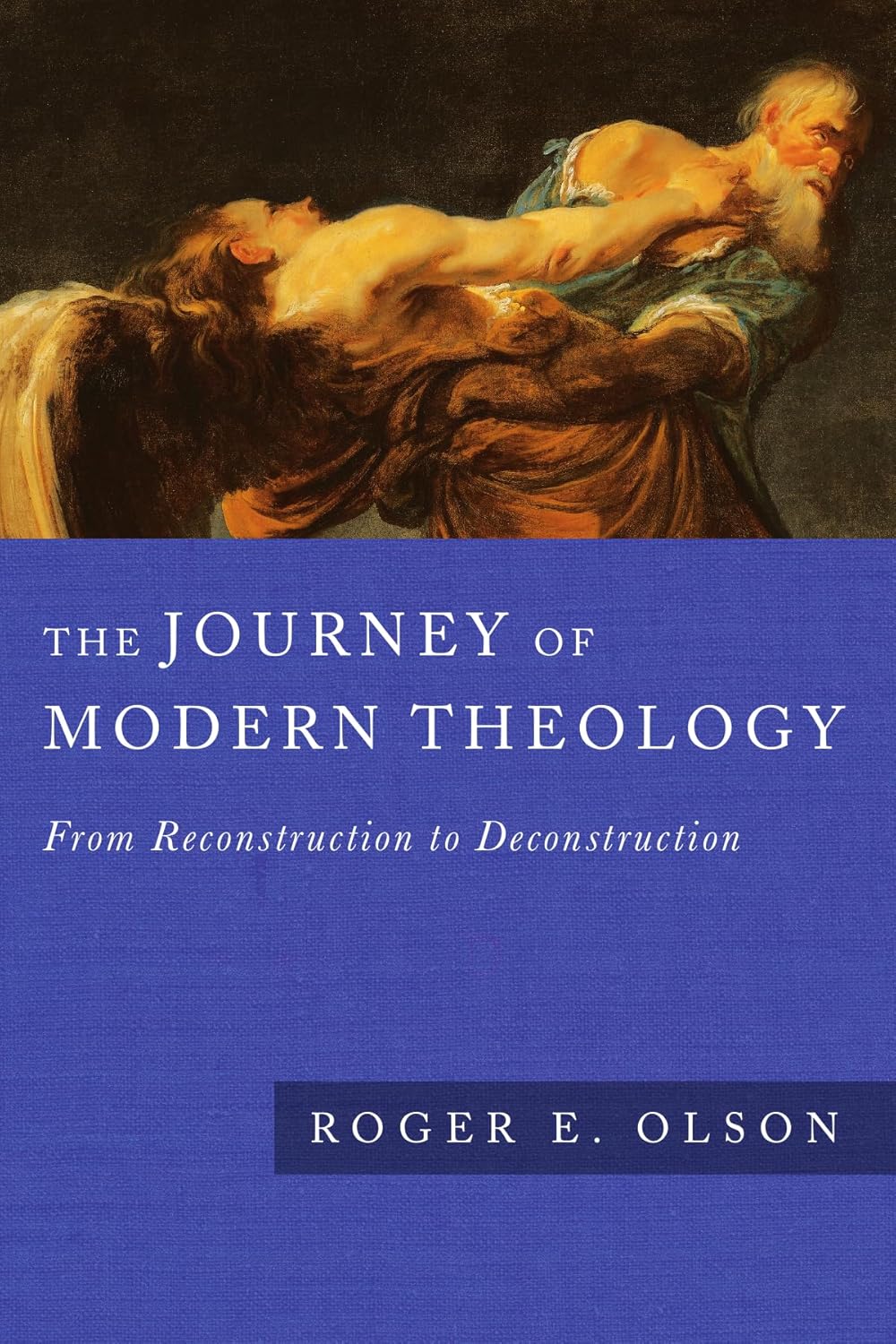
The Journey of Modern Theology: From Resconstruction to Deconstruction by Roger E. Olson is a monumental achievement of theological analysis and history.
The book is focused around modernity and the theology inspired from it, opposed to it, and moving with, against, and towards it. It is roughly divided chronologically and topically, with each chapter denoting an era of theological development and highlighting various theologians involved in that development. Olson’s accounting is largely neutral and fact-based reportage–he is informing readers on what the various theologians taught and believed rather than providing an analysis thereof. However, many of the major thinkers’ sections include a small section on contemporaneous critiques and responses.
Olson starts off with a brief overview of modernism and modernity, showing the scientific and cultural revolutions often associated with it. Then, he moves to various chapters analyzing modernist theologians and thinkers. Theologians given overviews include (but are not limited to): Friedrich Schleiermacher, Albrecht Ritschl, Karl Barth, Horace Bushnell, Paul Tillich, Jurgen Moltmann, Dietrich Bonhoeffer, Hans Kung, Hans Urs von Balthasar, Charles Hodge, Stanley Hauerwas, Reinhold Niebuhr, Ernst Troeltsch, and many, many more. Chapters include: “Liberal Theologies Reconstruct Christianity in Light of Modernity,” Mediating Theologies Build Bridges Between Orthodoxy and Liberalism,” Theologians Look to the Future with Hope,” etc.
The chapter headings give broad brush introductions to the topics at hand. As I said above, these chapters are roughly chronologically based, though there is plenty of overlap. Olson organizes these around movements, showing the warp and weft movement of theology throughout the modernist period into the postmodern one. Again almost all of the analysis is fact based reportage–here’s what Schleiermacher wrote and believed–sometimes accompanied by a section of “here’s what Schleiermacher’s critics said.” Olson only really tips his hand in the conclusion, showing where his own views lie. As such, that makes the book an incredibly valuable work to simply learn about modernist theologians and theological movements. There were many times I found myself pursuing a thread of thought outside the bounds of the book, getting an interlibrary loan from an author I hadn’t read before, or researching more online.
The value of a book like this can’t really be understated. It is a must have for readers interested in theological history and knowing where and how a lot of current theology came from. Additionally, students of theology can find within it many guidelines for further research and avenues to explore. Are you interested in a theology of liberation? There’s a brief summary here that names names and shows where the thought process is going. Want to know about conservative development related to modernist thought? Those thinkers are here, too. Whether orthodox or not; intentionally or not; Olson does an incredible job across the board giving readers much to learn and contemplate.
The Journey of Modern Theology is a fantastic read that will give readers many, many avenues of further research alongside a baseline understanding of the origins and development of theology alongside and against modernism. Highly recommended.
All Links to Amazon are Affiliates
Links
Be sure to check out the page for this site on Facebook!
Book Reviews– There are plenty more book reviews to read! Read like crazy! (Scroll down for more, and click at bottom for even more!)
SDG.
——
The preceding post is the property of J.W. Wartick (apart from quotations, which are the property of their respective owners, and works of art as credited; images are often freely available to the public and J.W. Wartick makes no claims of owning rights to the images unless he makes that explicit) and should not be reproduced in part or in whole without the expressed consent of the author. All content on this site is the property of J.W. Wartick and is made available for individual and personal usage. If you cite from these documents, whether for personal or professional purposes, please give appropriate citation with both the name of the author (J.W. Wartick) and a link to the original URL. If you’d like to repost a post, you may do so, provided you show less than half of the original post on your own site and link to the original post for the rest. You must also appropriately cite the post as noted above. This blog is protected by Creative Commons licensing. By viewing any part of this site, you are agreeing to this usage policy.
Book Review: “Haunted by Christ: Modern Writers and the Struggle for Faith” by Richard Harries
 Haunted by Christ is a riveting look at how modern writers dealt with lingering doubts, anger, sorrow, and the question of Christianity. Richard Harries asks readers to engage with several writers to ask them questions that might not normally be asked, and he challenges readers in ways that are intricately tied into these authors’ lives.
First, it is worth pointing out that the concept of “modern” here is being used in the technical sense, related to modernism. Harries sets this period starting with Fyodor Dostoevsky (1821-1881) and Closing in the early 20th century. The authors Harries surveys are Dostoevsky, Emily Dickinson, Gerard Manley Hopkins, Edward Thomas, T.S. Eliot, Stevie Smith, Samuel Beckett, W.H. Auden, William Golding, R.S. Thomas, Edwin Muir and George Mackay Brown, Elizabeth Jennings, Graham Greene with Flannery O’Connor, Shusaku Endo, and Evelyn Waugh, C.S. Lewis and Philip Pullman, and Marilynne Robinson. Readers familiar with the works of these authors will know they run the gamut from skeptics to devout Christians. What ties them together, in Harries reading, is that their works are “haunted” by the supernatural, and specifically through a grappling with the person of Jesus Christ.
As a reader, I was unfamiliar with many of the authors, not having read much from the modernist movement. (This line makes me want to say sorry to my English teachers.) Nevertheless, Harries gives enough biographical information on each author to understand the points he’s making. Indeed, most of the information in the book is biographical, as Harries draws out each authors’ struggle with faith and coming to terms with the person of Jesus Christ. Even the skeptics surveyed clearly interact with Christianity, even if in negative ways.
I found several chapters of particular interest. Seeing C.S. Lewis’s and Philip Pullman’s competing mythologies set alongside each other for examination was fascinating. The chapter on W.H. Auden and his quiet, almost “polite” faith drew to light the great impact culture can have on one’s perception of religion and the work of God. The chapter on Golding makes me want to read more from him, despite not enjoying The Lord of the Flies. Emily Dickinson as “smouldering volcano” was an insightful look at a phenomenally successful poet. Each chapter had something that struck me, though the book also left me wishing I did know more about the authors and their works. I suspect Harries would be pleased to know his work led me to reach out and start reading some of these other works.
The biographical way Harries writes integrates worldview questions into the writings of each author. It never felt as though he subverted their own personal narratives, however. He didn’t pull punches in describing the way a skeptic like Pullman spoke about religion. Nor did he cover up aspects of authors’ lives that some might find unappealing. It’s an honest, almost unyielding book. It made me uncomfortable at times, but in ways that challenged me to learn and understand.
Haunted by Christ is a fascinating work. Harries offers insight and vision into Christianity in ways that I hadn’t really thought of before. It made me want to read many of the authors mentioned. And it made me want to know what someone who actually was more familiar with these authors might think. Recommended.
Disclaimer: I was provided with a copy of the book for review by the publisher. I was not required to give any specific kind of feedback whatsoever.
Links
Be sure to check out the page for this site on Facebook and Twitter for discussion of posts, links to other pages of interest, random talk about theology/philosophy/apologetics/movies and more!
Book Reviews– There are plenty more book reviews to read! Read like crazy! (Scroll down for more, and click at bottom for even more!)
SDG.
——
The preceding post is the property of J.W. Wartick (apart from quotations, which are the property of their respective owners, and works of art as credited; images are often freely available to the public and J.W. Wartick makes no claims of owning rights to the images unless he makes that explicit) and should not be reproduced in part or in whole without the expressed consent of the author. All content on this site is the property of J.W. Wartick and is made available for individual and personal usage. If you cite from these documents, whether for personal or professional purposes, please give appropriate citation with both the name of the author (J.W. Wartick) and a link to the original URL. If you’d like to repost a post, you may do so, provided you show less than half of the original post on your own site and link to the original post for the rest. You must also appropriately cite the post as noted above. This blog is protected by Creative Commons licensing. By viewing any part of this site, you are agreeing to this usage policy.

 J.W. Wartick - Reconstructing Faith