paleobiology
Young Earth Creationism and the Problem of Multiple Dating Methods for a Tyrannosaur Fossil

When I was a young earth creationist (here after YEC), I often heard about the absurdity of dating methods used to arrive at millions of years for the age of fossils. One such argument I have seen repeated is that scientists determine the date of fossils based upon presuppositions about the age of each layer in the fossil record. What I want to emphasize is that this massively oversimplifies the way scientists date fossils. When we look at how scientists actually do date individual fossils, the evidence for the age of the Earth against YEC mounts quickly.
There are many, many more methods of dating fossils that continue to show that entirely independent strands of evidence yield the same ages or relative ages. In an essay in Tyrannosaurid Paleontology edited by Parrish et al., the authors show the age of a juvenile Tyrannosaurid based upon pollen, leaves, and paleomagnetism. What is important to note is that these are independent ways of measuring the age of this specific fossil. That is, the data that needs to be explained by the YEC is not simply dismissal of Carbon dating or something, but rather that each of these data points must be independently falsified, along with an explanation for why they would all align. Additionally, the paper summarized below shows how much more complex dating methods based upon looking at the layer in which a fossil is found. In other words, it helps to show that the creationist teaching that remains fairly common on YouTube and elsewhere that scientists simply look at the layer a fossil is in and assume the age is quite complex and based upon a series of data points.
Brief Summary of the Evidence
Note: I am not a trained scientist. I am summarizing the content of the paper cited, and attempting to put quotations at every point I’m directly quoting. This section is largely a glossed summary of points of the paper, and any errors and misunderstanding thereof in such a summary are on me.
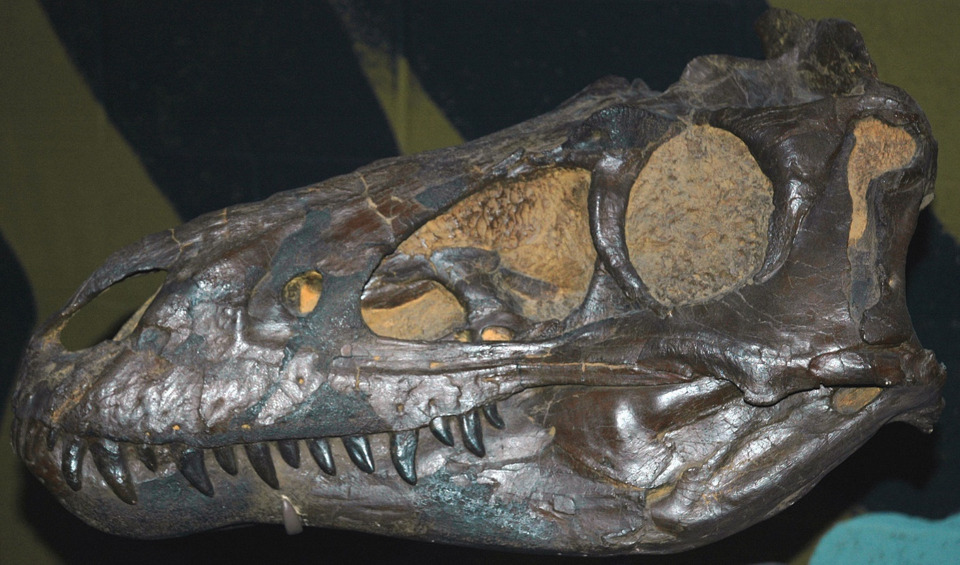
In an essay entitled “Using Pollen, Leaves, and Paleomagnetism to Date a Juvenile Tyrannosaurid in Upper Cretaceous Rock” by William F Harrison et al., the authors argue that a juvenile fossil tyrannosaurid fossil (named and sometimes hereafter referred to as “Jane”) can be confidently dated to about 66 million years ago. The juvenile tyrannosaurid (still an astonishing 7 meters in length!) was discovered in the Hell Creek formation in southeastern Montana in Carter County. The authors give details of the find, including the longitude/latitude, the place within the Hell Creek formation in which it was found, and other relevant details.
One of these is that the place the fossil was found was missing the top of the Hell Creek Formation with the Cretaceous-Tertiary boundary. This is a common part of the formation and other parts of the formation were visible from the site but the paleontologists were not granted access to the other sites within view to conduct a direct survey of the geologic columns there. This meant that they had to rely on additional dating methods.
First, they used a borehole log, which is made by cutting a cylindrical hole into the ground and extricating a section therefrom, allowing geologists to make a detailed summary of the formation. Another survey of nearby Blacktail Creek area of Montana was able to locate a magnetic reversal, which could then be used at the site of the Jane find to help place it in the formation. A stratigraphic section of the formation at the Jane site is provided, showing in detail each of these layers and correlations thereof. Jane, after death, was “buried within a 40 cm thick lens of poorly sorted silt, sand, and clay balls… This clay ball conglomerate contains abundant plant and animal fossils…” Again, a photograph shows a polished section of the clay ball conglomerate and siderite (a mineral compound) in which Jane was found.
Interestingly, from this conglomerate in which Jane was buried, scientists were able to extract fossilized pollen, vegetational residue, and more for analysis. This allowed them to determine what kind of plants the residue and pollen came from. The pollen was demonstrably from aquilapollenites and wodehouseia, each of which are entirely extinct now (more on that later). Fossil leaves were also collected from the Jane site, and these correspond to “the stratigraphic position indicated by the pollen and support the determination of its geologic age.” Once again, these leaves were determined to genus and species and they correspond to a “very narrow megafloral zone.” This is important, because, again, this megafloral zone is a zone in which only certain species occur within a stratigraphic layer on the Earth, and at the Jane site, only leaves from certain megaflora in a specific zone were found. Other types of plant leaves found are restricted in the fossil record to very specific parts of the Hell Creek formation. For conventional scientists, this marks their extinction [for YEC possibilities and problems thereof, see the section below]. The greatly delimited range of these plants allows scientists to narrow down the age of the Jane site even more, because it occurs only within a very specific stratigraphic range alongside very specific other fossils.
Additionally, the scientists collected samples from the fine grained sediment at the Jane site and analyzed them at the Paleomagnetics Laboratory of the University of California, Davis. There, based on the way the clay balls were sorted within the samples, they found the magnetic polarity of the sample corresponded to normal polarity and thus set another limit on the age of the Jane site (based upon stratigraphic samples showing differing magnetic polarity above or below it). Because these polarity shifts–reverse-normal-reverse-etc.–can be measured through stratigraphic analysis essentially globally, this allowed the scientists at the Jane site to determine that the age range of 65.9-66.0 million years ago is the correct age for the Jane fossil. The precision was possible because of both the paleobotanical and palynological–ancient plants and microorganisms–samples from the site.
Some Conclusions and Issues
It worth noting that the pollen at the Jane site was from two types of plants which are entirely extinct now. Young Earth Creationists often argue that all or most fossils, including the overwhelming majority (or all) dinosaurs were deposited by Noah’s Flood. One wonders, then, why in this great conglomeration and mixture of plants and animals, there is no fossilized pollen found from species that exist now. Why only extinct species? How did it just so happen that only extinct pollen–microscopic pollen!–settle onto this site? And how is that the case time and again, at site after site after site? To say that all this pollen and all these plants were washed away by the Flood but then somehow sorted into extinct and non extinct species, remarkably from bottom to the top of the geologic column, should be enough to stretch even the most credulous minds.
Similarly, the determination of just a few species of megaflora found at the Jane site demands explanation. Here, because leaves are obviously much larger than pollen, the creationist could theoretically just say that it so happened this area was only covered with that type of plant during the pre-Flood time and so it happened that only that kind of plant was preserved here. That does not, however, explain why totally different and distinct layers of plants are found in layers above and below this generalized stratigraphic layer, or why this specific megafloral zone is consistent across not just the Hell Creek Formation but elsewhere, and why examples of this can be multiplied essentially indefinitely. Time and again, specific fossils are only found with other specific fossils. There’s no mixing of them all together. You don’t find rabbit fossils with dinosaur fossils with the type of megaflora fossils found with Jane. Why not? Were there no rabbits roaming the pre-Flood world of Montana? Were there no flowering plants close enough to have their leaves cast about massive expanses of fossilized land? Again, it is far, far more parsimonious and plausible to acknowledge that, instead, the YEC narrative is simply mistaken on this. It cannot handle the sheer weight of the evidence.
The evidence here does not rely on Carbon-14 dating directly. Instead, it relies upon generally acknowledged dates for things like the Cretaceous-Tertiary (K/T) boundary, which again was sheered off by weather or some other events at the Jane site. This, along with the pollen fossils, microorganism fossils, and botanical fossils allowed scientists to make determinations to continue narrowing the date of the site from a broad range (before the K/T boundary) to a much more narrow range. These dating techniques were done independently. That is, the identification of the leaves was not used to determine the age of the polarity shifts in the magnetism of Earth. Instead, the way the sediments were sorted in the samples was used to determine a date; the specific pollen of megaflora was used to determine a specific date range because they only lived during a certain time range; the leaves were used to determine a specific range (here, independently, based upon botanical analysis of the age range possible with these plants). These all independently yielded a similar and narrow range. It was narrowed not arbitrarily but by noting the relative ages of each range.
So, for example, if you discovered a text fragment from the ancient world, you could narrow down the timeline in which it was made or discussing by finding out more about it. If, for example, it was in Latin and talking about events in the Roman Empire, that would broadly limit the possible dates to within the existence of the Roman Empire; then, if it talked about a specific province of Rome that wasn’t conquered until a certain time, that would narrow the possible timeline even more, and then if it talked about a governor of that province, it would narrow the dates to within the rule of that governor, etc. Similarly, since certain plants or microorganisms can be known to only occur in certain stratigraphic layers–and this is consistently determined by actual digs finding actual evidence of this assortment and lack of mixing–one can set ever-narrowing limits on the age based upon the overlaps of these events. Adding in the polarity shifts to the dating method was just icing on the cake. And again, why should all these data methods correspond unless the Earth is actually as old as conventional science supposes?
One obvious objection in all of this is the question of how the scientists determined the relative ages of things like the leaves, pollen, etc. While it seems, on the surface, problematic that these all correspond to ages in the millions of years that all align, just having a leaf in a fossil layer is not enough to put a date on it. Aren’t those dates slapped on based on radiometric dating of some kind, thus making the whole thing one line of evidence, not many? The objection has some weight at first glance because, to my knowledge, it is true that the ages for the stratigraphic layers were determined, in part, by radiometric dating, and thus saying that a certain layer has a consistent date across the region is reliant upon that dating method. Setting aside the many, many arguments and clarifications about radiometric dating, however, the problems in this paper go far beyond reliance upon radiometric dating. They also are grounded upon measurements about the magnetic polarity of Earth, as well as independent, multiple lines of evidence showing a narrow range of dates for when Jane was possibly alive. Supposing radiometric dating is entirely unreliable and that it just somehow continually yields similar age ranges for similar layers and fossils and consistently is measured in the same ranges across regions and beyond, the fact remains that Jane was identified in a unique stratigraphic layer with unique and exclusive megaflora pollen, unique and exclusive leaves, unique and exclusive microorganisms, and unique and exclusive polarity measurements through the clay ball sediment sorting present.
Why, given Noah’s Flood’s deposition of these layers, would this even possibly be the case? There’s not even one piece of pollen out of place from a plant in a different stratigraphic layer; there’s not even one piece of evidence of sediment being sifted in a different direction by changing tides of Flood water; there’s not even one leaf from an olive tree or any modern botanical features that happened to show up in this entire layer of deposited sediment; there’s not even one microorganism out of place; there’s not even one out of place animal fossil from a different sedimentary layer; there’s not even one post K-T Boundary layer creature found out of place. Not. Even. One. Did God miraculously sort each grain of sediment, each microorganism, each animal washed away by the Flood, each leaf, each pollen grain, each plant, each megafloral layer so that they would layer upon each other in distinct and evidentially detectable ways? It’s absurd to suppose this. It’s not that this would be impossible for God. No, it’s that there’s no biblical or extrabiblical evidence to suggest that God interacts in the world in this way. The only reason to even posit it is a desperate attempt to save modern young earth creationism from scientific absurdity. And that means that acts of God are being determined by modern science after all, in an ironic twist–YECs are determining how and why God acted based upon scientific evidence. The whole thing collapses on examination.
Additional Evidence and Conclusion
I have argued elsewhere about the stunning congruity of such divergent dating methods as tree rings, varves (annual layers of sediment), and Carbon-14. If YEC is true, there seems to be no explanation for why tree rings, Carbon-14, and varves should all align on the age of the Earth. I’ve also noted the argument from GPS measurement of the movement of the Hawaiian Islands and Carbon-14 dating of those same islands. Again, why should the measured movement rate of the Hawaiian Islands align with C-14 dating methods on YEC? And, as argued above, why should leaves, pollen, and paleomagnetism align as well? There is a stunning and constant refrain from these various and independent ways for measuring the age of fossils or the Earth generally: they point to an age that is orders of magnitude larger than that of YEC.
Young Earth Creationism, therefore, must contend either that all of these independent methods for dating fossils are mistaken in multiple independent ways or come up with a plausible explanation for why God would provide all these independent methods to provide false data. Proposals I have seen for the latter (eg. God intentionally creating with the appearance of age) suffer from severe theological problems, while proposals for the former are essentially nonexistent. It seems far more plausible, then, to suppose that it is Young Earth Creationism that is falsified.
Links to Amazon are Affiliates Links
Links
Be sure to check out the page for this site on Facebook and Twitter for discussion of posts, links to other pages of interest, random talk about theology/philosophy/apologetics/movies and more!
Gregg Davidson vs. Andrew Snelling on the Age of the Earth– I attended a debate between an old earth and young earth creationist (the latter from Answers in Genesis like Ken Ham). Check out my overview of the debate as well as my analysis.
Ken Ham vs. Bill Nye- An analysis of a lose-lose debate– In-depth coverage and analysis of the famous debate between young earth creationist Ken Ham and Bill Nye the science guy.
SDG.
——
The preceding post is the property of J.W. Wartick (apart from quotations, which are the property of their respective owners, and works of art as credited; images are often freely available to the public and J.W. Wartick makes no claims of owning rights to the images unless he makes that explicit) and should not be reproduced in part or in whole without the expressed consent of the author. All content on this site is the property of J.W. Wartick and is made available for individual and personal usage. If you cite from these documents, whether for personal or professional purposes, please give appropriate citation with both the name of the author (J.W. Wartick) and a link to the original URL. If you’d like to repost a post, you may do so, provided you show less than half of the original post on your own site and link to the original post for the rest. You must also appropriately cite the post as noted above. This blog is protected by Creative Commons licensing. By viewing any part of this site, you are agreeing to this usage policy.

 J.W. Wartick - Reconstructing Faith