presuppositional apologetics
Really Recommended Posts 9/1/12
 I am constantly delighted by the great quality of posts by my brothers and sisters in Christ. This week, I have provided a choice selection. The topics range from politics (the doctrine of peace through strength) to young earth creationism to presuppositional apologetics and Islam and beyond. I even linked to three of my favorite songs, to give a slightly different feel this go-round.
As always, please let me know what you liked!
———
The Natural Historian writes about Isaac Newton’s thoughts on the Mosaic account of creation. Check out this excellent quote:
Attempts to bring explanations for the physical origins of the geographic features of the earth into conformity with a six day creation and a universal flood has never yielded a unified view of how to interpret the data… [T]he application of that traditional view [young earth creationism] to an understanding of the physical creation and the origin of the earth has never accomplished a satisfying nor widely accepted result.
Refuting Islam: Philosophical Analysis– Mike Robinson uses presuppositional apologetics to evaluate Islam and argues that Islam is founded upon a logical fallacy.
Of Jesus, the Woman Caught in Adultery, Public Morality, The Law…– A fantastic and lengthy post on Christianity in the public square, legislating morality, and some specific moral issues. Recommended if you enjoy political discussion and the interaction of faith with politics.
What is the Doctrine of Peace Through Strength?– Wintery Knight weighs in on a national defense policy of peace through strength. This isn’t directly related to Christian apologetics, but I found it interesting, and Wintery Knight is a master of discussing Christianity in the public square. Check out the rest of his site. A choice quote from the article on peace through strength:
The way to stop most wars is to make dictators believe that you have the means and the will to stop their aggression.
The Ring Makes All the Difference: A Word to the Wise on Cohabitation– Does marriage make a difference? Should we do trial runs of living together first? What does sociology say about these issues? Check out this informative article.
Some of My Favorite Music– Here are some links to songs by three of my favorite artists. Yes, they range wildly in genre. I like some Christian rap- like Lecrae; I like Christian Metal like Demon Hunter (my favorite band) and I love some Christian Blues too, check out the Glenn Kaiser Band.
Debate Review: Greg Bahnsen vs. Gordon Stein
 Advocates of the presuppositional approach to Christian Apologetics have long hailed the debate between Greg Bahnsen (the late Christian theologian and apologist, noted for his achievements in presuppositional apologetics and development of theonomy–a view of the Law for Christians, pictured left) and Gordon Stein (the late secularist noted for his links to Free Inquiry among other things, pictured below, right) as a stirring triumph of presuppositional apologetics over atheism in a point-by-point debate. Recently, I listened to the debate and thought I would share my impressions here.
Debate Outline
Bahnsen Opening Statement
From the outset, it was clear this debate was going to be different from others I’d listened to or watched. Bahnsen outlined what he means by “God,” outlined a few general points about subjectivism, and then quickly dove into a presuppositional type of argument. He began with an attack on the idea that all existential questions can be answered in the same way:
The assumption that all existence claims are questions about matters of fact, the assumption that all of these are answered in the very same way is not only over simplified and misleading, it is simply mistaken. The existence, factuality or reality of different kinds of things is not established or disconfirmed in the same way in every case. [All quotes from the transcript linked below. My thanks to “The Domain for Truth” for linking this.]
Bahnsen then mounts an argument which is perhaps the most important innovation of presuppositional apologetics: the attack on neutrality. He notes that Gordon Stein in his writings puts forth a case for examining evidence in order to determine if God exists. He relies upon the laws of logic and seems to think that this avoids logical fallacies. Yet, Bahnsen argues, Stein has just argued in a circle as well. By presupposing the validity of the laws of logic and other forms of reasoning, he has fallen into the trap he has stated he is trying to avoid. As such, Stein’s outlook is not neutral but it is colored by his presuppositions. Bahnsen notes:
In advance, you see, Dr. Stein is committed to disallowing any theistic interpretation of
nature, history or experience. What he seems to overlook is that this is just as much begging the question on his own part as it is on the part of the theists who appeal to such evidence. He has not at all proven by empirical observation and logic his pre commitment to Naturalism. He has assumed it in advance, accepting and rejecting all further factual claims in terms of that controlling and unproved assumption.Now the theist does the very same thing, don’t get me wrong. When certain empirical
evidences are put forth as likely disproving the existence of God, the theist regiments his
commitments in terms of his presuppositions, as well.
Therefore, what Bahnsen presses is that it is only on the Christian theistic presupposition that things like the laws of logic, the success of empirical sciences, and the like can make sense. He makes the transcendental argument for the existence of God:
we can prove the existence of God from the impossibility of the contrary. The transcendental proof for God’s existence is that without Him it is impossible to prove anything.
Gordon Stein Opening Statement
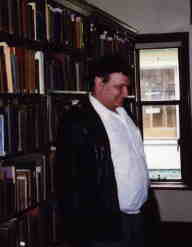 Stein opens by clarifying what he means by “atheist”: “Atheists do not say that they can prove there is no God. Also, an atheist is not someone who denies there is a God. Rather, an atheist says that he has examined the proofs that are offered by the theists, and finds them inadequate.”
Stein then argues that the burden of proof is definitely in the theist’s court. He goes on to address a number of theistic proofs and finds them wanting. In fact, the rest of his opening statement is spent addressing 11 separate arguments for the existence of God, including the major players like the moral, cosmological, and teleological arguments.
Cross Examination 1
In the first cross-examination, Bahnsen asked Stein whether the laws of logic were material or immaterial. Stein finally, quietly, admits that the laws of logic are not material. Yet then Stein turns around and in his own cross examination presses triumphantly a point he thinks will be decisive. He asks Bahnsen, “Is God material or immaterial”; Bahnsen responds, “Immaterial.”; after a brief segway, Stein poses the following question which, by the tone of his voice, he seems to think carries some weight: “Apart from God, can you name me one other thing that is immaterial?” To this question, Bahnsen responds quickly, “The laws of logic.” The crowd erupts. Stein lost that one.
First Rebuttal: Bahnsen
Bahnsen spends most of his rebuttal arguing that the laws of logic are not mere conventions, and that Stein cannot make them such. If Stein does, then, argues Bahnsen, he can’t actually participate in a logical debate, because they could each declare a convention in which they each win the debate.
He goes on to re-stress the transcendental argument and point out that Stein failed to address it. He develops it a bit further by attacking the notion that an atheistic worldview can make sense of logic:
And that’s because in the atheistic world you cannot justify,you cannot account for, laws in general: the laws of thought in particular, laws of nature,cannot account for human life, from the fact that it’s more than electrochemical complexesin depth, and the fact that it’s more than an accident. That is to say, in the atheist conceptionof the world, there’s really no reason to debate; because in the end, as Dr. Stein has said, allthese laws are conventional. All these laws are not really law-like in their nature, they’re just,well, if you’re an atheist and materialist, you’d have to say they’re just something that happensinside the brain.
But you see, what happens inside your brain is not what happens inside my brain.
Stein First Rebuttal
Stein argues that laws of logic are indeed conventions, saying:
The laws of logic are also consensuses based on observations. The fact that they can predict something correctly shows they’re on the right track, they’re corresponding to reality in some way.
Oddly, Stein continues to act as though Bahsnen’s argument was a variety of cosmological argument. He argues that before we can ask “what caused the universe” we must ask whether the universe is actually caused. He then tries to address the argument more explicitly, saying that it is “nonsense” and that various cultures do indeed have different logic. His most direct argument against the trasncendental argument is that “If matter has properties that it behaves than we have order in the universe, and we have a logical, rational universe without God.”
Debate Segment Two
Stein Opening 2
Stein argues that the problem of evil is an evidential argument against the existence of God. He states that it raises the probability that there is no God. He asserts that there is no physical evidence for God. Stein then argues that God has not provided evidence for his existence, but that He should do so. Finally, he turns to the problem of religious diversity, asking why God would allow other religions if there is only one God.
Bahnsen Opening 2
Bahnsen argues that Stein placing the laws of logic into a matter of consensus undermines their usefulness and in fact defeats the purpose of rational inquiry and debate. He argues further that Stein’s definition of laws of logic within pragmatic terms doesn’t come close to the extent of the laws of logic.
Stein Rebuttal
Stein argues that bahnsen hasn’t actually done anything to explain the laws of logic. He argues that simply saying they are the thoughts of God doesn’t mean anything, and that it does nothing to explain them. He therefore argues that Bahnsen fails to provide an adequate explanation for the facts of the universe.
Bahnsen Rebuttal
Bahnsen presses the point that Stein’s entire system is based upon presuppositions which he cannot justify. Induction is undermined in an atheistic worldview because there is no reason to believe that things will continue to happen as they do currently happen. He briefly addresses the problem of evil by saying that within an atheistic universe there simply is no evil, so it makes no sense from Stein’s perspective to press that issue.
Closing Statement: Stein
Stein’s closing statement seems to be more of a rebuttal than anything. He argues that there can be evil defined in an atheistic universe as that which decreases the happiness in people. Yet even this, he says, “We don’t know”–we don’t know that there is evil in an atheistic universe, rather it is a consensus and pragmatically useful.
He argues that we can know about induction because of statistical probability: it is highly improbable that the future will be different from the past because it has been similar in activity to the past for as long as we know.
Closing Statement: Bahnsen
Bahnsen finally presses the transcendental one last time. He argues that while Stein has called it hogwash and useless, he hasn’t actually responded to it. Bahnsen states that once more the atheistic worldview can’t make sense of itself. For example, saying the future will be like the past due to probability begs the question: there is nothing in the atheistic worldview to say that probability can help determine what the future will be like. It might work pragmatically, but it fails to give any explanation. Finally, Bahnsen argues that you cannot be a rational, empirical human being an an atheistic universe.
Analysis of the Debate
It is abundantly clear throughout this debate that the presuppositionalist takes a very different approach to debate and apologetics than those from other methods. One can see this immediately when Gordon Stein delivers his opening statement, which was presumably prepared beforehand, and goes to answer common theistic arguments like the cosmological and teleological argument. But Bahnsen never once used either of these arguments, and took an entirely different approach. I think this initially caught Stein off guard and that impression remained throughout the debate.
Stein’s responses to Bahnsen were extremely inadequate. This became very clear in their debate over induction and empiricism. For example, although Stein held that he could say the future will be like the past based upon probability, he had no way to say that the world was not spontaneously created 5 minutes ago with implanted memories and the notion that the future will be like the past. Bahnsen didn’t make this argument, but it seems like it would line up with his reasoning. Of course, he would grant that the theist has to presuppose that God exists in order to make sense of induction, but that was exactly his point: without God, nothing can be rational.
I found it really interesting that Stein kept insisting that the laws of logic are mere social conventions. He kept pressing that some cultures do not hold that they are true as defined. But of course, cultural disagreement about a concept doesn’t undermine the truth value of a concept. If, for example, there were a culture that insisted that 2+2=5, that wouldn’t somehow mean that 2+2=4 is a logical convention, it would mean the culture who insisted the sum was 5 would be wrong. Similarly, the laws of logic may be disagreed upon by some, but to deny them is to undermine all rationality.
Overall, I have to say I was shocked by how this debate turned out. I have long been investigating presuppositional apologetics and continually wondered how it would work in an applied situation. It seems to me that to insist on a presupposition in order to debate would not work, but Bahnsen masterfully used the transcendental argument to reduce Stein to having to argue that logic is merely a social convention while ironically using logic himself to attack theism.
It seems to me that this debate showed what I have suspected for some time: presuppositional apologetics is extremely powerful, when used correctly. Now I’m not about to become a full-blown presuppositionalist here. My point is that it is another approach Christians can use in their witnessing to those who do not believe. I envision a synthesis of presuppositional apologetics with evidentialism. Some may say this is impossible, that they are anathema to each other, but I do not think so. They can be used in tandem: the presuppositional approach to question the worldview of others, while the evidentialist approach can be used to support the notion that the Christian worldview provides the best explanation for the data we have.
Links
Listen to the debate yourself. Get it here. The transcript I used was also from this page. Thanks to the author for such a great resource.
I’ve been researching and writing about presuppositional apologetics. For other posts about presuppositional apologetics, check out the category.
I highly recommend starting with the introduction to the most important thinker in the area, Cornelius Van Til.
Choosing Hats– A phenomenal site which updates fairly regularly with posts from a presuppositional approach (the author uses the term “covenental apologetics”). The best place to start is with the post series and the “Intro to Covenental Apologetics” posts.
The Domain for Truth– Another great presuppositionalist web site. I highly recommend browsing the topics here.
SDG.
——
The preceding post is the property of J.W. Wartick (apart from citations, which are the property of their respective owners) and should not be reproduced in part or in whole without the expressed consent of the author. All content on this site is the property of J.W. Wartick and is made available for individual and personal usage. If you cite from these documents, whether for personal or professional purposes, please give appropriate citation with both the name of the author (J.W. Wartick) and a link to the original URL. If you’d like to repost a post, you may do so, provided you show less than half of the original post on your own site and link to the original post for the rest. You must also appropriately cite the post as noted above. This blog is protected by Creative Commons licensing. By viewing any part of this site, you are agreeing to this usage policy.
The Presuppositional Apologetic of Cornelius Van Til
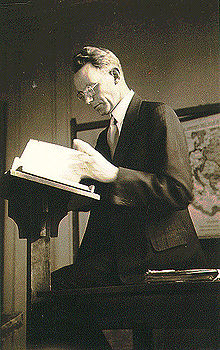 Cornelius Van Til pioneered the field of “presuppositional apologetics” primarily through his works Christian Apologetics

The Presuppositional Apologetic: Theory
Van Til was very adamant that believers cannot and should not give up any ground to those who are non-Christian. He argued that “Christian theism is a unit. Christianity and theism are implied in one another… Christianity can never be separated from some theory about the existence and the nature of God” (Christian Apologetics, 17). Again, he is adamant: “We must defend Christian-theism as a unit” (The Defense of the Faith, 28).
Along with his emphasis on defending Christianity as a unit, Van Til equally impressed the point of the extreme divergence of views between the Christian and the non-Christian. Apologetics must acknowledge the nature of man. Van Til placed particular emphasis upon the notion that apologists cannot ignore that “we shall have to choose between two theories of knowledge. According to one theory God is the final court of appeal; according to the other theory man is the final court of appeal” (The Defense of the Faith, 58). Because of this, “it becomes quite impossible…. [to] agree with the non-Christian in his principles of methodology to see whether or not Christian theism be true” (The Defense of the Faith, 118-119).
The key to understand here is that Van Til does not accept that there is a neutral reason “out there” by which Christians and non-Christians can arbitrate the truth of Christianity; his point is that there is no neutral ground and that one’s presuppositions will determine one’s end point. Again, he writes, “this [apologetic method] implies a refusal to grant that any area or aspect of reality, any fact or any law of nature or of history, can be correctly interpreted except it be seen in the light of the main doctrines of Christianity” (Christian Apologetics, 124).
However, Van Til takes it even further and argues that one must presuppose the truth of Christianity in order to make sense of reality: ” What is the content of this presupposition, then? It is this: “I take what the Bible says about God and his relation to the universe as unquestionably true on its own authority” (The Defense of the Faith, 253); again, “The Bible is thought of as authoritative on everything of which it speaks. Moreover, it speaks of everything” (Christian Apologetics, 19). Thus, Van Til’s apologetic does not make Christianity the conclusion of an argument; rather, Christianity is the starting presupposition.
The presuppositional approach here cannot be stressed enough. For Van Til, one simply cannot grant to the non-Christian any epistemic point. “We cannot avoid coming to a clear-cut decision with respect to the question as to whose knowledge, man’s or God’s, shall be made the standard of the other. …[O]ne must be determinative and the other subordinate” (The Defense of the Faith 62-63).
What place is had for evidences in Van Til? At some points, he seems to be very skeptical of the use of Christian evidences. In particular, the fact that he argues there is no neutral evaluation grounds between the Christian and non-Christian seems to imply that there can be no real evaluation of such arguments apart from Christianity. One of Van Til’s most famous illustrations of the use of evidences can be found in The Defense of the Faith pages 332 and following. He uses three persons, Mr. Black (non-Christian), Mr. Grey (Christian non-presuppositionalist), and Mr. White (presuppositional/reformed apologist):
Mr. Grey… says that, of course, the “rational man” has a perfect right to test the credibility of Scripture by logic… by experience… [Mr. Grey then takes Mr. Black a number of places to show him various theistic evidences. Mr. Black responds:] “you first use intellectual argument upon principles that presuppose the justice of my unbelieving position. Then when it it is pointed out to you that such is the case, you turn to witnessing [subjectively].
…At last it dawned upon Mr. White that first to admit that the principles of Mr. Black, the unbeliever, are right and then to seek to win him to the acceptance of the existence of God the Creator… is like first admitting that the United States had historically been a province of the Soviet Union but ought at the same time to be recognized as an independent and all-controlling power… If one reasons for the existence of God and for the truth of Christianity on the assumptions that Mr. Black’s principles of explanation are valid, then one must witness on the same assumption [which makes witnessing wholly subjective.] (p. 332-339)
It can be seen here that even evidences for Van Til must be based within a presupposition. There is no way to look at evidences in the abstract. One can either offer them within the presuppositions of Christianity or outside of Christianity. For Van Til, once one has agreed to offer evidences outside of Christianity, one has granted the presuppositions of the non-believer, and therefore is doomed to fail.
 His argument is therefore a type of “transcendental argument.” He argues that only within the Christian worldview can even the rationalism of the unbeliever make sense. Non-Christians may reject belief in God, but this is not a rational rejection, according to Van Til. Rather, “Sin will reveal itself in the field of knowledge in the fact that man makes himself the ultimate court of appeal… Man has declared his autonomy as over against God” (The Defense of the Faith, 58). Mankind is actively suppressing the knowledge of God. “It is not that we are merely brought into existence by God, but our meaning also depends upon God” (The Defense of the Faith, 63).
To sum up Van Til’s apologetic, then, there are three major points:
1) There is no neutral starting point between the Christian and non-Christian. One must presuppose either.
2) Christians should therefore presuppose Christianity in their apologetic and seek to show how only upon Christian presuppositions can one make sense of reality.
3) The transcendental argument: Only if God exists can their be a basis for morality, science, history, and rationality.
Analysis and Application
I admit that I am quite sympathetic to those who argue this type of apologetic is viciously circular. For example, one proponent of Van Tilian apologetics is John Frame. In his defense of presuppositional apologetics, he writes, “Premise 1: Whatever the Bible says is true. Premise 2: The Bible says it is the Word of God. Conclusion: Therefore, the Bible is the Word of God” (Frame, 356, cited below). I can’t help but think that while this argument is deductively valid, using P1 is to beg the question against the non-Christian. But of course, that’s exactly what Van Til urges. One must start with Christian theism and the Bible as presuppositions and reason from there. Therefore, I’m inclined to think that presuppositionalism cannot stand on its own. However, I do think that Van Til’s method can be saved from logical absurdity and made applicable in a part of a “cumulative case” type of reasoning (or certainly, it could be paired with a type of Reformed Epistemology).
The way I would propose for this is to utilize Van Til’s apologetic by showing Christians and non-Christians how philosophical presuppositions can color one’s evaluation of evidence and even of reasoning itself. Instead of offering only evidences or only witness in a vacuum, the Christian apologist should indeed focus upon how one’s presuppositions change one’s evaluation of evidence or witnessing. One presuppositional approach to the problem of evil can be found, I’ve suggested, in Job.
Furthermore, it seems to me that the transcendental argument is extremely potent. By arguing that even the process of reasoning cannot make sense apart from God, Christians can effectively place the burden of proof upon their opponents to show how their system can cohere with reality.
Finally, I can’t help but appreciate the tenacity with which presuppostional apologists, in the spirit of Van Til, pursue incoherent positions and actively turn people back to the presuppositional approach. The presuppositional apologetic, while not necessarily one I think can stand on its own, is extremely powerful.
Conclusion
Reading Van Til leaves me at points breathless with his innovation and boldness; but at other points it leaves me frustrated. He is not easy to understand, nor are his arguments always convincing. Too often, he axiomatically states a position and assumes his argument has carried his point. However, one can hardly dismiss the whole of Van Til’s thought as useless to Christian apologetics. Van Til’s transcendental argument has staying power, and his urges to focus upon presuppositions cannot be ignored.
This is but the first in a series of posts I have planned on presuppositional apologetics. I will be analyzing Van Til’s thought further, as well as diving into some other well-known proponents of presuppositionalism like John Frame, K. Scott Oliphant, and Greg Bahnsen. A few posts will focus on applied presuppositional apologetics.
Sources
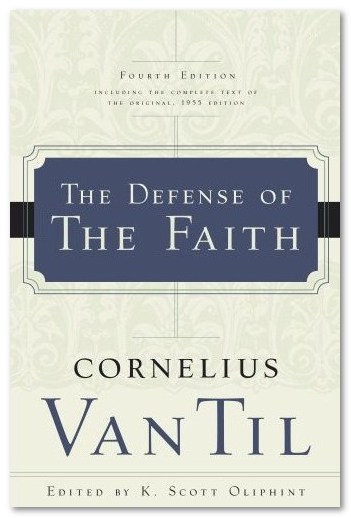
Cornelius Van Til, The Defense of the Faith
—-, Christian Apologetics
John Frame, “A Presuppositional Apologist’s Closing Remarks” in 5 Views on Apologetics (Grand Rapids, MI: Zondervan, 2000).
Links [Will update as series continues]
Proof that God Exists– an insightful view of presuppositional apologetics in practice.
Choosing Hats– A mammoth collection of articles from a presuppositional apologetic.
SDG.
——
The preceding post is the property of J.W. Wartick (apart from citations, which are the property of their respective owners) and should not be reproduced in part or in whole without the expressed consent of the author. All content on this site is the property of J.W. Wartick and is made available for individual and personal usage. If you cite from these documents, whether for personal or professional purposes, please give appropriate citation with both the name of the author (J.W. Wartick) and a link to the original URL. If you’d like to repost a post, you may do so, provided you show less than half of the original post on your own site and link to the original post for the rest. You must also appropriately cite the post as noted above. This blog is protected by Creative Commons licensing. By viewing any part of this site, you are agreeing to this usage policy.
Really Recommended Posts: 6/23/12
 Charles Darwin, Meet Friedrich Nietzsche– Really challenging post on Nietzsche’s thought as a reaction to Darwin’s theory. In particular, Max Andrews focuses upon the secular teleology of Nietzche’s system of thought, “Nietzsche’s attempt to construct a secularized teleology is subjective and produces no objective purpose or meaning. He understands this to be true, particularly more so if God is dead.” Very interesting.
“This is the End of America”– Eric Metaxas weighs in on the HHS mandate. I think this is spot on: ‘The requirement that religious institutions violate their consciences proves “the government, with all its power, can bully people,” he said. “This is the end of America.”‘
Even if the universe is eternal, it still needs a cause– Atheists miss an important point in regards to the Kalam Cosmological Argumentwhich Jason does an excellent job drawing out. Namely, a denial of the first premise of the Kalam does not show that the universe is acausal.
From Jesus to Us: A Look at P.O.W.E.R.– Eric presents a unique way to remember the evidences about Jesus.
‘Prometheus’ raises big questions– A look at the recent movie, Prometheus and the big questions it raises about life’s origins and the universe.
MP3 Podcasts on Presuppositional Apologetics– I’ve been prepping a post on presuppositional apologetics for a while now, and was delighted to find these discussions of the topic.
Ask an Egalitarian (Response)– An insightful post to how egalitarians (those who are for ordaining women) respond to various complementarian (people against) questions. For my own discussion of this issue, see my posts on egalitarianism.
What kind of evidence?
It seems that it is often the case that when I read works from atheists or talk to atheists one primary objection to the existence of God is “There’s not enough evidence.” A question I ask in response is “What kind of evidence?”
For many atheists (generalizing here, and I realize this), the assumption is that the scientific method is the only way to yield truth. But, assuming for the sake of argument that God exists, how would the scientific method show God exists? It seems to me that the scientific method cannot do so. There could be ways to see traces of God’s influence on the natural world (such as Intelligent Design theorists have claimed), but the God of Classical Theism is Spirit–this God is not part of nature, but created nature. Thus, God is transcendent to nature. God can interact with nature, but is, Himself, not nature.
But then there is a quandary. If I take it that the scientific method (hereafter E for empiricism) is the only way to yield truth, then I have no means by which I can even investigate the truth claims of Theism (hereafter T). For E, at best, can only perhaps give traces of T, but these will not be sufficient for evidence of T on their own. Thus, if I take E to be the only way to investigate reality, I am, a priori, ruling out even the possibility of T, for I am ruling out any means by which I could discover T to be true.
So again the question is “What kind of evidence does one want to show God exists?” Sensory experience could be one reasonable demand, but this seems question begging, as Classical Theism generally doesn’t claim that God interacts on such a sensory (i.e. auditory, visual, etc.) level except in extremely special circumstances (as in the Call of Moses, the Call of Elijah, etc.). What kind of evidence would convince someone to believe in God? Perhaps we could grant that not just E, but also philosophy and logic (hereafter L) are means by which we can yield truth (I believe that this is not an unreasonable suggestion at all, given that science is governed by logic). This opens us up to the possibility of considering arguments for and against the existence of God.
But, at most, L could demonstrate T, but such claims could be ignored, denied, etc. It seems that L could not get one to an understanding of T that would lead to belief. Let’s be honest here, would a good argument really convince anyone that God exists? I sincerely doubt it–for reasons outlined below (and here).
It seems to me that the existence of God necessarily involves one’s will. For if T is true, then the entire world is completely different than it would be if ~T were true. If T is true, then there is a God who created, sustains, and is personally involved with the universe. This includes every person in that universe, every creature, and every object. All of these have their origins in God. But if such a proposal is true, then it seems as though one would have to think, act, and live very differently on T versus ~T. One would be obligated to think about God, to act according to God’s will, and to live daily as though God exists–interacting with God in prayer, praise, thanksgiving, exhortation, etc.
So it seems to me that if T is true, it is not just a matter of seeing enough evidence. I can believe all sorts of things and not have them mean anything to me in actuality. For example, I believe that turtles hatch from eggs. This doesn’t change my behavior. Rather, it is simply factual knowledge. But would that kind of knowledge about God be enough? Let’s say that I have some overwhelming evidence, call it x, that God exists. Is x going to be regarded by me on the same level of the proposition that turtles hatch from eggs? Obviously not, for if x exists, then T is true, and then my entire life should be different. Thus, when asking about evidence, one should realize that such evidence absolutely involves not just belief but also life. Because of this, it seems to me that God could and would make evidence of His existence “purposively available“.
So who is asking for the evidence for God’s existence? Is it someone willing to change his/her life based on the answers? Is it someone who is ruling out the possibility to begin with? Is it someone willing to submit to this God, if this God exists?
Therefore, I return to the question: “What kind of evidence?” and even this question seems to miss the point. Perhaps the answer to the assertion that “There’s not enough evidence to believe in God” or “What evidence is there for belief in God?” should be “Who’s asking?”
——
The preceding post is the property of J.W. Wartick (apart from citations, which are the property of their respective owners) and should not be reproduced in part or in whole without the expressed consent of the author.
The Life Dialogue: Christian Presuppositions and Science
This is part of a series of posts on the debate within Christianity about how life diversified on earth (i.e. evolution, creationism, ID, or something else). See other posts in the series here.
I’ve been reading a whole lot of material on this debate for this series of posts. I’ve been reading from all sides of the debate. As such, I’m often presented with completely conflicting views of interpretation of the same data or conflicting views about overall methodological approaches.
Thus, I’ve been thinking quite a bit about how it is the Christian should interact with this whole debate. It dawned on me as I was eating dinner today (and reading through a creationist magazine–I like to multitask) that most of the driving force behind this whole debate may simply be with the methodology. There seem to be two major groups within the Christian community who are arguing on this issue. One group asserts that Christians absolutely must keep up with science, and that this means jumping on board with the entire methodological approach inherent in contemporary science. The other group asserts that Christians should indeed keep up with science, but should do so while acknowledging that God is going to be intricately connected at all stages.
This is perhaps the absolute center of the entire debate. What presuppositions do Christians have when entering the “life dialogue” (as I’ve called it)? I tied this almost immediately with Paul K. Moser’s idea in The Elusive God that philosophy should be done differently by Christians, who assume God exists, and therefore focus philosophy around God. Should not science also be done differently by Christians?
What I mean to say is that basic to the Christianity is the idea that God not only created the universe and all things visible and invisible, but He also loves and interacts with that same creation. For Christians interacting with science, I think this must mean that Christians should enter any kind of scientific inquiry acknowledging that there are points not just historically (as in the case of Jesus or any number of Biblical events) but also biologically, astronomically, etc. (see Psalm 19:1-6 for reasons to think this). This doesn’t support a “God of the Gaps” proposition, in which God is thrown in anywhere that science can’t describe, but it does support a God who interacts with the universe.
The problem is that mainstream science does not share such propositions. Unfortunately, despite Christian origins of science (see here), science today seems to take naturalism as absolutely true. Thus, it is simply not a fair field of play for Christians. I see this happening often in theistic evolution. It seems to me that many some Christians seem to think that we can never assert that God did something (other than the things recorded in the Bible) in physical history. But I don’t see any reason why Christians should be encouraged to embrace wholly the naturalistic presuppositions of contemporary science. Christians, I think, should instead try to use their own paradigms to interpret scientific data. If God is seen as creator and sustainer of the universe, what does that mean for biology, astronomy, physics, or other fields of scientific inquiry? I don’t think Christians should have to operate under a naturalistic worldview in order to explore science.
Christians should make use of science. I would never argue otherwise. My point is that Christians shouldn’t be Christians in one realm (outside of science), but atheists in another realm (within science).
So what does this mean for the “life dialogue”? I tend to think that any view of the diversity of life that attempts to completely cut God out of the equation is ultimately deistic or atheistic, not theistic/Christian. Questions for Christians in this debate could be “What does this mean to our relationship with God?” or “What was God doing during this time span?” If the answer to either question is “nothing”, then it really doesn’t mean that much to the Christian. I believe that all truth will have relevance to our relationship with God. God is never inactive. He doesn’t passively sit back and “let it happen.” This can be seen in Scripture (see Psalm 104 for a particularly wonderful account of God’s interaction with the world).
Thus, as I continue in this “Life Dialogue”, I’ll be analyzing positions based on these presuppositional questions as well: What do these accounts of the diversity of life teach us about God and what do they mean to us?
——
The preceding post is the property of J.W. Wartick (apart from citations, which are the property of their respective owners) and should not be reproduced in part or in whole without the expressed consent of the author.

 J.W. Wartick - Reconstructing Faith