Progressive Christianity
Why I left the Lutheran Church – Missouri Synod: Still Faithful

Still Faithful
It has taken me a long time to work up to writing this post. It’s actually been more than a year since I last made a post in this series, in part because of my own processing of the events. However, I’ve been asked time and again by many who have left the LCMS or who have left evangelicalism or other restrictive Christian groups to tell about why I am still a Christian. Why did I stay, despite the abuse, despite so many things I saw as wrong, despite everything? And, an oft-unspoken part of the question that I’ve heard is “How?” How is it, that after all these observations, after coming to a place in which I found much of what I was taught and thought was true is totally wrong, that I continue to believe anything?
Faithful?
Part of my hesitancy to write this post is because I know from bitter experience how many might read it and scoff. “‘Still faithful,’ he says? He’s a heretic/wolf in sheep’s clothing/demon-possessed!” I have heard each of these from various people, including people in person. And, while it’s easy to say to ignore those people who dress up their power trip in theological garb, it is so much easier said than done. When you had a true fear of literal hellfire for many years, it’s very harmful to be confronted by people who use that fear to try to silence and oppress. So yes, I know the scoffers are out there, and that I’ll hear or see some of those awful comments again. But I still think it’s important to write on this because there are so many out there who are wondering if it is okay to still be faithful when so much harm comes from within. I write this for you–and for me.
I Still Believe… what?
One thing that is easy to trip up on as people are deconstructing and/or reconstructing faith is the constant refrain of questions pushing to get at exactly what we believe. I get that a lot from more conservative Christians and especially apologists, who are often, unfortunately, seeking to argue about whatever beliefs I espouse instead of engage with me honestly. I know this is true. I have my degree in Apologetics. Literally. I did this same thing from the other side, and I repent of that. Engaging online is often helpful because it opens you up to others who might be on the same path, but it also invites in those who simply out to argue with everyone. And so often, the way people are taught about Christianity is a “my way or the highway” mentality such that any divergent view isn’t just seen as wrong, but actually excludes the person who holds that view from the Christian community.
Suppose I told you that I believe trans people are worthy and loved by God not in spite of but for who they are. If your visceral reaction to that is to immediately turn to argument, then that is that same upbringing or that same background of beliefs I’m referring to. You, the one reading this, are using that belief I hold in order to “other” me. I am now “less than” on your view.
It is this black and white, either/or thinking that I have broken away from. It has taken more than a decade, and it has taken so much pain and spiritual agony and angst, but I have finally broken beyond the dichotomy in my thinking. None of this means that I don’t think that reality has things that are true or false, or that some theological positions are correct, while others are not. No, it’s the inherent urge to repress/correct/change those who disagree with me that I’ve broken out of. And, more importantly, it’s the urge in myself to stand upon certainty in all things that I am still in the process of breaking away. It’s okay to say “I don’t know” as a response to theological questions. It really is. And maybe you are fairly sure about some things. That’s okay, too. What I’m talking about breaking away from is that inherent tension, fear, and othering of anyone who disagrees or any belief that is different. Some things I do still hold fairly strongly to. Others, not so much. There are so many things I hold now that while I may be able to answer “I believe this about that,” I am also comfortable saying, “but I’m not really sure about it.”
All of this is to say I’m not as interested in the “nail down the answers to theological questions A, B, C, ….Z” approach anymore. Sure, there are many theological positions I still hold, and may hold firmly. But to me that’s so much less interesting than God in Christ.
False Gods
Recently, I went to a retreat for a bunch of progressive Christians or formerly-Christian people still interested in theology. It was incredibly life-giving. It was filled with praise. It was filled with questions. It was uncomfortable at times.
One song that I heard live was “Some Gods Deserve Atheists” by Derek Webb. I’d never heard it before. He prefaced his singing by saying we should constantly be trying to kill our gods. Any god we could kill simply by thinking hard enough about it would deserve such a death. And some gods deserve atheists–they aren’t real; they’re formed of hate or fear. For me, a god who created people for the express purpose of condemning them to an eternal hellfire is one such god. Such a god deserves atheists; that god is not worth our time or worship. That’s a god of “othering” when the God I believe in, the God I learned about in Christ, is a God of Love, a God who is literally described as love itself on the highest possible level. God is love; and any God who doesn’t reflect that deserves atheists.
Does this mean I’m putting myself in judgement of God? Well, only if that god is small enough to be able to be judged by me. Any god that can be so contained into a box that I can sit back and disprove that god in my head, or by that god’s fruits on Earth, is no god.
Still Faithful
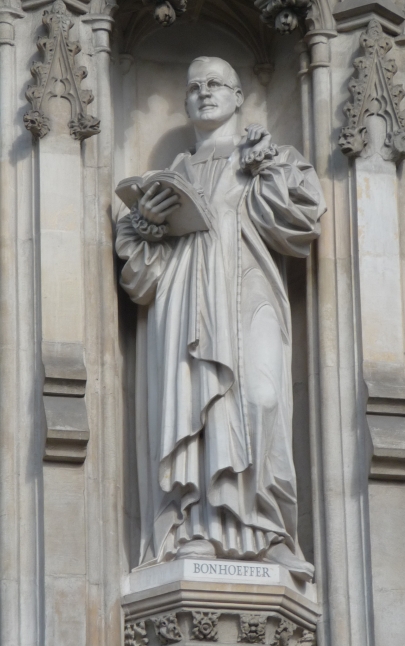
One thing that has shocked me, and that I am by turns disturbed and comforted by, is that a big part of why I still believe is that I still tend to think a lot of Lutheran answers to big questions are correct. Dietrich Bonhoeffer was a Christian theologian in Nazi Germany who was executed, in part, for his participation in the Confessing Church, a tiny minority of Christians in Germany who opposed the Nazis even as the overwhelming majority of Christians capitulated to or joyfully joined hands with them. Before he was murdered, some of his writings feature him speaking of “religionless Christianity.” Misinterpretations of his theology here have him lionized by various movements. But at the core of his thought wasn’t the overthrow of churches–that wouldn’t have made sense for a man whose theology included seeing sacraments such as Baptism as integral to Christian faith. The core, rather, is the stripping away of the structures that prevent Christians from living wholly into Christ or mirroring Christ to others. Bonhoeffer wrote of the maximal importance of living for the people around us and for the world. One helpful summary of religionless Christianity is found in Tom Greggs’s work, Theology Against Religion. Therein, he writes in part that religionless Christianity is “fiercely anidolatrous”–its doctrine of God seeks to constantly fight against the human tendency to create God in our own image or a God who defends our preconceptions; it is “resolutely unwilling to engage in articulating binaries“–it doesn’t seek to “other” but to unite; it is “not differentiating between sacred and secular spaces“–our lives are lives reflecting Christ in whatever spheres we enter; and it is “seeking to meet people in the fullness of their lives” (emphasis his, 218).
All of this is an extended way to get at some things I want to highlight. First, I think that the faith I hold now welcomes others in radical ways. Second, it remains tied inherently to streams of thought in Christian tradition, often reaching back to the earliest Christian theologians like Origen or Gregory of Nyssa. Third, it remains a faith radically against Christianity empowered by structures of state or hierarchies of power. That is, my faith stands against any use of Christianity for oppression. And yes, the church has so much to answer for here.
Finally, I must turn to a few concrete beliefs and affirmations because without them it doesn’t make sense of the question “How do I remain Christian” in a meaningful way.
The evils of the world, merely contemplating them, left me broken for a time. School shootings that could have easily been prevented if humans would have acted also call into question why God wouldn’t act. I mean, if God could really drop a stone on anyone at any point, why wouldn’t God do so–just once–in order to stop a school shooting in progress even as humans failed to do so? And the tired apologetic answer I used to rely on–that we don’t know how many such tragedies God has prevented by whatever means–just doesn’t work for me anymore. If God really could just intervene, why don’t we just see it?
I know all the answers to this question. Like, really. I studied theodicy so much while getting my degree. Molinism, open theism, process thought, free will defense, etc. The answers range from God doesn’t intervene because God has greater goods planned (free will, or whatever) to God can’t actually prevent such evil, so that’s why God doesn’t. And I have a confession: none of them are really satisfactory to me. Why does God allow evil? I don’t know. And the more I suffered over this question, the more I fell into holes of anxiety looking at the latest news of a massive shooting or some other horrible evil, the more I realized that I just don’t know, but I feel like I know other things that make me live in tension on this question. For example, I feel I know Jesus Christ is real, and that God is love. And since those feel real to me, and I believe them, I live in tension on the question of evil. If I were a really good Lutheran, I’d fully embrace an appeal to mystery here. And that’s kind of what I’m doing, in a way. But it’s deeper; I just don’t know that we can know. Whatever answer is given here is going to be unsatisfactory in some way. If it’s because God can’t prevent evil; to me that seems to make God smaller in ways I don’t understand. If it’s because God has some greater good in mind, it seems to underplay the real horrible suffering of people now. If it’s because God can’t prevent evil due to allowing for free will, it seems that it would be worth suspending free will–even entirely–in order to prevent so much suffering. And so I just… I don’t know. And I’m learning to be honest with myself in holding to that uncertainty.
Other theological questions have led to rethinking of positions. One such question was that of the fate of the lost. Why would a God who claims to be loving form people who that same God would then sentence to suffer for eternity? For a time, I held to conditional immortality, also known as annihilationism. That view, which I still think is better attested Scripturally than any kind of eternal conscious torment view, holds that those who don’t believe in Christ for whatever reason are ultimately annihilated or destroyed by God. Immortality, that is, is conditional upon faith in Christ. But I continued to struggle with this, whether it’s the reality that so many never get a chance to even hear about Christ, or that so many hear about Christ only through systems of colonialism and oppression, it didn’t make sense to me. Additionally, many verse in Scripture suggest that God wants all to be saved. So why not do so? More than that, long Christian tradition reaching back to the earliest teachers of Christianity affirms universal salvation. So, a short answer to the question of the lost and how I stay Christian regarding that question is that I think God will really reconcile the whole world to Godself, so that God really will be all in all (1 Cor. 15:28).
Ah! One might immediately challenge that with other scriptural verses that strongly suggest that not all are saved. And to that, another answer I have come to is that the Bible is polyvocal. It doesn’t speak with a united front on these topics. And, while that is annoying and has caused confusion and so much pain, it also is somewhat freeing and beautiful. God didn’t pigeonhole the authors of Scripture into losing their opinions and voices. It’s far more complex than that.
There are so many more, but these are some of the big questions I personally faced that I hadn’t addressed yet in the series, and some of the answers I continue to settle upon. I offer them not to try to convince you, but to try to answer the question of how I remain Christian. I remain Christian, in part, because I reconstructed my faith, and I came to answers that I think make more sense of reality than the answers I had before.
Concluding Thoughts
I have so much more to say. I wish that for those readers who ask me the question “why/how do you stay Christian” who are genuinely wondering about it, that I could sit and have brunch with you and talk about it for hours. I mean, isn’t that question so far reaching, so fascinating? And I look back over what I wrote and it all seems so small, and so inadequate to even begin the conversation.
For me, Jesus Christ is so fascinating, so loving, and so central still, that it compels me to come back time and again. When I see the awfulness that is so much of Christianity; the latest report of a Christian pastor using a position of power to assault or degrade others, for example, I find myself fleeing back to Christ. And I don’t mean a trite “that’s not real Christianity” type answer to the evils Christians perpetrate. The links of Christianity in America and power are too interwoven to pretend that real Christians don’t bring about much harm. Rather, what I mean is, I flee back to a God who came into our world, who suffered, and who rose, and who intentionally brought so much powerful goodness to the world that our lives, when viewed from eternity, will all be for good.
Links
Formerly Lutheran Church – Missouri Synod (LCMS) or Wisconsin Synod (WELS)– A Facebook group I’ve created for people who are former members of either of these church bodies to share stories, support each other, and try to bring change. Note: Anything you post on the internet has the potential to be public and shared anywhere, so if you join and post, be aware of that.
Leaving the LCMS/WELS– Not sure about whether to leave or thinking about leaving? Do you want to others who are thinking along the same lines? I created a group for those who are contemplating leaving these denominations, as well.
Why I left the Lutheran Church – Missouri Synod Links Hub– Want to follow the whole series? Here’s a hub post with links to all the posts as well as related topics.
Be sure to check out the page for this site on Facebook and Twitter for discussion of posts, links to other pages of interest, random talk about theology/philosophy/apologetics/movies and more!
SDG.
——
The preceding post is the property of J.W. Wartick (apart from quotations, which are the property of their respective owners, and works of art as credited; images are often freely available to the public and J.W. Wartick makes no claims of owning rights to the images unless he makes that explicit) and should not be reproduced in part or in whole without the expressed consent of the author. All content on this site is the property of J.W. Wartick and is made available for individual and personal usage. If you cite from these documents, whether for personal or professional purposes, please give appropriate citation with both the name of the author (J.W. Wartick) and a link to the original URL. If you’d like to repost a post, you may do so, provided you show less than half of the original post on your own site and link to the original post for the rest. You must also appropriately cite the post as noted above. This blog is protected by Creative Commons licensing. By viewing any part of this site, you are agreeing to this usage policy.
Much Ado About Nothing: Alisa Childers’ “Another Gospel?”

I believe one of the most important thing anyone can do for their edification is to read books with which one disagrees. There are a number of reasons for this, such as the possibility that such books may enlighten or even change one’s position about at topic or to ensure that one does not misrepresent the “other side” when discussing topics with which you disagree. Alisa Childers’ Another Gospel? A Lifelong Christian Seeks Truth in Response to Progressive Christianity* presents her opinions on what she calls Progressive Christianity, and, being sometimes labeled progressive myself, I figured it was worth taking a look.
The book has a Foreword by Lee Strobel, a journalist who writes bestselling apologetic works centered around interviews of experts and whose fame was only increased by the “A Case for Christ” movie about his life. I was honestly stunned when I saw his example of sailing a boat and needing an anchor to ensure one’s safety. He goes on to say that the anchor for Christianity is… what? Reading the analogy, I most definitely expected the answer to the question: “What is the anchor of Christianity?” to be, well, Christ! After all, Christ is the chief cornerstone of our faith (Ephesians 2:19-20). It seems reasonable to expect that the anchor would be similar enough to a cornerstone in an analogy to have Christ be the answer. Well, you’d be wrong. Strobel’s answer is: “In Christianity, the anchor is sound biblical doctrine” (xiii). Strobel’s answer is not only surprising but also wrong. Christ just is the foundation and anchor of our faith. Having the right beliefs is all well and good, but those right beliefs are nothing but foolishness without Christ. I belabor this point because Strobel’s answer in this foreword is indicative of Childers’ approach. For Childers, progressive Christianity is a threat not because it fails to honor Christ or because Christ is not at work in the progressive Church. No, progressive Christianity is a danger because they don’t agree with her own definition and beliefs of what is entailed by “sound biblical doctrine.”
Childers provides autobiographical details throughout the book, many of which resonated with me because I had some similar experiences growing up in the church. Childers was apparently a member of a CCM group known as ZOEgirl, which had songs I’m sure I’ve listened to at some point. What’s interesting is that these autobiographical details are often used as the foundation for her chapters dealing with her analysis of progressive Christianity. For example, a surprising example of a pastor who was an agnostic with whom she took a class serves, apparently, as her definition of what a progressive Christian is. I don’t say this to be disingenuous. It just appears that, as far as Childers is operating, her experience with this agnostic pastor became so formative for her with her visceral reaction away from him that she then associates anything even remotely related to that pastor’s views as progressive and therefore not really Christian, in her mind. I admit I’m taking some psychoanalysis too far here, but if one reads the book just trying to find what she means by “progressive Christianity,” this seems to be the ultimate answer. Indeed, Childers herself writes that this single class “would permanently embed the voice of a skeptic into my mind–that has to this day affected my ability to read the Bible without inner conflict” (20-21). That Childers reveals this is good, because it tells us about her biases. But then it clouds not just her personal reading of the Bible, but also her interaction with any Christian who strays from an unconflicted idea of “sound biblical doctrine.”
Childers words quoted above reveal what seems a painful experience to her based on her wording about conflict. It also shows a recurring theme in Another Gospel?, namely, that doubt is inherently to be distrusted or “fixed.” A later example occurs in Childers discussion of church, “Fixing What Isn’t Broken.” Over the course of a few pages, Childers delivers a terribly confusing message about doubt, first noting the problem with defining faith as 100% certainty all the time (49-50), then helpfully suggests that faith is “trust based on evidence” (51), and finally suggests that churches must become “safe places for those who experience doubt” (51-52). That sounds great, until Childers adds the addendum, “If people don’t feel understood, they are likely to find sympathy from those in the progressive camp who thrive on reveling in doubt. In progressive Christianity, doubt has become a badge of honor to bask in, rather than an obstacle to face and overcome” (52). Citation. Needed. Childers has absolutely nothing to back this up. Again, contextually, the aforementioned agnostic pastor is mentioned (50), apparently setting up Childers’ entire view of what progressive Christianity is, such that she can make these broad stroke claims about “progressive Christianity” without even a single citation of evidence. Indeed, one may wonder based on her own encouragement of churches to become “safe places” (note that she dare not use safe “spaces,” for that term is too progressive) for doubters is itself evidence that the non-progressive church itself dares not “face and overcome” the “obstacle” of doubt. Her words are insulting at best, and uninformed in the text itself.
Critical theory serves as a bogeyman in Another Gospel? just as it does in much conservative Christianity. Rather than providing any primary sources to discuss what critical theorists actually believe or think, Childers is content to set up false dichotomies regarding critical theory and Christianity (59-61). She ends this brief section with this whopper: “[W]hen someone accepts the ideas of critical theory, it can begin to erode their Christian worldview… It can lead someone into progressive Christianity, which already devalues the historic Christian answers to these ‘worldview questions’ and focuses on actions over belief. That becomes just another works-based gospel that ebbs and flows with cultural norms” (61). This passage is riddled with unwarranted assumptions, and Childers hasn’t even come close to establishing that progressive Christianity does anything of the sort regarding what she claims.
Claims about historical Christian belief abound in Another Gospel?, but it is clear that Childers has, at best, a passing knowledge of selections from church history. Her claims about the apparent unanimity of church history in agreement with her own current moral compass should set off alarm bells already (again, see quote above). Once she actually turns to discussing church history, those alarms turn into blaring claxons. For example, her discussion of “digging into their [church fathers’] writings” is especially revealing in that she she portrays them as seemingly united in doctrine (78-80), emphasizing that there are “hundreds” of quotes (81) about Scripture showing similar views to her own, but failing to demonstrate that what they were saying actually aligns in any way to her own views beyond superificial similarities in appealing to Scriptural authority. Yes, the church fathers had a high view of Scripture, but the way Childers writes, one comes away thinking they aligned on virtually everything else regarding morals, doctrine, &c.
A simple demonstration of Childers’ strange mixture of attempted awareness of church history and ignorance thereof is her treatment of universalism. I’m not a universalist myself, but it is clear there is a strand of universalist thought throughout church history. Childers’ discussion rejects universalism with little more than a trite “I learned that it is not biblical” and a quote from Richard Bauckham (187). The standard proof texts for eternal conscious torment are cited, but Childers seems to think that universalists have never even attempted to deal with these, and shows no actual awareness of a position like conditional immortality. No, for Childers, unsurprisingly at this point, it’s her way or the highway. After all, we know the anchor of Christianity is what? For Childers, it’s sound biblical [read: her view] doctrine.
Childers’ chapter about atonement is abysmal. I don’t use that word lightly, but Childers shows that she’s totally uninformed about historical positions on the atonement. Yes, there are voices in progressive Christianity that talk about the atonement theory in ways that don’t make sense historically as well. Yes, the “cosmic child abuse” narrative is nonsense. But also, yes, there have historically been several atonement theories. And Childers has the audacity to conclude this chapter by writing “Progressive Christians assume they are painting God in a more tolerant light by denying the substitutionary atonement of Jesus. But in reality, they are simply constructing a codependent and impotent god who is powerless to stop evil. That god is not really good. That god is not the God of the Bible. That god cannot save you” (224). Throughout this chapter, Childers cherry-picks quotes from various people and then trashes them based on proof texts that she presumably believes prove substitutionary atonement as the One True Atonement Theory. But if Childers really, truly believes that one must hold to substitutionary atonement or else have a “god” who “cannot save you,” then she’s writing off many, many Christians even back to church fathers throughout history. And the thing is, I genuinely do not believe Childers has any idea she’s doing this. Childers could not actually believe what she writes about competing atonement theories while also quoting C.S. Lewis in a positive light (Lewis did not believe that a single theory of atonement was necessary, as anyone who has read his views in Mere Christianity would know, and he seems to have held to a ransom theory or some variation thereof, though Lewis scholars continue to debate this). The chapter on atonement is, once again, Childers widely missing the mark. And that’s unfortunate, because a genuine critique of those within progressive circles who say things like “cosmic child abuse” needs to be written, but maybe it just can’t be done by someone who’s going to throw people’s salvation into question. Again, for Childers, the “achor” of Christianity seems to be “sound biblical doctrine” (read: doctrine she agrees with) rather than Christ.
Another Gospel? is an unfortunate mess. I say unfortunate because I, as a sometimes-labeled progressive Christian, believe that progressive Christians could use a gut check at times. It is true that the “cosmic child abuse” view some Christians put forward is astonishingly ignorant of church history and probably very poor Trinitarian theology, at that. It is true that progressive Christianity could stand to think more strongly about church history. It is true that progressive Christianity could use some subtle corrections. But Childers’ work is not that work. It is a series of misrepresentations, mistakes, and fear-mongering. Childers, like Strobel, appears to think that the anchor of Christianity is doctrine, not Christ. Perhaps they could each learn from so many progressives I’ve known personally who value Jesus so much that they’re willing to be uncomfortable with their own beliefs or those of others for the sake of the Gospel. Perhaps they could learn that God is strong and powerful enough to exceed our own expectations and break out of the boxes we set up.
*I did not comment upon the subtitle in the main body of my text because I know authors often don’t get to choose their titles or even subtitles. Nevertheless, the implication of progressive Christianity being so obviously untrue that “lifelong Christians” (such as myself, a lifelong, sometimes labeled progressive Christian) must “seek truth in response” to it is, minimally, a tough pill to swallow.
All Links to Amazon are Affiliates links
Links
Be sure to check out the page for this site on Facebook and Twitter for discussion of posts, links to other pages of interest, random talk about theology/philosophy/apologetics/movies and more!
Book Reviews– There are plenty more book reviews to read! Read like crazy! (Scroll down for more, and click at bottom for even more!)
SDG.
——
The preceding post is the property of J.W. Wartick (apart from quotations, which are the property of their respective owners, and works of art as credited; images are often freely available to the public and J.W. Wartick makes no claims of owning rights to the images unless he makes that explicit) and should not be reproduced in part or in whole without the expressed consent of the author. All content on this site is the property of J.W. Wartick and is made available for individual and personal usage. If you cite from these documents, whether for personal or professional purposes, please give appropriate citation with both the name of the author (J.W. Wartick) and a link to the original URL. If you’d like to repost a post, you may do so, provided you show less than half of the original post on your own site and link to the original post for the rest. You must also appropriately cite the post as noted above. This blog is protected by Creative Commons licensing. By viewing any part of this site, you are agreeing to this usage policy.

 J.W. Wartick - Reconstructing Faith