religionless Christianity
Bonhoeffer’s Catechesis: Foundations for his Lutheranism and Religionlessness
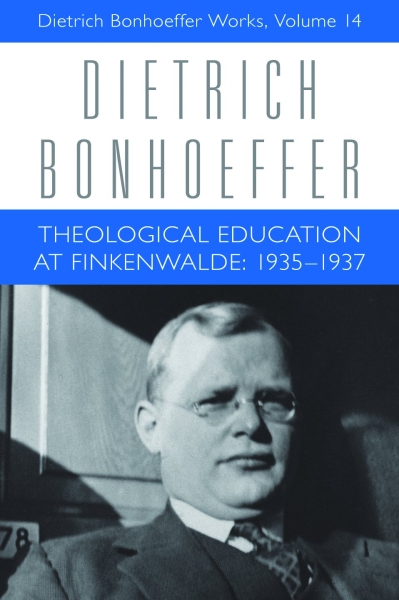
Dietrich Bonhoeffer was deeply involved in educating youths. He saw the need for it and was apparently quite skilled, building a reputation in Barcelona for caring for a rambunctious group of students. When teaching at the illegal seminary at Finkenwalde, one of the many subjects he touched upon was catechesis–basic Christian education. Bonhoeffer’s teaching on catechesis revealed that his thoughts on religionless Christianity were already quite embedded at this middle stage of his theology, and that his staunch Lutheranism held throughout his life.
When starting his lectures on catechesis, he began with some commentary on Christian instruction. However, this commentary was fronted with the notion that Christian instruction is embedded in proclamation. Conceptually, this is because those involved in catechesis have been baptized, and, due to their baptism, they are already Christian. Thus, Bonhoeffer declares that, related to the education of young people: “the struggle, the victory belongs to the church because God has long since brought the children into the church through baptism. Whereas the state must first make itself master [Herr], the church proclaims the one who is Lord [Herr].” Bonhoeffer goes on to clarify, “Christian education begins where all other education ceases: What is essential has already happened. You have already been taken care of. You are the baptized church-community claimed by God” (DBWE 14:538).
Because of the status of those learning from the church as the already baptized, Bonhoeffer argues, the church can proclaim from the start the reality that they are already in the church community. Baptism has made this happen, by the power of the Spirit. It would be hard to imagine a more Lutheran understanding of the starting point of Christian instruction than this. For Bonhoeffer, baptism was not an abstraction or a symbol: it was a very real status change of the person being baptized as becoming part of the church-community.
The same lecture series shows Bonhoeffer’s thoughts on religionless Christianity were not merely a late development while in prison. While commenting on “What makes Christian education and instruction possible…” Bonhoeffer notes that it is “baptism and justification” (DBWE 14:539). This obviously hearkens back to the discussion above; baptism as a reality-changing sacrament. But he goes on: “People may well argue about whether religion can be taught. Religion is that which comes from the inside; Christ is that which comes from the outside, can be taught, and must be taught. Christianity is doctrine related to a certain form of existence (speech and life!)” (ibid, 539-540).
Bonhoeffer here links religion with that that comes from within–something he not-infrequently links to idol-building. Religion in his own time is what allowed the German Christian movement to join and overwhelmingly support the Reich Church of the Nazis. By contrast, Christ comes from the outside, through baptism, and can and must be taught. Our religious ways are attitudes we shape and create, but Christ, the God-reality, comes from outside of us and must be proclaimed. And, ironically, this leads to true foundations of doctrine that entail a “certain form of existence” which Bonhoeffer clearly links to the reality of everyday life but also to resistance and calls to repentance for the church itself.
In this way, we can see the foundations, at the least, are here in Bonhoeffer’s thought for religionless Christianity. The fact that there is a contrast between religion and Christ is quite evident. The link between Christ, word, and sacrament is fully there. So while some may claim Bonoheffer’s religionless Christianity is anti-ritual, this cannot be further from the truth. Here, Bonhoeffer very clearly links religionlessness to sacrament and true faith. For Bonhoeffer, what signifies religion is not traditions or sacrament, but rather that which comes from within us and causes us to create our idols.
Links
Dietrich Bonhoeffer– read all my posts related to Bonhoeffer and his theology.
Be sure to check out the page for this site on Facebook and Twitter for discussion of posts, links to other pages of interest, random talk about theology/philosophy/apologetics/movies and more!
SDG.
——
The preceding post is the property of J.W. Wartick (apart from quotations, which are the property of their respective owners, and works of art as credited; images are often freely available to the public and J.W. Wartick makes no claims of owning rights to the images unless he makes that explicit) and should not be reproduced in part or in whole without the expressed consent of the author. All content on this site is the property of J.W. Wartick and is made available for individual and personal usage. If you cite from these documents, whether for personal or professional purposes, please give appropriate citation with both the name of the author (J.W. Wartick) and a link to the original URL. If you’d like to repost a post, you may do so, provided you show less than half of the original post on your own site and link to the original post for the rest. You must also appropriately cite the post as noted above. This blog is protected by Creative Commons licensing. By viewing any part of this site, you are agreeing to this usage policy.
Book Review: “Attacks on Christendom in a World Come of Age: Kierkegaard, Bonhoeffer, and the Question of ‘Religionless Christianity'” by Matthew D. Kirkpatrick
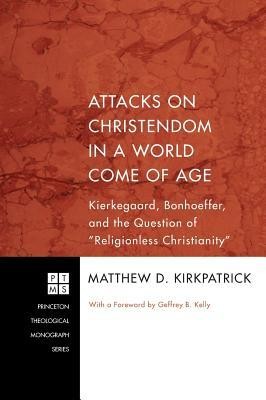
Søren Kierkegaard and Dietrich Bonhoeffer were both Lutherans who lived in a time of tremendous pressure on the church from outside forces to conform to their culture. Each developed a theology that called into question the nature of the church and of Christianity itself. Matthew D. Kirkpatrick, in Attacks on Christendom in a World Come of Age, explores the theological strands and trends of these two theologians. He shows how influential Kierkegaard was on Bonhoeffer’s thought, but he also draws out applications from both thinkers to today.
Kirkpatrick begins by drawing out Kierkegaard’s attack on Christendom. Then, he outlines Bonhoeffer’s pushing back against the German concept of volk. Idealism is a major factor for both Bonhoeffer and Kierkegaard. Three chapters that make up the bulk of the book are dedicated to the attacks from each theologian on idealism. Before a conclusion, Kirkpatrick turns to the theologians’ attacks on Christendom and how they drew out what was plaguing Christianity in their own times.
Kierkegaard’s own theology developed against a kind of lackadaisical approach to Christianity in which people did not truly practice their faith. It had been incorporated into the culture in ways that made it a servant of the state rather than something to invigorate the populace and awaken faith. For Bonoheffer, it was a growing awareness of how the concept of the Volk had become an idol that led him to question the people’s use of Luther’s doctrine of the Two Kingdoms to demand loyalty to the Nazi regime (49ff). Bonhoeffer strongly pushed back against this use of the two kingdoms and developed his own theology, in part, against this. This does not, however, mean that Bonhoeffer was immune to his cultural upbringing or the Volkish nationalism. Early on, he flirted with some of the questions of Christian ethics in regard to the Volk when he was in Barcelona (63ff). However, he ultimately rejected this, along with nationalism (64ff).
The attack on idealism occupies a major portion of the book. Kierkegaard and Bonhoeffer feature prominently throughout this section. Each saw idealism as an elimination of the individual and reality, a kind of fleeing from reality (90-91). Bonhoeffer’s attack on idealism is developed directly along Kierkegaardian lines, and Kirkpatrick argues that Bonhoeffer demonstrates his continuity and reliance upon Kierkegaard’s thought throughout this section (95ff).
Bonhoeffer’s development of discipleship uses Kierkegaard, Luther, and theologians of the Middle Ages (166). It is also developed alongside a rejection of an idealist view of discipleship. Idealism leads to a kind of deification of reason that is detrimental to faith.
Kierkegaard’s attack on Christianity has been criticized by some as aristocractic pride or a demonstration of a deeply unsettled, angry mind. Kirkpatrick argues that, by contrast, the attack on Christendom from Kierkegaard is a logical development of his previous theological stages (175ff). Drawing from numerous works of Kierkegaard, Kirkpatrick shows that Kierkegaard’s attack was a call to genuine Christianity and an attack on a kind of cultural, comfortable “faith” that failed to live up to the need to set aside all for Christ. Bonhoeffer’s own attack on Christendom was influenced heavily by Barth, but he goes well beyond Barth as he shows how the Christian develops from religion and in faith (186ff). Bonhoeffer’s attack is against a kind of detached Christianity that sees God as a working hypothesis for life (192); instead, Christian faith must allow God into life in such a way that God is not a principle or belief but rather God become human in the form of Christ as a challenge to all ages (193, 194). This sets Bonhoeffer apart from Bultmann and others who tried to demythologize Christianity. That is not Bonhoeffer’s project; Bonhoeffer’s project is to reinvigorate Christianity and throw off the chains that various cultural worldviews placed upon it, but specifically the notion of deus ex machina that is so pervasive (see, for example, 206).
Attacks on Christendom in a World Come of Age draws readers into a dialogue with two of the most important modern theologians. It calls readers to realize that Christianity is in a dialogue with events in the world, all while able to truly bring truth and Gospel to the world. I highly recommend it.
Disclaimer: I was provided with a copy of the book for review by the publisher. I was not required to give any specific kind of feedback whatsoever.
Links
Be sure to check out the page for this site on Facebook and Twitter for discussion of posts, links to other pages of interest, random talk about theology/philosophy/apologetics/movies and more!
Book Reviews– There are plenty more book reviews to read! Read like crazy! (Scroll down for more, and click at bottom for even more!)
SDG.
——
The preceding post is the property of J.W. Wartick (apart from quotations, which are the property of their respective owners, and works of art as credited; images are often freely available to the public and J.W. Wartick makes no claims of owning rights to the images unless he makes that explicit) and should not be reproduced in part or in whole without the expressed consent of the author. All content on this site is the property of J.W. Wartick and is made available for individual and personal usage. If you cite from these documents, whether for personal or professional purposes, please give appropriate citation with both the name of the author (J.W. Wartick) and a link to the original URL. If you’d like to repost a post, you may do so, provided you show less than half of the original post on your own site and link to the original post for the rest. You must also appropriately cite the post as noted above. This blog is protected by Creative Commons licensing. By viewing any part of this site, you are agreeing to this usage policy.
Book Review: “Karl Barth and Dietrich Bonhoeffer: Theologians for a Post-Christian World” by Wolf Krötke
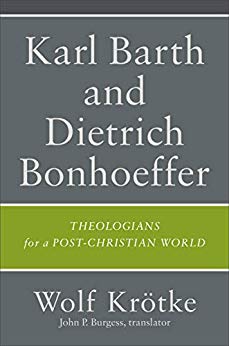
Karl Barth and Dietrich Bonhoeffer: Theologians for a Post-Christian World by Wolf Krötke is a formidable interpretation of both Karl Barth and Dietrich Bonhoeffer. Specifically, this collection focuses on how each of these theologians sought to relate to what they viewed as a post-Christian world.
Karl Barth is the subject of the first half of the book, and Krötke offers a range of topics engaging with Barth’s theology at multiple points. Krötke begins with an essay that highlights the challenges of engaging with Karl Barth to begin with. Then, he moves into Barth’s attack on “religion” itself as unbelief. Of course, what is meant by “religion” is key in this and many other essays, and the exact meaning of the term is notoriously difficult to pin down. Thus, much of the discussion here and elsewhere is spent drawing out what is being critiqued as “religion” vs. how Christianity can offer a better way forward.
Election, for Barth, is the “sum of the gospel,” and Krötke spends one essay discussing what is meant by Barth’s doctrine of election. In this doctrine, Barth sees that many major theological problems can be reconciled through Christ’s “Yes” to humanity (86).
Krötke’s interactions with Bonhoeffer are insightful and sometimes surprising, even to the point of being stunning (a word this reviewer used when taking notes on a few of the pages). In particular, the final essay on Bonhoeffer about Bonhoeffer’s “Nonreligious Interpretation of Biblical Concepts” alongside the “Missionary Challenge of the Church” was fascinating. Therein, Krötke notes that Bonhoeffer was extremely against any concept of God as a God available to us at our whim. God is not the kind of being who is available at the push of a button. Additionally, Krötke interprets Bonhoeffer’s religionless Christianity as putting forth the idea that God in Christ chooses to become powerless for us, such that in Christ, God leads us to the suffering of the cross (242-244). Rather than a God who could right all wrongs and does not, or one who cannot do so, the God of religionless Christianity, as Krötke reads it, is God in Christ who enters the world and, in doing so, intentionally gives up power in order to lead humanity to God. It’s a fascinating look at Bonhoeffer’s work, and a somewhat alarming interpretation in some ways, but also one that takes the notion of deity and makes it squarely within Christian theology.
Other essays on Bonhoeffer are equally fascinating, whether its when Krötke notes that Bonhoeffer’s life itself has become a theological resources for his interpreters or when he turns to the question of Bonhoeffer’s letters to his fiancee. On the latter point, Krötke reflects on his own attempts to look at Bonhoeffer’s letters to Maria von Wedermeyer. Ultimately, he found himself deciding that it was a kind of voyeurism–the theologian moving into an intensely personal scene in order to try to find any resource. It was a kind of question about biography and finding the past that this reader hadn’t considered before.
Karl Barth and Dietrich Bonhoeffer: Theologians for a Post-Christian World is a fascinating, engaging, and challenging read. I highly recommend it to those interested in the legacy of either one (or both) of these fascinating individuals. Krötke consistently presents startling insights and fascinating ways to move research forward. Highly recommended.
Disclaimer: I was provided with a copy of the book for review by the publisher. I was not required to give any specific kind of feedback whatsoever.
Links
Be sure to check out the page for this site on Facebook and Twitter for discussion of posts, links to other pages of interest, random talk about theology/philosophy/apologetics/movies and more!
Book Reviews– There are plenty more book reviews to read! Read like crazy! (Scroll down for more, and click at bottom for even more!)
SDG.
——
The preceding post is the property of J.W. Wartick (apart from quotations, which are the property of their respective owners, and works of art as credited; images are often freely available to the public and J.W. Wartick makes no claims of owning rights to the images unless he makes that explicit) and should not be reproduced in part or in whole without the expressed consent of the author. All content on this site is the property of J.W. Wartick and is made available for individual and personal usage. If you cite from these documents, whether for personal or professional purposes, please give appropriate citation with both the name of the author (J.W. Wartick) and a link to the original URL. If you’d like to repost a post, you may do so, provided you show less than half of the original post on your own site and link to the original post for the rest. You must also appropriately cite the post as noted above. This blog is protected by Creative Commons licensing. By viewing any part of this site, you are agreeing to this usage policy.

 J.W. Wartick - Reconstructing Faith