salvation by works
Review of “Love Wins” by Rob Bell: Chapter 2
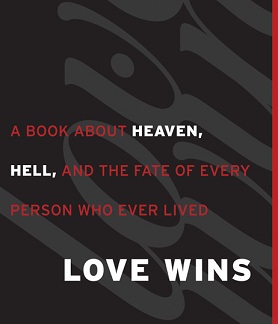 I have been going through Love Wins
There are many other looks at Love Wins available online, both critical and positive. What do I hope to offer here? I will analyze Rob Bell’s arguments in three primary ways: in light of historical theology, in light of methodology, and in light of analytic theology. I believe this will offer a thorough look at several of Bell’s claims. I hope to offer as even-handed an analysis as possible.
Rob Bell’s argument will be examined for historical accuracy and philosophical rigor. Furthermore, I will examine how Rob Bell makes his argument, because method is often one of the primary ways that people err in their theology. I begin with an analysis of the Preface and Chapter 1. I am hoping to release one post a week as I analyze this text. I will post each section with an outline of the arguments followed by my analysis.
For other posts in the series, view the links below.
Chapter 2
Outline
Rob Bell begins with imagery of heaven, followed by a series of questions about the nature of heaven. He notes the cultural picture of heaven: “harps and clouds and streets of gold, everybody dressed in white robes” (24). Heaven leads us to ask questions like “What will we do all day? …What will it be like? Will there be dogs there?” (24-25). Bell uses these questions as a bridge into another question: “who will be there and who won’t be there” (25). He discusses a young woman who contemplates heaven and realizes her family won’t be there, based on a pastor’s answers to this question:
When she asks the pastor afterward if its true that, because they aren’t Christians none of her family will be there, she’s told that she’ll be having so much fun worshipping [sic] God that it won’t matter to her. Which is quite troubling and confusing, because the people she loves most in the world do matter to her. (25)
This leads Bell to ask the question:
Are there other ways to think about heaven, other than as that perfect floating shiny city hanging suspended there in the air above that ominous red and black realm with all that smoke and steam and hissing fire?
I say yes, there are. (26)
Bell then turns to an analysis of Jesus’ interaction with the rich man in Matthew 19:16-30. He notes that Jesus’ answer to the rich man’s question about “eternal life” restates his question as “Enter life” (28ff). He argues that “Heaven, for Jesus, was deeply connected with… ‘this age’ and ‘the age to come'” (30).
The Greek word aion is analyzed, and Bell concludes that it has multipple meanings such as “age” with a beginning and end, or “forever” (but not in the way we understand forever, he adds). He then surveys a number of passages in the Bible which discuss about the new creation/age, concluding by pointing out “Life in the age to come. If this sounds like heaven on earth, that’s because it is. Literally” (33).
Bell insists upon focusing on life now as opposed to in the future. “Jesus takes the man’s question [in Matthew 19:16] about his life then [in eternal life] and makes it about the kind of life he’s living now. Jesus drags the future into the present…” (41). This raises the question for Bell: “What does Jesus mean when he uses that word ‘heaven’?” (42).
Bell answers the question by noting a number of meanings for the word “heaven” in Jesus’ day. He concludes that heaven is “The day when God’s will would be done on earth as it is now in heaven. The day when earth and heaven will be the same place…. Life in the age to come” (43). This entails that “Taking heaven seriously… means suffering seriously, now. Not because we’ve bought into the myth that we can create a utopia… but because we have great confidence that God has not abandoned human history and is actively at work within it, taking it somewhere” (45). He notes that our beliefs about the future shape our actions now (46).
The analysis of heaven continues, as Bell notes that “the confusion [about heaven]… comes from the idea that in the blink of an eye we will automatically become totally different people who ‘know’ everything. But our heart, our character, our desires, our longings–those things take time” (51). He returns to aion and argues that “heaven is not forever in the way that we think of forever, as a uniform measurement of time…” instead, translators use the word “‘eternal.’ By this they don’t mean the literal passing of time; they mean transcending time, belonging to another realm altogether” (58).
Based on his understanding of heaven as heaven on earth, Bell suggests that “Eternal life doesn’t start when we die; it starts now. It’s not about a life that begins at death; it’s about experiencing the kind of life now that can endure and survive even death” (59).
Analysis
Bell’s critique of cultural notions of heaven should be well-received. The way that pop-culture has portrayed heaven is extremely inaccurate and perhaps even dangerously wrong. Harps and wings and the like are pop imagery, not necessarily Biblical imagery. We must look to the Bible to determine what it is that heaven will be like. It seems that Bell is correct to note that heaven will be a New Creation and that the notion of heaven and earth coming together is a theme in the Bible.
Furthermore, he seems spot on when he notes that there are confused notions of heaven which constitute humans suddenly, miraculously, entirely changing into all-knowing spirit creatures. I have yet to find anywhere in the Bible that it says anything at all about humans suddenly knowing everything in heaven, yet it is a claim that persists in everyday conversation.
Bell does once more commit a minor methodological error when he simply notes that there are other views on heaven as though the simple existence of other views about heaven somehow validates these other views. The context in which he says this was in his argument against the pop view of heaven, and so it seems he is correct in favoring a view of heaven that is closer to the Biblical account, but it remains an issue that Bell argues in this fashion. The mere existence of differing views on a topic does nothing to validate any or all of said views.
Furthermore, it seems that some of Bell’s conclusion go beyond the Biblical text. For example, his suggestion that eternal life is “about experiencing the kind of life now that can endure and survive even death” (59). It seems that at this stage Bell drifts dangerously close to a kind of works-righteousness. After all, who exactly is it that needs to live this kind of life? You, dear reader. According to Bell, it is each person’s task to live a kind of life which is capable of surviving death.
In fact, Bell illustrates this through his example from Matthew 19. He notes that the rich man does not live eternal life now because “The man can’t do it, and so he walks away” (41). It is hard to think about a view of eternal life more contrary to what Jesus did and what is taught in the Bible about salvation. Eternal life does not come because we are capable of living a life that somehow transcends our current reality. That is impossible for us to do.
It is truly unfortunate that Bell’s interpretation of the text he makes key for his point (Matthew 19) illustrates another methodological error. Namely, ignoring context. The entire section on the need for living eternal life now is based upon Bell’s reading of Jesus as reinterpreting the rich man’s question as asking about “enter[ing] life” (27ff). He takes two words from the middle of a phrase Jesus says and then bases what seems like his entire discussion of the doctrine of heaven around it. Yes, he cites many prophetic passages about the new creation, but instead of taking these to provide a broader commentary on the notion of eternal life, he reads them all through the filter of those two words: “enter life.” He therefore commits a serious methodological blunder, and it seems that it is this blunder which leads him to a doctrine of heaven which becomes tied into what it is that we do to get to heaven.
Conclusion
Overall, it seems that Bell has done a great job of providing some critiques of the “pop culture” view of heaven which is decidedly unbiblical. He even gets many things right about heaven, including the notion that it will be a new creation and that it will be tied to the creation we experience now.
In light of these positives, it is sad to say that Bell’s discussion of the nature of salvation seemingly turns upon an idiosyncratic reading of two words ripped from their context and used to reinterpret every other passage he references. It is even worse to note that Bell’s doctrine of heaven wavers right on the edge of works righteousness, if it does not step over into that camp altogether. The fact is that Bell discusses eternal life as something which we have to do. It is something which we can do if we just live a life that is capable of transcendence.
It is hard to imagine a doctrinal stance more removed from the notion of salvation by grace through faith. Sola gratia.
Next week, we will look at Chapter 3: Hell.
Links
Review of “Love Wins” by Rob Bell: Preface and Chapter 1– I discuss the preface and chapter 1 of Love Wins.
Review of “Love Wins” by Rob Bell: Chapter 3– I look at Chapter 3: Hell.
Review of “Love Wins” by Rob Bell: Chapter 4– I look at Chapter 4: Does God Get what God Wants?
Review of “Love Wins” by Rob Bell: Chapter 5– I analyze chapter 5.
Love Wins Critique– I found this to be a very informative series critiquing the book. For all the posts in the series, check out this post.
Should we condemn Rob Bell?– a pretty excellent response to Bell’s book and whether we should condemn different doctrines. Also check out his video on “Is Love Wins Biblical?“
Source
Rob Bell, Love Wins
SDG.
——
The preceding post is the property of J.W. Wartick (apart from citations, which are the property of their respective owners, and works of art as credited) and should not be reproduced in part or in whole without the expressed consent of the author. All content on this site is the property of J.W. Wartick and is made available for individual and personal usage. If you cite from these documents, whether for personal or professional purposes, please give appropriate citation with both the name of the author (J.W. Wartick) and a link to the original URL. If you’d like to repost a post, you may do so, provided you show less than half of the original post on your own site and link to the original post for the rest. You must also appropriately cite the post as noted above. This blog is protected by Creative Commons licensing. By viewing any part of this site, you are agreeing to this usage policy.

 J.W. Wartick - Reconstructing Faith