science
Really Recommended Posts 01/26/12
 Jump: Hiking the Transcendent Trail– I can’t describe how aesthetically pleasing this site is. But, apart from that, Anthony Weber outlines a basic argument from aesthetics towards the existence of God. I found this post really interesting and mind-opening. Check it out!
Was Adolf Hitler a Better Man Than Martin Luther King, Jr.?– Relativism cannot make sense of moral heroes. Arthur Khachatryan makes an excellent argument towards this end here.
Maverick Philosopher: Why Do Some Physicists Talk Nonsense about Nothing?– A discussion of Lawrence Krauss’s position on the universe from “nothing.” [Warning: There are a few curse words here.]
My recent discussion of the moral argument had many up in arms about the fact that I didn’t explicitly defend its premises. [Note that that was never the intention of the post, as its title explicates.] Glenn Peoples has an excellent post defending P1 of the moral argument: that If God did not exist, there would not be any objective moral values or duties. Check out his “The conditional premise of the moral argument.”
Ehrman’s Problem: He Misreads the Bible and Impugns God’s Fairness– Clay Jones discusses a number of difficulties with Bart Ehrman’s interpretations of the Bible. Check out the entire series. Part 2: Free Will and Natural Evil Part 3: God Could Have Made Us So We’d Always Do Right Part 4: Why Don’t We Abuse Free Will in Heaven? Part 5: God Should Intervene More to Prevent Free Will’s Evil Use He’s Confused About the Free Will Defense
Alexander Vilenkin: “All the evidence we have says that the universe had a beginning.”- Discussion of reasons to hold the universe began based on cosmology.
Quantum Indeterminacy, Materialism, and Free Will: Do our minds shape reality?
The idea is that “freedom” of the will is simply the fact that human behavior is unpredictable, and that this unpredictability is a consequence of the random character of “quantum processes” happening in the brain… To be subject to random mental disturbance is not freedom but a kind of slavery or even madness. (Professor of Theoretical Particle Physics at the University of Delaware, Stephen Barr, 178)

Can there be free will on materialism?
The question has been perpetuated throughout the history of modern science. For quite a while, it was thought that all things were deterministic, given materialism. Thus, the view of life was a bit fatalistic. However, with the advent of Quantum Mechanics, some have argued that quantum indeterminacy allows for freedom of the will. Is that the case?
First, it’s important to outline quantum indeterminacy. On the quantum level, events are probabilistic. What that means is that “given complete information about the state of a physical system at one time, its later behavior [cannot] be predited with certainty… [only] the relative probabilities of various future outcomes [can be predicted]” (Barr, 176, cited below).
It becomes immediately apparent how some might see this as salvation for a physicalist perspective on free will. If events are not determined on a quantum level, perhaps our choices are free in some sense as well. But difficulties with this interpretation arise immediately. First, quantum indeterminacy is not a reflection of our choices, but just that: indeterminacy. As quoted above, our supposed choices would (on physicalism) be merely probabilistic. Our actions would be unpredictable, but that is not freedom. Surely, if the actions we take are merely the reflections of probability curves on a quantum level, that is not the same as freedom. Rather, they would be actions taken due to a basically random process. If I have the “choice” between A and B, and the probability is 50/50 on a quantum level, then my “choice” for B instead of A is just the same as if I flipped a coin. The coin doesn’t choose which side to land on, its just probability.
So it seems that right off the bat, quantum indeterminacy cannot explain free will on materialism or physicalism. Rather than being “free will” it would boil down to random events. As Barr wrote, we would be subject to random mental disturbances, and this would entail slavery at best (178).
But can materialists circumvent this problem? One suggestion is that we have control of quantum events themselves, so we therefore would be in control of our choices. But note that this presupposes a kind of extra-quantum center of control from which we can observe and control quantum events. Let’s put it into a thought experiment. Suppose we granted materialism. In that case, our “selves” are our brains. The brain is a physical object, itself governed by quantum events. Now, the purported way out for materialism is that our brain, a physical thing governed by physical processes, itself monitors and controls physical processes such that they effect the brain in the way the brain has chosen. The difficulties with this position should be immediately apparent. The brain, as a physical object, is itself governed by quantum events. These quantum events are not just logically prior but also temporally prior to the brain. Therefore, those things the brain chooses have been determined by previous physical states of affairs. So ultimately, it’s all material, and it’s all probabilistic. The freedom does not enter into the equation.
The problems don’t end there for those who wish to rescue freedom of the will in materialism. Another issue is that of the observer in a quantum event. In order for quantum indeterminacy to be helpful in regards to free will, the observer of a quantum event would have to be outside of the system. “[T]he observer cannot be considered part of the system that is being physically described and remain the observer of it” (Barr, 238). If all there is were the physical world, then the system would include “me.” I could not be the observer who took action in the quantum events, because I would be part of the description of these events. As Barr puts it:
The mathematical descriptions of the physical world given to us by quantum theory presuppose the existence of observers who lie outside those mathematical descriptions (238).
If materialism were true, then quantum indeterminacy could not rescue free will. The agents who were suppoed to be free would be, themselves, part of the system which they were supposed to observe and determine.
So does quantum indeterminacy factor into free will at all? Here’s where things get really interesting. It seems that those who argue for its importance with free will are correct, in a qualified sense. The indeterminacy provides a necessary, but not sufficient, reason for free will. We’ve already seen that it can’t help out in a purely materialistic world–the brain states which supposedly select from various choices are themselves physically determined by prior choices and/or other physical aspects of reality. But what if there were an immaterial mind in the mix? This immaterial mind would not be determined by prior quantum events, and indeed it could take the place of observer for quantum events. Thus, the immaterial mind could serve as the observer of these quantum events.
Quantum indeterminacy, then, acts as a necessary but not sufficient reason for freedom of the will. While the discovery of quantum indeterminacy ushered in an era in which comprehensive physical determinism was tempered by probability, it allowed an opening for free will which can only be utilized by an extra-physical observer. Because our experience of the world includes an intuitive sense of freedom, the previous arguments therefore provide a strong reason to embrace substance dualism. If we experience the world as one in which we are free, and we cannot be free on materialism, then our experience provides us with evidence against materialism.
The world, it seems, is more than merely the physical.
Source:
Stephen Barr, Modern Physics and Ancient Faith (Notre Dame, Indiana: University of Notre Dame, 2003).
SDG.
——
The preceding post is the property of J.W. Wartick (apart from citations, which are the property of their respective owners) and should not be reproduced in part or in whole without the expressed consent of the author. All content on this site is the property of J.W. Wartick and is made available for individual and personal usage. If you cite from these documents, whether for personal or professional purposes, please give appropriate citation with both the name of the author (J.W. Wartick) and a link to the original URL. This blog is protected by Creative Commons licensing. By viewing any part of this site, you are agreeing to this usage policy.
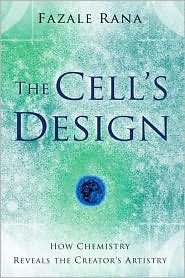
Book Review: “The Cell’s Design” by Fazale Rana
 Arguments for intelligent design often hinge upon what mechanistic, naturalistic means “cannot explain.” The arguments go something like “See feature x, how can naturalistic mechanisms explain x? They cannot. Therefore, ID is true.” There is something to be said for this type of argument. If one simply cannot explain a specific thing by means of the mechanisms suggested, one must look for different means. That said, if the case for intelligent design rested only upon negative arguments, it would not be as robust as if it also had positive evidence.
Fazale Rana’s book, The Cell’s Design
Rana’s argument is an argument from analogy. He draws heavily from William Paley’s “watchmaker” example (If one came across a watch in the sand, they’d know it was designed… Paley argued that one could similarly conclude that life was designed). Rana doesn’t ignore the arguments raised against such analogical reasoning, but confronts them head on. After identifying several criteria which allow proper analogical reasoning (30ff), Rana makes his case for the Creator.
The first line of evidence comes from the machines in the cell. Again, Rana’s approach is analogical, rather than negative. The machine-like nature of the flagellum, along with other motor-like cellular functions presents an argument: “Organisms display design. Therefore, organisms are the product of a creator” (86).
The case doesn’t rest merely upon molecular machines. Rather, that is but one of the many lines of evidence. Rana draws out the implications of several “chicken-and-egg” paradoxes. These include the “mutual interdependence of DNA and proteins” (99), the origin of proteins themselves (100ff), and more (105ff). These systems present a kind of “irreducible complexity in which the system depends on the system to exist” (108).
Other elements of design are present in the cell as well. Aquaporins intricate and detailed workings illustrate the design that is present in the system (111ff). Other detailed, intricate designs (such as collagen, mRNA, and the breakdown of proteins) hint at the need for a designer. But the reasoning is not only supported by the details, it is also bolstered by the structural composition of the cell (126ff). The analogy of cells to machines is strengthened further by the quality control systems within the cell (198ff). Again, the reasoning is analogical–these things are designed, therefore they need a designer.
“Information can’t be separated from the activity of an intelligent agent” (142). The numerous examples of information in the cell lead to the inference of an agent. But it is not only the information’s presence that hints at a designer. Here Rana’s case really builds on and develops the work of other ID theorists. The information alone could be enough to infer an agent, but one must also account for the fact that cellular information follows rules like syntax, semantics, and pragmatics (144ff). It is not merely information, it is the use of that information and the rules governing that use that strengthen the case for an agent behind the information.
One of the most amazing parts of The Cell’s Design is the chapter called “A Style All His Own.” Darwinian evolution, if rewound, would come out different ways every time. Different mutations would occur, which would lead to different organisms. What is not expected, on Darwinism, is a convergence pattern in evolution. When the same templates keep showing up through independent routes of development, it provides strong evidence for a designer. Yet this “molecular convergence” is exactly what scientists have discovered again and again. On pages 207-214 Rana writes, with citations from scientific journals, of no less than 100 examples of molecular convergence. As a reader, one can’t help but be stunned as they go through these pages. Over and over, there is evidence that the same designs show up in different places, independently, throughout nature. As Rana writes, “if life emanates from a Creator, it’s reasonable to expect he would use the same designs repeatedly…” (215). And this repetition of design is found in life’s most basic components: DNA (216ff).
Rana does not ignore detractors arguments against his position. One counter-argument to Rana’s conclusions is the presence of poorly-designed mechanisms in nature. Yet Rana effectively nullifies these examples, citing how many of them have turned out to be optimally tuned for life, and how others may be expected to be equally tuned (258ff).
The Cell’s Design is an extremely difficult read, but it does not leave readers who are not scientists to flounder. Rana’s second and third chapters provide some basic biological understanding which readers must have to understand the argument throughout the rest of the book. There is also a 12-page glossary at the back of the book which will let those unfamiliar with the terminology follow along. That said, this is not an easy book. The argument is heavily scientific and involves an exploration, in extreme detail, of the mechanisms and machines at work in the cell. The book presents a fantastic case for ID, but not at the expense of the details.
Finally, it is important to underscore the reasoning behind Rana’s conclusions. His argument is abductive. He explicitly outlines it:
1) X is observed
2) If Y were true, then X would be expected.
3) There is good reason to believe that Y is true.
In the case of the cell:
1) Design is observed in biochemical systems.
2) If life stemmed from the direct work of a Creator, the elegant design of biochemical systems would be expected.
3) There is good reason to believe that life is the product of a Creator (276, these arguments are an exact quote).
After reading through The Cell’s Design, this reader cannot help but agree with this argument. Over and over again, Rana has drawn out the exquisite design in the cell. The positive evidence is there, life is designed.
The Cell’s Design presents a phenomenal case for a designer of life. Those interested in exploring intelligent design should add this book to their list. It is not an easy read, by any means, but it provides some explicit, positive evidence for the conclusion that a Creator exists. Those wishing to deny this fact will find much with which they must contend in Rana’s work. I recommend it without reservation.
Source:
Fazale Rana, The Cell’s Design
Disclaimer: I was provided with a review copy of this book by Reasons to Believe. You can learn more about this science-faith think tank at reasons.org.
SDG.
——
The preceding post is the property of J.W. Wartick (apart from citations, which are the property of their respective owners) and should not be reproduced in part or in whole without the expressed consent of the author. All content on this site is the property of J.W. Wartick and is made available for individual and personal usage. If you cite from these documents, whether for personal or professional purposes, please give appropriate citation with both the name of the author (J.W. Wartick) and a link to the original URL. This blog is protected by Creative Commons licensing. By viewing any part of this site, you are agreeing to this usage policy.
“The Multiverse Created Itself” and “Who made God after all?” -The Kalam Cosmological Argument

The most reasonable belief is that we came from nothing, by nothing, and for nothing. -Quentin Smith, Theism, Atheism, and Big Bang Cosmology, 135.
Is this so reasonable? Is it true that we came from nothing, by nothing, and for nothing? The Kalam Cosmological Argument is one of the most compelling arguments for theism. The broad opposition to the Kalam (or, more specifically, to its implications) from atheists has lead to some sophisticated arguments (like those of Graham Oppy or J.L Mackie), but it has also lead to some pretty poor arguments. Below, several objections to the Kalam Cosmological Argument have been outlined, along with rebuttals of varying lengths.
The Multiverse?
Some have objected to the Kalam by raising the possibility of a multiverse. They say that this counters the Kalam because it’s possible that our universe is one of nearly infinite past universes, generated as another “bubble” among untold trillions of other bubble universes. There should be one glaring difficulty with this objection that most can see immediately: “Whence the multiverse?” If the multiverse is proposed as eternal, then every objection about actual infinites applies to the multiverse. Not only that, but the multiverse itself would have to account for entropy. How is it that all the energy in this (nearly) infinite multiverse has not been used if it has existed for all eternity?
Ways around these difficulties have been proposed. For example, regarding entropy, some have argued that perhaps different laws of nature apply to the multiverse as a whole. Clearly, this is an extremely ad hoc theory that is really only invented to try to get around the argument. Once we’re allowed to modify reality to our every whim, we could indeed create anything we like–including (nearly) infinite universes.
Another problem with the multiverse objection is that we have startlingly little evidence for such a hypothesis. While there are many hypothetical scientists proposing bubble universes and the like, it’s shocking to read just how little evidence there really is for such a hypothesis.
Finally, even were there an infinite multiverse–as some have proposed due to string theory–this would not avoid an absolute beginning for the entirety of the multiverse. Bruce Gordon points out that the standard inflationary models still use inflation with a finite duration, which would entail that regardless of the number of universes which exist, there would still have to be an absolute beginning to the multiverse (Gordon, cited below, 86-87).
Perhaps, however, this multiverse (or the universe) is finite, but it created itself. There are a number of proposals suggesting just that.
The Universe Created Itself
I don’t think I can do much better than Edgar Andrews did over at his blog when he asks “Could a universe create itself?” He points out that the difficulty with each scenario proposed in which the universe creates itself is that it presupposes the existence of either matter, energy, or the laws of nature–the very things which this objection is supposed to answer. Andrews writes,
Stephen Hawking [who recently proposed the universe created itself] falls into this dilemma by claiming that the universe was created as a result of quantum mechanical fluctuations (in a vacuum) which became stabilized by gravitational forces [Hawking pp. 131-135; Hawking review]. He thus requires the laws of quantum mechanics and of gravity to have pre-existed the universe… But what is the law of gravity but a description of the way materialbodies interact — either with one another or with the space-time continuum? To claim that such a law existed in the absence of matter, energy, space or time stretches credulity and is incapable of demonstration. Only ‘mind of God’ and ‘non-material blueprint’ arguments remain and these are theological not scientific.
Similarly, suppose we took the claim of Smith (above) seriously–that the universe created itself from nothing. Does this even make sense? William Lane Craig writes, “…if prior to the existence of the universe, there was absolutely nothing–no God, no space, no time–how could the universe possibly have come to exist?” This is an extremely important question for the atheist to answer. Most often, however, atheists have instead changed the meaning of “nothing” to mean quantum vacuum or some other physical reality. This is hardly “nothing” that would have existed before the universe. Before the universe, there was no space, no time, no anything.
Edgar Andrews points out the confusion that some atheist philosophers and physicists perpetuate with this conflation of “nothing”:
[Victor Stenger] begins by utterly confusing the pre-creation ‘nothing’ that lies outside of space-time with the ‘nothing’ of a vacuum within space-time. Next, without making it clear which ‘nothing’ he is talking about, he claims that ‘the transition from nothing to something is a natural one, not requiring any agent.’ (Andrews, 97, cited below).
The problem isn’t solved when one lends it the idea of a multiverse, either. Oscillating universe models still imply a finite beginning (Gordon, 86ff). The idea that an infinite number of universes caused each other in a causal loop does no better–it leads only to a vicious regress. Ultimately, such proposals must be rejected for what they are–fiction.
Who Caused God?
Another trite response to the Kalam is the classic “Well fine, you say the universe is caused, well who caused God?” line. Here the atheist commits a number of classic blunders, to steal the phrase from “The Princess Bride.”
First, as in all scientific (and otherwise) inquiry, once one has reached the best possible explanation for an event, one has reached the end of the inquiry. An inference to the best explanation does not require an explanation of that explanation. There’s a reason that scientific inquiry can appeal to laws: they best explain how the world works.
Second, the first part of the Kalam is that “Everything which begins to exist has a cause” not “Everything is caused.” The atheist has merely misread or misinterpreted this principle. Should the atheist want to press the second point–that everything is caused, they have already conceded the weaker principle (that everything which begins has a cause), and they must further argue for a much stronger metaphysical claim. I leave it to the atheist to establish this claim.
“But,” the atheist may object, “you’re just denying the antecedent!” Not quite. I’m not saying that God didn’t begin, therefore God was uncaused–rather, I’m arguing that because God did not begin, this argument does not apply to God. There could be other arguments made to establish that God is caused, but to do so would require, as I pointed out, arguing for the metaphysical principle that “everything is caused.” Again, I leave the atheist to make this argument.
Conclusion
While many objections to the Kalam might be made in good faith, it is clear upon examination that they all fall far short of defeating the argument. The Kalam Cosmological Argument succeeds in its goal: to show that the universe is caused. What is this cause? That’s a question we must all consider with fear and trembling.
Links
Those interested in a broad outline of the Kalam Cosmological Argument can read my post on the topic.
For a discussion of one both Richard Dawkins’ and Graham Oppy’s objections to the Kalam, read Dawkins and Oppy vs. Theism: Defending the Kalam Cosmological Argument.
Sources:
Edgar Andrews, “Could a universe create itself?”
Edgar Andrews, Who Made God (Darlington, England: EP books, 2009). Reviewed here.
Bruce Gordon, “Inflationary Cosmology and the String Multiverse” in New Proofs for the Existence of God by Robert Spitzer (Grand Rapids, MI: William B. Eerdmans, 2010).
William Lane Craig and Paul Copan, Creation Out of Nothing (Grand Rapids, MI: Baker, 2004).
SDG.
——
The preceding post is the property of J.W. Wartick (apart from citations, which are the property of their respective owners) and should not be reproduced in part or in whole without the expressed consent of the author. All content on this site is the property of J.W. Wartick and is made available for individual and personal usage. If you cite from these documents, whether for personal or professional purposes, please give appropriate citation with both the name of the author (J.W. Wartick) and a link to the original URL. This blog is protected by Creative Commons licensing. By viewing any part of this site, you are agreeing to this usage policy.
Materialists: Where is hope? Look to the stars!
 “[T]he Universe may harbor civilizations more intelligent than our own. Perhaps one day, through interstellar communication, some advanced civilization will help us resolve such age-old problems as war, famine, disease, overpopulation, misuse of natural resources, and human aging.”- John Oró, “Historical Understanding of Life’s Beginnings” (40, cited below).
Such is the hope of materialism. I’ve argued elsewhere that if all we are is matter, then there is no meaning. The pervasive response was that “we make our own meaning.” Leaving questions over the tenability of such a view aside, I have turned to a different, and interesting phenomenon: Where is there room for hope, within materialism?
It didn’t take long to dig up some quotes. One of the classes I’m taking this semester is on the Origins of Life. A few books we were assigned for this class were from a materialist perspective. The quote above is from one of those books. It resonated deeply with me. Consider this: If all we are is matter, having arrived here by unguided, biochemical processes, living on a dying planet in a dying universe–where is our hope? One cannot turn to transcendence with such a worldview, but one can attempt to emulate it.
Such is the case found in materialistic literature. Such is the grand materialist hope:
We can look hopefully for our saviors from the stars. There must be more intelligent life out there, and they will usher in a new era, a near utopia wherein disease, death, war, and hunger are all eliminated. Our alien saviors will rush to our aide once they’ve found us on this dying rock, and we will worship them as we used to worship the mythic gods of old.
But it is not just hope for the future which must guide us. Our realization that we are but one among many (and many who are probably smarter than us) must lead us to a new set of ethics. Oró writes of new ethical principles we must embrace: “Humility: The life of all cells descends from simple molecules… Hope: Someday we may communicate with more advanced civilizations… Universality: We come from stardust and to stardust we shall return… Peace: We should change our culture of war into a culture of peace” (Oró, 40-41 cited below). Humility, hope, peace, universality–these are all things Christians embrace also, but the materialist has redefined them. Our hope is not int the transcendent but in the here-and-now. Our hope, again, reaches for the stars.
But is this really a hope? We know the universe is dying. We know that, even were we to escape death, eventually the cosmic heat death of the universe would occur, and our ultimate doom is sealed. Should we hope that our alien saviors are also inter-dimensional travelers? Should we hope that they transcend space and time? I leave these questions open.
But the most interesting phenomenon in all of this is that the materialist has abandoned their presupposition. Rather than hoping for what is they hope for what we know not. They look to the stars, grasping at things unseen. Iris Fry, a professor at both Tel Aviv University and Technion-Israel Institute of Technology in Haifa and author of The Emergence of Life on Earth writes honestly and lucidly of the philosophical commitments of the materialist in this sphere:
[T]he realization that many non-empirical factors are involved in determining scientific positions and in the adoption of scientific theories leads to the notion of theoretical and philosophical decision, or commitment. Research into the origin of life and the search for extraterrestrial life are a clear case in point, because here the weight of the philosophical commitment is much greater than in more conventional scientific fields. As long as no empirical evidence of life beyond Earth has been found, and as long as no scientific theory has succeeded in providing a fully convincing account of the emergence of life on Earth, the adoption of an evolutionary point of view toward the question of life’s origin and the rejection of the idea of purposeful design involve a very strong philosophical commitment. -Iris Fry (283, Cited Below)
Ultimately, I think she is quite right. There is a philosophical commitment being espoused here, not a scientific commitment. Too often, materialists forget that, but kudos to Fry for honestly admitting it while also espousing the very commitment.
Where is our hope?
The materialist answers: The stars.
Is this really rational?
Sources:
John Oró “Historical Understanding of Life’s Beginnings” in Life’s Origin ed. J. William Schopf (Berkeley, CA: University of California, 2002).
Iris Fry The Emergence of Life on Earth (New Brunswick, NJ: Rutgers, 2000.
SDG.
——
The preceding post is the property of J.W. Wartick (apart from citations, which are the property of their respective owners) and should not be reproduced in part or in whole without the expressed consent of the author. All content on this site is the property of J.W. Wartick and is made available for individual and personal usage. If you cite from these documents, whether for personal or professional purposes, please give appropriate citation with both the name of the author (J.W. Wartick) and a link to the original URL. This blog is protected by Creative Commons licensing. By viewing any part of this site, you are agreeing to this usage policy.
The Kalam Cosmological Argument
 One of the most frequently cited and debated arguments for the existence of God is the Kalam Cosmological Argument. I have not written on the argument before because there is simply so much good material on it out there that I don’t think I can add anything new. I have, however, run into numerous people with questions on the argument recently, and felt the need to finally get around to a post on the Kalam. Those interested in the argument are highly encouraged to read the links included at the end.
The argument
The argument itself is quite simple:
1) Everything that began to exist has a cause
2) The universe began to exist
3) Therefore, the universe has a cause
The argument is deductively valid, so the question is whether the premises are true. If true, the conclusion is certain.
Defense of Premise 1
Why should we think that whatever began to exist has a cause? First, it seems a denial of this principle would undermine science. Science is an investigation of causation. If the anti-theist wishes to deny this premise, she is committed to a fallacy similar to that which she calls the “goddidit” fallacy: dismissing explanation for an event. (Interestingly, saying “God did it” is not a dismissal of explanation: it is, itself, an explanation. It’s saying the explanation which best fits the evidence is theism.)
Suppose premise 1 were false. In that case, things could and would be coming into existence for no reason whatsoever out of nothing. We would observe a remarkably different universe than that which we do, in fact, observe. A tiger would miraculously materialize in my room and eat me.
Now, it must be noted that some appeal to quantum physics in order to say this premise is false. They hold that certain quantum events bring things into existence without reason. Such an interpretation seems misguided at best, however, for a few reasons. First, the event would seem to have an explanation, namely, that it is a quantum phenomena of type x. Second, even were one to deny that this is a form of explanation or causation, the fact remains that these quantum events don’t originate from nothing. They originate from the laws and systems present within our universe. Third, these quantum events, on an examination of quantum theory, are not uncaused; they are merely spheres of probability. Finally, an exclusion of causal chains seems to undermine quantum theory itself or at least make it difficult to correctly interpret (on this, see William Wharton’s paper “Causation with Quantum Mechanics”). Like Wharton, I think the main reason causation is sometimes excluded from interpretations of QM is because of an avoidance of “metaphysical first causes.” Obviously, if this is the motivation for avoiding causation, it is not spurred by a commitment to science, but a commitment to avoiding the metaphysical implications of science.
Finally, consider what Wintery Knight points out about QM and the Kalam:
First, quantum mechanics is not going to save the atheist here. In QM, virtual particles come into being in a vacuum. The vacuum is sparked by a scientist. The particles exist for a period of time inversely proportional to their mass. But in the case of the big bang, there is no vacuum – there’s nothing. There is no scientist – there’s nothing. And the universe is far too massive to last 14 billion years as a virtual particle. (Wintery Knight, “How to defend the kalam cosmological argument just like William Lane Craig” April 8th, 2009).
The quantum events observed are caused: by the scientist. Therefore, they don’t undermine premise 1.
To sum up, the reasons for thinking the first premise true are clear: 1) to deny it undercuts science; 2) we don’t observe a universe with uncaused events; 3) the only reason found to deny the premise is an a priori commitment to anti-theism.
Defense of Premise 2
Did the universe begin? There are many arguments to support the premise that the universe did, in fact, begin, but I’m going to focus on only two: the impossibility of an infinite past and the empirical evidence of a finite past.
Impossibility of an infinite past
If the past is infinite, then we will have had to cross an infinite number of moments of time in order to come to the present moment. However, for any finite number of moments in time, x, there will always be a moment such that x+1 does not equal infinity. There is no way to start at any arbitrary moment in the supposedly infinite past and then add enough successive moments to arrive at the present moment. As such, it would be impossible to experience the present moment. However, we are experiencing the present moment, therefore, the past is finite.
Empirical evidence for a finite past
Despite misgivings from some Christians about the Big Bang theory, it has proven to be eminently valuable for arguments like the Kalam. I would go so far as to say the Big Bang serves as powerful evidence for a creator.
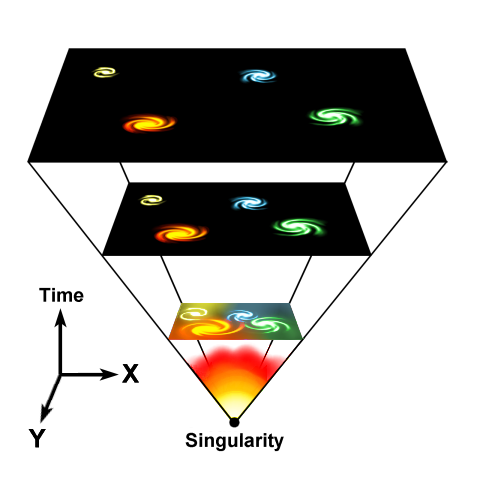
The reasoning behind this is that when we measure cosmic background radiation we can measure the expansion of the universe. Extrapolating backwards leads us to the conclusion that at some point in the finite past, the universe began to exist.
Therefore, it is reasonable to conclude that both premise 1 and 2 are true. However, because the argument is deductively valid, it follows that the universe has a cause.
Conclusions
Okay, so the universe has a cause. That doesn’t prove God exists! Well no, it doesn’t, but it does show that whatever caused the universe has many of the attributes classical theism has attributed to God, and therefore lends credence to the claim God exists. For whatever caused the universe must have extraordinary power (omnipotence); it must have made a choice to create the universe out of nothing (personal causation/agency); it must have been outside of time (the universe came into existence along with space and time); it must have been outside of space; and it must exist necessarily. As such, the Kalam doesn’t prove Christianity true instantly; it just proves theism is more plausible than atheism. Not only that, but it does show that whatever caused the universe is remarkably similar to the God Christians claim exists.
Appendix: Who made God?
Perhaps the most common objection to the argument outlined above is “Okay, well who made God?” This common retort can be answered after a minute of reflection. Classical theism holds that God exists necessarily, which means that God is eternal and beginningless. The first premise asserts that “whatever begins to exist…” therefore, it doesn’t apply to God. Is this a mere ad hoc fix on theism? No, because it isn’t saying God has no explanation for His existence (which reason is found in His necessary existence); it is saying that he did not begin, and is therefore uncaused. The detractor at this point would have to establish that “everything which exists is caused”–a much more difficult claim to defend than the claim that “everything which began to exist has a cause.” In fact, the anti-theistic claim seems necessarily false, for things which don’t begin are uncaused.
Links
Answers to objections towards the Kalam Cosmological Argument from Richard Dawkins and Graham Oppy
Did the multiverse create itself? Who made God?– more objections to the KCA are answered.
Sites
Wintery Knight “How to defend the kalam cosmological argument just like William Lane Craig”
Thinking Matters “The Kalam Cosmological Argument”
Wintery Knight, “The kalam cosmological argument defended in a peer-reviewed science journal”
Books
The Kalam Cosmological Argument by William Lane Craig
The Blackwell Companion to Natural Theology edited by Craig and J.P. Moreland
SDG.
——
The preceding post is the property of J.W. Wartick (apart from citations, which are the property of their respective owners) and should not be reproduced in part or in whole without the expressed consent of the author. All content on this site is the property of J.W. Wartick and is made available for individual and personal usage. If you cite from these documents, whether for personal or professional purposes, please give appropriate citation with both the name of the author (J.W. Wartick) and a link to the original URL. This blog is protected by Creative Commons licensing. By viewing any part of this site, you are agreeing to this usage policy.
The Life Dialogue: Matt Moss Guest Post Part 2
This post is the second guest post in my series on the “Life Dialogue” within Christianity. See Part 1 here. See other posts in the series here.
PART 2
Thesis 4– Genesis 1 does not address the specific method that God used in material creation, therefore (given T1-3) no specific answer to the questions of how or when is necessary to salvation.
Walton makes an important distinction between material creation and functional creation. Material creation is what modern debates obsess over. How did the material (the animals and people) get here: did they evolve or were they created or both? When did they come about? A quick reading of Genesis 1:1 – 2:3 shows that good, solid answers to these questions are not given. “In the beginning” is hardly a round number. Even those who attempt to date the earth using the various genealogies of the Bible prove their ignorance of ancient Near Eastern family lists which often “telescope” or skip generations of individuals and focus on the most notable. In other words, no one should think that the genealogy from Adam to Abraham is intended to tell us exactly how old the earth is. That was not the purpose of the genealogy and that is not what the genre allows a modern reader to do either.
Now, as for the “how material was created.” Walton argues very convincingly that Genesis 1 remains silent on this. With our modern biases we immediately object, “how can that be!? It says plainly, ‘and God said let there be light.’” Walton backs up to Gen 1:1 and addresses the Hebrew word bara’ (to create). In our understanding we always attach an ex nihilo understanding onto this word. That alone shows how materially minded we are, we have a very material focused cosmology. Walton first demonstrates that all ancient Near Eastern cosmologies were ‘function’ oriented, not material oriented. This means that the neighbouring creation accounts are concerned with the gods assigning functions to what comes about. How and when was not the question they were asking.
Walton then shows a similar mindset in ancient Israel. Even the word bara’ is a functional word. Walton provides a survey (p. 42) that outlines every use of the verb in the Hebrew Bible. The first thing of note is that God is always the subject. The second thing of note is that it nearly always is used in a functional sense, where God is giving something a specific purpose or function. Let’s look back to that light example. Genesis 1 does not stop with, “And God said let there be light.” No, Genesis 1:3-5 says “‘Let there be light,’ and there was light. 4And God saw that the light was good. And God separated the light from the darkness. 5Godcalled the light Day, and the darkness he called Night. And there was evening and there was morning, the first day. (italics mine)”
More than making light is taking place. God is assigning functions to the light and the darkness, he is naming them for their functions! This is seen even more specifically when God creates the Sun and Moon. “Let there be lights in the expanse of the heavens to separate the day from the night. And let them be for signs and for seasons (A more accurate translation is “festivals”- a temple word), and for days and years, 15and let them be lights in the expanse of the heavens to give light upon the earth. (underlining mine)” How and when is not important. Why are they present? That is the question God chose to answer for the people.
Walton does go through these days in detail and then gives brief critiques of the various models out there. The first thing worthy of note is that yom (Day) does mean day… not age. Walton would argue that this hardly seals the deal for Young Earthers since they are completely fixated on material models of creation. Walton seems to take the side that the seven days of Genesis 1 are the seven days in which God assigned all creation its specific function, indeed without function one might hardly say that they exist at all (he uses the analogy of a company- before it is certified it cannot be said to exist even if it has a building and equipment and workers). Thus, Walton, like Genesis 1, remains mute on the hows and whens of material origins before the days when God assigns the functions and Walton sticks with what Genesis 1 does give us, which is the next thesis [coming next week in part 3].
The Life Dialogue: The Interaction of Science and Faith
This is part of a series of posts on the “Life Dialogue” within Christianity. Check out other posts in the series here.
While I’ve explored some of the major perspectives of this debate within Christianity, one element I’ve left untouched is the different approaches people take on the interaction between science and faith.
This interaction can be seen in (at least) four ways:
1) Faith and Science are both accurate and support each other in a mutually beneficial relationship–this view, interestingly enough, is advocated by all sides of the dialogue I’ve explored before: intelligent design, old and young earth creationism, and theistic evolution
2) Faith and Science discuss completely different realms, and as such are both accurate, but independent and non-overlapping–this is often referred to as the “Independence” theory or “Non-Overlapping Magisteria” (check out this post for an interesting exploration of this possibility)
3) Faith and Science are at odds, and we should favor Faith–this view is often advocated by those who feel uncomfortable with scientific discoveries they may feel challenge Christianity and Scripture
4) Faith and Science are at odds, and we should favor Science– this view is often favored by those who believe their religion must “keep up” with current science
Now, it seems to me that 1) should be the favored position by those interested in the interaction between science and faith.
First, 4) seems unacceptable because it endorses giving up truths of Scripture or belief as scientific discoveries emerge. This also means that faith must change as science does. This is not an attack on science; rather, it acknowledges that science can and does often change to correct theories, etc. Take the following hypothetical situation: science advocated some position z which seemed to be in confrontation with doctrine y, but then later science found that z was untenable–instead, it was x which was more likely, and x served as scientific affirmation of y. This convoluted scenario seems problematic for those who endorse 4), for they would give up y at first, but then would they take y as true again once x was advocated?
3) seems equally unacceptable because the opposite scenario would work to show potential absurdities in such a view. On this view, take the following example: science takes position z which serves to support the doctrinal position y, but then new discoveries are made which show that x is really the case, which goes against y. The scientist, however, can run multiple tests that demonstrate beyond a doubt that x is indeed the case. It doesn’t seem to me to be intellectually honest to say that x is not the case. Doctrine y would need to be evaluated Biblically and evaluated to see if it really fit the picture, not only that, but x and z would have to be evaluated Biblically.
2) seems to fare little better. Clearly there are places that science and faith will overlap, as has been demonstrated in this series of posts on the Life Dialogue. It seems as though the advocate of 2) would have to argue that any apparent overlap between science and faith is really just that: apparent. It seems to overlap but in reality it does not. However, the advocate of 2) could simply advance the argument that perhaps these positions do overlap in a sense, but the overlap doesn’t matter, as they are investigating different parts of reality. Faith explores the metaphysical aspects of a situation, x, while science explores the empirical aspects.
So why do I prefer 1)? I take for granted that faith explains reality. The claim, for example, that “God exists” seems to me not only obvious, but demonstrably true. Science also explains reality. Thus, as I accept that both science and faith explain reality, I believe that they must operate in a mutually beneficial way: where one has nothing specific to say, the other takes over, where they both have things to say, the interplay will occur. But I see no reason to deny aspects of faith for science or vice versa. Thus, it seems to me that the Christian doesn’t need to deny science, but neither should he/she deny aspects of her faith.
——
The preceding post is the property of J.W. Wartick (apart from citations, which are the property of their respective owners) and should not be reproduced in part or in whole without the expressed consent of the author.
The Life Dialogue: Christian Presuppositions and Science
This is part of a series of posts on the debate within Christianity about how life diversified on earth (i.e. evolution, creationism, ID, or something else). See other posts in the series here.
I’ve been reading a whole lot of material on this debate for this series of posts. I’ve been reading from all sides of the debate. As such, I’m often presented with completely conflicting views of interpretation of the same data or conflicting views about overall methodological approaches.
Thus, I’ve been thinking quite a bit about how it is the Christian should interact with this whole debate. It dawned on me as I was eating dinner today (and reading through a creationist magazine–I like to multitask) that most of the driving force behind this whole debate may simply be with the methodology. There seem to be two major groups within the Christian community who are arguing on this issue. One group asserts that Christians absolutely must keep up with science, and that this means jumping on board with the entire methodological approach inherent in contemporary science. The other group asserts that Christians should indeed keep up with science, but should do so while acknowledging that God is going to be intricately connected at all stages.
This is perhaps the absolute center of the entire debate. What presuppositions do Christians have when entering the “life dialogue” (as I’ve called it)? I tied this almost immediately with Paul K. Moser’s idea in The Elusive God that philosophy should be done differently by Christians, who assume God exists, and therefore focus philosophy around God. Should not science also be done differently by Christians?
What I mean to say is that basic to the Christianity is the idea that God not only created the universe and all things visible and invisible, but He also loves and interacts with that same creation. For Christians interacting with science, I think this must mean that Christians should enter any kind of scientific inquiry acknowledging that there are points not just historically (as in the case of Jesus or any number of Biblical events) but also biologically, astronomically, etc. (see Psalm 19:1-6 for reasons to think this). This doesn’t support a “God of the Gaps” proposition, in which God is thrown in anywhere that science can’t describe, but it does support a God who interacts with the universe.
The problem is that mainstream science does not share such propositions. Unfortunately, despite Christian origins of science (see here), science today seems to take naturalism as absolutely true. Thus, it is simply not a fair field of play for Christians. I see this happening often in theistic evolution. It seems to me that many some Christians seem to think that we can never assert that God did something (other than the things recorded in the Bible) in physical history. But I don’t see any reason why Christians should be encouraged to embrace wholly the naturalistic presuppositions of contemporary science. Christians, I think, should instead try to use their own paradigms to interpret scientific data. If God is seen as creator and sustainer of the universe, what does that mean for biology, astronomy, physics, or other fields of scientific inquiry? I don’t think Christians should have to operate under a naturalistic worldview in order to explore science.
Christians should make use of science. I would never argue otherwise. My point is that Christians shouldn’t be Christians in one realm (outside of science), but atheists in another realm (within science).
So what does this mean for the “life dialogue”? I tend to think that any view of the diversity of life that attempts to completely cut God out of the equation is ultimately deistic or atheistic, not theistic/Christian. Questions for Christians in this debate could be “What does this mean to our relationship with God?” or “What was God doing during this time span?” If the answer to either question is “nothing”, then it really doesn’t mean that much to the Christian. I believe that all truth will have relevance to our relationship with God. God is never inactive. He doesn’t passively sit back and “let it happen.” This can be seen in Scripture (see Psalm 104 for a particularly wonderful account of God’s interaction with the world).
Thus, as I continue in this “Life Dialogue”, I’ll be analyzing positions based on these presuppositional questions as well: What do these accounts of the diversity of life teach us about God and what do they mean to us?
——
The preceding post is the property of J.W. Wartick (apart from citations, which are the property of their respective owners) and should not be reproduced in part or in whole without the expressed consent of the author.
Science: “Thanks, Christianity”
I remember recently I was talking to someone and they asserted that Christianity and science simply don’t mix. Often I run into the idea that somehow Christianity hinders science (and a great many people seem to believe science can hinder Christianity as well!).This is not only wrong, it is historically and demonstrably wrong. Science as it stands today would not exist if it were not for Christianity.
Christian presuppositions allowed science to develop. Science was built on the presupposition that God was rational. Because the universe was created by this rational God, “Christian Philosophers linked rationality with the empirical, inductive method” (Schmidt, 218). These philosophers included such giants as William of Ockham (1285-1347) and Francis Bacon (1561-1626).
Lynn White states that “From the thirteenth century onward to the eighteenth, every major scientist, in effect, explained his motivations in religious terms” (Quoted in Schmidt, 222). But it wasn’t just the motivations that were explained in religious terms. Too often it is the case that people argue, fallaciously, that they were only Christian because of the time these scientists were born into. They were too afraid, it is alleged, to state their true beliefs. Not only is this utterly without evidence, but it could not be farther from the truth. Many of these scientists spent as much time on theology as they did on science. They credited God with their discoveries. They believed that God had set the universe up in such a way as to be explored by His people. These convictions permeated the writings of scientists.
Alvin Schmidt, in his monumental work, How Chistianity Changed the World, outlines how Christianity changed science on every level. Gregor Mendel, Leonardo Da Vinci, Andreas Vesalius, Copernicus, Johannes Kepler, Galileo, Isaac Newton, Liebniz, Pascal, Ohm, Andre Ampere, Kelvin, Boyle, and Pasteur are just a few of the almost limitless examples. All of these were Christians. It is wholly fallacious to assert that science and Christianity do not mix.
Some might immediately attack Christianity when names like Galileo are brought up. The problem with this is twofold:
1) In the case of Galileo or Copernicus, Christians were actually supporting these astronomers, just Christians of a different variety (Lutherans backed Copernicus financially and offered encouragement and support, while Roman Catholics, still basing their assumptions on Aristotelian astronomy, persecuted him [Schmidt, 231])
2) These men were, themselves, Christian. It’s easy to argue that Christians were putting down science when one can point to cases of persecution, but these men were Christians!
Perhaps it is now, however, that Christianity is opposed to science. Perhaps in the modern day, Christians are not scientists. This is not true. Take the case of Francis Collins, for example. He is the scientist who was the head of the human genome project. He is also a devout Christian and the author of The Language of God, in which he argues that science has lead him even more into his belief in God.
It is simply not the case that Christianity and science do not mix. Christian presuppositions allowed for the development of the empirical method. Christian philosophers and scientists were the “giants” on whom people like Newton (and modern scientists) built their theories (Newton himself asserts this). Science is just another of the many areas Christianity has helped transform for the better. Science can rightly say, “Thanks, Christianity.”
Sources:
Collins, Francis. The Language of God. 2007.
Schmidt, Alvin. How Christianity Changed the World. Zondervan. 2004.
——
The preceding post is the property of J.W. Wartick (apart from citations, which are the property of their respective owners) and should not be reproduced in part or in whole without the expressed consent of the author.

 J.W. Wartick - Reconstructing Faith