Sean McGever
Book Review: “Ownership: The Evangelical Legacy of Slavery in Edwards, Wesley, and Whitefield” by Sean McGever
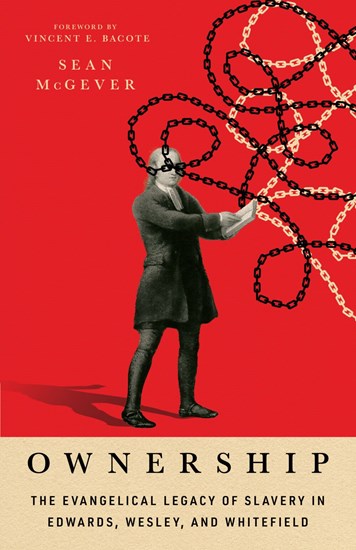
Jonathan Edwards, John Wesley, and George Whitefield remain incredibly influential on American Evangelicalism to this day. Yet, in their own times, they were morally compromised on the issue of slavery. Edwards and Whitefield were enslavers, while Wesley didn’t speak against slavery until late in life. Ownership: The Evangelical Legacy of Slavery in Edwards, Wesley, and Whitefield by Sean McGever explores the history of these evangelicals related to slavery and appraises that legacy into today.
The book is broken up into four parts. The first explores the historical context of the titular men, the second outlines their participation in a society of enslavement, the third shows actions taken against slavery in their times, and the final part explores the legacy of these men.
The first task McGever sets for himself is to outline why it is important today to talk about slavery then and the impact thinkers may continue to have despite their history with slavery. He sets out some of the questions asked about studying slavery and bringing it up as a live topic today, then he argues that the legacy of enslavement in White Evangelical circles continues to cause rifts and problems into the present time. He directly confronts the argument that these were “men of their times.” He contextualizes the counter-argument by noting that how we are remembered does matter and asks how we would want to be remembered in the future–as people who were simply following whatever whims of our times or as people who follow timeless moral truths? (10-11).
The historical section is a fairly straightforward history of the three men and their history with slavery. The contextual history showing that there were movements for abolitionism during the time helps refute the “men of their times” argument. It also shows how easy it would be to stay a “person of their time” in such an era. Once again, though, McGever questions whether this is really the excuse to give to historical persons–and certainly whether we’d want to give it to ourselves. If one believes in any kind of objective or timeless moral truth (for example, the truth that enslaving others is wrong), then that is a truth that could be recognized and striven for even if it would be easy to not do so. Wesley did ultimately speak up against slavery, though it took many, many years to do so.
McGever’s work is unique because it not only traces the history of the deeply problematic legacy of slavery in American Evangelicalism but also calls on readers today to explore and counter that legacy. “Our stories do not end when we die” (153). This is a central aspect of McGever’s thesis–that legacy does matter and that our legacy lives in in friends, family, and others. For us, this means ownership of the failures of our heroes (169ff). Failures may lead to pointing fingers and making even heroes enemies, but McGever notes that “Loving our enemies includes holding people accountable and expecting change” (171). He urges readers to realize the society they’re born into has deep influence on moral and other decisions (175-176); that ideologies we perpetuate can yield larger results (176-178); and that we can make changes throughout our lives to own our moral legacy (178-184).
Ownership is a fascinating book that not just informs readers but also calls them to action. By using the examples of Edwards, Whitefield, and Wesley, McGever urges readers to learn from the past and be better in the future. Highly recommended.
All Links to Amazon are Affiliates
Links
Be sure to check out the page for this site on Facebook and Twitter for discussion of posts, links to other pages of interest, random talk about theology/philosophy/apologetics/movies and more!
Book Reviews– There are plenty more book reviews to read! Read like crazy! (Scroll down for more, and click at bottom for even more!)
SDG.
——
The preceding post is the property of J.W. Wartick (apart from quotations, which are the property of their respective owners, and works of art as credited; images are often freely available to the public and J.W. Wartick makes no claims of owning rights to the images unless he makes that explicit) and should not be reproduced in part or in whole without the expressed consent of the author. All content on this site is the property of J.W. Wartick and is made available for individual and personal usage. If you cite from these documents, whether for personal or professional purposes, please give appropriate citation with both the name of the author (J.W. Wartick) and a link to the original URL. If you’d like to repost a post, you may do so, provided you show less than half of the original post on your own site and link to the original post for the rest. You must also appropriately cite the post as noted above. This blog is protected by Creative Commons licensing. By viewing any part of this site, you are agreeing to this usage policy.

 J.W. Wartick - Reconstructing Faith