Shroud of Turin
“An Artful Relic” by Andrew R. Casper- Apologetics of the Shroud
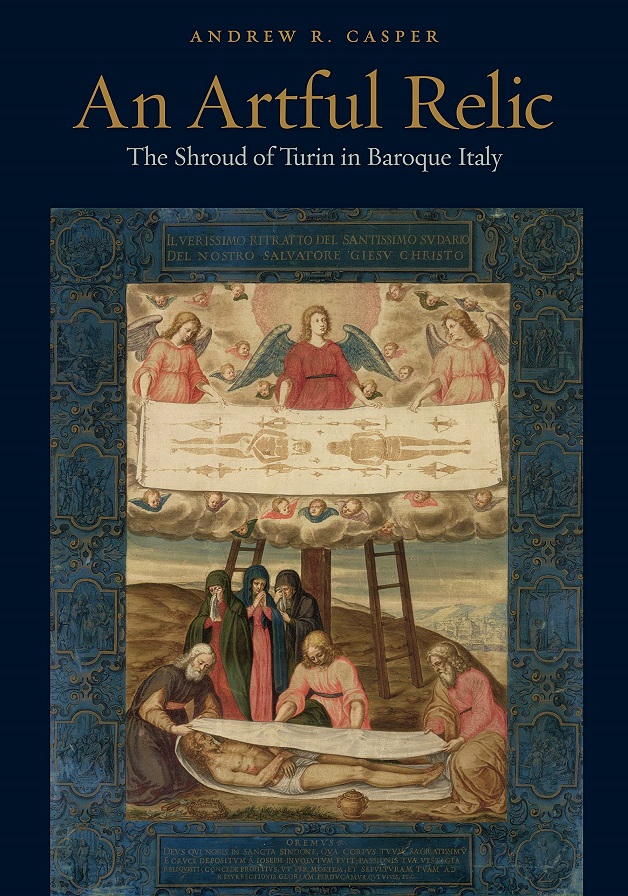
An Artful Relic: The Shroud of Turin in Baroque Italy by Andrew R. Casper is an impressive study of the impact of the Shroud of Turin on art, artists, and society in the 1500s-1600s. Not only is it lavishly illustrated, it also provides excellent historical data for those interested in the Shroud of Turin.
The thesis of the book is simple: the Shroud of Turin was immensely important in shaping art and even culture in Baroque Italy. That said, the work touches upon many important aspects for those interested in Shroud research. One aspect is the debate over its authenticity in history. While the debate over the Shroud’s authenticity continues today, the historical debate should inform those interested in the question. Casper notes that the acceptance of the Shroud’s authenticity in Italy (and elsewhere) was at least partially due to the immense influence of the House of Savoy. Their vested interest in making the Shroud a focal point for veneration and cultic worship greatly raised its esteem in Europe. Additionally, its survival of a fire in 1532 was seen as only explicable by miraculous intervention, thus leading more to accepting the Shroud as authentic (10). Neither of these, of course, will fully tilt opinion in modern minds regarding the Shroud’s authenticity. For people interested in that question, though, they should take into account the fact that the Shroud’s authenticity only became cemented in this time, and that its appearance in history cannot be traced to earlier than the latter half of the 1300s.
Casper draws attention to the way artists and others commented upon the supposed miraculous nature of the Shroud’s image in Baroque Italy. This included much comment on the way blood formed the image. The notion that the Shroud was explicitly a work of art made by God arose in this time period. It was insisted that God’s handiwork was shown with Christ’s blood as the pigmentation (57-58). These contentions had to deal with earlier Christian theology that argued against the possibility of Christ’s blood being left behind in the resurrection. For example, Aquinas had argued that because Christ’s body was true and complete in the Resurrection, the blood all rose with Christ “without any diminution” (73). Of course, not all Christian theology held to this view, and others argued that not all the blood had to be back in Christ’s body at the resurrection (74). The notion that it was the blood that formed the image stands in contrast to some modern arguments that radiation from the energy of resurrection formed the image. While it might be too strong to suggest that these two interpretations are irreconcilable, the inability to agree upon the formation of the Shroud remains an open question in research. Casper notes the blood as central to the veneration and worship of/around the Shroud in Baroque Italy, however. This would suggest that any modern explanation that does not hold to the same view has shown evolution from and important differences with earlier thought on the Shroud.
Casper goes over the influence of the Shroud on art in detail, noting the care with which copies were made, contrasting that with the apparent carelessness (or at least, lack of caring for) selection of artists to copy the Shroud was sometimes conducted. The Shroud and veneration thereof appeared all over in artwork, and influenced how illustrations of Christ were made. Casper forcefully makes the point that the Shroud as an artwork hasn’t been explored enough, and that its influence on contemporary artwork (here going with the assumption that it did not exist earlier than the 14th century) is quite strong.
Indeed, this raises a question for those who argue in favor of the Shroud’s authenticity: why did it not influence art so heavily before? While some arguments insist upon coins or certain icons being based upon the Shroud, no artwork exists depicting the Shroud qua Shroud prior to this time period. If the Shroud existed and was venerated in the 4th century or earlier, as some argue, why did artwork not depict it as such? No argument about the alleged secret history of the Shroud could work here, because if other artworks depicting Christ were widely distributed that depict a Christ allegedly based upon the Shroud of Turin, why could not the Shroud itself exist in such artworks? And why is it that only once an imminently powerful European family, the House of Savoy, threw their weight behind it that the Shroud rose in cultural prominence? One could anticipate various answers to these questions, but for this author, the answers are insufficient to demonstrate the Shroud’s actual existence prior to the 14th century. Indeed, the ubiquity and influence of the Shroud in and upon art in Baroque Italy seems an argument against its earlier existence.
Casper’s work is not, I should clarify, an argument for or against the authenticity of the Shroud. While he touches upon the question, his focus is almost entirely on the way the Shroud was depicted in art. nd this itself is a fascinating question. Casper presents many firsthand accounts of the Shroud, explanations of its depiction, and specific inquiries into artworks based upon it. The book therefore is of great interest to anyone interested in the Shroud of Turin.
An Artful Relic is a highly recommended read. It clearly demonstrates the influence of the Shroud in Baroque Italy and raises many questions and paths of research into religious art and the Shroud specifically. Those interested in the question of its authenticity should also read the book and see what questions and answers may come to mind based upon Casper’s thorough research.
Links
The Shroud of Turin- An Apologetics Sinkhole? – My first post in the series on the Shroud of Turin in which I comment broadly about my interest in it and why I think it demonstrates so many problems.
Be sure to check out the page for this site on Facebook and Twitter for discussion of posts, links to other pages of interest, random talk about theology/philosophy/apologetics/movies and more!
SDG.
——
The preceding post is the property of J.W. Wartick (apart from quotations, which are the property of their respective owners, and works of art as credited; images are often freely available to the public and J.W. Wartick makes no claims of owning rights to the images unless he makes that explicit) and should not be reproduced in part or in whole without the expressed consent of the author. All content on this site is the property of J.W. Wartick and is made available for individual and personal usage. If you cite from these documents, whether for personal or professional purposes, please give appropriate citation with both the name of the author (J.W. Wartick) and a link to the original URL. If you’d like to repost a post, you may do so, provided you show less than half of the original post on your own site and link to the original post for the rest. You must also appropriately cite the post as noted above. This blog is protected by Creative Commons licensing. By viewing any part of this site, you are agreeing to this usage policy.
Coins, Icons, and the Shroud of Turin- Apologetics of the Shroud

One category of claims made in favor of the authenticity of the Shroud is that other artwork reflects the image of the Shroud. Often, this is linked to legal status for points of congruence. Thus, for example, it is argued that legally, 14 points of congruence between a suspect’s fingerprint and a fingerprint from a crime scene are necessary to determine a match. But with the Shroud, there are allegedly many icons and coins and other objects with a huge number of points of congruence well beyond the legal standard. Thus, in a video on Shroud3D (linked to me by one apologist interest in the Shroud), it is stated that there are “250 points of congruence between [the] Shroud and icon,” which is left as an argument for the clear link between the icon and the Shroud.
There are a number of problems with this species of argument related to the Shroud of Turin. I don’t have the time nor the expertise to analyze individual alleged points of congruence. Indeed, most of the sources I found making claims like this cited other sources, which in turn cited other sources, which in turn I was either unable to find or unable to determine the specific alleged points of congruence. The video I linked above shows someone waving a mouse icon on a screen at some alleged similarities between the Shroud and an icon, but that, with the claim on screen of “250 points of congruence,” does not do nearly enough to allow for any kind of detailed analysis. And, again, I am not any kind of expert in forensics of icons or the like. Instead, what I’m going to focus on are some broader problems with the argument.
Why It Matters
The reason this argument matters is that apologists of the Shroud claim that because coins, icons, and possibly other artworks reflect attempts to imitate the Shroud, this allows them to place the date of the Shroud much earlier in history than the earliest historical mentions of it (14th century). The logic is simple: if coins from earlier than the 14th century show that they are copied from or based upon the Shroud, it follows that the Shroud existed prior to the 14th century. I’ll have more to say about this argument in the future.
Points of Congruence
I mentioned above that claims are made about these alleged “points of congruence” or similarities between the Shroud of Turin and other objects. What I’ve struggled to track down are both the actual diagrams showing these exact points of congruence, the methodology used to detect these alleged points, and the linkage between those points and actual forensic evidence. After some deep searching online on the website of the Department of Justice, I was able to find a number of articles about fingerprint analysis. One of these, an abstract of a chapter of a book about forensics and fingerprinting, notes that identification of similarities involves: “perception, similarity judgments, memory, and decision making. These abilities vary among individuals and can be improved with training and experience.” This raises far more questions than it answers regarding the alleged proof of the earlier dating of the Shroud of Turin based upon its alleged “congruencies” with icons, coins, and the like.
First, what kind of actual training do those marking these supposed similarities have? From what I can tell, the people making these types of claims do not have any training in forensic analysis of photographs, art, or fingerprints. While expertise is not absolutely necessary in order to make identification of similarities (I’m fairly sure that without a degree in art, I could identify a painting by or in the style of Salvador Dali, for example), it certainly would give more credence to the claims being made. And, it’s possible that I, being fairly new to this discussion, am missing people with relevant degrees or job experience. But I do know how often I’ve seen online apologists making these claims without citation, and those doing that certainly do not have the relevant expertise, nor are they citing sources with that expertise. This alone should be enough to urge skepticism about said claims.
Second, what about making judgment calls? If I have an image with a crown of thorns and another image with a crown of thorns, how do I make a judgment call of how many similarities there are? One has a thorn piercing the forehead directly in the middle of the left eyebrow? That could be evidence of congruence, but it could also be happenstance–the thorns had to hit the head at some points, after all. It seems somewhat obvious to me that those making these judgment calls in favor of the Shroud may have significant bias in favor of finding more congruence than there may actually be. And without degrees or expertise to back them up, this becomes even more likely. It’s easy to multiply points of congruence when one wants them to be there. And, as I will note below, this is even more problematical because of the nature of what is being alleged about, anyway (see the section on Baseline below).
Third, it’s clear that nearly every aspect of these points of congruence regarding the Shroud and various artworks are matters of opinion. But when the subject being depicted has many features that are generally well-known (crucified figure, scourged, with crown of thorns, etc.), how does one determine whether a point of congruence is evidence of actual copying or whether it is just happenstance based upon the known circumstances of the subject being depicted? It seems like sorting that question out would be nearly impossible. It would rely so much upon judgment calls it would start to become absurd. Indeed, one would have to constantly assume intent into the depictions on the coins or icons–that they were intended to look like the Shroud, rather than happening to follow the same general outline of an image. But that brings us to the argument below.
There is a Baseline
Perhaps the most severe problem with claims about the supposed congruence between the Shroud and various artworks, coins, etc. is that these arguments fail to note the works are not independent. What I mean by this will take a little explaining. Going back to the example that is being cited–fingerprint analysis–the example has no independent goal towards which to aim. If I have a fingerprint from a crime scene, and I have the fingerprints of the suspect, I can compare them and conclude that if there are enough similarities–whatever that standard is legally–then that means they’re a match.
With the Shroud, however, we have two objects, the Shroud, and some other item, say a coin, which are not independent of each other. This isn’t like plucking a fingerprint from somewhere and hoping to find a match. Instead, it is taking two objects, each of which has a goal oriented towards depiction of a specific subject, and then declaring that because they have similarities to each other, they are necessarily connected. Icons, coins, and the like are all intended to depict Jesus, at least in some sense. Obviously, they didn’t have a photograph, and details about what Jesus looked like in the Bible are totally scarce, but there are very early artistic depictions of Jesus, some with significant variation. There are also obvious features of a crucified human being with a crown of thorns that would lead to points of similarity in depiction of a human in that state. Two people trying to show a crucified Jewish man from the first century would likely align on many “points of congruence” without having any other knowledge of each others’ works.
The history of iconography of Jesus is its own separate subject, but by the time the artworks like the coins and icons being discussed by Shroud apologists were created, there was already an established baseline for what Jesus was supposed to look like in such iconography. So if you have an established representative style for what a subject, Jesus, is supposed to look like, and you have an icon and a coin that match that style, having another object–the Shroud–have many dozens or even hundreds of “points of congruence” with those other objects does not prove that those objects are based upon the Shroud. At best, it just proves the Shroud is consistent with the established baseline representation of Jesus in that era, but that would hardly be surprising whether it is a copy or genuine. But if I have three independent things, Bob, a coin that is supposed to depict Bob, and something that allegedly is the cloth Bob was buried in, it would hardly be surprising that both the burial cloth and coin are similar, given that they are both trying to aim at Bob as an image. That would be true whether the cloth is genuine or not.
One example of this was found in a podcast I was listening to about the Shroud of Turin [and, of course, my apologies as I have been unable to find the exact time stamp, but it was the Backstory on the Shroud of Turin Podcast, “The Stories Coins Can Tell with Justin Robinson,” August 11, 2022]. In that podcast, the person being interviewed noted that the way a strand of hair came across Jesus’s face matches the Shroud of Turin. In fact, it gets better, said Robinson, because the coin had to be printed in reverse, and so the artist was intentionally matching how that strand of hair came across the face to the Shroud of Turin! But this argument is specious. If you have two depictions intentionally aimed at a long haired Jewish man crucified, it would hardly be surprising for there to be a strand of hair dangling across the face, no matter which side the strand of hair falls upon. And the argument about the image having to be flipped for a coin does nothing to strengthen the attempt to link it to the Shroud, apart from making a supposed link to intention that cannot be proven. But these types of arguments are put forth as if they give definitive proof of (or at least, strong evidence for) the notion that these artists were copying the Shroud. Even as one who would love to have such evidence, this rings hollow and reads as attempted justification for something tenuous at best.
Fingerprints and Coins?
Similarly, those making claims about coins, icons, and the like fail to recognize the goal-directed nature of artwork. These aren’t just someone’s happenstance fingerprints or something; these are intentional depictions of a figure purported to be a representation of Jesus. The people making the argument about forensic evidence in court of law and applying that same style of evidence-gathering to questions about the Shroud of Turin seem to be engaging in a category error.
Fingerprints, as one might note, are not coins. Fingerprints are subjects of nature, possibly subject to scarring, and have numerous other aspects that are quite different from coins or icons. Icons and the faces on coins are intentional depictions of something. They are meant to appear as whatever vision the artist intended. Not only does this make it problematic as an argument because there is a baseline, as noted above, but it also means that trying to establish a 1:1 correspondence between what is required to demonstrate in court of law that a suspect and a piece of fingerprint evidence are the same and what is required to establish that a coin was specifically based upon the Shroud at least requires some kind of argument to establish. But that argument is never made. It’s just noted that in court of law there is some number of similarities required for fingerprints, and then because there are allegedly even more similarities between the Shroud and some piece of artwork, that establishes the artwork was copying the Shroud.
The leaps in logic here are over vast chasms. Criminal forensic evidence just is not the same as analysis of art and vice versa. Expert analysis simply does not exist for comparison of the coins with the Shroud imagery, so far as I can tell. Forensic analysis would not be the correct category to make this comparison with anyway. What possible correspondence could there be between an artwork and a supposedly genuine image of a body and between a naturally occurring phenomenon–a fingerprint–and the discovery of a fingerprint at the scene of a crime? They’re entirely different fields of study with entirely different backgrounds, contexts, and levels of intent. While it sounds like a good argument to cite one to defend the other, when one examines the actual arguments, they fall apart.
Conclusion
There are more problems that could be raised with the supposed similarities between the Shroud and various icons or coins or other artworks, but many of them would need to focus on specific artwork. I have left aside analysis of specific, individual claims to focus more upon methodology. Because of this, my argument may be dismissed by some as being to vague or broad. That may be, but I think that the points I’ve raised here should cause some to pause and urge caution about claims related to the Shroud of Turin. So often, it’s not experts doing this analysis, the arguments are vague, or categories are confused. Apologists should hold ourselves to a higher standard, and I don’t think this is happening with the Shroud.
Links
The Shroud of Turin- An Apologetics Sinkhole? – My first post in the series on the Shroud of Turin in which I comment broadly about my interest in it and why I think it demonstrates so many problems.
Be sure to check out the page for this site on Facebook and Twitter for discussion of posts, links to other pages of interest, random talk about theology/philosophy/apologetics/movies and more!
SDG.
——
The preceding post is the property of J.W. Wartick (apart from quotations, which are the property of their respective owners, and works of art as credited; images are often freely available to the public and J.W. Wartick makes no claims of owning rights to the images unless he makes that explicit) and should not be reproduced in part or in whole without the expressed consent of the author. All content on this site is the property of J.W. Wartick and is made available for individual and personal usage. If you cite from these documents, whether for personal or professional purposes, please give appropriate citation with both the name of the author (J.W. Wartick) and a link to the original URL. If you’d like to repost a post, you may do so, provided you show less than half of the original post on your own site and link to the original post for the rest. You must also appropriately cite the post as noted above. This blog is protected by Creative Commons licensing. By viewing any part of this site, you are agreeing to this usage policy.
The Shroud of Turin: A Secret History? – Apologetics of the Shroud
I am writing a series of posts about the problems I see in apologetics related to the Shroud of Turin. Check out my introductory post here.
Tracing the Shroud in History
A number of claims are made about the Shroud historically and the alleged trail that can be pieced together in order to get it from Turin back to Palestine. Most apologists I’ve read or watched in videos are careful to say that we know with a fairly high degree of certainty where the Shroud was in the 14th century, but before that it becomes murkier. That doesn’t stop many apologists from then turning to making extremely specific claims about the Shroud in history. Here, I’ll be starting an examination of “The Shroud of Turin: Photograph of the Resurrection,” a video from Duran Smith, an apologist with Ratio Christi, an apologetics organization.
Even referring to a “murky history of the Shroud” prior to the 14th century begs the question in a way, by assuming the Shroud did exist and so would have had a history at all prior to the 14th century. I wrote in my introductory post that I’m not convinced by the evidence for the Shroud. In fact, I think the apologetics related to the Shroud of Turin generally show many of the issues I have identified with apologetics more broadly.
Duran Smith, in this video, goes over a wide swathe of arguments about the Shroud of Turin. Here, I’ll be focusing only on how he traces the Shroud in the earliest periods of its supposed existence.
The Discipline of the Secret?
Smith alleges that the Discipline of the Secret is something that can be applied to discussions of the Shroud. In the video at 8:24, you can see a slide in which he writes about the Discipline of the Secret: “It was used until the 5th century.” Intentionally or not, this slide and the discussion surrounding it make it seem as though the Discipline of the Secret is both an established fact of history with a specific lineage and that it persisted in Christianity from the beginning “until the 5th century.” Neither of these are true as stated that way. The Discipline of the Secret is, like many assignations from historians, a categorization of something they observed in the past, rather than a specific Discipline. Hopping again over to Wikipedia, one can trace the historical origins of the phrase and that it was a categorization invented in the 17th century to describe something happening in the 4th and 5th centuries, but not before. So it is technically true that the practice was “used until the 5th century,” but not true that it was persistent throughout Christianity until then, and certainly doesn’t appear to be some kind of strict practice as Smith makes it out to be.
I belabored the above point because it is important to see that it is easy to throw out terms, phrases, and dates and start piecing a case together based upon them. The untrained eye may find it very easy to go along with this. However, on examination, it makes the case pretty thin to have it based on a 17th century categorization of something that was 4th-5th century, especially when it’s applied in this way. Smith specifically says that the Christians after Jesus’s resurrection “had to keep a lot of things hidden,” which strongly implies he is saying that this was a 1st century discipline. “There were things that they couldn’t… write down,” Smith says (about 8:35).
Smith actually goes on to make a number of claims about the Discipline of the Secret. Starting around 8:50 into the video, he claims: “the Apostles and the disciples spoke in a secret code… it was called The Discipline of the Secret. That’s [a/the] name given to it by some of the early church fathers. It was a code language that the early Christians used to protect themselves [from] being found out by the oppressive government. And it was used until the 5th century.” He goes on to imply this may be why we don’t have exacting evidence of the Shroud’s existence in this early period. The problem is that each of these claims, so far as any research I can do, appears to be false. There is no church father that talks about the “Discipline of the Secret,” falsifying the claim that that name was “given to it by some of the early church fathers.” Web searches turn up many, many sites talking about the discipline, but even in the corners of Catholic Encyclopedias, one finds time and again that they say that term did not originate until the 17th century or so, and the practice itself may have had earliest origins with Tertullian (3rd century) but didn’t solidify until the time of Basil (early 4th century) or Gregory of Nazianzus (mid-late 4th century). Not one of these church fathers used the phrase “Discipline of the Secret.” Where Smith found a source for his claim is unclear, and I understand YouTube is not an easy place for citations, nor are lectures like this, but I am curious as to exactly what source Smith is basing this claim upon. There doesn’t appear to be a foundation for it anywhere.
The claims about this Discipline continue, as Smith says a lot of research goes into decoding this secretive language and says that “this is where the fish comes from” referring to the symbol of a fish as a symbol early Christians used. Once again, there is no source cited or concrete evidence to suggest that this is in any way connected to an actual discipline that any church father referenced or named anywhere.
Note that I have not used the word “lying” here in regards to what Smith is saying about the Discipline of the Secret. I don’t know Smith’s intentions or mindset and believe one should always assume others are sincere unless you have direct counter-evidence. Instead, what I’m observing is that Smith is making a number of explicit claims about the origins of the Shroud and this “Discipline,” none of which appear to be backed by reliable historical data. So where did it come from? It is possible Smith made it up, but in my own experience in academic apologetics as well as apologetics circles online, it seems more likely that Smith has fallen victim to what I’ve seen as a kind of group re-affirmation process in which a claim is made and then others pile on more supposed evidences to back up that claim, whether through anecdotes or other experiences, which are then taken to be true and real evidences, which then back up the claim, until an kind of circle of evidence is made such that the original claim seems unassailable. I could see someone reading about the Discipline of the Secret, and then having a kind of enthusiastic discussion about that related to the Shroud and how it could explain why there aren’t explicit writings about the Shroud or evidence referring explicitly to it prior to the 14th century. How you get from that to making an explicit claim that the church fathers explicitly gave the practice the name is conjecture on my end, but I could see it being inferred and then taken as true at some step along the way.
However it happened, Smith’s discussion of the Discipline of the Secret shows some gaps in understanding, along with several claims that, upon examination, cannot hold weight.
The Lost Gospel of the Hebrews?
Smith then turns to an allegedly lost Gospel of the Hebrews. Again, digging around online turns up that this lost Gospel may in fact be three separate Gospels, that it may have had its origin in the Gospels in the Bible today, and a number of other tidbits. There’s not a lot there, just some fragmentary quotes, including one from Origen (a favorite of mine) that hedges bets a bit when he writes “And if any accept the Gospel according to the Hebrews” before citing a fragment in his On John. Anyway, all of this is to say we don’t have much by way of established fact here, either.
After noting that the Gospel is lost and we don’t have it at all, Smith claims that “We use it to kind of get insight into what those early Christians were thinking… It’s used for some theological purposes, but it also has some historical details…” [around 10:20 and following]. Then he quotes it, “and when the Lord had given the linen cloth to the servant of the priest, He went to James and appeared to him.” I was able to confirm this is a quote from Jerome attributed to the Gospel of the Hebrews. Smith then states that the “servant of the priest probably refers to Peter, who was traditionally known as the Priest.” Going on, he says “it’s very likely that, according to the Discipline of the Secret, that the Gospel of the Hebrews is indicating that Jesus gave the linen cloth to Peter.” Going on, Smith notes that Peter is the head of the church, and the rock upon which the church is founded, and that it would then make sense that Peter would have this “very important relic” (the Shroud). Peter then spent quite a bit of time in Antioch.
There are problems with many of the claims made in this section. First, Peter wasn’t traditionally known as “the Priest.” He was known as the Rock. I don’t have comprehensive knowledge of or access to early church writings, but I struggle to find any reference to any tradition in which Peter is known as “the Priest.” Some believe he was known to the High Priest. Several Roman Catholic claims about Peter being the first Pope would then make him a priest, but having him referred to as “the Priest” is different from that claim. Again, I found no referent anywhere in searches online or through books on church history. I’m willing to be corrected here, of course, but it seems to me that if a claim can offhandedly be made that Peter “was traditionally known as the Priest” then that tradition should be fairly easily associated with Peter, and it is not. But suppose Smith is right, suppose Peter was known as “the Priest.” The passage he cites says that the “linen cloth” was given to “the servant of the priest.” So the passage would in fact be saying that the linen cloth was given to Peter’s servant, not to Peter himself. Of course, one might surmise that that would then mean that the linen made its way to Peter, but that is another step of transmission that Smith needs to establish. He also needs to establish that the linen cloth is, in fact, the Shroud.
Second, given the problems with Smith’s interpretation of the Discipline of the Secret noted above, it is highly problematical for him to deduce anything from that analysis. But he explicitly states that it is “according to the Discipline of the Secret” that the citation from the Gospel of the Hebrews is telling readers that the linen cloth is given to Peter. Note the shift here. It’s subtle, but it happens. In just a few minutes in the video, Smith has moved from saying that there is such a thing as a Discipline of the Secret in which Christians secretly communicated with each other to making that very Discipline the actor in interpreting passages from a fragmentary text available only through quotations from others. It isn’t that it is possible that there is a secretive explanation of a passage; no, Smith states that it is “according to” that secretive discipline that we may then infer that the passage is referring to the Shroud. In no small amount of time, and without argument, the Discipline of the Secret has moved to a broad way to explain that Christians spoke secretively to a means by which we may infer truths. I really can’t belabor this point enough because it’s a major shift. It is according to the Discipline, which is by no means established by a discipline and which did not exist even according to sources writing about it in this time period, that we may then conclude that a fragmentary passage from a book that is not extant to this day is explicitly referring to none other than the Shroud of Turin. This is such a massive leap, but is made without even an argument.
The shift from “there’s a secretive discipline in the early church” to “we may infer from that secretive discipline conclusions about what they were saying in specific texts” is huge. Again, careful examination of Smith’s arguments make it clear they come up quite short when it comes to whether they can actually support the conclusions he’s drawing.
Conclusion
Duran Smith has demonstrated here a number of problems I find in apologetics more generally. He makes claims that are unsupported by evidence, other claims are, upon closer examination, false. He shifts from argument to evidence without enough evidential support to make the conclusions he does. It also seems that he’s not as fully versed in the claims he’s making as someone giving a lecture on a topic ought to be. Whether it’s the claims about what Peter is traditionally called or about the actual dates and extent of the Discipline of the Secret, there are a number of errors that a bit more research could have prevented. But these errors are integral to the case Smith has made so far. If they are indeed errors, most of his case to this point falls apart. We’ll be examining more of the historical evidence Smith claims exists for the Shroud in the next post in this series.
Links
What’s Wrong with Apologetics? – I raise a number of pitfalls apologists ought to avoid.
Be sure to check out the page for this site on Facebook and Twitter for discussion of posts, links to other pages of interest, random talk about theology/philosophy/apologetics/movies and more!
SDG.
——
The preceding post is the property of J.W. Wartick (apart from quotations, which are the property of their respective owners, and works of art as credited; images are often freely available to the public and J.W. Wartick makes no claims of owning rights to the images unless he makes that explicit) and should not be reproduced in part or in whole without the expressed consent of the author. All content on this site is the property of J.W. Wartick and is made available for individual and personal usage. If you cite from these documents, whether for personal or professional purposes, please give appropriate citation with both the name of the author (J.W. Wartick) and a link to the original URL. If you’d like to repost a post, you may do so, provided you show less than half of the original post on your own site and link to the original post for the rest. You must also appropriately cite the post as noted above. This blog is protected by Creative Commons licensing. By viewing any part of this site, you are agreeing to this usage policy.
The Shroud of Turin: An Apologetics Sinkhole?
I have noticed an increasing amount of interest in some apologetics circles about the Shroud of Turin. When I was in graduate school, there was a group of people studying apologetics I deemed “The Shroud Crowd” due to their especial interest in the topic. Increasingly, I have seen articles getting shared about the supposed authenticity of the Shroud of Turin. For those unfamiliar, the Shroud of Turin [wiki link] is alleged to be the burial shroud in which Jesus was wrapped or covered after the crucifixion. Yes, the actual thing. One could see why this would be of great apologetic interest if it could be shown to be genuine.
I’ve found is that apologetic arguments in favor of the authenticity of the Shroud often fall victim to some of the issues I’ve found in apologetics more broadly. One of these is the tendency to make major claims instead of modest ones. Apologists tend toward maximal conclusions when minimal ones might be easier to establish based upon argument. But because maximal conclusions are more exciting and easily seen as relevant, apologists tend to focus on those rather than more minimalistic arguments. For the specific scenario of the Shroud, I have seen multiple videos of apologists arguing for its authenticity explicitly stating that “It is the true burial Shroud of Christ” without any kind of hedging or contextualizing of that claim. Such a bold claim needs a massive amount of evidential support to carry the day. A more modest claim regarding the Shroud might be more defensible[1]. By claiming not only that this is a burial shroud of someone in the first century, or someone who was crucified, or some other more modest claim, the apologist is taking on the burden of proof a number of degrees of certainty higher. After all, supposing the Shroud is from the first century and is from Palestine and is an actual burial shroud of someone who was crucified. None of that yet makes it the burial shroud or cloth of Jesus Christ!
Now, the apologists arguing in favor of that latter claim would likely counter by saying the miraculous nature of the image itself and how it was formed point to it being the shroud of Christ, but my point is that that claim itself needs a much more significant defense than a mere claim that it is a burial shroud of a crucified person. But of course that more modest claim doesn’t have the theological and apologetic import that making it the shroud of Christ would provide. It would be much less interesting if it were just an anonymous burial covering of a crucified man from the first century[2]. And for the apologist, the apologetic value of the shroud would be greatly undermined if it weren’t directly pointing at Christ.[3]
Another common mistake apologists make is to throw every possible argument at a question instead of focusing on the best arguments. Videos, lectures, and presentations I’ve watched about the Shroud of Turin are generally excellent examples of this very problem. Rather than focusing upon a select few extremely powerful evidences–or at least developing one or two arguments more fully–the apologist throws every possibly related argument in favor of their position out there. The seeming conclusion is then sometimes that this constitutes a great deal of evidence for the apologist’s claim. But simply making arguments is not the same as finding evidence. Conflating argument and evidence is a major problem in apologetics generally. Additionally, a bunch of speculative phrases or hypothetical scenarios thrown out alongside a few pieces of actually compelling arguments doesn’t bolster the strength of the latter, but can rather distract or even undermine them. Examples of this very situation regarding arguments related to the Shroud of Turin will be a primary focus of my future post(s) on this topic.
Apologists arguing for the authenticity of the Shroud also tend to make a number of seemingly outlandish claims related to it. For example, more than once I’ve seen arguments made that the Shroud’s image could only have been made by radiation coming from a body being miraculously resuscitated. While it is perfectly acceptable to hold such a belief, it is to me apparent that we can’t do much to evaluate such a claim. After all, how are we even supposed to begin testing it? We have no way to resuscitate a dead body, and no way to induce a miracle, so a claim that that is exactly the one and only possible explanation is either unable to be grounded in reality or may only be held as a pillar of faith. That’s fine, but claims like this are being presented at times as if they are themselves evidence!
So, where are we going from here? My plan is to look at a few apologetics videos related to the Shroud of Turin and analyze the arguments therein. I’ll be using the video(s) to show how apologists are arguing in favor of its authenticity and then offering my own counters to and problems found with several of these arguments.
I am by no means an expert in several of the related topics. I take some comfort in the fact that, so far as I have been able to determine, those apologists making arguments in favor of the Shroud are also people without expertise in any related field (eg. radiometric dating). That said, I want to make it clear that I’m not claiming any special authority in this area. I’m just an interested observer who believes there are severe problems in many of the most popular arguments in favor of the authenticity of the Shroud of Turin. I also want to be clear that I am a faithful Christian. It would certainly be wonderful if we could have such a wonderful piece of evidence for the resurrection, but I do not want to have people staking their belief in Christianity on what I believe are poorly constructed arguments.
[1] I say “might be more defensible” because while it would be easier to defend a more modest claim, I’m not convinced the endeavor would be worthwhile, nor am I convinced that a more modest claim could be carried on the evidence.
[2] Though, to be fair, any extant burial shroud from the first century of anyone, let alone someone who was crucified, would be of major archaeological interest, I would assume.
[3] And again, in this case, a more modest claim would still have apologetic value. After all, such an extant shroud could tell us a lot about how crucifixion occurred, the way it impacted the body, etc., etc., all of which would have apologetic import to some degree.
Links
What’s Wrong with Apologetics? – I raise a number of pitfalls apologists ought to avoid.
Be sure to check out the page for this site on Facebook and Twitter for discussion of posts, links to other pages of interest, random talk about theology/philosophy/apologetics/movies and more!
SDG.
——
The preceding post is the property of J.W. Wartick (apart from quotations, which are the property of their respective owners, and works of art as credited; images are often freely available to the public and J.W. Wartick makes no claims of owning rights to the images unless he makes that explicit) and should not be reproduced in part or in whole without the expressed consent of the author. All content on this site is the property of J.W. Wartick and is made available for individual and personal usage. If you cite from these documents, whether for personal or professional purposes, please give appropriate citation with both the name of the author (J.W. Wartick) and a link to the original URL. If you’d like to repost a post, you may do so, provided you show less than half of the original post on your own site and link to the original post for the rest. You must also appropriately cite the post as noted above. This blog is protected by Creative Commons licensing. By viewing any part of this site, you are agreeing to this usage policy.
Really Recommended Posts 10/24/14- Reconciling in Christ, Walking Dead, and more!
 Hello friends! I have another set of links for you to peruse. As always, let me know what you think of the links and if you enjoyed them, leave a comment on those blogs! Thanks for stopping in and reading!
Ambassadors for Reconciliation– There has been much ire flying around over the director of the theistic evolutionist group Biologos’ invitation to creationists like Ken Ham to have dinner and talk over the issues. Here, Hugh Ross reflects upon the extreme reactions of some and the ways we can work towards reconciliation. One quote in particular is helpful:
Enough is enough. There are mission fields still to be reached. How can we ask nonbelievers to dialogue with us if we cannot graciously dialogue with one another, if we treat one another as enemies? Unless we make some progress in reconciling our differences, how can we expect to help reconcile a skeptical world to Christ? We are commissioned by God to be His ambassadors. It’s time for us to start behaving as ambassadors.
I think this is spot on. I have personally been accused by a number of those who disagree with me of being a vile compromiser, someone who is actively leading people away from Christ, etc. If this is how we treat fellow believers, why should those who do not yet believe think that we will be capable of honest dialogue with them? Let’s stop the insults and start genuine dialogue. Let us show one another charity.
When Humans Lose their Humanity: “No Sanctuary” and the real Horror of Terminus– What happens when humans are dehumanized? Here’s an interesting look at ‘The Walking Dead’ which explores this question in deeply insightful ways.
Do we really need to teach our kids apologetics when God is in control anyway?– Here’s an excellent post on the need to educate our children in the Christian faith. Unfortunately, some think that we shouldn’t bother because God is in control. How might we answer this?
Is the Shroud Evidence for God’s Existence?– I have a number of friends in apologetics who are convinced that the Shroud of Turin is genuinely the image of Christ. I am personally unconvinced, but I found this article on it interesting for analyzing what we should make of the Shroud, were it to prove genuine.
Intersections: Summit on Origins– I’m going to be at this conference hosted by Bethel University. It’s on the origins debate, a topic of great interest to me. If you’re able to make it, I’d love to see you there! Let me know!
Really Recommended Posts 8/2/13
 After a brief hiatus, “Really Recommended Posts” are back. This go-round I have found for your reading/viewing pleasure a debate on sola scriptura, Buddhism, fear, the Shroud of Turin, and presuppositional apologetics. As always, let me know what you liked/didn’t like! Send me your own recommendations!
Is the Bible the only infallible rule of faith? Tim Staples vs. James White (Video)- A (lengthy) debate between a Roman Catholic and a Calvinist regarding the rule of faith. Should we hold to sola scriptura, or do we need the Magisterium in order to preserve teaching? The debate is really worth listening to.
A Comparison of the Ethical teachings and Impact of Jesus and Buddha– A brief insight into comparative religions between Buddhism and Christianity. What of truth in other religions? I found this a very interesting post.
Fiction and Fear– A really excellent post over at Hieropraxis which notes the importance of an element of fear in fiction. The post ties this back to the relevance of the Christian teaching of Christ’s redeeming work.
Shroud of Turin Blog– I am not convinced that the Shroud of Turin is authentic. However, I do find some of the work being done regarding its authenticity is very interesting. This blog has a constant string of posts related to various evidences in favor of the Shroud’s authenticity. I recommend it for those interested in reading on the topic, with the caveat of my own (hopeful) skepticism.
What is pre-suppositionalism? What is presuppositional apologetics?– Over at Wintery Knight, this interesting post turned up with a critique of presuppositionalism as an epistemology (largely based on this post at The Messianic Drew). I found it interesting, though I do not fully agree with all the critiques leveled therein. For balance, I would also direct readers to Janitorial Musings for a counter-argument to the first major contention against presuppositionalism- Presuppositionalism and Circularity. I think readers should read all the posts involved for a more complete picture. Judge for yourselves what to think of the presuppositional “worldview” (to use Drew’s term–I would lean towards saying “epistemology” instead).

 J.W. Wartick - Reconstructing Faith