the Bible
“Captain America: The Winter Soldier”- The Longing for Purpose and Truth
 “Captain America: The Winter Soldier” opened to a tune of a $300 million weekend. The film has been “certified fresh” by reviews aggregate Rotten Tomatoes (currently at an 89%). People are talking about the film. Here, we will explore some major themes in the movie from a Christian perspective. There will be SPOILERS in what follows.
Purpose
A question which reverberates throughout the film is that of purpose. What is Captain America’s purpose? He struggled with this himself; in a world far different from the one he sprung from, what place did he have?
It’s a kind of struggle that all humans experience at some point: an existential crisis of place. Where are we in the world? What is our purpose? How do we pursue it?
These questions speak to a longing for something greater. They are questions which address the core of human nature: awash in a universe which at times seems empty and without purpose, we mirror the uncertainty Captain America displayed. Yet the film itself speaks to the fact that there is real purpose in the universe. In “The Winter Soldier,” friendship and loyalty play major roles. The revelation that The Winter Soldier is, in fact, Bucky, a friend from the Captain’s past, leads to a poignant scene in which the Captain refuses to fight his friend due to an earlier vow. Purpose, it seems, is grounded on relationships. It is grounded in persons.
Ultimately, of course, the Christian worldview holds to that same concept but on a cosmic scale. Purpose in the universe is grounded on a person: God.
Human Nature
The depths of human nature are plumbed in the film, as it is discovered that Hydra, an evil Nazi organization, has managed to infiltrate Shield at the highest levels. At the core of the film’s portrayal of human nature is the notion that we are ruled by various fears. We are overwhelmed by chaos, and, if given enough of it, will succumb to any amount of limitations and control in order to turn away from the pit of destruction. Hydra helped bring about as much chaos as possible in order to push humanity to the brink.
It is a conspiracy theorists dream come true: the highest levels of intelligence infiltrated by an evil institution bent on wiping out all threats to its ultimate power. But the fact is that the plot twist was not really that unbelievable. But the strength of the scenario is how very believable it was. The notion that humans would give in to extreme injustice in order to flee from those things which scare them most really wasn’t unbelievable. The fact that both Hydra and Shield were working to eliminate “potential” threats ahead of time sealed the deal.
The commentary on human nature should not be missed: humanity is inherently fearful. Separated from a sense of tranquility and order, we often cling to things which are patently unjust in order to try to overcome our current situation. Think about it frankly: do you really think the scenario in this movie is all that preposterous? That’s what makes it so powerful. It’s not preposterous. In some ways, it’s already happening.
 Captain America: The Moral Compass
The portrayal of human nature discussed above leads naturally into the question of justice. Captain America acts as a kind of moral compass in the current Marvel universe. It is hard to resist the reasoning from both ends–Hydra and Shield–regarding the nature of humanity. In one scene, people are asked whether, if able, they would “press a button” to prevent violent hostage situations, terrorism, and the like. The appeal could have some nodding along with it. But think about it, touching that button would kill those who had yet to do anything wrong.
Thus, Captain America seems initially naive when it comes to this moral reasoning. After all, why would he be so opposed to a system that could prevent the loss of life and ruination of people? But the Captain doesn’t stop the chain of reasoning there. Instead, he calls for a view of justice towards all people; one in which even the “bad guys” aren’t assumed to be irreparable. Its a strong message, and one which resonates with the Christian worldview in powerful ways.
Think of Jonah, who would have preferred to see Nineveh burn than to see them repent. But he knew that God was a loving God, eager to show love and mercy to repentant sinners. Or consider the cry of Ezekiel to “turn” from wicked ways and repent to avoid certain death (Ezekiel 33:11). These themes echo in “The Winter Soldier” as the notion that simply terminating people who may be threats is explored.
Viewing the Captain as a moral compass has some interesting outcomes. For example, though Joss Whedon (director of “The Avengers”) is an avowed non-theist, in that flick, Captain America quips to Thor: “There’s only one God, and… he doesn’t dress like that.” Though an offhand remark, it is interesting to see that Captain America affirms there is “a” deity at all, let alone “only one.” This, from the man who in the face of pressure from all sides, refused to kill the man he promised to protect.
Regarding the Winter Soldier, I have to say that I see shades of the biblical Jonathan and David in the relationship here. There is a mutual vow to protect each other. The two are enmeshed in conflict and end up on opposite sides. Ultimately, they are forced to choose between destroying the other or honoring their loyalty to each other. Again, I’m not saying this is intentional, but the theme is there.
Conclusion
“Captain America: The Winter Soldier” has much for Christians to discuss. It’s an extremely compelling tale filled with themes of justice, loyalty, and friendship. In order to effectively engage the culture, we should use it as a springboard to start discussions about the deeper things. Let me know your thoughts on the movie in the comments.
Links
Be sure to check out the page for this site on Facebook and Twitter for discussion of posts, links to other pages of interest, random talk about theology/philosophy/apologetics/movies and more!
Check out my other looks at films from a Christian perspective. (Scroll down for more.)
A Christian Look at “The Avengers”– I examine a number of themes in “The Avengers” which Christians and non-Christians can discuss.
Engaging Culture: A Brief Guide for movies– I reflect on how Christians can engage with popular movies in order to have meaningful conversations with those around them.
The image is copyrighted by Marvel and I make no claim to rights. I use it under fair use.
SDG.
——
The preceding post is the property of J.W. Wartick (apart from quotations, which are the property of their respective owners, and works of art as credited; images are often freely available to the public and J.W. Wartick makes no claims of owning rights to the images unless he makes that explicit) and should not be reproduced in part or in whole without the expressed consent of the author. All content on this site is the property of J.W. Wartick and is made available for individual and personal usage. If you cite from these documents, whether for personal or professional purposes, please give appropriate citation with both the name of the author (J.W. Wartick) and a link to the original URL. If you’d like to repost a post, you may do so, provided you show less than half of the original post on your own site and link to the original post for the rest. You must also appropriately cite the post as noted above. This blog is protected by Creative Commons licensing. By viewing any part of this site, you are agreeing to this usage policy.
Inerrancy and Presuppositional Apologetics: A different approach to defending the Bible
Scripture is inerrant because the personal word of God cannot be anything other than true. -John Frame (The Doctrine of the Word of God
, 176 cited below)

One of the most difficult issues facing evangelical Christian apologists is the doctrine of inerrancy. I’m not trying to suggest the doctrine is itself problematic. Indeed, I have defended the doctrine in writing on more than one occasion. Instead, I am saying that defending this doctrine in an apologetics-related discussion is difficult. Here, I will explore one way that I think should be used more frequently when discussing the doctrine.
What is the problem?
There are any number of attacks on inerrancy and Biblical authority, generally speaking. Very often, when I discuss the Bible with others in a discussion over worldviews, I find that the challenge which is most frequently leveled against the notion of inerrancy is a series of alleged contradictions. The second most common objection is some sort of textual criticism which allegedly shows that the Bible could not be without error in its autographs. A third common argument against inerrancy is to quote specific verses and express utter incredulity at their contents.
Of course, it doesn’t help that the definition of inerrancy is often misunderstood. For simplicity’s sake, I will here operate under the definition that “The Bible, in all it teaches, is without error.” I have already written on some misconceptions about the definition of inerrancy, and readers looking for more clarification may wish to read that post.
How do we address the problem?
Most frequently, the way I have seen apologists engage with these challenges is through a series of arguments. First, they’ll argue for the general reliability of the Bible by pointing out the numerous places in which it lines up with archaeological or historical information we have. Second, they’ll argue that these historical reports given in the Bible cannot be divorced from the miraculous content contained therein. Given the accuracy with which these writers reported historical events, what basis is there to deny the miraculous events they also report?
Other apologists may establish inerrancy by rebutting arguments which are leveled against the doctrine. That is, if one puts forth an argument against inerrancy by pointing out alleged contradictions, these apologists seek to rebut those contradictions. Thus, once every single alleged error has been addressed, this approach concludes the Bible is inerrant.
Now, I’m not suggesting that either of these methods are wrong. Instead, I’m saying there is another way to approach the defense of the Bible.
A Presuppositional Defense of Inerrancy
Suppose God exists. Suppose further that this God which exists is indeed the God of classical Christian theism. Now, supposing that this is the case, what basis is there for arguing that the Bible is full of errors? For, given that the God of Christianity exists, it seems to be fairly obvious that such a God is not only capable of but would have the motivation to preserve His Word as reported in the Bible.
Or, consider the first step-by-step argument for inerrancy given in the section above, where one would present archaeological, philosophical, historical, etc. evidence point-by-point to make a case for miracles. Could it not be the case that the only reason for rejecting the miraculous reports as wholly inaccurate fictions while simultaneously acknowledging the careful historical accuracy of the authors is simply due to a worldview which cannot allow for the miraculous at the outset?
What’s the Point?
At this point one might be thinking, So what? Who cares?
Well, to answer this head on: my point is that one’s overall worldview is almost certainly going to determine how one views inerrancy. The point may seem obvious, but I think it is worth making very explicit. If we already hold to a Christian worldview broadly, then alleged contradictions in the Bible seem to be much less likely–after all, God, who cannot lie (Numbers 23:19), has given us this text as His Word. Here it is worth affirming again what John Frame said above: the Bible is inerrant because it is of God, who is true.
Thus, if one is to get just one takeaway from this entire post, my hope would be that it is this: ultimately the issue of Biblical inerrancy does not stand or fall on whether can rebut or explain individual alleged errors in the Bible–it stands or falls on one’s worldview.
One final objection may be noted: Some Christians do not believe in inerrancy, so it seems to go beyond an issue of worldview after all. Well yes, that is true. I’m not saying a defense of inerrancy is utterly reducible down to whether or not one is a Christian or not–as I said, I think evidential arguments are very powerful in their own right. I am saying that inerrancy is impossible given the prior probabilities assigned by non-Christian worldviews and altogether plausible (not certain) given Christian worldview assumptions.
A Positive Case for Inerrancy
Too often, defense of inerrancy take the via negativa–it proceeds simply by refuting objections to the doctrine. Here, my goal is to present, in brief, a positive argument for inerrancy. The argument I am proposing here looks something like this (and I admit readily that I have left out a number of steps):
1) Granting that a personal God exists, it seems likely that such a deity would want to interact with sentient beings
2) such a deity would be capable of communicating with creation
3) such a deity would be capable of preserving that communication without error
Therefore, given the desire and capability of giving a communication to people without error, it becomes vastly more plausible, if not altogether certain, that the Bible is inerrant. Of course, if God does not exist–if we deny that there is a person deity–then it seems altogether impossible that an inerrant text could be produced on anything, let alone a faith system.
I consider this a positive argument because it proceeds from principles which can be established (or denied) as opposed to a simple assertion. It is not a matter of just presupposing inerrancy and challenging anyone who would take it on; instead it is a matter of arguing that God exists, desires communication with His people, and has brought about this communication without error. Although each premise needs to be expanded and defended on its on right, I ultimately think that each is true or at least more plausible than its denial. Christians who deny inerrancy must, I think, interact with an argument similar to this one. Their denial of inerrancy seems to entail a denial of one of these premises. I would contend that such a denial would be inconsistent within the Christian worldview.
Note that this argument turns on the issue of whether or not God exists. That is, for this argument to be carried, one must first turn to the question of whether God exists. I would note this is intentional: I do think that inerrancy is ultimately an issue which will be dependent upon and perhaps even derivative of one’s view of God.
Other Books
One counter-argument which inevitably comes up in conversations about an argument like this is that of “other books.” That is, could not the Mormon and the Muslim (among others) also make a similar case.
The short answer: Yes, they could.
Here is where I would turn to the evidence for each individual book. Granting a common ground that these claimed revelations–the Bible, the Book of Mormon, the Qu’ran, etc.–are each purported to be inerrant and that their inerrancy is more probable on a theistic view, which best matches reality? In other words, I would turn here to investigate the claims found within each book in order to see if they match with what we can discern from the world.
The argument I am making here is not intended to be a one step argument for Christian theism. Instead, it is an argument about the possibility of an inerrant work.
 Appendix 1: Poythress and Inerrancy
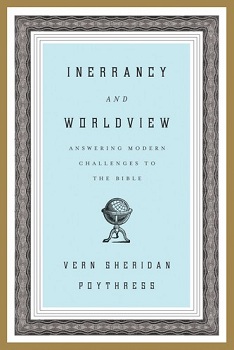
Vern Poythress provides an example of how this approach works. In his work, Inerrancy and Worldview (my review of this work can be found here), he continually focuses on how worldviews color one’s approach to challenges presented against inerrancy such as historical criticism, certain sociological theories, and philosophy of language. One example can be found in his discussion of historical criticism:
The difference between the two interpretations of the principle [of criticism] goes back to a difference in worldview. Does God govern the universe, including its history, or do impersonal laws govern it? If we assume the latter, it should not be surprising that the resulting principle undermines the Bible… It undermines the Bible because it assumes at the beginning that the God of the Bible does not exist. (Poythress, Inerrancy and Worldview
, 53, cited below)
Yet it is important to see that my approach here is different from that of Poythress. His approach seems to be largely negative. That is, he utilizes presuppositionalism in order to counter various challenges to the Bible. When a challenge is brought up to inerrancy, he argues that it of course stems from an issue of worldview. Although this is similar to my approach, Poythress never makes a positive argument for inerrancy, which I consider to be a vital part of the overall defense of the doctrine.
Appendix 2: Standard Presuppositionalism and Inerrancy
I would like to note that I am not attempting to claim that my defense of inerrancy here is the standard presuppositional approach. The standard presuppositional approach is much simpler: the apologist simply assumes the absolute truth and authority of God’s word as the starting point for all knowledge.
It should not surprise readers that, given this approach, most (if not all) presuppositionalists embrace the via negativa for defense of inerrancy. That is, the standard presuppositional defense of the Bible usually is reducible to merely pointing out how the attacks on Scripture stem largely from one’s worldview, not from the facts.
Thus, one of the foremost presuppositional apologists to have lived, Greg Bahnsen, writes:
[I]f the believer and unbeliever have different starting points [that is, different presuppositions from which all authority comes for the realm of knowledge] how can apologetic debate ever be resolved? [In answer to this,] the Christian carries his argument beyond “the facts…” to the level of self-evidencing presuppositions–the ultimate assumptions which select and interpret the facts. (Bahnsen, Always Ready, 72 cited below).
It should be clear that this standard presuppositional defense is therefore very different from what I have offered here. The standard presuppositional defense simply reduces the debate to “starting points” and attempts to show contradictions in other “starting points” in method, exposition, or the like. My defense has noted the vast importance of worldviews in a denial of inerrancy, but has also offered a positive defense of inerrancy. Yes, this defense turns on whether God exists, but that can hardly be seen as a defect or circularity in the argument.
Links
Like this page on Facebook: J.W. Wartick – “Always Have a Reason.” I often ask questions for readers and give links related to interests on this site.
The Presuppositional Apologetic of Cornelius Van Til– I explore the presuppositional method of apologetics through a case study of the man who may fairly be called its founder, Cornelius Van Til.
Debate Review: Greg Bahnsen vs. Gordon Stein– I review a debate between a prominent presuppositional apologist, the late Greg Bahnsen, and a leading atheist, Gordon Stein. It is worth reading/listening to because the debate really brings out the distinctiveness of the presuppositional apologetic.
Sources
Greg Bahnsen, Always Ready
John Frame The Doctrine of the Word of God
Vern Sheridan Poythress, Inerrancy and Worldview
SDG.
——
The preceding post is the property of J.W. Wartick (apart from citations, which are the property of their respective owners, and works of art as credited) and should not be reproduced in part or in whole without the expressed consent of the author. All content on this site is the property of J.W. Wartick and is made available for individual and personal usage. If you cite from these documents, whether for personal or professional purposes, please give appropriate citation with both the name of the author (J.W. Wartick) and a link to the original URL. If you’d like to repost a post, you may do so, provided you show less than half of the original post on your own site and link to the original post for the rest. You must also appropriately cite the post as noted above. This blog is protected by Creative Commons licensing. By viewing any part of this site, you are agreeing to this usage policy.
The Law Always Condemns, The Gospel Always Saves. Or, why I’m a Lutheran.
Comparing Holy Scripture with other writings, we observe that no book is apparently so full of contradictions as the Bible, and that, not only in minor points, but in the principal matter, in the doctrine how we may come to God and be saved… This riddle is solved when we reflect that there are in Scriptures two entirely different doctrines, the doctrine of the Law and the doctrine of the Gospel. C.F.W. Walther, The Proper Distinction Between Law and Gospel
, 6 (cited fully below)
How are Christians to view the relationship between Law and Gospel? The issue has generated countless views and debates. One recent work which illustrates the breadth of views on this topic is Five Views on Law and Gospel
C.F.W. Walther’s work, The Proper Distinction Between Law and Gospel
Law and Gospel
The most central point of all–that is, the point that I hope readers remember if nothing else–is this: The Law always condemns, the Gospel always saves. This point is emphasized throughout Lutheran theology. What does it mean? Simply put: it means that these two doctrines, found throughout Scripture, have entirely distinct meanings and usages. One cannot intermingle law and gospel while remaining true to either doctrine. Wherever the Gospel is presented as if it had requirements attached to it, there the Gospel is not rightly preached. Whenever the Law is preached as if it offered some kind of free gift, it is not rightly preached.
Law only has power to condemn. It cannot save. That is because none can keep God’s Law. All sin, and all fall short of the glory of God (Romans 3:23). The Law shows what God requires of us. It “issues only commands and demands” (Walther, Proper Distinction…, 9).
In contrast, the Gospel only gives offers without requirements attached (ibid). The Gospel shows us God’s promises and offer of grace.
At first face, one examines the whole of the Bible and finds these teachings throughout. The teachings seem so at odds with one another that one might suspect a contradiction throughout the Biblical teaching. However, the fact is that both doctrines are “equally necessary. Without the Law the Gospel is not understood; without the Gospel the Law benefits us nothing” (Ibid, 8). The reason this is so important is because Law and Gospel are not opposites working against each other. Instead, both “have their final aim [human] salvation” (Ibid, 7). They work together to present a full picture of how salvation comes unto men.
The Law, as we have noted, cannot bring salvation because none but God can fulfill it. That is, it gives the requirements for salvation but no one can meet these requirements! We would all be lost if this were the whole of Biblical teaching. Yet there is more to the story, for the Gospel offers only its promises. God has promised to save. He is mighty to save. God has accomplished our salvation. And this salvation does not come with requirements attached. Such is our hope.
Most simply put then, the purpose of the Law is to show our need for the Gospel because we cannot meet the requirements of the Law. The purpose of the Gospel is to show that God has already met these requirements for us in Jesus Christ and to offer us that fulfillment through Christ’s atoning work. So the Gospel, without the Law, would be empty promises. What need have we for Gospel if we are not sinners? Yet without the Gospel, the Law is only a terror which tells us that all are condemned.
 Some Distortions
A number of objections have been raised against this understanding of Law and Gospel. For example: “[The notion t]hat the law must be viewed as a single entity is one of the most common of all objections made against the Christian use of the Law” (Walter Kaiser, Jr., “The Law as God’s Guidance for the Promotion of Holiness,” 188, cited below). Kaiser then argues against viewing the Law as a single entity. He makes distinctions between Civil, Ceremonial, and Moral laws. I agree that we can make these distinctions, but they do not somehow mean it is impossible to refer to the “Law” as a whole entity with all of the commands God has issued.
Another common objection is that of dispensational thought. It is often charged that because we live in a new dispensation, the teachings of the Mosaic Law, for example, no longer apply to us. Without commenting on the plausibility of dispensationalism, I would simply answer that it seems extremely hard to reconcile the notion that the Mosaic Law has no applicability in our own context with Jesus’ words about the Law: “For truly I tell you, until heaven and earth disappear, not the smallest letter, not the least stroke of a pen, will by any means disappear from the Law until everything is accomplished” (Matthew 5:18). Note that this verse also shows Christ using the “Law” as a single, coherent entity.
Yet does this mean that everything recorded in the Mosaic Law has applicability exactly as written? No. A further discussion along this line of thought would take me too far afield, but I think that the Bible does clearly teach there is some discontinuity between the application of Mosaic Law to the Jew and the New Covenant with Christians (for example, the dietary laws do not apply to Christians). This hints back at the divisions Kaiser was keen to make within the Law, and I think the application to the Christian life can be viewed within the categories he discusses.
Conclusion
There is so much more worth saying about Law and Gospel, but in the interest of keeping this post at a readable length, I have had to set some aside. Interested readers should see the annotated sources below.
We have seen that the Law and Gospel must be properly divided in order to properly understand the whole of the Bible’s teaching. Why do I say that this is why I’m a Lutheran? I hope, at least, that other branches of Christianity teach these distinctions between Law and Gospel. But I have to admit that I have not seen it so consistently done as it is within the Lutheran perspective. Martin Luther was right to focus directly upon this teaching, and I believe it is central to the Reformation[s]. It touches upon soteriology, sanctification, the atonement, and more. Thus, I think it is vitally important to get this doctrine correct. In my studies, I have found no teaching so close to the Biblical truth as the Lutheran teaching on Law and Gospel. I’m not saying that everyone should go and become Lutherans. Instead, I think that everyone should benefit from learning the proper distinction between Law and Gospel and apply it to their lives.
The Law always condemns, the Gospel always saves.
Appendix: The Modified Lutheran View?
I think it is important to note that the view put forth as “The Modified Lutheran View” in Five Views on Law and Gospel
Those who have stuck with me this long should be able to immediately see how this is utterly different from the Lutheran view I proposed above. The distinction between law and gospel is not a temporal distinction whatsoever. The Law is still with us. Walther himself makes this explicit: “[W]e find both teachings in the Old as well as in the New Testament” (Proper Distinction… 62). There is no temporal dividing line between Old and New such that some new reality has dawned on Law and Gospel. Instead, the Law continues to condemn, while the Gospel continues to save.
Yet Moo goes so far as to say this is a point which needs to be “corrected” within the Lutheran view (ibid). He seems to think that Lutherans would deny that Jesus was able to speak law, while also mistakenly painting the Sermon on the Mount as being a preaching entirely of the Law. Indeed, Moo’s view seems to affirm many of the basic tenants the Lutheran view explicitly denies, such as mixing the uses of Law and Gospel.
I thus would say that Moo’s position is not at all the Lutheran view. It is not a modified Lutheran view at all. Instead, it seems to violate a number of the primary distortions noted above. That said, Moo does admirably to defend the notion of the Law as a coherent, cohesive whole. There is much to commend Moo’s essay, but it ultimately fails, I think, to provide a properly Lutheran view of Law and Gospel.
Links
Like this page on Facebook: J.W. Wartick – “Always Have a Reason.” I often ask questions for readers and give links related to interests on this site.
Annotated Sources
C.F.W. Walther, The Proper Distinction Between Law and Gospel
For a more succinct summary of what Walther argues in the above, see God’s No and God’s Yes: The Proper Distinction Between Law and Gospel
Five Views on Law and Gospel, ed. Stanley Gundry (Grand Rapids: MI: Zondervan 1999) – I specifically used the following essays: Walter Kaiser, Jr., “The Law as God’s Guidance for the Promotion of Holiness” in Five Views on Law and Gospel, ed. Stanley Gundry, 177-199, (Grand Rapids, MI: Zondervan, 1999); Douglas Moo, “The Law of Christ as the Fulfillment of the Law of Moses” in Five Views on Law and Gospel, ed. Stanley Gundry, 319-376, (Grand Rapids, MI: Zondervan, 1999). I found this book to be very helpful in outlining various views, but was disappointed with the “modified Lutheran view” (see my appendix here).
SDG.
——
The preceding post is the property of J.W. Wartick (apart from citations, which are the property of their respective owners, and works of art as credited) and should not be reproduced in part or in whole without the expressed consent of the author. All content on this site is the property of J.W. Wartick and is made available for individual and personal usage. If you cite from these documents, whether for personal or professional purposes, please give appropriate citation with both the name of the author (J.W. Wartick) and a link to the original URL. If you’d like to repost a post, you may do so, provided you show less than half of the original post on your own site and link to the original post for the rest. You must also appropriately cite the post as noted above. This blog is protected by Creative Commons licensing. By viewing any part of this site, you are agreeing to this usage policy.
Book Review: “Inerrancy and Worldview” by Vern Sheridan Poythress
Vern Sheridan Poythress approaches the defense of the truth of the Bible in a unique way in his recently-released duo of books, Inerrancy and Worldview
Overview
Poythress has set Inerrancy and Worldview
That is the central thesis of the book: our preconceived notions shape how we will view the Bible. Poythress writes:
Part of the challenge in searching for the truth is that we all do so against the background of assumptions about truth. (21)
Thus, it is critical to recognize that one’s presuppositions will in some ways guide how they view the Bible.
Poythress then introduces the materialistic worldview as the primary presupposition for the Western world which sets itself up against a Biblical worldview. The essential point here is that the world is a very different place if primary causes are personal or impersonal.
From here, Poythress dives into the various challenges which are set up against the Bible. First, he looks at modern science. The major challenges here are the Genesis account of creation, which he argues is explained by God making a “mature creation” where the world appears aged (41) and other alleged scientific discrepancies, which he argues are due to God’s condescending to use human expressions to explain the concepts in the Bible (38-39).
What of historical criticism? Again, worldview is at the center. If God exists, then history inevitably leads where God wills it. If, however, one assumes the Bible is merely human, then it is unsurprising to see the conclusions which historical critics allege about the text.
Challenges from religious language are dealt with in the same fashion. On a theistic worldview, God is present “everywhere” including in “the structures of language that he gives us.” Thus, we should expect language to refer to God in meaningful ways (101). Only if one assumes this is false at the outset does one come to the conclusion that language cannot possibly refer to God (ibid).
Sociology, psychology, and ordinary life receive similar treatments. The point which continues to be pressed is that ideologies which reject God at the outset will, of course, reject God in the conclusions.
Analysis
Inerrancy and Worldview was a mixed read for me. Poythress at times does an excellent job explaining points of presuppositional apologetics, but at others he seems to be floundering in the vastness of the topics he has chosen to discuss.
There are many good points Poythress makes. Most importantly is his focus on the concept of one’s worldview as the primary challenge to Biblical authority. It seems to me that this is the most important thing to consider in any discussion of inerrancy. If theism is true, inerrancy is at least broadly possible. If theism is false, then inerrancy seems to be prima facie impossible.
The continued focus upon the fact that worldview largely determines what one thinks about various challenges to the Bible is notable and important. In particular, Poythress’ conclusion about challenges from religious language is poignant. The notion that we can’t speak meaningfully about God is ludicrous if the God of Christianity exists.
While there are numerous good points found in the book, but they all seem to be buried in a series of seemingly random examples, objections, and response to those objections. For example, an inordinate amount of space is dedicated to the OT discussing “gods” (including sections on p. 63-65; 66-70; 71-78; 79-81; 111-112; 116-117). His discussion of the Genesis creation account also left much to be desired. The “appearance of age” argument is, I believe, the weakest way to defend a Biblical view of creation.
Poythress’ discussion of feminism is also problematic. The reason is not so much because his critique of feminist theology is off-base, but rather because his definition is far too broad for the view he is critiquing. He writes, “feminism may be used quite broadly as a label for any kind of thinking that is sympathetic with gender equality. For simplicity we concentrate on the more popular, militant, secular forms” (121). But from the text it seems clear that Poythress is focused upon feminist theology more broadly speaking then secular feminism specifically. Where he does seem to express secular feminism, he still mentions the Bible in context (124). Not only that, but his definition of feminism seems to express a view which should be entirely unproblematic (“sympathy with gender equality”) yet he then spends the rest of the section as though there is some huge negative connotation with gender equality. One must wonder: is Poythress suggesting we should advocate for “gender inequality”? And what does he mean by “equality” to begin with? Sure, this section is a minor part of the book, but there are major problems here.
Furthermore, one is almost forced to wonder how this work is a defense of inerrancy. For example, the lengthy discussion of gods referenced above has little if anything to do with inerrancy. Instead, Poythress spends the bulk of this space attempting to show how the gods referenced are really idols which people worship instead of God. Well, of course! But what relevance does this have for inerrancy specifically? Perhaps it helps solve some issues of alleged errors, but solving individual errors does little to defend the specific doctrine of inerrancy.
And that, I think, is one of the major issues with the book. Poythress seems to equate rebutting specific errors with a defense of inerrancy. While this obviously has relevance for inerrancy–if there were errors, the Bible is not inerrant–it does little to provide a positive case for inerrancy.
Perhaps more frustratingly, Poythress never spends the time to develop or explain a robust doctrine of inerrancy. It seems to me that this is part of the reason the defense seems so imbalanced. Rather than clearly defining the doctrine and then defending it, he spends all his time defending the Bible against numerous and varied errors. This is important; but it does not establish inerrancy specifically. There are plenty of Christians who are not inerrantists who would nevertheless defend against particular alleged errors in the Bible.
Conclusion
Inerrancy and Worldview
Addendum
I must make it clear that I am an inerrantist. The reason I do this is because I have seen other critical reviews of this work where comments are left that the author of the review must not believe inerrancy. Such an accusation is disingenuous. It is perfectly acceptable to say that a specific defense of inerrancy is insufficient while still believing the doctrine itself.
Links
Like this page on Facebook: J.W. Wartick – “Always Have a Reason”.
Inerrancy, Scripture, and the “Easy Way Out”– I analyze inerrancy and why so many Christians reject it. I believe this is largely due to a misunderstanding of the doctrine.
The Presuppositional Apologetic of Cornelius Van Til– I analyze the apologetic approach of Cornelius Van Til, largely recognized as the founder of the presuppositional school of apologetics.
The Unbeliever Knows God: Presuppositional Apologetics and Atheism– I discuss how presuppositional apologetics has explained and interacted with atheism.
Source
Vern Sheridan Poythress, Inerrancy and Worldview
SDG.
——
The preceding post is the property of J.W. Wartick (apart from citations, which are the property of their respective owners, and works of art as credited) and should not be reproduced in part or in whole without the expressed consent of the author. All content on this site is the property of J.W. Wartick and is made available for individual and personal usage. If you cite from these documents, whether for personal or professional purposes, please give appropriate citation with both the name of the author (J.W. Wartick) and a link to the original URL. If you’d like to repost a post, you may do so, provided you show less than half of the original post on your own site and link to the original post for the rest. You must also appropriately cite the post as noted above. This blog is protected by Creative Commons licensing. By viewing any part of this site, you are agreeing to this usage policy.
Really Recommended Posts 3/8/13
 It really is difficult to keep up with all the excellent posts around the internet. But, I have taken the liberty of doing some of that work for you and found a diverse array of posts on fascinating topics. Read them, love them, comment! This week, we’ll be looking at the prosperity gospel, Calvinism, women in the Bible, Young Earth Creationism, the History Channel’s TV show on “The Bible”, and design flaws in creation.
The Prosperity Gospel Revisted– I found this post about the “Prosperity Gospel” quite fascinating. Dan offers critical interaction with the notion that the Gospel is about empowering us to gain. I also really recommend checking out the entire site, Rockadoodee, which is always thought-provoking.
Jerry Walls: What’s wrong with Calvinism? (Video)- One of the most interesting evangelical scholars writing right now, Jerry Walls, evaluates Calvinism. I found this video quite interesting. I’ve met Walls in person and I find him to be very gracious and thoughtful.
Correcting Caricatures: Women in the Bible [This link appears to be broken now… I don’t know why. Please let me know if you can view it]- Eminent scholar Walter Kaiser looks at several key texts related to women in the Bible. I found this fascinating and enlightening. Whether you are egalitarian or complementarian, it is worth reading.
2013 International Conference on Creationism– The Geochristian outlines a number of interesting discussions at this conference, which is where all the major scholars within the Young Earth Creation movement meet. Alongside this article, you should check out these articles on the state of Young Earth Creationism: The State of Creation Science as Measured by Scholarly Publishing– this one looks at scholarly works by YECs over a recent period of time and evaluates what it means for YEC; The Next Generation of Creation Scientists?– this post looks at who may be stepping in to fill the roles of the major YEC organizations.
The Bible–Night One Review– A look at the theology in the new TV series by the History Channel: The Bible.
If God Designed Humans, How Do We Account for “Design Flaws”?– One of my favorite blogs, “Well-Spent Journey” examines the notion that humans are flawed designs as an argument against intelligent design.
Book Review: “Understanding End Times Prophecy” by Paul Benware
 Understanding End Times Prophecy
Wait, What?
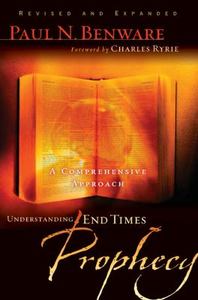
Yes, I just used the words dispensational premillenialism together in a sentence as though it made sense. It does. That is one of the many views Benware surveys in the book. Before reading Understanding End Times Prophecy (hereafter UEP), I admit I could not have distinguished a dispensational premillenialist from an amillenialist. Nor could I have identified a pre-wrath view in contrast with a post-wrath view. Benware’s book touches all of these and more, explaining the various positions out there on the various eschatological themes while also providing a thorough critique of those with which he disagrees.
Outline of Contents
Benware starts by outlining some principles for interpreting Biblical prophecy. Primary among these is the notion that prophetic passages must be interpreted literally. Benware explains: “Literal interpretation assumes that… [God] based His revelatory communication on the normal rules of human communication. Literal interpretation understands that in normal communication and in the Scriptures figures of speech are valuable as communication devices…” and it is therefore “not… a rigid ‘letterism’ or ‘mechanical understanding of the language’ that ignores symbols and figures” (23-24).
UEP then outlines a broad understanding of Biblical covenants, noting that the covenant God made with Abraham was unconditional, and so must be fulfilled.Next, Benware turns to a number of passages which outline the Palestinian, Davidic, and New Covenants. These he discusses in the context of promises God makes to Israel which must be fulfilled.
The next major section outlines the major views on the millennium. Benware favors the dispensational premillenial view and so spends some time outlining it.The dispensational view focuses on the covenants found throughout the Bible. It holds that there are different “economies” of God’s working. These dispensations are not time periods, nor are they different ways of salvation. Instead, they are specific truths about how God chooses to work with His people (86ff). This view also holds that God will fulfill promises through Israel as a literal nation in the place that God promised them (88ff).
The premillenial view holds that Christ returns before the millennial kingdom. It holds that the millennium is a literal thousand-year reign of Jesus on earth. Thus, there are two resurrections: first, before the millennial kingdom; second, after the millennial kingdom. Israel factors prominently into this view; Israel will be part of the thousand year reign and will occupy the land that God promised unconditionally to Abraham (94ff). Benware argues against the notion that Israel has become displaced or fulfilled in the church (103-120).
Then Benware turns to the view of amillenialism. Essentially, this view holds that the “millennium” is non-literal and is being fulfilled now during the church age. There is one resurrection, and the judgment comes immediately upon Christ’s return. Thus, the current period is the millennial kingdom (121-137).
Postmillenialism is the subject next discussed in UEP. This view tends to be tied into the notion that we are now living in the kingdom of God and so will usher in a golden age through social justice or action. After this undefined point, Christ will return to judge (139ff). Benware is highly critical of this view, noting that it relies upon the notion that we will continue improving the world (yet the world seems to be falling farther rather than progressing); as well as its rejection of the notion of a literal reign of Israel (150ff).
Finally, Benware evaluates preterism. Essentially, this view holds that the events prophesied in Revelation and elsewhere have either all or mostly been fulfilled already. There is much diversity within this perspective, but largely it is tied in with the notion that the destruction of the temple ushered in the end times (154ff).
The next major area of evaluation in UEP is that of the rapture. Benware analyzes pre-tribulation; post-tribulation; and other rapture views. Pre-tribulation is the view that the rapture will happen before the tribulation period. Post-tribulation is the view that the rapture happens after the tribulation. These directly tie into how one views the coming of Christ and the millennial kingdom (207ff).
Finally, UEP ends with outlines of the seventieth week of the book of Daniel, the Kingdom of God, death and the intermediate state, and the final eternal state. An enormous amount of exposition and discussion is tucked into these final chapters. For example, Benware includes a critique of annihilationism.
I have here only touched on the surface of UEP. Benware is exceedingly thorough and has managed to write an amazing resource on the issues related to End Times Prophecy.
Analysis
As has been noted, UEP is a simply fantastic resource for those who want to look at the various views which are discussed in contemporary evangelicalism. Benware has also provided an extremely detailed exposition of the dispensational premillenialist position. If someone wants to critique that view, UEP will be a book which they must reference. It is that good and that comprehensive.
Furthermore, Benware provides a number of excellent insights through the use of charts. Throughout UEP, there are charts scattered which summarize the content of what Benware argues, show pictorially what various views teach, and more. These charts will become handy for readers to reference later when they want to discuss the issues Benware raises. They also help interested readers learn what various views and positions teach.
Benware rightly shatters false notions that Biblical prophecy is some kind of indiscernible mystery language which humans weren’t meant to think on. His care for making clear what the Bible teaches on a number of issues is noteworthy.
Unfortunately, there are several areas in the book which are cause for caution. Benware’s use of proof texts is sometimes questionable. There is great merit to utilizing a series of related texts after an assertion in order to support one’s argument, but upon looking up several texts that Benware cites to make his points, it seems that he often stretched texts far out of their context or even cited texts which had nothing to do with the argument he made in the context in which he cited them. For just one example, Benware writes “The second phase of his [the Antichrist’s] careerwill take place during the first half of the tribulation… During his rise to power he will make enemies who will assassinate him near the midpoint of the tribulation (cf. Rev. 13:3, 12, 14). But much to the astonishment of the world, he is restored to life and becomes the object of worship (along with Satan)” (300). Note that Benware specifically says that the Antichrist will be assassinated and resurrected. Now, turn to the passages that Benware cites. Revelation 13:3, 12, and 14 state:
3: One of the heads of the beast seemed to have had a fatal wound, but the fatal wound had been healed. The whole world was filled with wonder and followed the beast… 12: It exercised all the authority of the first beast on its behalf, and made the earth and its inhabitants worship the first beast, whose fatal wound had been healed… 14: Because of the signs it was given power to perform on behalf of the first beast, it deceived the inhabitants of the earth. It ordered them to set up an image in honor of the beast who was wounded by the sword and yet lived. (NIV)
Now, where in this section does it say the Antichrist will be assassinated? Where in this section does it talk about the Antichrist dying and being raised to life? Strangely, Benware seems to reject the literal hermeneutic he advocates, and begins to interpret texts in ways that bend them to the breaking point.
The issue of these proof texts opens a broader critique of UEP. Benware constantly insists upon a literal reading of Revelation and other prophetic texts, while also criticizing those who hold other views of using an inconsistent hermeneutic. Yet, as I believe I demonstrated above, Benware often goes well beyond the literal meaning of the texts and comes to conclusions which stretch them past literal readings. In fact, it seems that Benware balances an often literalistic reading of the text with a non-literal reading. Thus, Benware seems to fall victim to the very error he accuses all other positions of falling into.
An overall critique of the position Benware holds would take far too much space and time for this reader to dedicate in this review, but I would note that the conclusions Benware comes to are often the result of the combination of literalistic readings and/or taking texts beyond what they say that I noted above. Some of the worrisome issues include the notion that the sacrificial system will be reinstated (334ff); a view in which the notion that the church seems in no way fulfill the Biblical prophecies about Israel (103ff); hyper-anthropomorphism of spiritual beings (i.e. demons, which are spiritual beings, being physically restricted [130]); and the insistence on literalizing all numbers in the Bible (168), among issues. It’s not that Benware doesn’t argue for these points; instead, it was that it seems his method to get his conclusions was sometimes faulty, and the case not infrequently was overstated.
One minor issue is Benware’s use of citations. It’s not that he fails to cite sources; rather, the difficulty is that he inconsistently tells the reader where the source is from. Very often Benware block quotes another text (with proper end note citation) without letting the reader know who or what he is quoting. Although this may be better for readers only interested in the argument, it can be very frustrating for those interested in knowing where Benware is getting his information to have to flip to the back of the book all the time to trace down sources. The problem is compounded by the fact that sometimes he does tell the reader where the quote is from (for example, he’ll write “so-and-so argues [quote]”) while at other times he just dives directly into the quote. The inconsistent application here may be a minor problem, but it did cause major frustration through my reading of the text.
Conclusion
Understanding End Times Prophecy
Source
Paul Beware Understanding End Times Prophecy
Disclaimer: I was provided a review copy of this book by the publisher My thanks to Moody Books for the opportunity to review the book..
SDG.
——
The preceding post is the property of J.W. Wartick (apart from citations, which are the property of their respective owners, and works of art as credited) and should not be reproduced in part or in whole without the expressed consent of the author. All content on this site is the property of J.W. Wartick and is made available for individual and personal usage. If you cite from these documents, whether for personal or professional purposes, please give appropriate citation with both the name of the author (J.W. Wartick) and a link to the original URL. If you’d like to repost a post, you may do so, provided you show less than half of the original post on your own site and link to the original post for the rest. You must also appropriately cite the post as noted above. This blog is protected by Creative Commons licensing. By viewing any part of this site, you are agreeing to this usage policy.
Young Earth Creationism and Presuppositionalism: An Analysis
 Young Earth Creationism stands or falls based upon the specific use of presuppositionalism as an epistemological groundwork. Here, I will challenge the very core of the young earth paradigm: I will charge that it is an invalid presuppositionalist approach to viewing science and theology.
Young Earth Creationism (YEC will be used hereafter for “young earth creationism,” “young earth creationist” and other forms of those words as needed), is, of course, the position that the Genesis account of the creation of the universe took place over the course of seven literal 24-hour days about 6-12,000 years ago. I have extensively explored various aspects of young earth creationism and other positions, and my posts can be found under the “Origins Debate” page.
Presuppositionalism is a type of apologetics (defense of the faith) which relies upon presupposing the truth of the Christian worldview in order to defend it. I have analyzed presuppositional apologetics a number of times. For an introduction into this position, check out “The Presuppositional Apologetic of Cornelius Van Til.”
Epistemology is the study of how we come to know things. Essentially, it asks questions like “How do we know that we know?”
Before proceeding, it is worth noting that many debates between YECs and people who believe in an ‘old earth’ perspective turn on the YEC use of presuppositionalism. A common theme for mocking YECs is to say they just refuse to hear evidence or shout over evidence, yet it seems that this is an unfair portrayal. As we evaluate the young earth position, it will become clear that the YEC perspective operates from within a presuppositional framework that explains much of the way YECs reason. It will also become clear, however, that the YEC use of this framework is invalid.
Thus, it is my contention that YEC is directly dependent upon a presuppositional approach to how we know things. For support of this contention, I note the fact that many YECs see this connection themselves. For example, Answers in Genesis has a number of posts on the topic, including a post outlining the meaning of and need for presuppositional apologetics. Or again, Nathaniel Jeanson of ICR presented a presuppositional case for YEC (analyzed by the Geochristian). However, this is not the only evidence. YECs tend to argue exclusively within a presuppositional framework.
Consider this argument:
The Bible clearly states that the earth was made in seven days. There is no room to interpret the text in any way other than as a literal week of creation.
Such an argument is extremely typical within the YEC community. However, it is also clearly a presuppositionalist approach to the question of the age of the earth. YECs will argue that science must be interpreted in such away as to line up with the creation account. A common theme is that “The data is the same, it is the interpretations of that data that differ,” another notion is that people are rejecting the “plain and obvious meaning of the text” when they offer an old earth interpretation. Such a position is often united with the notion that only by using “man’s fallible ideas” can one come up with a date of millions or billions of years.
The thought process goes in this order: we presuppose the truth of the Bible => the Bible teaches that the earth is 6-12,000 years old => all scientific evidence for the age of the earth must line up with the truth of the Bible. The Bible is the infallible word of God, and so it cannot be in error. Because, according to the YEC paradigm, the only possible interpretation for the Biblical account of creation is the young earth perspective, it therefore becomes clear that all science and truth must line up with YEC.
We are thus left with two possible ways to challenge YEC. Evidence simply is not the problem. Any evidence, if the YEC use of presuppositionalism is valid, simply must line up with YEC. Thus, to challenge YEC, one must confront directly its presuppositions. First, one can challenge the position by attacking the premise that the YEC paradigm is the only possible interpretation of the Genesis creation account. Second, one can challenge the position by directly attacking the presuppositional epistemological groundwork that the arguments are built upon. Rather than focus upon the first challenge, we will here explore whether or not the YECs have validly made use of the presuppositional approach.
 Assuming a Young Earth
It is important to note that the way the YEC argument works is to begin by simply assuming the truth of young earth creationism. I know this may sound radical, but it plays out time and again when discussing the various positions on the age of the earth. The young earth paradigm brokers no alternatives; only the young earth perspective is even possibly correct. How is it that YECs are so confident in their approach?
Simply put, the confidence is gained from the very way that they defend the young earth. YEC is not defended based upon evidence. It is not as though scientists are examining the earth and coming to the conclusion that the earth was formed only some thousands of years ago. Indeed, several prominent YECs assert that the very notion of finding the age of the earth from investigation of the geologic past is impossible or hampered by sin and fallible ideas. For just one example, Whitcomb and Morris, in their highly influential work, The Genesis Flood
[I]f He [God] did this [created a universe full-grown], there would be no way by which any of His creatures could deduce the age or manner of Creation by study of the laws of maintenance of His Creation. (238, emphasis theirs, cited below)
Such a notion persists throughout much YEC literature. In principle, the only way to conclude a young earth is to abandon supposed “uniformintarianism” (hold that the processes in place today continue at the same rate they did in the past–see an evaluation of one YEC’s use of this notion here) and view all of the history of the earth through the lens of God’s word. Now, whether or not it is valid to assume that the Genesis text is a scientific account, the argument here should be fairly clear. Namely, the young earth position is assumed. It is not something demonstrated by science, but rather a given before any scientific investigation takes place. Similarly, the position is assumed to be true before any exegesis has occurred. All scientific evidence and any exegetical hints at a different position are subsumed into the YEC position because it is assumed from the outset as correct. Because YEC is correct, all evidence must line up with it.
Some may object by arguing that frequently YECs offer evidence for their position. They may cite various catastrophic theories or flood geology as alternative explanations of Earth’s geologic past. However, even the authors of books like these (such as Whitcomb and Morris, or Walter Brown in his In the Beginning) admit that the key is to presuppose Scripture, which is of course, on their view, to presuppose a young earth.
The Validity of the Young Earth Assumption
It is clear that YEC turns upon presupposing its truth. YEC is assumed to be true, and all alternative views are simply wrong by default. Unfortunately, this is an abuse of presuppositional apologetics.
It is important to contrast the specifically YEC use of presuppositionalism with the wider use of presuppositional apologetics. Presuppositional apologetics in general is the method of engaging entire worldviews by granting their core assumptions and lining them up against reality in a competition of best explanation. The YEC use of presuppostionalism is to defend a single contention–a young earth–against all comers. There are very significant disanalogies here. What the YEC has done is use presuppositionalism not to enter into the square of debate over whole worldviews, but rather to insulate their interpretation against any possible counter-evidence.
There is a distinct difference between the use of presuppositional apologetics, and the use of YEC in presuppositionalism. The latter tends to simply reject outright any challenge as either against the “clear word of God” or as “assuming uniformitarianism.” By placing their own view beyond the realm of rational inquiry, they have undermined their own potential to know that it is true.
 The Faulty Grounds of the YEC Presuppositionalist
The foregoing evaluation leads us to the greatest difficulty facing the YEC approach: a faulty epistemology. Unfortunately, the way that the defense of YEC has been shown to work introduces a paradigm of knowledge which is impossible to sustain. Essentially, the YEC must assume what they think they know. Such an assumption seems to be viciously circular. The YEC must reason thus: “The Bible teaches a young earth=> The Bible is True=> the earth is young.” When presented with counter evidence, rather than engaging with the evidence, the YEC generally falls back to this same argument and reinterprets the evidence. That is where the whole system breaks down: the YEC has not made the right use of presuppositionalism, which allows for entire worldviews to be falsified. Instead, the YEC has misused presuppostionalism to put a young earth interpretation beyond falsification.
The objection will be made that everyone has core beliefs that must be assumed without evidence. Although such an assertion is itself hotly debated, I think it is possible to sidestep such a difficult discussion. Instead, one can note that even if one grants that core beliefs are necessarily assumed, the burden of proof is squarely placed upon the YEC to show how holding to a young earth is necessary for knowledge. Why is this the case? The simplest explanation is that if one assumes the epistemology needed for presuppositionalism is correct, then one has essentially a framework that involves the assumption of core beliefs that are necessary to allow for any knowledge. Thus, for example, the existence of God might be argued as necessary for knowledge (a la Alvin Plantinga, Cornelius Van Til, Greg Bahnsen, and the like) because without God to make us rational, there is no basis for thinking that our beliefs have any actual relationship to reality. Whether or not this is the case, it seems that a young earth is not one of these core beliefs.
Thus, we have finally come to the ultimate failing of the presuppositional defense of YEC: it abuses its epistemological framework to the point of breaking. The YEC has utilized an epistemological approach that allows for core beliefs to be assumed, but has done so in such a way that essentially any belief could be assumed with equal validity. An old earth creationist or theistic evoloutionist could equally argue that their position is based upon a core belief that must be assumed, in which case YEC is undermined. In turn, they could assume their reading of Scripture and make all others wrong by default.
Presuppositionalism must walk a fine line to determine which presuppositions are genuinely those which must be assumed for knowledge. When challenged, the presuppositionalist must make arguments to show that the presuppositions are indeed necessary for knowledge. Unless and until a YEC makes a case that by abandoning the notion of a young earth, one necessarily undermines all knowledge–a case which I must admit seems impossible–the YEC use of presuppositionalism is undermined. Rather than making a valid use of that apologetic approach, YECs have undermined its very principles, and have thus eliminated their own possibility of knowledge. They have relativized all truth by introducing as “first principles” things which are not necessary for knowledge.
A Final Defense
The YEC may object, saying that they have indeed established that YEC is necessary for knowledge. After all, if one denies YEC, which is the clear teaching of Scripture, one has denied God’s word, which is the basis for the entire presuppositional approach.
Setting aside a critique of presuppositionalism as the notion that one must assume the entirety of Scripture to have any knowledge, I would respond by simply noting that this argument does nothing to rebut my charge. I have argued that believing the notion that the earth is merely thousands of years old is not necessary for knowledge. The burden of proof rests squarely on the YEC to show how it is. By merely asserting that denying YEC undermines all of Scripture, one has begged the question. They have engaged in a presuppositional defense of something for which it has been charged that such an approach is epistemologically impossible. In order to defend it, one cannot simply assume that the other side is wrong, one must show how they are wrong.
Objective Knowledge
We have seen that YEC misuses presuppositionalism. A final point worth noting is that the YEC approach to apologetics actually undermines the possibility of objective knowledge. For, as we have noted, the YEC simply assumes their interpretation of the text without argument and then evaluates all science and theology through that lens. However, the YEC offers no reason for rejecting the notion that others could do exactly the same thing with their interpreatations of the text. The YEC has essentially made all truth relative. Anyone can simply assume their position is correct without argument, and then reinterpret all counter-evidence based on that approach. It therefore becomes clear that the YEC use of presuppositionalism must be rejected.
Unfortunately for YECs, the young earth position itself stands upon the bedrock of its faulty use of presuppositionalism. It remains to be seen whether it can adapt itself for a solid evidential base.
A Way Forward in the Age of the Earth Dialogue
It has become clear that YEC is based upon a faulty use of presuppositionalism and that its use of the presuppositional approach undermines the very possibility of objective knowledge.
How, then, can one proceed? It seems that the best way to proceed is to simply throw off the bindings of the misuse of presuppositionalism (taking note that presuppositionalism in general is not necessarily invalid if used properly–see discussion here) and engage in an honest debate over the evidence for either position. Rather than throwing out rote accusations at the other side (“You’re denying Scripture”; “That’s just because you’re assuming ‘uniformitarianism'”; etc, etc), let us engage in dialogue on the evidence at hand. Let’s look at the text in its cultural and linguistic context. Let’s examine the geological evidence of the earth and see where the evidence leads us. Let us not cut off the discussion before it has even begun by simply assuming we’re right and the others are wrong. We are called to always have a reason (1 Peter 3:15). By abandoning the necessity of reasoning when it comes to an issue such as young earth creationism, YECs have undermined the very possibility of a consistent apologetic.
Links
I examine a number of common young earth creationist arguments. Also check out my extensive writings on the origins debate.
Naturalis Historia is a phenomenal site which largely focuses upon investigating claims about a young earth. Some great starting places would be the series on the amount of salt in the oceans (Part 1 here) or some of the thoughts on baraminology.
Geocreationism is another site that examines evidence for the age of the earth with a theological approach. I highly recommend it.
Finally, the GeoChristian offers a number of critiques of the young earth theological and scientific perspectives.
Sources
John Whitcomb and Henry Morris, The Genesis Flood 50th Anniversary Edition
The last image is from NASA. The other images were personal photographs and protected by the copyright on this site.
SDG.
——
The preceding post is the property of J.W. Wartick (apart from citations, which are the property of their respective owners, and works of art as credited) and should not be reproduced in part or in whole without the expressed consent of the author. All content on this site is the property of J.W. Wartick and is made available for individual and personal usage. If you cite from these documents, whether for personal or professional purposes, please give appropriate citation with both the name of the author (J.W. Wartick) and a link to the original URL. If you’d like to repost a post, you may do so, provided you show less than half of the original post on your own site and link to the original post for the rest. You must also appropriately cite the post as noted above. This blog is protected by Creative Commons licensing. By viewing any part of this site, you are agreeing to this usage policy.
“Fitzpatrick’s War”- Religion, truth, and forgiveness in Theodore Judson’s epic steampunk tale
The roar of our guns was more than my ears could hear. The slaughter in the two rivers was more than one man’s mind could absorb… A sort of madness over came us; we had an infinity of bullets and an infinity of Chinese before us. Every one of our men felt he was killing thousands… Death ran wild. How terrible it is, I thought, that the Yukons should be so good at this. (Judson, 319-320)
Fitzpatrick’s War
Brief Overview of the Plot
Fitzpatrick’s War is written as an autobiographic tell-all from the perspective of Sir Robert Mayfair Bruce. He is writing about Lord Isaac Prophet Fitzpatrick, a man who, like Alexander the Great, had conquered the world at a young age and also died young. Bruce was a close friend of Fitzpatrick (whom he calls Fitz) and so reveals a number of less-than-flattering aspects of his personality in his account of the life of the former ruler. It describes Fitzpatrick’s rise to power, his preparations for war during behind his father’s back, and his post-war rule.
Fitzpatrick is revealed as a man who lusted for power and ruled ruthlessly. He participated in assassinations, set up deaths, and mercilessly slaughtered his enemies. He used biological and chemical weapons and burned his enemies to the ground, all simply because of a desire to conquer the world. He had delusions of grandeur, envisioning himself as a kind of modern Alexander who would outdo the other man in every way.
The Timermen are another major player throughout the book. They are mysterious in their motivations and have supreme power over all space travel and most communications. Bruce reveals a number of unflattering details about these people as well.
The book has been edited by Doctor Professor Roland Modesty Van Buren, who is hostile to Bruce’s recounting of the events. Van Buren does not believe that Bruce is telling the truth about the great Fitzpatrick and believes he is instead attempting to make his own name live on through his lies. Thus, the book is footnoted throughout with Van Buren’s corrections to Bruce’s “lies.”
Religion
Religion is pervasive throughout Judson’s work. The characters constantly quote from the Bible to justify their positions which frequently seem unbiblical and evil. Although the society at large seems to think highly of the Bible, the United Yukon Church itself seeks to take over all religion and has repressed other expressions of religion for quite some time.
Yet Bruce is fully aware of how the Christian faith is being abused throughout the work for evil ends. In one scene, he is speaking privately with Fitzpatrick, who asks Bruce whether God can love someone who will wreak such evil on the world. Specifically, he asks about King David in the Bible. Fitzpatrick wants to know whether he himself is like King David and why God would love someone who so frequently strayed from righteousness. Bruce realizes that it is here that he could have influenced Fitzpatrick to turn from the great evils he would perpetuate. Yet, coveting power, Bruce makes the decision he would regret for the rest of his life and backs Fitzpatrick’s notions of glory and God. He writes:
I would today give up my soul if I could go back to that moment and tell Fitz he could still turn back from his awful destiny. I grant that he had at this date already committed murder. It was equally true that he had not yet made his oceans of blood… The world could have still been saved from his wrath… (204)
Instead, Bruce caves into his own lust for power and desire to please Fitzpatrick. He tells Fitzpatrick:
God loves you… There are a few special men… who, like David, walk through History as Angels walk through thunderstorms. Those about them become wet with sin, while they remain untouched. They may seem to be bad men, these special ones. If we judge them by the standards we hold ordinary men to, they are the worst of men. Ordinary standards do not apply to them. They are doing God’s work here on earth, and as we do not know God’s motives or His ends we cannot judge His servants… You [Fitzpatrick] will be said to be God’s beloved. (204-205)
Bruce regrets this discussion with Fitzpatrick for the rest of his life and struggles with the notion that he can be redeemed.
Fitzpatrick himself seeks a kind of syncretism of all religions, but realizes that it will not ultimately work. He keeps his old tutor, Dr. Flag, around mostly to feel superior about himself. But he had initially attempted Dr. Flag’s project of making all faiths equally valid. One discussion in the book is particularly revealing. Dr. Flag is expounding upon the notion that all religions are essentially the same, but Marshal Jeremiah Truth Hood challenges him on this notion:
“Sir, am I to understand you believe all major religions profess the same core beliefs?” [Hood Asked]
“Yes…” [replied Flag]
“Then that would mean, let us say, that the Chinese and the Arabs share the same beliefs on marriage and family?” asked Hood… “Can we say,” asked Hood, “that Arabs and the Chinese value life to the same degree? Or is human life another secondary question?”
“I mean specific, general matters. You see, such as treating others well.” [Responded Flag]
“You say cultures are essentially the same,” continued Hood. “How would you explain, sir, the different Histories of North and South America? Both continents are inhabited by Christians. The majority in both continents are of European descent…” (364-366)
Hood’s point is well taken. The fact of the matter is that all religions are not the same and to say otherwise devalues the religious persons themselves. The way that Judson presents this dialogue allows for some real insight into the issue: how is it possible to say that, at their core, all cultures or religions are the same when they are so radically different?
Evil, Repentance, and forgiveness
There is great evil in the world, and Bruce’s world is no different. Much of the evil is caused by Fitzpatrick and the war which he created in his lust for power.
Ultimately, Fitzpatrick is reduced to a broken, suspicious man who becomes incapable of even doing the simplest tasks on his own. Marshal Hood is greatly distressed over his own incapacity to make amends for the evils he had done during the War. Hood is sitting with Fitzpatrick and several other Lords when they watch a video from an aerial shot of China and see the destruction their war had done to the country. The bodies were strewn about and death was everywhere. Bruce, too, feels the need for repentance: “There were no words in my vocabulary I could utter that could justify this abomination, no act of contrition that could ever take away what I had done” (410). Hood himself begins quoting from the Bible, Joel chapter 1. He relates the evils they have done to the crimes that Joel cries out against. Later, Hood is found among the Chinese, trying to help them by growing food and feeding them. It was his way of making amends.
Bruce himself finds forgiveness only through his wife, who speaks with clarity on God’s will and his grace. It seems to me that this theme of forgiveness is grounded thoroughly in the Christian notion wherein people are to forgive each other. We act as God’s agents here on earth, and so we are called to repentance and forgiveness.
Charlotte
Bruce’s wife, Charlotte, is a paradigm example of a powerful, spiritual, loving woman. Van Buren, the hostile editor of the book, has several choice words to describe Charlotte, whom he believes is overstepping her bounds by attempting to be equal to Bruce. She often seems overbearing, but ultimately she strives to be equal to Bruce, and to temper the poor qualities of Bruce’s character. Charlotte is Roman Catholic, a religion which is violently oppressed in Yukon, until Fitzpatrick allows for religious freedom to endorse his own pluralism. Charlotte’s character is important throughout the work as one who provides the positive example of womanhood and the equality of men and women.
History and Doing History
History (always with a capital “H”) is an area of extreme interest in the world of Fitzpatrick’s War. Fitzpatrick himself continues to utter a recurring theme: History is written by the winners. Above, there was a discussion of King David. Fitzpatrick in that same conversation presses the notion that King David rewrote the history books in order to paint him in the most positive light. Later, in his own life, Fitzpatrick would do the same thing. He had the greatest poets and historians of his age come and write histories about him which were highly favorable in their portrayals of himself.
There is active repression of historical knowledge due to the fact that the culture at the time the book is set in believes that the “Electronic Age” (20th and 21st centuries) was a blight upon all History. During one scene, Bruce is being questioned about the Electronic Age and readers discover that only one history exists from that period. The reason is because “[A]ll other Histories of that era were perverted by the strange ideologies of the day…” (35).
As one who has studied historiography (and written on the method regarding Jesus), I can’t help but think of all the issues these discussions raise throughout the book. Interested readers should check out the post linked in the parentheses for one brief account of historiographic method.
Conclusion
I have read few books which have had such a great depth of knowledge about so many subjects as is demonstrated in Fitzpatrick’s War. The book is just phenomenal, and it touches upon so many areas of great importance for Christians and non-Christians alike. As with all great fiction, it does this without becoming overbearing, but instead focuses upon the story. Judson develops wonderful characters whom the reader can relate to, love, or loathe. He explores heady themes with wit and precision. I highly recommend this book to my readers.
Links
Religious Dialogue: A case study in science fiction with Bova and Weber– I explore two excellent science fiction books alongside each other to see how they speak to religious dialogue.
The Presumption of Pluralism: How religious pluralism devalues all religious persons– I discuss religious pluralism, a topic which is brought up throughout Fitzpatrick’s War and show how it fails.
Check out more of my looks at popular level books. (Just scroll down to see more!)
Hieropraxis is an excellent site which focuses upon a number of cultural issues and how they relate to Christianity. I really cannot recommend this site highly enough.
Empires and Mangers– Another phenomenal site which looks at many popular level works from a Christian perspective. The posts are consistently fantastic. I encourage you to follow this site closely.
SDG.
——
The preceding post is the property of J.W. Wartick (apart from citations, which are the property of their respective owners, and works of art as credited) and should not be reproduced in part or in whole without the expressed consent of the author. All content on this site is the property of J.W. Wartick and is made available for individual and personal usage. If you cite from these documents, whether for personal or professional purposes, please give appropriate citation with both the name of the author (J.W. Wartick) and a link to the original URL. If you’d like to repost a post, you may do so, provided you show less than half of the original post on your own site and link to the original post for the rest. You must also appropriately cite the post as noted above. This blog is protected by Creative Commons licensing. By viewing any part of this site, you are agreeing to this usage policy.
Resource Review: “In the Days of Noah: A Deeper Look at the Genesis Flood”
 Reasons to Believe is a science faith think-tank dedicated to showing that Christianity is true. Recently, I had the opportunity to view their resource, “In the Days of Noah.” The video features a lecture by Hugh Ross regarding the extent, location, and timing of the Noahic (Biblical) Flood.
One of the central points of Ross’ argument is that people must take an integrative approach to the question of the Genesis Flood. It is not enough to look at just one verse or one chapter or even one book of the Bible and declare the question closed. Instead, Ross argues, one must take the entirety of the Scriptural data and see what it tells readers about the Flood. Not only that, but the relevant scientific findings must be taken into account as well.
For many Christians, the extent of the Flood is taken as a test for orthodoxy. Ross argues convincingly, however, that the Biblical account does not necessitate that the Flood covered the entire surface of the planet. He goes over a wide range of texts that discuss events that are said to be “world wide” or to “cover the whole earth” or that are supposed to bring “every nation” to a certain place and shows how the usage of the term was relative to the author. Ross cites a number of texts to back up this claim and shows how in many places–the Joseph narrative, writings about Solomon, etc.–the words taken as universals generally (“whole earth,” “all nations,” etc.) are used specifically to mean the whole immediate/relevant world.
There are a number of texts describing creation that go into greater detail about specific aspects of the Genesis account. Ross outlines his argument via these texts by specifically noting a number which discuss the limits set for the waters. For example, Proverbs 8:29 states quite explicitly that God gave the sea its boundary. Ross continues through the Bible and cites numerous examples wherein it talks about God setting boundaries for the waters. From there, he makes the argument that these verses give us a principle: God has set the oceans in their boundaries from Creation. He then utilizes this as an argument for a local flood as opposed to a global flood.
I think that this may be the weakest part of Ross’ argument, because it is possible to counter this reasoning by saying that just because there are a number of texts talking about the boundaries set for the water, it does not mean that the water can never cross these boundaries. In fact, one might counter by noting that Ross’ view entails a kind of uncertainty over what exactly is meant when the Bible discusses the boundaries or limits for the oceans. After all, even on Ross’ view, some body of water covered a vast expanse of land–indeed, the whole inhabited world at the time. In fact, one may argue that due to what we know about plate tectonics, the oceans have not, in fact, had clear boundaries from the beginning but have instead been shifting as the continental plates drift.
Of course, Ross could counter by noting that those continental plates themselves act as boundaries for the oceans. Even though these plates shift, they remain ‘fixed’ in the sense of constant. Regardless, it seems that the rebuttal given above must be given at least some weight in considering Ross’ overall argument. However, even if one denies the force of his argument for the Scriptural notion of fixed boundaries as being a limit for a global flood, one must still contend with his argument to open up the possibility of a local flood by noting the difference between general and specific uses of the notion of a “worldwide” event.
That said, Ross turns to the scientific evidence and notes a number of evidences against a global flood. First, there are such things as unambiguous signs of a flood. He points out the possibility of checking ice cores and sediment cores for the continuous record of the last several hundred thousand years, so if there was a global flood there should be a signal in the ice layers evidence for a global flood. These layers are annual and we know this by looking for volcanic eruptions lined up in the layers at the correct times. These can therefore be calibrated by lining them up with volcanic eruptions that we know of historically. Moreover, the ice layers line up with the ellipticity of the earth, so there are multiple independent ways to test these ice layers. However, in these layers there are none of the telltale signs for a global flood.
So where was the flood? Ross notes a number of verses in the Bible to narrow in on the location of Eden, and then extrapolates from that where civilization would flourish. Due to some geological evidence for there having been a blockage on the end of the Persian Gulf which would have, combined with the melting of ice and the extreme amount of rain noted in the Biblical account, flooded a huge portion of the Mesopotamian Plain. The region is surrounded by mountains which would have blocked in the water for the flood. Such a flood would have wiped out the extent of known humanity at the time, argues Ross.
 There are a number of arguments that young earth creationists, who often rely upon “Flood Geology” to explain a number of features of the geological past to maintain their view of the history of the earth, would raise to Ross’ presentation. For example, the image on the right was created by Answers in Genesis to parody the notion that a flood can be local when the Bible says that even the mountain-tops were covered (Genesis 7:18-20) [all credit for the image to Answers in Genesis, I make no claim to having produced it in any way]. Ross answers this argument by noting that the word can also mean hills and that with the extent of the flood he proposed, there would be no visible hills or mountains from the Ark. Thus, Ross’ argument is much along the lines of his integrative approach: that we must take into account all the relevant Biblical texts as well as noting the scientific evidence.
It would be remiss to have a review of a video without looking into the visuals. The video is a lecture divided into chapters, so a decent portion of it is spent watching Hugh Ross talk. However, there are also a number of very useful images and slides presented which will provide viewers in groups with opportunity for discussion and individual viewers with valuable resources to discuss the Biblical Flood.
“In the Days of Noah” is a great resource for those interested in the Noahic Flood. Hugh Ross is a lucid thinker and clearly lays out his perspective on the flood in terms that listeners will easily comprehend. Ross’ case is based off a holistic approach to natural and special revelation. Although Ross does not answer every counter-argument which those opposed to his view may present, the video can act as a valuable way to open discussions and perhaps come to a better understanding of God’s truth.
Source
“In the Days of Noah: A Deeper Look at the Genesis Flood” (Reasons to Believe), 2010.
Image Credit for the second image goes to Answers in Genesis.
SDG.
——
The preceding post is the property of J.W. Wartick (apart from citations, which are the property of their respective owners, and works of art as credited) and should not be reproduced in part or in whole without the expressed consent of the author. All content on this site is the property of J.W. Wartick and is made available for individual and personal usage. If you cite from these documents, whether for personal or professional purposes, please give appropriate citation with both the name of the author (J.W. Wartick) and a link to the original URL. If you’d like to repost a post, you may do so, provided you show less than half of the original post on your own site and link to the original post for the rest. You must also appropriately cite the post as noted above. This blog is protected by Creative Commons licensing. By viewing any part of this site, you are agreeing to this usage policy.
Book Review: “Cold Case Christianity” by J. Warner Wallace
 I’ll forego the preliminaries here and just say it: this is the best introductory apologetics book in regards to the historicity of the Gospels I have ever read. If you are looking for a book in that area, get it now. If you are not looking for a book in that area, get it anyway because it is that good. Now, on to the details.
Cold-Case Christianity
He begins the work with a section on method. He argues that we must learn to acknowledge our presuppositions and be aware of them when we begin an investigation. Like the detective who walks into a crime scene with a preconceived notion of how the murder played out, we can easily fall into the trap of using our expectations about a truth claim to color our investigation of the evidence for that claim. Learning to infer is another vastly important piece of the investigation. People must learn to distinguish between the “possible” and the “reasonable” (34ff). This introduction to “abductive reasoning” is presented in such a way as to make it understandable for those unfamiliar with even the term, while also serving as great training on how to teach others to reason for those involved in apologetics.
Chapter 3, “Think Circumstantially” is perhaps the central chapter for the whole book. Wallace notes that what is necessary in order to provide evidence “beyond a reasonable doubt” is not necessarily “direct evidence.” That is, direct evidence–the type of evidence which can prove something all by itself (i.e. seeing it rain outside as proof for it actually raining)–is often thought of to be the standard for truth. Yet if this were the standard for truth, then we would hardly be able to believe anything. The key is to notice that a number of indirect evidences can add up to make the case. For example, if a suspected murderer is known to have had the victim’s key, spot cleaned pants (suspected blood stains), matches the height and weight a witness saw leaving the scene of the crime, has boots that matched the description, was nervous during the interview and changed his story, has a baseball bat (a bat was the murder weapon) which has also been bleached and is dented, and the like, these can add up to a very compelling case (57ff). Any one of these evidences would not lead one to say they could reasonably conclude the man was the murderer, but added together they provide a case which pushes the case beyond a reasonable doubt–the man was the murderer.
In a similar way, the evidences for the existence of God can add up to a compelling case for the God of classical theism. Wallace then turns to examining a number of these arguments, including the moral, cosmological, fine-tuning, and design arguments. These are each touched on briefly, as a kind of preliminary to consider when turning to the case for the Gospels. Furthermore, the notion of “circumstantial” or cumulative case arguments hints towards the capacity to examine the Bible and the Gospels to see if they are true.
Wallace then turns to examining the Gospels–Mathew, Mark, Luke, and John–in light of what he has learned as a detective. He utilizes forensic statement analysis as well as a number of other means by which to investigate witnesses and eyewitness reports to determine whether the Gospels can be trusted. He first turns to Mark and makes an argument that Mark had firsthand contact with Peter, one of the Disciples and an Apostle. He shows how we can search for and find “artifacts”–textual additions that were late into the accounts of the Gospels. None of these are surprises, because we know about them by investigating the evidence we have from the manuscript tradition. By piecing together the puzzle of the evidences for the Gospels, we form a complete picture of Christ (106ff).
It is easy to get caught up in “conspiracy theory” types of explanations for the events in the Bible. People argue that all kinds of alternative explanations are possible. Yet Wallace notes again that there is a difference between possible and reasonable. Simply throwing out possible scenarios does nothing to undermine the truth claims of the Gospels if the Gospels’ own account is more reasonable. Furthermore, drawing on his own knowledge from investigating conspiracy theories, Wallace notes that the Gospels and their authors do not display signs of a conspiracy.
A very important part of Cold-Case Christianity is the notion that we can trace back the “chain of custody” for the Gospels. By arguing that we are able to see how the New Testament was passed authoritatively from one eyewitness to disciple to disciple and so on, Wallace argues that conspiracy theories which argue the Gospel stories were made up have a much less reasonable explanation than that they are firsthand accounts of what happened. Much of the information in these chapters is compelling and draws on knowledge of the Apostles’ and their disciples. It therefore provides a great introduction to church history. Furthermore, Wallace notes that a number of things that we learn from the Gospels are corroborated not just by other Christians, but also by hostile witnesses (182ff). He also argues that we can know that the people who wrote the Gospels were contemporaries of the events they purported to report by noting the difficulties with placing the authors at a later date (159ff). This case is extremely compelling and this reviewer hasn’t seen a better presentation of this type of argument anywhere.
There are many other evidences that Wallace provides for the historicity of the Gospels. These include undesigned coincidences which interlink the Gospel accounts through incidental cross-confirmations in their accounts. I have written on this argument from undesigned coincidences before. Archaeology also provides confirmation of a number of the details noted in the Gospel accounts. The use of names in the Gospels place them within their first century Semitic context.
Again, the individual evidences for these claims may each be challenged individually, but such a case is built upon missing the forest for the trees. On its own, any individual piece of evidence may not prove that the Gospels were written by eyewitnesses, but the force of the evidence must be viewed as a complete whole–pieces of a puzzle which fit together in such a way that the best explanation for them is a total-picture view of the Gospels as history (129ff).
All of these examples are highlighted by real-world stories from Wallace’s work as a detective. These stories highlight the importance of the various features of an investigator’s toolkit that Wallace outlined above. They play out from various viewpoints as well: some show the perspective of a juror, while others are from the detectives stance. Every one of them is used masterfully by Wallace to illustrate how certain principles play out in practice. Not only that, but they are all riveting. Readers–even those who are hostile to Christianity–will be drawn in by these examples. It makes reading the book similar to reading a suspense novel, such that readers will not want to put it down. For example, when looking at distinguishing between possible/reasonable, he uses a lengthy illustration of finding a dead body and eliminating various explanations for the cause of death through observations like “having a knife in the back” as making it much less probable that accidental death is a reasonable explanation, despite being possible.
Throughout the book there are also sidebars with extremely pertinent information. These include quotations from legal handbooks which describe how evidence is to be viewed, explanations of key points within the text, and definitions of terms with which people may be unfamiliar. Again, these add to the usefulness of the book for both a beginner and for the expert in apologetics because it can serve either as a way to introduce the material or as helpful guides for using the book to teach others.
Overall, Cold-Case Christianity
Links
View J. Warner Wallace’s site, Please Convince Me, for a number of free and excellent resources. I highly recommend the blog and podcast.
I would strongly endorse reading this book alongside On Guard
Source
J. Warner Wallace, Cold-Case Christianity
Disclosure: I received a copy of the book for review from the publisher. I was not asked to endorse it, nor was I in any way influenced in my opinion by the publisher. My thanks to the publisher for the book.
SDG.
——
The preceding post is the property of J.W. Wartick (apart from citations, which are the property of their respective owners, and works of art as credited) and should not be reproduced in part or in whole without the expressed consent of the author. All content on this site is the property of J.W. Wartick and is made available for individual and personal usage. If you cite from these documents, whether for personal or professional purposes, please give appropriate citation with both the name of the author (J.W. Wartick) and a link to the original URL. If you’d like to repost a post, you may do so, provided you show less than half of the original post on your own site and link to the original post for the rest. You must also appropriately cite the post as noted above. This blog is protected by Creative Commons licensing. By viewing any part of this site, you are agreeing to this usage policy.

 J.W. Wartick - Reconstructing Faith