The New Atheist Novel
Book Review: “The New Atheist Novel” by Arthur Bradley and Andrew Tate
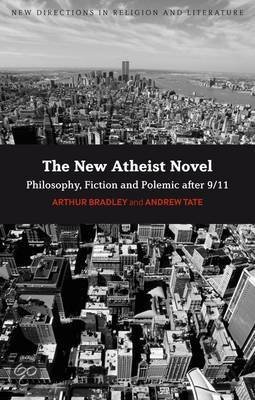 There are moments in which you pick up a book and are delivered into a completely unexpected and fresh-feeling experience. The New Atheist Novel: Fiction, Philosophy and Polemic after 9/11 was one such experience for me. Arthur Bradley and Andrew Tate take readers on a journey through the literature of four modern authors who, they argue, are representative of a new form of novel: the “New Atheist Novel.” This novel is a kind of counter-mythology which invents the transcendent within an atheistic universe. Bradley and Tate analyze the work of Ian McEwan, Martin Amis, Philip Pullman, and Salman Rushdie. The authors show how some have shifted their polemic after 9/11 to viewing religion as a kind of one-size-fits all mentality that has no distinction between liberalism and fundamentalism.
Bradley and Tate apply critical theory to the works of fiction presented in this book in incisive fashion. They draw out themes of the authors analyzed in order to show how often they are just as guilty of irrationality as those against whom they pontificate through the voices in their novels.
Ian McEwan’s fiction, they argue, shows a distinctly New Atheist bent. He sees religious persons as ultimately violent and anti-intellectual. Interstingly, McEewan’s vision of transcendence develops through music and the written word. His post 9/11 writings show a more distinctly anti-Islamist bent, which sees religion as a failure of the imagination. However, Tate and Bradley argue that McEwan’s imagination is itself failing in its capacity to see the radical Muslim act of terror as inherently symbolic and transcendent itself.
This kind of analysis proceeds across the authors analyzed, from Martin Amis’ cliché-filled war against cliché to Salmun Rushdie’s more even-handed but nevertheless anti-theistic vision of the “Quarrels over God.” The analysis of Philip Pullman’s work is perhaps the highest point of the work, as it shows how even in disagreement, one might learn from the “New Atheist Novel.” Pullman’s work shows the myth of the death of God as a kind of human transcendence and freedom from restraint. This vision may be seen as a sometimes on target critique of religion which sometimes becomes authoritarian and too bent towards heresy-hunting. Tate and Bradley ultimately see Pullman’s fiction as a kind of neo-heresy which is attempting to purify religion of its alleged bent towards fundamentalism and too-small vision of deity.
The book’s usefulness goes beyond simple critique. Instead, it gives readers a chance to interact with all literature in a critical fashion. Moreover, Bradley and Tate are not entirely unsympathetic to the “New Atheist Novel” and show how it may help to inform future discussions. The critical interaction is not merely critical but also constructive.
Perhaps the biggest weakness in the book is that its thesis doesn’t seem to carry throughout. The “New Atheist Novel” makes its debut with McEwan, but by the time the author’s reach Rushdie’s slightly more amiable vision of religions in conflict, it seems to lack cohesion as a concept. Perhaps it would be more accurate to say that the “New Atheist Novel” is more of an “Anti- (or Alter-) Theistic Novel” which encompasses not mere anger against religion but rather a critical and sometimes polemical and mistaken vision of the “religious other.” Thus, it seems in the end the “New Atheist Novel” namenclature might not be inaccurate after all, but I tend to think–and the authors reinforce this–of the “New Atheism” along specifically Dawkinsian lines of thought, and Rushdie and Pullman’s works did not seem to fit this usage of the term. A minor gripe, but one worth noting.
This is a book well worth reading and referencing. Don’t be deceived by its length (111 pages of text); it truly has an enormous amount of useful information and discussion. I took a monstrous amount of notes on this book given its length. It will get you thinking, whatever your own view. I recommend it without reservation.
Links
Be sure to check out the page for this site on Facebook and Twitter for discussion of posts, links to other pages of interest, random talk about theology/philosophy/apologetics/movies and more!
Sunday Quote!- The New Atheist Mythology– I share a quote from The New Atheist Novel which discusses the notion that there is a mythology growing up around atheism.
Source
Arthur Bradley and Andrew Tate, The New Atheist Novel: Fiction, Philosophy and Polemic after 9/11 
SDG.
——
The preceding post is the property of J.W. Wartick (apart from quotations, which are the property of their respective owners, and works of art as credited; images are often freely available to the public and J.W. Wartick makes no claims of owning rights to the images unless he makes that explicit) and should not be reproduced in part or in whole without the expressed consent of the author. All content on this site is the property of J.W. Wartick and is made available for individual and personal usage. If you cite from these documents, whether for personal or professional purposes, please give appropriate citation with both the name of the author (J.W. Wartick) and a link to the original URL. If you’d like to repost a post, you may do so, provided you show less than half of the original post on your own site and link to the original post for the rest. You must also appropriately cite the post as noted above. This blog is protected by Creative Commons licensing. By viewing any part of this site, you are agreeing to this usage policy.
Sunday Quote!- The New Atheist Mythology
Every Sunday, I will share a quote from something I’ve been reading. The hope is for you, dear reader, to share your thoughts on the quote and related issues and perhaps pick up some reading material along the way!
The New Atheist Mythology
I recently finished reading The New Atheist Novel: Fiction, Philosophy and Polemic after 9/11. The book was simply phenomenal as it applied critical theory to four novelists in order to draw out various themes in their works and parallels with the writings of the “New Atheists.” I’ll write up a review at some point, but for now I want to highlight the central theme of the book:
[I]t is possible to detect an obscure… reason for the massive popular appeal of the New Atheism: it constitutes a new and powerful creation mythology that–like all mythologies–performs an implicit anthropological service… For Dawkins… it has become de rigueur to wax lyrical about, say, the ‘breathtaking poetry of modern cosmology’ (whatever that means) even amidst attacks on the ‘fairy story’ that is monotheism. (7, 9, cited below)
The book analyzes various novels in light of this theme: that the New Atheists are, in a sense, creating a rival mythology to the monotheism they denigrate, and this expands into literature in various and interesting ways. In a sense, this mythologizing about the power of the human mind, the wonders of the cosmos, or the beauty of poetry is a project to create transcendence in a worldview which, by definition, rails against the transcendent. It is a kind of creation myth which allows for meaning to seep into the meaningless.
What do you think? Can humans live without a mythology? Is wonder a necessary part of the human condition? Why do you think that even the “New Atheists” have put forward such lyrical and mythological language in their writings?
As I said, I’ll try to get a review of this book up ASAP.
Links
Be sure to check out the page for this site on Facebook and Twitter for discussion of posts, links to other pages of interest, random talk about theology/philosophy/apologetics/movies and more!
Sunday Quote– If you want to read more Sunday Quotes and join the discussion, check them out! (Scroll down for more)
Source
Arthur Bradley and Andrew Tate, The New Atheist Novel: Fiction, Philosophy and Polemic after 9/11
SDG.

 J.W. Wartick - Reconstructing Faith