theology
“The Journey of Modern Theology: From Reconstruction to Deconstruction” by Roger E. Olson – An epochal work of theological history
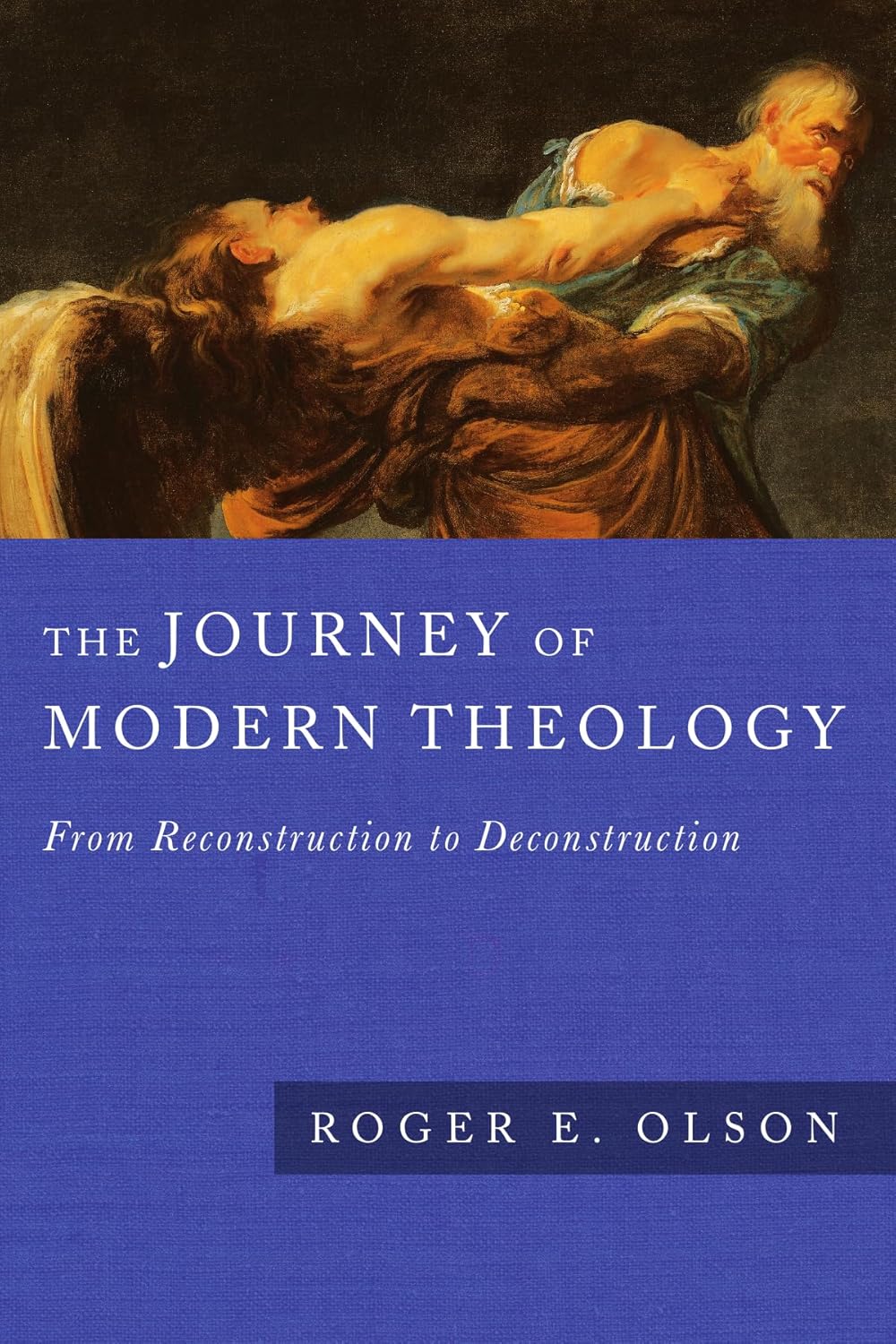
The Journey of Modern Theology: From Resconstruction to Deconstruction by Roger E. Olson is a monumental achievement of theological analysis and history.
The book is focused around modernity and the theology inspired from it, opposed to it, and moving with, against, and towards it. It is roughly divided chronologically and topically, with each chapter denoting an era of theological development and highlighting various theologians involved in that development. Olson’s accounting is largely neutral and fact-based reportage–he is informing readers on what the various theologians taught and believed rather than providing an analysis thereof. However, many of the major thinkers’ sections include a small section on contemporaneous critiques and responses.
Olson starts off with a brief overview of modernism and modernity, showing the scientific and cultural revolutions often associated with it. Then, he moves to various chapters analyzing modernist theologians and thinkers. Theologians given overviews include (but are not limited to): Friedrich Schleiermacher, Albrecht Ritschl, Karl Barth, Horace Bushnell, Paul Tillich, Jurgen Moltmann, Dietrich Bonhoeffer, Hans Kung, Hans Urs von Balthasar, Charles Hodge, Stanley Hauerwas, Reinhold Niebuhr, Ernst Troeltsch, and many, many more. Chapters include: “Liberal Theologies Reconstruct Christianity in Light of Modernity,” Mediating Theologies Build Bridges Between Orthodoxy and Liberalism,” Theologians Look to the Future with Hope,” etc.
The chapter headings give broad brush introductions to the topics at hand. As I said above, these chapters are roughly chronologically based, though there is plenty of overlap. Olson organizes these around movements, showing the warp and weft movement of theology throughout the modernist period into the postmodern one. Again almost all of the analysis is fact based reportage–here’s what Schleiermacher wrote and believed–sometimes accompanied by a section of “here’s what Schleiermacher’s critics said.” Olson only really tips his hand in the conclusion, showing where his own views lie. As such, that makes the book an incredibly valuable work to simply learn about modernist theologians and theological movements. There were many times I found myself pursuing a thread of thought outside the bounds of the book, getting an interlibrary loan from an author I hadn’t read before, or researching more online.
The value of a book like this can’t really be understated. It is a must have for readers interested in theological history and knowing where and how a lot of current theology came from. Additionally, students of theology can find within it many guidelines for further research and avenues to explore. Are you interested in a theology of liberation? There’s a brief summary here that names names and shows where the thought process is going. Want to know about conservative development related to modernist thought? Those thinkers are here, too. Whether orthodox or not; intentionally or not; Olson does an incredible job across the board giving readers much to learn and contemplate.
The Journey of Modern Theology is a fantastic read that will give readers many, many avenues of further research alongside a baseline understanding of the origins and development of theology alongside and against modernism. Highly recommended.
All Links to Amazon are Affiliates
Links
Be sure to check out the page for this site on Facebook!
Book Reviews– There are plenty more book reviews to read! Read like crazy! (Scroll down for more, and click at bottom for even more!)
SDG.
——
The preceding post is the property of J.W. Wartick (apart from quotations, which are the property of their respective owners, and works of art as credited; images are often freely available to the public and J.W. Wartick makes no claims of owning rights to the images unless he makes that explicit) and should not be reproduced in part or in whole without the expressed consent of the author. All content on this site is the property of J.W. Wartick and is made available for individual and personal usage. If you cite from these documents, whether for personal or professional purposes, please give appropriate citation with both the name of the author (J.W. Wartick) and a link to the original URL. If you’d like to repost a post, you may do so, provided you show less than half of the original post on your own site and link to the original post for the rest. You must also appropriately cite the post as noted above. This blog is protected by Creative Commons licensing. By viewing any part of this site, you are agreeing to this usage policy.
Book Review: “Markus Barth: His Life & Legacy” by Mark R. Lindsay

Markus Barth, son of the well-known theologian Karl Barth, was also a theologian. He is less-discussed and his legacy less well-established, but Mark R. Lindsay seeks to offer some corrective to that in Markus Barth: His Life & Legacy.
Lindsay offers this study in a work that is biographically and chronologically organized, but splits the focus with a look at Markus Barth’s theology and thought. What’s especially interesting is how Barth got caught up in controversies in Baptist and Reformed theology at his time, many of which touched upon events in the “real world” (read: life outside academic theology). For example, he criticized adoption of new Sunday School curricula as accommodation to coddling of children. While he didn’t use that very phrase, he was taken as being hyper-critical of children’s education in church, rather than the actual point he was making about integrating children into the life of the (adult) church as well. At other times, his views got him in hot water about various topics related to the Cold War (such as a divided Germany).
Barth also united his ethical-theological thought with the real world. His book, Acquittal by Resurrection argued that Christian ethical perspectives must be grounded in the Resurrection life of the church. This was doubly controversial due to his reliance upon the actual historicity of the Resurrection and the way he saw societal justice as being caught up in the theological narrative of the Bible (see 166-167).
One topic that occupied Barth at multiple points in his life was the Eucharist, which he taught in an anti-Sacramental way. He wrote on it as early as 1945, but returned to the topic in 1980. Then, he argued that because the Eucharist was a remembrance, it couldn’t be a Sacrament meant to be repeated. Despite his claim to go back to Scripture here, it is intriguing that Christ himself commanded his followers to “do this”–suggesting repetitive, Sacramental nature.[1]
Markus Barth: His Life & Legacy offers a solid look at the theology of Markus Barth. It’s unlikely the younger Barth will step out of the shadow of his father any time soon, but Lindsay offers some reasons to think that his theology should be explored as well. Whatever the topic, Lindsay offers a number of intriguing insights from Barth’s theology alongside contemporary events. It is a fascinating read that deserves careful study.
[1] I say this, of course, as a Lutheran with all the biases that entails. But I am admittedly baffled by Barth’s arguments here.
All Links to Amazon are Affiliates
Links
Be sure to check out the page for this site on Facebook!
Book Reviews– There are plenty more book reviews to read! Read like crazy! (Scroll down for more, and click at bottom for even more!)
SDG.
——
The preceding post is the property of J.W. Wartick (apart from quotations, which are the property of their respective owners, and works of art as credited; images are often freely available to the public and J.W. Wartick makes no claims of owning rights to the images unless he makes that explicit) and should not be reproduced in part or in whole without the expressed consent of the author. All content on this site is the property of J.W. Wartick and is made available for individual and personal usage. If you cite from these documents, whether for personal or professional purposes, please give appropriate citation with both the name of the author (J.W. Wartick) and a link to the original URL. If you’d like to repost a post, you may do so, provided you show less than half of the original post on your own site and link to the original post for the rest. You must also appropriately cite the post as noted above. This blog is protected by Creative Commons licensing. By viewing any part of this site, you are agreeing to this usage policy.
“Only a Suffering God can help” – Dietrich Bonhoeffer’s Theologia Crucis
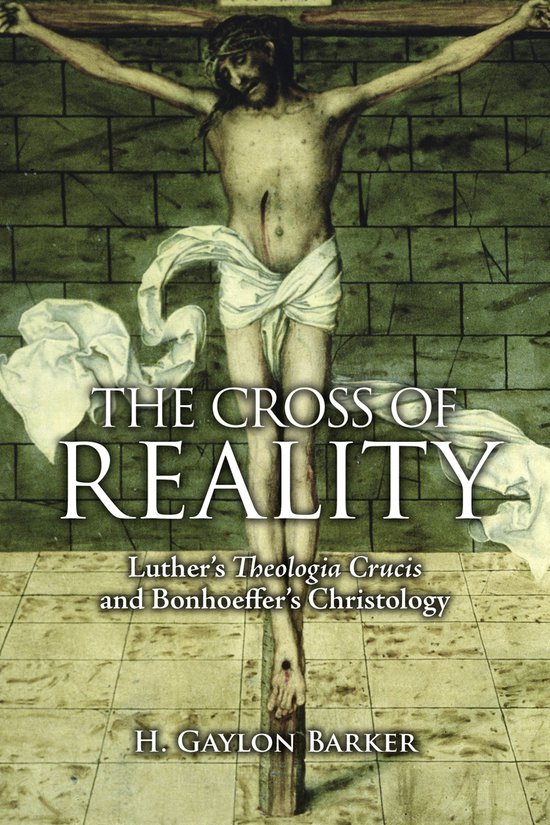
Dietrich Bonhoeffer’s theology is heavily based upon the Theologia Crucis or the Theology of the Cross which he inherited from Martin Luther. H. Gaylon Barker’s The Cross of Reality is a book-length exposition of this important aspect of Bonhoeffer’s theology that brings an enormous amount of material and analysis to bear.
Barker’s analysis of Bonhoeffer’s theology of the cross is worth quoting at length:
“One problem… religion produces , from Bonhoeffer’s perspective, is that it plays on human weakness. In the world in which people live out their lives… this means a disjuncture or contradiction. Daily people rely on their strengths, in which they don’t need God. In practical terms, therefore, God is pushed to the margins, turned to only as a ‘stop-gap’ when other sources have given out. Then God, perceived as a deus ex machina, is brought in to rescue people. This, in turn, leads to the religious conception of God and religion in general as being only partially necessary; they are not essential, but peripheral. All of this leads to intellectual dishonesty, which is not so unlike luther’s description of the theology of glory. The strength of the theology of the cross, on the other hand, is that it calls a thing what it is. It is honest about both God and the world, thereby enabling one to live in the world without seeking recourse in heavenly or escapist realigous practices. Additionally, such religious thinking leads to the creation of a God to suit human needs… For Bonhoeffer and Luther, however, the real God is one who doesn’t appear only in the form we might expect, one whom we can incorporate into our worldview or lifestyle. God is one who is always beyond our grasp, but at the same time is a hidden presence in the world” (394).
Barker highlights Bonhoeffer’s own words to make this point extremely clear:
“[W]e have to live in the world… [O]ur coming of age leads us to a truer recognition of our situation before God. God would have us know that we must live as those who manage their lives without God. The same God who is with us is the God who forsakes us (Mark 15:34! [“And at three in the afternoon Jesus cried out in a loud voice, ‘Eloi, Eloi, lema sabachthani?‘ (which means ‘My God, my God, why have you forsaken me?’)”]). The same God who makes us to live in the world without the working hypothesis of God is the God before whom we stand continually. Before God, and with God, we live without God. God consents to be pushed out of the world and onto the cross; God is weak and powerless in the world and in precisely this way, and only so, is at our side and helps us. Matt. 8:17 [“This was to fulfill what was spoken through the prophet Isaiah: ‘He took up our infirmities and bore our diseases.’] makes it quite clear that Christ helps us not by virtue of his omnipotence but rather by virtue of his weakness and suffering!” [388, quoted from DBWE 8:478-479]
Thus, for Bonhoeffer, God is not there as the divine vending machine, there to send out blessings when needed or called upon due to human inability. Instead, God enters into the world and by suffering, alongside us, helps us.
Bonhoeffer put it thus: “Only a suffering God can help.” Bonhoeffer, seeing the world as it was in his time, during the reign of terror of the Nazis, imprisoned, knew and saw the evils of humanity. And he knew that in seeing this, theodicy would fail. A God who worked only through omnipotence and only where human capacities failed was a God that did not exist. Instead, the God who took on our suffering and came into the world, who “by viture of his weakness and suffering” came to save us, is the only one who acts in the world–in reality.
Only a suffering God can help.
Links
Dietrich Bonhoeffer– read all my posts related to Bonhoeffer and his theology.
SDG.
——
The preceding post is the property of J.W. Wartick (apart from quotations, which are the property of their respective owners, and works of art as credited; images are often freely available to the public and J.W. Wartick makes no claims of owning rights to the images unless he makes that explicit) and should not be reproduced in part or in whole without the expressed consent of the author. All content on this site is the property of J.W. Wartick and is made available for individual and personal usage. If you cite from these documents, whether for personal or professional purposes, please give appropriate citation with both the name of the author (J.W. Wartick) and a link to the original URL. If you’d like to repost a post, you may do so, provided you show less than half of the original post on your own site and link to the original post for the rest. You must also appropriately cite the post as noted above. This blog is protected by Creative Commons licensing. By viewing any part of this site, you are agreeing to this usage policy.
Learning about Reformation History: “Melanchthon: The Quiet Reformer” by Clyde L. Manschreck
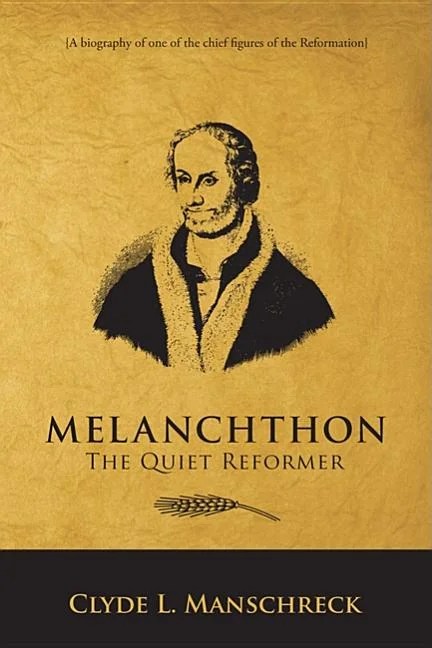
I have long wondered about Philip Melanchthon. He seemed to get vilified in a lot of Lutheran circles I ran in, but he also was clearly at the forefront of Lutheran theology at the time of its formation. Luther rarely seemed to have said anything negative about Melanchthon, but the charge was that he turned away from Lutheranism later in his life and compromised. Enter Clyde L. Manschreck’s excellent biography, Melanchthon: The Quiet Reformer. Manschreck presents a fascinating, balanced perspective on Melanchthon, one of the most intriguing of Reformation persons.
Manschreck starts off, appropriately enough, with looking at how Melanchthon has been treated historically. Surprisingly few biographies exist of the Reformer, especially compared to other luminaries of the period who had less of an impact. After his death, there was criticism from three fronts: he was too Lutheran for Catholics, too Calvinist for Lutherans, and too Catholic for Calvinists. That’s oversimplifying it a bit, but it becomes clear that his legacy was marred by attacks from all sides. So who was the man, and what did he really believe–and was he an infamous compromiser?
Manschreck moves very swiftly past Melanchthon’s early life, almost immediately settling into the time that brought him to Wittenberg. But as Manschreck paints the picture of Melanchthon’s time there, first as an extraordinary lecturer with phenomenal skill and later as a Reformer, we also get deep insight into his character and beliefs. Melanchthon, like many early Lutherans (and a huge amount of the surrounding population) believed in astrology. It’s a strange thing when you look back on it, but it was conceived as a kind of science. Melanchthon was a firm believer, even lamenting the sign a child-in-law was born under when he came to dislike them. Melanchthon also was a champion for public schools, creating the first publicly funded schools across Germany, and advocated for (and got) living wages for teachers. His reasoning was that if a teacher had to work yet another job to just be able to eat or live, the wouldn’t be able to focus on bettering their mind and, in turn, their students’ minds.
Melanchthon and Luther hit it off almost immediately, and Melanchthon joining the Reformation was an organic thing, rather than something one can just point to a single moment as the moment of changing of heart. He clearly believed in the arguments of justification, and ultimately became one of the primary (or the primary) authors of much of the Lutheran Confessions. Setting the writing of these alongside the circumstances in which they occurred makes them more understandable. The Augsburg Confession being prepared to try to, in part, make it clear that their movement wasn’t heretical and could be defended on Scriptural grounds is a fascinating story. Additional clarification due to attempts to unite with other Reformers–attempts that ultimately failed with Zwingli and Calvin–is also set in its historical perspective. The writing of the Confessions should not be separated in understanding from their historical circumstances.
Fascinating historical details about Melanchthon’s life can be found in abundance. Did you know that he had no small amount of correspondence with Henry VIII? The latter desired Melanchthon’s comments on his marriage, hoping the Reformer might be open to giving him an out. Even when Melanchthon failed to deliver for Henry VIII, the King realized the political expediency of an alliance and, perhaps, even was swayed ever so slightly towards some Protestant points. Manschreck makes it clear Henry VIII’s interest was almost certainly political–how to get out of an undesired marriage in a desirable way.
Ultimately, Manschreck paints Melanchthon as a man of convictions who was willing to change his beliefs as he learned more. One of the most obvious examples was Melanchthon’s shift towards a kind of spiritualized view of real presence regarding the Lord’s Supper. What’s interesting with this is that Manschreck is able to document that Luther was aware of this shift and yet explicitly did not condemn it, despite multiple means and opportunities to do so. Was it out of respect for Melanchthon? Or was it a recognition that Melanchthon’s position was somewhere within the Lutheran fold (a fold that is anachronistic to apply to the situation anyway)? I don’t know, but it is worth reading the whole account, including Luther’s non-condemnation. Perhaps Melanchthon could be somewhat welcomed back into Lutheran teaching on some level? Again, I know not. But what’s clear is that Melanchthon sought to go back to the source (the ad fontes of the Reformation and Renaissance) and to understand Scripture’s teaching without trying to invent new doctrines.
Melanchthon: The Quiet Reformer is a superb biography that is well worth the read by any wishing to learn more about one of the most important figures of the early Reformation. I found it informative, balanced, and of interest to even broader world events.
Links
Reformation Theology– Check out all my posts on various topics related to the Reformation (scroll down for more).
SDG.
——
The preceding post is the property of J.W. Wartick (apart from quotations, which are the property of their respective owners, and works of art as credited; images are often freely available to the public and J.W. Wartick makes no claims of owning rights to the images unless he makes that explicit) and should not be reproduced in part or in whole without the expressed consent of the author. All content on this site is the property of J.W. Wartick and is made available for individual and personal usage. If you cite from these documents, whether for personal or professional purposes, please give appropriate citation with both the name of the author (J.W. Wartick) and a link to the original URL. If you’d like to repost a post, you may do so, provided you show less than half of the original post on your own site and link to the original post for the rest. You must also appropriately cite the post as noted above. This blog is protected by Creative Commons licensing. By viewing any part of this site, you are agreeing to this usage policy.
Bonhoeffer and the Challenge of Ecumenism
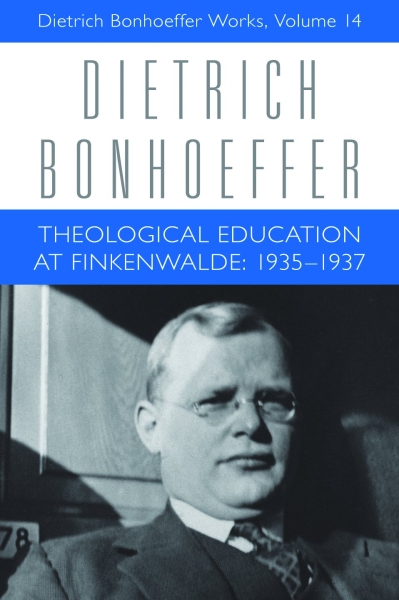
Ecumenism–the work of bringing unity to worldwide Christianity–is a constantly challenging work throughout the history of the church. Dietrich Bonhoeffer was deeply involved in ecumenical movements in his own time. One fascinating aspect of this is that while Bonhoeffer worked for ecumenism, he also was quite clear that the German Christian Church, which had been taken over by the Nazis, was no longer a Christian church and could not be designated as such. In calling out the German Christians, Bonhoeffer presented one of the great challenges of ecumenism: how to define “in” or “out” when it comes to Christianity.
The obvious and immediate objection here, of course, is that the German Christian church was actually being run by Nazis. Historical retrospect with 20/20 vision allows us to say that clearly, such a church had indeed lost the Gospel of our Lord Jesus Christ. However, at the time, such historical vision did not exist. Instead, we can see some of the challenges inherent in ecumenical work in a fascinating exchange Bonhoeffer had with Canon Leonard Hodgson[1]. The exchange can be found in Dietrich Bonhoeffer’s Works in English, Volume 14: Theological Education at Finkenwalede: 1935-1937. Bonhoeffer was invited by Hodgson in 1935 to come to the World Council of Churches as a visitor to the meeting of the Continuation Committee. Bonhoeffer declined, writing, “I should very much like to attend the meeting. But there is first of all the question if representativies of the Reichskirchenregierung [Reich Church Government (of the Nazi-sanctioned German Christian Church)] will be present, which would make it impossible for me to come” (DBWE 14, 68). Hodgson wrote back, imploring Bonhoeffer to attend. After noting that representatives of the German Christian church would be attending, Hodgson wrote, “I think you will understand our position when I say that we cannot, as a Movement [the World Council of Churches and the ecumenical movement], exclude the representatives of any Church which ‘accepts our Lord Jesus Christ as God and Saviour.’ Right from the start, there has been a general invitation to all such churches, and we cannot arrogate to ourselves the right to discriminate between them…” (Ibid, 69).
Defining a Christian church as one which “accepts our Lord Jesus Christ as God and Savior” seems like a reasonable step, especially within an ecumenical movement. But is it enough? That must always be the lingering question, and I’m not sure it is one I can answer. Bonhoeffer, however, answered Hodgson directly. After thanking Hodgson for the repeated invitation to attend, he wrote, “Can there be anything finer and more promising to a Christian pastor and teacher than to co-operate in the preparation for a great oecumenical[2] synod…?” But, then he went on to note that the Confessional Church in Germany did not believe the German Christian church did in fact believe that Jesus Christ is God and Savior. Wrote Bonhoeffer, “There may be single representatives…. who propound a theology which is to be called a Christian theology… But the teaching as well as the action of the responsible leaders of the Reich Church has clearly proved that this church does no longer serve Christ but that it serves the Antichrist… The Reich Church…. continues to betray the one Lord Jesus Christ, for no man can serve two masters…” (DBWE 14, 71-72).
It is hardly possible to issue a more direct and explicit statement than Bonhoeffer did regarding the status of the German Christian Church. He simply asserted: it serves the Antichrist. He went on to note the Confessional Church’s condemnation of the German Christian Church and some specific points thereof.
Hodgson, however, persisted. And his letter is one that highlights so many difficulties with ecumenism. Before diving in further, it is worth noting I am in favor of ecumenism, generally. Just as Bonhoeffer quoted Jesus’s words in John 17:21 to note that Christ wishes all of His followers to be one; so we should also wish for that and work towards it. However, where do lines get drawn, if at all? And surely, a church being taken over by a Nazi state is enough to draw the line? But even so, the historical difficulty of doing so, reflected in the words of Hodgson, should give us some fuel for thought in our own time.
Hodgson countered first by noting the 400+ years of the Ecumenical Movement, always seeking to unite the churches that had been separated. The Movement itself, Hodgson argued, must never act in behalf of individual church bodies; instead it worked as a kind of outside guiding body to bring those individual churches together. Hodgson highlighted that acceptance of Jesus Christ as God and Savior is the “one and only qualification” for a Christian church and that “the Movement has never taken upon itself to decide which churches conform to this definition and which do not” (DBWE 14, 78). He raised a neutral example of a Czechoslovakian National Church and internal debates with others over whether that church was Trinitarian or Unitarian. Turning to the Confessional and Reich church in Germany, Hodgson noted that the former appeared to have stated that the latter no longer accepted the sole criterion required by ecumenism. However, he also argued that the Reich church did not seem to see itself as outside the bounds of that confession; and who is the Ecumenical Movement to arbitrate such disagreements (Ibid)? After all, if they took up the question of the Confessional vs. Reich Church, where does it end? Could not various American churches raise charges against each other that, even while denying such a denial existed, one church does not really believe in Jesus Christ as God and Savior? Wrote Hodgson, “If we once begin doing this kind of thing, would there be any end to it?” (Ibid, 79). Finally, Hodgson wrote that the Movement doesn’t necessitate setting aside all differences. Instead, it allowed for people from different churches to stand side-by-side and even highlight differences; not with the goal of eliminating or washing them over, but with the goal of understanding and to “speak the truth in love” (Ibid, 80).
Bonhoeffer wouldn’t attend the conference, and while he would reach out to Hodgson four years later in 1939, Bonhoeffer would again be met with the kind of “open to interpretation” answer Hodgson gave in the letters of 1935.
This fascinating historical insight into arguing over the inclusion (or not) of a church literally overtaken by Nazis should serve as at least a partial warning to those interested in ecumenism. And, again, I am largely favorable to the idea. But is it possible that the definition defended by Hodgson is too broad? Or, is it possible that Bonhoeffer’s own certainty was too strong? I don’t think the latter is true. It should be possible for someone to look at a church body and say “the teaching as well as the action” of some church body, Christian leader, or whatever can be defined as no longer reflecting Christ as God and Savior. But how does one go about doing that? And how much should a body like the World Council of Churches stand back from seemingly intramural conflict?
Surely in today’s era, there are American churches that would label others as outside the bounds of Christianity or serving the Antichrist. Anti-LGBTQ+ church bodies might say that affirming church bodies are un- or anti-Christian and vice versa. The rise of Christian Nationalism begs the question of how one can serve two masters–the Nation State and Christ. The prominent sacrifices of orthopraxy for the sake of purported orthodoxy could yield countless other difficulties even as those who claim orthodoxy for themselves argue the contrary.
All of this is to highlight what is a very frustrating situation in which we find ourselves. It is one in which we cannot easily navigate our Lord’s wishes that we might truly be one. One temptation is to give it all up and say we may just have to wait for the eschatological future in which Christ will be all in all before any of this happens. But is it worth just giving up? I don’t think that’s the case, either. Instead, I think it is worth seeing this back-and-forth between Bonhoeffer and Hodgson about a church literally overrun by Nazis as a warning. What is confessed with lips must also be done in deed. What that means for ecumenism is something we must work out with fear and trembling.
[1] Fun fact- Hodgson unsuccessfully proposed to Dorothy L. Sayers. I couldn’t see that on Wikipedia and not share it.
[2] Simply an alternate spelling of ecumenical.
All Links to Amazon are Affiliates links
Links
Dietrich Bonhoeffer– read all my posts related to Bonhoeffer and his theology.
Be sure to check out the page for this site on Facebook and Twitter for discussion of posts, links to other pages of interest, random talk about theology/philosophy/apologetics/movies and more!
SDG.
——
The preceding post is the property of J.W. Wartick (apart from quotations, which are the property of their respective owners, and works of art as credited; images are often freely available to the public and J.W. Wartick makes no claims of owning rights to the images unless he makes that explicit) and should not be reproduced in part or in whole without the expressed consent of the author. All content on this site is the property of J.W. Wartick and is made available for individual and personal usage. If you cite from these documents, whether for personal or professional purposes, please give appropriate citation with both the name of the author (J.W. Wartick) and a link to the original URL. If you’d like to repost a post, you may do so, provided you show less than half of the original post on your own site and link to the original post for the rest. You must also appropriately cite the post as noted above. This blog is protected by Creative Commons licensing. By viewing any part of this site, you are agreeing to this usage policy.
“Bearing Sin as Church Community: Bonhoeffer’s Harmartiology” by Hyun Joo Kim- A fascinating look at the doctrine of sin through Bonhoeffer’s theology
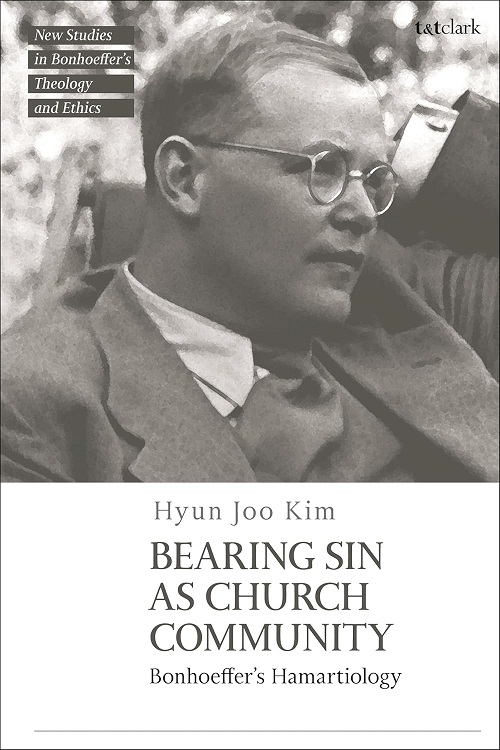
Dietrich Bonhoeffer’s theology continues to contribute enormously to discussions of theology today. What is especially rewarding about the work being done on Bonhoeffer’s corpus is finding topics that haven’t been explored as deeply as others. Hyun Joo Kim’s Bearing Sin as Church Community: Bonhoeffer’s Harmartiology specifically explores Bonhoeffer’s theology for the doctrine of sin, and the book richly rewards careful reading.
One of the central beliefs of Lutheranism, Catholicism, Calvinism, and several other branches of Christianity is that of original sin. For my own part, I find it an incredibly fruitful doctrine when contemplating the state of the world. Humans are incredible adept and finding imaginative ways to bring harm to each other. The horrors of the world are immense, and for me, one way to explain humanity’s awfulness to itself is to hold to a notion of original sin. Bonhoeffer’s views, by Kim, also make the position of original sin less incredible to believe, particularly in regards to explaining how it works. Instead of being linked to a (likely non-extant) original human couple, or being passed along through intercourse, Bonhoeffer’s view makes original sin and the Fall linked to human community and brings it into his ecclesiology. It all helps lend itself to his broader ethical stance, while still preserving the Lutheran view of original sin and guilt.
Before diving into Bonhoeffer’s doctrine of sin (harmartiology), Kim dives into the Augustinian doctrine of original sin. Augustine’s doctrine of original sin is closely linked with the notion of concupiscence–original sin as being transferred through the act of intercourse. Obviously, there is much more to it, but for Augustine, explaining original sin eventually boiled down to a kind of generational passing down through the act of intercourse itself. This saddled the doctrine of original sin with quite a bit of theological and other baggage. Kim then outlines Luther’s move from Augustinian original sin to a shift of seeing original sin integrated within Luther’s Christocentric theology. In essence, Luther’s focus on Christocentrism leads to a holistic theology that, while maintaining several aspects of Augustine’s view of original sin, centers Christ even in the doctrine of original sin. Luther’s view already started driving a wedge between concupiscence and original sin because while he apparently viewed the former as an essential aspect of transmitting the latter, he also held that original sin is forgiven in Baptism but that concupiscence remains a powerful influence on humankind (43).
Next, Kim turns to Bonhoeffer’s view of original sin. This includes a rejection of concupiscence as the basis for original sin. Rather than framing original sin in the “the biological and involuntary transmission of culpability…” Bonhoeffer frames original sin in “the relational and ethical bearing of the sin of others” (71). One of the main aspects of Bonhoeffer’s ethic is that the Christian has freedom for the other, and in this case, his doctrine of sin echoes that but in the bearing of sin for the other; it remains an alien guilt imputed, but a guilt nonetheless. Bonhoeffer’s reflection on original sin moves the alien culpability of Augustine’s doctrine of original sin from the sovereignty of God and to the church community. For Bonhoeffer, “the culpability of Adam is not biologically inherited; however, it is inseprably related to all human beings individually and corporately by the universal sinfulness after the fall” (72). This has some relation to Orthodox understandings of the fall [so far as I know from thinkers like Richard Swinburne–I admit very little direct knowledge of Orthodox teaching on the topic]. Bonhoeffer’s move, however, neither requires an original couple from whom all humanity is descended, such that the culpability can be passed down from one to another like a genetic lineage; nor does it need a specific means by which the original sin can be passed along. By sidestepping these two issues, essentially assigning guilt not to the individual through inheritance but rather through the very nature of humanity as sinful beings, he avoids many of the modern challenges to original sin, such as the question of human evolution–despite this clearly not being in Bonhoeffer’s mind as he wrote about the doctrine.[1]
Kim does draw some distinctions between Bonhoeffer’s earlier thinking on the doctrine of sin and his later theology, but to me these largely seem to be things that could be reconciled together as a continuum of the same theology. And of course the whole story is not told simply through Bonhoeffer’s views on original sin. Quite a bit more is featured on Bonhoeffer’s thoughts on sin and Christian life and ethics. Kim pays careful attention to Bonhoeffer’s book Creation and Fall and his exegesis of the Genesis narratives here. Kim’s argument is that Creation and Fall exists in the same sphere as his other works, Sanctorum Communio and Act and Being, and as such, it focuses on communal personalism and still integrates aspects of Lutheran and Augustinian notions into the reading.
Bearing Sin as Church Community is an absolutely essential read for those wishing to dive deeply into Bonhoeffer’s theology. It also is an exceptionally powerful theological work that demands close and careful reading. It provides new ways forward in understanding some of the core doctrines of some branches of Christianity, and new challenges to those that do not hold those doctrines. Highly recommended.
Notes
[1] It seems fairly clear in reading Bonhoeffer’s corpus both that he was largely aware of scientific consensus on his day on various topics, which would have included the evolutionary lineage of humankind, and also that he was supremely unconcerned with scientific truths related to theology. For him, it seems, there was no conflict between Christianity and science unless Christians themselves decided to make such a conflict by purposely moving theology into the sphere of science (or vice versa) when that is an utterly inappropriate move. See, for example, his brief comments about science near the beginning of Creation and Fall.
All Links to Amazon are Affiliates links
Links
Dietrich Bonhoeffer– read all my posts related to Bonhoeffer and his theology.
Be sure to check out the page for this site on Facebook and Twitter for discussion of posts, links to other pages of interest, random talk about theology/philosophy/apologetics/movies and more!
SDG.
——
The preceding post is the property of J.W. Wartick (apart from quotations, which are the property of their respective owners, and works of art as credited; images are often freely available to the public and J.W. Wartick makes no claims of owning rights to the images unless he makes that explicit) and should not be reproduced in part or in whole without the expressed consent of the author. All content on this site is the property of J.W. Wartick and is made available for individual and personal usage. If you cite from these documents, whether for personal or professional purposes, please give appropriate citation with both the name of the author (J.W. Wartick) and a link to the original URL. If you’d like to repost a post, you may do so, provided you show less than half of the original post on your own site and link to the original post for the rest. You must also appropriately cite the post as noted above. This blog is protected by Creative Commons licensing. By viewing any part of this site, you are agreeing to this usage policy.
“The Foolishness of God” by Siegbert W. Becker- An engaging struggle
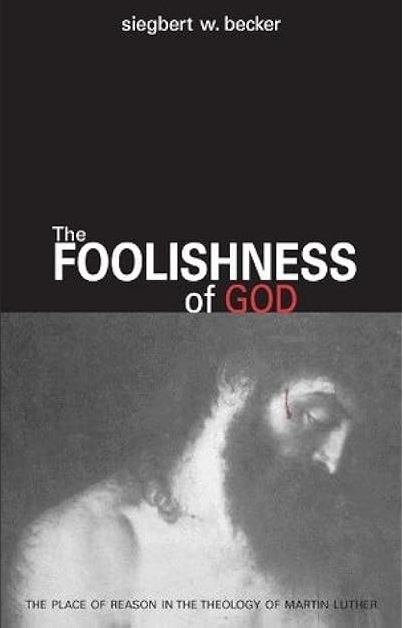
Many years ago, when I was deep into apologetics and trying to figure out my place in the world and in my faith, my dad gifted me with a copy of The Foolishness of God: The Place of Reason in the Theology of Martin Luther by Siegbert W. Becker. Well, a lot has changed since then, and I am still trying to figure out my place in the world and in my faith, but I am much more skeptical of apologetics than I was then… to say the least. I re-read The Foolishness of God now, probably more than a decade after my original reading. It was fascinating to see my scrawling notes labeling things as ridiculous or wrong when I now basically think a lot of it is right. On the flip side, I still have quite a bit to critique. I’ll offer some of my thoughts here, from a viewpoint of a progressive Lutheran.
Becker starts by quoting several things Luther says about reason, from naming it “the devil’s bride” to being “God’s greatest and most important gift” to humankind (1). How is it possible that reason can be a great evil, vilest deceiver of humanity while also being one of the most enlightening parts of human existence? One small part of Luther’s–as Becker interprets him–answer is that it depends on what reason is being used for. That’s a simplistic answer, though, suggesting one could categorize things like nature and science (reason is good!) and judging biblical truth (reason is bad!) into neat boxes for Luther. In some ways, this can be done; but in others, when one digs more deeply, it becomes clear that such an application would be an okay rule of thumb for reading Luther but would not be accurate all the way through. For example, where Luther sees the Bible teaching directly on nature or science, using reason to judge that teaching would be rejected. This, of course, opens up my first and probably greatest point of disagreement with Luther’s theses about reason. And yet, it also is confusing, because in some ways I’m not sure I wholly disagree.
What I mean by this is that I, too, am skeptical of the use of human reason for any number of… reasons. This is especially true when it comes to thinking about God. Supposing it is true that there is a God and that God is an infinite being in any way–whether it is infinitely good, infinitely powerful, etc. In that case, it seems that to suggest that we can use reason to grasp things about God is a fool’s errand. We are not infinite and can certainly not grasp the infinite; how can we expect our brains that cannot contain the multitudes to reason around God? On the other hand, in many ways reason is all we have. Even supposing God exists, we ultimately act or believe in ways and things we think are reasonable. And I’m deeply skeptical of a denial of this. What I mean by the latter is that I simply do not believe that people can believe things they think are inherently anti- or irrational. Becker outright makes the claim that Luther–and presumably Becker himself–do believe such things. Time and again, Becker flatly states that some claims of Christianity are inherently contradictory–be it the Trinity, the Incarnation, or [for Lutherans] Christ’s presence in the Lord’s Supper. So Becker is claiming that Luther truly did believe in things he thought were inherently anti-reason and irrational. But when push comes to shove, I strongly suspect that Luther and people like him who make these claims think that it imminently reasonable to believe in the irrational. Even while claiming that they believe in things they claim they think are contradictory, they are doing so because it makes sense to them. And this is precisely because of the limitations of human reason and thinking. We cannot go beyond our own head, we have to go with what we think is right, perhaps even while claiming we think it is irrational to do so.
Setting aside that question, Luther’s solution to the gap between the finite and the infinite is that of revelation. Because God became incarnate and came to humanity, we, too, can know God. God revealed God to us. Becker rushes to use this to attempt to counter what he calls Neo-orthodox interpretations that stack the Bible against Christ. He writes, “Neo-orthodoxy’s distinction between faith in Christ and faith in statements, or ‘faith in a book,’ is artificial and contrary to reason. By rejecting ‘propositional revelation’ and making the Bible only a ‘record of’ and ‘witness to’ revelation, the neo-orthodox theologians drain faith of its intellectual content” (11). I find this deeply ironic wording in a book that later has Becker outright claiming that Luther–and by extension Becker himself–believed things that are contrary to reason and affirming that this is a perfectly correct (we dare not say “reasonable”) thing to do. In my opinion, at least, it is quite right to make the distinction between faith in Christ and faith in statements. That doesn’t mean the Bible is devoid of revelation or can have no revelation; rather, it means that, as Luther put it [paraphrasing here], the Bible is the cradle of Christ. But to put the Bible then on par with Christ as a similarly perfect revelation is to make a massive mistake, as people, including Lutherans like Dietrich Bonhoeffer, have argued.
All of this might make it seem I have a largely negative outlook on Becker’s work. Far from it. I found it quite stimulating and generally convincing on a number of points. Most of it, of course, is exegesis of Luther’s own views of reason. And I think that Luther, while he could stand to be far more systematic and clear, makes quite a few excellent points about reason. When it comes to trying to draw near to God, reason does not do well. Why? Our own era has so many arguments in philosophy of religion about the existence of God. Anyone who has read or engaged with the minutiae of analytic theology or analytic philosophy getting applied to God has experienced what I think, in part, Luther was warning against. Philosophers, apologists, and theologians continue to attempt to plumb the very nature of God and gird it up with scaffolds of reason, providing any number of supposed arguments for God’s existence, proofs of Christological points, and the like. Bonhoeffer, a favorite theologian of mine, put many of these attempts to shame in a succinct quote: “A God who could be proved by us would be an idol.”
I think a similar sentiment applies to so much about God and even just the universe. I mean, we’re on a planet that is less than a speck in a cosmos that is so unimaginably huge and ancient that thinking we can comprehend it is honestly shocking. Sure, we can slap numbers on it, using our human reason to try to slice the universe into chewable bites, but when we find out things like how it takes more than 1 million Earth’s to fill the Sun, and that our Sun isn’t even remotely the largest star, nor the largest solar system, etc… how absurd is it to think we really comprehend any of it? And so, for me, from a very different angle, Luther’s words about reason make sense. Sure, we can use it to try to understand little slices of nature. But when we start to line it up with things of the infinite, it may be better to just let God be God.
The Foolishness of God is a fascinating, engaging, and sometimes frustrating work. In a lot of ways, it’s like engaging with Luther’s own works. It’s not systematic; it doesn’t cohere; it’s intentionally provocative. I will likely give it another read one day, and who knows where I–and it–shall stand?
All Links to Amazon are Affiliates links
Links
Dietrich Bonhoeffer– read all my posts related to Bonhoeffer and his theology.
Be sure to check out the page for this site on Facebook and Twitter for discussion of posts, links to other pages of interest, random talk about theology/philosophy/apologetics/movies and more!
SDG.
——
The preceding post is the property of J.W. Wartick (apart from quotations, which are the property of their respective owners, and works of art as credited; images are often freely available to the public and J.W. Wartick makes no claims of owning rights to the images unless he makes that explicit) and should not be reproduced in part or in whole without the expressed consent of the author. All content on this site is the property of J.W. Wartick and is made available for individual and personal usage. If you cite from these documents, whether for personal or professional purposes, please give appropriate citation with both the name of the author (J.W. Wartick) and a link to the original URL. If you’d like to repost a post, you may do so, provided you show less than half of the original post on your own site and link to the original post for the rest. You must also appropriately cite the post as noted above. This blog is protected by Creative Commons licensing. By viewing any part of this site, you are agreeing to this usage policy.
Book Review: “Kierkegaard and the Changelessness of God” by Craig A. Hefner
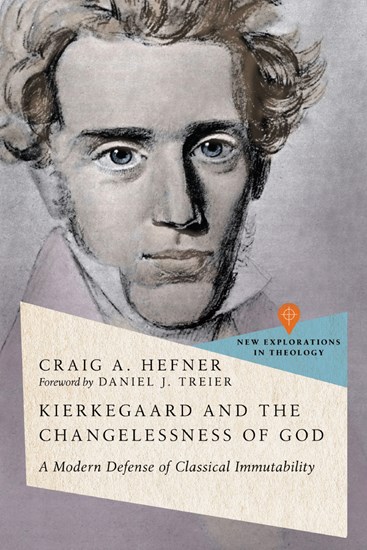
Kierkegaard and the Changelessness of God by Craig A. Hefner presents an unusual dynamic: Kierkegaard being used in defense of a core tenet of classical theology: divine immutability.
Hefner begins with a brief introduction to Kierkegaard and correction of misconceptions, including the notion that Kierkegaard was somehow out of tune with classical Christian theology. What Kierkegaard was reacting against was not Christian doctrine but rather than sleepy, comfortable way in which people were living in light of it. Kierkegaard united, rather than divided, traditional Christianity and existentialism.
Next, Hefner moves into four chapters that cover Kierkegaard and the doctrine of divine immutability or changelessness. What makes this defense of immutability unique is in part its focus on Kierkegaard’s existentialism as a defense of that changelessness. The two topics appear to be divergent, but Hefner argues the are in fact unified in Kierkegaard’s milieu. Kierkegaard’s existentialism provides a way to contrast God and humanity. The changing, “all flesh is grass” nature of humanity is contrasted with the immutable God.
Rather than simply relying on this contrast, however, Hefner with Kierkegaard argues that the Self can be reintegrated across change due to its relationship only with an immutable God. God, in other words, is the ground for the Self in a very real way. A whole chapter focuses on James 1:17 and Kierkegaard’s interpretation thereof. James 1:17 is often used as the core text for divine immutability, and Hefner draws on various interpreters to bring its insights to life.
Finally, Hefner argues that Kierkegaard’s conception of immutability doesn’t rely upon metaphysics but rather upon the concept of the self. I admit some of this section was a bit beyond me, because it seems to me that ultimately anything relies upon some kind of metaphysics. However, grounding the concept of immutability on the divine self was an interesting endeavor.
Kierkegaard and the Changelessness of God is an unexpected read. I found it refreshing despite being extremely dense. Recommended for readers looking for deep discussion of existential theology and its application to classical theism.
All Links to Amazon are Affiliates links
Links
Be sure to check out the page for this site on Facebook and Twitter for discussion of posts, links to other pages of interest, random talk about theology/philosophy/apologetics/movies and more!
Book Reviews– There are plenty more book reviews to read! Read like crazy! (Scroll down for more, and click at bottom for even more!)
SDG.
——
The preceding post is the property of J.W. Wartick (apart from quotations, which are the property of their respective owners, and works of art as credited; images are often freely available to the public and J.W. Wartick makes no claims of owning rights to the images unless he makes that explicit) and should not be reproduced in part or in whole without the expressed consent of the author. All content on this site is the property of J.W. Wartick and is made available for individual and personal usage. If you cite from these documents, whether for personal or professional purposes, please give appropriate citation with both the name of the author (J.W. Wartick) and a link to the original URL. If you’d like to repost a post, you may do so, provided you show less than half of the original post on your own site and link to the original post for the rest. You must also appropriately cite the post as noted above. This blog is protected by Creative Commons licensing. By viewing any part of this site, you are agreeing to this usage policy.
Book Review: “Nobody’s Mother: Artermis of the Ephesians in Antiquity and the New Testament” by Sandra L. Glahn
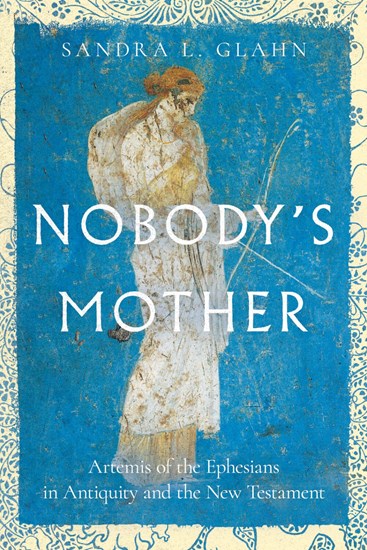
Nobody’s Mother by Sandra L. Glahn is a detailed look at questions about Artemis’s influence in Ephesians and the NT as well as specifically at 1 Timothy 2:11-15.
Glahn, after some discussion of why it’s worth taking a fresh look at Artemis in the NT, dives into Ephesus and Artemis across several chapters. For example, a common argument I’ve seen is that Artemis in Ephesus was associated with prostitution and that this should provide a background for how texts related to Artemis might play out. Glahn, however, argues that this is not the case and that the evidence for prostitution as a connection with Artemis is missing either Empire-wide or in the city of Ephesus specifically. Indeed, the opposite seems to be the case as Artermis is consistently associated with chastity and virginity. Artemis, one might say, is “Nobody’s Mother.”
Artemis was also associated with childbirth and midwifing, to the extent that she was seen as taking the pain of childbirth away. This, Glahn argues later, explains some of the complexities behind the 1 Timothy passage. One example of this is that the argument of being saved through or persevering through childbearing appears to be a reference to Artemis and has the author of 1 Timothy essentially giving readers the advice to set aside an idol–the Greek god Artemis–for Christ as Lord.
Glahn also applies some of these findings to how to read the rest of the text, noting that having Artemis in Ephesus and the related background provided in the foregoing chapters explains some of how Paul might have been arguing against false teaching and confronting the Artemis cult more directly.
Nobody’s Mother is a deep book that makes several well-informed arguments about topics related to NT interpretation. It is recommended highly.
All Links to Amazon are Affiliates links
Links
Be sure to check out the page for this site on Facebook and Twitter for discussion of posts, links to other pages of interest, random talk about theology/philosophy/apologetics/movies and more!
Book Reviews– There are plenty more book reviews to read! Read like crazy! (Scroll down for more, and click at bottom for even more!)
SDG.
——
The preceding post is the property of J.W. Wartick (apart from quotations, which are the property of their respective owners, and works of art as credited; images are often freely available to the public and J.W. Wartick makes no claims of owning rights to the images unless he makes that explicit) and should not be reproduced in part or in whole without the expressed consent of the author. All content on this site is the property of J.W. Wartick and is made available for individual and personal usage. If you cite from these documents, whether for personal or professional purposes, please give appropriate citation with both the name of the author (J.W. Wartick) and a link to the original URL. If you’d like to repost a post, you may do so, provided you show less than half of the original post on your own site and link to the original post for the rest. You must also appropriately cite the post as noted above. This blog is protected by Creative Commons licensing. By viewing any part of this site, you are agreeing to this usage policy.
Dietrich Bonhoeffer’s Paper “The Character and Ethical Consequences of Religious Determinism” and Theodicy
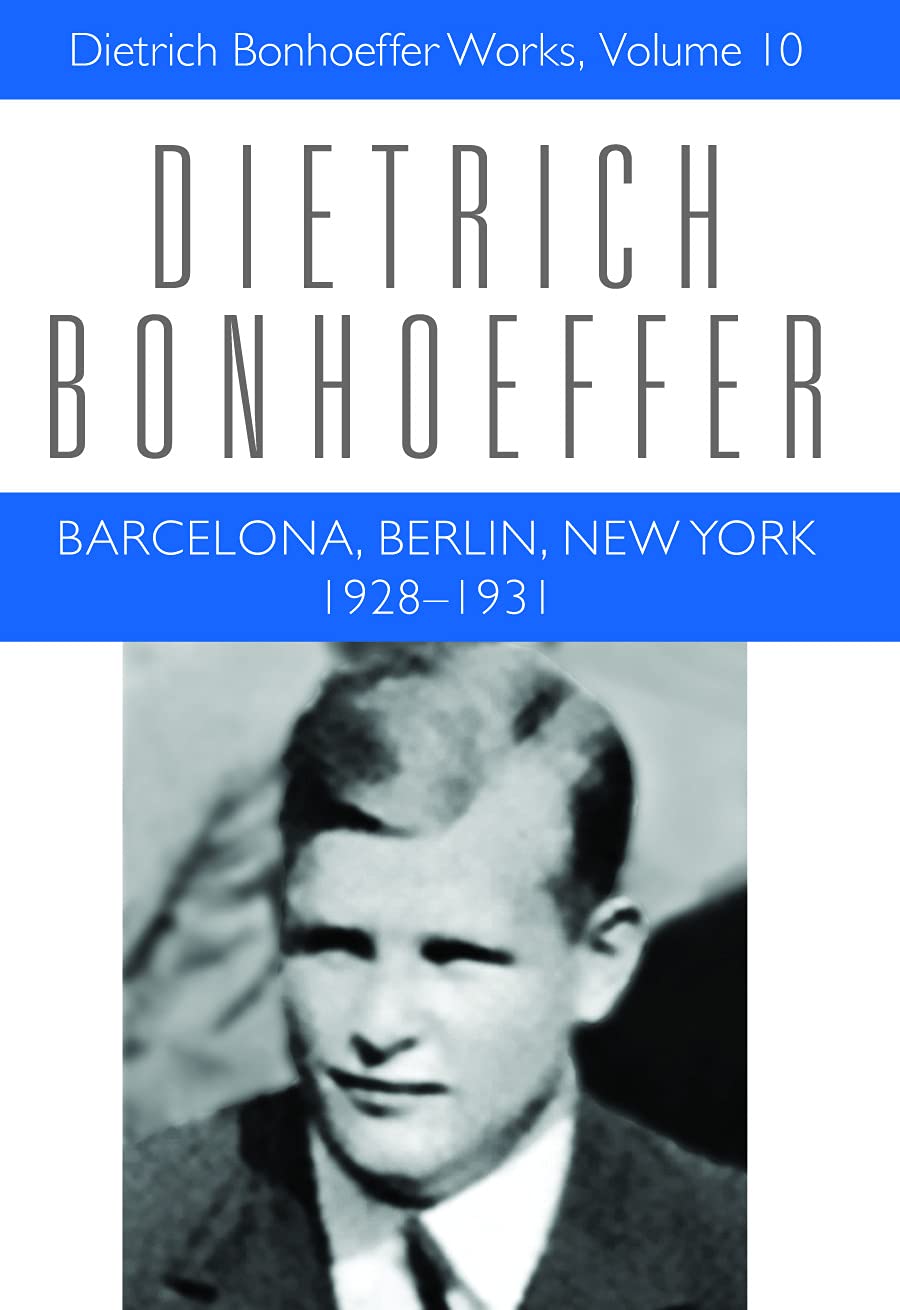
I’ve been thinking quite a bit about divine action in the world, theological determinism, and related topics. It’s honestly been a tough part of my reconstructing faith journey–trying to figure out how it all fits together. Questions about God’s action and evil have been particularly vexing. And the trite answers I received and even argued through my apologetics training just don’t seem to work for me as well as they once did. Dietrich Bonhoeffer has been a major–indeed the major–figure in my theological journey. I was shocked to come yesterday upon a paper I know I’d read before but that hadn’t registered as I read all of his works. That paper was about the very topic I’ve been agonizing over of late. It is entitled “The Character and Ethical Consequences of Religious Determinism.” The paper is found in print in Volume 10 of Dietrich Bonhoeffer’s Works in English, Barcelona, Berlin, New York 1928-1931.
First, I should note that Bonhoeffer is not concerned in this paper with theodicy as a primary or perhaps even secondary concern. Bonhoeffer tends to treat evil as a fact of the world rather than attempting to downplay or explain it away. That said, I think the points he makes in this paper are highly relevant to those who are wondering about divine control and theodicy.
Bonhoeffer argues that there is a threefold way to think about determinism in the world. He doesn’t say this is totally expansive of every option. Rather, this is how he divides the possibilities. First, there is philosophical determinism. This largely relates to causal determinism of events in nature. Because of this, he states that this kind of determinism is irrelevant to the question of ethical consequences. While I don’t fully agree with him here–natural evil is a category that is often discussed–I get the point he is getting at. He says it is irrelevant because his next two categories encompass what would be the case if God is involved in such evils.
Thus, his second category is religious determinism. Here, God determines all. A consequence of this view is that evil is good, actually. Bonhoeffer goes on to note the problems with such a view. If one holds this, then “I always know that evil has already been overcome; it follows from my concept of God, which I always have at my disposal in order to explain ‘rightly’ all misfortune in the world…” This, Bonhoeffer says, makes evil and good a “synthesis of nondifference… evil is merely a paradoxical means of actualizing the good” (DBWE10 441-442) Another problem is that it conflates “Creator” with “world cause.” God is the former, not the latter, so God isn’t causing all the evil. To say God causes such is not “Christian determinism.” Here Bonhoeffer gets at the heart of my difficulty with more traditional views of God, because so many of them either bite the bullet on this or try some other means to make it so that while God determines every event that happens, God is still not the cause or direct actor of evil. Bonhoeffer undercuts those claims by noting that they destroy the differences between good and evil, making good and evil ultimately the same. On such a view, as Bonhoeffer states, evil is just a “paradoxical means” of doing good.
It is important, too, to reflect on Bonhoeffer’s brief point about the conflation of God as “Creator” and God as “world cause.” Bonhoeffer only briefly touches on this topic, but he is quite clear that he believes the two are actually opposed to each other. “God is conceived as the world cause, rather than as Creator. The two are completely distinct so that the one excludes the other, something rarely taken into account even though everything follows from this premise.” God, instead, is Creator–the one who brought the world into existence–rather than the one who is causing every event in the world.
From this, Bonhoeffer gets, finally, to what he calls Christian determinism. Here, he argues that Christian determinism merely holds that justification–salvation, if you prefer the term–is the act of God alone. Human beings aren’t capable of doing this act, so God must do it–as “God’s free and sole act” this makes “huma beings… completely in God’s omnipotence” (DBWE 443). The question of human freedom and lack of freedom, says Bonhoeffer, ultimately relates only to… “the ultimate, to salvation” (ibid). Bonhoeffer, a Lutheran, also comments briefly that he thinks this is the point of Luther’s Bondage of the Will; not that all things are determined by God, but that human beings cannot act on their own related to salvation. Bonhoeffer admits Luther goes beyond this, but attributes it instead to Luther’s propensity to “not always clearly distinguish this idea [that of freedom in salvation] from others of a more speculative of cosmically interpretive nature” (ibid).
The ethical consequences of this view of determinism, Bonhoeffer argues, are that evil is actually evil against God. “Good does not stand behind every evil” in contrast to the notion that God intends for evil to happen. Instead, “God wants the good” (ibid). The good that God brings about in salvation is one that “makes human beings free… for God” (444). He turns again to Luther’s assertion that “God brings about both evil and good,” calling it the “ultimate speculative insight that should not itself be used to interpret other circumstances.” This view leads to an antinomy–back to the paradox of religious determinism. Bonhoeffer says this question may remain open, but it seems clear that his Creator vs. world cause (and the opposition here–the vs.–is intentional in Bonhoeffer’s writing) would allow for some interesting spaces to explore here. Bonhoeffer himself notes that the notion “That God as the Creator hates evil and that nonetheless nothing can occur in the world that God does not want is an insoluble antinomy…” However, he goes on to say it is “no longer antinomy… as soon as one believes oneself able to draw conclusions from it for a Christian devaluation of evil” (ibid). He essentially leaves it at that, later saying that the God of guidance is derived from the God of justification, not the reverse. The point here seems to be that the God of determinism in salvation is only arrived at through a God of guidance–eg, non-omni-determinism.
Ultimately, Bonhoeffer’s view remains largely within Lutheran thinking on the issue. He gives credence to Luther’s views of God as ultimate cause of even evil, while arguing that this is mere speculation. His point seems to be that Luther and others who draw that thinking from Luther’s basic positions on justification are doing the reverse of what they should be doing–drawing the God of world cause from the God as Creator. Does Bonhoeffer ultimately appeal to antinomy or mystery? No, he doesn’t. But his position is left somewhat vague, then. What do his final lines about antinomy being defeated by conclusions “for a Christian devaluation of evil” mean? I am not clear on this. However, I think the distinctions between Creator/world cause and his differences between Christian and religious determinism are on the right track of where I’d like to go. Lutheran theology allows for paradox and mystery at times, and I admit that makes me uncomfortable. But Bonhoeffer’s positions in this paper may make it easier to wade into those waters while living in a kind of happy space between speculation and antinomy.
All Links to Amazon are Affiliates links
Links
Dietrich Bonhoeffer– read all my posts related to Bonhoeffer and his theology.
Be sure to check out the page for this site on Facebook and Twitter for discussion of posts, links to other pages of interest, random talk about theology/philosophy/apologetics/movies and more!
Book Reviews– There are plenty more book reviews to read! Read like crazy! (Scroll down for more, and click at bottom for even more!)
SDG.
——
The preceding post is the property of J.W. Wartick (apart from quotations, which are the property of their respective owners, and works of art as credited; images are often freely available to the public and J.W. Wartick makes no claims of owning rights to the images unless he makes that explicit) and should not be reproduced in part or in whole without the expressed consent of the author. All content on this site is the property of J.W. Wartick and is made available for individual and personal usage. If you cite from these documents, whether for personal or professional purposes, please give appropriate citation with both the name of the author (J.W. Wartick) and a link to the original URL. If you’d like to repost a post, you may do so, provided you show less than half of the original post on your own site and link to the original post for the rest. You must also appropriately cite the post as noted above. This blog is protected by Creative Commons licensing. By viewing any part of this site, you are agreeing to this usage policy.

 J.W. Wartick - Reconstructing Faith