Theology of the Cross
“Only a Suffering God can help” – Dietrich Bonhoeffer’s Theologia Crucis
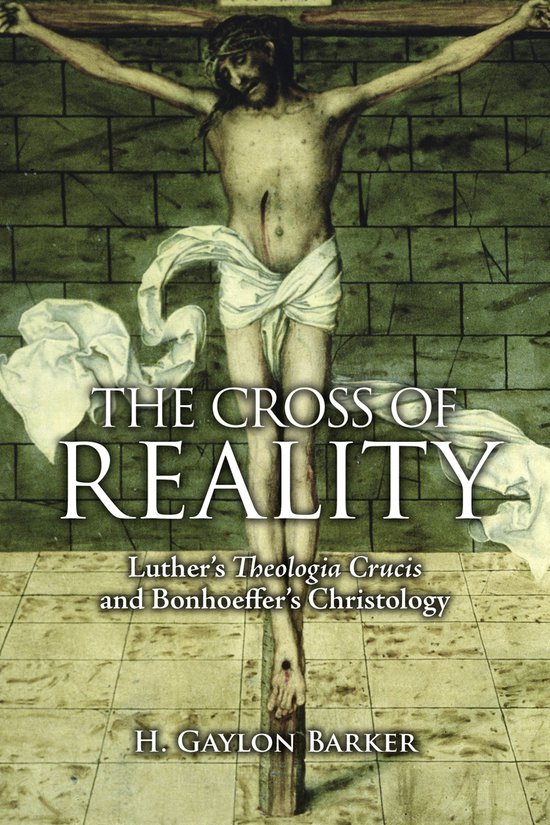
Dietrich Bonhoeffer’s theology is heavily based upon the Theologia Crucis or the Theology of the Cross which he inherited from Martin Luther. H. Gaylon Barker’s The Cross of Reality is a book-length exposition of this important aspect of Bonhoeffer’s theology that brings an enormous amount of material and analysis to bear.
Barker’s analysis of Bonhoeffer’s theology of the cross is worth quoting at length:
“One problem… religion produces , from Bonhoeffer’s perspective, is that it plays on human weakness. In the world in which people live out their lives… this means a disjuncture or contradiction. Daily people rely on their strengths, in which they don’t need God. In practical terms, therefore, God is pushed to the margins, turned to only as a ‘stop-gap’ when other sources have given out. Then God, perceived as a deus ex machina, is brought in to rescue people. This, in turn, leads to the religious conception of God and religion in general as being only partially necessary; they are not essential, but peripheral. All of this leads to intellectual dishonesty, which is not so unlike luther’s description of the theology of glory. The strength of the theology of the cross, on the other hand, is that it calls a thing what it is. It is honest about both God and the world, thereby enabling one to live in the world without seeking recourse in heavenly or escapist realigous practices. Additionally, such religious thinking leads to the creation of a God to suit human needs… For Bonhoeffer and Luther, however, the real God is one who doesn’t appear only in the form we might expect, one whom we can incorporate into our worldview or lifestyle. God is one who is always beyond our grasp, but at the same time is a hidden presence in the world” (394).
Barker highlights Bonhoeffer’s own words to make this point extremely clear:
“[W]e have to live in the world… [O]ur coming of age leads us to a truer recognition of our situation before God. God would have us know that we must live as those who manage their lives without God. The same God who is with us is the God who forsakes us (Mark 15:34! [“And at three in the afternoon Jesus cried out in a loud voice, ‘Eloi, Eloi, lema sabachthani?‘ (which means ‘My God, my God, why have you forsaken me?’)”]). The same God who makes us to live in the world without the working hypothesis of God is the God before whom we stand continually. Before God, and with God, we live without God. God consents to be pushed out of the world and onto the cross; God is weak and powerless in the world and in precisely this way, and only so, is at our side and helps us. Matt. 8:17 [“This was to fulfill what was spoken through the prophet Isaiah: ‘He took up our infirmities and bore our diseases.’] makes it quite clear that Christ helps us not by virtue of his omnipotence but rather by virtue of his weakness and suffering!” [388, quoted from DBWE 8:478-479]
Thus, for Bonhoeffer, God is not there as the divine vending machine, there to send out blessings when needed or called upon due to human inability. Instead, God enters into the world and by suffering, alongside us, helps us.
Bonhoeffer put it thus: “Only a suffering God can help.” Bonhoeffer, seeing the world as it was in his time, during the reign of terror of the Nazis, imprisoned, knew and saw the evils of humanity. And he knew that in seeing this, theodicy would fail. A God who worked only through omnipotence and only where human capacities failed was a God that did not exist. Instead, the God who took on our suffering and came into the world, who “by viture of his weakness and suffering” came to save us, is the only one who acts in the world–in reality.
Only a suffering God can help.
Links
Dietrich Bonhoeffer– read all my posts related to Bonhoeffer and his theology.
SDG.
——
The preceding post is the property of J.W. Wartick (apart from quotations, which are the property of their respective owners, and works of art as credited; images are often freely available to the public and J.W. Wartick makes no claims of owning rights to the images unless he makes that explicit) and should not be reproduced in part or in whole without the expressed consent of the author. All content on this site is the property of J.W. Wartick and is made available for individual and personal usage. If you cite from these documents, whether for personal or professional purposes, please give appropriate citation with both the name of the author (J.W. Wartick) and a link to the original URL. If you’d like to repost a post, you may do so, provided you show less than half of the original post on your own site and link to the original post for the rest. You must also appropriately cite the post as noted above. This blog is protected by Creative Commons licensing. By viewing any part of this site, you are agreeing to this usage policy.

 J.W. Wartick - Reconstructing Faith