theology
Did the Son have a beginning? – Origen vs. heresies
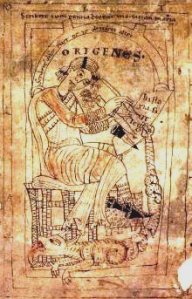
Image credit: https://commons.wikimedia.org/wiki/File:Origen3.jpg – Public Domain
Origen (184-253 AD) was one of the earliest defenders of the Christian faith.* In his work, Contra Celsum, he engaged with a Greek skeptic who brought many arguments against Christianity. In his De Principiis, he laid out the foundations of the Christian faith. (Both works are availble in The Works of Origen.) The latter work demonstrates key points to understanding the relationship between God the Father and God the Son:
John… says in the beginning of his Gospel, “And God was the Word, and this was in the beginning with God.” Let him, then, who assigns a beginning to the Word or Wisdom of God, take care that he be not guilty of impiety against the unbegotten Father Himself, seeing he denies that He had always been a Father, and had generated the Word…
This Son, accordingly, is also the truth and life of all things which exist… For how could those things which were created live, unless they derived their being from life? (Origen, De Principiis, Book I Chapter 2)
Origen, then, notes that the very descriptor of “Father” for God the Father entails that the Son has always been generated. Otherwise, one must deny that God was always the Father. But in that case, the Son must also always have been. And to deny this, one would have to deny creation itself, for all things were made through the Son.
Again, this point must not be lost: Origen, one of the earliest defenders of the church, saw the Father and the Son as distinct from each other and also co-eternal. Effectively, this goes against many false teachings, including modalism (the idea that the Father, Son, and Holy Spirit are different aspects of one God), any form of Arianism (that Jesus is not fully God), and the like. For a modern example, Jehovah’s Witnesses teach that Jesus is not fully God and not co-eternal with God the Father (whom they call Jehovah). Origen would repudiate this, noting that the Father can only right so be called in eternity, which entails the Father has always been the Father, and so the Son is co-eternal with the Father.
Reading many of these ancient historians reveals much truth about Christianity and helps to correct false teachings of today. I recommend readers read the Works of Origen.
*Origen did hold many unorthodox views which were later condemned as heretical. His faith was clearly one influenced by Platonic thought in which the human soul pre-existed and was eternal. Moreover, his view of the relations between the persons of the Trinity is deficient on many levels. My point in this post is specifically to show that Origen showed that the Son is co-eternal with the Father.
Links
Be sure to check out the page for this site on Facebook and Twitter for discussion of posts, links to other pages of interest, random talk about theology/philosophy/apologetics/movies and more!
Faith is Belief Without Evidence? Origen contra Boghossian (and others)– Origen countered the claim that faith is to be categorized as belief without evidence, as many atheists continue to claim to this day.
Eclectic Theist– Check out my other blog for posts on Star Trek, science fiction, fantasy, books, sports, food, and more!
SDG.
——
The preceding post is the property of J.W. Wartick (apart from quotations, which are the property of their respective owners, and works of art as credited; images are often freely available to the public and J.W. Wartick makes no claims of owning rights to the images unless he makes that explicit) and should not be reproduced in part or in whole without the expressed consent of the author. All content on this site is the property of J.W. Wartick and is made available for individual and personal usage. If you cite from these documents, whether for personal or professional purposes, please give appropriate citation with both the name of the author (J.W. Wartick) and a link to the original URL. If you’d like to repost a post, you may do so, provided you show less than half of the original post on your own site and link to the original post for the rest. You must also appropriately cite the post as noted above. This blog is protected by Creative Commons licensing. By viewing any part of this site, you are agreeing to this usage policy.
Really Recommended Posts 10/14/16- Apologetics, Egalitarianism, the Ark, and more!
 I must apologize for a long absence from Really Recommended Posts… posts. There’s no specific reason other than forgetfulness of a dad with a toddler. With no further adieu, we have:
5 False Assumptions about Egalitarians– Think you know what those who advocate for women’s equality in the church and home believe? Check your assumptions against this list! I know I made these assumptions about egalitarians before I became one, and I have experienced people assuming these about me repeatedly since then.
5 Things I Wish I Knew When I Started Apologetics– Continuing on the “5’s” theme, here are 5 simple things to keep in mind regarding apologetics.
Ark Encounter Common Ancestors The Increasing Inclusiveness of Biblical Kinds– As Young Earth Creationists continue to try to fit all known animals on board the ark, the understanding of biblical “kinds” has changed. Here’s a post showing the great swathes of the animal kingdom included in these categories now.
The next two posts are different sides of the same issue. Jerry Walls has made an argument that he alleges shows Calvinism cannot be true. On the one hand, one answer has been offered that argues that Walls’ argument is mistaken. However, a more recent post argues that Walls’ argument is sound and Calvinism is false. Yet another more concise post argues that Wall’s argument is mistaken in specific premises. I’ve been following this debate with interest. I think it is worth viewing both sides’ points. What do you think?
Master of the Arts in Apologetics: World Religions– An intriguing, 100% online program for getting an MA in Apologetics with a special focus on world religions. We need more Christians out there not just learning apologetics related to atheism, but also on doing evangelism worldwide in a truly inter-religious atmosphere. Check out the program info here.
Book Review: “Eight Women of Faith” by Michael A.G. Haykin
 Haykin’s Eight Women of Faith sets out with an admirable goal: highlight the contributions of women at key points in church history. The women chosen each have biographical information reported alongside brief discussion of their primary contributions to theology. In this sense, the book achieves its goal.
One difficulty with the book is the lack of critical historical perspective. For example, Jane Austen is gently chastised for her aversion to evangelicalism(Kindle location 1994ff), while then being recruited for the same evangelical cause (Location 2005, 2064). But to see evangelicalism of today as the same as evangelicalism in Austen’s own time (the late 18th and early 19th centuries) does little justice to the development of what has been called “evangelical” over that time into today. This is perhaps the most glaring example in the book, but time and again similar oversight of historical perspective is demonstrated.
Another negative is that Haykin’s work is clearly written with a very specific doctrinal agenda in mind that undercuts the book’s value outside of the circle of those with whom he agrees. For example, he spends no small amount of time promoting the Calvinist view of the Lord’s Supper, attempting to cling both to a literal and figurative meaning of Christ’s words (see especially the excursus in the chapter on Anne Dutton starting around Kindle Location 903). Later, a lengthy section of the chapter on Ann Judson is dedicated to highlighting Judson’s autobiographical account of her change from pedobaptism (infant baptism) to a more Baptist position. Very few arguments are offered in favor of the latter position, other than highlighting that Judson herself believed the arguments for the it were stronger than for infant baptism. This is not a deep theological work, but this section again shows no interaction with opposing views and so provides those who come from a different background little reason to read or enjoy the book.
Perhaps the greatest problem with the book is the irony of continually attempting to silence women’s voices in a book that is, on the surface, about calling attention to them. This begins on the very first page of the Forword, as Karen Swallow Prior writes, “Both within the church and outside it, we too have treated in a similar fashion the biblical admonition against women preaching: we focus on the single thing that is off-limits and thereby fail to see the abundant opportunities and roles God has clearly offered…” (Kindle location 59-64). Of course, this biblical admonition is not cited–and could not be, for there is no Bible verse that says women cannot preach (it is instead an inference from a number of verses that are often misread)–but beyond that, the point is that the book highlights the silence of women throughout.
In the chapter on Anne Dutton, for example, we see that Dutton argued for the validity of her theological writings, so long as they were not read in churches or used in public worship but rather read privately (Kindle loc 825-834). But of course the line drawn in the sand here between private and public use is not drawn in the Bible but in human tradition. Moreover, the prior alleged admonition against women preaching comes from verses that, if read literally as must be the case for restring women in the ministry, also would prevent women from speaking at all in church, yet one of the women highlighted is Anne Steele, a prolific hymn writer.
All of this is to say that the book has a very limited appeal. Only those from the very specific perspective of Reformed Baptists will be able to see their perspective put forward without critique. This is not necessarily a bad thing, for the publisher, Crossway, continues to publish Reformed Baptist books. It’s not a bad thing to have books that appeal to your own readers. The problem is that anyone outside of that perspective has no reason to read the book. Their views are not presented well if they are presented at all, and there is an almost self-congratulatory feel to the way specific doctrines are presented. Moreover, the lack of historical perspective gives the book a simplistic feel that grants readers only the most surface-level understanding of the issues at hand.
The best that can be said for Eight Women of Faith is that it at least acknowledges that women have made significant contributions to the Christian faith. It just doesn’t acknowledge all of women’s contributions, and continues to limit women.
The Good
+Highlights importance of women in church history
The Bad
-Unbalanced perspective
-Uncritical look at historical development of theology
-Undermines women’s voices while ostensibly uplifting them
-Limited appeal beyond denominational lines
Disclaimer: I received a copy of the book from the publisher for review. I was not obligated to provide any specific kind of feedback whatsoever.
Links
Be sure to check out the page for this site on Facebook and Twitter for discussion of posts, links to other pages of interest, random talk about theology/philosophy/apologetics/movies and more!
Book Reviews– There are plenty more book reviews to read! Read like crazy! (Scroll down for more, and click at bottom for even more!)
Eclectic Theist– Check out my other blog for my writings on science fiction, history, fantasy movies, and more!
SDG.
——
The preceding post is the property of J.W. Wartick (apart from quotations, which are the property of their respective owners, and works of art as credited; images are often freely available to the public and J.W. Wartick makes no claims of owning rights to the images unless he makes that explicit) and should not be reproduced in part or in whole without the expressed consent of the author. All content on this site is the property of J.W. Wartick and is made available for individual and personal usage. If you cite from these documents, whether for personal or professional purposes, please give appropriate citation with both the name of the author (J.W. Wartick) and a link to the original URL. If you’d like to repost a post, you may do so, provided you show less than half of the original post on your own site and link to the original post for the rest. You must also appropriately cite the post as noted above. This blog is protected by Creative Commons licensing. By viewing any part of this site, you are agreeing to this usage policy.
Really Recommended Posts 9/9/16- Zionism, Lewis on Medieval Literature, and more!
Hello friends! I have gathered some links from around the web to share with you! Be sure to let the authors know if you find them interesting, and let me know what you think in the comments.
Notes on “Studies in Medieval and Renaissance Literature” by C.S. Lewis– Some interesting insights gleaned from Lewis’ work on writings of the period noted. Lewis was a fascinating literary critic, and these insights are worth reading through.
The Popular Bonhoeffer Quote that Isn’t in Bonhoeffer’s Works– One of the most popular quotes I’ve seen circulating from Dietrich Bonhoeffer may not actually be from Bonhoeffer. Check out this thorough investigation into finding the source for the quote. Be sure to let me know if you know of some actual citation from Bonhoeffer for the quote.
The New Christian Zionism- Introduction- Review- The beginning of a thorough look at a book I’ve also been in the process of reviewing, The New Christian Zionism.
Celebrating 50 Years of Star Trek– Check out the series of posts in which I collaborated with The Sci-Fi Christian to celebrate 50 years of Star Trek.
Book Review: “Justification” by N.T. Wright
 N.T. Wright’s views about the doctrine of justification have continued to be quite controversial, and his book Justification is a brief summary of his entire project. Essentially, Wright is attempting to go back to the Pauline corpus to see exactly what Paul means by the doctrine of justification. Part of this project, for Wright, is to become aware of the idea that we may be asking the texts the wrong questions from the get-go. We need to understand the context to which Paul was writing before we can even properly formulate questions.
Wright begins with a number of preliminary comments. He first outlines the difficulties faced by biblical interpreters when they do start with the wrong questions. He argues that a number of our interpretations are based less on the text than an interpretation of the text itself. He argues that the Reformation tradition ought to continue to lead us to question even Reformation conclusions about texts like Galatians–and Luther’s “mistaken” reading (according to Wright) thereof. In other words, we need to acknowledge that we could be deeply mistaken, and have been deeply mistaken, about the meaning of these texts for hundreds of years. It’s a tough pill to swallow, but one that ought to be taken seriously. Acknowledging the possibility that an interpretation is based less on the text than on tradition or modern assumptions is one of the first steps to understanding the text.
Then, Wright proceeds to show the context to which Paul was writing. Specifically, much of the context he was writing to makes certain parts of the text make a lot more sense than they may otherwise. When you realize what was happening in the early church it becomes easier to understand some of the basic questions Paul was asking and answering. Next, Wright outlines his view of justification, which is admittedly never distilled (so far as I can tell) down to a single sentence. It is thus difficult to say exactly what his view is without an extended excursus longer than a book review, but the bare-bones basics, at risk of being overly simplistic, is that justification is God’s work through Israel of bringing the whole world to himself, declaring it righteous not through imputed righteousness, but through a law court declaration of righteousness. Yes, before those who understand Wright’s position better than I do, this is very simplistic and misses some key points of his doctrine. Yet, I have to make the attempt to summarize as best I can what he was arguing.
Finally, Wright concludes with lengthy exegesis of a number of Pauline passages. Though he himself says these are but the first steps along the lines of understanding Paul, it ought to be noted that it is in this section of the book that Wright engages most thoroughly with critics of his position as well as providing a positive statement of his view. This new edition that I’m reviewing adds an additional introduction from Wright, which outlines the continuing debates over Pauline theology.
One difficulty with Wright’s approach that many may object to is the notion that it undermines the perspicuity of Scripture. Now, I’m one who hates throwing that term around, because perspicuity is used as a kind of battering ram doctrine to try to silence critics on all sorts of topics. However, the real doctrine of perspicuity of Scripture, yes, inherited from the Reformation, is that the Bible is clear in that which is necessary to understand for salvation. If, however, Wright is correct in saying that must understand a great deal of historical context before we can even get to the right questions for the doctrine of justification, this seems to make it quite complex indeed to get to the knowledge that people need for salvation. Of course, Wright would–and did–argue that this is already starting off on the wrong track, because Paul was not so much interested in individual salvation as he was interested in the plan of Salvation through Israel of the whole world. And that is a fair answer, though it does seem to–in some sense–undermine the clarity of Scripture as has been taught. Once again, Wright would probably accept this and argue that that idea is itself an inherited tradition that the Reformers themselves would call us to examine and test by Scripture.
Perhaps the strangest aspect of the book to me was the continued targeting of Luther and Lutheran theology by Wright. I know of some Lutheran pastors who have argued Wright’s position is not far at all from the Lutheran one, and others who believe he is as far from Lutheranism on justification as possible. Though this may simply show confusion within Lutheran theology, it may also show–and I think does–that Wright’s position (and probably Luther’s) is not so clearly stated as he thinks. Moreover, I am curious about the continued calling out of Lutherans (and, yes, Reformed thinkers) by Wright, considering that his position seems, on the face of it, so utterly close to what Lutherans do believe about justification, and much farther from some other denominational perspectives.
Justification is required reading for those interested in Pauline theology, whether one agrees with Wright or not. That said, it is unfortunate that a decent amount of the work seems to be polemical against perceived enemies rather than embracing potential allies.
The Good
+Leads readers to a deeper look at biblical texts
+Provides solid background to understanding Pauline corpus
+Outlines Wright’s ways in a concise fashion
The Bad
-Strangely focused on the Lutheran position
-Not always very clear
Disclaimer: I received a copy of the book for review from the publisher. I was not required to provide any specific kind of feedback whatsoever.
Source
N.T. Wright, Justification (Downers Grove, IL: InterVarsity, 2016).
Links
Be sure to check out the page for this site on Facebook and Twitter for discussion of posts, links to other pages of interest, random talk about theology/philosophy/apologetics/movies and more!
Book Reviews– There are plenty more book reviews to read! Read like crazy! (Scroll down for more, and click at bottom for even more!)
Eclectic Theist– Check out my other blog for my writings on science fiction, history, fantasy movies, and more!
SDG.
——
The preceding post is the property of J.W. Wartick (apart from quotations, which are the property of their respective owners, and works of art as credited; images are often freely available to the public and J.W. Wartick makes no claims of owning rights to the images unless he makes that explicit) and should not be reproduced in part or in whole without the expressed consent of the author. All content on this site is the property of J.W. Wartick and is made available for individual and personal usage. If you cite from these documents, whether for personal or professional purposes, please give appropriate citation with both the name of the author (J.W. Wartick) and a link to the original URL. If you’d like to repost a post, you may do so, provided you show less than half of the original post on your own site and link to the original post for the rest. You must also appropriately cite the post as noted above. This blog is protected by Creative Commons licensing. By viewing any part of this site, you are agreeing to this usage policy.
Book Review: “Introduction to World Christian History” by Derek Cooper
 Derek Cooper’s Introduction to World Christian History provides a look at the development of Christianity across the world. It is a broad introduction to Christianity around the globe.
The book is formatted both by space and time. That is, sections on each general area (i.e. Asia) are traced for a specific time period (i.e. First through Seventh Centuries). Thus, readers looking to have a reference to work from need not look much farther than this book. Other readers, who may simply be interested in the broad development of world Christianity will not be disappointed either. Cooper does an excellent job showing the ebb and flow of Christianity’s spread across vast regions of time and place. Individual stories of prominent Christians are told in historical context to highlight specific periods or ideas. These individual stories accompany a broader narrative that is delivered in a readable, engaging style.
What makes the book particularly excellent is the way it provides all levels of readers with more to explore. It is an introductory text, for sure, but the notes are excellent and the topics explored are so broad that even readers with serious knowledge of Christian history will find more to explore. It is such a vast topic that no one can grasp each area, and Cooper gives glimpses into history that entice, like stained glass windows, much study.
The only real downside here is unavoidable: with so much material covered, it is impossible to get a complete picture of any one topic. Readers must go beyond this introduction. But again, kudos to Cooper for making readers want to do so with such a rich narrative style.
Introduction to World Christian History is the kind of book that will broaden readers minds in a number of ways. From those merely interested in a specific region to those who want to know just how we got to where we are, the book has broad appeal. Cooper’s style makes it extremely accessible for any level of reader, with plenty to tantalize more advanced readers as well. I recommend it highly.
The Good
+Fantastic overview covering large swathes of time and space
+Provides readers with broader understanding of Christianity
+Written in an interesting, readable style
The Bad
-Extremely brief on many interesting points
Disclaimer: I received a copy of the book for review from the publisher. I was not required to provide any specific kind of feedback whatsoever.
Links
Be sure to check out the page for this site on Facebook and Twitter for discussion of posts, links to other pages of interest, random talk about theology/philosophy/apologetics/movies and more!
Book Reviews– There are plenty more book reviews to read! Read like crazy! (Scroll down for more, and click at bottom for even more!)
Eclectic Theist– Check out my other blog for my writings on science fiction, history, fantasy movies, and more!
SDG.
——
The preceding post is the property of J.W. Wartick (apart from quotations, which are the property of their respective owners, and works of art as credited; images are often freely available to the public and J.W. Wartick makes no claims of owning rights to the images unless he makes that explicit) and should not be reproduced in part or in whole without the expressed consent of the author. All content on this site is the property of J.W. Wartick and is made available for individual and personal usage. If you cite from these documents, whether for personal or professional purposes, please give appropriate citation with both the name of the author (J.W. Wartick) and a link to the original URL. If you’d like to repost a post, you may do so, provided you show less than half of the original post on your own site and link to the original post for the rest. You must also appropriately cite the post as noted above. This blog is protected by Creative Commons licensing. By viewing any part of this site, you are agreeing to this usage policy.
Practical Lutheranism: What is Sabbath?
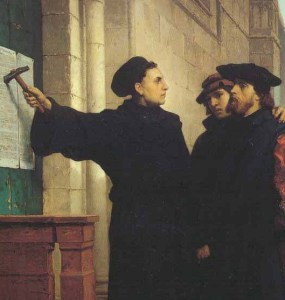 I have been reading through the Book of Concord. I think it is vitally important for one who, like me, claiming to be Lutheran to be familiar with the Lutheran Confessions. That is, after all, what we believe and confess. I have been writing a series of posts on Practical Lutheranism based on the Book of Concord. These teachings remain viable and valuable today.
What is Sabbath?
One of the debates that has raged within Christianity (with different levels of flame behind this raging, whether it be a mere flickering candle or a roaring fire) has been the meaning of “Sabbath” and how it is integrated into the Christian life. Volumes have been written, multi-view books published, denominations split or created, and the like on this topic.
Luther’s Large Catechism offered a way forward in this debate, offering an understanding of keeping the day holy that could be lived by the Christian. He wrote:
Accordingly, when you are asked what “You are to hallow the day of rest” means, answer: “Hallowing the day of rest means to keep it holy.” What is meant by “keeping it holy”? Nothing else than devoting it to holy words, holy works, and holy living… [The Sabbath Day] becomes holy or unholy on your account, depending on whether you spend it doing something holy or unholy. How does such sanctifying take place? Not when we sit behind the stove and refrain from hard work, or place a garland on our head and dress up in our best clothes, but… when we make use of God’s Word and exercise ourselves in it. [The Large Catechism, Part I, 87-88, cited below]
Yet Luther, as is so often the case for Luther (and Lutherans), was not content to leave it there. In the spirit of the Lutheran both/and, he expanded this notion of making holy to the whole of Christian life:
Truly, we Christians ought to make every day such a holy day and devote ourselves only to holy things, that is, to occupy ourselves daily with God’s Word and carry it in our hearts and on our lips… For non-Christians can spend a day in rest and idleness, too… but without keeping a single day holy, because they neither preach nor practice God’s Word… [Large Catechism, I:89-90]
Thus, for Luther, we ought to remember Christ’s words: we were not made for Sabbath, but Sabbath for us. Moreover, Sabbath is part of the overall Christian life instead of being relegated to merely one part of the week. Making the day holy is something we ought always be doing: reflecting on God’s Word, singing Psalms, and praying.
Source
Robert Kolb and Timothy J. Wengert, eds. The Book of Concord: The Confessions of the Evangelical Lutheran Church (Minneapolis, MN: Fortress, 2000).
Links
Be sure to check out the page for this site on Facebook and Twitter for discussion of posts, links to other pages of interest, random talk about theology/philosophy/apologetics/movies and more!
Adhering to the Book of Concord “In So Far As” or “Because” it Agrees with Scripture?– I argue that Lutherans must hold the position that we adhere to the Book of Concord In So Far As it Agrees with Scripture.
Eclectic Theist– Check out my other blog for posts on Star Trek, science fiction, fantasy, books, sports, food, and more!
SDG.
——
The preceding post is the property of J.W. Wartick (apart from quotations, which are the property of their respective owners, and works of art as credited; images are often freely available to the public and J.W. Wartick makes no claims of owning rights to the images unless he makes that explicit) and should not be reproduced in part or in whole without the expressed consent of the author. All content on this site is the property of J.W. Wartick and is made available for individual and personal usage. If you cite from these documents, whether for personal or professional purposes, please give appropriate citation with both the name of the author (J.W. Wartick) and a link to the original URL. If you’d like to repost a post, you may do so, provided you show less than half of the original post on your own site and link to the original post for the rest. You must also appropriately cite the post as noted above. This blog is protected by Creative Commons licensing. By viewing any part of this site, you are agreeing to this usage policy.
Book Review: “The Great Divide: A Lutheran Evaluation of Reformed Theology” by Jordan Cooper
 The Great Divide: A Lutheran Evaluation of Reformed Theology presents a broad-spectrum look at Reformed theology from a Lutheran perspective.* Cooper breaks this analysis up into three parts: Predestination and Free Will, Worship and the Sacraments, and Salvation. These parts are intended to show the greatest dividing lines between Reformed and Lutheran thought.
It is really quite exciting to see how well-read Cooper is on both Reformed and Lutheran thought. On the Reformed side, he frequently cites Calvin (of course), Bavinck, Edwards, Piper, Grudem, and more. On the Lutheran side, he draws from Luther, Chemnitz, Melanchthon, Kolb, and more. This thorough use of sources on both sides helps shield against bias, as Cooper continually cites the words of prominent theologians of each tradition.
Cooper provides in each chapter a presentation of Reformed thought on the topic, drawing extensively from prominent Reformed thinkers past and present, as well as various Reformed Confessions. Then, he provides a look at the Lutheran perspective, often quoting the Lutheran Confessions as well as prominent Lutheran thinkers. After providing this comparison, Cooper argues for the Lutheran position, noting the points of divergence along the way. At many points, this analysis is fairly robust. However, at other points Cooper does swiftly move from one point to another before providing enough to establish each point.
One of the things that comes to the front most clearly in the book is just how close Reformed and Lutheran thought are on a number of issues. Unfortunately, as close as the two traditions come on many areas, the chasm between the two remains vast. This is particularly clear in regards to the Sacraments and Predestination. I was also pretty surprised to see how different the Reformed and Lutheran view regarding worship is. The regulative principle within Reformed thought–that whatever is not commanded in Scripture ought not to be done in worship–was something that startled me. I hadn’t considered such a position, but Cooper showed the arguments for and against this position, coming down on the side of Lutheranism (again, he’s coming from that perspective), which sees worship as something that God allows for more leeway in than do Reformed thinkers.
It is truly amazing how much information Cooper manages to convey in just 200 pages. Readers are introduced to both Lutheran and Reformed perspectives on a number of important theological topics, treated to both exposition of those views and offered critique of the Reformed position all in a very clear style and form.
There are two minor critiques I’d offer of the book. The first is the continued use of the archaic “man” to refer to all people. There were, in fact, a few places in which I had to work to discern whether Cooper meant all people or just men when it came to what he was writing. A second critique is that because of the books relatively short length, some of the arguments on either the Reformed or Lutheran side seem extremely brief, leaving some of the arguments inconclusively demonstrated.
Jordan Cooper’s The Great Divide: A Lutheran Evaluation of Reformed Theology is a vast trove of information and analysis. Extensively researched and well-reasoned, it will provide readers unfamiliar with either Reformed or Lutheran theology (or both) an introduction to each tradition as well as a look at how they may interact with one another.
The Good
+Engages with prominent theologians from each group
+Historically informed
+Treats Reformed thought fairly
+Vast wealth of information
The Bad
-Continued use of archaic “man” etc. as inclusive
-Some points are breezed through very quickly
*It is worth noting my own bias here: I am a Lutheran who was raised Lutheran and, though I wandered a little bit, have become quite convinced of Lutheran theology in recent years.
Disclaimer: I was provided with a copy of the book for review by the publisher. I was not required to provide any specific kind of feedback whatsoever.
Source
Jordan Cooper The Great Divide: A Lutheran Evaluation of Reformed Theology (Eugene, OR: Wipf & Stock, 2015).
Links
Be sure to check out the page for this site on Facebook and Twitter for discussion of posts, links to other pages of interest, random talk about theology/philosophy/apologetics/movies and more!
Book Reviews– There are plenty more book reviews to read! Read like crazy! (Scroll down for more, and click at bottom for even more!)
Eclectic Theist– Check out my other blog for my writings on science fiction, history, fantasy movies, and more!
SDG.
——
The preceding post is the property of J.W. Wartick (apart from quotations, which are the property of their respective owners, and works of art as credited; images are often freely available to the public and J.W. Wartick makes no claims of owning rights to the images unless he makes that explicit) and should not be reproduced in part or in whole without the expressed consent of the author. All content on this site is the property of J.W. Wartick and is made available for individual and personal usage. If you cite from these documents, whether for personal or professional purposes, please give appropriate citation with both the name of the author (J.W. Wartick) and a link to the original URL. If you’d like to repost a post, you may do so, provided you show less than half of the original post on your own site and link to the original post for the rest. You must also appropriately cite the post as noted above. This blog is protected by Creative Commons licensing. By viewing any part of this site, you are agreeing to this usage policy.
Book Review: “Karl Barth’s Infralapsarian Theology” by Shao Kai Tseng
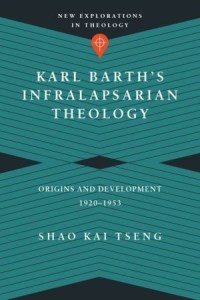 Shao Kai Tseng’s Karl Barth’s Infralapsarian Theology is a thorough examination of Barth’s lapsarian position. There are two major positions in Reformed circles regarding how God ordered the divine decrees. Supralapsarianism teaches that God decreed election (who would be saved) and reprobation (who would be condemned) prior to the Fall, while infralapsarianism teaches that God first decrees the Fall, then election and reprobation (among other things). Not all Reformed thinkers hold to one of these two positions. For a fuller explanation, see here, or look more deeply at the book. Barth, historically, has been understood as a supralapsarian, and even at times explicitly claimed that position for himself. Tseng argues, however, that Barth’s position is truly infralapsarian.
Tseng argues for his thesis through an examination of Barth’s developing thought. He begins with Barth’s earliest works and then traces his thought on problems of atonement, decree, and redemption throughout his life. Tseng interacts with numerous interpreters of Barth, utilizing them to support his theory or showing where they are mistaken.
The two greatest difficulties with the book are linked. Tseng’s tone is relentlessly even, such that there are few breaks for readers to pause and consider the contents, and few examples of application of the texts are given. This means that there is little reason given to investigate the central topic of the book: Barth’s lapsarian position. Why, exactly, does Barth’s lapsarian position actually matter to us now? Other than scratching a curious itch, what application does it have? Surely, for historical reasons, it is good to know where Barth ought to line up, but beyond that Tseng doesn’t give much of a reason for seeing why this impacts broader theological studies.
Of course, that doesn’t mean the book is without merit. Those deeply interested in Barth will want to engage with it and debate its contents. Moreover, because Tseng looks deeply at Barth’s developing thought, it provides some analysis of Barth’s overall theology.
Karl Barth’s Infralapsarian Theology is dry and fairly esoteric. For those who are deeply interested in Barthian thought, however, this will be necessary reading, particularly if one wants to engage in Barth’s doctrine of election. If one wishes to delve deeply into Barthian thought and Reformed disputes over lapsarian positions, this is a good read, but its audience is limited to that group.
The Good
+Exposes readers to large amounts of Barth’s thought
+Utilizes interpreters of Barth well
+Detailed look at the central topic
The Bad
-Little reason offered to pursue central topic
-Tone doesn’t put much “life” in the text itself
Disclaimer: I was provided with a review copy of the book by the publisher. I was not required to provide any specific kind of feedback whatsoever.
Source
Shao Kai Tseng, Karl Barth’s Infralapsarian Theology (Downers Grove, IL: InterVarsity, 2016).
Links
Be sure to check out the page for this site on Facebook and Twitter for discussion of posts, links to other pages of interest, random talk about theology/philosophy/apologetics/movies and more!
Book Reviews– There are plenty more book reviews to read! Read like crazy! (Scroll down for more, and click at bottom for even more!)
Eclectic Theist– Check out my other blog for my writings on science fiction, history, fantasy movies, and more!
SDG.
——
The preceding post is the property of J.W. Wartick (apart from quotations, which are the property of their respective owners, and works of art as credited; images are often freely available to the public and J.W. Wartick makes no claims of owning rights to the images unless he makes that explicit) and should not be reproduced in part or in whole without the expressed consent of the author. All content on this site is the property of J.W. Wartick and is made available for individual and personal usage. If you cite from these documents, whether for personal or professional purposes, please give appropriate citation with both the name of the author (J.W. Wartick) and a link to the original URL. If you’d like to repost a post, you may do so, provided you show less than half of the original post on your own site and link to the original post for the rest. You must also appropriately cite the post as noted above. This blog is protected by Creative Commons licensing. By viewing any part of this site, you are agreeing to this usage policy.
Really Recommended Posts 6/17/16- horror movies, The Gospel Coalition, and more!

A picture of a goldfinch I took. All rights reserved.
Another week, another round of posts for you to enjoy, dear readers! This week has an exciting lineup–hopefully with some posts that will get you thinking and talking! This week, we have horror movies and Christianity, the Gospel Coalition’s (non-)engagement with culture, apologetics for kids with elephants and waterfalls, debate over the relation between the Father and Son in the Trinity, and the topic of the use of guns. As always, I’m curious to read your thoughts. I don’t always agree with 100% of everything I link, but try to choose posts that get me thinking and that I hope will get you thinking as well! [EDIT: I accidentally had one link to the wrong post. My apologies! It is fixed now.]
Why Horror Movies Make Me a Better Christian– I don’t like horror movies at all. Unless by “horror movies” you mean black-and-white horror movies with monsters that are hilarious now due to special effect differences (i.e. Creature from the Black Lagoon, etc.), then I love them. Can horror movies, with all their gore and violence, really have any redeeming qualities? This post made me think about that in a fresh light. What do you think?
The Gospel Colition and How Not to Engage Culture– Can The Gospel Coalition really claim to be about engaging with culture when they continually silence critics on social media? Check out this post for more information on this issue.
How Elephant is a Waterfall– How do you get kids thinking in different categories? What is concrete/abstract? What is a contradiction? Here’s a post from an exciting new site about apologetics for kids.
The Coming War: Nicene Complementarians vs Homoian Complementarians– There is a debate raging within complementarian camps over the subordination of the Son to the Father in the Trinity. Here is an outline of that debate. Read the follow-up posts as well for more. I’ve written on one side of this debate before- “Is the Son ‘Equal to God‘?”
Actually, Guns do kill people (Think Christian)– Think Christian is a great site for engaging culture and getting us thinking about topics we might not normally. This post is, I think, thought provoking regarding issues related to gun violence. It doesn’t offer solutions, but rather a way to conceptualize. What do you think about this issue? How might Christians engage with the topic of gun violence–or should we?

 J.W. Wartick - Reconstructing Faith
