theology
Book Review: “Discovering Biblical Equality” Third Edition edited by Ronald W . Pierce, Cynthia Long Westfall, and Christa L. McKirland
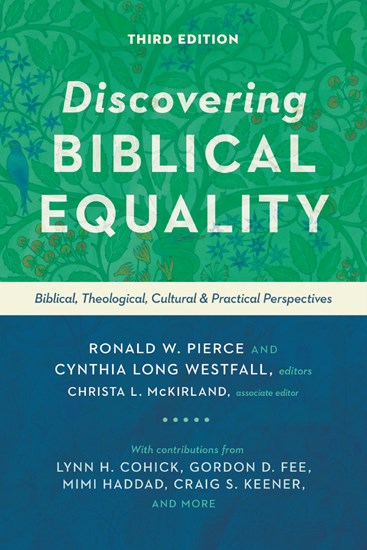
Discovering Biblical Equality: Biblical Theological, Cultural, & Practical Perspectives is a massive tome defending the equality of women in the church and home from a Christian standpoint.
The book is organized around 31 chapters plus an introduction and conclusion. The chapters are broken up into four parts: Looking to Scripture: The Biblical Texts; Thinking it Through: Theological and Logical Perspectives; Addressing the Issues: Interpretive and Cultural Perspectives; Living it Out: Practical Applications. There are highlights in each section, and each essays has its own strengths. Linda Belville’s “Women Leaders in the Bible” goes through many names readers might be familiar with, but also dives into details about some of the specifics, such as the background info we can see in the text for the importance of Huldah (p. 73) and some surprising examples readers might be unfamiliar with (74-75). The discussion of both marriage and singleness with regards to mutuality in Ronald W. Pierce and Elizabeth A. Kay’s chapter (“Mutuality in Marriage and Singleness: 1 Corinthians 7:1-40) is refreshing because so often the discussion centers entirely around marriage. The so-called “clobber passages” of 1 Timothy 2:11-15 and 1 Corinthians 14:34-35 each get their own passage, as do many other related passages.
Kevin Giles’s chapter on “The Trinity Argument for Women’s Subordination” shows the lengths to which some have gone to try to ground women’s inequality. Jeffrey D. Miller’s chapter on gender accurate Bible translation was fascinating and shows how the issues that are often dismissed regarding translation issues can have real, spiritual implications. Mimi Haddad’s chapter on global perspectives and why gender equality matters helps demonstrate the real-life applications of theology.
The book is the third edition of this collection. I own the second edition, which I read some years ago. I compared the table of contents for the two editions, and there is in the third edition a significant overhaul of the included essays. There are 31 chapters in the new edition vs. 29 in the previous one. Several chapters have been entirely replaced, and several new topics are introduced in the third edition. For example a chapter on “Gender Equality and Homosexuality” by William J. Webb in the second edition appears to have been replaced by “Biblical Equality and Same-Sex Marriage” by Ronald W. Pierce in this third edition. The third edition also addresses race and gender, a topic that I don’t recall or see a chapter dedicated to in the second edition. In other words, readers interested in knowing whether it’s worth re-purchasing should rest assured that it very much is. This new edition has a huge amount of new content. I cannot comment on whether essays that appear in each are revised in any way from the original.
The chapter on “Biblical Equality and Same-Sex Marriage” is written by Piece, who is non-affirming in his stance on same-sex marriage. The thrust of the chapter seems to be that one can be a fully committed egalitarian while not affirming same-sex marriage. Such a topic is certainly of interest to the many people who are caught in the middle on these issues. For my part, I’d have liked to see another chapter from an affirming perspective, though I wonder if it wasn’t included because that’s a less controversial pairing. The chapter on race and gender is fascinating and shows how these topics often intersect and overlap.
Discovering Biblical Equality is unquestionably the standard text for those wishing to explore the basics of egalitarian theology on a scholarly level that remains accessible. Every chapter has something to add to the discussion. The depth and breadth of some of the chapters is truly remarkable. I recommend it extremely highly as among the best books on the topic.
Disclaimer: I was provided with a copy of the book for review by the publisher. I was not required to give any specific kind of feedback whatsoever.
All Links to Amazon are Affiliates links
Links
Be sure to check out the page for this site on Facebook and Twitter for discussion of posts, links to other pages of interest, random talk about theology/philosophy/apologetics/movies and more!
Book Reviews– There are plenty more book reviews to read! Read like crazy! (Scroll down for more, and click at bottom for even more!)
SDG.
——
The preceding post is the property of J.W. Wartick (apart from quotations, which are the property of their respective owners, and works of art as credited; images are often freely available to the public and J.W. Wartick makes no claims of owning rights to the images unless he makes that explicit) and should not be reproduced in part or in whole without the expressed consent of the author. All content on this site is the property of J.W. Wartick and is made available for individual and personal usage. If you cite from these documents, whether for personal or professional purposes, please give appropriate citation with both the name of the author (J.W. Wartick) and a link to the original URL. If you’d like to repost a post, you may do so, provided you show less than half of the original post on your own site and link to the original post for the rest. You must also appropriately cite the post as noted above. This blog is protected by Creative Commons licensing. By viewing any part of this site, you are agreeing to this usage policy.
Book Review: “A Short History of Christian Zionism” by Donald M. Lewis
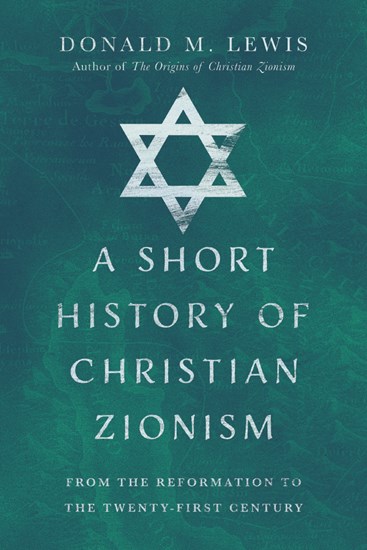
Christian Zionism is a major force in today’s political landscape. It’s especially powerful in the United States, but it’s also a global force. Donald M. Lewis’s A Short History of Christian Zionism gives readers a background for understanding what Christian Zionism is, where and when it came from, and how it impacts us to this day.
The book specifically deals with the time period from the Reformation to the modern day. Chapters cover a huge range of topics, largely in chronological order. First, Lewis’s helpful introduction deals with the competing definitions of Zionism and related terms. Ultimately, he settles upon this as a definition for Christian Zionism: it is “a Christian movement which holds to the belief that the Jewish people have a biblically mandated claim to their ancient homeland in the Middle East” (3, emphasis removed). Lewis notes how Christian Zionism has played a part in identity formation, especially for those in the dispensationalist movement. From there, Lewis moves into tracing the history of the movement itself. The first chapter does give a brief history from the Early Church to the Reformation, after which several chapters deal with different strands of Zionism emerging from various links to the Reformation. From there, links are forged showing Christian Zionism in American Puritanism, 19th Century British Evangelicalism, and how prominent a role the British Empire played in establishing some of the groundwork for later Zionist movements. The vision of World War I and II as vindications for Premillennialism and the correlating rise of Premillennial Dispensationalism and Christian Zionism presents a fascinating case study in the tenth chapter, and multiple developments in Palestine and global revivalist and Zionist activities form out the rest of the book.
Each chapter is filled with enlightening information. I was especially surprised to learn about the Balfour Declaration, a 1917 document in which the British Government publicly declared its support for a “national home of the Jewish people.” This, despite it being opposed by or ignored by many Jews of the time. The chapters outlining the rise of Christian Zionism in the British Empire laying the groundwork for this Declaration and how that declaration impacted later Zionism were absolutely fascinating.
Insights like those are present in virtually every chapter. The early is often cited by modern Zionists to support their reading of Scripture, but Lewis shows how many in the early church were largely ambivalent to ideas that would later form the basis for Christian Zionism. Lewis also is consistently even-keeled in his evaluation of Christian Zionism, rarely offering direct critique or support for any specific aspects of Christian Zionism. It makes the book invaluable as a reference work with little to bother readers about how it reports the historical information.
A Short History of Christian Zionism is a commendably fair evaluation of the Christian Zionist movement. Any readers remotely interested in the topic would be well-served to pick up and read a copy of this fine historical overview.
Disclaimer: I was provided with a copy of the book for review by the publisher. I was not required to give any specific kind of feedback whatsoever.
All Links to Amazon are Affiliates links
Links
Be sure to check out the page for this site on Facebook and Twitter for discussion of posts, links to other pages of interest, random talk about theology/philosophy/apologetics/movies and more!
Book Reviews– There are plenty more book reviews to read! Read like crazy! (Scroll down for more, and click at bottom for even more!)
SDG.
——
The preceding post is the property of J.W. Wartick (apart from quotations, which are the property of their respective owners, and works of art as credited; images are often freely available to the public and J.W. Wartick makes no claims of owning rights to the images unless he makes that explicit) and should not be reproduced in part or in whole without the expressed consent of the author. All content on this site is the property of J.W. Wartick and is made available for individual and personal usage. If you cite from these documents, whether for personal or professional purposes, please give appropriate citation with both the name of the author (J.W. Wartick) and a link to the original URL. If you’d like to repost a post, you may do so, provided you show less than half of the original post on your own site and link to the original post for the rest. You must also appropriately cite the post as noted above. This blog is protected by Creative Commons licensing. By viewing any part of this site, you are agreeing to this usage policy.
A Dilemma for Bonhoeffer’s Martyrdom? – Conflicting views of Bonhoeffer as Martyr
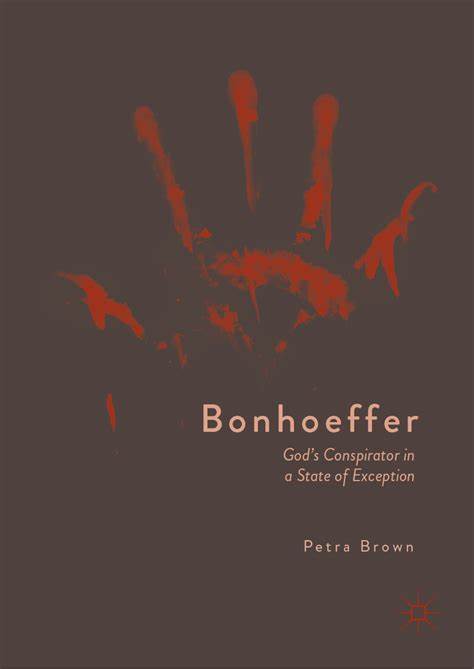
Dietrich Bonhoeffer is widely viewed as a martyr, a view that has only become more prevalent as popular-level interpretations of his life circulate broadly. Though it may seem fairly straightforward to claim Bonhoeffer as martyr, there are a number of potential stumbling blocks when it comes to the specifics of this claim. Broadly, Bonhoeffer as martyr makes a kind of intuitive sense if one views him as being killed by the Nazis for religious reasons. However, once one begins to examines his life and the reasoning behind viewing his death as a martyrdom, it becomes more complicated.
Petra Brown has argued against Bonhoeffer’s status from a number of directions in her work, Bonhoeffer: God’s Conspirator in a State of Exception. The first way she argued against this status is that she believes viewing his activity as worthy of martyrdom leads to a number of dangerous outcomes (I examine this and related claims at length in my review of the book). The second claim is a more direct challenge: that naming Bonhoeffer as martyr is problematic because it is difficult to locate him within a realm of standard martyrdom accounts. More clearly, she argues that seeing Bonhoeffer as a martyr is a challenge because of the very reasons he may be considered as such.
Again, the first thrust of Brown’s argument fails, I believe, because taking Bonhoeffer in his own context and with his own theology undercuts her point. Though her point could be modified to an argument that Bonhoeffer’s theology may be dangerous when wrongly interpreted, this same point could be true of nearly any ethical or theological system. My arguments to this effect can be found elsewhere. Here, her second argument is worth drawing out. Brown pushes that Bonhoeffer as martyr leads to a somewhat unique dilemma, quoting at length (some formats of this site don’t show block quotes, so my quote from her will be in quotation marks instead of a standard block quote format):
“On the one hand, if Bonhoeffer is admirable because he exhibits qualities praiseworthy of a religious martyr in his decision to conspire [against Hitler in a plot to assassinate him], then… [this] provides an example of martyrs who are willing to kill in the name of religion for political causes. On the other hand, if the theological and religious justifications for Bonhoeffer’s political actions are avoided, and he is judged admirable because he embodied the cultural values that shaped Western civilisation, where civilised sensibilities, education, and reason led him to make a rational choice in the face of an irrational regime that usurped power, then he is a political martyr… There spans a seemingly unbridgeable gulf between Bonhoeffer as martyr, who died as the result of faithful witness to Christ, and Bonhoeffer as political conspirator, who participated in an assassination attempt.” (Petra Brown, Bonhoeffer: God’s Conspirator in a State of Exception, Kindle location 302-313.)
My first set of ellipses there cuts out her reference to Craig J. Slane’s work, Bonhoeffer as Martyr: Social Responsibility and Modern Christian Commitment. Brown is attempting to show that, on Slane’s own attempt to portray Bonhoeffer as martyr, there are a number of problems. I believe, however, that Slane’s work does a better job answering some of Brown’s charges than it may appear. Additionally, there are other avenues the defender of the thesis of “Bonhoeffer as martyr” could utilize to avoid the horns of her dilemma. None of this is to say, however, that it is possible that viewing Bonhoeffer as martyr may be problematic. Again, this goes back to my critique of Brown’s primary point. It does seem clear that a misreading of Bonhoeffer or an intentional distortion of his reasoning could lead to disastrous and even violent outcomes. That alone is enough to urge caution to the Bonhoeffer scholar or fan.

Brown’s charges are a significant challenge. There are a few ways that immediately come up in avoiding them, however. One is to embrace a horn of the dilemma. For example, one may say that yes, Bonhoeffer may be viewed as a political martyr, and what is the issue with that? Indeed, Brown’s only apparent problem with that is that there are others just as (or more) deserving of being labeled a “martyr” for political resistance to the Nazi state as Bonhoeffer was. But that doesn’t constitute a problem for the Bonhoeffer proponent. The Bonhoeffer proponent could then move on to say that they still highly value and appreciate his theology and ethical system without falling into the apparent challenge of the first horn of Brown’s dilemma. However, it seems likely that most who wish to label Bonhoeffer as martyr would do so at least on some level for religio-theological reasons. Clearly, those reasons are what Slane has in mind in his monograph-length defense of that very idea.
Another way around Brown’s dilemma is to point out the first horn of her dilemma appears problematic itself. Bonhoeffer’s death as martyr is not, one may argue, an example of someone willing to “kill in the name of religion for political causes,” but rather is any number of alternatives. Those who use Bonhoeffer’s example to kill religiously for politics would then be distorting Bonhoeffer rather than following his example. Rather than elucidating this alternatives, readers could turn to Slane’s work for some of these examples, and certainly to broader Bonhoeffer scholarship for additional reasons.
Bonhoeffer as Martyr from Slane is at least part of Brown’s focus for her arguments and is quoted and responded to throughout her work. Slane’s own argument, however, is worth examining as I believe that it provides a strong reason to continue to see Bonhoeffer as martyr and shows that it is a misreading of Bonhoeffer to make him problematic in the ways Brown argues. Briefly, Slane surveys a number of Christian conceptualizations of martyrdom, looks at specific examples of Christians widely regarded as martyrs, and then utilizes a filter of a number of categories martyrs often fulfill to show that Bonhoeffer meets the common criteria. Some of these avenues are especially interesting, such as Slane’s deeper examination of Bonhoeffer and specific action related to Jews (see esp. chapter 6). Slane also notes the several streams of thought that see Bonhoeffer as primarily a political martyr (eg. 32).
However, when Bonhoeffer’s life is examined against a kind of standardized list of traits of martyrdom, it stacks up surprisingly well for theological-ethical martyrdom as opposed to merely political martyrdom. And this is, in part, because Slane highlights the reasons for Bonhoeffer’s death as less related to the plot to kill Hitler as it was to his work in the Abwehr with espionage, communication, and at least one instance of getting Jews out of Germany. This point also undercuts some of the thrust of Brown’s argument about politicized religious violence because if Bonhoeffer was martyred for non-violent action, it hardly justifies violent action. A deeper look at the specific reasons for Bonhoeffer’s murder by the Nazis is beyond what I’m doing here, but to my knowledge Slane is closer to accurate here.
Slane links Bonhoeffer’s theological-ethical-political acts with what he calls a “‘Formal Pattern’ of Jewish-Christian Martyrdom” (76ff). While the list of this formal pattern includes 24 points, Slane notes very few, if any, martyrs fulfill them all. What’s meant instead is a broad linking of this pattern to the martyr, and Bonhoeffer meets many of these criteria. Slane notes Bonhoeffer has a kind of foreknowledge of death (78ff), refuses to flee (80ff), refuses to retract (82), increases offense by repetition (here regarding Bonhoeffer’s continued illegal teaching as well as aiding and abetting Jews, see 82-83), comforts his disciples (83ff), pronounces his fate just (84-85), has strength, even gladness of soul (85-86), has last words, proclamation of immortality, and a death of a tyrant (86). Alongside all of this, Slane notes Bonhoeffer’s own theology is itself constructed in such a way as to leave open the possibility of martyrdom (87ff, but see especially 153-156 as well for a deeper look at this unity of thought).
The case for Bonhoeffer as martyr, specifically of the religious-theological-ethical variety, seems especially strong. Slane’s argument is sound, I believe, and it also pre-emptively answers some of Brown’s points despite the latter explicitly working after and even against Slane’s work. The dilemma Brown presents has several answers, but perhaps the most forceful is that Bonhoeffer’s resistance and martyrdom itself obviates against the utilization of his ethics in the very way she charges–individual violent acts apart from any kind of responsibility. Indeed, though Slane only briefly hints at this, broader Bonhoeffer scholarship (such as Christine Schliesser’s excellent Everyone Who Acts Responsibly Becomes Guilty) provides means to see Bonhoeffer’s radical “state of exception” as being grounded very solidly in a Lutheran view of guilt, corporate responsibility, and certainly within his own project of seeing the church-community as central to any ethical act.
Brown’s Bonhoeffer: God’s Conspirator in a State of Exception continues to prod at the edges of my thoughts about Bonhoeffer. It’s a powerful critique of wholesale acceptance of Bonhoeffer’s legacy. I believe it deserves wide reading and interaction from Bonhoeffer scholars. Slane’s Bonhoeffer as Martyr was written before it, and is critiqued by Brown, but I still believe it provides a solid foundation for viewing Bonhoeffer as martyr, especially when answering some of Brown’s charges as above.
All Links to Amazon are Affiliates links
Links
Dietrich Bonhoeffer– read all my posts related to Bonhoeffer and his theology.
Be sure to check out the page for this site on Facebook and Twitter for discussion of posts, links to other pages of interest, random talk about theology/philosophy/apologetics/movies and more!
Book Reviews– There are plenty more book reviews to read! Read like crazy! (Scroll down for more, and click at bottom for even more!)
SDG.
——
The preceding post is the property of J.W. Wartick (apart from quotations, which are the property of their respective owners, and works of art as credited; images are often freely available to the public and J.W. Wartick makes no claims of owning rights to the images unless he makes that explicit) and should not be reproduced in part or in whole without the expressed consent of the author. All content on this site is the property of J.W. Wartick and is made available for individual and personal usage. If you cite from these documents, whether for personal or professional purposes, please give appropriate citation with both the name of the author (J.W. Wartick) and a link to the original URL. If you’d like to repost a post, you may do so, provided you show less than half of the original post on your own site and link to the original post for the rest. You must also appropriately cite the post as noted above. This blog is protected by Creative Commons licensing. By viewing any part of this site, you are agreeing to this usage policy.
Book Review: “Spiritual Practices of Jesus: Learning Simplicity, Humility, and Prayer with Luke’s Earliest Readers” by Catherine J. Wright
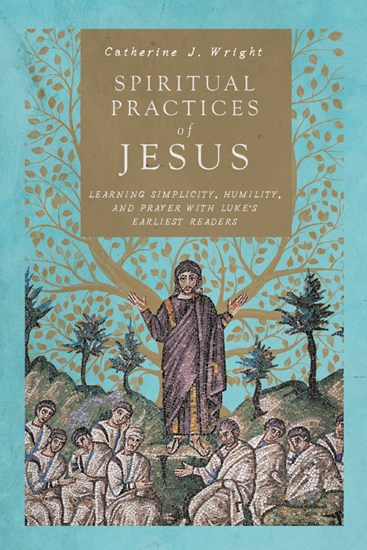
It is rare to read a book that is not just insightful, but also formative and challenging. Catherine J. Wright’s Spiritual Practices of Jesus: Learning Simplicity, Humility, and Prayer with Luke’s Earliest Readers is one such book. Each part of the subtitle is deeply important to the contents of the book. Wright introduces readers to a number of early readers of the Gospel of Luke and provides their insights into how to read the texts. These insights often challenge modern readings and spiritualization of the text.
Each section–on Simplicity, Humility, and Prayer–features a chapter that highlights how the early church read the Gospel of Luke on these issues. That means readers will see how Augustine, Chrysostom, and many others read Luke on questions related to those topics. It’s deeply important to read about that, because those early readers have a different cultural context than we do. Their readings can therefore offer correctives that highlight the importance of the texts in ways that we may not think of otherwise.
The sections start with a chapter in which Wright goes through Luke highlighting where verses or stories reflect the theme at hand. For example, in the section on simplicity, Wright shows how frequently Jesus speaks about giving to the poor and highlights the plight of the poor and the difficulties and sinfulness in wealth. Pairing this with the second chapter in the section on how the early church read these verses shows how many modern readings that try to spiritualize these texts do not align with both the earliest readings and probably the intended meaning of the text. A second chapter in each section highlights the first-century context of the passages and how understanding the challenges of that time can lead to correcting our readings of the text as well.
Some of the content with simplicity has been highlighted, but each section has numerous parts worth interacting with. Whether it’s the challenge to live humble lives or how to read Jesus’s prayers and pray ourselves, Wright constantly brings applicable insights to the table throughout the book.
Wright’s Spiritual Practices of Jesus is a phenomenal read that could even change how readers live their lives. By reading the early church on Jesus, readers are exposed to challenges to our own culture that can cause use to rethink our reading of the text and the ways we live. Highly recommended.
Disclaimer: I was provided with a copy of the book for review by the publisher. I was not required to give any specific kind of feedback whatsoever.
All Links to Amazon are Affiliates links
Links
Be sure to check out the page for this site on Facebook and Twitter for discussion of posts, links to other pages of interest, random talk about theology/philosophy/apologetics/movies and more!
Book Reviews– There are plenty more book reviews to read! Read like crazy! (Scroll down for more, and click at bottom for even more!)
SDG.
——
The preceding post is the property of J.W. Wartick (apart from quotations, which are the property of their respective owners, and works of art as credited; images are often freely available to the public and J.W. Wartick makes no claims of owning rights to the images unless he makes that explicit) and should not be reproduced in part or in whole without the expressed consent of the author. All content on this site is the property of J.W. Wartick and is made available for individual and personal usage. If you cite from these documents, whether for personal or professional purposes, please give appropriate citation with both the name of the author (J.W. Wartick) and a link to the original URL. If you’d like to repost a post, you may do so, provided you show less than half of the original post on your own site and link to the original post for the rest. You must also appropriately cite the post as noted above. This blog is protected by Creative Commons licensing. By viewing any part of this site, you are agreeing to this usage policy.
Book Review: “Majority World Theology: Christian Doctrine in Global Context”

Christianity is a global religion, yet many discussions of theology are dominated by American or European voices. In Majority World Theology: Christian Doctrine in Global Context, the editors Gene L. Green, Stephen T. Pardue, and K. K. Yeo seek to provide a partial remedy to this problem.
The Majority World is sometimes called the Global South. It’s the part of Earth in which the majority of humans reside and includes Africa, Asia, and Latin America, among other places. The editors have focused on giving theologians from these places voices addressing several major topics in theology. The book is organized around six parts with multiple essays in each part. These parts are: The Trinity Among the Nations: The Doctrine of God in the Majority World, Jesus Without Borders: Christology in the Majority World, The Spirit Over the Earth: Pneumatology in the Majority World, So Great a Salvation: Soteriology in the Majority World, The Church from Every Tribe and Tongue: Ecclesiology in the Majority World, and All Things New: Eschatology in the Majority World.
The essays are each of interest. This reader read the book front-to-back, but it is clear that it could be read in parts, used for classes with individual essays, or in any number of other ways. One thing that readers ought to keep in mind is that each of these essays is just that–a single essay introducing one perspective on a huge topic. Thus, for example, the fascinating essay “The Trinity in Africa: Trends and Trajectories” by Samuel Waje Kunhiyop shows readers some ways in which African theologians are exploring the doctrine of the Trinity. Readers should not come away thinking that these are the only trends or that all African theologians are thinking along these lines. That said, Kunhiyop brings readers to engage with numerous lines of African theology. Each of the essays included in this collection is like that: it provides a way forward for additional exploration.
One example of an essay that provides many avenues for additional reading is “Asian Reformulations of the Trinity: An Evaluation” by Natee Tanchanpongs. Tanchanpongs Highlights several Asian theologians and the way they have discussed or reformulated the doctrine of the Trinity within their own contexts. It’s a fascinating read and one that allows Tanchanpongs to analyze numerous ways to take the Trinity in exploratory theology.
Majority World Theology is an excellent introduction to global theology. Readers can treat it as a reference book, read it front-to-back, or sample as they see fit. Most importantly, readers will be exposed to global perspectives on Christianity that they otherwise may not have ever experienced.
Disclaimer: I was provided with a copy of the book for review by the publisher. I was not required to give any specific kind of feedback whatsoever.
All Links to Amazon are Affiliates links
Links
Be sure to check out the page for this site on Facebook and Twitter for discussion of posts, links to other pages of interest, random talk about theology/philosophy/apologetics/movies and more!
Book Reviews– There are plenty more book reviews to read! Read like crazy! (Scroll down for more, and click at bottom for even more!)
SDG.
——
The preceding post is the property of J.W. Wartick (apart from quotations, which are the property of their respective owners, and works of art as credited; images are often freely available to the public and J.W. Wartick makes no claims of owning rights to the images unless he makes that explicit) and should not be reproduced in part or in whole without the expressed consent of the author. All content on this site is the property of J.W. Wartick and is made available for individual and personal usage. If you cite from these documents, whether for personal or professional purposes, please give appropriate citation with both the name of the author (J.W. Wartick) and a link to the original URL. If you’d like to repost a post, you may do so, provided you show less than half of the original post on your own site and link to the original post for the rest. You must also appropriately cite the post as noted above. This blog is protected by Creative Commons licensing. By viewing any part of this site, you are agreeing to this usage policy.
Book Review: “The Doctrine of Creation: A Constructive Kuyperian Approach” by Bruce Riley Ashford and Craig G. Bartholomew
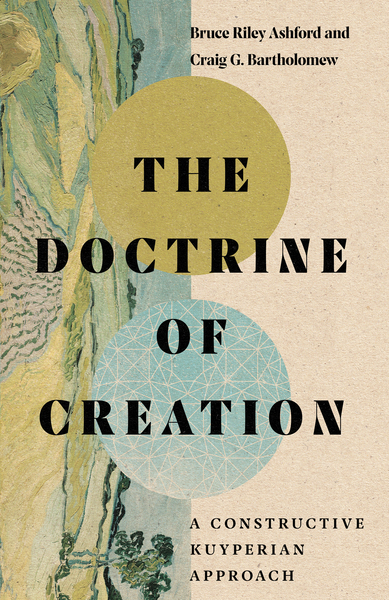
A systematic doctrine of creation is the core of Bruce Riley Ashford and Craig G. Bartholomew’s The Doctrine of Creation: A Constructive Kuyperian Approach. The subtitle begs questions about what is meant by this specific doctrine of creation. First, the authors follow the theology of Abraham Kuyper, a Dutch Reformed theologian of the late 19th and early 20th centuries. Second, the notion of being “constructive” means the doctrine builds upon itself, layer upon layer, making a truly systematic approach.
The authors pursue a broad approach, first discussing the historic Christian Creeds and their place in a construction of a doctrine of creation, then moving on to a broad historical overview of the doctrine itself. Next, they turn to God’s omnipotence and its bearing on creation, then move through biblical and theological discussion of creation to show a specific view of how Creation occurred and what relevance it has for today. Providence–God’s sustaining of the world–is a subject of its own chapter, followed by a chapter about Christ and the Holy Spirit in the New Creation, and the book ends with a application of the doctrine of creation to a few modern topics. There is a short appendix about missional neo-Calvinism at the end.
The way Ashford and Bartholomew build the doctrine of creation is infused with insight from Kuyper throughout, though it’s clear that calling it “Kuyperian” is more to designate it as along the Newo-Calvinist tradition than specifically or robotically following Kuyper. I am by no means an expert in Kuyper’s theology. My comment to this effect is based upon the extensive use of more modern citations as well as more generalized theological strands than simply adherence to Kuyper. Much as a Lutheran might call their approach Lutheran without explicitly following Luther in every regard, the authors are doing the same here.
It was interesting to see the first chapter begin with a discussion of the historic Christian Creeds and a defense of their use in helping construct a doctrine of creation. The book’s audience is clearly intended to be broader than Dutch Reformed readers, and this was perhaps included to show the authors have done their legwork regarding why we should see the Creeds as important to faith formation and theology today. As a Lutheran myself, it is just a given that the Creeds are of great import, and it was most interesting to see the authors engaging in such an extended defense of their use. Speaking of the book’s audience–this book is one that will largely yield fruits based on two things: the effort the reader puts into understanding and following the systemic theology therein; and one’s own theological biases. For example, the author’s discussion of the creation accounts (yes, the “s” is intentional) in Genesis was of great interest to this reader, but others might be inclined to see the accounts as a unified whole. More specifically on the doctrines of providence, omnipotence, and elsewhere, the authors’ Neo-Calvinist/Kuyperian view looms large and so will challenge readers who hold other positions.
I was somewhat surprised to see the focus in the chapter about God’s omnipotence to be so specifically focused on God the Father. Indeed, the chapter itself, following the language of the Apostle’s Creed, is titled “God, the Father Almighty.” But one gets a sense within the chapter that the other members of the Trinity are almost afterthoughts in this aspect of the doctrine of Creation. This is most clear when the authors use language that seems almost a concession in describing the role of the other divine Persons: “we know that the Son and the Spirit are also involved in the act of creation” (140). However, those Persons get little say until a later chapter discusses the New Creation (306ff). Many modern controversies are discussed, with views of omniscience and providence being at the center of a section about creatio continua (continued creation). Here, the authors wrestle with authors within their own tradition (eg. Barth’s resistance to philosophy p. 290-292 and elsewhere) as well as others like Molinists with competing views (they argue for an Augustinian view against the Molinist position, see p. 293-294, but also the discussion on 126).
Numerous intriguing insets are found throughout the text, such as an extended discussion of creation out of nothing (133-137) that includes some discussion of ancient Near Eastern literature. However, the authors focus much more upon Christian tradition and writings than on any attempt to understand the contemporary culture or meanings inherent in the text from an ANE perspective. Many other insets highlight important topics relevant to the issues at hand and present readers with more extensive looks at the authors’ arguments.
I was quite surprised in the final chapter to see the author’s application of their systematic theology to contemporary issues. I wasn’t surprised to see that application made–surely if a Christian doctrine of creation is true, it ought to be able to speak to many modern problems–but rather with the seeming lack of care given in this section to sources and argumentation. Specifically, the authors turn to the question of transgender individuals. They make a distinction between gender dysphoria and “transgender ideology” (360) and assert that “we must recognize transgenderism as deeply incoherent” (ibid). Beyond that, they agree with another writer that “it is a gnostic denigration of the material body that nonetheless insists that a trans person must transform his or her body in order to be whole…” among other things. Here we see the ugly aphorism that “If I don’t like a theological position, it must be Gnosticism” rearing its ugly head.
Beyond the utter historical nonsense that is the equivocation of modern transgender ideology to ancient Gnosticism without anything more than bald assertion, the authors themselves produce the very type of incoherent argument they accuse their interlocutors of performing. First, their definition of “transgender ideology” as the belief that “a person can be born into the body of the wrong sex and can be transformed into the other sex through gender reassignment surgery and/or hormone therapy” (ibid). This definition may reflect the beliefs of some people, but surely not a broad enough consensus as to lump all who go beyond mere acknowledgement of gender dysphoria into this category. Moreover, the authors themselves seem to totally miss one of the central aspects of an understanding of gender dysphoria–something they at least seem to acknowledge as a real difficulty–as they move quite swiftly from discussion of “sex” to discussion of gender. Just one page after their definition, they continue: “A person should not, and indeed cannot, change his or her gender” (361). This seems utterly confused, because the language they’re using reflects objectivity of gender standards which simply cannot be the case given how frequently throughout history those expectations have changed. Men in Elizabethan England were expected to wear ruffles and stockings, so according to these authors’ confused understanding, men today are either sinfully attempting to change their gender by not doing so, or the whole of societal expectations in that era and place were themselves mistaken and indeed impossible (referring to the language of “cannot”). Given the deep misunderstandings of the basic tenets and talking points of modern discussions of transgender topics (something I myself do not claim any expertise in), it seems the authors may have been better served if they’d let the topic lie instead of attempting a triumphant broadside that dissolves into silliness on the most superficial examination.
It is clear that readers of The Doctrine of Creation: A Constructive Kuyperian Approach will be challenged on many levels as they read the book. It is an impressive look at what it means to build a doctrine of creation within a specific theological tradition. There are some stumbles throughout the book, but readers–especially those interested in Reformed doctrine–will find much of interest. Unfortunately, I cannot recommend some of the discussion of modern topics.
Disclaimer: I was provided with a copy of the book for review by the publisher. I was not required to give any specific kind of feedback whatsoever.
All Links to Amazon are Affiliates links
Links
Be sure to check out the page for this site on Facebook and Twitter for discussion of posts, links to other pages of interest, random talk about theology/philosophy/apologetics/movies and more!
Book Reviews– There are plenty more book reviews to read! Read like crazy! (Scroll down for more, and click at bottom for even more!)
SDG.
——
The preceding post is the property of J.W. Wartick (apart from quotations, which are the property of their respective owners, and works of art as credited; images are often freely available to the public and J.W. Wartick makes no claims of owning rights to the images unless he makes that explicit) and should not be reproduced in part or in whole without the expressed consent of the author. All content on this site is the property of J.W. Wartick and is made available for individual and personal usage. If you cite from these documents, whether for personal or professional purposes, please give appropriate citation with both the name of the author (J.W. Wartick) and a link to the original URL. If you’d like to repost a post, you may do so, provided you show less than half of the original post on your own site and link to the original post for the rest. You must also appropriately cite the post as noted above. This blog is protected by Creative Commons licensing. By viewing any part of this site, you are agreeing to this usage policy.
“Bonhoeffer’s America: A Land Without Reformation” by Joel Looper
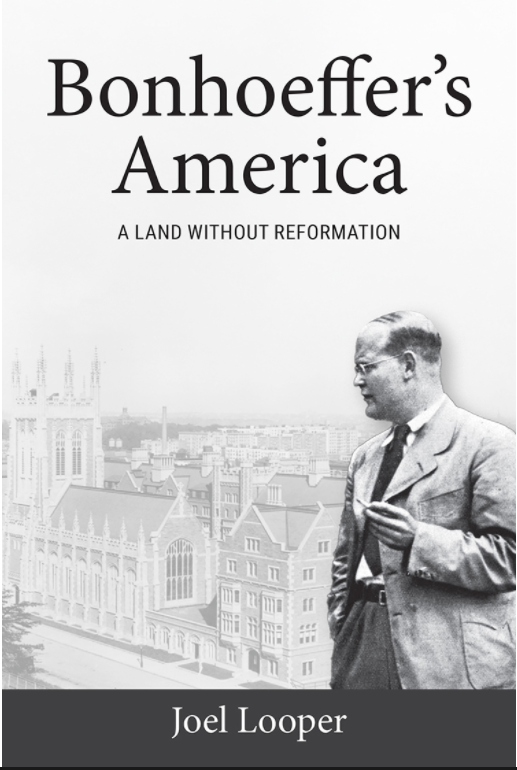
Dietrich Bonhoeffer’s time in America has been the subject of much scholarly discussion. It is clear it had enormous impact on his theology, but what hasn’t been as clear is exactly what kind of impact it may have had. Joel Looper’s phenomenal, challenging work, Bonhoeffer’s America: A Land Without Reformation not only seeks to answer definitively what kind of impact Bonhoeffer’s time in the United States had on the man and his theology, but also shows how extremely timely Bonhoeffer’s words and warnings about American theology can be for us today.
The book is divided into three parts. The first, “What Bonhoeffer Saw in America,” is Looper’s deep narration of Bonhoeffer’s life in America. Here, Looper delves deeply into Bonhoeffer’s coursework at Union Theological Seminary, who he interacted with, and what he himself reports about the situation with American theology. This part lays the foundation for the rest of the book. Here, Looper’s depth of knowledge and exploration of Bonhoeffer’s theology is on full display. It’s not just a report of Bonhoeffer’s time and words, but also an analysis that helps elucidate themes in Bonhoeffer’s writing from this time period that make much more clear what his issues were with American theology. Much of Bonhoeffer’s writing from his time in America is difficult to understand or comprehend without significant knowledge of contemporary issues, and Looper does an admirable job filling in those gaps, showing readers the background for understanding many of Bonhoeffer’s critiques. For example, some have utilized Bonhoeffer’s hard critiques of the social gospel to attempt to decry modern movements for social justice. However, Looper demonstrates that Bonhoeffer’s critique of the social gospel is not because it seeks to bring justice, but rather because it displaces the very gospel itself–that is, it doesn’t center revelation in Christ in the Christian message (see, for example pages 41, 46, and especially 48-49). The problem is not the ultimate efforts to feed the poor, stand with the oppressed, &c. The problem is, rather, the starting point of theology and its abandonment of revelation as the ultimate grounds.
The second part of the book focuses on Bonhoeffer’s analysis of American Protestantism specifically. American theology, as read by Bonhoeffer, had a primary problem in that it was “Protestantism without Reformation.” The meaning of this phrase is complex, but Looper notes that for Bonhoeffer, it can be traced back to Wycliffe and the Lollards. This sounds like an obscure point, but Looper, making Bonhoeffer’s own arguments clearer, shows how and why one might take this to be the case, particularly in the circles in which Bonhoeffer ran. It is clear, of course, that Bonhoeffer was not exposed to all of American theology, but what he saw ran in this vein, and the more conservative branches of theology he encountered were, in his opinion, little more than the most blunt and un-nuanced attempts to enforce orthodoxy. The Protestantism of the United States is so influenced by the strands Bonhoeffer mentioned that even Jonathan Edwards, cited by many as one of the greatest theologians America as produced, doesn’t even mention the church in his discussion of what one needs to be saved (75-76). American churches gave up any kind of confessional standard, only enforcing them after splitting again and again, and, in doing so, abandoned the Christian confession (86). American Protestants, for Bonhoeffer, no longer had something against which to protest, because they had severed themselves so distantly from the one true, holy, catholic church (86-87).
Even more damning is Bonhoeffer’s analysis of secularization in America. The pluralism enforced in America led to a kind of secularization of the church and idolization of the individual to the point that the allegiance was given to the nation state rather than to the church and God (102-103). This can be traced, again, to English dissenters who formed the backbone of colonial America. The secularization of the church is not due to some outside force acting upon it, but rather due to the church itself abandoning the word and being, again, a Protestantism without any kind of Reformation. In America, rather than having state churches, secularization came into play precisely because of the focus on freedom and independence–the church then becomes a mouthpiece for the alleged freedom the state provides (106-107).
Bonhoeffer’s own oft-misunderstood theology of the two kingdoms is, according to Looper, central to his understanding of the Gospel as well. Here is where Bonhoeffer’s Lutheranism is so central to his understanding of the problems with American theology and beyond. The call for “thy kingdom come” must include both church and state precisely because of the two kingdoms theology–the church and state are both necessary and linked to one another (113-114). Thus, the famous phrase from Bonhoeffer about “seizing the wheel” is not actually revolutionary but rather counter-revolutionary. Bonhoeffer saw the Nazis as the revolutionaries, and such an understanding fits well within the Two Kingdoms theology Bonhoeffer so ardently supported.
The third part of the book centers around objections to both Bonhoeffer’s view of the American church and objections that seek to counter this narrative. For example, much has been made of Bonhoeffer’s largely positive analysis of the Abyssinian Baptist Church in Harlem. Looper doesn’t downplay this positive theme in Bonhoeffer’s analysis of America, but he does contextualize it. The Abyssinian Baptist Church was, to our knowledge, the only African American church he encountered in the United States apart from perhaps one or two Sundays in the American south (131). Bonhoeffer has threads that sound like W.E.B. Du Bois in some of his analysis of the American situation, such as when he talks about what is “hidden behind the veil of words in the American constitution saying ‘all men are created free and equal'” (136). It’s clear this had a positive and even eye-opening impact on Bonhoeffer, and traces of this can be found in his theology. Bonhoeffer’s own discussion of Jews in Germany, such as in his “The Church and the Jewish Question” may have been somewhat influenced here. Looper analyzes Bonhoeffer’s discussion of the Jewish people and shows how, while at times it is couched in problematic language, it demonstrates a deeper understanding and concern than one could credit him merely given his background or upbringing. (The whole section on this is a fascinating read, showing clear analysis that’s well-worth reading. See p. 141-146 in particular.) Bonhoeffer’s theology, however, remained firmly German Lutheran, and his own life-risking efforts in behalf of the Jews were not traceable to some kind of vague Western morality of “equality of all” but rather, Looper asserts, clearly based upon his Christology (150). Thus, Bonhoeffer’s experience with the Abyssinian church demonstrates a caveat in his analysis of American theology. Rather than a total rejection of all American theology, Bonhoeffer’s words ought to be seen directed exactly as they were, against the overwhelmingly popular academic streams of thought in contemporary American theology.
Bonhoeffer’s imprisonment and his now famous Letters and Papers from Prison have led some to argue that he changed his views profoundly while in prison. Looper instead notes that his late-stage theology has continuity with that of his earlier life.
Looper’s work serves as a powerful challenge to many theologies of today. For those adhering to modern forms of the social gospel, Bonhoeffer’s warnings and critiques of that movement from his own time continue to apply: are these movements removing Christ from the center? For progressive Christians, Bonhoeffer’s critique of the social gospel can loom large–“Do such [progressive] theologies tend to respond to the critique of the word [revelation, Scripture] and think critically about their subjects in its wake? Or, rather, do they often begin with the (oppressed) self and work from the experience of that self and the non-ecclesial community with which it identifies? If the latter, are these theologies then only variants of ‘religious’ logic…?” (197-198). For conservatives, especially American evangelicals, Looper notes that the constant efforts to try to maintain a “seat at the table” in the larger world and their defense of their institutions, even to the point of, as many have said, voting while “holding their nose” for someone who, ethically, cannot be defended, would have been seen by Bonhoeffer as “Niebuhrian realism, pragmatism par excellence, and, in working from this script, evangelicals both brought the name of Christ into disrepute and forgot how the economy of God and of the church are supposed to work… Bonhoeffer would have called this evangelical struggle a cause of American secularization, not a buffer against it” (196). Bonhoeffer would see American theology today as a total abandonment of Protestant norms, exactly because of his theology of two kingdoms (joined with Luther’s) and because of the stark pragmatism of the right and the rush to de-center the Gospel on the left (198). Looper’s book thus serves as a blunt reminder of the dangers of our modern theological era and the need to offer correctives.
I have now read more than 70 books by or about Dietrich Bonhoeffer, his theology, and the world he inhabited in order to try to understand more about the man and his theology. Bonhoeffer’s America: A Land Without Reformation easily ranks in the top 10 of those books. Anyone who is interested in learning more about Bonhoeffer’s theology should consider it a must read. More importantly, though, those wishing to have an understanding of American theology and its problems to this day should seek out this fantastic book. I highly recommend it without reservation.
All Links to Amazon are Affiliates links
Links
Be sure to check out the page for this site on Facebook and Twitter for discussion of posts, links to other pages of interest, random talk about theology/philosophy/apologetics/movies and more!
Book Reviews– There are plenty more book reviews to read! Read like crazy! (Scroll down for more, and click at bottom for even more!)
SDG.
——
The preceding post is the property of J.W. Wartick (apart from quotations, which are the property of their respective owners, and works of art as credited; images are often freely available to the public and J.W. Wartick makes no claims of owning rights to the images unless he makes that explicit) and should not be reproduced in part or in whole without the expressed consent of the author. All content on this site is the property of J.W. Wartick and is made available for individual and personal usage. If you cite from these documents, whether for personal or professional purposes, please give appropriate citation with both the name of the author (J.W. Wartick) and a link to the original URL. If you’d like to repost a post, you may do so, provided you show less than half of the original post on your own site and link to the original post for the rest. You must also appropriately cite the post as noted above. This blog is protected by Creative Commons licensing. By viewing any part of this site, you are agreeing to this usage policy.
Book Review: “Every Leaf, Line, and Letter: Evangelicals and the Bible from the 1730s to the Present” edited by Timothy Larsen
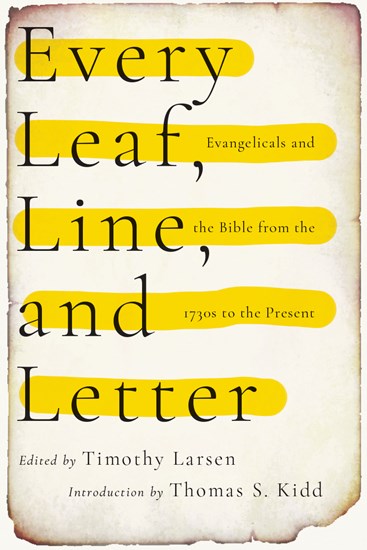
Timothy Larsen is an author whose works have fascinated me time and again, so when I saw his edited volume on evangelicals’ reading of the Bible, I knew I had to hop in. Every Leaf, Line, and Letter: Evangelicals and the Bible from the 1730s to the Present is a superb look at some specific ways evangelicals have engaged with the Bible throughout the last several centuries.
Collections of essays are often hit-or-miss affairs, but Larsen has compiled a selection of essays full of excellent topics and insights. The essays are grouped by century, starting in the 18th and terminating in the 21st. They rnage fro mearly evangelical readings of the Bible to global evangelical mindset in today’s contexts. Instead of providing an overview of every one of these great works, I’ll highlight a few I found especially insightful.
With “British Exodus, American Empire: Evangelical Preachers and the Biblicisms of Revolution,” Kristina Benham introduces readers into the ways in which American evangelicals and their British forebears used the biblical narrative–particularly those of the Exodus–to draw parallels to their own situations in colonial and Revolutionary America. It’s a fascinating look at how one’s own context can shape how one reads Scripture. Mark A. Noll’s “Missouri, Denmark Vesey, Biblical Proslavery, and a Crisis for Sola Scriptura” engages with readings of the Bible and advocates of slavery. Indeed, at times the proslavery position claimed the high ground of reading the Bible more literally or even accurately than did those who opposed slavery. Such readings of the Bible in evangelicalism are too often ignored or skirted around.
Malcom Foley’s essay about resisting lynching, “‘The Only Way to Stop a Mob’: Francis Grimke’s Biblical Case for Lynching Resistance” seems poignant to this day, despite being part of twentieth century readings of Scripture. Catherine A. Brekus’s examination, “The American Patriot’s Bible: Evangelicals, the Bible, and American Nationalism,” shows how evangelicalism in the 21st century has so often conflated nationalism, patriotism, and theology. Her detailed analysis of what may seem an aberration also highlights how emblematic of American Evangelicalism the American Patriot’s Bible actually is.
This short sampling of just a few topics out of the 12 essays offered shows the broad array of topics available to the reader. I can’t emphasize just how refreshing this collection was. Yes, the topics are focused around a single subject: evangelical readings of the Bible; but they did so from such broad categories that each essay felt it broached new and intriguing avenues of exploration for the reader.
One drawback of collections of essays does loom here, though: there is, again, an unbalance in authors selected. I’m unsure of the racial breakdown in authorship, but the contributors are heavily weighted towards males, with at least 2/3 being men. Though each essay is excellent on its own merits, one wonders whether there couldn’t have been more attention paid to a diversity of voices.
Every Leaf, Line, and Letter gives readers a broad swathe of topics related to evangelicals’ reading of the Bible both past and present. Each essay brings a unique perspective and whole avenues of new reading and insight along with it. This volume is highly recommended.
Disclaimer: I was provided with a copy of the book for review by the publisher. I was not required to give any specific kind of feedback whatsoever.
All Links to Amazon are Affiliates links
Links
Be sure to check out the page for this site on Facebook and Twitter for discussion of posts, links to other pages of interest, random talk about theology/philosophy/apologetics/movies and more!
Book Reviews– There are plenty more book reviews to read! Read like crazy! (Scroll down for more, and click at bottom for even more!)
SDG.
——
The preceding post is the property of J.W. Wartick (apart from quotations, which are the property of their respective owners, and works of art as credited; images are often freely available to the public and J.W. Wartick makes no claims of owning rights to the images unless he makes that explicit) and should not be reproduced in part or in whole without the expressed consent of the author. All content on this site is the property of J.W. Wartick and is made available for individual and personal usage. If you cite from these documents, whether for personal or professional purposes, please give appropriate citation with both the name of the author (J.W. Wartick) and a link to the original URL. If you’d like to repost a post, you may do so, provided you show less than half of the original post on your own site and link to the original post for the rest. You must also appropriately cite the post as noted above. This blog is protected by Creative Commons licensing. By viewing any part of this site, you are agreeing to this usage policy.
Book Review: “Science and the Doctrine of Creation: The Approaches of Ten Modern Theologians” edited by Geoffrey H. Fulkerson and Joel Thomas Chopp

The question of how the doctrine of creation interacts with science (and vice versa) has loomed large in the past few hundred years. Many theologians have offered a whole realm of responses to questions about how these two relate. Science and the Doctrine of Creation brings the views of ten theologians to the forefront, highlighting through essays by different authors the way these theologians interacted with science and creation.
The theologians in this collection range from the late 19th century through the early 21st century. They also span a wide range of denominational backgrounds. This gives the volume a robust look at several different strands of theological thought being applied to the doctrine of creation (though see below, on women).
B.B. Warfield has been at the center of several debates regarding Christianity and science because several different sides want to enlist his writings in their defense. Bradley J. Gundlach clarifies that Warfield’s views on evolution–that it’s complicated–while also showing Warfield’s fascinating piloting of a doctrine of creation that navigates several hot button topics in fairly unique ways. Jürgen Moltmann’s doctrine of creation operates seemingly apart from science, though the author of the essay on his theology, Stephen N. Williams, shows that there is more subtlety there that might provide a way forward in science-faith discussions. Abraham Kuyper’s discussion of science and creation is highlighted by aspects that show that one’s approach and intent may matter just as much as their outcomes, argues Craig Bartholomew (my words summarizing some of his content–see esp. 40-41). These and other highlights of the book show just how deep readers can go in thinking in different ways about the doctrine of creation in light of modern science.
I was disappointed by the overall lack of women in this volume. Only one of the ten essays was written by a woman, and not a single woman was selected as a subject of any of the essays. It is remarkable to me that among all modern theologians, not even one woman was selected to give voice to her view on science and creation. This is particularly egregious given that many women are involved in studying the intersection of the doctrine of creation and science. The book would have been improved by diversifying its sample of theologians and authors.
Science and the Doctrine of Creation shows a broad spectrum of views on the titular topics, but doesn’t integrate as many diverse voices as it may have been nice to see. That said, readers interested in Christianity and science will want to check out this book, particularly to see how wide the range of views there are even among just 10 theologians.
Disclaimer: I was provided with a copy of the book for review by the publisher. I was not required to give any specific kind of feedback whatsoever.
All Links to Amazon are Affiliates links
Links
Be sure to check out the page for this site on Facebook and Twitter for discussion of posts, links to other pages of interest, random talk about theology/philosophy/apologetics/movies and more!
Book Reviews– There are plenty more book reviews to read! Read like crazy! (Scroll down for more, and click at bottom for even more!)
SDG.
——
The preceding post is the property of J.W. Wartick (apart from quotations, which are the property of their respective owners, and works of art as credited; images are often freely available to the public and J.W. Wartick makes no claims of owning rights to the images unless he makes that explicit) and should not be reproduced in part or in whole without the expressed consent of the author. All content on this site is the property of J.W. Wartick and is made available for individual and personal usage. If you cite from these documents, whether for personal or professional purposes, please give appropriate citation with both the name of the author (J.W. Wartick) and a link to the original URL. If you’d like to repost a post, you may do so, provided you show less than half of the original post on your own site and link to the original post for the rest. You must also appropriately cite the post as noted above. This blog is protected by Creative Commons licensing. By viewing any part of this site, you are agreeing to this usage policy.
Book Review: “Bonhoeffer: God’s Conspirator in a State of Exception” by Petra Brown
It’s no secret that I have been deeply impacted by Dietrich Bonhoeffer’s theology. However, as with everything, I believe it is important to read views which are critical of your own. Sometimes, this can help moderate your own enthusiasim for a view by showing potentially problematic aspects of it. Other times, reading something which disagrees with your views can help confirm you in that view as you rebut the critique. Petra Brown’s book, Bonhoeffer: God’s Conspirator in a State of Exception is a remarkable critique leveled directly at Bonhoeffer’s ethic. I found it enlightening and, at times, course-correcting.
The central point Brown argues that Bonhoeffer’s ethic is dangerous because it essentially allows the individual Christian disciple to justify essentially any form of violence so long as they believe they are living in a state of “exception.” Brown cites numerous examples of Christians who used violence, claiming Bonhoeffer for support when challenged on it.
The state of exception is developed by Brown through the lens of Carl Schmitt, a Nazi jurist who developed the notion of “state of exception” as “a state of emergency which requires decisive action by the sovereign (in Schmitt’s case) or by other actors within the state” (5). Schmitt is explicitly cited by Brown as the lens through which she’s viewing the state of exception and analysis of Bonhoeffer, though she also clearly state’s Bonhoeffer’s own concept of exception is intended “in a fairly straightforward way, based on Machiavelli’s concept of necessita” (106). Brown rigorously documents Bonhoeffer’s writings showing that he did speak about a state of exception, along with the need for potential individual action on the part of the disciple. However, Brown’s own definition of exception is, by her own argument, placed squarely within Schmitt’s writings, not those of Bonhoeffer. And, since Brown denotes a significant divergence between the two, this seemingly undercuts her central point. Indeed, at times this reader wondered if the point was more akin to arguing that Bonhoeffer’s ethic could be misunderstood in light of other writers on states of exception, thus becoming dangerous because of that misunderstanding. Yet Brown herself seems to be arguing that Bonhoeffer’s ethic is problematic in just this sense: that it can and does yield individual, “lone wolf” type violence. The tension between these two points is, to my eye, not resolved.
Brown does make attempts to unite Bonhoeffer’s state of exception with that of Schmitt’s, but these arguments are tenuous. For example, she notes that one possible objection to her use of Schmitt with Bonhoeffer is that comparing Schmitt’s ideas with the “emerging ideas of Bonhoeffer” is mistaken because Schmitt was “a German Catholic who explicitly claimed to speak from a Catholic position” (112). Brown argues instead that Schmitt’s position was “highly idiosyncratic” compared to traditional Catholic political stance such that it was “neither neoscholastic, nor Romantic as German Catholicism tended to be at the time” (ibid). Of course, showing Schmitt had theological distance from Roman Catholicism of his time and place does not somehow mean that Bonhoeffer’s state of exception can be seamlessly united with Schmitt. Indeed, it is telling that after making these distinctions, Brown simply moves on with the analysis of Schmitt’s concept of exception rather than attempting to unite it with Bonhoeffer’s. Indeed, she noted earlier that Bonhoeffer’s position is more akin to Machiavelli, from whom she says Schmitt is “a significant departure” (114). This, again, makes it seem as though Brown’s point is less that Bonhoeffer’s ethic itself is dangerous than that it can be dangerous once one unites it with other ethical theories or concepts that are, yes, adjacent to it, but not actually part of it.
On this latter point, I think Brown and I are in general agreement. In fact, Brown’s argument here seems to demonstrate that American evangelicals who cite Bonhoeffer in support of violent acts are doing so by misunderstanding him. But Brown, as far as I saw (and I could have missed something in my own reading), never actually makes this point explicitly. Instead, the implication is that Bonhoeffer’s own ideas are dangerous in that exact way; but that point is not sufficiently established.
Another area in which Brown’s argument loses ground is that she attempts–and fails–to adequately account for Bonhoeffer’s moderation of that state of exception and ethic when related to the church. She acknowledges that Bonhoeffer’s writings about church-community present a significant problem to her reading of Bonhoeffer’s ethic as dangerous (184). However, even as she agrees that one cannot isolate Bonhoeffer’s discussion of ethics from his discussion of the church-community, she works to move Bonhoeffer’s concept of church to that of an individual.
Brown writes, “Bonhoeffer regards the church-community not as an institution, but as a collective person; the personhood of the church-community reflects its identity as the ‘body of Christ’ that is made [up of] ‘actual, living human beings who follow Christ” (187). Thus, she says, “The church community is understood by Bonhoeffer to have ‘personhood,’ and as such I suggest that it can suffer the same isolation experienced by Abraham or the isolated disciple in her obedience to Christ’s call” (ibid). The passage she quotes in support of giving the church-community personhood is from Discipleship (aka The Cost of Discipleship). Brown moves from this quote using the words “actual living beings who follow Christ” to saying the church-community has personhood. However, Bonhoeffer himself, in that very passage which Brown quotes, is not making that point. Instead, Bonhoeffer’s point is made explicitly: the church-community is the physical embodiment of Christ on Earth, preaching God’s word to the world (DBWE 4: 225-226). Thus, for Bonhoeffer, the church-community does not become personal by means of its composition of persons. No, for Bonhoeffer, the church-community has personhood because it becomes Christ to others. And this remarkable claim obviates the difficulty Brown is trying to press. For the church-community is not reducible to a person except that that person is Christ in the world. Therefore, Brown’s argument here fails, because she reduces the church-community to the person in the wrong direction. For her argument to work, it must be reducible, again, to the Christian acting as lone wolf, possibly through violence. But in fact, Bonhoeffer’s reduction is to bring it all to Christ.
One difficulty for Brown is that shared by her imagined–and real–opponents in interpreting Bonhoeffer. Namely, by lifting his name and ethic of the pages of a book and the specific time in which he lived and plugging it in to modern debates, they’ve assumed the context and intent of his ethic today. I need to unpack this a bit. It is abundantly clear that Bonhoeffer’s ethic is not meant to be a list of principles from which people are supposed to draw to make their decisions. Indeed, his ethic does encourage individual action. However, it always does so within the community of believers. Brown’s rebuttal for this was mentioned above, but I think it is worth noting again that community for Bonhoeffer is irreducible to the individual except that of Christ. Thus, the lone wolf violence about which Brown worries and which several have attempted to justify using Bonhoeffer’s words is deeply mistaken in putting Bonhoeffer’s name to it. Just as Bonhoeffer argues one cannot have church without sacrament, so too does he insist upon the church community as working together to embody Christ on Earth. Acting in state of exception does not mean merely acting individually–it means acting along with Christ and the church.
Brown’s arguments do have merit. It is demonstrable that many violent acts have been done in the name of, or at least justified after the fact by, Dietrich Bonhoeffer. Brown’s argument that Bonhoeffer’s own ethic justifies this violence is, I believe, mistaken. However, her argument has powerful force if one includes those positions which are adjacent to Bonoheffer’s. So, for example, if one integrates others’ views of a state of exception, it becomes much simpler to justify violence. If one ignores or is ignorant of Bonhoeffer’s insistence upon the church-community and acting ethically alongside that, it becomes much easier to justify violence. So, is Bonhoeffer God’s conspirator, ushering in the possibility for violent acts by Christians? Yes and no. Yes, if Bonhoeffer’s ethic is read divorced from much of its context and with others’ interpretations and concepts smuggled in. No, if one takes Bonhoeffer at his own words.
There is, however, one clear exception to this. Brown presses hard on a sermon Bonhoeffer gave in Barcelona in which he clearly stated that even violent acts could be sanctified. She states, “I don’t believe that the 1929 Barcelona lecture can be dismissed as an aberration” for Bonhoeffer’s ethic. Her attempt to unify this lecture with Bonhoeffer’s Ethics and Discipleship is intriguing. I also think that we ought to see Bonhoeffer’s ethic more as unified whole than as a collection of different positions. The Barcelona lecture needs to fit into that somewhere. Of course, Bonhoeffer himself wrote of having some regrets about what he’d written before, so one wonders if it’s possible that, due to the influence of pacifism on his views, he would have wholly rejected what he said in Barcelona. That, or, as others have argued, perhaps Bonhoeffer was moving along a continuum of a Lutheran view of ethics, and one can unify the whole through that. Whatever the case, more work needs to be developed to discover what was meant by Bonhoeffer in Barcelona, or whether Brown’s case succeeds at this point.
Petra Brown’s Bonhoeffer: God’s Conspirator in a State of Exception presents a significant challenge for Bonhoeffer scholarship. Those who wish to engage with Bonhoeffer’s ethics–particularly those of resistance–ought to engage carefully with Brown’s critique.
All Links to Amazon are Affiliates links
Links
Dietrich Bonhoeffer– read all my posts related to Bonhoeffer and his theology.
Be sure to check out the page for this site on Facebook and Twitter for discussion of posts, links to other pages of interest, random talk about theology/philosophy/apologetics/movies and more!
Book Reviews– There are plenty more book reviews to read! Read like crazy! (Scroll down for more, and click at bottom for even more!)
SDG.
——
The preceding post is the property of J.W. Wartick (apart from quotations, which are the property of their respective owners, and works of art as credited; images are often freely available to the public and J.W. Wartick makes no claims of owning rights to the images unless he makes that explicit) and should not be reproduced in part or in whole without the expressed consent of the author. All content on this site is the property of J.W. Wartick and is made available for individual and personal usage. If you cite from these documents, whether for personal or professional purposes, please give appropriate citation with both the name of the author (J.W. Wartick) and a link to the original URL. If you’d like to repost a post, you may do so, provided you show less than half of the original post on your own site and link to the original post for the rest. You must also appropriately cite the post as noted above. This blog is protected by Creative Commons licensing. By viewing any part of this site, you are agreeing to this usage policy.

 J.W. Wartick - Reconstructing Faith