theology
Devotion for a Philosopher/Apologist: Job and Natural Theology
 One thing I’ve noted throughout my involvement in apologetics and philosophy is a constant need and desire for good devotions. I’ve written some guidelines for how to go about a devotional life here, but I’ve noticed that many readers are coming to my site looking for actual devotions themselves. Thus, I’ve decided to start this series of devotions for the Christian Philosopher or Apologist.
Job and Natural Theology
Recommended reading: The book of Job, a chapter or book on natural theology
Often, I find myself struggling, as I am so enmeshed in abstract concepts of God and philosophy, to maintain that personal connection with my Lord. Nowhere do I find a better place to reignite this personal connection than the book of Job. It appeals to me on a number of levels–it has verses which demonstrate the greatness of faith, the horrors of evil, and the greatness and existence of God.
As Christian philosophers/apologists, we can smile and nod along with such passages as Job 12:7-10″
“But ask the beasts, and they will teach you; the birds of the heavens, and they will tell you; or the bushes of the earth, and they will teach you; and the fish of the sea will declare to you. Who among all these does not know that the hand of the LORD has done this? In his hand is the life of every living thing and the breath of all mankind.”
We can note how often we echo these very words, pointing to such things as the teleological argument or arguments from design. Scripture preaches what we teach! We are told here that creation itself witnesses the Creator! But these aren’t the only verses in Job which help affirm the tasks to which we have set ourselves, for we are told in Job about the attributes of God (He is unchangeable 23:13, almighty chapters 25-26, majestic 37:1ff, omnibenevolent 34:10 [though note that we must be careful to assertain doctrinal truths from Job’s friends, who are often mistaken about the works of God], and sovereign 1:21) we are informed that religious experience can convey knowledge (4:12, but again note that this is a friend of Job’s, so be careful with interpretation), and we discover that there will be a physical resurrection (19:25).
Already, we have experienced many of the parts of Job which speak directly to us as apologists and philosophers. But there is so much more here! We are to focus upon faith. As I said before, I often lose sight of my personal relationship with God in the midst of the abstract arguments, but Job (the book) calls us towards such a strong relationship with God.
Job 5:8-27 can give us great comfort. It is God to whom we commit our cause (5:8). God does great and unsearchable things, providing for our every need (5:9-16). Furthermore, we are comforted in times of trouble. God may allow us to be wounded, but he binds us, we may be shattered, but God heals us (5:18).
Finally, within Job we have a stirring account from God. Another struggle I can find myself involved in is an inflated view of my knowledge. Job struggled with this same issue, as he complained to God about his sufferings. God’s response is not to explain suffering, but to reassert His greatness and unlimited knowledge (see the dialogue in chapters 38 and following). We are then shown what our proper response is to God’s great majesty, Job 42:1-6:
Then Job answered the LORD and said: “I know that you can do all things, and that no purpose of yours can be thwarted. ‘Who is this that hides counsel without knowledge? ‘Therefore I have uttered what I did not understand, things too wonderful for me, which I did not know. ‘Hear, and I will speak; I will question you, and you make it known to me.’ I had heard of you by the hearing of the ear, but now my eye sees you; therefore I despise myself, and repent in dust and ashes.”
Job understands how our lives should reflect our commitment to God. We too often utter what we do not understand, when we encounter God, we realize that compared to His great glory, we can only repent of inability to always be perfect ambassadors of Christ. Yet, along with Job, we know that our redeemer lives (Job 19:25). What a great blessing it is to know that we will walk with him, in the flesh, upon the earth!
God’s grace and peace to you, my fellow brothers and sisters in Christ Jesus. I hope this devotion will be helpful in your studies. I’d appreciate any feedback you can give me to help improve any future devotions I may share.
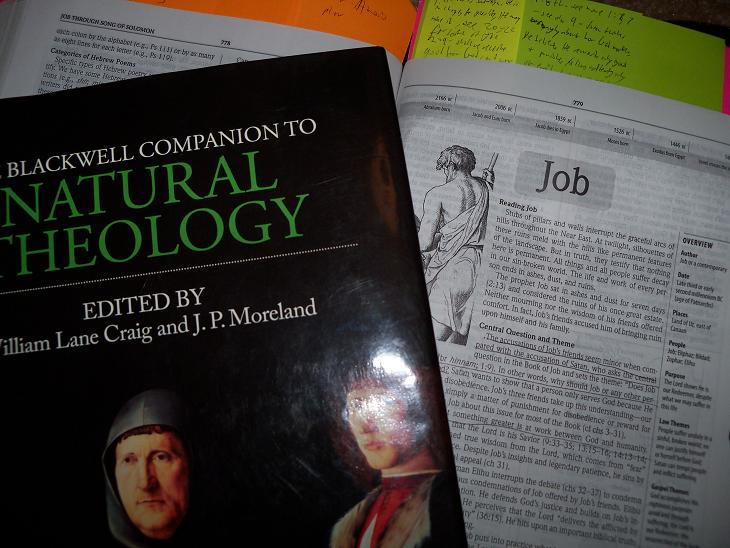
The image in this post was a (very unprofessional) photograph by me of the Lutheran Study Bible and the Blackwell Companion to Natural Theology
——
The preceding post is the property of J.W. Wartick (apart from citations, which are the property of their respective owners) and should not be reproduced in part or in whole without the expressed consent of the author.
Searching for Writers
I’m planning to start a new site (in addition to this one). The point of the site is to have internal Christian dialogue, with an emphasis on the fact that despite our disagreements on matters not related to salvation, we are all Christians and should treat each other with love.
The writers for the site will be required to affirm the three ecumenical creeds (Apostles’, Nicene, and Athanasian). The posts on the site will be intended for the lay reader but will feature doctrinal discussion on a loving, Christian level. Specifically, some topics could include: the origins of life (i.e. creation vs. evolution vs. ID), Christian approaches to religious diversity, original sin, baptism, the role of women in the church, the authority of the Bible, the authority of the Church, etc. The posts would be laid out either as a point-by-point dialogue between the contributers (i.e. a back and forth with short e-mails in published form) or as series of posts with writers talking back and forth.
The purpose will be many-faced: to encourage discussion among Christians about issues which are important, while still maintaining Christian love for each other; striving for church unity by increasing respect among members of the Body of Christ; potentially apologetic/evangelistic purposes; and giving glory to God.
Posts on this new site will be short, so as to make sure the time commitment is not too high. I’m thinking about around 500 words as being the upper limit (though writers could exceed that if they desired–these issues are important and some could require several pages to fully address).
Any interested writers should be prepared to demonstrate writing skill and a knowledge base sufficient for engaging in discussion on the aforementioned topics. Applicants may submit an up to 500 word sample of writing on one of the topics above, along with a short biography and affirmation of Christian belief (this part will not count towards the 500 words) to oontabob@yahoo.com. Applications from Christians of any denomination are accepted, though, once more, adherence to the three ecumenical creeds is a requirement (which includes belief in the Trinity, the divinity of Christ, etc.).
I’m also looking for people talented with graphics/etc. who could potentially help with making pictures/banners/etc. for the site.
The Life Dialogue: Matt Moss Guest Post 5
This is part 5 of a series of guest posts by Matt Moss on the Genesis Creation account. Check out the first post here, the second here, the third here, and the fourth here.
Thesis 6: The Fall of Man into Sin destroys the order of God’s Cosmic Temple.
This destruction and disarray can be seen firstly in this: Man has tried to make himself God. This is what the deceiver promised in 3:5- “eat of the tree of which you were commanded not to eat and you will be like God.” Man has separated himself from communion with God in this Cosmic Temple. The price for his rebellion is expulsion from the Cosmic Temple, man and woman are cast out, East of Eden (this will be important in a moment).
A brief note on “sin:” I must say that one of the worst parts of Walton’s book is when he tries to address the place of death in creation before the 7 days of functional ordering and how it fits in after the Fall. I think this happens because Walton suffers from the same fate as most reformed evangelicals who deny any hereditary original sin that is a condition plaguing all mankind and even causing detriment to the world around us. Surely he would hold that all are sinful, but his language in the book leaves the door open for someone to think that he defends natural disasters and animal attacks on humans as if that’s always the way it was meant to be. He gives no indication that sin is a condition of chaotic disorder in this world. For him, sin is simply a wrong action we commit (or good we omit).
In retrospect I think Walton would find that a Lutheran understanding of Sin would actually HELP the case he tries to make in the book and even make sense of some of the loose ends that he leaves untied. Allow me to explain how a Lutheran understanding of Sin fits into this Genesis 1 Cosmic Temple. The word for sin in Hebrew is hta. Many have said that this is the word for when an arrow misses its mark. That is true, but it is not speaking of the ACTION of missing the mark (sin as an action would be what Walton and the reformed hold as do Lutherans although we do not limit it to that).Hta is the condition that things are not as they are intended to be! Sin is not, “oops I missed the target” (an act of committing wrong). Hta is “I shot the arrow straight down and now gravity is going UP!” or better yet, “I shot at the target and now the arrow is facing the opposite way, impaling my heart!” The correct condition is that the arrow is where it belongs: in the target. The hta is the condition where the arrow is completely confounded and misplaced.
When it comes to the Cosmic Temple then, the entrance of SIN (hta), as this condition of chaos, reverts the perfect, ordered, functional Cosmic Temple to the chaos of 1:2a. God spent seven days ordering this Cosmos into a Temple of communion between God and man and now man has rejected this Temple and sent all of creation back into tohu andbohu, purposelessness and functionlessness, worse than that! The world is now a place of rebellion and death. The ground of the earth is cursed (3:17-18) and as man and woman are expelled from the Cosmic Holy of Holies they are sent into the wilderness where animals, weather, and nature itself are now hostile to them! Throughout the OT and even into the NT the wilderness is viewed as the land of desolation, tohu and bohu, and separation from God. And yet, God is not about to let their chaotic overturn of His creation be the final word on the matter!
Thesis 7: God’s establishment of the Israelite Tabernacle/Temple serves to return mankind to the divine order of the Cosmic Temple: communion with God.
Finally we get to the point of all these temple comparisons. What was the point of all those tabernacle/temple regulations in Exodus and Kings? Why was God so specific? Because God wanted to show them in explicit visual detail that He was opening a new Eden by which the Israelite sinners could return to communion with their God! However, one thing had changed. Man was no longer pure and clean. Man was sinful and defiled and would need atonement to come before God. This is why the ONLY thing that differs between the Cosmic Temple and the Israelite Temple is the sacrificial system.
Allow me to quickly go through some of the aspects of the Temple that reminded Israelites that they were returning to God’s Holy Eden- the pleasure of His presence. First, recall that the man and woman were banished EAST of Eden. The Tabernacle and Temple of Israel each had the Ark of the Covenant, the Holy of Holies positioned in the West and the worshipers would enter through the East gate. By going from East to West they are coming home from the way God banished them.
Second, we recall the rivers of Eden: the Pishon, the Gihon, the Tigris and the Euphrates. In addition to the water basins looked at above, it is also of remarkable note that there stands a spring just south of Solomon’s temple, in the Kidron Valley which was named, “The Gihon Spring.” Hmm. Very Interesting!
Once inside the main gate the Israelite worshiper walks among the courts, surrounded by wooden walls and looking at the pillars of the Holy Place with their decorated tops made to look like trees. Even to this day Cathedrals all throughout the world use pillars with decorated tops to act as trees leading to the centre of the Garden: the Holy of Holies in the Temple and the Chancel of the Cathedral!
Inside the Holy Place you have your lampstands to mark the minor lights just like the large menorah in the outer court acts as a greater light! Finally, you find behind the curtain of the Holy Place the Holy of Holies where God Himself sits on the Mercy seat. For Israel worship at the Temple is a return to the divine order of Creation as God intended, the sinful corruption of the world is made right. And yet, all of this was incomplete. The sacrifices all looked forward to a final sacrifice. Through the Israelite Temple worship God was reconciling His people, but through the final redemption, all the Earth would be restored to the Cosmic Temple God created.
Thesis 8: Jesus Christ finalizes the restoration of the Cosmic Temple.
Hebrews 10:1-18 is worth your read right now! Once you’re done, come back and read on.
Christ is the finale of the sacrificial system as surely as he is the only true sacrifice. More than this, the tearing of the Temple curtain at his crucifixion speaks of this restoration. Through Christ Jesus man is reunited to God and the Cosmic Temple is restored. Likewise, going back to our seven days of creation, there is now an eighth day of creation. Just as God rested on the seventh day, so Christ rested in the tomb on the seventh day. Then on the eighth day Christ was raised from death to life and established a NEW Creation through Resurrection!
“It doesn’t look so new,” you might say. “There is still death and disaster, pain and suffering.” Yes indeed. We live in a period of “now and not yet.” We are saved yet we are not in heaven yet. Sin has been defeated, yet we live in a fallen world. As Paul writes in Romans 8:18-30 (do look it up and read it, I won’t post it all here, the post is long enough) we and the whole of creation await the future glory. I find it marvellous that in the last two chapters of Revelation we find an undoing of the seven days of creation. In Revelation 21 – 22 we read of the New Heaven and the New Earth and we see an unravelling of what was created in Genesis 1. The sea is no more but all will drink from the spring of the water of life (cf. John 4; 7:37-39- the latter occurring in the Temple during the Feast of Booths where water is poured out as libation). The sun and the moon are no more because Christ the Lamb is their light (cf. John 8 “I am the Light of the world”- said while he was in the Temple for the Feast of booths, standing by the menorah)! In every way the New Heaven and New Earth are much greater than the pre-Fall Cosmic Temple.
To summarize what the last posts have addressed: Genesis 1 – 3 is an ancient Temple Cosmology that does not specifically address the questions of how or when God did His material creating work. Beyond that Genesis 1 – 3 serves as a Liturgical text, a Temple text, a Christological text, a Trinitarian text, a Redemption text, a Sacramental text, a Teleological text, and an Eschatological text, but NOT a 21st century scientific treatise. As I have told many people before, there is such a wealth and richness to these initial chapters that we simply miss the point of the text when we try to force it into modern scientific debates and attempt to answer questions that God did not deem important enough to address in His revelation to ancient Israel. What God does answer in these chapters is why He has made creation work the way it does, how man has thrown it into chaos, and how He will restore it to an even greater glory.
“The Shack” Reviewed by a Conservative (With Poll)
The Shack
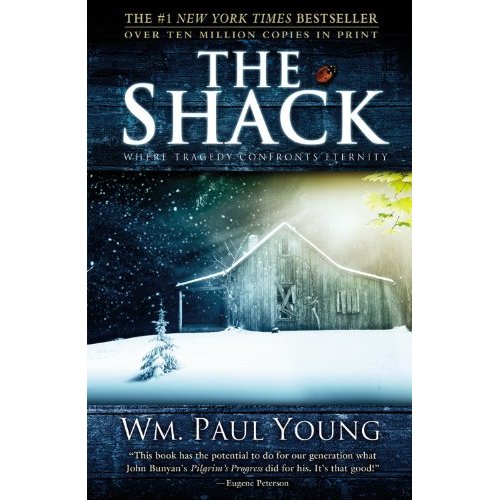
I went in with some strong biases against the book. I’d heard from others that it is pretty terrible theology and borderline (or actual) heresy. Needless to say I wasn’t expecting to enjoy it, but, like any good work will do, The Shack proved my biases wrong.
The plot is fairly simple. A man, Mackenzie, has a horrific tragedy happen to his daughter; this tragedy affects his whole family in negative ways; then he receives a letter from God (?) asking him to come to the place the tragedy happened to talk about things. The rest of the narrative revolves around this discussion. One note I should make as a reviewer is that Young’s prose is fantastic. His descriptions of everyday events and locations inject a reality into the story that is necessary to get readers hooked, and he writes about the uncommon and the supernatural with stunning beauty.
The plot serves as just the background for what the book seems (to me) to be; The Shack is a stirring work of philosophical and theological investigation of the nature of God, the problem of evil, and our hope in Christ.
Readers who have read the work or read anything about it probably already know that God is portrayed in the work as three “persons” in a very literal way. The Father, “Papa”, is a motherly black woman, Jesus is a plain-looking middle-eastern workman, and the Holy Spirit changes her (?) form throughout the work. I feel it is necessary to address this, because this is perhaps the most controversial part of the book. It seems to me, at least, that the idea of God coming to people where they are should not be such a hot issue. Christ Himself describes God’s action in terms of a hen gathering chicks beneath her wings (Luke 13:34). God appeared in various forms throughout the Old and New Testaments (burning bush, still voice in the wind, incarnate Christ, etc.). I find it dubious at best to claim that God does not/can not appear otherwise to individuals–perhaps as a mother to those in need (and this would line up well with the Christian background of religious experiences, cf. Perceiving God by William Alston).
These three persons serve to drive the narrative of The Shack while also making claims about the various works of the persons of God. There are many points throughout the book where I found myself nodding as Young wrote a wonderful insight about the work of God. Young’s answers to some of the most poignant questions of humanity resound throughout the work. One of the most stirring moments is a chapter in which Mackenzie is asked to decide which of his children goes to hell. This is meant to reflect the way Mackenzie (and some Christians) seem to put God in the judgment seat, arbitrarily determining who goes to heaven and who is damned to hell. Mackenzie begs to be condemned instead of his children, and in a powerful turnabout, he is told that this is exactly how God feels. He became incarnate to die for our sins, to give the opportunity for all to be saved, loving all God’s children perfectly (p. 165). Moments like this occur throughout The Shack.
Another thing I must share is The Shack‘s answer to religious diversity. Jesus says that those who love Him come from every background, including other religions. This leads Mackenzie to ask, “Does that mean… that all roads will lead to you?” Jesus answered, “Not at all… Most roads don’t lead anywhere. What it does mean is that I will travel any road to find you” (184). Should Christians agree with this answer? I leave it open to the reader to answer this question. Suffice to say that The Shack will challenge readers from all walks of Christian life.
I finished the book in the span of a day. I set it down late at night, realizing I couldn’t be the same Christian I was before. The Shack grabbed me and wouldn’t let go. The questions Young asks through Mackenzie are questions all Christians must face, and the answers he provides focus on one thing: the Love of God. There are definitely things that made me uncomfortable while reading The Shack, but there are other things I realized were suddenly made clear. Treating The Shack like a theological treatise is unfair. It’s not a doctrine book, it’s a work of Christian fiction, and it excels in its niche, asking questions, giving answers, and leaving it to the reader to decide whether he/she agrees or disagrees. This is a fantastic work and I highly recommend it to my readers. You don’t have to agree with what Young says in The Shack to make the book worth reading, but you should read it.
The Shack
The Life Dialogue: Matt Moss Guest Post Part 4
This is part 4 of a series of guest posts by Matt Moss on the Genesis Creation account. Check out the first post here, the second here, and the third here.
It would now be my contention that day two and its parallel day four are the building and filling of the Cosmic Temple. In the religious Tabernacle/Temple of Israel this comes off a bit differently because of the Fallen status of the world. Day 2’s establishment of the expanse parallels the setting up of the tent of the Tabernacle and the walls of the Temple. Notice then that day 5 is the creation/assignment of the birds of the sky (above the tent’s curtain) and the sea creatures (below the tent’s foundation). What fills the temporal Temple will come on days 3 and 6.
For now I would like to add one more decorative indicator of Temple cosmology. If you remember your temple diagrams that you’ve seen and the Levitical procedures you may have read about in various OT courses/studies, you will surely remember the pools and the washings! Priests had to regularly wash themselves and their robes before proper use in the Temple. For the Tabernacle, see Exodus 30:17-21. And for the Temple see 1 kings 7:23-26; 2 Chron 4:2-5. As with the lampstand above, these serve a symbolic purpose as well as a practical one! They are part of the Temple precisely because they are part of the Cosmic Temple in Genesis 1!
Genesis 1:11-13 and 24-25, “And God said, “Let the earth sprout vegetation, plants yielding seed, and fruit trees bearing fruit in which is their seed, each according to its kind, on the earth.” And it was so. 12 The earth brought forth vegetation, plants yielding seed according to their own kinds, and trees bearing fruit in which is their seed, each according to its kind. And God saw that it was good. 13 And there was evening and there was morning, the third day… [day 6] And God said, “Let the earth bring forth living creatures according to their kinds—livestock and creeping things and beasts of the earth according to their kinds.” And it was so. 25 And God made the beasts of the earth according to their kinds and the livestock according to their kinds, and everything that creeps on the ground according to its kind. And God saw that it was good.”
As foreshadowed above, on day 3 we have a further establishment of the Cosmic Temple and on day 6 we have the first part of the filling of the Cosmic Temple. First I will deal with day 3. While travelling through the wilderness, the Israelite Tabernacle did not uproot and replant trees in the Tabernacle every where they went. However! You will read and see Acacia wood being used in everything from the Ark of the Covenant to the pillars that hold up the curtain and the walls of the Holy Place (see The Lutheran Study Bible page 141 for a great breakdown of materials used). The tent posts all the way around the outer court too serve as a garden image with all their rich colours. Later in the Solomonic Temple, there is a similar tree-like architectural feature. First we note that cedar and cypress timber from Lebanon was used (1 Kings 5:8-9; 6:14-18). Just as the trees and vegetation of day 3 served to decorate the Cosmic Temple, so also the acacia, cedar and cypress wood are used to decorate Israel’s Tabernacle & Temple.
As for day six, I have isolated the first part from the second part (mankind) simply because man deserves a bit of time on his own. Much like the birds and fish are to fill the Cosmic Temple but are kept out of the temporal Tabernacle/Temple, so too these animals are included in the Cosmic Temple BUT are only brought into the Israelite Tabernacle/Temple to be sacrificed (more on this later!).
Genesis 1:26-31- “Then God said, “Let us make man in our image, after our likeness. And let them have dominion over the fish of the sea and over the birds of the heavens and over the livestock and over all the earth and over every creeping thing that creeps on the earth.”
27 So God created man in his own image,
in the image of God he created him;
male and female he created them.
28 And God blessed them. And God said to them, “Be fruitful and multiply and fill the earth and subdue it and have dominion over the fish of the sea and over the birds of the heavens and over every living thing that moves on the earth.” 29 And God said, “Behold, I have given you every plant yielding seed that is on the face of all the earth, and every tree with seed in its fruit. You shall have them for food. 30 And to every beast of the earth and to every bird of the heavens and to everything that creeps on the earth, everything that has the breath of life, I have given every green plant for food.” And it was so. 31 And God saw everything that he had made, and behold, it was very good. And there was evening and there was morning, the sixth day.”
I’ll cut right to the chase. Man is the priest of the Cosmic Temple. This becomes even more explicitly clear in 2:15, “The LORD God took the man and put him in the garden of Eden to work it and keep it.” These two tasks, “to work it and keep it” (avad and shamar) are only used together in reference to the Levitical priesthood. Upon God’s resting of day seven, the Cosmic Temple is fully ordered and filled, that is, it is fully functional! God is present and he places His man in the Garden of Eden, the Holy of Holies of this Cosmic Temple, to be the High Priest who serves God by working and keeping this Temple. And at the centre of this Cosmic Temple stands the Tree of Life and the Tree of the Knowledge of Good & Evil. Man is given one command by which he might serve and love the gracious Creator, “You may surely eat of every tree of the garden, but of the tree of the knowledge of good and evil you shall not eat, for in the day that you eat of it you shall surely die (Gen 2:16-17).”
Despite avoiding material creation questions throughout his book, Walton appears to lean toward the special creation of mankind. He therefore rejects the evolution of man even though he allows room for evolution of animals. For him, Genesis 2 allows us to have a material understanding of man’s formation/creation (out of the dust). I don’t think it’s the strongest part of his book, but for now I am too fixated on the notion of the man as priest of the Cosmic Temple.
God then makes a suitable helper for the man (gender roles, order of creation, marriage, and the like are topics for further discussion in other forums). We all know what happens next. The perfect, complete, finished, and functional Cosmic Temple, perfectly and wonderfully ordered by God that He might live in communion with His creation, is disturbed. No, that’s too weak a description. The fully ordered creation is hurled into disorder, chaos, and disarray. SIN enters in 3:7.
The next post will discuss Thesis 6.
The Historicity of Jesus: The Tools for the Task
This is part of a series I’ve entitled “Jesus: the Living God,” which explores Jesus from Biblical, theological, and apologetic levels. View other posts in the series here.
For now, let us focus on the “tools for the task” (Wright, 29 and following). What kind of historical, textual means are used to talk about Jesus? I’ll be outlining views made by N.T. Wright in his The New Testament and the People of God, (hereafter NTPG) and Blomberg in The Historical Reliability of the Gospels. First, I should outline my presuppositions. I believe that Jesus Christ is Lord and Savior, whose salvation is freely available to all who believe by grace through faith (Ephesians 2:8-9). There is no other name by which we are saved (Acts 4:12). I believe that the Bible is the Holy, Inerrant Word of God. It is infallible in its teachings.
Wright argues for a “critical realist” view of history. This view describes a “process of ‘knowing’ that acknowledges the reality of the thing known, as something other than the knower… while also fully acknowledging that the only access we have to this reality lies along the spiralling path of appropriate dialogue or conversation between the knower and the thing known” (Wright, 35 emphasis his). This acknowledges that observers have their own point of views, that they have their own interpretations, and that metaphysical beliefs will influence interpretation of data (36). This is vitally important throughout not just Wright’s body of works, but any historical (or other field) study–one’s presuppositions will influence how one interprets the same data.
Wright argues that one primary function of worldviews is to tell “stories” (38). This doesn’t mean these stories are fiction, rather, Wright is arguing that these stories form the basis of a worldview as well as the ways the worldview will interact with other views (38-40). In the context of the New Testament, “They [first-century Jews] never expressed a worldview in which the god in question was uninterested in, or uninvolved with, the created world in general, or the historical fortunes of his people in particular” (41). It is this worldview that, upon reading more of Wright, I think Wright not only acknowledges but agrees with. God is not uninterested or uninvolved, rather, the opposite is true–God is intimately involved and interested in His creation and creatures.
Wright emphasizes the “impossibility of ‘Mere History'” that is wholly divorced from any worldview (82). This doesn’t mean there are no facts… rather, it means there is no such thing as an uninterpreted fact (88). These interpretations are generally used in conjunction with historical hypotheses. Thus, it is important to note what composes a good historical hypothesis:
1) The historical hypothesis must include the data. One cannot, for example, simply drop the eschatology which was clearly part of Jesus’ teachings as well as the rest of the New Testament, in order to make one’s hypothesis easier to produce. The data must all be included (99).
2) “It must construct a basically simple and coherent overall picture” (100).
3) The hypothesis must show that it is useful in related areas, it must explain other problems (100).
It is important to realize that a simply enormous amount of material has been produced on Jesus and the Gospels, not to mention the rest of the New Testament. Thus, I will turn to Craig Blomberg’s work, The Historical Reliability of the Gospels (hereafter HRG) to analyze some of the ways this study has been done. The tools for our task (to borrow Wright’s terminology) should utilize the best available evidence from New Testament scholarship, while discerning everything in light of the truth of Scripture.
Craig Blomberg wonderfully summarizes the various methods of historical criticism and analyzes them for usefulness in HRG. Note that I’m not endorsing historical criticism, rather, I’m endorsing taking what is useful from historical criticism and use it as part of the toolbox. In my summing up, I’m leaving out much of Blomberg’s task of pointing out flaws in these criticisms (which is not only in-depth, but also illuminating), but rather emphasizing his ways to use them in the presuppositions that I’ve outlined above.
1) Form Criticism- Form criticism emphasizes the genre of the work being viewed (Blomberg, 50). It also discusses how a text was transmitted or brought into being. Christians can find this useful as it can be readily implemented in the “historical grammatical” type of reading of Scriptures. The background of the text is indeed important, as well as realizing the genre involved (i.e. the historical telling of what Jesus did, as opposed to His parables, which are not literal history).
2) Redaction Criticism- Redaction criticism views the writers of the Gospels as “editors” of the New Testament, “selecting, arranging, and rewording their sources to highlight particular theological and stylistic emphases” (Blomberg, 67). Christians can utilize this not to break down the reality of the Gospels, but rather they can use it as they realize there are indeed differences in the portrayal of Jesus in the Gospels (i.e. Mark’s suffering servant and Matthew’s son of David), not as contradictions, but as parts to a whole picture of Christ as suffering servant, son of David, compassionate teacher, and Word Incarnate (74).
3) Midrash- Midrash criticism of the Gospels focus on the “relationship of the Gospels to various [Hebrew Scripture] passages to which they may refer” (75). Clearly, this has uses for the Christian. How did the writers of the Gospels utilize Hebrew Scriptures to make their arguments or draw their conclusions about who Jesus was and what He did? This is vitally important to Christological study–who did Jesus say He was, based on the passages He cites, and who did others say He was?
4) Literary Criticism- this discipline is broken down into three types, though the most useful type for the Christian is the “narrative criticism” which analyzes characters, symbolism, figures of speech, etc. within the Gospels (87).
I’ve left out much of Blomberg’s analysis in order to simply sift off what we can use from these various methods, in light of the presuppositions I’ve outlined above. There is much more that could be said about either of these fantastic works (NTPG or HRG), and there is much more that could be said about the “tools for the task”, but for now, these are our tools, and I shall soon move into some of the historicity of Jesus.
Sources:
Blomberg, Craig L. The Historical Reliability of the Gospels. InterVarsity Press. 2007.
Wright, N.T. The New Testament and the People of God. Fortress. 1992.
——
The preceding post is the property of J.W. Wartick (apart from citations, which are the property of their respective owners) and should not be reproduced in part or in whole without the expressed consent of the author.
Science: “Thanks, Christianity”
I remember recently I was talking to someone and they asserted that Christianity and science simply don’t mix. Often I run into the idea that somehow Christianity hinders science (and a great many people seem to believe science can hinder Christianity as well!).This is not only wrong, it is historically and demonstrably wrong. Science as it stands today would not exist if it were not for Christianity.
Christian presuppositions allowed science to develop. Science was built on the presupposition that God was rational. Because the universe was created by this rational God, “Christian Philosophers linked rationality with the empirical, inductive method” (Schmidt, 218). These philosophers included such giants as William of Ockham (1285-1347) and Francis Bacon (1561-1626).
Lynn White states that “From the thirteenth century onward to the eighteenth, every major scientist, in effect, explained his motivations in religious terms” (Quoted in Schmidt, 222). But it wasn’t just the motivations that were explained in religious terms. Too often it is the case that people argue, fallaciously, that they were only Christian because of the time these scientists were born into. They were too afraid, it is alleged, to state their true beliefs. Not only is this utterly without evidence, but it could not be farther from the truth. Many of these scientists spent as much time on theology as they did on science. They credited God with their discoveries. They believed that God had set the universe up in such a way as to be explored by His people. These convictions permeated the writings of scientists.
Alvin Schmidt, in his monumental work, How Chistianity Changed the World, outlines how Christianity changed science on every level. Gregor Mendel, Leonardo Da Vinci, Andreas Vesalius, Copernicus, Johannes Kepler, Galileo, Isaac Newton, Liebniz, Pascal, Ohm, Andre Ampere, Kelvin, Boyle, and Pasteur are just a few of the almost limitless examples. All of these were Christians. It is wholly fallacious to assert that science and Christianity do not mix.
Some might immediately attack Christianity when names like Galileo are brought up. The problem with this is twofold:
1) In the case of Galileo or Copernicus, Christians were actually supporting these astronomers, just Christians of a different variety (Lutherans backed Copernicus financially and offered encouragement and support, while Roman Catholics, still basing their assumptions on Aristotelian astronomy, persecuted him [Schmidt, 231])
2) These men were, themselves, Christian. It’s easy to argue that Christians were putting down science when one can point to cases of persecution, but these men were Christians!
Perhaps it is now, however, that Christianity is opposed to science. Perhaps in the modern day, Christians are not scientists. This is not true. Take the case of Francis Collins, for example. He is the scientist who was the head of the human genome project. He is also a devout Christian and the author of The Language of God, in which he argues that science has lead him even more into his belief in God.
It is simply not the case that Christianity and science do not mix. Christian presuppositions allowed for the development of the empirical method. Christian philosophers and scientists were the “giants” on whom people like Newton (and modern scientists) built their theories (Newton himself asserts this). Science is just another of the many areas Christianity has helped transform for the better. Science can rightly say, “Thanks, Christianity.”
Sources:
Collins, Francis. The Language of God. 2007.
Schmidt, Alvin. How Christianity Changed the World. Zondervan. 2004.
——
The preceding post is the property of J.W. Wartick (apart from citations, which are the property of their respective owners) and should not be reproduced in part or in whole without the expressed consent of the author.
Debate on Sam Harris’ “Letter to a Christian Nation”
I have received permission to repost this. Some things are quotes from my blog, specifically “But Christians are Bad People” and others are quotes from Sam Harris’ “Letter…” (abbreviated due to laziness, not lack of respect). Some editing was done (i.e. removing names and extra info at the beginning, also added “if you’d like” to my bracketed side note on Matthew 22, and a few spelling errors were corrected).
This is a debate between an atheist and myself on Christianity in general. We decided to use my most recent blog and Sam Harris’ “Letter…” as the starting point. This will likely be only the first of many such posts.
His text is in normal print. My responses are in bold.
“Christians do bad things, so Christianity must be bad.” I would argue that opponents of Christianity such as Sam Harris, would likely say that “Christians do bad things – and as the Bible specifically instructs in and sanctions such things – Christianity must be bad.” I realize Sam Harris attempts to outline a case that the Bible commands evil in the beginnings of his book–citing Deuteronomy 13:6, 8-15. He then argues that Jesus does not remove responsibility from the law by quoting Matthew 5:18ff (page 5-6 in PDF form, 8-10 in the book). The problem is that Harris takes the Matthew verse out of context by either unintentionally or otherwise leaving out 5:18 “Do not think that I have come to abolish the Law or the Prophets; I have not come to abolish them, but to fulfill them.” One of the core teachings of Christianity is justification. Jesus paid the price. The Law that is written in the Hebrew Scriptures (aka Old Testament) is indeed not abolished, but fulfilled in the person of Christ. Jesus’ statement that He came to earth to fulfill them (the Law He states will not be overthrown) outlines this idea. Paul makes this point clearer throughout his letters to the churches. Galatians 5:4-6, 14 (the rest of the passage can certainly be read, but I don’t think its wholly necessary to get the meaning)- “You who are trying to be justified by law have been alienated from Christ; you have fallen away from grace. But by faith we eagerly await through the Spirit the righteousness for which we hope. For in Christ Jesus neither circumcision [a requirement of the Law] nor uncircumcision has any value. The only thing that counts is faith expressing itself through love… The entire law is summed up in a single command: ‘Love your neighbor as yourself.'” This is ultimately a doctrinal and theological issue. It seems it is one that Harris does not understand. His argument stems from taking Bible passages out of context and arguing against one of the core teachings of not only the church fathers, but also of Paul and Jesus himself–that Christ came as the sacrificial lamb to fulfill the Law, which no man can ever do. As far as whether Christianity sanctions bad things, I think that is nothing but an unfair charge. Christianity’s command can be summed up by what Paul stated before and by what Jesus Himself said of the law (Matthew 22:37ff [read before it for context if you like]): ” ‘Love the Lord your God with all your heart and with all your soul and with all your mind.’ This is the first and greatest commandment. And the second is like it: ‘Love your neighbor as yourself.’ All the Law and the Prophets hang on these two commandments.” It seems clear that the Christianity Christ preaches is not one that condones violence. Whether one wants to twist it to do so is another matter entirely. “Christians are bad, so Christianity is false.” In the second paragraph, you have changed the premise of your argument from “This is blantantly false, and I’m honestly shocked that someone like Sam Harris…” Again, your first premise is closer to what Harris has stated – the second I find questionable. The second is what you refer to here, and attribute it to Harris. I find no reference in his book that suggests he takes this position – correct me if I’m mistaken. That is, have you a reference that indicates that Harris thinks that because Christians do bad things, Christianity is false? I should have stated that more clearly. It’s a problem I’ll hope to rectify a bit by taking —‘s advice to lessen my amount of posts and increase the editing and thought on each. Harris doesn’t specifically argue that Christianity is false. He does seemingly believe it should be rejected because of the initial premise, however. Though, to be fair, if Christianity is true (i.e. exclusive claim to eternal life in heaven), then it should be embraced by all means. The only logical reason to abandon it would be if Christianity were false. Arguing against Christianity by saying it’s bad does nothing to its claims of truth, making the argument an ad hominem attack on the character of Christians rather than an attack on Christianity. Harris, it could be said, argues that Christianity specifically teaches bad things, but I’ve already demonstrated his lack of theological knowledge on the first point, and his other points (i.e. condom use, etc.) could be valid against Catholicism, which is not the Christianity I (and about 50% of Christians) ascribe to. It seems dishonest of Harris to assert that atheists are completely different while shoehorning the Christian right into a Catholic view. There were several times, whilst reading his book, that I found myself saying to his “You believe…” statements “No I don’t.” Those times are straw men arguments to me, though I would say that Christians who believe, say, in not having birth control, should try to defend their position (one I disagree with). I would suggest a simpler test; read the text of their holy scripture, and see if it advocates and/or sanctions said violence. If it does, the religion is violent. If it’s holy scriptures are replete with violent act after violent act, the religion is violent. Admittedly, I do find (at least) the international data concerning religious vs. non religious nations rather interesting. Though, Harris himself states; “Of course, correlational data of this sort do not resolve questions of causality…these statistics prove that atheism is compatible with the basic aspirations of a civil society; (and) …that widespread belief in God does not ensure a society’s health.” “A very good breaking down of Harris can be found in The Irrational Atheist by Vox Day…” Day states, “By applying his metric to the state-wide voting instead of the more Let’s do justice to what Day is pointing out, however. He’s taking the same sample size (i.e. the U.S.) and simply giving a more in depth analysis of what the statistics show. He’s being more specific with the data. Rather than showing that red areas have higher violence than blue areas, they show that blue counties have higher violence on average than red ones. Examples Day gives: Florida–11 blue counties account for 44% of the state’s population, but more than 50% of its murders and 60% of the robberies. Maryland–5 blue counties with a murder rate of 13.22/100,000 verses 0.89/100,000 in the red counties. Washington, D.C.–voted 91% blue but has the highest murder rate in the nation, almost 7 times the average national rate. Harris’ examples of cities are also taken by state, but not by county. When one goes by county, 13/25 of the safest cities are in red counties (verses the by state of 8/25), while 21/25 of the most dangerous cities are in blue counties (verses by state 12/25). In other words, when one gets specific with the data, it can be shown that red areas are potentially safer than blue areas. To say that it is a “smaller” sampling is inaccurate. Rather, it is looking more specifically at the same sampling. An analogy could be the body. Sam Harris points to one’s midsection and says there is something wrong with it. We can use that same data and zero in on, say, the kidney and point to that as the problem area. The same amount of data is there (we have examined the midsection), but the more specific information leads to a more correct conclusion. “…how is it that showing violence by political beliefs automatically shows a correlation to religious beliefs?” Because it can be shown that there is a strong correlation between the population’s political and religious beliefs. Therefore, show a correlation between violence and one’s political affiliation, and one can extrapolate from this. It is fair to say that certain geographical locations in the U.S. are in fact predominately one party or another (thus the whole red state – blue state dichotomy), and that those parties do in fact represent certain religious affiliations more than others – the stats bare this out quite well, and candidates stake their chances of winning an election on it. e.g. – The ‘deep south’ is predominately quite religious – compared to say, the much more liberal coastal areas, and to some extent, the mid west. The break down is shown here; http://www.valpo.edu/geomet/pics/geo200/religion/adherents.gif The blue and red correlates very closely to this reality; http://www-personal.umich.edu/~mejn/election/2008/statemapredbluer1024.png Certainly it isn’t perfect, but it is quite illuminating, and certainly enough to gain some reasonable insight as to the connections present between political and religious beliefs in the U.S.. Okay, let’s examine this in detail as well. Day points to a 2001 ARIS study that shows that 14.1% of Americans are atheists. About 1/2 of eligible Americans vote. So assuming that every eligible atheist voted, that means that 28.2% of the vote was potentially atheist. The problem is that exit polls show that atheists were less likely to vote than religious people, accounting for about 10% of voters in CNN exit polls. They went about 2/3 blue. But the problem is that Harris seems to want to use this to show that non-religious people are less violent. This discounts all those who didn’t vote, and it also means that only 16% of blue voters were actually non-religious. It seems kind of ridiculous to attribute all that nonviolent behavior to a lack of religion when it is only 16% of the voting total. So I stand by my idea that using votes to determine religious belief seems pretty silly. Not only that, but if we do use it as a determining factor, it would show the opposite of what Harris wants to argue. “…religion does do a lot of good, whether people like Harris want to admit it or not.” “It is undeniable that many people of faith make heroic sacrifices to relieve the suffering of other human beings.” – Sam Harris He has no trouble admitting that at all. (straw man) I’ll concede again that I should have been more clear here. Harris does admit that religious people do good things, but it seems to me that his argument centers around the idea that no religion = better people. Note especially pages 12-13 in the PDF version of “Letter…” He seems to argue that if religion were removed, more good would be done. I could stand to reword that part of my blog entry, but again I don’t think I’m attacking a straw man when Harris specifically tries to detract from the good that religious people do (i.e. his Mother Theresa example in which he says she was “…deranged by religious faith.”) If she were not so deranged, she would have been better. That seems to be a valid way to argue from what he is saying. But one major thing could be said here theologically as well. Christianity isn’t about achieving goodness. It isn’t about being good. It’s the fact that we are not good that means we need Christ. Whether or not one wants to say Christians are worse than non-Christians doesn’t do anything to hurt the message of Christ–because it’s not based on being good people, it’s based on being saved people. “But those who are, say, Christian, are commanded to be good,…” This is in fact a strike against Christianity in many an atheist’s mind; that the idea of Christian morality is ‘commanded’ of its adherents. Here Harris completely misunderstands large amounts of Christian belief. Again the assumption is that being Christian = better morals. But that’s not what Christianity is about. Also, this explanation of goodness begs the question entirely against the Christian. It assumes that a religious person only does good things out of belief of reward (or perhaps fear of punishment). The conclusion has snuck [edit: sic, blast!] into the premise. It is wholly possible that Christians do good things out of the kindness of their hearts. The Christianity I believe means that I am saved. Any good that I do is for other reasons, not for the hope of reward. The premise in the argument begs the question because it implies that the only reason a Christian does good is for reward, so the good acts they do aren’t as good as one who doesn’t do it for a reward. “…whilst atheism can at best offer an evolutionary view of morality that is not obligatory” Perhaps you can explain to me what the negative is here, assuming that the result – a person acting with moral responsibility – is the same? I meant to say “objective” not “obligatory.” This was wholly a mistake I can ascribe to lack of sleep. The point you make about the result being the same is interesting, given that you just argued above that it is somehow better to do good things without a responsibility to do so. But again, the use of obligatory was a complete mistake. Read it as “objective” and that is my meaning. I had a ridiculously long list here, and have decided it would be of no avail, at least not in this discussion. The violent history of religion would require its own debate. It does after all entail a couple thousand years of history. One could make the same argument for the history of irreligion. Harris concedes as much when he points out that Christians bring up people like Pol Pot, Stalin, and the like. Interestingly, I think simply looking at an overall # of death rate, it is possible that irreligion has lead to more violence than religion. It is also worthy of note that Harris specifically tries to get around these people by calling them irrational and makes some attempt to try to put them outside of atheism. Page 14 on the PDF version of his book (40ff in the book) demonstrates Harris in a very uncomfortable position. “The problem with such tyrants is not that they reject the dogma of religion, but that they embrace other life-destroying myths. Most become the center of a quasi-religious personality cult, requiring the continual use of propaganda for its maintenance. There is a difference between propaganda and the honest dissemination of information that we (generally) expect from a liberal democracy. Tyrants who orchestrate genocides, or who happily preside over the starvation of their own people, also tend to be profoundly idiosyncratic men, not champions of reason. Kim Il Sung, for instance, demanded that his beds at his various dwellings be situated precisely five hundred meters above sea level. His duvets had to be filled with the softest down imaginable. What is the softest down imaginable? It apparently comes from the chin of a sparrow. Seven hundred thousand sparrows were required to fill a single duvet. Given the profundity of his esoteric concerns, we might wonder how reasonable a man Kim Il Sung actually was.” His argument here seems to be that these people are irrational, so they can be dismissed. Yet I’d make the argument that Christians in particular who try to use that belief system for violence are irrational. Either both can be discounted, or neither can. “Further, is it not obvious that much religion embraces peace?” No, it isn’t. (begging the question) The Christian Bible is simply one of the most violence-ridden pieces of literature I’ve encountered. Page after blood soaked page espouses more brutal rape, slavery, torture, genocide, sacrifice – and often to the elation of, or under the direct command of, the Creator – than you can shake a stick at. The Bible does indeed have much violence in it. I’ve argued that things such as killing that is endorsed by God can be logically defensible here. I can sum up: “In this case, the one presenting the argument is suggesting that:
1. God is morally perfect
and
2. God commands killing
are incompatible. Thus, in order to counter this argument, all that needs to be done philosophically is show there is no inconsistancy. In other words, all that needs to be done is show another alternative. That alternative readily makes itself available:
3. There are some whose moral depravity is such that God will not suffer them to live
This third explanation gives a logical “way out” of the supposed dilemma presented by the first two statements. While this explanation may not seem satisfactory to some who would wish to debate the finer points of individual verses, cherry-picking out-of-context Scripture does nothing in light of the fact that option 3. is logically valid. The defender of the faith need not even demonstrate that this statement is true, only that it is possible.
Thus, I conclude that to have 1. God is morally perfect and 2. God commands killing is not a contradiction in light of 3. There are some whose moral depravitiy is such that God will not suffer them to live.
The case for God’s love could fill numerous volumes, but it is clear from Scripture that God is intentionally portrayed as the definition of Judge, morally perfect, and righteous. The writers of the inspired Word are clearly not recording stories of massed killings in the name of the Lord for the sake of showing God’s moral imperfections (which, I would argue, points even more towards the innerrancy of Scripture, but that’s a whole other issue), but they are rather recording these stories to show that God is indeed God and He is in control. In His moral perfection, there are things He cannot tolerate. Those things are punished in righteousness. Those who argue that the God of the Bible is evil are merely skimming scripture for verses they believe will back them up in out-of-context situations. Further, they are rejecting the Holy Spirit’s role in directing true and upright teaching of the word. Finally, even if one does not accept Scripture as innerrant, the Word of God, or as being passed on by the Holy Spirit, the philosophical problem of evil in the Bible is solved quite simply, contrary to general belief, by the assertion that God’s role as Judge could mean He cannot allow certain evils to pass unpunished.” Arguing that God portrayed in the Bible is evil is to not only do so by specifically searching for verses to support the case in light of much evidence to suggest otherwise (just see God’s interactions with the nation of Israel in light of their constant apostasy, the example of Jesus, the Psalms, and all kinds of other verses that deal with the mercy and goodness of God), but it is also to argue without a knowledge of the culture that such a text originated from. In other words, to argue that God is evil in light of the Bible is to look on such acts with modern eyes and completely discount the fact that the Biblical world was a completely different place than the world we have. There’s a couple of things wrong with this statement – almost to the point that I would respectfully ask that you amend your blog, and make the correction. But that feels beyond the scope of what we’re doing here. I’ll abstain from that request – but do consider what it is you’ve actually said; First, he does not endorse this religion. He highlights it as an exception to the rule. That is, he notes that it “preaches a doctrine of utter non-violence”, and he does so in order to contrast it with Christianity, which is replete with violence. Second, you then choose to use the unfortunate phrase ‘adhere to’ when describing Harris’ statements about Jainism – stating he in fact adheres to Jainism. Certainly you know he does not adhere to this or any religion? This is an issue of semantics and I’m willing to concede the point that Harris does not adhere to Jainism. Though it is clear that he has some interesting views on spirituality (I grant that Wikipedia is not the best source for this type of thing, but the quote from End of Faith, combined to his specific exclusion of Eastern religions from his general attack on religion show at least a predisposition). “…it is telling that Harris feels the need to include a chapter about Are atheists evil?” Do tell? I’m not at all clear what you think this exposes about Harris? I can explain for you why this inclusion was quite necessary in a book of this sort. Day in and day out, the American atheist is absolutely inundated with accusations from his Christian neighbor, that he is without morals, “spiritually” bankrupt, brimming with sin, in a word, evil. The need for a look into the morality of the atheist was an important component of the discussion – esp. in a book addressing a ‘Christian Nation’. Or more accurately, to show that no such connection can be made. A simple question; Do you honestly think that any of the evil that Stalin, Pol Pot or Mao perpetrated, could be said to have been done in the name of ‘rationality’? I’d be quite curious to hear you justify that if it is your belief. I consider what these men did to be the very height of irrationality. Yet Harris, and it seems you, continue to argue using points from people who are Christian and irrational. This doesn’t really seem fair. Also, I doubt that someone like, say, Stalin, would say they were being irrational. My main point is that either both types of irrational extremities (violent Christians and violent atheists) don’t need to be addressed, or they both do. Regarding the inclusion of atheism in that quote, simply, nothing can be done in the name of atheism. It’s a statement without meaning. As I’m sure you’ve heard many times, atheism is simply the lack of a belief in a god. Nothing more. How you one do something ‘in the name of’ a lack of a belief? Fair enough, then I’ll say that these men were atheists. The people who did violence and were Christian can still be compared to as a legitimate analogy. Atheists who do violence. Christians who do violence. I’d argue both are bad. If you wish to tack on some other world view or belief system (secularism, humanism, etc.), they actually begin to carry some baggage, and one might say they did something in the name of some ideal that that particular world view or ideology holds. But then you are no longer talking exclusively about atheism. Belief in a God can, however, give an objective standard by which all actions must be judged. Thus there is a better basis by which to reject certain actions than if there is no objective standard. “Sam Harris accuses Christianity in particular…He goes on to attempt to disassociate atheism with these obvious atheists” by saying “While it is true that such men are sometimes enemies of organized religion…” [Here I’d like to note that this is completely deceptive.” I will agree, within this section anyway, that he did seem to directly avoid saying that the men were atheists. It felt disingenuos to me. He does elsewhere, but that isn’t relevant. I have to concede that he might have been more direct here. I don’t appreciate the dodge either. That said… “These men absolutely were enemies of organized religion and wholly atheist. Harris is attempting to downplay the evil of these men.] “ It’s entirely honest on his part to say ‘sometimes’ in this case, as Hitler was in the list. Hitler’s atheism, as you know, is quite debatable, and he was a staunch bedfellow with the Church as well (however opportunist that relationship may have been). It would have been inaccurate to claim that ‘all’ of his list were enemies of religion and that they were all atheists. I can’t say for sure that this is why he stated it this way, but it would have been inaccurate to do other wise. “Isn’t it obvious that those who champion murder in the name of God are just as irrational as these atheists that Harris, Dawkins, and the like are quick to condemn as irrational?” Arguing this is false in light of the points I’ve already made, but it seems to be the central issue, so I’ll address it again. To argue that Christianity is violent is to go against the core teachings of Christianity from its founding (and indeed the person of Christ) to the present day. Not only are the two core law statements to love God and neighbor, but Christ specifically condemns violence in all forms. To argue otherwise is to beg the question. Again, it would be easy to pick out violent examples from Scripture and debate them on a verse-by-verse basis, but that is not the core issue. Christianity teaches the entire Bible points to Christ at the center. What does Christ teach? Nonviolence. This may sound like a variation of the “No True Scotsman” argument, but it isn’t, as we do have a strict definition of what it means to be Christian in the Bible. One need only look at what Christ Himself says and one can find what is indeed a “true Christian.” Not only that, but Paul, Peter, etc. are further examples of what Christianity means. Again, I refer you to the above statements. Christians can use the very scripture their religion is based on to justify the evils they do. Atheists have no such justification. An atheist committing an act of violence must assume the responsibility solely on their own. There is no dogma to point to and say “See, that’s what happens when you are an atheist.”. No ancient scripture or holy text, no authorities from whom rules and such are handed down, only an individual making a choice. Christians who use the Scripture to justify violence have missed what Christ himself says about violence. There can be nothing more clear than this when one simply reads what Jesus says. “I’d argue that atheists like Stalin could defend their killing from an atheologically defensible position as well: personhood doesn’t matter, so we can kill as we please.” There is no such position in existence. Not having a belief in a god says nothing of one’s beliefs about the worth of a human life. It does not put special value on it, nor does it devalue it – it says nothing at all about it – or anything else for that matter. It only denotes that one has no belief in a god. Conceded. Though the atheism you are describing is a “soft atheism” that goes against the definition of atheism as seen in both the Encyclopedia of Philosophy and the Cambridge Dictionary of Philosophy. See further points about that here. “I do, however agree that either side can use those beliefs (or lack thereof) to condone violent actions.” How is it you arrive at some belief system (that would ‘condone’ an action), from the statement that one dose not have a belief in a god? “His examples include preaching abstinence over use of condoms,…All of these are ad hominem attacks (or ad Deum)” How is mentioning that the church preaches abstinence an ad hominem attack? I submit that it most certainly is not. This seems ad hominem to me. Rather than attacking any specific argument, he is attacking, say, Catholics, for preaching abstinence. I’m almost willing to concede your point here except for the virulent nature of his attack in this section. I may be reading too much into it, but this passage seems full of emotional appeal and very much like an attack on people who would dare believe such things and less like a legitimate complaint. I won’t comment on your subsequent three fold explanation – mostly in the interest of length (this is already ridiculously long!). I’m quite interested in discussing morality as it pertains to religion and atheism in the future though. Let’s hope we can return to this. Well. That’s quite a lot. More than enough for now, I’m sure. Hopefully it wasn’t too terribly dull, and I’ve left you with something worthy of response. Hope to hear from you soon, |
Another thing I’d love to point out is that Harris is a wonderful example of the argument from atheism (page 5 in PDF) which I address https://jwwartick.com/2009/07/24/the-argument-from-atheism/.This argument is demonstrably false because by definition a theist is not an atheist, check out the blog for a longer rebuttal.
Walking in Faith as a Christian Philosopher
Okay, we all knew that there’s no way I could keep this blog limited entirely to apologetics.
Thus, here is the first non-apologetic post (other than the obviously satirical Evolution of the Rock)!
It is easy as someone who focuses so much on the philosophical proofs of God and the constant defense of Biblical inerrancy, the resurrection and Godhood of Christ, etc. to get completely overtaken in faith life by the scholarly side of faith. It’s so easy to stray from the narrow door that Christ opens. That verse, Luke 13:24 “[Jesus said]’Make every effort to enter through the narrow door, because many, I tell you, will try to enter and will not be able to,'” is one of my favorite things Jesus says in the Bible.It’s a reminder during those times that I tend to lose focus. The way is narrow. The door is narrow. And the only way to stay on that path or enter through that door is Jesus Himself.
It’s sometimes interesting to be aware of the spiritual warfare that is occurring, especially around one’s own life. It’s scary sometimes to realize that the minions of Satan will use anything, even one’s undying interest in Christian philosophy, to pull them away from Christ. I have plainly seen sometimes how I’ve been tempted away from diligent reading of Scripture or seduced into reducing faith utterly into philosophical arguments. It is in those times that I realize how real the battle is. It is in those times that God the Father never ceases to call me to return, and the Spirit never ceases to fill me. The life of a Christian Philosopher is one of continual effort. One must constantly fight the urge to reduce that most important thing–salvation through faith by grace–to philosophy.
There is nothing more wonderful than being called by God. Nothing can match the glory of the Holy Spirit’s presence. Those nights in which Christ calls me home to Him are the best nights of my life. Each day there are so many blocks placed in my path, but it is always the Lord’s call, His hand bearing me across the hard times, that upholds and uplifts me. There is nothing to do at times like this than rejoice and sing His Name. Jesus Christ is Lord over all!
[P.S.: The verse discussed in context, for the more insistent exegetes among us:
Then Jesus went through the towns and villages, teaching as he made his way to Jerusalem. Someone asked him, “Lord, are only a few people going to be saved?”
He said to them, “Make every effort to enter through the narrow door, because many, I tell you, will try to enter and will not be able to. Once the owner of the house gets up and closes the door, you will stand outside knocking and pleading, ‘Sir, open the door for us.’
“But he will answer, ‘I don’t know you or where you come from.’
“Then you will say, ‘We ate and drank with you, and you taught in our streets.’
“But he will reply, ‘I don’t know you or where you come from. Away from me, all you evildoers!’
“There will be weeping there, and gnashing of teeth, when you see Abraham, Isaac and Jacob and all the prophets in the kingdom of God, but you yourselves thrown out. People will come from east and west and north and south, and will take their places at the feast in the kingdom of God. Indeed there are those who are last who will be first, and first who will be last.”‘]

 J.W. Wartick - Reconstructing Faith