Tim Judson
Bonhoeffer and Universalism?
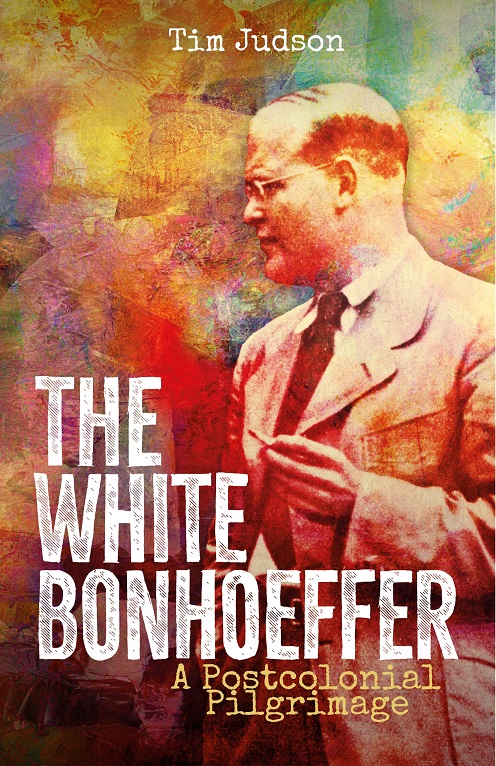
Dietrich Bonhoeffer’s theology is hotly debated to this day, from his views on pacifism to his stance on various ethical issues that face us now. One area that I haven’t seen discussed as much in Bonhoeffer scholarship is his view of universalism. Tim Judson’s recent work, The White Bonhoeffer: A Postcolonial Pilgrimage addresses Bonhoeffer’s stance on this doctrine in a short section. Judson’s insights are illuminating, showing that this is a topic fruitful for further discussion.
Judson notes, first, that the topic is grounded in Bonhoeffer’s theology of the cross and its universality. Second, Bonhoeffer’s thinking seems to be tied up in the ultimate stance of creation rather than individual salvation. Indeed he saw the hyper-focus on individual salvation as entirely the wrong starting point. Individual salvation isn’t the starting point, but rather something caught up in God’s working both through sacrament and the Cross. Third, this focus on the eschaton–the final end of creation–lead Bonhoeffer to brief defenses of the view of apokatastasis: the notion that all creation will have ultimate restoration. He defends this in Sanctorum Communio, for example, noting that “The strongest reason for accepting the idea of apocatastasis [alternate spelling of the Greek word] would seem to me that all Christians must be aware of having brought sin into the world, and thus aware of being bound together with the whole of humanity in sin, aware of having the sins of humanity on their conscience…” (DBWE 1, 286-287, cited in The White Bonhoeffer, 56). The universality of the sinfulness of humanity is, paradoxically, linked therefore to the hope for all humanity’s salvation in Christ. Bonhoeffer concedes this can only be a hope, not a certainty (ibid), but it seems his stance is in favor of the concept.
There are many things of interest in this brief analysis of Bonhoeffer’s universalism. The first is that there seems to be a connection between Lutheran soteriology and universalism, though that is not what Luther himself held. Lutherans explicitly hold to the cross as universally applicable. On the cross, God reconciled the whole world to Godself. If that’s true, then sin as the barrier between humans and God has been removed. As such, what can there be a reason for not having such reconciliation? A second point of interest is that Bonhoeffer sees soteriology as much more corporate- than individual-focused. This is something that is often difficult for theologians who come from backgrounds focused on individual salvation to understand, but it is a stance that I think is correct. The focus on individual soteriology has displaced the focus in Scripture which is on God’s work in Christ, not on an individual. None of this is to say that the individual is unimportant or not discussed in Scripture, but rather that the focus is mistaken when it is on the individual rather than the whole. Finally, Bonhoeffer’s view that we can have hope for final reconciliation, despite his own questions and affirmation of reprobation, lends itself to a very Lutheran stance of merely affirming what one finds in Scripture without trying to always reconcile potential paradoxes. (I have argued that a Lutheran non-rational stance can be taken for universalism in a post here.)
The White Bonhoeffer is a thought-provoking work overall. I am thankful to Judson for shedding light on so many intriguing topics. The book is recommended.
Links
Dietrich Bonhoeffer– read all my posts related to Bonhoeffer and his theology.
SDG.
——
The preceding post is the property of J.W. Wartick (apart from quotations, which are the property of their respective owners, and works of art as credited; images are often freely available to the public and J.W. Wartick makes no claims of owning rights to the images unless he makes that explicit) and should not be reproduced in part or in whole without the expressed consent of the author. All content on this site is the property of J.W. Wartick and is made available for individual and personal usage. If you cite from these documents, whether for personal or professional purposes, please give appropriate citation with both the name of the author (J.W. Wartick) and a link to the original URL. If you’d like to repost a post, you may do so, provided you show less than half of the original post on your own site and link to the original post for the rest. You must also appropriately cite the post as noted above. This blog is protected by Creative Commons licensing. By viewing any part of this site, you are agreeing to this usage policy.

 J.W. Wartick - Reconstructing Faith