timelessness
The Consolation of Counterfactuals: The Molinism of Boethius
Whence comes this powerful understanding
That all things sees and all discerns?
…This is a cause more powerful
More forceful and effectual
Than that which passively awaits… (Boethius, The Consolation of Philosophy, Book V, section IV)
Molinism is holds that God has counterfactual knowledge of every situation. What this boils down to is that God knows conditional statements for every possible situation, such that God knows statements like “If J.W. has free time, then he will read.”
One prominent challenge to molinism is the notion that such counterfactuals about future choices cannot exist or that God simply couldn’t know them. I was startled as I read Boethius’ (480-525 AD) work, The Consolation of Philosophy, to see that he had anticipated this objection and provided the outline of an answer to it about 1500 years ago.
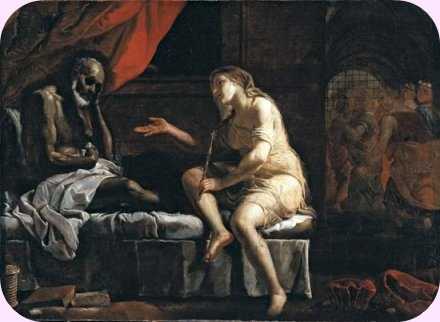
Boethius wrote the work as a dialog between himself and Philosophy, a woman who represented, well, philosophy. The last book focuses upon God’s foreknowledge and human freedom.
Writing as philosophy, Boethius states
All those things which happen without happening of necessity are, before they happen, future events about to happen, but not about to happen of necessity… But this, you will say, is the very point in question–whether there can be any foreknowledge of things whose occurrence is not inevitable. (Book V, section IV)
Again, it was amazing to see that Boethius had anticipated an objection to molinism–a system of theological thought which hadn’t been conceived fully yet (and wouldn’t be for about 1100 years!)–and provided an answer. The objection was seen above: many modern philosophers and theologians contend that God could not know that which is not necessitated to happen.
Yet Boethius answers the problem in a unique way:
The cause of this mistake [believing that God couldn’t know things that will not happen by necessity] is that people think that the totality of their knowledge depends on the nature and capacity to be known of the objects of knowledge. But this is all wrong. Everything that is known is comprehended not according to its own nature, but according to the ability to know of those who do the knowing. (Book V, section IV)
Before developing this argument, it is important to note that it rests squarely within Boethius’ later reflection upon the eternity of God–a being who has “the complete, simultaneous, and perfect possession of everlasting life” (Book V, section VI). Because Boethius holds that God is eternal in this sense–timeless–he can reasonably hold that God’s capacity to know is not limited by temporal constrictions.
Thus, we get back to the nature of his response to the counterfactual objection to molinism. Boethius, holding that God is eternal and therefore not limited by time, grounds the knowledge of counterfactuals not in their own inherent ability to be known or not known, but rather in the ability of the knower to know them.
It is worth emphasizing how radical and powerful this response is to the modern argument against molinism. If God is indeed timeless in the sense Boethius presses, then God would have access to the entirety of time as far as knowledge and action are concerned. Thus, by grounding knowledge not in the objects of knowledge themselves but in the capacity of the knower, Boethius grounded counterfactual knowledge.
Objection
Now, modern opponents of molinism would take this in stride and argue either against the contention that God is timeless or against the contention that knowledge is based in the capacity of the knower rather than the known. Exploring either of these objections is beyond the scope of this post, but it is worth noting that Boethius’ rebuttal to the problem of counterfactual knowledge works if both of his contentions are true. The question is, of course, whether they are.
A Final Objection and Response
Another way to attack Boethius’ defense of God’s knowledge of counterfactuals is to argue that even if it is the case that God is eternal and that His knowledge is grounded in the knower rather than the known, then it still would only mean that God knows what will happen, not what would happen if something were to happen. In other words, one could hold that Boethius’ answer doesn’t actually apply to counterfactual knowledge.
It seems possible, however, to modify Boethius’ defense to counter this argument as well. One could note that because God is eternal, any event that would happen, God would know about it. In other words, if x were z instead, then God’s knowledge would simply be z instead of x. This response turns the counterfactual into a counterfactual about God’s knowledge rather than about freedom. The response offered turns the question from whether God could know that “If x, then y” about John Smith into a question of “If z instead of x, then God knows z.”
Conclusion
It seems clear to me that there is much to develop yet in the objections and responses offered above. The last critique offered and my response certainly opens a number of areas of inquiry. However, for now it seems clear that Boethius has offered a unique way to look at the problem of counterfactual knowledge. Whether his perspective is correct remains a matter for further inquiry.
Boethius offered a unique and stirring defense of molinism over a thousand years before it was fully articulated by Luis de Molina. It is worth looking into his answer, even if it fails, simply for the foresight it provided. But Boethius’ work is known as an astounding discussion of divine eternity as well, among other things. Thus, I encourage readers to look into his short work, The Consolation of Philosophy. Who knows, you may even find the consolation of counterfactuals therein.
Edition Used: For this post I used the Penguin Classics edition of The Consolation of Philosophy (New York: Penguin, 1999).
SDG.
——
The preceding post is the property of J.W. Wartick (apart from citations, which are the property of their respective owners) and should not be reproduced in part or in whole without the expressed consent of the author. All content on this site is the property of J.W. Wartick and is made available for individual and personal usage. If you cite from these documents, whether for personal or professional purposes, please give appropriate citation with both the name of the author (J.W. Wartick) and a link to the original URL. If you’d like to repost a post, you may do so, provided you show less than half of the original post on your own site and link to the original post for the rest. You must also appropriately cite the post as noted above. This blog is protected by Creative Commons licensing. By viewing any part of this site, you are agreeing to this usage policy.
Book Review: “Eternal God: A Study of God Without Time” by Paul Helm
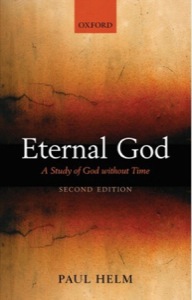 Paul Helm is, in my opinion, one of the most lucid thinkers on the topic of God and Time. His Eternal God
Helm points out early in his book that the issue of divine temporality/atemporality is “underdetermined” in Scripture (7). This means it’s one of those fun issues that lies most squarely in philosophy of religion.
And that is where Helm excels. Chapter-by-chapter he outlines a cohesive case for divine atemporality. Where Paul is most successful, I think, is in his rebuttals of arguments for temporality. For example, a well-known argument for temporality is that if God interacts in time, he must be temporal. Helm counters by pointing out that a precisely parallel argument could be constructed for God and space. Yet few Christian philosophers accept that God is spatial (49ff). While this doesn’t rebut the argument, it does point out something important: it doesn’t seem as though the conclusion (God is temporal) follows from the premise (God interacts in time) any more than it would if it were spatial (God is spatial/God interacts with space).
There are many different accounts of divine timelessness, from Brian Leftow’s spaceless timelessness (see his work Time and Eternity) to relative timelessness, and beyond. Helm takes the much less popular route and takes the tough pill of saying that God created spacetime as a static bloc. This allows Helm to easily deny many of the arguments for temporality which stem from a-theory or dynamic time. But it also raises many problems. Foremost among these (in my opinion) is human freedom. For, on the B-Theory of time (static theory), everything which will ever happen, has happened, and in a sense exists. As we go from moment to moment, we’re really just passing through a bloc of spacetime, we aren’t literally moving through a present. Presentness is a subjective phenomenon, given static/B-theory. It’s just our perspective. So where does human responsibility and freedom come in?
Helm here turns to compatibilism. He freely admits that timeless creation entails determinism (170). Thus, he denies that humans have free will in the libertarian sense. But this, he argues, does not undermine human responsibility. I don’t think I can do justice to the nuances of his argument, but the basic idea is that Helm argues that just because past actions/events determine our actions in the future, that doesn’t mean that we aren’t responsible for what we do. As I said, this is a really, really watered down version of his argument, but I think this is one of the weaker points of his work.
Why? Because the idea of responsibility simply does not make sense on determinism, particularly when it is theistic determinism. For consider the idea proposed here. God has created all of time and space as one bloc. Thus, everything I do or have ever done was created by God once he brought the universe into being. Literally, everything I did, I do because God created the universe such that I would do x. So how could it be that I am responsible for doing x, if I never chose to do x. I simply do x because I have to, I have “already” done it, on the static theory. If I could create a time travel device, I could travel forward in time and see myself doing x, and could not prevent it, because God created the world such that I would do x. But the core of responsibility is that I chose to do x. While we punish people for things they do by accident (vehicular manslaughter, for example, or accidentally breaking a window), these things still resulted from prior choices (playing baseball near breakable window/driving carelessly). I simply do not see how any account of responsibility could make sense unless someone can choose to do what they do.
There are several different positions about divine temporality/atemporality. Helm swallows the hard pill of going with the static theory of time to ground his divine atemporality. This, I believe, grants his account extreme philosophical plausibility. If God created the entire universe as a space-time continuum (I’ve always wanted to use that phrase from Star Trek!), then there’s no reason to suppose God would be affected by time. It’s ontologically outside of God, and all of his interactions already have taken place. While I’ve already pointed out some of the problems with this view, these problems are not with the coherence of the view but with the theological nature of it. Thus, I think it possible to say that Helm has adequately defended a position of divine eternity.
It would be impossible to cover everything of interest in such a comprehensive look at the topic of divine timelessness. Helm analyzes an extraordinary number of arguments in great detail. I cannot recommend the book more highly. Although I ultimately reject Helm’s second contention (B-theory), I believe his view is extremely coherent, and I can find little fault in it. Anyone interested in the issue of God’s relationship to time must read this book. It’s a book I think I shall re-read so that I can better grasp his arguments.
(Note: This review is based on the recently published second edition of this text, which includes several new chapters with much of interest, including a rebuttal of William Lane Craig’s arguments against timelessness. I recommend interested readers get their hands on the newer edition.)
SDG.
Source:
Paul Helm, Eternal God
——
The preceding post is the property of J.W. Wartick (apart from citations, which are the property of their respective owners) and should not be reproduced in part or in whole without the expressed consent of the author. All content on this site is the property of J.W. Wartick and is made available for individual and personal usage. If you cite from these documents, whether for personal or professional purposes, please give appropriate citation with both the name of the author (J.W. Wartick) and a link to the original URL. This blog is protected by Creative Commons licensing. By viewing any part of this site, you are agreeing to this usage policy.
Molinism and Timelessness–A Match Made in Heaven (No, really!)
It seems to me that there are few matches better made than the doctrine of Divine Timelessness and Molinism (aka Middle Knowledge). I think they truly are a match made in heaven, for God Himself possesses both of these attributes/properties.
First, some definitions. God is timeless, which means that “God exists, but exists at no time” (Leftow, xi). Middle knowledge is God’s knowledge of counterfactuals (simplifying the case to some extent here, see Thomas Flint’s discussion in Divine Providence: The Molinist Account). Jointly these propositions serve as explanations for a number of phenomena of Christianity.
First, human freedom and divine omniscience is a problem curtailed jointly by these doctrines. Timelessness solves any kind of potential incompatibility by simply denying that omniscience is foreknowledge. Instead, it is simply knowledge, known all at once in one “instant” in eternity (Leftow, 246ff). That which is not in time cannot determine things “ahead of time”.
Molinism, on the other hand, can also deny any incompatibility by asserting that the counterfactuals of God’s knowledge are not under the control of God. In other words, God has no control over whether or not Jenny will freely choose to go mountain climbing. God can control the circumstances in which Jenny is placed, and then bring it about that some other counterfactual would be true (i.e. Jenny does not go mountain climbing because she stays home to nurse her ailing goldfish). But this control over circumstances does not entail control over choices. The choices remain free (Flint, 11ff).
Now, one objection to Molinism is that because God decides which circumstances in which to place Jenny before the creation of the world, he still is determining what she will do because he picks from the circumstances. But this is not quite the case. Jenny’s actions are not determined, but some of the circumstances in which she is placed are. This doesn’t preclude her free choice, however, for God only controls the situations Jenny will encounter, while her free choices remain outside of His control.
Timelessness is sometimes denied due to a perception that a timeless God could not have meaningful interactions with His creatures. This does not seem to be the case however, once one analyzes exactly what timelessness entails. Leftow argues convincingly that timelessness can be thought of as, in some sense, a parallel “time” during which all things happen at once, though not simultaneously. The relationship of successive temporal instants can be thought of in some ways as similar to logical priority. If a timeless God has middle knowledge, furthermore, then God can indeed have “real” interactions with creatures, because He, in eternity, all-at-once performs the creative, providential act. This includes the situations in which His creatures will be placed.
Thus, by His creative act, He sets the situations in which He will interact with His creatures, and this action is a true interaction because He factors in their free choices and takes such things into account. Furthermore, the objection that God’s interactions are diminished because they happen “before” the interaction occurs is a specious claim, for if God is timeless, then none of His actions occur “at a time” other than in Eternity.
Therefore, it seems to me that jointly, a molinist account and a timeless God make quite a lot of sense. This is not to say that there are no other accounts of God that make sense, but this is part of the interest of philosophy of religion, after all, particularly among Christians: the dialogue, the interaction with the Biblical texts which perhaps speak to each issue, and the different conclusions which can be drawn. These differing conclusions do not take away from or destroy the validity of our faith, rather, they ensure that we delve ever deeper, striving for an understanding of the divine Godhead.
Sources:
Leftow, Brian. Time and Eternity. Cornell University Press. 2009 (reprint).
Thomas Flint, Divine Providence: A Molinist Account. Cornell University Press. 2006.
——
The preceding post is the property of J.W. Wartick (apart from citations, which are the property of their respective owners) and should not be reproduced in part or in whole without the expressed consent of the author.

 J.W. Wartick - Reconstructing Faith