Toni Allen
Women, Emotions, and Apologetics: A Response to “Apologetically Blonde”
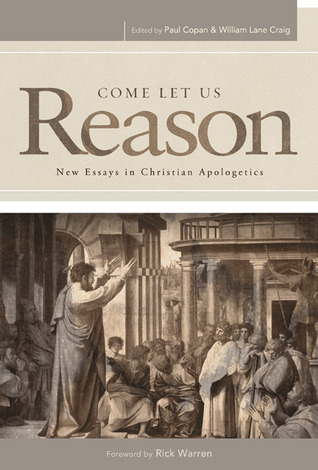 I recently came upon Come Let Us Reason: New Essays in Christian Apologetics, a book I’d been meaning to read for some time. I decided to take a break from the unpacking I was doing to do a little browsing as my son crawled around on my lap. I turned to the index to discover an article entitled: “Apologetically Blonde: The Struggle of Women to Defend Their Faith and What They Should Do about It” by Toni Allen (full citation below- all references to this text). As I browsed the article I knew I needed to write a response, because–with apologies to Toni Allen–I felt much of it was misguided.
Emotional Reasoning
The first critique I have of Allen’s article is the continued references to emotional reasoning and its apparent lack of justification for knowledge. Writes Allen:
…I find that women often depend on their experience and emotional connection with God as the primary justification for the beliefs they hold. In other words, women tend to perceive meaningful experiences and their corresponding emotions to be validation that what they believe is accurate. (40)
She goes on to say:
Yes, the gospel is for the whole person, and this includes existential reasons (including personal experience as well as our deepest emotions and longings)… However, a well-rounded defense of the gospel will include rational reasons and evidences. (40)
Throughout this section, Allen affirms the reality of personal experience and emotions as a basis for believing, but continually asserts that rational reasons are required in the public defense of Christianity. It is difficult to pin down exactly what Allen’s critique is in this section, because the wording is such that it could allow any number of exceptions. Words like “typically,” “often,” “includes,” and the like allow for broad interpretations of her meaning. But it does seem like the whole tone of the article as a whole is that emotions are somehow inadequate as a defense of the faith or that they are opposite or opposed to reason. This latter point is particularly problematic, and it seems like it is closest to the way Allen is leaning throughout the essay.
The reason I say this is because emotions are set up not alongside reasons and rationality, but rather as something separate from them. But this is itself mistaken. As any number of authors have pointed out, emotions themselves are part of the reasoning process and indeed can be integral or even essential to rationality. For example, Daniel Westberg argues in Renewing Moral Theology, a Thomistic approach to ethical theology, that emotions are a central part of the process of reasoning and judgment (see especially 40-43; see also my review of the book here). If Westberg is right, then for Thomists–a formidable bunch of philosophers indeed–emotions are a central aspect of reasoning; not something separate from and possibly antithetical to it. But even if he’s wrong, his case is fairly persuasive that emotions should not be dismissed from the reasoning process, and philosophers of several other flavors have agreed.
Thus, one of the major points of Allen’s assessment is itself mistaken because it operates from a false understanding of the relationship between emotions and reasoning.
As an aside, Allen’s assertion that “we must realize that appeals to religious experience typically do not function as a decisive apologetic” (41) is shifty in its wording (“typically”) while also being mistaken, as philosophers like Richard Swinburne, Caroline Franks Davis, Keith Yandell, and the like have made the argument from religious experience a powerful apologetic tool. Moreover, people like Alvin Plantinga have argued (persuasively, in my opinion), that we can have a rational basis for belief in God through properly basic belief and religious experience.
Can Women Do Apologetics?
Alongside Allen’s constant stream of arguing that women think more emotionally, there is the question of what exactly that is supposed to mean. Again and again we are treated to quotes like the one shared above and those below:
“[W]omen are naturally more cognizant of their emotions… depending on them as the primary validation for our beliefs directly affects our judgment.” (42)
“[I]n mentoring many women over the years, I have found it very common that rather than evaluate an idea on its merits, they are instead more reluctant to adopt an idea if it actuates negative feelings, or more eager to accept it because of positive ones.” (42)
“As women, we should welcome the challenge of defending our faith, even if this pushes us out of our comfort zone.” (45)
Lines like these are found throughout the essay with little supporting evidence other than personal experience–itself a great irony given the previous analysis. But apart from this, it fails to take into account that men and women operate on bell curves in regard to emotional–and other–reasoning skills and so making broad statements like these fails to reflect the reality of the spectrum of capacities for either gender.
Women, according to Allen, also are hamstrung in their attempts to do apologetics through “their natural inclination to avoid conflict” (37). But again, what does this say about men and women essentially (in the philosophical sense)? Do men who have an inclination to avoid conflict somehow become women or more feminine because of this? If so, in what fashion? And what biblical basis do we have for these kinds of assertions?
These and other issues betray a primary underlying presupposition of Allen’s article: gender essentialism. This is a deep topic that I cannot explore thoroughly here, but basically what Allen has–consciously or not–bought into is the notion that men and women operate in largely different spheres with clearly defined cognitive and other barriers between them. That’s why lines like “Women are naturally more cognizant of their emotions…” manage to sneak into the text. But these lines find little argumentative support and again fail to take into account the aforementioned reality that men and women do not operate in entirely different planes of existence–or even emotions. Although Allen generally included lines that allowed for some wiggle room, the overall message was clearly based on this presupposed and unfounded adherence to gender essentialism.
Apologetically Blonde?
A final issue I wanted to mention with the article is the title itself. Although “blonde jokes” have become part of our culture, I think that we as Christians are called to a higher standard. “Blonde” jokes select a specific portion of the population for the sake of ridicule. Though these are often “in good fun” the question is whether such jokes are taken that way and what kind of impact that might have on the people who are, well, blonde. I am not, but it’s easy to see how the use of “blonde” in the title as a synonym for “challenged” could be taken poorly and works against the gentleness and respect we need to display as Christian case-makers.
Links
Be sure to check out the page for this site on Facebook and Twitter for discussion of posts, links to other pages of interest, random talk about theology/philosophy/apologetics/movies and more!
Source
Toni Allen, “Apologetically Blonde: The Struggle of Women to Defend Their Faith and What They Should Do about It” in Come Let Us Reason: New Essays in Christian Apologetics eds. Paul Copan & William Lane Craig (Nashville, TN: B&H Publishing Group, 2012).
SDG.
——
The preceding post is the property of J.W. Wartick (apart from quotations, which are the property of their respective owners, and works of art as credited; images are often freely available to the public and J.W. Wartick makes no claims of owning rights to the images unless he makes that explicit) and should not be reproduced in part or in whole without the expressed consent of the author. All content on this site is the property of J.W. Wartick and is made available for individual and personal usage. If you cite from these documents, whether for personal or professional purposes, please give appropriate citation with both the name of the author (J.W. Wartick) and a link to the original URL. If you’d like to repost a post, you may do so, provided you show less than half of the original post on your own site and link to the original post for the rest. You must also appropriately cite the post as noted above. This blog is protected by Creative Commons licensing. By viewing any part of this site, you are agreeing to this usage policy.

 J.W. Wartick - Reconstructing Faith