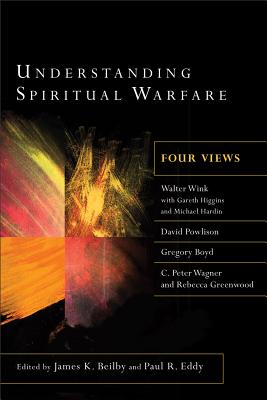
Understanding Spiritual Warfare Four Views
Sunday Quote!- Spiritual Warfare and Mapping the Land?
 Every Sunday, I will share a quote from something I’ve been reading. The hope is for you, dear reader, to share your thoughts on the quote and related issues and perhaps pick up some reading material along the way!
Spiritual Warfare and Mapping the Land?
I recently read through Understanding Spiritual Warfare: Four Views
Spiritual mapping is the practice of identifying the spiritual conditions at work in a given community, city, or nation. By gathering objective information (including key historical facts… locations of bloodshed, idolatrous practices, [etc…]) and combining it with spiritual impressions (prophecy, revelation, words of knowledge, dreams, and visions), believers can prayerfully combine all of this information and draw a map that identifies the open doors between the spiritual world and the material world (182-183, cited below).
Now I admit that I come from a background in which spiritual warfare was little (if at all) discussed, but this does seem a little bit more than we can glean from the biblical image of spiritual warfare. Where, for example, are we instructed to try to use dreams and revelation in order to find “open doors” of the spiritual world? Where are we instructed that there might be doors for the spiritual world into our own that are identifiable? I think some aspects of this notion might be helpful for witnessing and the like–after all, knowing the landscape in this fashion would be helpful for identifying areas of conflict in a community and offering Christlike compassion in those areas–but I hesitate to think that the way they can be applied is in this fashion.
What are your thoughts on this? What do you think of spiritual warfare?
Again, I highly recommend this book with its very wide range of diverse views presented on the topic in order to get an introduction.
Links
Be sure to check out the page for this site on Facebook and Twitter for discussion of posts, links to other pages of interest, random talk about theology/philosophy/apologetics/movies and more!
Microview: Understanding Spiritual Warfare: Four Views– I briefly review this highly interesting book on different views of spiritual warfare.
Sunday Quote– If you want to read more Sunday Quotes and join the discussion, check them out! (Scroll down for more)
Source
C. Peter Wagner and Rebecca Greenwood, “The Strategic-Level Deliverance Model” in James Beilby and Paul Rhodes Eddy, eds., Understanding Spiritual Warfare: Four Views
SDG.
Microview: “Understanding Spiritual Warfare: Four Views” edited by James Beilby and Paul Rhodes Eddy
Understanding Spiritual Warfare: Four Views
The work starts with an introduction that does a great job introducing questions of primary importance in discussions of spiritual warfare. Walter Wink’s (alongside Gareth Higgins and Michael Hardin) view is presented first and might best be summarized as: Satan is equal to (and reducible to) human institutions of evil and suffering; he is neither personal nor is he the enemy of God but rather God’s servant–showing people their evil. We fight Satan by fighting institutionalized evil.
David Powlison’s “Classical” view is that spiritual warfare is essentially living like Christ and fighting temptation and sin. Satan is a real person and tempts us. Evils are combated through prayer and a call to repentance. Gregory Boyd’s “Ground-Level Deliverance model” argues for both a Christlike life but also for active warfare against demonic powers and Satan (who are personal and ontologically extant) on an individual level. C. Peter Wagner and Rebecca Greenwood’s “Strategic Level Deliverance model” is committed to finding and rooting out demonic activity in local and even national levels, including making “spiritual maps” to find where areas of demonic activity might be found and trying to identify the specific demons behind various activity.
From the above, it may seem like these views are radically diverse. You’d be correct to think so. James Beilby and Paul Rhodes Eddy did a fantastic job putting together this volume with such diverse views. Questions of orthodoxy at times arise (particularly in regard to Wink’s perspective), but this makes it clear how much divergence there is related to this specific issue. The responses to the different views are each insightful and provide more material of interest to pursue.
It’s rare that I’ve had a book be this interesting and engaging throughout. I highly recommend this volume for anyone with even a remote interest in the topic of spiritual warfare.
The Good
+Excellent diversity of views never feels like you’re reading rehashed material
+Clearly defines several key terms
+Superb introductory material prepares readers to understand some key questions on issue
+Author responses insightful and given just enough space to make serious points
+Cool cover
+Excellent indices
The Bad
-Could have given even more space to responses
-Not enough interaction on exegetical questions
-No rejoinders for authors to responses
Links
Be sure to check out the page for this site on Facebook and Twitter for discussion of posts, links to other pages of interest, random talk about theology/philosophy/apologetics/movies and more!
Book Reviews– There are plenty more book reviews to read! Read like crazy! (Scroll down for more, and click at bottom for even more!)
Source
James Beilby and Paul Rhodes Eddy, eds., Understanding Spiritual Warfare: Four Views

 J.W. Wartick - Reconstructing Faith