Why I Left the LCMS
Because of Concordia and Seminex

The news broke about a week ago (writing in February 2024). The Ann Arbor campus of Concordia University, also known as Concordia University – Ann Arbor (hereafter CUAA) is in dire financial straits. The University has been special through my life, as multiple family members including myself eventually attended and graduated from CUAA. However, I have mixed feelings about the place itself, especially some specific parts of the theology taught and interactions with people there. I’ve written some about this in posts elsewhere.
At the same time as I was thinking about CUAA and the complex feelings I have about it, Seminex hit its 50th anniversary. Seminex was shorthand for Seminary in Exile, a schism in the LCMS specifically centered at Concordia Seminary in St. Louis that led to several professors and hundreds of students leaving the Seminary. A complete history of Seminex is beyond the scope of that post. Briefly, the rise of a militantly conservative wing in the LCMS led to calls of heresy against multiple professors at Concordia Seminary in St. Louis due to their teaching mainstream tools for biblical interpretation. Rather than filing formal charges, these accusations essentially acted as a kind of blackballing and besmirching of the names of those professors deemed unorthodox by this radical wing. It ultimately led to the majority of professors and students walking out to form their own seminary, which ultimately merged with other Lutheran groups, including what would be come the ELCA.
As I prepared to write this article, I sifted through hundreds of photographs I took from my time on campus. It was like revisiting an old friend, in some ways literally. But it was also painful. A lot of those old friends aren’t friends anymore. Some of them have messaged me to tell me I’m going to hell. Others set people I didn’t even know to do the same. Still others disappeared without a trace, turning into nothing but ghosts from the past, living their lives as if I don’t exist.

I also revisited some of the works I’ve read about Seminex. Power, Politics, and the Missouri Synod by James C. Burkee tells the story of the conservative takeover of the LCMS. Like other denominations (eg. the Southern Baptist Convention), this takeover, when examined in the light of history, was less about the theological positions held by those involved than it was about power politics. Burkee himself taught at Concordia University Wisconsin, and tells the story from the perspective of a concerned insider, not an anti-LCMS outsider. It’s incredibly detailed, well-documented, and frankly alarming on almost every level.
But the book that has resonated most right now is No Room in the Brotherhood by Frederick W. Danker. Danker was one of the professors who left to be part of Seminex, and his telling of the way Seminex played out is both insightful and cutting in its analysis. His conclusion states explicitly that the various major names on either side of the conflict were not heroes or villains. Instead, the culprit was the “deep-seated conviction of the Missouri Synod that it was completely right. Any actions undertaken in concert with that conviction were therefore also right and it [the LCMS] was willing to perpetuate its institutional identity at any cost” (352).
The reason this resonated, and the reason my mind connected these two events–the possible closure of CUAA and Seminex’s 50th–is because the reaction and impetus seem so intertwined. I can’t tell you how many posts I’ve seen in the last week about how CUAA is the “city on a hill.” The language Jesus uses surrounding the city on a hill is that of letting Christians’ light so shine so that the good deeds of those will lead others to God. As Danker wrote, there’s this deep-seated conviction that the Missouri Synod (in this case, CUAA) is “completely right.” But it wasn’t completely right for so many.
It wasn’t completely right for gay people on campus who were mocked for who they were. It wasn’t a city on a hill for a woman who wanted to follow God’s call to be a pastor but was told she was disobeying God for wanting to serve. It wasn’t completely right for a Baptist friend who was told their view of baptism meant they were facing hellfire. It wasn’t a city on a hill when I witnessed pre-seminary men make fun of women, Jews, and Muslims. It wasn’t completely right for anyone perceived as “liberal.”
And here’s the hell of it: CUAA felt completely right so long as you were “in.” So long as you were LCMS, thought men should be in charge, and toed the party line, it felt like a city on a hill. I know, because I absolutely felt that way while I was there for a lot of the time I was there. Being an insider wasn’t just great, it was also, often, blissful ignorance that anyone was outside. After all, if we were experiencing this lovely joyful celebration of God, if we could really feel God’s working and presence in a chapel service or a late night call to prayer around a bonfire, how could it be anything but perfection? And how could anyone not want the same thing? And, importantly, how could they not want it in the same way?
That’s what makes this all feel so complex and, to use a sort of silly term, “yucky” about the whole thing. Because the second I was on the outside, I saw the willingness of people on the inside to perpetuate that identity “at any cost” as Danker wrote. A friend sicced an unknown seminarian on me to tell me that both I and my wife would be going to hell for thinking women could preach. Other friends disappeared, whether from the age-old Facebook friends list or entirely out of our lives. People I thought would be by my side throughout my life are no more than fragments of memory now. There was “no room in the brotherhood” for a man like me. And, like those attacked during the purge of the LCMS 50 years ago, I felt firsthand the equivocation between the perfection of the LCMS and the inerrancy they ascribe to Scripture. Questioning the LCMS view on anything wasn’t just questioning the LCMS, it was questioning Scripture and, by proxy, God!
So now, we’re here, and CUAA feels like this kind of epic thing in my life; a crucible through which I passed. Yes, there were good times–great times. That’s what makes it all so very hard. Because what was there could have been amazing. But if you stepped a toe out of line, God help you. The hashtag #becauseofconcordia is being used by people working to save CUAA. But I know that a few dollars–even the several million dollars that the campus needs to be in the black–aren’t enough to save CUAA. Only God can save CUAA and the LCMS. From itself.
Maranatha.
Links
Formerly Lutheran Church – Missouri Synod (LCMS) or Wisconsin Synod (WELS)– A Facebook group I’ve created for people who are former members of either of these church bodies to share stories, support each other, and try to bring change. Note: Anything you post on the internet has the potential to be public and shared anywhere, so if you join and post, be aware of that.
Leaving the LCMS/WELS– Not sure about whether to leave or thinking about leaving? Do you want to others who are thinking along the same lines? I created a group for those who are contemplating leaving these denominations, as well.
Why I left the Lutheran Church – Missouri Synod Links Hub– Want to follow the whole series? Here’s a hub post with links to all the posts as well as related topics.
Be sure to check out the page for this site on Facebook and Twitter for discussion of posts, links to other pages of interest, random talk about theology/philosophy/apologetics/movies and more!
SDG.
——
The preceding post is the property of J.W. Wartick (apart from quotations, which are the property of their respective owners, and works of art as credited; images are often freely available to the public and J.W. Wartick makes no claims of owning rights to the images unless he makes that explicit) and should not be reproduced in part or in whole without the expressed consent of the author. All content on this site is the property of J.W. Wartick and is made available for individual and personal usage. If you cite from these documents, whether for personal or professional purposes, please give appropriate citation with both the name of the author (J.W. Wartick) and a link to the original URL. If you’d like to repost a post, you may do so, provided you show less than half of the original post on your own site and link to the original post for the rest. You must also appropriately cite the post as noted above. This blog is protected by Creative Commons licensing. By viewing any part of this site, you are agreeing to this usage policy.
Why I left the Lutheran Church – Missouri Synod: Still Faithful

Still Faithful
It has taken me a long time to work up to writing this post. It’s actually been more than a year since I last made a post in this series, in part because of my own processing of the events. However, I’ve been asked time and again by many who have left the LCMS or who have left evangelicalism or other restrictive Christian groups to tell about why I am still a Christian. Why did I stay, despite the abuse, despite so many things I saw as wrong, despite everything? And, an oft-unspoken part of the question that I’ve heard is “How?” How is it, that after all these observations, after coming to a place in which I found much of what I was taught and thought was true is totally wrong, that I continue to believe anything?
Faithful?
Part of my hesitancy to write this post is because I know from bitter experience how many might read it and scoff. “‘Still faithful,’ he says? He’s a heretic/wolf in sheep’s clothing/demon-possessed!” I have heard each of these from various people, including people in person. And, while it’s easy to say to ignore those people who dress up their power trip in theological garb, it is so much easier said than done. When you had a true fear of literal hellfire for many years, it’s very harmful to be confronted by people who use that fear to try to silence and oppress. So yes, I know the scoffers are out there, and that I’ll hear or see some of those awful comments again. But I still think it’s important to write on this because there are so many out there who are wondering if it is okay to still be faithful when so much harm comes from within. I write this for you–and for me.
I Still Believe… what?
One thing that is easy to trip up on as people are deconstructing and/or reconstructing faith is the constant refrain of questions pushing to get at exactly what we believe. I get that a lot from more conservative Christians and especially apologists, who are often, unfortunately, seeking to argue about whatever beliefs I espouse instead of engage with me honestly. I know this is true. I have my degree in Apologetics. Literally. I did this same thing from the other side, and I repent of that. Engaging online is often helpful because it opens you up to others who might be on the same path, but it also invites in those who simply out to argue with everyone. And so often, the way people are taught about Christianity is a “my way or the highway” mentality such that any divergent view isn’t just seen as wrong, but actually excludes the person who holds that view from the Christian community.
Suppose I told you that I believe trans people are worthy and loved by God not in spite of but for who they are. If your visceral reaction to that is to immediately turn to argument, then that is that same upbringing or that same background of beliefs I’m referring to. You, the one reading this, are using that belief I hold in order to “other” me. I am now “less than” on your view.
It is this black and white, either/or thinking that I have broken away from. It has taken more than a decade, and it has taken so much pain and spiritual agony and angst, but I have finally broken beyond the dichotomy in my thinking. None of this means that I don’t think that reality has things that are true or false, or that some theological positions are correct, while others are not. No, it’s the inherent urge to repress/correct/change those who disagree with me that I’ve broken out of. And, more importantly, it’s the urge in myself to stand upon certainty in all things that I am still in the process of breaking away. It’s okay to say “I don’t know” as a response to theological questions. It really is. And maybe you are fairly sure about some things. That’s okay, too. What I’m talking about breaking away from is that inherent tension, fear, and othering of anyone who disagrees or any belief that is different. Some things I do still hold fairly strongly to. Others, not so much. There are so many things I hold now that while I may be able to answer “I believe this about that,” I am also comfortable saying, “but I’m not really sure about it.”
All of this is to say I’m not as interested in the “nail down the answers to theological questions A, B, C, ….Z” approach anymore. Sure, there are many theological positions I still hold, and may hold firmly. But to me that’s so much less interesting than God in Christ.
False Gods
Recently, I went to a retreat for a bunch of progressive Christians or formerly-Christian people still interested in theology. It was incredibly life-giving. It was filled with praise. It was filled with questions. It was uncomfortable at times.
One song that I heard live was “Some Gods Deserve Atheists” by Derek Webb. I’d never heard it before. He prefaced his singing by saying we should constantly be trying to kill our gods. Any god we could kill simply by thinking hard enough about it would deserve such a death. And some gods deserve atheists–they aren’t real; they’re formed of hate or fear. For me, a god who created people for the express purpose of condemning them to an eternal hellfire is one such god. Such a god deserves atheists; that god is not worth our time or worship. That’s a god of “othering” when the God I believe in, the God I learned about in Christ, is a God of Love, a God who is literally described as love itself on the highest possible level. God is love; and any God who doesn’t reflect that deserves atheists.
Does this mean I’m putting myself in judgement of God? Well, only if that god is small enough to be able to be judged by me. Any god that can be so contained into a box that I can sit back and disprove that god in my head, or by that god’s fruits on Earth, is no god.
Still Faithful
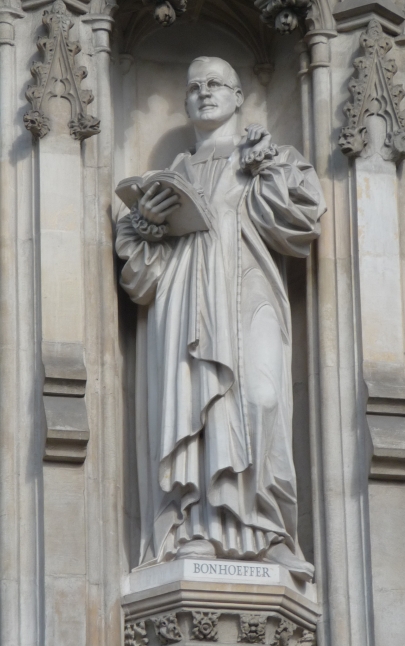
One thing that has shocked me, and that I am by turns disturbed and comforted by, is that a big part of why I still believe is that I still tend to think a lot of Lutheran answers to big questions are correct. Dietrich Bonhoeffer was a Christian theologian in Nazi Germany who was executed, in part, for his participation in the Confessing Church, a tiny minority of Christians in Germany who opposed the Nazis even as the overwhelming majority of Christians capitulated to or joyfully joined hands with them. Before he was murdered, some of his writings feature him speaking of “religionless Christianity.” Misinterpretations of his theology here have him lionized by various movements. But at the core of his thought wasn’t the overthrow of churches–that wouldn’t have made sense for a man whose theology included seeing sacraments such as Baptism as integral to Christian faith. The core, rather, is the stripping away of the structures that prevent Christians from living wholly into Christ or mirroring Christ to others. Bonhoeffer wrote of the maximal importance of living for the people around us and for the world. One helpful summary of religionless Christianity is found in Tom Greggs’s work, Theology Against Religion. Therein, he writes in part that religionless Christianity is “fiercely anidolatrous”–its doctrine of God seeks to constantly fight against the human tendency to create God in our own image or a God who defends our preconceptions; it is “resolutely unwilling to engage in articulating binaries“–it doesn’t seek to “other” but to unite; it is “not differentiating between sacred and secular spaces“–our lives are lives reflecting Christ in whatever spheres we enter; and it is “seeking to meet people in the fullness of their lives” (emphasis his, 218).
All of this is an extended way to get at some things I want to highlight. First, I think that the faith I hold now welcomes others in radical ways. Second, it remains tied inherently to streams of thought in Christian tradition, often reaching back to the earliest Christian theologians like Origen or Gregory of Nyssa. Third, it remains a faith radically against Christianity empowered by structures of state or hierarchies of power. That is, my faith stands against any use of Christianity for oppression. And yes, the church has so much to answer for here.
Finally, I must turn to a few concrete beliefs and affirmations because without them it doesn’t make sense of the question “How do I remain Christian” in a meaningful way.
The evils of the world, merely contemplating them, left me broken for a time. School shootings that could have easily been prevented if humans would have acted also call into question why God wouldn’t act. I mean, if God could really drop a stone on anyone at any point, why wouldn’t God do so–just once–in order to stop a school shooting in progress even as humans failed to do so? And the tired apologetic answer I used to rely on–that we don’t know how many such tragedies God has prevented by whatever means–just doesn’t work for me anymore. If God really could just intervene, why don’t we just see it?
I know all the answers to this question. Like, really. I studied theodicy so much while getting my degree. Molinism, open theism, process thought, free will defense, etc. The answers range from God doesn’t intervene because God has greater goods planned (free will, or whatever) to God can’t actually prevent such evil, so that’s why God doesn’t. And I have a confession: none of them are really satisfactory to me. Why does God allow evil? I don’t know. And the more I suffered over this question, the more I fell into holes of anxiety looking at the latest news of a massive shooting or some other horrible evil, the more I realized that I just don’t know, but I feel like I know other things that make me live in tension on this question. For example, I feel I know Jesus Christ is real, and that God is love. And since those feel real to me, and I believe them, I live in tension on the question of evil. If I were a really good Lutheran, I’d fully embrace an appeal to mystery here. And that’s kind of what I’m doing, in a way. But it’s deeper; I just don’t know that we can know. Whatever answer is given here is going to be unsatisfactory in some way. If it’s because God can’t prevent evil; to me that seems to make God smaller in ways I don’t understand. If it’s because God has some greater good in mind, it seems to underplay the real horrible suffering of people now. If it’s because God can’t prevent evil due to allowing for free will, it seems that it would be worth suspending free will–even entirely–in order to prevent so much suffering. And so I just… I don’t know. And I’m learning to be honest with myself in holding to that uncertainty.
Other theological questions have led to rethinking of positions. One such question was that of the fate of the lost. Why would a God who claims to be loving form people who that same God would then sentence to suffer for eternity? For a time, I held to conditional immortality, also known as annihilationism. That view, which I still think is better attested Scripturally than any kind of eternal conscious torment view, holds that those who don’t believe in Christ for whatever reason are ultimately annihilated or destroyed by God. Immortality, that is, is conditional upon faith in Christ. But I continued to struggle with this, whether it’s the reality that so many never get a chance to even hear about Christ, or that so many hear about Christ only through systems of colonialism and oppression, it didn’t make sense to me. Additionally, many verse in Scripture suggest that God wants all to be saved. So why not do so? More than that, long Christian tradition reaching back to the earliest teachers of Christianity affirms universal salvation. So, a short answer to the question of the lost and how I stay Christian regarding that question is that I think God will really reconcile the whole world to Godself, so that God really will be all in all (1 Cor. 15:28).
Ah! One might immediately challenge that with other scriptural verses that strongly suggest that not all are saved. And to that, another answer I have come to is that the Bible is polyvocal. It doesn’t speak with a united front on these topics. And, while that is annoying and has caused confusion and so much pain, it also is somewhat freeing and beautiful. God didn’t pigeonhole the authors of Scripture into losing their opinions and voices. It’s far more complex than that.
There are so many more, but these are some of the big questions I personally faced that I hadn’t addressed yet in the series, and some of the answers I continue to settle upon. I offer them not to try to convince you, but to try to answer the question of how I remain Christian. I remain Christian, in part, because I reconstructed my faith, and I came to answers that I think make more sense of reality than the answers I had before.
Concluding Thoughts
I have so much more to say. I wish that for those readers who ask me the question “why/how do you stay Christian” who are genuinely wondering about it, that I could sit and have brunch with you and talk about it for hours. I mean, isn’t that question so far reaching, so fascinating? And I look back over what I wrote and it all seems so small, and so inadequate to even begin the conversation.
For me, Jesus Christ is so fascinating, so loving, and so central still, that it compels me to come back time and again. When I see the awfulness that is so much of Christianity; the latest report of a Christian pastor using a position of power to assault or degrade others, for example, I find myself fleeing back to Christ. And I don’t mean a trite “that’s not real Christianity” type answer to the evils Christians perpetrate. The links of Christianity in America and power are too interwoven to pretend that real Christians don’t bring about much harm. Rather, what I mean is, I flee back to a God who came into our world, who suffered, and who rose, and who intentionally brought so much powerful goodness to the world that our lives, when viewed from eternity, will all be for good.
Links
Formerly Lutheran Church – Missouri Synod (LCMS) or Wisconsin Synod (WELS)– A Facebook group I’ve created for people who are former members of either of these church bodies to share stories, support each other, and try to bring change. Note: Anything you post on the internet has the potential to be public and shared anywhere, so if you join and post, be aware of that.
Leaving the LCMS/WELS– Not sure about whether to leave or thinking about leaving? Do you want to others who are thinking along the same lines? I created a group for those who are contemplating leaving these denominations, as well.
Why I left the Lutheran Church – Missouri Synod Links Hub– Want to follow the whole series? Here’s a hub post with links to all the posts as well as related topics.
Be sure to check out the page for this site on Facebook and Twitter for discussion of posts, links to other pages of interest, random talk about theology/philosophy/apologetics/movies and more!
SDG.
——
The preceding post is the property of J.W. Wartick (apart from quotations, which are the property of their respective owners, and works of art as credited; images are often freely available to the public and J.W. Wartick makes no claims of owning rights to the images unless he makes that explicit) and should not be reproduced in part or in whole without the expressed consent of the author. All content on this site is the property of J.W. Wartick and is made available for individual and personal usage. If you cite from these documents, whether for personal or professional purposes, please give appropriate citation with both the name of the author (J.W. Wartick) and a link to the original URL. If you’d like to repost a post, you may do so, provided you show less than half of the original post on your own site and link to the original post for the rest. You must also appropriately cite the post as noted above. This blog is protected by Creative Commons licensing. By viewing any part of this site, you are agreeing to this usage policy.
Why I left the Lutheran Church – Missouri Synod: Points of Fracture: “On the Other Side”

The reasons I left the Lutheran Church – Missouri Synod were complex. Whether it was the science I was taught as a child not aligning with reality or the misogynistic and racist actions of pastors and those training to be the same, or any of a number of other issues I had, these all were contributing factors. Now, I am going to spend some time on perhaps the biggest reason I am no longer part of the LCMS, which is their views on women in the church and home. This is a deeply personal subject for me, and I have numerous personal stories related to it. Names and other details may be modified for privacy. Links to the series can be found here.
Points of Fracture: “On the Other Side”
I’ve written extensively about my moving away from various doctrines the LCMS deems especially important, even while still maintaining my commitment to core Lutheran doctrines (such as the Sacraments). What I didn’t realize as I shifted my doctrinal positions was the amount of pushback on a personal level that I would receive. I knew I’d have some arguments about the facts of the matter(s), but I didn’t realize how deeply, intensely personal the attacks would get. I should note I’m not sharing many because trying to remove identifiers would be too difficult. Instead, in this post I’m just sharing a broad view with some examples of what it felt to be on the “other side” of some of these issues, and why it spurred me to leave the LCMS.
Conflicts while Leaving
Whether it was for Christianity and science, women in the ministry, or several other topics, I experienced multiple, personal attacks on myself or those around me due to my differing in viewpoints from the LCMS. When it came to science and Christianity, the oft-repeated phrase was that I’d compromised with “man’s wisdom” instead of following “God’s word.” I trusted scientists to teach me about the world instead of the Genesis Creation accounts. Never mind that the creation accounts do nothing to set a date for creation, nor do they at any point hint that the purpose was to help date the earth, etc. Instead, the refrain was that I’d abandoned Scripture in folly. My turn from young earth creationism led to me being denied communion at different points, despite churches not listing this as a reason to do so. (See more of my discussion of close/closed communion here.) Several different pastors and LCMS resources I looked up suggested a denial of young earth creationism was capitulating to “the world” and led directly to a denial of the Bible and therefore of Christ Himself.
Even worse were the many experiences related to my change of position on women pastors. For one, there’s the knee jerk reaction many LCMS leaders and even laity have when they hear about me being married to a woman pastor. I have experienced ostracization for this position in the form of having conversations immediately end, having them devolve into arguments, ghosting, etc. More concretely, as my view on this topic shifted, I was warned there would be financial consequences. It was alleged I would need to pay back scholarships because I didn’t end up as an LCMS pastor or teacher after all. I want to state this plainly: this did not happen, nor did any official in any capacity suggest it would. However, I found this threat especially astonishing given that it came from a church and people who talk about how financial considerations cannot come between one’s faith and their profession of that faith. Those same people then turned around and threatened me with financial consequences if I didn’t change my belief. The suggestion was insulting, because it implied my beliefs could be bought. It was also nonsensical, because belief formation doesn’t happen that way.
Other attempts to get me to change my beliefs were similarly misplaced. Very few LCMS individuals were willing to engage me on the level of actually going to scripture. One exception was an LCMS pastor who genuinely wanted to know why I’d changed my views. When we talked about things like Junia being an apostle in Romans 16:7, he acknowledged that was a serious problem for his position. Other verses I raised were similarly given consideration, and he acknowledged it was more complex than he’d thought. Much more common, however, was a blithe dismissal of any Scriptural case and even a total ignoring of the reasons why women were excluded from the ministry in the LCMS. Instead, people refused to go to church with me, made false claims about my then-fiancée, used the pulpit to decry women in leadership, made insulting remarks about my lack of masculinity, made insulting remarks to my then-fiancée about church history and women, and more.
These supposed arguments are much more aligned with spiritually abusive practices than they are with reality. For example, assuming you, dear reader, are a Christian, suppose someone close to you took a dearly held belief of yours (let’s say your belief about whether babies should be baptized) and said that they would refuse to visit your church or refuse to go to church with you until you changed your belief about baptism. Would you think that’s a good reason? And if you did, would you really be able to change this deeply held belief just because of someone not going to church with you? Would you be able to change that belief just because you might have to pay some extra money for a debt? What if that person insulted you a bunch–would that change your belief?
This is the kind of argument raised against women pastors in my experience from within the LCMS, including from pastors.
Hate the sin, love the sinner
I was taught this concept and felt it was pretty much correct, especially in relation to some of the more controversial topics. What I’ve found time and again, however, is that hatred of the sin often turns into hatred of the sinner. It’s easy to say a trite phrase like this, but I’ve observed that it leads to a “holier than thou” attitude in which the one who is “loving the sinner” still has a lower view of that sinner. I experienced this myself within the LCMS when we talked about LGBTQ+ issues, and I know personal stories from others about the same thing. It’s one thing to say you “love the sinner”; but when that “sinner” experiences versions of “love” that include things like being denied communion, being called a sinner, being told they need to change their life/lifestyle, and other related things, the experience feels much less like love than it does like hate. For my own part, I had an LCMS pastor say that due to my embrace of women being pastors, they were “hating the sin” of women being pastors and “loving the sinner,” me. Even this somewhat mild comment felt like a stern rebuke from the mouth of a pastor, and certainly did not reflect the alleged “love” I was being given.
“The Holy Spirit Shut Your Mouth”
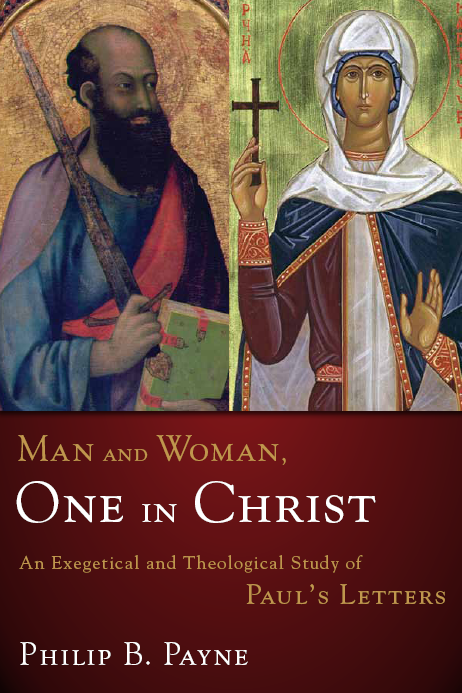
One of the most angry attacks I received was completely out of the blue. I began receiving messages on Facebook from someone who had attended the same university I had. I’d never spoken with them. The man was an LCMS pastor by this point, having graduated ahead of me by some years. He began by asking me about why I believed women could be pastors. It quickly became apparent that he was not at all interested in my responses. He quickly became aggressive, saying my arguments were obviously mistaken and wrong. When I directed him to further reading, suggesting he read Man and Woman, One in Christ to find deeper answers to some of his questions, he claimed to have read the book already. A few exchanges later, he then admitted he had never read it or even heard of it.
I asked him why he felt comfortable lying about that. He denied that he’d lied, saying he was caught up in the moment. When I pointed out that him being “caught up in the moment” didn’t somehow change lies to truths, he got more upset. I was wrong on every level, and no book could possibly change his mind or have any other impact on him or anyone who didn’t already want to ignore God’s “clear word” [according to him]. It was so clear, apparently, that even questioning it meant that I was likely already trying to follow the temptations of Satan. When I pointed out his misuse of Greek in multiple points he was trying to make, he became even more agitated and proceeded to insult my wife, heaping name-calling and vile phrases upon both her and myself.
At this point, I knew I wouldn’t engage this horrid person any more. I told him I was done talking with him because he had insulted myself and my wife personally. He changed tactic, saying that his wife told him that meant the “Holy Spirit had shut your mouth” so I could no longer type up “heresies” about women in leadership in the church. He said he agreed wholeheartedly–the reason I wouldn’t respond, despite me specifically stating it was because he was attacking my family personally–is because the Holy Spirit had shut me up and made it so I could no longer interact with him. I had already made the decision not to continue interacting with this person who had quickly moved to disgusting tactics to try to clobber me over the head with his position. It was extremely difficult for me to not fire off retorts or responses, because I knew he would take it as proof that the Holy Spirit had indeed silenced me. But I also knew for my own mental well-being, I could not continue interacting with such an awful excuse for a pastor.
I’ll not mince words: this was spiritual abuse. It was an attempt to coerce me using religious trappings and invoking God to try to say that I was in the wrong. This LCMS pastor, with whom I’d never interacted before and never have since, took it upon himself to personally insult my wife and then declared himself the “winner” of a discussion by claiming the Holy Spirit was on his side and even actively preventing me from typing a response to him. This is a man who was an LCMS pastor at the time who, despite whatever training he received to be a pastor, apparently believed these were both appropriate ways of interacting with other people. And someone–someone I know personally–gave my name and contact information to this LCMS pastor so that they could attack me and my family in this fashion. Unconscionable.
Is it really that bad?
People who’ve read this series–multiple people in different contexts–have responses like “Well we’ve never experienced that in an LCMS church” or “I haven’t seen that happen” or “is it really that bad?” One response I’d have to that is that maybe they haven’t been looking hard enough. For example, maybe their pastor or members in their church haven’t shown homophobia because there hasn’t been an opportunity to do so. After all, as I shared in an earlier post, gay men (and others) are leaving the LCMS due, in part, to their treatment therein. Maybe the LGBTQ+ people have already quietly left their church, so they don’t experience the comments about gay men that I observed. Moreover, the ubiquity of these comments when you start asking others about them is undeniable. It may be true that, in isolation, some LCMS congregations have pastors who aren’t homophobic, or who aren’t spiritually abuse, or whatever. I’d be surprised if that weren’t the case. But my series has shown time and again, citing multiple instances of pastors and those training to be pastors or teachers in the LCMS, that these things are happening and that they are perpetrated at levels of leadership within that church body.
I experienced real, religious trauma within the LCMS. That’s certainly not the case for everyone therein, but I know many, many people who have been “on the other side” can share similar stories. And I suspect many of these stories will never be told. If you’re out there reading this–please know you’re not alone. It’s okay to be “on the other side.”
Links
Formerly Lutheran Church – Missouri Synod (LCMS) or Wisconsin Synod (WELS)– A Facebook group I’ve created for people who are former members of either of these church bodies to share stories, support each other, and try to bring change. Note: Anything you post on the internet has the potential to be public and shared anywhere, so if you join and post, be aware of that.
Leaving the LCMS/WELS– Not sure about whether to leave or thinking about leaving? Do you want to others who are thinking along the same lines? I created a group for those who are contemplating leaving these denominations, as well.
Why I left the Lutheran Church – Missouri Synod Links Hub– Want to follow the whole series? Here’s a hub post with links to all the posts as well as related topics.
Be sure to check out the page for this site on Facebook and Twitter for discussion of posts, links to other pages of interest, random talk about theology/philosophy/apologetics/movies and more!
SDG.
——
The preceding post is the property of J.W. Wartick (apart from quotations, which are the property of their respective owners, and works of art as credited; images are often freely available to the public and J.W. Wartick makes no claims of owning rights to the images unless he makes that explicit) and should not be reproduced in part or in whole without the expressed consent of the author. All content on this site is the property of J.W. Wartick and is made available for individual and personal usage. If you cite from these documents, whether for personal or professional purposes, please give appropriate citation with both the name of the author (J.W. Wartick) and a link to the original URL. If you’d like to repost a post, you may do so, provided you show less than half of the original post on your own site and link to the original post for the rest. You must also appropriately cite the post as noted above. This blog is protected by Creative Commons licensing. By viewing any part of this site, you are agreeing to this usage policy.
Why I Left the Lutheran Church – Missouri Synod: Points of Fracture: Women in the Church Part 2
The reasons I left the Lutheran Church – Missouri Synod were complex. Whether it was the science I was taught as a child not aligning with reality or the misogynistic and racist actions of pastors and those training to be the same, or any of a number of other issues I had, these all were contributing factors. Now, I am going to spend some time on perhaps the biggest reason I am no longer part of the LCMS, which is their views on women in the church and home. This is a deeply personal subject for me, and I have numerous personal stories related to it. Names and other details may be modified for privacy.
Points of Fracture: Women in the Church, Part 2
I wrote before about being confronted about the possibility of women being pastors when I was in college and dated a woman who wanted to be a pastor. I went straight to texts approved by the LCMS to try to prove that women could not be pastors. For a while, I was in a comfortable space thinking I was right, despite a few hiccups here and there. But one question that I’d never thought of before continued to plague me: why couldn’t women be pastors? It was one thing to read the texts a certain way and believe they excluded women from the ministry, but why would that be?
The answers I received when I asked LCMS pastors–who were plentiful at my school and the churches I attended in college–were unsatisfactory. With few exceptions, they boiled down to “Because God said so.” I could accept that. There were plenty of things I believed God had done or determined that I either couldn’t understand or hadn’t the information to even begin trying to comprehend them. But what bothered me more is that this didn’t seem to be the reason given until very recently. When I looked into why women were excluded from the ministry in older LCMS works or in church history, the answer continually came up that women had less ability to pastor. That is, they weren’t as smart, or they had some inferiority in them. Or, because of the curse from the fall, women had to submit to men. Another answer was a reading of 1 Timothy 2:14 (“Adam was not the one deceived; it was the woman who was deceived and became a sinner”) that claimed women were inherently more prone to being deceived.
These reasons, while they didn’t align with reality I observed, at least were reasons apart from “God said so.” As someone who was becoming increasingly interested in Christian Apologetics (a branch of theology in which people work to defend the Christian faith against objections and provide positive reasons for belief), I was especially sensitive to the “God did it” type of reasoning which many non-Christians accused Christians of appealing to when it came to questions of how the universe works. To me, having a reason why women shouldn’t be pastors, even if it was a poor and transparently misogynistic one, was better than having no reason other than a bare appeal to authority. But this reason didn’t stand up when I raised it to others. At one point, I recall even foolishly raising it to the young woman I was dating who wanted to be a pastor. She shot the reasoning down with all the scorn it deserved. After all, did I really, truly believe that men were any less inclined than women towards sinfulness? And didn’t the Lutheran confessions themselves teach that all people–men and women alike–are inherently sinful? How did men somehow get a free pass on this?
I realized that the reason I’d found didn’t work pretty quickly. Not only did it not match reality, but it also was blatantly misogynistic on a level with which I was uncomfortable despite the misogyny in my own background (see, for example, here). This left me adrift. I thought the Bible taught women couldn’t be pastors, but I could find no adequate as to why that should be the case. Then, one day, I walked into a Christian bookstore and came upon a book: Man and Woman, One in Christ by Philip Payne.
The first few pages of the book had the author talking about how he affirmed inerrancy but believed that men and women were equally gifted to serve and lead in the church. Here was someone who claimed to believe as I did about the authority of the Bible while still affirming women in leadership. I bought the book and over the course of the vacation I was on I read it, underlining copiously, looking up Bible passages (“Does it really say that!?”), looking at my Greek New Testament, and more. Payne focused on the Pauline corpus related to women in the church, but as that’s where the most significant “clobber passages” were drawn from in my own tradition, that made it a nearly comprehensive study of the topic. And what I found is what I’d begun to suspect: the reading I had been taught was mistaken. Not only did it ignore the cultural context of the text, which I’d been taught was important for understanding the true meaning of the words, but the readings were simplistic on the highest level. They relied, often, on English translations by people already inclined to exclude women from ministry in order to make their points. Payne’s analysis was insightful and absolutely cut the core out of my own view.
I still wasn’t ready to accept women as pastors, but I realized I had massively oversimplified the biblical debate. Then, one day, push came to shove.
My girlfriend had changed her career path because of my objections to her chosen field. She’d decided to study psychology and possibly do some kind of family counseling. But then she came to me telling me that her sense of call from the Holy Spirit into the pastoral ministry hadn’t gone away. Indeed, in some ways it had strengthened. Could I accept what she felt called to do?
I prayed fervently that God would show me the way. I believed–and believe–that God answers prayer, and I dedicated most of my free time for over a week to ask God to guide me. Finally, I prayed one night something like, “God, I know I should not test you, but even your servant Gideon asked for a sign[1]. Please, show me a sign.” I set my Bible on my bed, and flipped it open.[2] It landed on 1 Corinthians 12. I started reading, and became greatly agitated. There it was, about as plain as it seemed it could be, 1 Corinthians 12:28: “And God has appointed in the church first apostles, second prophets, third teachers, then miracles, then gifts of healing, helping, administrating, and various kinds of tongues.” The verse showed that God put an order in the church. That order seemed to be a kind of authoritative or hierarchal order. First were the apostles, second the prophets, third the teachers, and then other gifts. But those first 3 were numbered in an order form first through third. And every understanding I’d seen of pastors in the Bible would say the word “teachers” could be applied to pastors. And, while Junia was an apostle in the Bible, I hadn’t yet read enough on that topic to realize how important she was or even acknowledge that fact. No, what mattered is that women were prophets in the Bible. Absolutely no one could deny that. But if that was the case, then women prophets were set above teachers in the church by God Himself.
It can’t be emphasized enough how much this verse shifted my understanding of the topic. I had been taught that men were suppose to have more authority than women. Indeed, the word “authority” was absolutely essential to an understanding of the topic of women in the ministry. Women just weren’t supposed to have authority over men, they were supposed to submit to them in everything. But here was a verse that plain as day stated that prophets ranked above teachers–the word I’d been assured was one of the biblical words for pastors. And because women prophets existed and no one denies that, that meant that women could be above pastors in whatever sense the verse meant.[3]
It was a revelation, and one that had struck me at the very moment I’d been most fervently praying for a sign from God. There it was. What more could I do than acknowledge it? My mind had been changed, and not because I wanted it to be changed for the sake of my relationship. It hadn’t been changed by “the culture,” whatever that’s supposed to mean. It had instead been changed by prayerful consideration of the text and a strong adherence to carefully reading the same. My mind had been changed. Women could be pastors. I realized this was going to be a major life-changing event for me in a way that people outside some obscure theological debates might not be fully able to grasp. It truly was a paradigm-shifting moment in my life, and one about which I’d not yet realized the full implications and consequences that would follow.
[1] The book of Judges has been a longtime favorite of mine, ever since I was enthralled by the illustrated kids’ Bible in which the action hero nature of this book made it jump off the page. Gideon’s story can be found in Judges 6 and following. The part I was referencing was Judges 6:37-40.
[2] I realize some readers might be uncomfortable about thinking God works this way. So am I. I don’t think God typically works in such a fashion. I can only report what I experienced and my belief that, in the moment, God used a broken, mistaken understanding about how God works to bring me to a better understanding of the Bible.
[3] Obviously much more nuance is needed here, and I’ve since thought and read quite a bit about this issue. However, I’ve yet to see a complementarian answer about this specific verse that is able to read the words on the page without somehow subverting the order in the church as stated here.
Next: Women in the Church Part 3- I write about my experience within the LCMS on the other side of the issue of women in the church.
Links
Formerly Lutheran Church – Missouri Synod (LCMS) or Wisconsin Synod (WELS)– A Facebook group I’ve created for people who are former members of either of these church bodies to share stories, support each other, and try to bring change. Note: Anything you post on the internet has the potential to be public and shared anywhere, so if you join and post, be aware of that.
Leaving the LCMS/WELS– Not sure about whether to leave or thinking about leaving? Do you want to others who are thinking along the same lines? I created a group for those who are contemplating leaving these denominations, as well.
Why I left the Lutheran Church – Missouri Synod Links Hub– Want to follow the whole series? Here’s a hub post with links to all the posts as well as related topics.
Be sure to check out the page for this site on Facebook and Twitter for discussion of posts, links to other pages of interest, random talk about theology/philosophy/apologetics/movies and more!
SDG.
——
The preceding post is the property of J.W. Wartick (apart from quotations, which are the property of their respective owners, and works of art as credited; images are often freely available to the public and J.W. Wartick makes no claims of owning rights to the images unless he makes that explicit) and should not be reproduced in part or in whole without the expressed consent of the author. All content on this site is the property of J.W. Wartick and is made available for individual and personal usage. If you cite from these documents, whether for personal or professional purposes, please give appropriate citation with both the name of the author (J.W. Wartick) and a link to the original URL. If you’d like to repost a post, you may do so, provided you show less than half of the original post on your own site and link to the original post for the rest. You must also appropriately cite the post as noted above. This blog is protected by Creative Commons licensing. By viewing any part of this site, you are agreeing to this usage policy.
Why I Left the Lutheran Church – Missouri Synod: Points of Fracture: Women in the Church Part 1
The reasons I left the Lutheran Church – Missouri Synod were complex. Whether it was the science I was taught as a child not aligning with reality or the misogynistic and racist actions of pastors and those training to be the same, or any of a number of other issues I had, these all were contributing factors. Now, I am going to spend some time on perhaps the biggest reason I am no longer part of the LCMS, which is their views on women in the church and home. This is a deeply personal subject for me, and I have numerous personal stories related to it. Names and other details may be modified for privacy.
Points of Fracture: Women in the Church, Part 1
My dad was an LCMS pastor, which meant that I’d only had a male pastor–him–my whole life. I don’t recall ever hearing anything about whether women could or could not be pastors as a young child. I met several other pastors and families, of course. My parents formed lasting friendships at seminary and many of their friends and circles they were in were LCMS pastors as well. I never really thought about the fact that all the pastors I met were men.
The first time I remember encountering anything about whether women could be pastors was in middle school, at an LCMS school. We were in small groups talking about future careers and in my group there was a girl who said she wanted to be a pastor when she grew up. Again, I’d never really thought about it one way or another that I can recall. I mentioned it to a few LCMS people in the school and was told that no, women couldn’t be pastors. It was against the Bible. Nothing could be a higher authority than that. There wasn’t an in-depth discussion of why women couldn’t be pastors, or what verses allegedly made that the case. It was just that: because the Bible says so. Carelessly, I then went back to that girl and told her she couldn’t be a pastor. Why not? Because the Bible says so. I felt a kind of righteous vindication, because I was telling her what God had said about what she could or couldn’t do. I’m sorry.
It wasn’t until college that I would have any further reflection on women pastors. After a deeply religious experience, I decided to become a pastor. Knowing the LCMS well, I knew that involved a kind of commitment to doctrinal purity. Whether it was biblical inerrancy, ordaining only men, or something else, I knew I had to be ready to fight the ways of the world when it came to these things. After the summer, I was in student leadership as a spiritual life representative–think of them kind of like Resident Assistants, but for spiritual life. We did devotions in the dorms, were there for talking, that kind of thing. I helped move the freshman in on their first day, and I met one young woman. We hit it off and decided to hang out later.
Later that week, I was at breakfast for pre-seminary students, those who were planning to go on to be pastors, and she showed up at the breakfast. I was stunned. Why… was she here? It turned out she was there because she was planning to study to become a pastor–something she was manifestly Not Supposed To Do. The series of events after that is difficult to piece together, but I know that the theological question of whether women could be pastors went from something I couldn’t be bothered to learn more about to something that I needed to be able to prove to others. I needed to be able to show that women should not be pastors.
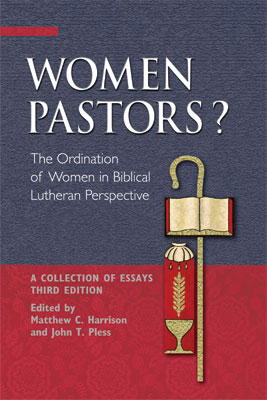
Like some of my favorite literary characters, when confronted with a challenge to something I thought, I hit the books. And, like most people do, I hit the books on my own side to see how I could refute this belief. The first book I dove into was Women Pastors? The Ordination of Women in Biblical Lutheran Perspective edited by Matthew C. Harrison and John T. Pless. The book was published by Concordia Publishing House, the publishing arm of the LCMS. It had, in other words, a doctrinal seal of approval that meant I could trust implicitly anything that it had to say therein. I knew that this book would have the answers I was seeking. However, as I cracked the cover and skimmed through the chapters, I found some things of deep concern. While passages like 1 Corinthians 14:34-35 were cited and used to silence women in the church, other exegesis did not align with what I was being taught about how to read the Bible.[1]
For example, in a chapter about the Trinity in the book, I read, “Even though [God the Son] is in all ways equal to the Father and in no way inferior to the Father, he is nevertheless utterly subordinate to the Father… Christ’s relation as Son to his Father is therefore characterized by his subordination to the headship of the Father” (222-223, first edition only, the chapter by John Kleinig). This was not what I’d learned about Trinitarian orthodoxy. Indeed, it seemed to be skirting the lines of Arianism. I was strongly put off. Much later, I’d learn that this chapter was either removed or heavily edited in a subsequent edition. At the time, I was shaken. If this was the kind of thing that got past official doctrinal review, what would it mean for other doctrinal issues?
Of course, this hardly caused a collapse of my position. Other chapters seemed more solid in their approach, and I felt like I was armed to show people, especially this young woman, why women shouldn’t be pastors after all. I don’t recall exactly how our discussion played out, but I do know it didn’t escalate into an outright argument. She decided to switch from the pre-seminary program to a different one, and I thought that’d be the end of it.
It wasn’t. The question was opened in my mind. It was even more open because I realized there were people who appeared to be faithful Christians who nevertheless believed women should be ordained and, shockingly, there were even ordained women pastors who weren’t clearly working to undermine Christianity at every step. I know this reads dramatically, but this is truly the way I thought, and certainly the way many pastors and others I interacted with thought about women pastors. The Bible, it is assumed, is simply so clear on whether women can be pastors that anyone who disagrees and even engages in the opposite practice absolutely must be some kind of heretical person or someone actively working to try to discredit Christianity. But because the question had been opened, I couldn’t just drop it. I kept investigating, despite the fact that the woman I was dating had changed course. This wasn’t the kind of thing I could just drop and leave aside. The very question of whether God was calling women into the ministry was at stake. If I really believed that God wanted to keep one half of the human population from even being possibly called by the Holy Spirit, I wanted to be sure that I was supremely confident that I was right.
I kept reading the Women Pastors? book, but became more and more disillusioned with the LCMS arguments against women pastors. Contradictory arguments abounded, and the exegetical principles used to conclude women couldn’t be pastors were simplistic even by the standards I was being taught in LCMS pre-seminary classes. It was like the pastors and theologians who’d written the book had abandoned things like the historical grammatical method when it came to this one issue.[2] I began to start asking questions, mostly in private, about the LCMS teaching on women pastors, but was met with either horror or a blanket statement about how clearly the Bible taught against it.
It’s worth a brief aside here at how often people–including more than one pastor–would try to silence the questions I was asking about women pastors or other issues by quoting Satan in the Garden of Eden: “Did God really say?” [Genesis 3:1]. This was used time and again as an answer to any questioning of the LCMS’s supposedly clear and exclusively biblical teachings. So, when it came to Genesis 1-3 and I pointed out that it seemed to be based upon ANE myths while turning them on their heads to refute aspects of them, not a literal, blow-by-blow account creation, I was told that I was like Satan in saying “Did God really say” that creation happened a certain way. When I asked about whether a verse truly taught what I was told it did, I was again questioning not the interpretation, but the word of God itself: Did God really say what the LCMS said it did–oops–what the Bible says God did? This clobber passage in context, of course, isn’t intended the way these pastors and others were using it at all. Indeed, the phrase itself is ripped from the middle of a sentence from the serpent’s mouth in which he was asking specifically about whether God had told them not to eat from any tree in the garden. The way the passage was being used against me was abusive and did cause trauma. Imagine being told that you’re just like Satan, tempting others with your nefarious questions just because you genuinely care about and want to know what the Bible says. It’s terrible.
My questioning would continue as I kept reading more about the topic, but while I was no longer convinced the Bible taught women shouldn’t be pastors with certainty, I was also unconvinced by arguments that women should or could be pastors. I was stuck in a kind of confused middling view. It was deeply uncomfortable, and not just because the woman I was dating had agreed to change her life based upon my discomfort. No, the very way God worked to call people to the ministry was at question, and I struggled to find any reason why God wouldn’t call women apart from a trite “The Bible says God doesn’t do that” type of answer. But did the Bible say that, or did it only read that way if one adopted the overly-simplistic hermeneutic I saw time and again in LCMS works on the topic–a hermeneutic that was different from the one I was being taught in LCMS classrooms? It was a question that would loom larger soon.
Next Time: Women in the Church, Part 2
There had to be some kind of reason why women weren’t called to the ministry. Only in some older LCMS works or references to earlier Christian teaching on the topic would I find any kind of answer.
[1] I wrote more about this same phenomenon when it came to young earth creationism. Time and again, despite being told to read the Bible contextually and take care to try to find the original meaning, the historical sense, etc., I did not find that reading reflected in LCMS teaching or reading of various texts. And, when I challenged those readings, I was told that I was challenging the text itself.
[2] I have been critically reviewing the Women Pastors? book chapter-by-chapter. Not all of the issues I raise with it in my reviews were ones I realized at the time I’m writing about now, but the more one reads the book, the more one realizes the poorly argued nature of it. See also note 1 above and the link therein about how I found on other issues the hermeneutical method I was being taught and the one actually being used did not align.

 J.W. Wartick - Reconstructing Faith