william lane craig
Really Recommended Posts 9/23
 The World’s First Talking Chair Shows Up in the UK– one of my favorite websites, No Apologies Allowed, has recently featured a comic on Dawkins’ failure to man up and meet William Lane Craig in a debate on the existence of God. Given the absolute trouncing Craig gave to Dawkins’ buddy, Sam Harris, it’s not surprising Dawkins is hiding as far from this debate as possible.
Thinking Christian is another site I follow closely, and he recently had two fantastic posts. The first is a review of the Intelligent Design movie, “Metamorphosis.” I recently purchased the film but have yet to watch it. I anticipate it greatly. The second post points out some pretty interesting aspects about how the “person” status of slaves was revoked–just as people now revoke the unborn’s “person” status. Check out his post, “Non-Persons Yesterday and Today.”
Holly Ordway over at Hieropraxis has another interesting post which reflects on why we should be “Reclaiming Story for Christ.” Holly has a ton of awesome posts, and I highly recommend her site.
“God is Still Holy and What You Learned in Sunday School Is Still True: A Review of ‘Love Wins'” by Kevin DeYoung. I think the title says it all.
Randy Everist over at “Possible Worlds” has a fun post reflecting on the “Worst Objection to the Kalam Cosmological Argument.” For some reason I can’t get a direct link, so simply go to his site http://randyeverist.com/ and scroll down.
Readers should recognize that I’ve also been focusing on the Kalam recently, and can check out my more recent posts on the topic: Dawkins and Oppy vs. Theism: Defending the Kalam Cosmological Argument; “The Multiverse Created Itself” and “Who Made God after all?”- The Kalam Cosmological Argument
Do you like Biblical Archaeology? I do! Jason Dulle over at Theo-sophical Ruminations has featured another post in his series on the topic. This one features the ossuary of Caiaphas.
Image Credit:
“The Multiverse Created Itself” and “Who made God after all?” -The Kalam Cosmological Argument

The most reasonable belief is that we came from nothing, by nothing, and for nothing. -Quentin Smith, Theism, Atheism, and Big Bang Cosmology, 135.
Is this so reasonable? Is it true that we came from nothing, by nothing, and for nothing? The Kalam Cosmological Argument is one of the most compelling arguments for theism. The broad opposition to the Kalam (or, more specifically, to its implications) from atheists has lead to some sophisticated arguments (like those of Graham Oppy or J.L Mackie), but it has also lead to some pretty poor arguments. Below, several objections to the Kalam Cosmological Argument have been outlined, along with rebuttals of varying lengths.
The Multiverse?
Some have objected to the Kalam by raising the possibility of a multiverse. They say that this counters the Kalam because it’s possible that our universe is one of nearly infinite past universes, generated as another “bubble” among untold trillions of other bubble universes. There should be one glaring difficulty with this objection that most can see immediately: “Whence the multiverse?” If the multiverse is proposed as eternal, then every objection about actual infinites applies to the multiverse. Not only that, but the multiverse itself would have to account for entropy. How is it that all the energy in this (nearly) infinite multiverse has not been used if it has existed for all eternity?
Ways around these difficulties have been proposed. For example, regarding entropy, some have argued that perhaps different laws of nature apply to the multiverse as a whole. Clearly, this is an extremely ad hoc theory that is really only invented to try to get around the argument. Once we’re allowed to modify reality to our every whim, we could indeed create anything we like–including (nearly) infinite universes.
Another problem with the multiverse objection is that we have startlingly little evidence for such a hypothesis. While there are many hypothetical scientists proposing bubble universes and the like, it’s shocking to read just how little evidence there really is for such a hypothesis.
Finally, even were there an infinite multiverse–as some have proposed due to string theory–this would not avoid an absolute beginning for the entirety of the multiverse. Bruce Gordon points out that the standard inflationary models still use inflation with a finite duration, which would entail that regardless of the number of universes which exist, there would still have to be an absolute beginning to the multiverse (Gordon, cited below, 86-87).
Perhaps, however, this multiverse (or the universe) is finite, but it created itself. There are a number of proposals suggesting just that.
The Universe Created Itself
I don’t think I can do much better than Edgar Andrews did over at his blog when he asks “Could a universe create itself?” He points out that the difficulty with each scenario proposed in which the universe creates itself is that it presupposes the existence of either matter, energy, or the laws of nature–the very things which this objection is supposed to answer. Andrews writes,
Stephen Hawking [who recently proposed the universe created itself] falls into this dilemma by claiming that the universe was created as a result of quantum mechanical fluctuations (in a vacuum) which became stabilized by gravitational forces [Hawking pp. 131-135; Hawking review]. He thus requires the laws of quantum mechanics and of gravity to have pre-existed the universe… But what is the law of gravity but a description of the way materialbodies interact — either with one another or with the space-time continuum? To claim that such a law existed in the absence of matter, energy, space or time stretches credulity and is incapable of demonstration. Only ‘mind of God’ and ‘non-material blueprint’ arguments remain and these are theological not scientific.
Similarly, suppose we took the claim of Smith (above) seriously–that the universe created itself from nothing. Does this even make sense? William Lane Craig writes, “…if prior to the existence of the universe, there was absolutely nothing–no God, no space, no time–how could the universe possibly have come to exist?” This is an extremely important question for the atheist to answer. Most often, however, atheists have instead changed the meaning of “nothing” to mean quantum vacuum or some other physical reality. This is hardly “nothing” that would have existed before the universe. Before the universe, there was no space, no time, no anything.
Edgar Andrews points out the confusion that some atheist philosophers and physicists perpetuate with this conflation of “nothing”:
[Victor Stenger] begins by utterly confusing the pre-creation ‘nothing’ that lies outside of space-time with the ‘nothing’ of a vacuum within space-time. Next, without making it clear which ‘nothing’ he is talking about, he claims that ‘the transition from nothing to something is a natural one, not requiring any agent.’ (Andrews, 97, cited below).
The problem isn’t solved when one lends it the idea of a multiverse, either. Oscillating universe models still imply a finite beginning (Gordon, 86ff). The idea that an infinite number of universes caused each other in a causal loop does no better–it leads only to a vicious regress. Ultimately, such proposals must be rejected for what they are–fiction.
Who Caused God?
Another trite response to the Kalam is the classic “Well fine, you say the universe is caused, well who caused God?” line. Here the atheist commits a number of classic blunders, to steal the phrase from “The Princess Bride.”
First, as in all scientific (and otherwise) inquiry, once one has reached the best possible explanation for an event, one has reached the end of the inquiry. An inference to the best explanation does not require an explanation of that explanation. There’s a reason that scientific inquiry can appeal to laws: they best explain how the world works.
Second, the first part of the Kalam is that “Everything which begins to exist has a cause” not “Everything is caused.” The atheist has merely misread or misinterpreted this principle. Should the atheist want to press the second point–that everything is caused, they have already conceded the weaker principle (that everything which begins has a cause), and they must further argue for a much stronger metaphysical claim. I leave it to the atheist to establish this claim.
“But,” the atheist may object, “you’re just denying the antecedent!” Not quite. I’m not saying that God didn’t begin, therefore God was uncaused–rather, I’m arguing that because God did not begin, this argument does not apply to God. There could be other arguments made to establish that God is caused, but to do so would require, as I pointed out, arguing for the metaphysical principle that “everything is caused.” Again, I leave the atheist to make this argument.
Conclusion
While many objections to the Kalam might be made in good faith, it is clear upon examination that they all fall far short of defeating the argument. The Kalam Cosmological Argument succeeds in its goal: to show that the universe is caused. What is this cause? That’s a question we must all consider with fear and trembling.
Links
Those interested in a broad outline of the Kalam Cosmological Argument can read my post on the topic.
For a discussion of one both Richard Dawkins’ and Graham Oppy’s objections to the Kalam, read Dawkins and Oppy vs. Theism: Defending the Kalam Cosmological Argument.
Sources:
Edgar Andrews, “Could a universe create itself?”
Edgar Andrews, Who Made God (Darlington, England: EP books, 2009). Reviewed here.
Bruce Gordon, “Inflationary Cosmology and the String Multiverse” in New Proofs for the Existence of God by Robert Spitzer (Grand Rapids, MI: William B. Eerdmans, 2010).
William Lane Craig and Paul Copan, Creation Out of Nothing (Grand Rapids, MI: Baker, 2004).
SDG.
——
The preceding post is the property of J.W. Wartick (apart from citations, which are the property of their respective owners) and should not be reproduced in part or in whole without the expressed consent of the author. All content on this site is the property of J.W. Wartick and is made available for individual and personal usage. If you cite from these documents, whether for personal or professional purposes, please give appropriate citation with both the name of the author (J.W. Wartick) and a link to the original URL. This blog is protected by Creative Commons licensing. By viewing any part of this site, you are agreeing to this usage policy.
Book Review: “Who Made God?” by Edgar Andrews
 Who Made God?
Interestingly, Andrews gets the title of the book out of the way quickly. Andrews argues against the common atheistic retort, “Well if God made everything, who made God?” He writes, “Because cause and effect is only proven for the physical world, we can no longer insist that cause and effect are relevant when it comes to the origin of a spiritual entity like God.” I am not sure about the strength of this response. It seems to potentially put God outside the rules of logic, something of which most theists are very wary. A more convincing response, in my opinion, is to simply point out that the concept of God includes necessity. Theistic arguments are designed to show just this–that God is the uncaused ground of being.
Who Made God, however, quickly jumps into stride and doesn’t look back. Andrews lucidly argues that while science can describe events and put them to the test, it cannot explain things in the sense of a comprehensive explanation. Science, for example, “doesn’t tell us why there is [a force of gravity]” (30).
Without slowing down Andrews jumps into a clear explanation of String Theory and its attempts to be a “theory of everything.” Even were science to unify into a theory of everything, however, Andrews point would still stand. The theory would offer descriptions of how things happen, but it wouldn’t explain why the theory itself worked. He also offers a few critiques of string theory, such as the counter-intuitive nature of the theory (48).
Andrews continues on, offering God as a “hypothesis.” He argues that “the methodology of science” can be applied to God (58-59). He argues that Victor Stenger’s God: the failed hypothesis fails on a number of levels. Stenger claims that God “should be detectable: (1) by scientific ‘models’; (2) by scientific measurements… (3) by scientific ‘methods'” (67). Against this, Andrews points out that Stenger is trying to exclude God from existence by “having it both ways.” Stenger argues that God should be detectable, but cannot be because the measurements of science are restricted to the physical. Obviously, this begs the question against theism.
Andrews also addresses nothing, by which I mean the redefinition of “nothing” into “something” often done by atheists (see the debate between Lawrence Krauss and William Lane Craig). He points out that they often use “nothing” to reference vacuum and/or empty space or dark matter. But this is either deliberately misleading or just incomprehensible (97ff). As the atheists who say this often admit themselves, this “empty” space is hardly “nothing.” It is full of energy. But beyond space, beyond the existence of our universe, outside of space and time–that is what is meant by “nothing” (105).
The God hypothesis is vindicated when it comes to the evidence from astronomy and physics. The low entropy state of our universe (117-118), along with its origin (98ff) both point to a creator. Andrews moves on to argue that the origin of the laws of nature must also point to the God hypothesis (138-153). He then goes on to argue that our biological origins, the information found in cells, and the diversity of life have their best explanation with God. To cover these arguments fully would double the size of this review, but I found these arguments just as exciting as the rest of Who Made God. A sampling: proteins and DNA must have information in order to function correctly (181ff); origin of life theories can only be explained with the God hypothesis (196ff); evolution is nonfalsifiable (214-216); natural selection is a tautology (219-220); junk DNA isn’t junk (234ff); mutations really only help within dynamic populations and cannot lead to new species (230ff [through 240]). Andrews isn’t finished there, however, he tackles arguments for and against mind/body dualism (250ff).
Another strength of Who Made God is the format. There is a summary of each chapter prior to its contents, along with definitions of important terms. Humor is found throughout the work as the author tells funny stories or makes witty comments about the arguments. These aspects increase the readability of the book to a great degree.
This is not to say the book is without faults. Andrews’ treatment of the Ontological Argument was a bit abrupt. I’ve written on the argument before (see my posts here and here). Andrews’ critiques don’t apply to the most current versions of the argument. The most commonly used ontological argument is the modal version developed by Alvin Plantinga and others. This version of the argument doesn’t appeal to human ideas, but to modal necessity and possibility. To his credit, Andrews does point out that some philosophers find the argument compelling.
Another issue with Who Made God is the sometimes unconventional use of philosophical terms. For example, Andrews defines “phenomenology” as “The way phenomena… manifest themselves” (27). Phenomenology, however, is most commonly used (in philosophy) as the study of consciousness. Outside of philosophy, it generally refers to conscious experience or sense experience, not so much about the phenomena themselves. While the definition is not wrong, it caused some confuse, and may confuse other readers familiar with the other, more conventional uses. Another uncommon definition was given for “Monism.” Most often, the term refers to the idea that all of reality is one [i.e. it is all material, or all immaterial]. Andrews definition makes sense in context (he defines it as “The idea that mind is nothing more than the brain at work” [257] but that definition in philosophy of mind is more often used for “reductionism” which Andrews defines differently as well).
However, neither of these negatives outweigh the significant positives found throughout Who Made God. You know that I’m nitpicking when my main critique focuses on a couple unconventional definitions, particularly when Andrews uses valid definitions that simplify the terminology for the reader.
Edgar Andrews’ Who Made God is unique among the slew of apologetics books written at a popular level in that it offers a nearly comprehensive argument for Christianity based upon various scientific theories. Despite a few small flaws, I unreservedly recommend this book to all Christians looking to increase their knowledge of biology, physics, and astronomy. Andrews clearly and succinctly explains several scientific theories in terms which are easy to understand, while also showing the relevance for the “God hypothesis.” Readers will come away convinced that when it comes to science, their faith stands on firm ground. Books with scopes this broad most often shine their lights upon lots of topics and illumine none. Readers will find that Who Made God illumines nearly every topic it touches, bringing new insight and clarity into often confusing issues.
Source: Edgar Andrews, Who Made God?
Disclaimer: I was provided with a review copy free of charge by EP books. My thanks to both Edgar Andrews and EP books.
SDG.
——
The preceding post is the property of J.W. Wartick (apart from citations, which are the property of their respective owners) and should not be reproduced in part or in whole without the expressed consent of the author. All content on this site is the property of J.W. Wartick and is made available for individual and personal usage. If you cite from these documents, whether for personal or professional purposes, please give appropriate citation with both the name of the author (J.W. Wartick) and a link to the original URL. This blog is protected by Creative Commons licensing. By viewing any part of this site, you are agreeing to this usage policy.
Dawkins and Oppy vs. Theism: Defending the Kalam Cosmological Argument
 “[Arguments for God’s existence from an infinite regress] make the entirely unwarranted assumption that God himself is immune to the regress.” -Richard Dawkins, The God Delusion, 101.
Dawkins vs. the Kalam
Just over a year ago at Richard Dawkins’ site, someone asked Dawkins to respond to the Kalam Cosmological Argument (see an exposition of the argument here). The reader outlined the argument:
- Whatever begins to exist has a cause
- The universe began to exist
- Therefore, the universe has a cause
Dawkins is frequently witty, but often wrong. The argument is for broad theism. The Kalam is intended to show that the universe is caused, it is not an argument for Christianity specifically. I pointed out in another post that just because an argument is for broad theism (or just the brute existence of God), that doesn’t mean the argument is useless evidentially for Christianity. If we know the universe is caused, then we also know whatever caused the universe must be capable of causation (obviously), choice (it must select a moment to bring about the universe), powerful enough to bring the universe into existence out of nothing, etc. This would be powerful evidence and part of a cumulative case towards Christianity.
Then there’s Dawkins’ quote in The God Delusion which I have seen utilized to challenge the Kalam. First, I should note that Dawkins’ quote is in response to Aquinas’ Five Ways/Proofs. Further, it seems to be intentionally pointed towards a Leibnizian version of the Cosmological Argument (for a fuller defense of that argument, see here). But, a simple answer to Dawkins objection, which he seems to think is devastating, would be to point out that the universe and God are different types of entities. The universe is contingent, and God is necessary. That’s not arbitrary, that’s just the kind of things those entities are.
A Philosophical Attack On the Kalam
Not all atheists are as capable of blind, willful ignorance as Dawkins. Graham Oppy’s recent book Arguing About Gods has a thoughtful, challenging section dedicated to William Lane Craig’s exposition of the Kalam.
Oppy challenges Craig on every step of the Kalam, but I’m going to focus upon one. Oppy writes, “[I]t is quite unclear why one should suppose that the allegedly counter-intuitive behavior of the transfinite [numbers]… casts doubt on the idea that the very smallest transfinite cardinals do find application to ‘the real world'”(Arguing About Gods, 140).
This proposal is meant to challenge Craig’s contention that the infinite cannot actually exist. For, if there can be no actual infinites, then the objects we see around us–indeed, the universe itself–must have begun. Yet Oppy’s contention really only reflects mathematical truths. But surely this is a rather untenable claim. Oppy would have to provide evidence that the infinite actually exists and is not just an abstract mathematical concept. Craig’s contention is that the infinite can only be used in things like Cantor’s theory for mathematical equations. Why does Craig make this restriction? He cites David Hilbert, the famous German Mathematician, who points out that:
the infinite is nowhere found in reality. It neither exists in nature nor provides a legitmate basis for rational thought… the role for infinite to play is solely that of an idea… (David Hilbert Quoted in Craig, 87, cited below)
Yet Oppy provides no reason to think that there are actually infinite things found in reality. Rather, he resorts to claiming that Craig misinterpreted Hilbert’s paradoxes and that “If the Cantorian theory of the transfinite numbers is intelligible, then we can suppose that some parts of it find application ‘in the real world…'” (Oppy, 140). But is that true? Aren’t there plenty of things that are intelligible but for which we have no application ‘in the real world’? I abstract a bit when I point this out, but it is perfectly intelligible that there could be flying pigs, yet we don’t find an application of that in “the real world” other than as a false statement. There are nearly limitless examples of intelligible things we can think of, or intelligible theories, which have no application in the real world.
But perhaps Oppy isn’t making a claim quite as strong as saying actual infinites exist. Perhaps he is just referring to the possibility that they do. The problem then, however, is that, as Craig writes in a critique of Oppy’s position, “Oppy’s attempt to defend the possibility of the existence of an actual infinite is vitiated by his conflation of narrowly and broadly logical possibility.” The problem is that Oppy has confused broad logical possibility (that it is possible to construct a consistent set with an actual infinite) with modal (the notion that an infinite actually does exist in a possible world) or actual possibility in the real world. Again, Craig writes, ” Oppy… seems to take a proposition’s freedom from inconsistency in first-order logic to be indicative of that proposition’s being true in some possible world” (Craig b, cited below). So Oppy has not done anything to defeat the Kalam. Even were Craig to grant that Cantorian theory allows for broad logical possibility of actual infinites, it would not show that they are actually possible in our world. And again, even were they possible in the real world, an actual infinite would have to exist in order to discredit the Kalam. Thus, Oppy’s counter to the Kalam is quite weak–it’s based upon a conflation of broadly logical and actual possibility, and even were he to show that infinites are actually possible, the problem would remain that we have observed none.
Yet, and this is very important to note, even if actual infinites did exist, that wouldn’t undermine the idea that everything which began has a cause. It would only allow atheists to claim the universe did not begin. But how would they go about claiming that? They’d have to show that a model of the origins of the universe which allowed for an infinite past was plausible–more plausible than the alternative. Yet the only hope for showing this would be to make a theory as parsimonious as the Big Bang theory, which postulates an absolute beginning to the universe. So, even were there actually infinite things in the universe, which I very much doubt, that would not undermine the Kalam. It would make the argument more difficult to defend, but it would not falsify it. All it would show is that there are objects which are not caused.
Thus, I take it that the Kalam Cosmological Argument does not suffer defeat, either from vocal, misguided atheists like Dawkins, or thoughtful philosophers like Graham Oppy.
Links:
Again, see an outline and defense of the Kalam Cosmological Arugment here.
William Lane Craig discusses another objection: whether a beginningless past is actually infinite: here. He offers a number of critiques of Oppy’s position here. You can also access a review by Craig of Oppy’s book here (you will need to sign up for a free account on http://www.reasonablefaith.org/).
Check out my review of a recent debate between Craig and Lawrence Krauss, in which the Kalam was discussed here. (Includes a link to the actual debate.)
Wintery Knight writes about how to defend the Kalam at his site: http://winteryknight.wordpress.com/2009/04/08/how-to-defend-the-kalam-cosmological-argument-just-like-william-lane-craig/
Sources:
Graham Oppy, Arguing About Gods (New York, NY: Cambridge, 2006).
Richard Dawkins, The God Delusion (New York, NY: Houghton Mifflin, 2008).
William Lane Craig, The Kalam Cosmological Argument (Eugene, OR: Wipf and Stock, 1979).
William Lane Craig b, “Graham Oppy on the Kalam Cosmological Argument” (Leadership U, November 8, 2005), http://www.leaderu.com/offices/billcraig/docs/oppy.html, accessed 9/1/2011. Also found at http://www.reasonablefaith.org/site/News2?page=NewsArticle&id=5162.
Image credit: ESA/Hubble and NASA: http://spacetelescope.org/images/potw1021a/, found at http://commons.wikimedia.org/wiki/File:PGC_39058.jpg.
SDG.
——
The preceding post is the property of J.W. Wartick (apart from citations, which are the property of their respective owners) and should not be reproduced in part or in whole without the expressed consent of the author. All content on this site is the property of J.W. Wartick and is made available for individual and personal usage. If you cite from these documents, whether for personal or professional purposes, please give appropriate citation with both the name of the author (J.W. Wartick) and a link to the original URL. This blog is protected by Creative Commons licensing. By viewing any part of this site, you are agreeing to this usage policy.
Really Recommended Posts 8/29
Here’s another roundup of several posts I found worth reading:
The Apologetics of Love:
http://1peter315.wordpress.com/2011/08/18/apologetics-of-love/
William Lane Craig answers a question about genocides in Canaan:
http://www.reasonablefaith.org/site/News2?page=NewsArticle&id=8973
Review of the book “Clouds of Witnesses”:
http://greatcloud.wordpress.com/2011/07/24/book-review-clouds-of-witnesses/
A very brief discussion of the Euthyphro Dilemma:
http://josiahconcept.org/2011/08/11/on-the-euthyphro-dilemma/
Gay activist explains how same-sex marriage will change marriage:
I stumbled across this phenomenal outline of some of the issues dealing with God and the Problem of Evil:
Quick Links: Craig on the Ontological Argument
A common objection to the ontological argument for the existence of God is that existence is not a property. People often misunderstand that modern versions of the argument don’t rely on making existence a property, but upon the idea that necessary existence is greater than contingent existence. William Lane Craig has some clarifying comments on the ontological argument in response to two questions regarding this confusion: here.
Book Review: “Eternal God: A Study of God Without Time” by Paul Helm
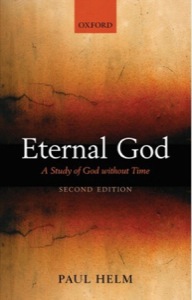 Paul Helm is, in my opinion, one of the most lucid thinkers on the topic of God and Time. His Eternal God
Helm points out early in his book that the issue of divine temporality/atemporality is “underdetermined” in Scripture (7). This means it’s one of those fun issues that lies most squarely in philosophy of religion.
And that is where Helm excels. Chapter-by-chapter he outlines a cohesive case for divine atemporality. Where Paul is most successful, I think, is in his rebuttals of arguments for temporality. For example, a well-known argument for temporality is that if God interacts in time, he must be temporal. Helm counters by pointing out that a precisely parallel argument could be constructed for God and space. Yet few Christian philosophers accept that God is spatial (49ff). While this doesn’t rebut the argument, it does point out something important: it doesn’t seem as though the conclusion (God is temporal) follows from the premise (God interacts in time) any more than it would if it were spatial (God is spatial/God interacts with space).
There are many different accounts of divine timelessness, from Brian Leftow’s spaceless timelessness (see his work Time and Eternity) to relative timelessness, and beyond. Helm takes the much less popular route and takes the tough pill of saying that God created spacetime as a static bloc. This allows Helm to easily deny many of the arguments for temporality which stem from a-theory or dynamic time. But it also raises many problems. Foremost among these (in my opinion) is human freedom. For, on the B-Theory of time (static theory), everything which will ever happen, has happened, and in a sense exists. As we go from moment to moment, we’re really just passing through a bloc of spacetime, we aren’t literally moving through a present. Presentness is a subjective phenomenon, given static/B-theory. It’s just our perspective. So where does human responsibility and freedom come in?
Helm here turns to compatibilism. He freely admits that timeless creation entails determinism (170). Thus, he denies that humans have free will in the libertarian sense. But this, he argues, does not undermine human responsibility. I don’t think I can do justice to the nuances of his argument, but the basic idea is that Helm argues that just because past actions/events determine our actions in the future, that doesn’t mean that we aren’t responsible for what we do. As I said, this is a really, really watered down version of his argument, but I think this is one of the weaker points of his work.
Why? Because the idea of responsibility simply does not make sense on determinism, particularly when it is theistic determinism. For consider the idea proposed here. God has created all of time and space as one bloc. Thus, everything I do or have ever done was created by God once he brought the universe into being. Literally, everything I did, I do because God created the universe such that I would do x. So how could it be that I am responsible for doing x, if I never chose to do x. I simply do x because I have to, I have “already” done it, on the static theory. If I could create a time travel device, I could travel forward in time and see myself doing x, and could not prevent it, because God created the world such that I would do x. But the core of responsibility is that I chose to do x. While we punish people for things they do by accident (vehicular manslaughter, for example, or accidentally breaking a window), these things still resulted from prior choices (playing baseball near breakable window/driving carelessly). I simply do not see how any account of responsibility could make sense unless someone can choose to do what they do.
There are several different positions about divine temporality/atemporality. Helm swallows the hard pill of going with the static theory of time to ground his divine atemporality. This, I believe, grants his account extreme philosophical plausibility. If God created the entire universe as a space-time continuum (I’ve always wanted to use that phrase from Star Trek!), then there’s no reason to suppose God would be affected by time. It’s ontologically outside of God, and all of his interactions already have taken place. While I’ve already pointed out some of the problems with this view, these problems are not with the coherence of the view but with the theological nature of it. Thus, I think it possible to say that Helm has adequately defended a position of divine eternity.
It would be impossible to cover everything of interest in such a comprehensive look at the topic of divine timelessness. Helm analyzes an extraordinary number of arguments in great detail. I cannot recommend the book more highly. Although I ultimately reject Helm’s second contention (B-theory), I believe his view is extremely coherent, and I can find little fault in it. Anyone interested in the issue of God’s relationship to time must read this book. It’s a book I think I shall re-read so that I can better grasp his arguments.
(Note: This review is based on the recently published second edition of this text, which includes several new chapters with much of interest, including a rebuttal of William Lane Craig’s arguments against timelessness. I recommend interested readers get their hands on the newer edition.)
SDG.
Source:
Paul Helm, Eternal God
——
The preceding post is the property of J.W. Wartick (apart from citations, which are the property of their respective owners) and should not be reproduced in part or in whole without the expressed consent of the author. All content on this site is the property of J.W. Wartick and is made available for individual and personal usage. If you cite from these documents, whether for personal or professional purposes, please give appropriate citation with both the name of the author (J.W. Wartick) and a link to the original URL. This blog is protected by Creative Commons licensing. By viewing any part of this site, you are agreeing to this usage policy.
Against Open Theism: Scrooge and God’s knowledge of the Future
 I was listening to William Lane Craig’s Defenders podcast (Doctrine of God: Part 13) and he brought up an interesting analogy about omniscience. He discussed Scrooge in Dickens’ “Christmas Carol.” The last spirit to appear to Scrooge is the ghost of Christmas to come. He takes Scrooge around and shows him all sorts of disturbing imagery that will happen. Scrooge asks the ghost whether these are things that must happen, or whether he can stop them. The spirit remains silent.
Craig pointed out the spirit would have to remain silent to have any sort of effect. For suppose the spirit knows what will happen: that Scrooge will repent and so these awful things won’t happen. But then if he tells Scrooge what he knows, Scrooge will feel little remorse about not acting to prevent them. Yet if the spirit told Scrooge these things would happen, then Scrooge has no reason to modify his behavior, for he cannot prevent the events from happening.
Craig suggests, then, that we should look at omniscience and instances of God “changing his mind” in the same fashion. This has some interesting applications in the case of Open Theism, because it undermines one of the core exegetical arguments for the position: cases of God “repenting” or “changing his mind.”
God, on classical theism, knows what will happen in every circumstance. He comprehensively knows the future (contra Open Theism). If this is so, then God would have to withhold some of his knowledge in order to bring things about, despite his knowledge that it would occur. Like the Ghost of Christmas Yet to Come, God would know the answer to Scrooge’s question, but would not answer him, so that he could bring it about that Scrooge would repent.
Consider Jonah. Open Theists often point to the story of Nineveh as an example of God not comprehensively knowing the future. Because God sends Jonah with the message that Nineveh will be destroyed, but then, when Nineveh repents, he shows mercy, many people say that God did not know the Ninevites would have such a reaction. Yet why should this be the case? Isn’t it plausible that God did know they would repent and that God sent the message that they would be destroyed because that is the only way Nineveh would be led to repentance? This is, in fact, hinted at later in the book, when Jonah says to God, “Isn’t this what I said, LORD, when I was still at home? That is what I tried to forestall by fleeing to Tarshish. I knew that you are a gracious and compassionate God, slow to anger and abounding in love, a God who relents from sending calamity” (4:2).
But if God had told the Ninevites “I will not destroy you” because he knew that he would not, would not the impetus of Jonah’s message lose its strength. With the threat of destruction, the Ninevites repented. Without, would they have done so? Imagine Jonah’s message going through the streets “Forty more days and Nineveh will not be destroyed!” I think it obvious that this would probably not have the same effect that the initial message was.
So it seems quite plausible that God, like the Ghost of Christmas Yet to Come (in our analogous case), may refrain from telling all he knows at many points throughout Scripture. For if he told people everything he knew, he would know that they would not repent, turn aside from their evil ways, or bring about the actions he desired. The instances wherein God ‘changes his mind’ or ‘repents’ are instances of this: rather than revealing his knowledge, God withholds it, in order to bring about the ends that he desires to (and knows will) happen. We, like Scrooge, would not respond to calls for repentance if we felt it didn’t make a difference in the end.
Final note: the above account implicitly assumes molinism to be the case. So much the better for it, I say!
SDG.
This is part of a series I’ve written against the doctrine of Open Theism. If you’d like to read more, check out the original post for discussion and links.
——
The preceding post is the property of J.W. Wartick (apart from citations, which are the property of their respective owners) and should not be reproduced in part or in whole without the expressed consent of the author. All content on this site is the property of J.W. Wartick and is made available for individual and personal usage. If you cite from these documents, whether for personal or professional purposes, please give appropriate citation with both the name of the author (J.W. Wartick) and a link to the original URL. This blog is protected by Creative Commons licensing. By viewing any part of this site, you are agreeing to this usage policy.
The Kalam Cosmological Argument
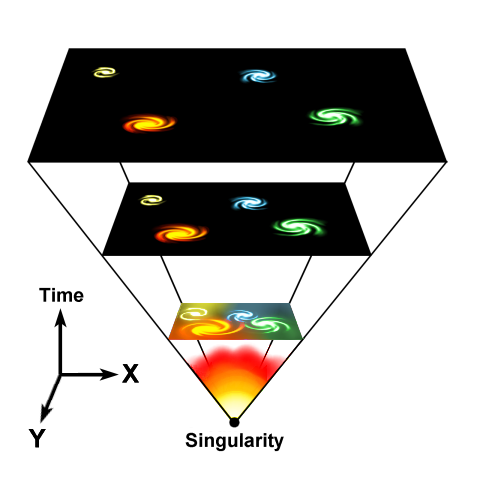 One of the most frequently cited and debated arguments for the existence of God is the Kalam Cosmological Argument. I have not written on the argument before because there is simply so much good material on it out there that I don’t think I can add anything new. I have, however, run into numerous people with questions on the argument recently, and felt the need to finally get around to a post on the Kalam. Those interested in the argument are highly encouraged to read the links included at the end.
The argument
The argument itself is quite simple:
1) Everything that began to exist has a cause
2) The universe began to exist
3) Therefore, the universe has a cause
The argument is deductively valid, so the question is whether the premises are true. If true, the conclusion is certain.
Defense of Premise 1
Why should we think that whatever began to exist has a cause? First, it seems a denial of this principle would undermine science. Science is an investigation of causation. If the anti-theist wishes to deny this premise, she is committed to a fallacy similar to that which she calls the “goddidit” fallacy: dismissing explanation for an event. (Interestingly, saying “God did it” is not a dismissal of explanation: it is, itself, an explanation. It’s saying the explanation which best fits the evidence is theism.)
Suppose premise 1 were false. In that case, things could and would be coming into existence for no reason whatsoever out of nothing. We would observe a remarkably different universe than that which we do, in fact, observe. A tiger would miraculously materialize in my room and eat me.
Now, it must be noted that some appeal to quantum physics in order to say this premise is false. They hold that certain quantum events bring things into existence without reason. Such an interpretation seems misguided at best, however, for a few reasons. First, the event would seem to have an explanation, namely, that it is a quantum phenomena of type x. Second, even were one to deny that this is a form of explanation or causation, the fact remains that these quantum events don’t originate from nothing. They originate from the laws and systems present within our universe. Third, these quantum events, on an examination of quantum theory, are not uncaused; they are merely spheres of probability. Finally, an exclusion of causal chains seems to undermine quantum theory itself or at least make it difficult to correctly interpret (on this, see William Wharton’s paper “Causation with Quantum Mechanics”). Like Wharton, I think the main reason causation is sometimes excluded from interpretations of QM is because of an avoidance of “metaphysical first causes.” Obviously, if this is the motivation for avoiding causation, it is not spurred by a commitment to science, but a commitment to avoiding the metaphysical implications of science.
Finally, consider what Wintery Knight points out about QM and the Kalam:
First, quantum mechanics is not going to save the atheist here. In QM, virtual particles come into being in a vacuum. The vacuum is sparked by a scientist. The particles exist for a period of time inversely proportional to their mass. But in the case of the big bang, there is no vacuum – there’s nothing. There is no scientist – there’s nothing. And the universe is far too massive to last 14 billion years as a virtual particle. (Wintery Knight, “How to defend the kalam cosmological argument just like William Lane Craig” April 8th, 2009).
The quantum events observed are caused: by the scientist. Therefore, they don’t undermine premise 1.
To sum up, the reasons for thinking the first premise true are clear: 1) to deny it undercuts science; 2) we don’t observe a universe with uncaused events; 3) the only reason found to deny the premise is an a priori commitment to anti-theism.
Defense of Premise 2
Did the universe begin? There are many arguments to support the premise that the universe did, in fact, begin, but I’m going to focus on only two: the impossibility of an infinite past and the empirical evidence of a finite past.
Impossibility of an infinite past
If the past is infinite, then we will have had to cross an infinite number of moments of time in order to come to the present moment. However, for any finite number of moments in time, x, there will always be a moment such that x+1 does not equal infinity. There is no way to start at any arbitrary moment in the supposedly infinite past and then add enough successive moments to arrive at the present moment. As such, it would be impossible to experience the present moment. However, we are experiencing the present moment, therefore, the past is finite.
Empirical evidence for a finite past
Despite misgivings from some Christians about the Big Bang theory, it has proven to be eminently valuable for arguments like the Kalam. I would go so far as to say the Big Bang serves as powerful evidence for a creator.
The reasoning behind this is that when we measure cosmic background radiation we can measure the expansion of the universe. Extrapolating backwards leads us to the conclusion that at some point in the finite past, the universe began to exist.
Therefore, it is reasonable to conclude that both premise 1 and 2 are true. However, because the argument is deductively valid, it follows that the universe has a cause.
Conclusions
Okay, so the universe has a cause. That doesn’t prove God exists! Well no, it doesn’t, but it does show that whatever caused the universe has many of the attributes classical theism has attributed to God, and therefore lends credence to the claim God exists. For whatever caused the universe must have extraordinary power (omnipotence); it must have made a choice to create the universe out of nothing (personal causation/agency); it must have been outside of time (the universe came into existence along with space and time); it must have been outside of space; and it must exist necessarily. As such, the Kalam doesn’t prove Christianity true instantly; it just proves theism is more plausible than atheism. Not only that, but it does show that whatever caused the universe is remarkably similar to the God Christians claim exists.
Appendix: Who made God?
Perhaps the most common objection to the argument outlined above is “Okay, well who made God?” This common retort can be answered after a minute of reflection. Classical theism holds that God exists necessarily, which means that God is eternal and beginningless. The first premise asserts that “whatever begins to exist…” therefore, it doesn’t apply to God. Is this a mere ad hoc fix on theism? No, because it isn’t saying God has no explanation for His existence (which reason is found in His necessary existence); it is saying that he did not begin, and is therefore uncaused. The detractor at this point would have to establish that “everything which exists is caused”–a much more difficult claim to defend than the claim that “everything which began to exist has a cause.” In fact, the anti-theistic claim seems necessarily false, for things which don’t begin are uncaused.
Links
Answers to objections towards the Kalam Cosmological Argument from Richard Dawkins and Graham Oppy
Did the multiverse create itself? Who made God?– more objections to the KCA are answered.
Sites
Wintery Knight “How to defend the kalam cosmological argument just like William Lane Craig”
Thinking Matters “The Kalam Cosmological Argument”
Wintery Knight, “The kalam cosmological argument defended in a peer-reviewed science journal”
Books
The Kalam Cosmological Argument by William Lane Craig
The Blackwell Companion to Natural Theology edited by Craig and J.P. Moreland
SDG.
——
The preceding post is the property of J.W. Wartick (apart from citations, which are the property of their respective owners) and should not be reproduced in part or in whole without the expressed consent of the author. All content on this site is the property of J.W. Wartick and is made available for individual and personal usage. If you cite from these documents, whether for personal or professional purposes, please give appropriate citation with both the name of the author (J.W. Wartick) and a link to the original URL. This blog is protected by Creative Commons licensing. By viewing any part of this site, you are agreeing to this usage policy.
“Extraordinary claims need…” What, exactly?
 We’ve all heard it before, “Extraordinary claims need extraordinary evidence.”
It’s a maxim repeated all over the internet, and it keeps popping up in debates between Christians and atheists. But what exactly is the phrase telling us? Do extraordinary claims really need extraordinary evidence? And what exactly qualifies as “extraordinary” evidence anyway?
Is it true?
Do extraordinary claims really need extraordinary evidence? Well, intuitively, it seems the answer yes. But is it really true?
Suppose I were to claim that I were not a human, and instead am a giant pink salamander. What kind of evidence would be required in order to back this claim? Well I could obviously submit pictures of myself typing these blog posts as evidence. I could submit videos. I could allow people to come observe me. None of these would really be “extraordinary” types of evidence. Merely observing something is nothing extraordinary. But these could certainly serve as proof for my claim. People would be justified in believing me upon observation–it’s possible that they could be within their epistemic rights simply by seeing pictures of me typing (though with Photoshop and the like, it is more difficult to justify that epistemically).
So despite our intuitions, it seems there must be some kind of argument to establish the truth of the phrase. It seems, upon further thought, that the phrase is false. Ordinary evidence (x observes y to be the case, therefore, x believes y is true) will do even for extraordinary claims. Examples of this nature could be multiplied. So it seems the phrase, on this interpretation, is simply false.
What qualifies as an ‘extraordinary’ claim?
Another problem with the statement “Extraordinary claims need extraordinary evidence” is that those who make the claim never explain what exactly it is that qualifies as an “extraordinary claim.” I mean surely, we could reduce almost any claim to something extraordinary, if we worked hard enough. I claim to be human; that entails a huge amount of ontology such as the existence of a planet which is capable of supporting life, the existence of life on said planet, the higher order of life such that intelligent life could exist, intelligent life which created machines capable of typing out thoughts, etc, etc. Any claim could be said to be “extraordinary”. The attack on “extraordinary claims” fails, in part, because it does not define what qualifies as “extraordinary”. I suspect this is another case of proving too much or not enough: either all claims are extraordinary and not to be believed until we have overwhelming evidence, or claims need just enough evidence to be justified in believing them.
Without a clear explanation of what qualifies as an “extraordinary claim” (and I think there can be none offered without begging the question), there is no reason to accept the statement as true to begin with. But this leads us to the next level:
What is ‘extraordinary evidence’?
What exactly is “extraordinary evidence” anyway? The phrase is thrown around as though it has meaning, and for someone studying philosophy with a heavy analytic bent, this is maddening. What is meant by “extraordinary”!? I think it could give us one of two options: either a) a large amount of evidence; or b) extremely powerful evidence. But even these definitions are ambiguous: what constitutes a “large amount” of evidence or “extremely powerful” evidence?
The phrase therefore seems to rely upon a certain ambiguity in order to maintain its power. There is no clear definition of what constitutes extraordinary evidence; and it seems likely that the phrase is merely used to try to increase the burden of evidence on the theist. Without a clear definition or any kind of argument to support the assertion, however, the theist is justified in rejecting it.
Is that the issue?
Perhaps I’ve missed what’s really the issue here. I suspect the reasoning is that the phrase is meant to refer either to:
1) Things which can’t be observed in the usual fashion
2) Things of great existential import
Consider 1) first. The reasoning here could be that something, like God, which can’t be observed simply by going somewhere and staring, would need extraordinary evidence in order to justify belief in said being. The problem here is that the definition of extraordinary is being used differently than (I think) the phrase is intended. For here, extraordinary would have to mean simply”other” than the ordinary. There would have to be some kind of evidence for a thing’s existence such that it would act as a substitute for “seeing” the thing. But that doesn’t mean we need “more” or “greater” evidence for something described by 1) than we would for something which is a standard, everyday kind of thing. All it means is that we’d have to have a different kind of evidence.
What kind of evidence, specifically? Well it seems as though logical evidence or philosophical argument could serve as a valid substitute for empirical evidence. So either of those could serve to justify someone in her belief in a deity.
Consider 2)–that claims of great existential import need extraordinary evidence. William Lane Craig discussed this in his Reasonable Faith Podcast, “Doubting the Resurrection.” He asserted that if something is of existential importance, we don’t demand more evidence for it; if anything, we should be more open and eager to explore the viability of the claims. Craig proposed the following example: suppose you are diagnosed with a fatal disease and there was “some experimental evidence that a vaccine… might cure you, wouldn’t you be desperate to [try the medicine and] find out if that might save your life… rather than saying, ‘Well, this is such a life-changing situation that I’m going to be as skeptical as I can, and only take this medicine as a last resort when it’s been demonstrated absolutely that” it will cure the disease.
The key point is that claims of extraordinary existential significance require evidence, but they are of such import that it is almost absurd to be totally skeptical of these claims due to their total importance. As Craig points out, if God exists and sent His Son to save us through belief in Him, that is such an extraordinarily significant difference between the universe if that is true as opposed to if it is false that it is worth exploring. He points out that even if there’s only a 1/1,000,000 chance that it’s true, it is worth looking into.
The most obvious rebuttal to this kind of reasoning is a kind of argument from religious diversity: “All the world’s religions have existential significance, and it would be impossible to fully explore all of them in a lifetime”… therefore, what? Perhaps one could argue that because we can’t explore all the options, we shouldn’t bother with any–but that seems to be throwing out everything for no reason. A diversity of options does not entail the falsehood of all.
It may be best to instead look at world religions in light of the kinds of evidence which could be available, and take 1) above with 2) to yield an exploration of religions based upon the types of evidence available for them. For example, the Qur’an contradicts the Bible on the topic of whether Jesus was crucified. Yet we have irrefutable evidence that Jesus was indeed crucified from both Gospel accounts and extrabiblical, contemporary accounts. Therefore, one could see it fit to exclude Islam from the exploration and move on. Perhaps one finds the existential claims of Buddhism less compelling than that of Judaism–in such a case, she would be well within her epistemic rights to explore Judaism rather than Buddhism.
A complete answer to this objection would take us far afield, but for now I think that it may be best to note simply that the objection does not undermine the argument against 2) anyway. As noted, a mere diversity of positions does not entail they are all false. Similarly, our inability to explore all possible options does not mean we should explore none. Perhaps it means, instead, that we should get started.
——
The preceding post is the property of J.W. Wartick (apart from citations, which are the property of their respective owners) and should not be reproduced in part or in whole without the expressed consent of the author. All content on this site is the property of J.W. Wartick and is made available for individual and personal usage. If you cite from these documents, whether for personal or professional purposes, please give appropriate citation with both the name of the author (J.W. Wartick) and a link to the original URL. This blog is protected by Creative Commons licensing. By viewing any part of this site, you are agreeing to this usage policy.

 J.W. Wartick - Reconstructing Faith

