Archive for
Really Recommended Posts 6/6/14- Hell, Pterosaurs, cessationism, and more!

I have once more found a number of excellent reads from all over the web before you, dear reader! Check out the list of topics: the continuation (or lack thereof) of spiritual gifts, a famous paleontologist–Mary Anning, gender and theology, wonder of God, and Hell. Oh yes, how’s that for a broad list? Anyway, be sure to drop a comment to let me know what you thought!
Does Cessationism Still Stand?– Cessationism is the view that spiritual gifts like prophecy, healing, and the like “ceased” after the apostolic period. Here, one author responds to a cessationist critique.
Mary Anning, Plesiosaurs, Pterosaurs, and the Age of Reptiles– Google recently had a celebration of Mary Anning on the search page. What’s the big deal? Here, Joel Duff explores some of the implications of Mary Anning’s discoveries about the “Age of Reptiles.” Want to read more on big lizards and time scales? Check out my post about dinosaurs, Noah’s Flood, and creationism.
Power, Gender, and Evangelicals: Ideas Have Consequences– What does it mean to say that “ideas have consequences”? Should women rely entirely upon men to shape their identity in Christ? Check out this excellent post exploring some if these and related issues.
Stars, sand, and God (Comic)- How important are you in the grand scheme of things? What does the massive scale of our universe say about God? In this comic, we are invited to bask in God’s glory.
Book Plunge: Rethinking Hell– The book Rethinking Hell asks us to do just that; consider hell as not eternal torment or punishment but rather annihilation. Check out this insightful review of the book.
Book Review: “Chance and the Sovereignty of God” by Vern Poythress
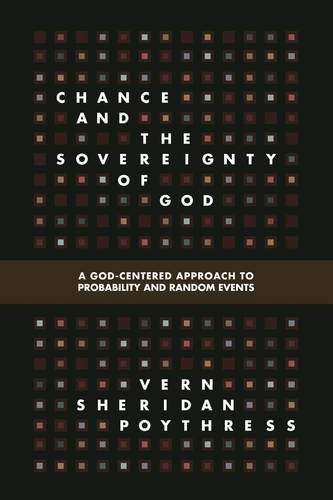 When I saw the title Chance and the Sovereignty of God: A God-Centered Approach to Probability and Random Events, I pounced on the opportunity to review it. This is a topic I’ve been considering for doctoral work so I was extremely excited to dive in.
The book starts off well, with discussions on the nature of chance and exploration of the biblical material for anything dealing with seemingly random events. Poythress ably shows that the Bible clearly presents God as in control of all these events. Numerous verses suggest that God is in control over “all” events, while verses which explicitly mention seemingly random or chance occurrences also attribute such events to divine knowledge and control. Poythress’ look into these topics is detailed and broad. He addresses the weather, random events like the toss of a die, human free choices, the life and death of the smallest creature or plant, and even gambling! These things are all argued to be ultimately, biblically under the sovereignty of God.
Another area the book excels in is the discussion of chance in rival worldviews. Any view which denies the centrality of God is one which suppresses the knowledge of God (Romans 1). Poythress notes that this means that “chance” may become a God-substitute. Chance is seen as being not only the explanation of events but their actual cause:
People are implying that [Chance] has the power to bring about events… The word chance first gets associated with events that we as humans cannot predict or explain… Then, in a second step… [Chance] becomes a label that we offer as the new explanation for the unpredictable event… We say “Chance brought it about”… (Kindle Location 1707)
Chance as an explanation, Poythress argues, is ultimately empty. For chance is substituted to become whatever we cannot predict or explain, and is then used itself as the explanation. I found Poythress’ comments here interesting and very insightful. His application of this concept to other worldviews later in the book makes it worth the read for these sections alone.
One difficulty with the book is the question of audience. At times, the discussion of probability theory becomes complex and very scholarly, but the earlier sections of the book speak broadly and with words that seem aimed more at a general readership. This mixture of technical and general writing makes it hard to pinpoint the audience. Who is supposed to read this book? What is it supposed to be used for?
Another problem I saw in the book is the lack of thorough argumentation for many points. No complaint of this nature may be lodged against the book’s discussion of probability theory, which is well fleshed-out. But on God’s relation to probability theory and how that relates back to sovereignty, there are often only a few sentences at a time to make a claim about the nature of the interrelationship. For example, throughout Section IV on “Probability and Mathematics,” there are lengthy discussions of probability theory with passages on how it relates back to God seemingly tacked on throughout. Near the beginning of this section, one sample is representative:
Both of these [mathematical] principles [discussed above] have their foundations in God… The separations within this world have their ultimate foundation in the distinction among the persons of the Trinity… The unity and diversity in outcomes rest… on the original pattern of unity and diversity in God. God has caused the creation to reflect his glory and wisdom. (Kindle Location 3346)
Poythress does make some earlier references to this argument, but it just never seems to be fully established and surely a statement about mathematical separations for probability in the world being a reflection of distinction among persons in the Trinity may cause some skepticism. It is a point which begs for more argumentation than was dedicated to it here. Where Poythress does address it (Chapter 11), we find more detail to the arguments, but even more questions left unanswered. For example, granting that God is revealed in all things which are made, why think that a sequence of flipping coins is explicitly a revelation of the Trinity instead of simply a revelation of God’s imbuing the universe with order and regularity so that seemingly random events are possible? But Poythress takes it as the former–a revelation of the Trinity–without so much as a comment on alternative possibilities.
Perhaps more problematic is that Poythress never seems to tackle the broader implications of his biblical argumentation. Yes, he put much work into showing God is sovereign over the weather, chance events, free will, and the like. But I kept thinking, “And now what?” What does it mean to say God is in control over natural disasters? What does it mean to say that the roll of dice I make in a game of Risk, for example, is controlled by God? What are the implications of the biblical data Poythress has set before me? Topics like these are taken up at points, only to be quickly set aside by a paragraph or even just a sentence or two.
Overall, Chance and the Sovereignty of God is an interesting look at an oft-neglected topic, but its scope is too broad and its argumentation at times too vague to be helpful. On biblical issues Poythress has offered much to consider. His outline of probability theory is helpful but technical. What I found after reading the book is that I continued to hope for a more detailed discussion on how sovereignty would interlink with chance. Yes, the book makes it plain that God has sovereignty over seemingly random events, but exactly how does that work? What does that mean for everyday life? At times these topics are taken up, only to be set down after but a few sentences. At times helpful and stunningly insightful, at other times frustratingly vague and broad, it’s a book that will leave you longing for more.
Links
Be sure to check out the page for this site on Facebook and Twitter for discussion of posts, links to other pages of interest, random talk about theology/philosophy/apologetics/movies and more!
Source
Vern Poythress, Chance and the Sovereignty of God: A God-Centered Approach to Probability and Random Events (Wheaton, IL: Crossway, 2014).

Disclaimer: I received a review copy of the book through Crossway. I was not obligated by the publisher to give any specific type of feedback whatsoever.
SDG.
——
The preceding post is the property of J.W. Wartick (apart from quotations, which are the property of their respective owners, and works of art as credited; images are often freely available to the public and J.W. Wartick makes no claims of owning rights to the images unless he makes that explicit) and should not be reproduced in part or in whole without the expressed consent of the author. All content on this site is the property of J.W. Wartick and is made available for individual and personal usage. If you cite from these documents, whether for personal or professional purposes, please give appropriate citation with both the name of the author (J.W. Wartick) and a link to the original URL. If you’d like to repost a post, you may do so, provided you show less than half of the original post on your own site and link to the original post for the rest. You must also appropriately cite the post as noted above. This blog is protected by Creative Commons licensing. By viewing any part of this site, you are agreeing to this usage policy.
Dinosaurs, Noah’s Flood, and Creationism- An ecological challenge
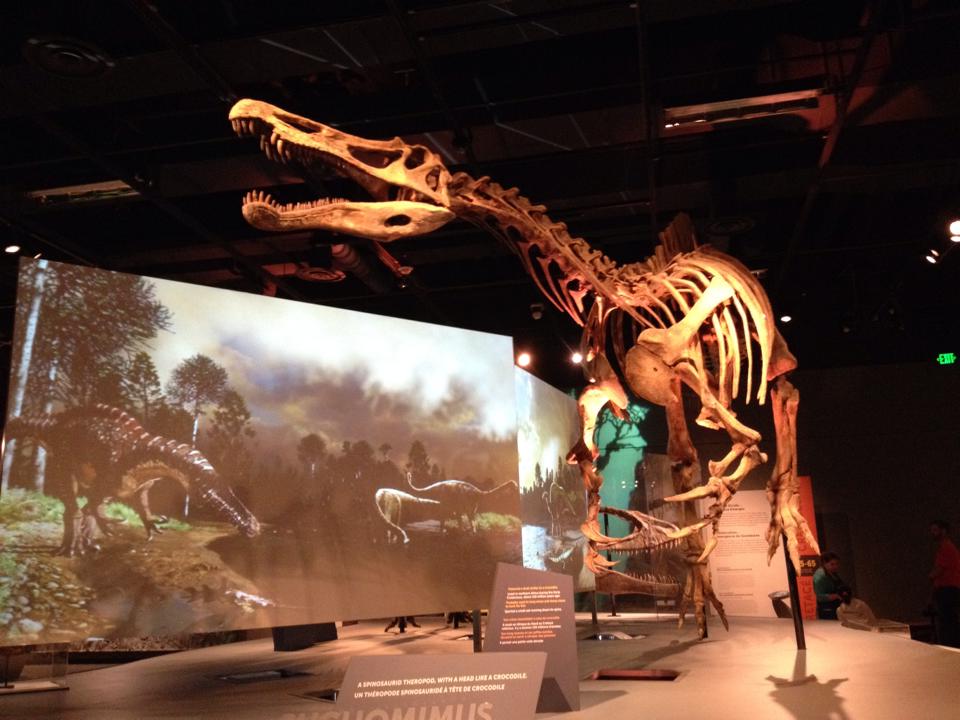 I recently visited the Science Museum of Minnesota to check out the exhibit “Ultimate Dinosaurs” which features a number of dinosaurs which aren’t typically displayed in North America. I heard one other museum-goer talking about how they always thought that dinosaurs just were dinosaurs–that they were the same all over the Earth. But they weren’t! In fact, there is great diversity in the types of dinosaurs found in different parts of the world. Some are found all over North America; others are restricted to small parts of Africa or South America.
That got me thinking on creationism. A standard young earth creationist account of the history of the world would state that dinosaur fossils are found where they lay because the Flood put them there. Many YEC accounts are catastrophic in nature, arguing that the Flood recreated the surface of the Earth and left most or all of the layers of sediment we now observe. The dinosaurs (and other creatures) we find were swept up in the Flood and then laid down once the water had settled.
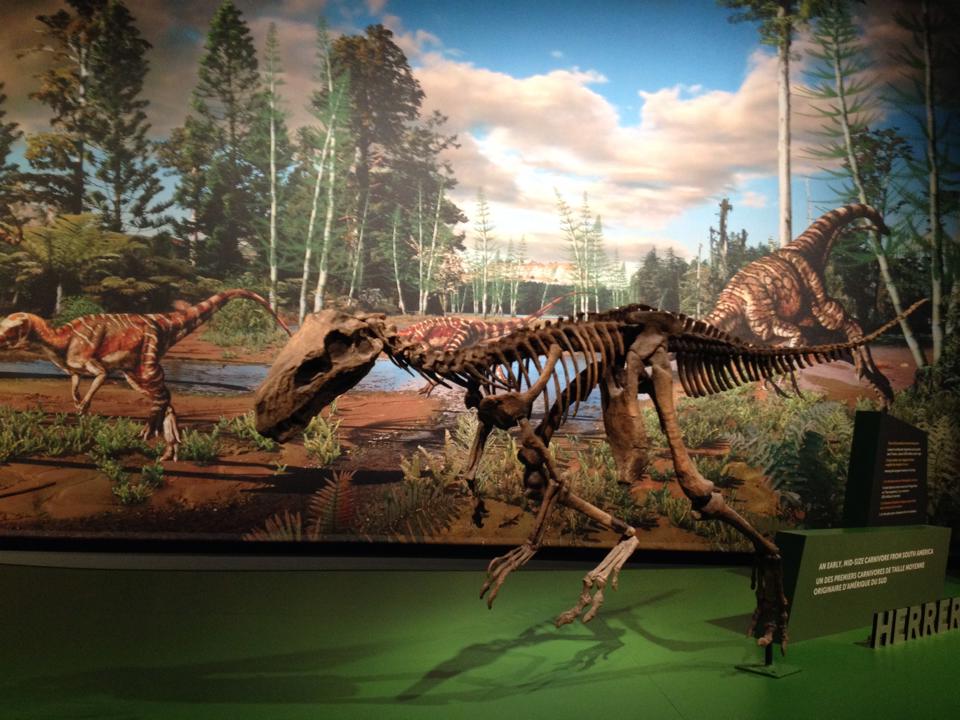
Pictured above and left, there is a fossil of a Suchomimus. Suchomimus was a fish-eating dinosaur which has only been found in Niger, Africa. According to standard scientific explanations, it lived in the Early Cretaceous period, about 121-112 million years ago. According to a young earth creationist account, this dinosaur died either during the Flood or migrated to the location it was found after the Flood. Either way, this was no more than a few thousand years ago. Pictured below and to the right, there is a fossil of a Tyrannosaurus Rex. It lived in the Late Cretaceous period, about 66-67 million years ago and ranged across what is now North America. Again, a young earth creationist account would have it dying during the flood or going extinct afterwards.
 The Young Earth Creationist Explanation- A problem?
The young earth creationist (YEC) account is once more generally based upon the notion that the Noachian Deluge deposited these fossils where they are now found. The Flood is to explain how these fossils ended up in their present locations.
The fact that dinosaurs are found in different parts of the planet–and only in those parts–suggests an interesting problem for YECs: How is it that such a catastrophic event managed to destroy the surface of the Earth and then remake it through layers while creating the illusion of localized ecosystems at different points in history?
Such a challenge should not simply be dismissed. YEC literature sometimes suggests that the fossilized ecosystems which are proposed in different parts of the world at different (millions of years ago) times are merely products of the Flood depositing the fossils where they now lay. For example, according to YEC literature, many scientists believe that there was an ancient sea over North America merely because the Flood happened to deposit a bunch of mosasaur fossils and other marine life in a certain layer of the sediment it laid down.
The observed evidence, however, goes against this notion. Consider the Suchomimus (pictured above, left) once more. It has been found only in a localized area in what is now Africa. It is nearly certain it was a fish eater. This notion is not a mere product of accidental laying down of fish fossils near and around where Suchomimus has been found. Instead, it is based upon observational evidence. First, its large claws seem perfectly adapted to snagging large lungfish along the shore (large lungfish fossils have been found in the same area). Second, its narrow skull lined with extremely pointy teeth suggest a fishy diet, as it is once more adapted to eating them. Third, and most telling, fish fossils have been found with tooth marks from Suchomimus on their bones.
So what? How does this bring up a problem for YEC? Well, to put it simply, it demonstrates that the localized ecosystem found near and around Suchomimus is not a mere random product of fossils being jumbled together and then deposited during the Flood. Instead, predator and prey are found in a localized environment with other fossil specimens that fit neatly into the same ecosystem. But on the YEC account, how could this happen? Surely it would be an astounding happening if an entire ecosystem were swept away by the Flood, jumbled up with others along with sediment and the like, subjected to tidal waves across the surface, and then neatly deposited in a localized area, preserving that same ecosystem.
 A Possible Alternative
Some YECs (such as Kurt Wise) have instead suggested that the Flood did not destroy the whole surface of the Earth but was rather providentially brought about by God along with catastrophic plate tectonics. On this scenario, water rapidly rose and covered the face of the Earth, bringing with it sediment and the like which rapidly buried such localized ecologies.
Setting aside difficulties with such a scenario related to the means by which it would have allegedly occurred, it should be clear that this explanation is at least somewhat more palatable. It doesn’t turn ecosystems into mere fictions. However, this scenario doesn’t solve everything. For example, why are there separate and distinct ecosystems, one atop the other, in the same place? Going to North America, Tyrannosaurus Rex has been found across much of what is now North America. Again, we find prey with T-Rex tooth marks in their bones and the like. We have preserved ecosystems from this time. But different places (like the inland sea I discussed here) feature what appears to be a marine environment. Moreover, different layers, like those exposed through glaciation in the upper Midwest, show entirely different (and seemingly more primitive) marine lief. This raises a number of issues, most of which are relevant for any alleged Flood scenario.
First, if the Flood was a sudden event which covered the face of the Earth and thus preserved ecosystems in place, how did it manage to kill off and bury so much marine life? It seems like it must have been gentle enough to preserve the fossil evidence, so why did the marine life not simply swim away and get scattered across other layers as it died? Second, how do we have distinct and separate ecosystems preserved in different layers, one atop the other? Again, the suggestion was that ecosystems were preserved in place–so why do some places have different ecosystems above one another? Third, why are the types of sediment laid down distinct for each ecosystem? If the sediment was all due to one event, then why does the sediment type match the ecosystems which it buries?
 The Balance of Evidence
At this point, I think we must remember that we may evaluate such claims from a number of angles. First, the YEC explanations seem very ad hoc–that is, they are invented by adjusting the Flood scenario (or some other device like distant starlight moving faster)–in order to explain away the difficulties rather than pursuing the evidence. It is reactionary rather than investigative. [I edited this line after some insight from a comment below.]
Second, realistically, which portions of the YEC explanation might be found in the Bible, if any? Having read the accounts of the Flood and Creation many times, I have to say I have never once spotted a place wherein it discusses the distribution of dinosaurs, the way the Flood laid down sediment, or any number of things put forward by YECs.
Third, when YECs and others are offering alternative scientific explanations–i.e. an explanation for “how did this [dinosaur] get here?”–they must deal with the fact that we’re looking for the most likely explanation. As I discussed in another post on dinosaurs and creationism, the proposed alternative YEC explanation is very clearly more complex and less likely than that of the one already offered–that the dinosaurs simply existed at different times and/or in different places over the course of history. We should be honest in our evaluations of evidence and look to see which explanation is more likely. Remember, we should be investigating the evidence while trying to stay free of any a priori assumptions about what must have happened and instead look at the evidence to see which explanation best fits. As I pointed out in the post linked above, proposing a global catastrophic Flood as the alternative hypothesis demands an enormous burden of proof.
Links
Be sure to check out the page for this site on Facebook and Twitter for discussion of posts, links to other pages of interest, random talk about theology/philosophy/apologetics/movies and more!
“Oceans of Kansas,” Unexpected Fossils, and Young Earth Creationism– I discuss the alleged findings out out-of-sequences fossils in the fossil record and how YEC explanations fail to show they are attributable to a global catastrophic Flood.
What options are there in the origins debate? – A Taxonomy of Christian Origins Positions– I clarify the breadth of options available for Christians who want to interact on various levels with models of origins. I think this post is extremely important because it gives readers a chance to see the various positions explained briefly.
The photographs in this post were taken by me at the Science Museum of Minnesota with permission. Any use of these pictures should be only with express, written consent. The map is an image created by BBC and I do not claim any rights over it but use it through fair use.
SDG.
——
The preceding post is the property of J.W. Wartick (apart from quotations, which are the property of their respective owners, and works of art as credited; images are often freely available to the public and J.W. Wartick makes no claims of owning rights to the images unless he makes that explicit) and should not be reproduced in part or in whole without the expressed consent of the author. All content on this site is the property of J.W. Wartick and is made available for individual and personal usage. If you cite from these documents, whether for personal or professional purposes, please give appropriate citation with both the name of the author (J.W. Wartick) and a link to the original URL. If you’d like to repost a post, you may do so, provided you show less than half of the original post on your own site and link to the original post for the rest. You must also appropriately cite the post as noted above. This blog is protected by Creative Commons licensing. By viewing any part of this site, you are agreeing to this usage policy.
Sunday Quote!- Scripture Reports Things that Didn’t Happen?
 Every Sunday, I will share a quote from something I’ve been reading. The hope is for you, dear reader, to share your thoughts on the quote and related issues and perhaps pick up some reading material along the way!
Scripture Reports Things that Didn’t Happen?
I finished reading Four Views on The Historical Adam recently, and it gave me a lot of food for thought. The only view which categorically denied the existence of an historical Adam was written by Denis Lamoureux. Regarding the reports of the natural world found in the Bible, he wrote:
God’s very words… in the [Bible] do not align with the physical reality in the Book of [Nature]. To state the problem more incisively, Holy Scripture makes statements about how God created the heavens that in fact never happened. (54, cited below)
I think it is pretty clear this is a highly contentious claim. Interested readers should read the book to get the full context, but basically Lamoureux was saying that some aspects of the physical world found recorded in Scripture do not line up with reality. What did he do with this statement? Immediately after this text, Lamoureux wrote:
So, to ask the question once more, “Did God lie in the Bible?” Again, my answer is “No! The Lord accommodated in the Bible.” (54)
In other words, his answer was that God accommodated to the scientific beliefs of the people in their time in order to convey spiritual truths.
It seems to me that this way out is questionable, and each of the other authors commented on it. Three quick issues I have are that the reading of the various texts Lamoureux cites do not support his claim; that the notion that God intentionally brought about recording of falsehoods in God’s Word requires a stronger answer than accommodation; and that although accommodation is a valid category, the linking of theological truths to specific claims about natural history makes the reading of accommodation in regards to Adam problematic.
What are your thoughts? Do you think there is accommodation in the Bible? Is accommodation a strong enough answer for the claim that God may have allowed false statements recorded in God’s Word? Are there other alternatives you prefer?
Links
Be sure to check out the page for this site on Facebook and Twitter for discussion of posts, links to other pages of interest, random talk about theology/philosophy/apologetics/movies and more!
Source
Denis Lamoureux, “No Historical Adam: Evolutionary Creation View” in Four Views on The Historical Adam eds. Matthew Barrett and Ardel Caneday (Grand Rapids, MI: Zondervan, 2013).

 J.W. Wartick - Reconstructing Faith