Archive for
“X-Men: Days of Future Past” – A Christian Perspective
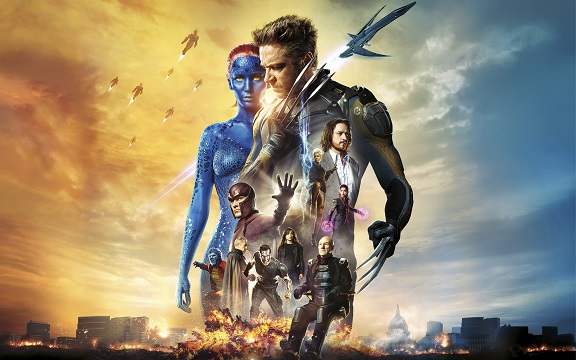 The X-Men franchise has been my favorite of the Marvel franchises for some time, largely because of the worldview questions it brings up. Here, we’ll take a look at the themes in “X-Men: Days of Future Past.” There will be SPOILERS for the film in what follows.
Evolution
Evolution continues to be at the heart of many of the questions raised by the X-Men franchise. What does it mean to say that Mutants are perhaps the next step in evolution for humanity? For some, it means that Mutants should overthrow humanity; after all, they are the lesser-evolved form of life. How should humans and Mutants interact? Are they really a step of evolution, or is it simply a different expression of humanity?
These questions are obviously speculative, but I think the most poignant of them center around the notion of an evolutionary morality. If all we see is merely the product of naturalistic evolution without any sort of grounding for objective morality, who is to say that those Mutants and humans who say that there is a fundamental war between Mutants and humanity are wrong? It seems as though they are exactly right: it is a competition for resources, pure and simple. Yet the questions the movie brings up go beyond such simplistic reasoning. After all, it seems, there is right and wrong that goes beyond the reasoning centered around survival-of-the-fittest. Again, we must wonder: why? Moreover: how is it grounded? These questions get at the heart of worldview questions, and viewers who are left thinking that it is wrong to perpetuate a war between Mutant and human should wonder what grounds they have for thinking it is wrong.
The Heart of Hum…utant?
Many strands of Christian expression view humanity as depraved. That is, humans are sinful at heart, rather than being generally good. “Days of Future Past” aligns with this vision of humanity in a number of ways, but it also, interestingly, portrays mutants as just as frequently evil-leaning as humankind.
The inherent fear of the “Other” was felt throughout, as both Mutant and human worked to destroy each other. However, Mystique’s quest for revenge was a deeper look at aspects of character and worldview. Her quest, despite it being a futile gesture, was telling: she sought revenge despite the possibility that it could destroy all of her own kind. Professor X’s words, however, echoed through time: “Just because someone stumbles and loses their way doesn’t mean they are lost forever.” Mystique, through her choice to refuse to pursue the way of violence into oblivion, ultimately plays a kind of figure of reconciliation. The theme of darkness in the heart which may be redeemed is one which resonates powerfully with the Christian worldview.
A Spectrum of Morality
I think one area that is not explored frequently enough is the notion that there really is a spectum when it comes to that which is moral. I’m not advocating any kind of relativism, but rather the notion that there aren’t always (or even often) black and white moral choices. “Days of Future Past” brings this to the forefront as viewers are confronted with various ways to approach the question of the Mutant. Does one opt for a warfare model which is put forth by Magneto and Dr. Trask, a model which allows for coexistence with separation/secrecy as was generally being followed in the 1970s of the film, or perhaps even cooperation as Dr. X seeks? Perhaps instead, one should forge one’s own way like Mystique or (old) Wolverine, seeking a personal agenda in order to follow one’s own ends.
These aspects are front-and-center throughout the film, as viewers most likely will unconsciously lean towards a certain expression themselves. We discussed above the aspects of evolutionary morality, but I think the movie goes even deeper, trying to get at more basic questions like “What is truth?” and “What is moral/right?” The way viewers answer these questions may lead to further conversations. It seems to me the film clearly favored the kind of mediation road in which Mutant and Human could coexist. But what does that mean for those who favored evolutionary morality or a warfare model? Perhaps such notions are themselves outdated and put to rest because they are of a “Future Past.”
Conclusion
The latest X-Men movie has received much critical acclaim and box-office success. I think that’s for a good reason. It has a compelling plot, great action, and excellent pacing. Our analysis of various themes throughout the movie shows there is thoughtfulness behind it as well. Issues of morality are front and center, though many other themes are worth discussing as well. This is a movie that could be used to start discussions about the faith from many different aspects.
There are many more issues which could be explored in the movie. What are some that resonated with you? Let me know your own thoughts in the comments.
Links
Be sure to check out the page for this site on Facebook and Twitter for discussion of posts, links to other pages of interest, random talk about theology/philosophy/apologetics/movies and more!
Movies– Read other posts I have written on the movies. Scroll down to see more!
The image is a movie poster for the film and I use it under fair use.
SDG.
——
The preceding post is the property of J.W. Wartick (apart from quotations, which are the property of their respective owners, and works of art as credited; images are often freely available to the public and J.W. Wartick makes no claims of owning rights to the images unless he makes that explicit) and should not be reproduced in part or in whole without the expressed consent of the author. All content on this site is the property of J.W. Wartick and is made available for individual and personal usage. If you cite from these documents, whether for personal or professional purposes, please give appropriate citation with both the name of the author (J.W. Wartick) and a link to the original URL. If you’d like to repost a post, you may do so, provided you show less than half of the original post on your own site and link to the original post for the rest. You must also appropriately cite the post as noted above. This blog is protected by Creative Commons licensing. By viewing any part of this site, you are agreeing to this usage policy.
“Edge of Tomorrow” – Sacrifice, Brutality, and Choice
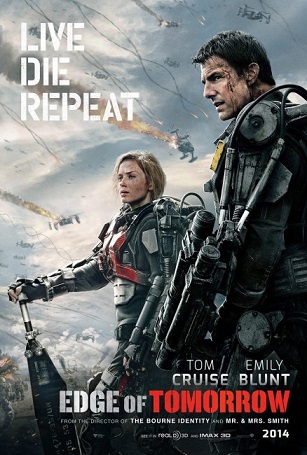 Live. Die. Repeat.
I had the chance to watch “Edge of Tomorrow” this past weekend and I was surprised by how much I enjoyed the film. It was fantastic. Here, I’ll discuss several themes found in the movie from a worldview perspective. There will be SPOILERS in what follows. I will not summarize the plot, but a summary may be found here.
Choice
Major William Cage (Tom Cruise was brilliantly cast for this role) is presented with a number of choices throughout the film, and it becomes clear that he is not a typical save-the-world type of hero. He is flawed, he has passions, he loses hope. But throughout these aspects of the film, we find the notion of choice. Will Cage has been given an extraordinary opportunity to impact the entire human race. When his blood is mingled with that of an Alpha, his death sets off the “Omega” which resets the day. Over and over again, Cage is faced with a choice: what do I do with this day?
He finds Sergeant Rita Vrataski, who is one of the only people who also realizes what’s happening, though she herself doesn’t remember the days. The question, again, is what do I do with this day? Cage’s character is forced to consider that he has the ability to possibly save all of humanity. In such a situation, what choice does he have? But he does make some choices: he chooses to try to save Rita, to save others. But at other times, he gives in to frustration, allowing members of his squad to die despite being able to prevent it. Cage is not a knight in shining armor, but he confronts us with a human thrown into an impossible situation with the highest possible stakes.
Placing the concept of choice against such a backdrop makes for good drama, but it also begs the question: what are you doing with your day? From a Christian perspective, the choices we make are extremely important–we are called to be witnesses, lights to the world–but do our choices each day reflect that? Do we, like Cage, sometimes allow injustices despite having to put forth just a little extra effort? How do our choices impact our life in Christ? The movie demands that we answer questions like these.
Sacrifice
Cage is also confronted with a kind of self-sacrifice. By admitting he is what he is, he must go through a cycle in which he dies continually, in often brutal ways, in order to try to improve, to save humanity. It is sacrifice, but a sacrifice knowing that he will be back the next day. One must ask, I think, whether that actually diminishes the sacrifice. I don’t think it does. Cage must steel himself each day knowing that death will come again, and again, and again. The only way to prevent it is to save all of humanity by destroying the Omega. Though, in the end, Cage ultimately does give up his life for humanity, only to be brought back by having his blood mingled with that of the Omega. One is left wondering whether he will retain the power or not.
The self-sacrifice of Cage (and Rita) for the sake of humanity is clearly a theme which resonates with the central Christian teaching of Jesus Christ as crucified and resurrected Lord. However, beyond the obvious parallels of giving up life for the sake of all (and subsequent resurrection/awakening), the sacrifice of going in knowing one is to die is something that resonates with the story of Christ. I have sometimes seen a challenge issued theologically to the Christian teaching saying Jesus didn’t really sacrifice himself if he knew he was going to be risen by God. But of course that hardly destroys the notion of self-sacrifice and the real price paid of death. Being risen does not destroy the sacrifice of death.
Brutality
Live. Die. Repeat.
The theme is echoed throughout the film. It may cause one to wonder about the brutality of such a story and its appropriateness, but I think that from a Christian perspective one has to incorporate the rest of the themes found in the movie. The brutality of the cross is itself something from which people shy away, but set against the backdrop of salvation, brutality can become sanctified.
Community/Individual
I have not read the manga that “Edge of Tomorrow” was based on, “All You Need is Kill,” but I have heard that there is some juxtaposition over the primacy of the community vs. individual in either. “Edge of Tomorrow” shows this kind of valuation in many ways throughout the film. First, there is Cage’s continued efforts to save Rita, despite what it might cost–including going on one part of the mission alone in order to prevent her death. Second, there is the concept of both Cage and Rita valuing the community of humanity over the self by willingly spending all the time they have left trying to defend humanity rather than find a way to survive themselves. Finally, both Cage and Rita choose to place the community over the self when rather than trying to save one or the other, they both do what needs to be done and give themselves to save humanity.
For Christians, themes of community and individual are extremely important. It is easy in the Western mindset to become obsessed with the self, but a true community of individuals exists in the body of Christ–each as important as the next. How do we go about living our lives in light of this truth?
Conclusion
There are many other themes to be explored from “Edge of Tomorrow”- what of the Alpha/Omega? What happens to Cage and Rita after the end of the film? Were there any efforts to try to make peace or reach out to the “Mimics”–the aliens that they fight against throughout the movie? These are important themes, and I’d love to get discussion of those started in the comments. For now, it should be clear that the film has many themes to reflect upon and it is well-worth seeing. What did you think of the movie? What other themes have you thought of in relation to it? Let’s get your thoughts in the comments below!
Links
Be sure to check out the page for this site on Facebook and Twitter for discussion of posts, links to other pages of interest, random talk about theology/philosophy/apologetics/movies and more!
All You Need Is Kill/Edge of Tomorrow– “Edge of Tomorrow” is based upon this graphic novel. Check out Anthony Weber’s excellent review and critique of the graphic novel from a Christian perspective. I really recommend you follow his blog as well. It’s in my top five must-read blogs, and it is worth your time to browse at length.
Movies– Read other posts I have written on the movies. Scroll down to see more!
The image is a movie poster for the film and I use it under fair use.
SDG.
——
The preceding post is the property of J.W. Wartick (apart from quotations, which are the property of their respective owners, and works of art as credited; images are often freely available to the public and J.W. Wartick makes no claims of owning rights to the images unless he makes that explicit) and should not be reproduced in part or in whole without the expressed consent of the author. All content on this site is the property of J.W. Wartick and is made available for individual and personal usage. If you cite from these documents, whether for personal or professional purposes, please give appropriate citation with both the name of the author (J.W. Wartick) and a link to the original URL. If you’d like to repost a post, you may do so, provided you show less than half of the original post on your own site and link to the original post for the rest. You must also appropriately cite the post as noted above. This blog is protected by Creative Commons licensing. By viewing any part of this site, you are agreeing to this usage policy.
Sunday Quote!- The New Atheist Mythology
 Every Sunday, I will share a quote from something I’ve been reading. The hope is for you, dear reader, to share your thoughts on the quote and related issues and perhaps pick up some reading material along the way!
The New Atheist Mythology
I recently finished reading The New Atheist Novel: Fiction, Philosophy and Polemic after 9/11. The book was simply phenomenal as it applied critical theory to four novelists in order to draw out various themes in their works and parallels with the writings of the “New Atheists.” I’ll write up a review at some point, but for now I want to highlight the central theme of the book:
[I]t is possible to detect an obscure… reason for the massive popular appeal of the New Atheism: it constitutes a new and powerful creation mythology that–like all mythologies–performs an implicit anthropological service… For Dawkins… it has become de rigueur to wax lyrical about, say, the ‘breathtaking poetry of modern cosmology’ (whatever that means) even amidst attacks on the ‘fairy story’ that is monotheism. (7, 9, cited below)
The book analyzes various novels in light of this theme: that the New Atheists are, in a sense, creating a rival mythology to the monotheism they denigrate, and this expands into literature in various and interesting ways. In a sense, this mythologizing about the power of the human mind, the wonders of the cosmos, or the beauty of poetry is a project to create transcendence in a worldview which, by definition, rails against the transcendent. It is a kind of creation myth which allows for meaning to seep into the meaningless.
What do you think? Can humans live without a mythology? Is wonder a necessary part of the human condition? Why do you think that even the “New Atheists” have put forward such lyrical and mythological language in their writings?
As I said, I’ll try to get a review of this book up ASAP.
Links
Be sure to check out the page for this site on Facebook and Twitter for discussion of posts, links to other pages of interest, random talk about theology/philosophy/apologetics/movies and more!
Sunday Quote– If you want to read more Sunday Quotes and join the discussion, check them out! (Scroll down for more)
Source
Arthur Bradley and Andrew Tate, The New Atheist Novel: Fiction, Philosophy and Polemic after 9/11 
SDG.
Question of the Week: Favorite Name in the Bible
 Each Week on Saturday, I’ll be asking a “Question of the Week.” I’d love your input and discussion! Ask a good question in the comments and it may show up as the next week’s question! I may answer the questions in the comments myself.
Favorite Bible Name
My wife and I are eagerly anticipating our firstborn, and part of that, of course, is picking out names. Because of this, I have had names on my mind, and I thought I’d ask you, dear reader, for your own thoughts:
What’s your favorite name in the Bible? I’m not asking for your favorite person, but rather the name you enjoy the most. Why is that one your favorite?
I look forward to reading your answers!
Links
Be sure to check out the page for this site on Facebook and Twitter for discussion of posts, links to other pages of interest, random talk about theology/philosophy/apologetics/movies and more.
Question of the Week– Check out other questions and give me some answers!
SDG.
Really Recommended Posts 6/13/14- Defining Faith, Bible Popularity, Aquinas, and more!
 Check out these posts from all over the web, collected for your own viewing pleasure by yours truly. If you enjoyed the posts, drop them a comment! Let me know what you think here. Thanks for stopping by, now go read!
The Least Popular Book in the Bible– I found this to be one of the most fun posts I have read in a long time. I really encourage you to check it out. But Don’t Cheat! Leave a guess as to which Bible book is least popular before you head over and find out! The post also gives reasons to read the book, so you may get some good reading in.
Is the Bible’s Definition of Faith Opposed to Logic and Evidence?– In light of the recent debate between Boghossian and McGrew on “Is Faith a False Epistemology?” (see my summary and analysis here), I found this post extremely insightful. What does the Bible say about faith? What kind of definitions does it give? Check out this great post on these questions.
Aquinas’ First Way (image)– Be sure to zoom in on this one! It’s a pictorial way to look at the “First Way” of Aquinas to reason to the existence of God. I think there are a couple problems with the exposition, particularly in speaking of water as only potentially cooling, but it is a good, basic introduction. Check it out.
Did Jesus Ride Two Animals Into Jerusalem?– How might we reconcile apparent differences in reports over how Jesus rode into Jerusalem? Check out this post to read up on a few ways, alongside some analysis. It’s well worth the time spent!
Book Review: The New Perspective on Mary and Martha– Drawing from Luke 10:38-42, Mary and Martha are often seen as quintessential examples of how to focus on Christ. But what message do we often get about/from them? Is there a corrective for some of the wrong pictures we may have? This review gives some insight into these and other questions.
Raise Up a Child: My father-to-be Father’s Day Reflection
Start children off on the way they should go,
and even when they are old they will not turn from it. (Proverbs 22:3, NIV)
I am going to be a father in September, provided baby isn’t born a week earlier in August. The anticipation of this joyous day has been building for some time as we await our firstborn child. We aren’t finding out if the child is a boy or girl, which increases the anticipation as we look forward to seeing our son or daughter’s face! I have been able to feel baby kicking several times now, and the wonder of the child growing is incredible.
As an avid reader, of course, I have turned to some books to say what it is like to be a father, but more importantly, I have looked to the Scriptures to see what it has to say about raising children. The verse above is one which I hope to emulate in my own life as a father. Of course, the natural question to follow, then, is “What is the way they should go?” There are a number of answers throughout the Bible provided for this, but at their core is this: follow God, bring forth justice. I hope I am able to instill a desire for these things in my child(ren).
There are so many voices providing insight into raising children. Do this, don’t do that, don’t worry about it, ignore all advice [except this!], etc…. The dissonant voices are helpful, but they bring with them much concern: there is so much to know, and I know that I will blunder at times. At those times, I will seek forgiveness, hoping that they will become moments where my child will see the way he or she should go.
We’ve also been looking at names, going through name books to see which we like the sound of, what kind of references they may make, how they may shape the person we will be caring for for many years. It’s an exciting adventure, but I also realize it is only one of many moments of excitement to which I look forward.
But then, I think of something else: a child is not born into a single family. The child is born into a community. They will be born again through baptism into a community of believers. So you, fellow believers, I ask for your prayers. Help me to raise up a child. Pray, praise, and give thanks with me!
Raise up a child…
What does it mean now? In this day and age, how do we “start [our] children” on the right path? We will seek to teach them God’s word, to teach them the ways to walk in. But we also have other concerns: we don’t want to limit them to one way of thinking, or one way of being. How do we allow the freedom for these things, while correcting where needed?
So as Father’s Day approaches, I look forward to my firstborn child. My wife and I are considering questions like these, and many more. But there’s one thing I do know: God will guide us.
Book Review: “To the Ends of the Earth” by Michael Haykin and C. Jeffrey Robinson Sr.
 The question of “Why evangelize?” is one which is often leveled against Calvinism. After all, it is reasoned, if people are fore-ordained to be elect or one of the damned, then why bother to go out and evangelize them? Interestingly, this is a charge which I think may be leveled against virtually any view of foreknowledge, so the Calvinist answers given in To the Ends of the Earth: Calvin’s Missional Vision and Legacy
Contents
The book begins with a survey of the arguments made to suggest that Calvinism would not endorse evangelism or makes evangelism pointless. Clearly, the charge has come from many fronts throughout the history of the church. Then, Haykin and Robinson introduce the primary reason for others’ concerns about Calvinism’s evangelical prospects: that Calvin believed God had ordained some to be elect, and others to be damned, before the foundations of the world.
The authors defend the doctrine, taking on many of the key “all” passages which some argue make explicit the openness of salvation to all individual people. Calvin is brought to his own defense alongside a number of modern Calvinist theologians, ably presenting the Calvinist case for exegesis of these key passages, which basically is that when “all” or “world” is used, it is referring to the breaking open of salvation for all tribes and nations as opposed to merely the chosen people of Israel. The book goes beyond these basics and also outlines how other passages might be understood in this context.
Next, the authors turn to an exposition of Calvin’s theology of missions. Part of this theology was the notion that a Christian life lived was a profound witness to the Gospel. Word and deed were central to Calvin’s missions theology. This missional activity was to be for all people (Kindle location 993). Prayer was also central to Calvin’s theology, as he believed that it might be used by God to bring about change in persons (rather than change in God).
Historical Reformed missions are surveyed in the next sections. Calvin taught many going into France and certain torture and death if discovered, and even made significant efforts towards (ultimately failing) missions into Brazil. These efforts showed that through his actions, Calvin himself valued global missions.
Later Calvinist traditions and persons also demonstrated the urge to missions that the Reformer’s theology compelled. The Puritans sought to evangelize and frequently prayed for the same, though they may not have had the success of other contemporaries. Calvinist Baptists in England feverishly evangelized and planted churches, while also demonstrating concern for global evangelism (Kindle loc. 1420ff). Jonathan Edwards, contrary to some opinions, was also focused on missions by developing his own missional theology and also going on a mission to Native Americans himself.
The book closes with thoughts on “developing missional passion” through observations about Samuel Pearce, a theologian known in his time for fervent prayer and love of missions. Central to Pearce’s theology was the cross; Christ crucified was “his darling theme from first to last”; while the other primary theme of his life was a “passion for the salvation of his fellow human beings” (Kindle loc. 1978).
Evaluation
To the Ends of the Earth is a great, pithy read on a topic that should be of interest to many from a diverse array of backgrounds. It has appeal which goes beyond Calvinism in the way it demonstrates missions ought to be of central importance and also in its justification of missions even in light of the notion that there really do exist an elect people. Of course, the thrust of the book is to demonstrate that Calvinist theology does not undermine the need or motivation for missions. Those interested in that topic will find the most to benefit from the book. Regardless of one’s level of interest, however, the book generates its own avenues for exploration by introducing several little-known figures and historical events for further reading. It is short enough to enjoy in a single afternoon (as I did), yet deep enough to keep one’s mind occupied for some time afterwards.
Perhaps the greatest weakness of the book, however, is its length in that there is little ultimate exposition of the counter-arguments to those who would fault Calvinism with lack of evangelical fervor. That is, readers are often left to tie the arguments off themselves instead of having them drawn out and defended. This, however, is a minor fault in what is an otherwise excellent book, regardless of one’s position on the arguments made therein. It was well worth the read, in my humble opinion.
Links
Be sure to check out the page for this site on Facebook and Twitter for discussion of posts, links to other pages of interest, random talk about theology/philosophy/apologetics/movies and more!
Source
Michael Haykin and C. Jeffrey Robinson, Sr., To the Ends of the Earth: Calvin’s Missional Vision and Legacy
Disclaimer: I received a review copy of the book through Crossway. I was not obligated by the publisher to give any specific type of feedback whatsoever.
SDG.
——
The preceding post is the property of J.W. Wartick (apart from quotations, which are the property of their respective owners, and works of art as credited; images are often freely available to the public and J.W. Wartick makes no claims of owning rights to the images unless he makes that explicit) and should not be reproduced in part or in whole without the expressed consent of the author. All content on this site is the property of J.W. Wartick and is made available for individual and personal usage. If you cite from these documents, whether for personal or professional purposes, please give appropriate citation with both the name of the author (J.W. Wartick) and a link to the original URL. If you’d like to repost a post, you may do so, provided you show less than half of the original post on your own site and link to the original post for the rest. You must also appropriately cite the post as noted above. This blog is protected by Creative Commons licensing. By viewing any part of this site, you are agreeing to this usage policy.
On the Feminization of Christianity
Christianity is being feminized–men just don’t go to church anymore!
Worship is so feminine now, with all of its appeals to emotions.
Christianity has a “masculine” feel to it.

I had a conversation recently in which several men were bemoaning the “feminization of Christianity,” particularly worship. I asked them what they meant by this and one man illustrated it with a story: he was at a church one time and this guy was up front singing this lovey-dovey song he had written about how Jesus loved him and wanted to hold him or something and he–the one telling the story–thought it was ridiculous. This, he said, was an example of the feminization of worship. It makes men leave the church.
I pointed out that his example was about a man singing a song written by a man–himself–leading worship in a church in which (the man had told me) the only leaders were men. He nodded and reiterated his point. …This, it seems, is the result of feminizing the church.
I thought that was rather odd, to be frank, but the conversation has stuck with me for its message. I’ve had many like it over the past year or two. I’ve seen fellow bloggers post on this apparently insidious trend of the “feminization of Christianity.” A prominent apologist recently issued a similar complaint, noting that worship has gotten more “emotional” and therefore more “feminine.” Some theologians and books I’ve read have had similar concerns about this “feminine” aspect being brought into churches. Apparently, from my reading of these sources and the conversations I’ve had, the message is that this is A Bad Thing.
Do you really think that Christianity is masculine? What does that even mean?
What does it mean to say worship is “feminine” or “masculine”? Does that mean that if I, a man, worship, then my praise is somehow “manly,” while my wife’s praise is “womanly”?
I want to focus on this notion that “feminization of Christianity” is A Bad Thing. What does this say about men and women?
It seems to me that if feminizing Christianity inherently makes it somehow deficient, then that means females are also deficient. If “feminized” worship is bad, or at least not as good as “masculine” worship–whatever either one of those things means–then that means that what are identified as male patterns of worship have higher value. But can such patterns really even be identified? If “feminization of the Church” is to be avoided, while making it more “masculine” is to be lauded, then what does that say about our position, male and female, as the image of God? On the one hand, humanity, male and female, were each created in God’s likeness, in the image of God. On the other, we are told that “feminine” themes within Christianity are to be avoided and downplayed, while “masculine” themes are to be pursued and emphasized.
The most common answer I’ve gotten to questions about the nature of masculine or feminine worship is that that which is feminine is emotional or passive, while masculine is rational or active. I would like to ask: how is this reflected in God’s Word? Recall that God gets angry (Psalm 7:11) or grieved by sin (Genesis 6:6), takes pleasure in obedience (Psalm 147:111), delights (Zephaniah 3:17), etc. God is a God with emotions and whether we set this aside as anthropomorphism or not, it seems clear that Scripture understands God not rejecting emotions but rather, in some sense, taking part in them. But if God’s Word does not denigrate emotions and even attributes them to God, why should we not worship in emotional ways? And why are emotions treated as something to be avoided, as necessarily feminine and somehow not good, or at least not as good as that which is identified as masculine?
I’m not trying to advocate for one side or the other in the so-called “worship wars.” Instead, my point is that the narrative of complaints about the “feminization of Christianity” is misguided and far from the truth. Being female is not bad, nor is it somehow less perfect than being male. Similarly, having a “feminine” Christianity is not an imperfection. To be honest, I’d like to call my Christian brothers and sisters to a more complete understanding of God and God’s word.
There is hope for us that applies to us all as people:
There is neither Jew nor Gentile, neither slave nor free, nor is there male and female, for you are all one in Christ Jesus. – Galatians 3:28
These are words of hope, words of reconciliation. But they are also words which cut against the notion that in our church there is masculine worship vs. feminine worship; masculine music vs. feminine music; masculine sermons vs. feminine ones. “Nor is there male and female… you are all one in Christ Jesus.” My heart leaps at these words. These words tell me I need have no fear, for our God–a great God–has reconciled us in our Lord Jesus Christ.
Links
Be sure to check out the page for this site on Facebook and Twitter for discussion of posts, links to other pages of interest, random talk about theology/philosophy/apologetics/movies and more!
Check out my posts on egalitarianism – the belief that men and women are equally qualified and called in the church and home (scroll down for more).
I found the image on Bing searching for images of worshipers in church and I claim no rights to it and saw no claims to rights upon it.
SDG.
——
The preceding post is the property of J.W. Wartick (apart from quotations, which are the property of their respective owners, and works of art as credited; images are often freely available to the public and J.W. Wartick makes no claims of owning rights to the images unless he makes that explicit) and should not be reproduced in part or in whole without the expressed consent of the author. All content on this site is the property of J.W. Wartick and is made available for individual and personal usage. If you cite from these documents, whether for personal or professional purposes, please give appropriate citation with both the name of the author (J.W. Wartick) and a link to the original URL. If you’d like to repost a post, you may do so, provided you show less than half of the original post on your own site and link to the original post for the rest. You must also appropriately cite the post as noted above. This blog is protected by Creative Commons licensing. By viewing any part of this site, you are agreeing to this usage policy.
Sunday Quote!- Reframe the Origins Debate?
 Every Sunday, I will share a quote from something I’ve been reading. The hope is for you, dear reader, to share your thoughts on the quote and related issues and perhaps pick up some reading material along the way!
Reframe the Origins Debate?
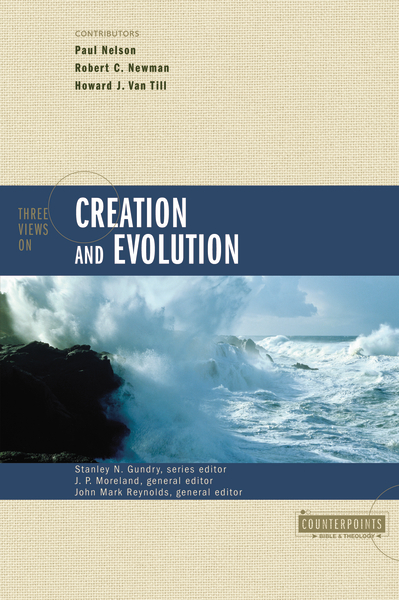
I have been going through a number of books in the Zondervan Counterpoints series and completed Three Views on Creation and Evolution
Is the creation’s formational economy sufficiently robust (that is to say, is it equipped with all the necessary capabilities) to make it possible for the creation to organize and transform itself from elementary forms of matter into the full array of physical structures and life-forms that have existed in the course of time? (Van Till 185-186, cited below)
Howard J. Van Till is a theistic evolutionist (he does not like the term–or at least did not at the publication of this book), and he views that position as a “fully gifted creation”–one in which God, on creating, imbued creation with the capacities to develop naturally over the course of time. This is the “economy of creation” in which–according to Van Till–God created without the need for continual intervention.
Now, so far as this reframing is concerned, it seems to me that Van Till, in attempting to avoid the either/or dichotomy between creation and evolution, went a bit to the other extreme. Putting a word like “robust” in there suggests that anyone who would disagree is clearly questioning the capacity of the Creator in creating. However, I do think there is something to the notion that we do need to rethink exactly where the lines form in the origins debate. I have written on the various options for Christian origins positions and I think that we need to be aware of the fact there is more to it than even “three views” could begin to outline.
Regarding the question itself: what do you think? Do we need to outline the origins debate with different terms so that we can avoid a false dichotomy? Moreover, do you think that creation is indeed set up in such a way?
Links
Be sure to check out the page for this site on Facebook and Twitter for discussion of posts, links to other pages of interest, random talk about theology/philosophy/apologetics/movies and more!
What options are there in the origins debate? – A Taxonomy of Christian Origins Positions– I clarify the breadth of options available for Christians who want to interact on various levels with models of origins. I think this post is extremely important because it gives readers a chance to see the various positions explained briefly.
Sunday Quote– If you want to read more Sunday Quotes and join the discussion, check them out! (Scroll down for more)
Source
Howard J. Van Till, “The Fully Gifted Creation: ‘Theistic Evolution'” in Three Views on Creation and Evolution
SDG.
Question of the Week: What’s your favorite “worldview” movie?
 Each Week on Saturday, I’ll be asking a “Question of the Week.” I’d love your input and discussion! Ask a good question in the comments and it may show up as the next week’s question! I may answer the questions in the comments myself.
Worldview Movie
One of my favorite activities is to go to the movies and evaluate a film from a Christian worldview perspective. In light of that, I wanted to ask you, dear reader:
What’s your favorite movie in regards to the way it portrays a worldview? Why?
When we watch a movie, we must always realize it has a “worldview” in it. What movie has impacted you most in the way it portrays a worldview? Let’s hear it, in the comments.
Links
Be sure to check out the page for this site on Facebook and Twitter for discussion of posts, links to other pages of interest, random talk about theology/philosophy/apologetics/movies and more.
Book Review: “Hollywood Worldviews” by Brian Godawa– Speaking of worldviews in the movies, why not check out my review of this book which seeks to provide a method for analyzing film from a worldview perspective? Let me know what you think.
Engaging Culture: A brief guide for movies– I outline my approach to evaluating movies from a worldview perspective.
I have a number of ways in which I have critically engaged with culture in movies, books, and other arts in my posts on current events (scroll down for more posts).
SDG.

 J.W. Wartick - Reconstructing Faith
