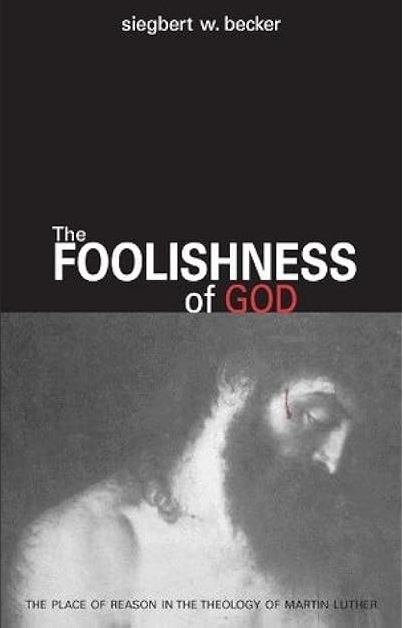
I’ve written already on The Foolishness of God: The Place of Reason in the Theology of Martin Luther. I found quite a bit of stimulating discussion within it. Here, I want to focus on the concept of grace and election in Lutheranism and essentially turn Becker’s argument around to see whether it could be used to argue for universalism rather than to simply punt the question of why some are not saved.
The Lutheran Positions on Humanity and God’s Will
There’s a section of the book called simply, “Antirationalism in the Lutheran Doctrine of Conversion.” Here, Becker argues that Lutherans should believe definitionally in humans being completely dead in spiritual things to the point where Lutherans could be seen as basically affirming total depravity. To this end, Becker quotes the Formula of Concord, directly from the Lutheran Confessions:
“[I]n spiritual and divine things the intellect, heart, and will of the unregenerate… are utterly unable, by their own natural powers to understand, believe, accept, think, will, begin, effect, do, work, or concur in working anything… there is not the least spark of spiritual power remaining… by which… [people] can accept offered grace…” (quoted in Becker, 201). On these points, Lutheranism appears to be Calvinism when it comes to the total inability of humankind to respond to, prepare for, or in any other way be credited for any aspect of saving faith.
Alongside this, however, Lutherans also, if they remain convinced by the Lutheran Confessions, “emphatically defend… the universal will of grace… It would be almost unthinkable that [anyone] call [themselves] a Lutheran and not accept the doctrines of universal atonement, universal reconciliation, and universal grace” (203). Despite this, Becker flatly states that all Lutherans and all evangelical Christians reject universalism. There’s no reason given for this rejection[note 1, below]. Thus, Becker’s position is left an unenviable question: why are some saved and not others? Indeed, this was a question I asked quite a bit as I was attempting to work out where I thought I stood on a number of theological questions, oscillating through a number of positions while still being amenable to the Lutheran one.
Becker’s Answer
Becker first outlines the situation in a series of simple charts contrasting numbers denoting how much God wills one to be saved vs. humanity’s resistence to salvation. Calvinism has 100 for humans resisting with 110 for God’s willing some and 90 for God’s willing others, resulting in some humans being saved (110) or not (90) depending on God’s will. Arminianism’s example has God’s willing 100, with human resistance being 90 for some and 110 for others, resulting in some humans being saved (90 resistance) and some not (110). “True Lutheranism” (Becker’s words) has both sides at 100.
So if God’s will and human resistance are at exacting odds, what explains salvation? For Becker, the “real Lutheran” answer is basically ‘we have no idea.’ He writes:
“Synergism, the doctrine that [humans] cooperate, even if only in the lightest degree… in conversion, was Melanchthon’s solution to this difficulty, and most modern Lutherans follow his lead[note 2]. But true historic Lutheranism holds that synergism is ‘the answer of reason.’ Yet true Lutheranism just as vehemently rejects every proposition which would establish either a ‘special grace’ or an ‘irresistable grace’ for the elect. In doing so, it finds itself in a rationally impossible dilemma.
“Because it is convinced that this is the teaching of Scripture, which does not explain the mystery, Lutheranism has simply resolved not to explain it either” (205).
Lutherans are generally inclined to appeal to mystery when there are things unexplainable within theology or doctrine, and I am not really opposed to that. Indeed, there is great appeal there. To assume we can know the intricacies of everything about God, assuming God exists and is infinite, is absurd on its face. So when we see things that are possibly contradictory but seem like they ought to be held, I do not really balk at holding them in tension and acknowledging the mystery of the same. So I do not fault Becker for this appeal. If one holds that the premises of Lutheranism are true AND that some are not saved, then appeal to holding these doctrines in tension and assuming they’re all true but that the way they are true is a mystery to humans isn’t, in my opinion, an invalid move. While I know Lutherans are not infrequently the butt of jokes for their appeals to mystery, I personally think this is both a more honest move and a better move than attempting to fully explain the intricacies of God’s workings. However, I also think that Becker’s imagination is limited by his theological precommitments here.
Lutheran Antirationalism Applied in Defense of Universal Salvation
Here’s the rub: could one not use Becker’s view of Luther’s anti-rationalism when it comes to theology and judging the Bible in order to support rather than reject universalism? Consider again the issue at hand: according to Lutheran theology [and using Becker’s arbitrary numbers], human nature is fallen and resisting God and turning away from salvation at 100 strength. Meanwhile, God wills all humans to be saved and even provided for that salvation, also at 100 strength. But why say that God’s will is only at 100 strength, why not also 110, outweighing the resistance? Lutheran theology, according to Becker, already includes the notion that God absolutely wills all people to be saved. So why doesn’t God get what God wants? As the infinitely powerful creator of the universe, doesn’t it seem odd that God would will all people to be saved and even provide the means by which they will be saved, and yet some are not saved?
Becker’s answer is the appeal to mystery–we just don’t know, and we simply hold in tension the apparently contradictory concepts in a kind of both-and relationship. But couldn’t we simply flip the script? The anti-rationalism involved here, then, is not in punting to mystery to explain why some are saved and not others. Instead, it is in appealing to antirationalism (or mystery) to explain why there are some passages that seem to suggest that some people are lost despite God’s universal salvific will and universal atonement through the Cross.[3] So on this view, instead of juxtaposing “God wills all are saved” and “Some are not saved” and holding those two premises in tension with each other, we are juxtaposing the propositions: “God wills all to be saved” and “There are some teachings in the Bible that appear to say some are not saved.” One can fully affirm that those passages teach Hell[4] and even that they teach it as a place populated eternally. But the tension here is the both and that we affirm that teaching even while affirming that God’s will for all to be saved actually comes to fruition. How is that possible? It’s a mystery, but, as Siegbert writes, “Because it is convinced that this is the teaching of Scripture, which does not explain the mystery, Lutheranism has simply resolved not to explain it either” (205).
Not So Hasty
There are a few counter-arguments here I’d like to briefly acknowledge. The first is the charge that universalism here is being presented in the Lutheran context, and it is essentially a rationalist answer to a question that Scripture doesn’t answer. That is, speaking along the same lines as Becker/Luther, Scripture does teach that God wants all to be saved and even provided for that salvation, but to insist upon actually affirming all are saved is a rationalist conclusion, using human reason to trump other Scriptural teaching [eg. on hell] or to go beyond the clear teaching of Scripture. In reply, it seems clear that the antirationalist Lutheran who attempts to affirm that some end up in hell is stuck with a very similar problem. After all, the only reason they are rejecting universalism, which does have clear passages teaching it in Scripture[5], is because they are reasoning and choosing to affirm some end up in hell as a stronger teaching of Scripture than that of universalism. Indeed, these non-universalists are reasoning that instead of teaching universalism, these passages only teach that God wants all people to be saved and has provided for that salvation. This is just as much a use of reason over Scripture as the contrary. Indeed, how does one really get out of choosing one of the options, with each being taught in Scripture? And since Becker himself admits that the Lutheran position is that God wills and has provided for all to be saved, why not embrace the absurdity of simply admitting that “therefore all are indeed saved, despite some apparent contradictory evidence”?
The second line of counter-argument is that my argument above is an unjustified use of the Lutheran position. Very often Lutheranism holds to both-and statements where Calvinist, Baptist, or other theology picks either-or. One clear example is that of Christ’s real presence in the Lord’s Supper. Whereas Calvinism and Baptist theology each insist upon an either present and detectable or not present and symbolic, Lutheranism teaches that Christ both is present and yet the bread and wine still remain. How is this true? Because Christ made the promise to be present there, and God breaks no promises. And how is that true when we cannot detect that presence? Because God said so. So for this counter-argument against universalism, the both-and is that both God wants all to be saved and yet some are not saved. However, there is nothing in Becker’s argument, nor in any specifically Lutheran position on this that I’m aware of, that suggests we cannot instead shift the both-and to is is true both that all are saved and God’s will succeeds and that Scripture teaches some are lost. How does this work? Because God’s will always succeeds and God’s promises to those who have had salvation provided for them (by Becker’s own admission, this means everyone) will not be broken.[6]
Obvious Other Possibility
Despite strong modern links between conservative Lutheranism and the modern doctrine of inerrancy, one obvious possibility within Lutheranism regarding universalism is to simply deny inerrancy and affirm a strong view of Scripture that isn’t bogged down by the modern invention of that doctrine. This has clear and repeated historic precedent in Lutheran theology, whether it was the questioning of books as canonical (including James and Revelation) by Luther and Lutherans early on or into later Reformers or even theologians like Dietrich Bonhoeffer or any number of German and American [and presumably elsewhere, though I’m not familiar enough to say so] Lutherans into today. For these Lutherans, one can simply accept the teaching that Becker strongly affirms just is basic Lutheranism: that God wants all to be saved and has provided the means for them to be saved and affirm universalism to basically make a set of non-contradictory doctrinal beliefs. In this case, the supposed clear teachings of Scripture that some are condemned to hell are simply mistaken or perhaps misinformed.
There is some obvious appeal to this strategy. For one, it eliminates the need to take an anti-rationalist or, minimally, a mysterian approach to affirm seemingly contradictory doctrines. For another, it eliminates the difficulty of trying to affirm teachings on hell that seem to be blatantly against God’s will in other passages. However, embracing an anti-inerrancy in Lutheranism simply to affirm universalism would clearly be a rationalist approach to the problem and perhaps then fall victim to the arguments to that effect. On the flip side, if Lutherans wish to simply follow what has long been the position of Lutherans throughout time–that of affirming the Bible as the authority on doctrinal teaching without rising the Bible up to the position of being on par with God as inerrancy does–this charge will not stick.
Whatever the case may be on this, even if it is mistaken, the anti-rationalist Lutheran defense of universalism seems possible.
A Final, Different Anti-Rationalist Defense
Adapting Becker’s nomenclature, he proposes {God 100% wills all humans are saved <=> Humans 100% resist being saved} as the Lutheran position. Thus, the question remains: how/why are some saved and not others?
However, it seems we could easily introduce a third part of this equation: {God 100% wills all humans are saved <=> Humans 100% resist being saved <=> all are saved}. Thus the question is “how are all saved?” and the answer is the same appeal to mystery Becker offers for his equation above. Really the only counter to this from the Lutheran perspective seems to be that you need to include a fourth part of the equation: {God 100% wills all humans are saved <=> Humans 100% resist being saved <=> all are saved <=> some are not saved}. This, however, would mean the Lutheran who is against universalism must defend the fourth term: that some are not saved. And since we both cannot know the mind of God and since Lutheranism is generally very keen to avoid making specific claims about the eternal ends of people and since Lutheranism allows for anti-rationalism in soteriology, at least according to Siegbert, this presents an enormous problem. Because even if the fourth term is defensible on a Lutheran view (and I genuinely believe any such defense would likely skew towards Calvinism or Arminianism instead of Lutheranism), one could simply affirm them all and say the blatantly contradictory terms are true and that we just don’t know how or why. And perhaps that means one affirms merely a “soft” or “hopeful” universalism, but it seems obvious that it could not entirely exclude universalism from the equation.
Conclusion
It seems to me that Becker’s explanation of salvation from a Lutheran perspectie is fairly accurate, but lacks theological imagination. For whatever reason, Becker has simply limited his perspective on what options are available for Lutherans to answer the question of why are some saved and not others. One possible answer is simply: all are saved. I should note I’m not claiming this is a distinctively Lutheran answer, nor am I claiming it is one that has deep roots in the Lutheran tradition. My main and basically only claim is that universalism simply is a possibility on Lutheran theology, and that supposed anti-rationalism when it comes to things like soteriology in Lutheranism can be applied to support it.
More interestingly, though, is the fact that it seems Lutheranism lends itself to this support. Is it possible that Lutheranism can be uniquely suited to affirm universalism, even for those who want to maintain affirmation of doctrines like inerrancy or of hell? It certainly seems so. The richness of Lutheran tradition is filled with both-ands. Here, we might affirm both that God desires all to be saves and that God succeeds at doing so.
Notes
[1] I suspect it is some sort of latent and inaccurate understanding of church history as seeing universalism as heretical despite it being affirmed by some of the most orthodox names in early Christianity (people like Gregory of Nyssa). There are a number of studies on universalism in Christian theology that demonstrate it was perhaps the majority position of the earliest church, and that multiple strands of Christianity preserved or reaffirmed the doctrine throughout history with little allegedly heretical fallout accompanying it.
[2] I’m quite curious about this side comment about “most modern Lutherans” following the lead of Melanchthon here. While Melanchthon is vehemently condemned in a lot of conservative Lutheran circles for a number of reasons, there are very few Lutherans I’m aware of who would appeal to synergism for… anything. And I’m being inclusive of conservative through progressive Lutherans here. If one claims to be Lutheran, synergism is typically out. I admit to not being knowledgeable enough of Melanchthon himself to know if he claimed synergism. Anyway, to me this claim of Siegbert’s needed quite the citation, and has nothing to back it up. Of course, he was also writing in a different time period (the book was published originally in 1982), so maybe whatever context he was in made it feel a reasonable statement to make.
[3] And this is, of course, assuming that we are reading those passages correctly. One universalist method of interpreting those passages is to see them as warning passages–calling on the Law to provoke people toward God or Godly living. I am not personally convinced of this, though I see it as a possible valid move.
[4] And here one could even affirm some kind of eternal conscious torment as the actual teaching of Scripture, despite much, much evidence to the contrary. Here, tipping my hand, it seems a much more likely reading of these passages is annihilationism or “conditional immortality” rather than eternal conscious punishment. It’s not my purpose here to argue for this, however, as it is not relevant to the point at hand. Instead, I’d direct readers towards arguments making the exegetical case for that position, such as Edward Fudge’s The Fire that Consumes.
[5] Romans 14:11 cf. Isaiah 45:23. In the latter, YHWH is speaking and swears that every knee will bow to YHWH. There are no exclusions. In the Romans passage this text is glossed with the same implication.
All Links to Amazon are Affiliates
Links
Be sure to check out the page for this site on Facebook and Twitter for discussion of posts, links to other pages of interest, random talk about theology/philosophy/apologetics/movies and more!
Book Reviews– There are plenty more book reviews to read! Read like crazy! (Scroll down for more, and click at bottom for even more!)
SDG.
——
The preceding post is the property of J.W. Wartick (apart from quotations, which are the property of their respective owners, and works of art as credited; images are often freely available to the public and J.W. Wartick makes no claims of owning rights to the images unless he makes that explicit) and should not be reproduced in part or in whole without the expressed consent of the author. All content on this site is the property of J.W. Wartick and is made available for individual and personal usage. If you cite from these documents, whether for personal or professional purposes, please give appropriate citation with both the name of the author (J.W. Wartick) and a link to the original URL. If you’d like to repost a post, you may do so, provided you show less than half of the original post on your own site and link to the original post for the rest. You must also appropriately cite the post as noted above. This blog is protected by Creative Commons licensing. By viewing any part of this site, you are agreeing to this usage policy.


 J.W. Wartick - Reconstructing Faith
“doesn’t it seem odd that God would will all people to be saved and even provide the means by which they will be saved, and yet some are not saved?”
Not at all odd. God wants all to be saved. However he has graciously given people free will, so they can choose to either trust in Jesus and his plan of salvation or reject it.
A lot of arguments for universal salvation are proof texting which ignores the context. The Biblical authors of specific books were primarily addressing people who were reading the specific passages, or hearing them read, rather than everyone. In other words, “all” largely meant all of us.
“universalism, which does have clear passages teaching it in Scripture” … “Romans 14:11 cf. Isaiah 45:23.” Do you really think that unbelievers being forced to bow the knee, even if they don’t want to do so and do so unwillingly, means all them will be saved?
As for the claim that universalism really “was perhaps the majority position of the earliest church,” doesn’t it seem odd that it would fade away so quietly? There didn’t seem to be any need to convene some kind of major council to dispose of it, it just went away.
Posted by Ralph Dave Westfall | October 7, 2024, 11:02 PMYour justifications all seem to be based on a starting point that human will is just as strong or prioritized over and against divine will. I reject that premise. Human will is not more sacred or powerful than divine will.
Posted by J.W. Wartick | October 9, 2024, 7:10 AMNowhere did I say or imply that human will is “more sacred or powerful than divine will.” I said God “has graciously given people free will, so they can choose.”
Humans can freely choose whether to love God or not. A love that is based on force is pathetic. It is a demonstration of God’s strength that humans rejecting him is not a threat to him.
By the way, thank you for dialoging with me. That’s a show of strength.
Posted by Ralph Dave Westfall | October 9, 2024, 10:11 PMYour position, however, prioritizes human will over divine will. Where human will and divine will diverge, the human will wins. On your position.
Posted by J.W. Wartick | October 9, 2024, 11:01 PMAlso none of this comment actually is directed at the core of my argument in this post. All you’ve got is generalized complaints about universalism based in prioritizing human will over divine will, a supposition that universalism “quietly faded away” which demonstrates a lack of knowledge of church history, and a lack of engagement with universalist texts beyond redefining words. Nothing addressing my central arguments here.
Posted by J.W. Wartick | October 9, 2024, 7:13 AM