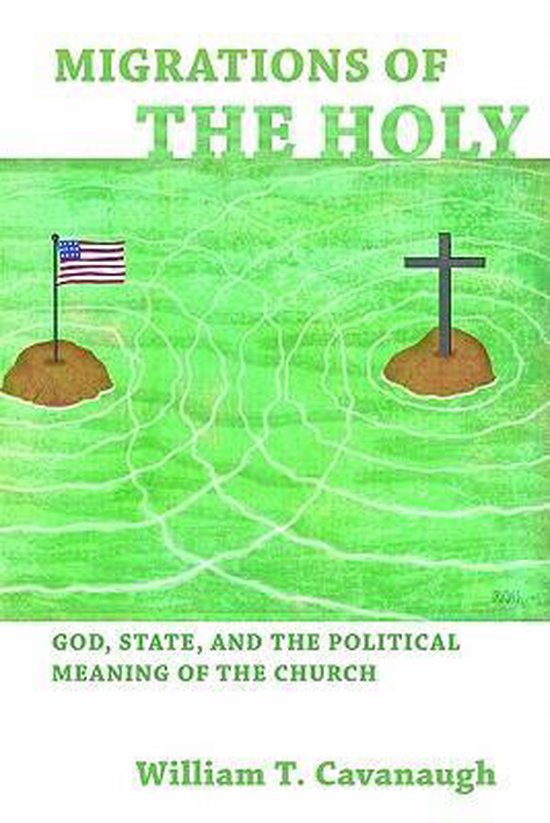
It would be difficult for me to understate how much reading William T. Cavanaugh’s book, The Myth of Religious Violence, changed my perspective and set me on paths exploring my faith and its relations with the world. Now, re-reading Migrations of the Holy: God, State, and the Political Meaning of the Church, once again has my head spinning and my thoughts going. Cavanaugh challenges readers to see that “religion” has never left in the west, but our religious fervor has instead been migrated to a new object of worship: the nation state.
Cavanaugh’s work here was written before the recent rise of Christian Nationalism, and it feels utterly prescient in so many ways. But beyond feeling predictive, it also provides warnings and evaluative principles to see how Christians–and other religious persons–in the so-called “West” have preserved deeply religious, deeply committed lifestyles but have simply moved their loyalty from radical loyalty to God-and-other to radical loyalty to the nation state. This can be seen in any number of ways, whether through the veneration of the flag of one’s favored nation state, complete with elaborate ceremonies for the exactly right and proper way to fold the flag to the way people are honored for their “service” to the nation state in the military and other endeavors.
The language used by Cavanaugh helps frame the narrative. He also uses quotes and interlocutors effectively. One example of the latter is the framing of the first chapter, entitled “Killing for the Telephone Company.” The comparison to killing in the name of the nation state and killing for the telephone company creates a radical juxtaposition that shows how absurd it seems to do the former, just as it is the case in the latter.
Cavanaugh’s argument builds on itself. An early assertion that “the state is not a product of society, but creates society” (18) is backed by a number of quotes and commentators from Hobbes to modern political theorists. The migration of the holy from so-called “religious” realms to the supposedly secular nation state is traced along a number of lines. One example draws all the way back on Augustine, who argued that coercive government is a [necessary-ish in his argument] result of the Fall (61). The movement of holy from church to state also creates a crisis for the church, which could lead to a kind of separation from the state even as the state continues to assert sovereignty over all aspects of life.
One later chapter offers a “Christian theological critique of American Exceptionalism” (88ff). Here, we find Cavanaugh fully in his element: “[W]hen a direct, unmediated relationship is posited between America and a transcendent reality, either God or freedom, there is a danger that the state will be divinized” (89). The conceptual nature of “freedom” as highest ideal and seeing America along theological notions of the doctrine of election create a dangerous situation in which the nation state is the object of veneration even as it functions as the arbiter of truth through violence projected internationally. “We [Americans] know what is good for everyone and we have the power to enforce that vision anywhere in the world” (95). This was seen in the time of the publishing of the book (2011) in the continuation of the occupation of Iraq and Afghanistan and can be seen into today with American power being projected internationally for the sake of tenuous and rarely-defined ideals of freedom.
Part of the migration of holy from church to state is the same myth of religious violence Cavanaugh wrote of in his book of that title. By democratizing violence; by moving it directly and exclusively into the sphere of the nation state, we have created dichotomies that are enforced systematically through “us in the West and them, the less enlightened peoples of the world” (111). Violent conflict is reframed in a narrative of cosmic rightness and wrongness, again showing the concept of holiness and judgment as the purview of the nation state (ibid and following). One example of this is “The recent debate over the use and justification of torture by the U.S. government… On the one hand, we claim that we do not torture; on the other hand, we imply that we must” (112). Violence is only accepted in the hands of the nation state and for the sake of whatever ends that nation state has framed as righteous: freedom and liberty, for example.
Cavanaugh puts the reality of holiness as nation state even more starkly when it comes to the use of violence: “It is clear that, among those who identify themselves as Christians in the United States and other countries, there are very few who would be willing to kill in the name of the Christian God, whereas the willingness, under certain circumstances, to kill and die for the nation in war is generally taken for granted” (119). This, of course, is not intended to suggest that violence should be done in the name of the Christian God. The point is, instead, to show that violence itself as showing dedication is wholly in the realm of the sovereign state now. Cavanaugh reinforces this in writing on the Eucharist as God sacrificing God’s self for us, an entirely foreign concept to that of loyalty to the nation state (121-122). From here, Cavanaugh moves into a kind of political theory for the church, among other things.
Honestly, reviewing a book like this almost feels wrong to me. Both of these works by Cavanaugh have had such a massive impact on how I think about things that I worry I cannot convey that adequately in a simple book review. How many superlatives are too many? How much praise is too much? I don’t know. But suffice to say that I believe Migrations of the Holy is a paradigm-shifting book. I hope you’ll read it.
All Links to Amazon are Affiliates
Links
Be sure to check out the page for this site on Facebook and Twitter for discussion of posts, links to other pages of interest, random talk about theology/philosophy/apologetics/movies and more!
Book Reviews– There are plenty more book reviews to read! Read like crazy! (Scroll down for more, and click at bottom for even more!)
SDG.
——
The preceding post is the property of J.W. Wartick (apart from quotations, which are the property of their respective owners, and works of art as credited; images are often freely available to the public and J.W. Wartick makes no claims of owning rights to the images unless he makes that explicit) and should not be reproduced in part or in whole without the expressed consent of the author. All content on this site is the property of J.W. Wartick and is made available for individual and personal usage. If you cite from these documents, whether for personal or professional purposes, please give appropriate citation with both the name of the author (J.W. Wartick) and a link to the original URL. If you’d like to repost a post, you may do so, provided you show less than half of the original post on your own site and link to the original post for the rest. You must also appropriately cite the post as noted above. This blog is protected by Creative Commons licensing. By viewing any part of this site, you are agreeing to this usage policy.




Discussion
No comments yet.