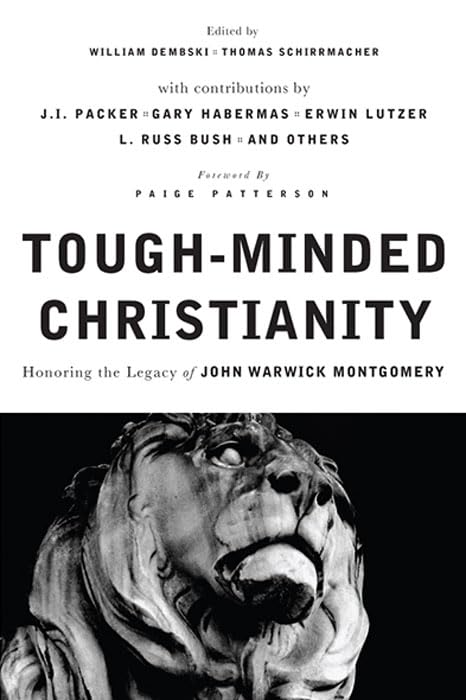
John Warwick Montgomery has been hugely influential on my own faith life, including in my development of theology while disagreeing with some of what he says. When he passed last year, I wrote a brief in memoriam. Since then, I’ve been rereading works by him and about him. One such work is Tough-Minded Christianity, a collection of essays in honor of Montgomery that was published in 2009 [1].
One essay in the collection takes on James Barr’s work, Fundamentalism. Barr was an extremely well-respected Old Testament Scholar who launched many a fusillade against fundamentalism and, in particular, against fundamentalist readings of Scripture. In particular, Barr wrote about how inerrancy would not work as a way of reading the Bible, and he especially attacked such a reading as impossible given the Bible we already have. Irving Hexham’s essay, “Trashing Evangelical Christians: The Legacy of James’ Barr’s Fundamentalism” clearly takes issue with Barr’s approach. Hexham frequently writes about Barr’s work in derogatory terms, such as calling it a “propaganda tract,” among other things. But Barr was a deep enough scholar to prompt Hexham to try to refute some of his arguments, and in doing so, I think he actually shows where Barr is right and evangelical defenders of inerrancy are wrong.
Hexham seeks to defend fundamentalist attempts to harmonize apparent contradictions in the Biblical text. One such example that he cites is the attempt to harmonize the cleansing of the Temple in John 2 with the same account in Luke 19, Mark 11, and Matthew 21). Barr writes about how some have argued that the best way to harmonize these passages is to assert that Jesus cleansed the temple twice, once at the beginning of his ministry and again near the end of his ministry. Barr writes that this harmonization is “simple but ludicrous.”
Hexham, by contrast, takes extreme issue with the use of the term “ludicrous,” and argues instead that it’s not unreasonable to make such an attempt at harmonization because, after all, we don’t have complete historical records. Hexham skirts around Barr’s incisive critique of the same evangelicals also attempting to harmonize two ascension accounts by arguing one is literal and the other is telescoping by asserting that Barr is just wrong to think fundamentalists can’t use both literal and non-literal techniques to read the Bible. At issue, however, is not whether one can defend inerrancy of Scripture by mixing ways of reading it; the issue is instead whether such readings are plausible or even necessary to begin with.
A more powerful critique from Hexham is the note that historians do this kind of harmonization all the time. And this is an extremely vital point. Hexham writes, “Harmonization, far from being an unhistorical attempt to explain discrepancies, is precisely what most traditional historians do every time they discover conflicting accounts in the archival record.” He goes on to cite others who note that historians often have “no external evidence as to whether the event recorded happened once, twice, or even three times…” and that in almost any historical writing, a selection effect is occurring which means the authors are intentionally highlighting aspects of the narrative at hand.
It is true indeed that no author can comprehensively write every detail of anyone’s life, nor do the Gospels claim to be doing so for Jesus. I think it’s also largely true that historians are quite comfortable harmonizing different stories to make them make sense. Indeed, it would quickly become impossible to write or engage with history if, every time there was a discrepancy between accounts, one simply said the account was unreal or did not happen. But there’s a huge gap between conceding that point and conceding that therefore the historical documents can be considered inerrant. Indeed, the opposite seems to be true.
When historians are harmonizing differing texts about an event, they aren’t doing so with the assumption that either text is completely without error. This is a far cry from what evangelical/fundamentalist readers of Scripture have to do in order to harmonize texts. Once one holds a doctrine like inerrancy, in which the entire Bible is supposed to be completely free from error, the process of harmonization takes on entirely new difficulties. One cannot, as historians do, harmonize two passages by simply stating one is mistaken. If one document says an event occurred at 14:00 and the other says it occurred at 04:00, the historian can do many things, such as find another source that might confirm one and deny the other. But the inerrantist cannot do that. They must come up with a harmonization that not only brings two passages together, but also makes them both somehow emerge from the harmonizing completely unscathed. And that is where things start to become absurd. Because for the inerrantist, the only way to harmonize the two times for the same event above is to multiply the event. After all, the times cannot be wrong; admitting one of the times is wrong is to admit an error into the text. Therefore, the event itself must have occurred at both times. And that is what Barr is getting at with his critique of fundamentalists readings as being ludicrous.
Certainly one may punt to the broad possibility that we don’t have the Bible telling us that a cleansing of the temple only occurred one time, but every indication seems to be that such an event was unique and powerful, not something that Jesus decided to do, say, every Tuesday or so. The ascension is even more absurd to multiply, which is what leads the inerrantist to suddenly abandon their attempt to read the historical narrative as historical reportage and instead read it as a telescoping timeline. That’s the only way to salvage the text–by turning it into something that is intentionally not reporting things in the exact timeline in which they occurred.
Hexham’s attempt to salvage inerrantist harmonization methods, then, fails. While it is still remotely possible that some events happened twice, allowing there to be a direct, historical reporting happening in both instances of an event; such a broad possibility is not all that matters. Not every harmonization can be achieved by simply multiplying instances of the event occurring. And no historian is attempting to harmonize other historic texts by assuming they are entirely without error. The parallel Hexham attempts to draw upon is undermined by his own prior commitments. Inerrantists aren’t mashing two texts together by using other sources to determine their accuracy or looking at the plausible explanations. No, they are absolutely committed to the assumption that any two (or more) Scriptural passages they are trying to harmonize are entirely without error, and therefore any harmonization must preserve that central assumption. There’s a vast chasm between those two methodologies, and one that makes the inerrantist reading seem, at times, ludicrous.
Notes
[1]It’s remarkable looking at the book now, with its foreword by Paige Patterson, who has since been implicated in covering up sexual abuse (see here), an essay by Ravi Zacharias (multiple allegations of sexual abuse here), and thinking about how highly touted this book was at the time. In apologetics circles, I remember seeing a lot of discussion, though I’ve rarely seen it mentioned since about 2014. This might be, in part, due to JWM not being as well-loved in those circles as some other apologists. In any case, this collection purports to carry on JWM’s “tough minded” approach to Christianity, one built upon strength of evidence and an apologetic approach of the same.
All Links to Amazon are Affiliates
Links
Be sure to check out the page for this site on Facebook!
Book Reviews– There are plenty more book reviews to read! Read like crazy! (Scroll down for more, and click at bottom for even more!)
SDG.
——
The preceding post is the property of J.W. Wartick (apart from quotations, which are the property of their respective owners, and works of art as credited; images are often freely available to the public and J.W. Wartick makes no claims of owning rights to the images unless he makes that explicit) and should not be reproduced in part or in whole without the expressed consent of the author. All content on this site is the property of J.W. Wartick and is made available for individual and personal usage. If you cite from these documents, whether for personal or professional purposes, please give appropriate citation with both the name of the author (J.W. Wartick) and a link to the original URL. If you’d like to repost a post, you may do so, provided you show less than half of the original post on your own site and link to the original post for the rest. You must also appropriately cite the post as noted above. This blog is protected by Creative Commons licensing. By viewing any part of this site, you are agreeing to this usage policy.


 J.W. Wartick - Reconstructing Faith
Excellent analysis of problems with the concept of inerrancy.
On the other hand, your footnote pointing to sexual abuse issues related to Patterson and Zacharias is irrelevant. As repugnant as it may seem, what they say needs to be evaluated with the tools of analysis, focusing on what they said, regardless of things they did (or may have done, since you use the squishy words ‘allegations’ and ‘implicated.’) See https://en.wikipedia.org/wiki/Association_fallacy
Posted by Ralph Dave Westfall | January 6, 2025, 5:03 PM