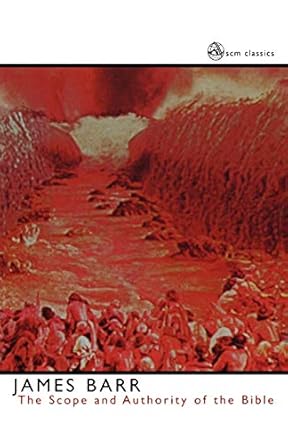
James Barr (1924-2006) is incredible to read as someone coming from a fundamentalist background. I’m reading his book The Scope and Authority of the Bible (1980) right now and it is so good. In one of the essays, “The Problem of Fundamentalism Today,” he writes:
“The problem of fundamentalism is that, far from being a biblical religion, an interpretation of scripture in its own terms, it has evaded the natural and literal sense of the Bible in order to imprison it within a particular tradition of human interpretation. The fact that this tradition… assigns an extremely high place to the nature and authority of the Bible in no way alters the situation described, namely that it functions as a human tradition which obscures and imprisons the meaning of scripture” (79).
Barr is an extremely gracious critic, as readers of this book will see–he bends over backwards to note fundamentalists still have good things to say about the Bible, for example–but his point is so incredibly valuable.
Conservative Christianity, while claiming to be solely biblical, has ‘imprisoned” the meaning of the Bible within its own logical and theological strictures. Fundamentalist Christianity is no more or less influenced by its cultural strictures than other forms, but takes enormous strides to avoid admitting that its attempt to read the Bible is conditioned by those lenses through which they read it. So they can claim their religion is “biblical” while the more liberal Christian might admit fully they’re reading the Bible through a lens and yet be more faithful to the text.
In the same essay, Barr notes that fundamentalism leads to difficulties with scholarship, too:
“The partisan light in which fundamentalists regard conservative scholarship itself corrupts the path which that scholarship may take. Partisan scholarship is of no use as scholarship: the only worthwhile criterion for scholarship is that it should be good scholarship, not that it should be conservative scholarship or any other kind of scholarship. And many conservative scholars realize this very well. Among their non-conservative peers they do not produce the arguments that fundamentalist opinion considers essential and they do not behave in the way that the fundamentalist society requires of its members.
“Fundamentalist apologists, exasperated, often ask me the question: but how can the conservative scholar win? Is not the balance loaded against [them]? The answer is: yes, he can win, but he can win only if he approaches the Bible… as a scholar of the biblical text” (74).
Time and time again, I have seen this play out. Some evangelical critique of their own apologists has gone down this line, noting that the engagement with non-evangelicals often takes a different tone and approach to the Bible than when it is an intra-conservative debate. And why? Because fundamentalist, evangelical interpretation itself is so culturally embedded that they cannot convince others on its own terms. This is yet another proof of Barr’s point above, that fundamentalism cannot make claim to being the sole biblical truth or even biblical at all when it is itself a culturally conditioned position to hold and interpret within.
The Scope and Authority of the Bible is proving as thought-provoking as any book I’ve read of late. This, despite it being more than 40 years old. I recommend Barr’s works quite highly.
SDG.


 J.W. Wartick - Reconstructing Faith
I used to be a fundamentalist. Eventually I realized that a lot of the Bible does not have to be taken literally to the nth degree. The Biblical message can be even more powerful for people who can appreciate that.
On the other hand a lot of liberal scholars, people who practice what academics would describe a good or very competent scholarship, reject the idea of the supernatural. They think Jesus’ literal resurrection is a myth fabricated by the early church. I would agree with the fundamentalists that such people should not be considered Christians. Also with the fundamentalists, I see no reason why any seminary that claims to be affiliated with Christianity should employ people like that even if they are great scholars.What do you think?
Posted by rdwestfallc7b056ad5e | April 21, 2025, 5:07 PM