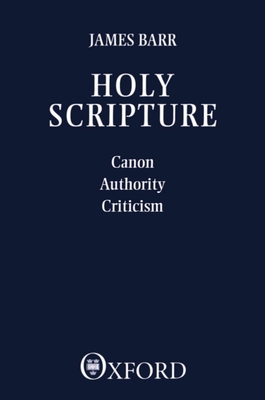
James Barr (1924-2006) was a renowned biblical scholar who, in part, made some of his life’s work pushing back against fundamentalist readings of Scripture and Christianity. I have found his work to be deeply insightful, even reading it 40 or more years after the original publications. One insight I gleaned recently was from Holy Scripture: Canon, Authority, Criticism (1982). Here, he made a clear argument for the need for freedom in biblical scholarship:
“Research requires freedom of thought; if this is lacking, it only means that the research will be less good, in extreme cases that it will dry up altogether. Freedom is not something that should have to be wrung from a reluctant grasp: the church should promote freedom because freedom is part of its gospel. The same is true of theology: it is in the interests of theology itself that it should not seek the power to control and limit, that it should recognize, accept, and promote the fact that there are regions of biblical study for which the criteria of theology are not appropriate; just as it is salutary for the church that it should not seek to dominate the nature of education…
“THe relations between freedom and religion are paradoxical. Freedom of religion is one thing, freedom within religion is another. Freedom of religion is often thought of as freedom of religion from coercion through the state, and that can sometimes be very important, though it is far from being the nucleus of the idea of Christian freedom. Religions can demand freedom of religion, while denying freedom within religion, which is much closer to the idea of Christian freedom…” (109-110).
Note that the last line is saying that it is closer to Christian freedom to have freedom within religion than the opposite. Barr is saying that biblical and theological scholarship–and Christianity generally–benefits from freeing its scholars to explore whatever fields or ideas they deem necessary or of interest. For one, this is because freedom is part of Christianity’s gospel itself–a point Barr makes in passing. For another, this freedom will benefit Christianity because additional insight into its truths coming from even non religiously motivated research is of great use (a point he explores on 110-111).
Thus, limiting research by strict doctrinal codes is not desired even as such doctrinal codes, standard, or confessions are permitted to exist and sometimes even bolstered by research. But where research might push back on such codes, standards, and confessions, Christians ought to welcome it as something that might offer a corrective and exemplification of the gospel rather than as something to be shunned and feared.
SDG.


 J.W. Wartick - Reconstructing Faith
Hi JW:
Isn’t he really just saying that colleges and seminaries should hire faculty whose views are contradictory to the basic tenets of Christianity? And continue to pay the salaries of people who adhere to and publicize their rationales for such views?
Here’s a question: Suppose there is a person who admits they don’t believe Jesus is the Son of God as Christians understand that title. Suppose this person also doesn’t believe there can be life after death, and thus no final judgment either. Should any educational institution supported by believing Christians hire a person like that, regardless of how brilliant their arguments (glorified by the sanctimonious term “research”) are?
Best regards, In Christ,
Dave (I share the name Ralph David with my father, so my family called me Dave and I go by that at church)
Ralph Dave Westfall
Professor Emeritus, California Polytechnic University Pomona
Break the cycle of poverty http://www.hopeinternational.org/https://exchange.csupomona.edu/owa/redir.aspx?C=KHEW76y1Dkq35_QByg2Es_KXK1uPqNFIBcYC9q5md9QOjay_wgaMjlSQ4q59cfYxTLPplGLbMUw.&URL=https%3a%2f%2fexchange.csupomona.edu%2fowa%2fredir.aspx%3fC%3dC28bisr6wU-CnHOc4vrm-n73JILhc9BI4LrC1NrD3eekZCpW0JMlBOz0slNCdOIr42hHC4e2JW0.%26URL%3dhttp%253a%252f%252fwww.hopeinternational.org%252f
Posted by rdwestfallc7b056ad5e | June 17, 2025, 6:22 PMI think a good piece of advice is that if you find yourself starting a comment with “Isn’t [x person] really just saying [y]?” that you think long and hard about whether [y] is entirely your interpretation rather than their words. In this case, I would lean towards yes. Your fictitious scenario is good for a scare, but could easily be flipped. Suppose there’s a person who ascribes to whatever beliefs you find acceptable who teaches at whatever university you find acceptable. Should that person be allowed to research in topics you find less amenable to those positions?
Posted by J.W. Wartick | June 24, 2025, 2:04 PMYou wrote: “Should that person be allowed to research in topics you find less amenable to those positions?”
No problem at all with that. It happens a lot. Apologists like William Lane Caig do a great deal of research on atheism, and other denials of the faith, in order to empower Christians who might otherwise be troubled by such influences.
By the way it was quite ironic that you shut down acceptance of comments within eight days of your publication of this article on the subject of Christian freedom. It is good you finally recognized how much more ironic it would have been if you had not eventually allowed my comments to be published on your site.
Posted by rdwestfallc7b056ad5e | June 24, 2025, 5:41 PMYour last comment assumes I’m an always online person. I’m not. I moderate all comments because there’s a lot of spam. Sorry it wasn’t timely enough for you but your irony is deeply misplaced.
Posted by J.W. Wartick | June 25, 2025, 10:21 AMLet’s clarify some things. I attempted to post a reply to your Christian freedom article on this page eight days after I received your email announcing the new article. I received an automated message that your article had been closed for new comments. In other words, there was no need for you to be “an always online person” because the issue was being handled on an automated basis. But the cutoff date was set by you.
Setting an arbitrary and relatively quite short time limit for accepting replies would seem quite inconsistent with the goal of promoting Christian freedom in disseminating ideas. Hence the irony.
Since your web page refused my reply, I submitted it in response to your email announcing the article. You did publish it, which was good.
But here’s a bigger issue. I specified just three beliefs that people teaching in Christian higher education institutions would be expected to adhere to: Jesus as the Son of God as Christians understand that title, life after death, and a final judgment.
Your reply said, “ascribes to whatever beliefs you find acceptable.” My beliefs are irrelevant. Those three items constitute core beliefs throughout all of Christianity, however you define it. Catholics, Calvinists, Arminians, and Pentecostals all agree on them. (Mormons don’t since they have a different view of Jesus.)
You advised me to “think long and hard about whether [y] is entirely your interpretation rather than their words.” I asked a rhetorical question. It doesn’t matter if “[y]” is my interpretation or their words. You are free to come to your own conclusions, and challenge anything you specifically don’t like about the question.
Proverbs 27:17As iron sharpens iron, so one person sharpens another.
Posted by rdwestfallc7b056ad5e | June 25, 2025, 7:43 PMI literally have no idea what you’re talking about with closed comments. I don’t have any setting for that on my end and have never closed comments, only moderated. Unless some setting got changed without my knowledge, this remains the case. It really doesn’t matter, and I don’t get why you’re pressing this point beyond wanting to say I’m shutting down freedom which a) I’m not and b) it’s a blog.
Regarding the actual meat of your comment- my point is that you seem to agree in principle with the point that scholars should be allowed to research in whatever directions they’re taken. Great!
Posted by J.W. Wartick | June 26, 2025, 4:37 PMAah, the old “declare victory and dash for the exit” maneuver. Not so fast, the issues here have not been resolved.
Freedom of research is only a part, a lesser part of what this discussion is about. To say that anyone can do research on anything (any topics they have the resources to delve into) is trivial and doesn’t get us anywhere.
The major issue at hand is support of research. Lack of support would be huge barrier to research.
There have been very notable scientific researchers in the past who were independently wealthy. See https://medium.com/@jonathan.lonsdale/the-rise-and-fall-of-the-gentleman-scientist-80218df587b3
However most researchers, scientific or otherwise, need institutional support to earn a living. For someone doing “Biblical research,” a Christian educational institution is a very likely source.
But the primary purpose of a truly Christian seminary or college is not research, it is in advancing the gospel of Jesus Christ by building students up in the faith while they are being educated.
Supporting a faculty member who would teach students that Jesus wasn’t the Son of God, as Christians understand that term, is contrary to that goal. Faculty who teach there is no life after death and no final judgment don’t deserve the support of such institutions either.
Even if a person with such views doesn’t bring them into the classroom, students will become aware of them if they get published. Supporters of the institution are also likely to hear about such publications and become reluctant to continue funding.
It is very difficult to fire a person after they have been hired and been around a while. Christian educational institutions would be well-advised to try to avoid hiring people who might bring these kinds of problems.
Your thoughts?
Posted by rdwestfallc7b056ad5e | July 4, 2025, 4:35 PM