J.W. Wartick
“Are Miraculous Gifts for Today?” A look at four views in Christian Theology
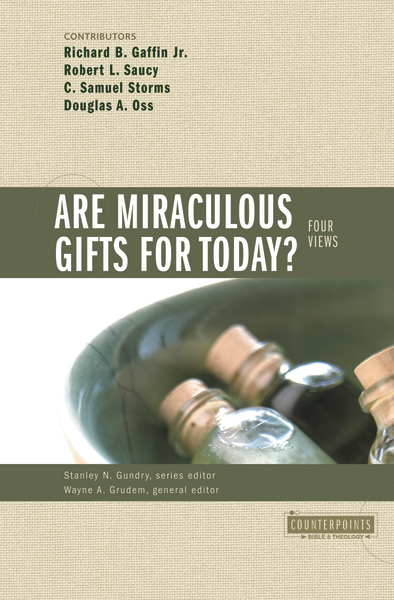 What are we to make of the notion of miraculous gifts today? Have they continued into the modern era, or did they cease after the apostolic age?
I want to preface the following discussion by expressing the fact that I am by no means an expert in this area. I only recently finished reading Are Miraculous Gifts for Today?, which presents four views on the issue of miraculous gifts in the church now. The
Here, I will outline what I understand to be the four views on the topic (as outlined in the book–I am more than willing to concede there are likely more views), along with a few arguments and against each. After that, I will offer a brief analysis. I’m hoping that you, the reader, will help spur the discussion.
Miraculous Gifts?
Before progressing, it is important to know what is meant by miraculous gifts. Essentially, these are the gifts outlined in various passages of the Bible. 1 Corinthians 12 is illustrative. It lists as spiritual gifts the following: speaking in tongues, prophecy, the gift of wisdom, etc.
One must note the issue of the “gift of healing.” What is the “gift of healing” and does it exist today? James 5:14-16 is integral to understanding what is meant by this gift.
Perhaps the most central issue regarding miraculous gifts is this: do they continue into today? A secondary, but still very important question is: if these gifts do continue, in what way?
Cessationism
Cessationism is the view that miraculous gifts essentially ended after the formation of the Apostolic Church. Richard B. Gaffin, Jr. defends this view. He clarifies his position by noting that he is not arguing that all gifts of the Spirit have ceased. Rather, the question is “not whether but which spiritual gifts continue today” (41). He notes that God may choose to miraculously heal persons, but expresses doubt over people being granted a specific gift of healing. His greatest difficulty lies with the “word” gifts such as prophecy, speaking in and interpreting tongues, and the like.
The problem with these sorts of gifts, argues Gaffin, lies in the question of the sufficiency and closedness of the canon. Suppose that prophecy does continue today. What level of authority should be ascribed to it? If it is truly the utterances of the prophet guided by God, he reasons, should we not grant such utterances the same authority as the Scriptures (47)? Gaffin notes that those who hold to the continuation of these gifts generally assert that prophecy may be fallible and thus should not be given the same authority as the canon. Gaffin responds by countering that the Bible does not seem to support the notion of fallible prophecy as a possibility (48-52).
Moreover, the gifts of the Spirit were intended for the Apostolic Church as signs of God’s special activity during that period (56-58).
Open but Cautious
The “Open but Cautious” view is championed by Robert Saucy. He expresses the view that the Bible does not make clear whether specific miraculous gifts continue today or not. Thus, he remains open to continuation of these gifts, but cautious in their application and use.
Central to Saucy’s caution is the argument that miraculous gifts are centered around specific times and purposes within salvation history. Thus, according to Saucy, miraculous gifts act as signs of God’s activity within very specific contexts. The Apostolic Era is to be considered unique, and the expression of spiritual gifts during this time should not be read verbatim onto the present era (100-102). Moreover, the Biblical evidence for periods of miraculous activity is “uneven” and “particularly concentrated at certain times,” specifically “that of Moses and the Exodus, the ministries of Elijah and Elisha, and Christ and the apostles” (103). Miracles are thus to be understood explicitly as a “sign” with a specific purpose in mind to “give credibility to something” (105). Miracles are used to “authenticate” specific individuals in times of need (108).
Saucy appeals to the history of the church to make his point. He argues that throughout the history of the church, there is little miraculous activity noted. Thus, although we should be open to the possibility that such gifts may manifest themselves, we should remain cautious of claims to that effect. Saucy concludes with a discussion of individual gifts and what the Bible teaches about them. Representative is his discussion of prophecy, which notes several clarifications regarding how it should be used and understood (including that it is to be done in an “orderly fashion” and that the content will be “edifying to the community”) (128).
Third Wave
C. Samuel Storms argues that miraculous gifts do continue today, but that the doctrine of “subsequence” should be rejected. Subsequence is the notion that after conversion, there is a “baptism in the Holy Spirit” which is initially experienced by speaking in tongues and manifests itself in various spiritual gifts (176).
Storms argues that cessationists misrepresent those who argue for continuation, for cessationists often appeal to the “infrequency” of the miraculous in order to argue against the notion of miraculous gifts. They argue that this demonstrates that such events are purely the actions of a sovereign God acting whenever God chooses. In contrast, Storms notes that God’s spontaneous action may indeed empower individuals and indeed that the intermittent nature of the practice of such gifts does not undermine their classification as spiritual gifts.
Storms further asserts that although miracles have indeed been used as signs, this fact does not allow one to reduce the miraculous gifts to being only signs and nothing else (188-189). Storms analyzes a number of major arguments for cessationism and finds them all wanting. In particular, Storms presses the notion that the Bible nowhere declares that the gifts found in the Apostolic period would have some cutoff time period.
Pentecostal
Douglas Oss argues that defining Pentecostalism as a “second blessing” theology must clarify what they mean by “second blessing.” He notes that Pentecostals do believe that believers receive the Holy Spirit post-conversion as an empowerment for charismatic gifts. However, this filling is not part of salvation nor is it required for salvation. Instead it is part of sanctification: it is empowerment by the Spirit. Moreover, Oss notes that there may be several empowerments or “refillings” of the Holy Spirit, for there is diversity in the “manifestations” of the Spirit (242-243).
Oss traces the Biblical data and concludes that the Old Testament shows that there is both the “inner-transforming” work of the Holy Spirit and the “empowering” work located therein. In the New Testament, Oss notes that the Holy Spirit works to empower the believers with various manifestations of miraculous gifts.
The gifting of the Holy Spirit is initially observable through speaking in tongues, but again this is not required for salvation. It is merely the pattern of God’s gifting. First tongues, later other gifts, though this is not always the case or even a requirement (260-263). Oss appeals to Joel 2:28-32 to note that the last days will not conclude until Christ’s second coming and so we should expect giftings of the Spirit throughout the present era (266ff).
Analysis
It seems to me that there is little warrant for arguing negatively that the miraculous gifts do not continue today. Gaffin provided no textual basis that I could discern for holding that when the NT authors speak of these gifts within the church, they intended to limit the gifting in their own era. Moreover, I think that Joel 2:28ff does speak of the current age, though some of it seems to be yet future. The future fulfillment left for some of the passage does not seem to imply that it should all be taken is “not yet,” however.
That said, Gaffin’s concerns regarding the authority and inspiration of prophecy should be rightly noted. The issue of the nature and authority of prophecy in the modern period is one which the other offers attempted to address, but it seemed to me they came up short in virtually every case. Moreover, some of the Pentecostal position seemed to be a bit off to me. Why even argue that speaking in tongues comes first, but then qualify that by saying that it doesn’t need to or that it may not always be the case? Would that not suggest that the pattern isn’t much of a pattern after all?
Storms in particular did an excellent job of showing the error of arguing that miracles in the Bible centered only around certain periods of time in which “signs” were needed. Although it seems clear that the Bible is a selection of time periods and parts of history, God’s miraculous activity is observable throughout much of the Bible. To argue otherwise, and to then build a framework for interpreting miraculous gifts for today (as both Saucy and Gaffin did to an extent) seems to be an overreach given the data.
Thus, I would say my position seems to be closest to a synthesis of Storms and Saucy. I think Saucy does not go far enough in his allowing for gifts of the spirit, but I think that Storms struggles with the notion of the authority of such continuing prophecy.
So what do you think of this issue? What is your position? Share your thoughts in the comments below.
Source
Stanley Gundry and Wayne Grudem, editors, Are Miraculous Gifts for Today?
SDG.
——
The preceding post is the property of J.W. Wartick (apart from citations, which are the property of their respective owners, and works of art as credited) and should not be reproduced in part or in whole without the expressed consent of the author. All content on this site is the property of J.W. Wartick and is made available for individual and personal usage. If you cite from these documents, whether for personal or professional purposes, please give appropriate citation with both the name of the author (J.W. Wartick) and a link to the original URL. If you’d like to repost a post, you may do so, provided you show less than half of the original post on your own site and link to the original post for the rest. You must also appropriately cite the post as noted above. This blog is protected by Creative Commons licensing. By viewing any part of this site, you are agreeing to this usage policy.
Really Recommended Posts 8/30/13- Dinosaurs, Mumford and Sons, Design, and more!
 Another search of the internet has turned up a number of excellent posts. I have found another diverse array of topics for you to browse at your leisure. This week, we’ll look at dinosaurs, Ray Comfort’s Evolution vs. God, cave diving, preterism, design, the economy, and Mumford and Sons!
Dinosaurs, Dragons and Ken Ham: The Literal Reality of Mythological Creatures– Often, the claim is made that legends about dragons sprang from humans living alongside dinosaurs. Young earth creationists cite this as evidence for their position. Here, the Natural Historian sheds some light on these claims in a well-researched post with plenty of pictures for those of us with short attention spans. I highly recommend following this blog as it remains an outlet for great analysis of young earth claims.
Evolution vs God– Another issue which has been making the rounds on apologetics/Christian sites has been the recent video by Ray Comfort, “Evolution vs God.” The video is available to watch for free on youtube. Feel free to check it out yourself (you can find a link to it here). My good friend over at No Apologies Allowed seems to endorse it to a limited extent (see his comment on this post), and his comments have touched off a great discussion: [DVD] Evolution vs. God. On the other hand, the Christian think-tank Reasons to Believe has offered their own brief video review (the link will stat playing instantly) of the movie which has a very different perspective. What are your thoughts?
Some Questions Concerning my Preterism– I am not a preterist, but I appreciate well thought out positions and the insights they provide into their positions. Here, Nick Peters shares a number of question-and-answers related to his preterist views. Preterism is the view that the majority of the prophecies found in Revelation and the like have been fulfilled, usually in the destruction of the Temple in AD 70.
The theory of intelligent design (Video)- As one friend sharing this video put it: “A video on MSN featuring Michael Behe narrated by Morgan Freeman? What world did I wake up in?” My thoughts exactly. This video is a very basic exposition of the theory of intelligent design. Check it out.
Cave Diving and Apologetics– I like caves, though I have never done cave diving and almost certainly never will. I found this post to be fairly helpful in regards to drawing out some of the dangers of apologetics and going everywhere at once. I wasn’t terribly appreciative of the explicit appeal to defense of Catholic dogma, but apart from that the post is pretty solid.
Mumford & Sons: Five Songs With All Sorts of Christian Undertones– A really excellent look into several Mumford & Sons songs. I admit I’m not a big fan of the style of music, but I found this post fascinating nonetheless. Check it out.
What happened to the economy after Democrats won the House and Senate in 2007?– People who know me personally realize that I am a complete mishmash of political views. I frankly despise both major political parties because I think they are both ridiculously partisan and do little correctly. That said, I found this post to be a pretty interesting look at the economics of policy. Let me know what you think.
Ben Hur- The Great Christian Epic
 There was a time when Hollywood battled for which studio could churn out the best epic, the greatest film, the most splendor upon the big screen. “Ben Hur” was a film which towered above all the rest. It won 11 academy awards, a feat matched only by two other movies (“Titanic” and “The Return of the King”), but it was also the only one of those three to win for acting (Best Actor: Charlton Heston as Ben Hur and Hugh Griffith won Best Support Actor).
Although best remembered for its famous chariot race scene, the film’s themes continue to echo with our own times. At the heart of “Ben Hur” is a struggle between ways of viewing the world set alongside an epic story which relates that struggle to the cosmic struggle for redemption and salvation of the people of God. There will be SPOILERS for the film in what follows.
Background
It is important to note that “Ben Hur” is based upon the novel of the same name by Lew Wallace. Wallace, a general during the Civil War, was disturbed by a conversation he had with a prominent skeptic of the time, Robert Ingersoll. Ingersoll’s challenge against the historicity of Christianity gave Wallace a great desire to search the historical acconts around the time of Christ and compose Ben-Hur: A Tale of the Christ
A Battle of Worldviews
The question of worldview is explored throughout the film. What is it that makes hte people of the Roman colony of Judea so obstinate? They seek after Messiahs, after a different savior each day of the week. One conversation poignantly illustrates the heart of this conflict:
Sextus, a centurion in charge of the Roman garrison asks Messala, who has come to relieve him, “How do you fight an idea?”
Messala responds “You ask how to fight an idea? Well, I’ll tell you how: with another idea.”
Messala realizes that at the heart of the people’s will is their worldview. Their hope is in the destruction of Rome. They long for a Messiah who will lead them to a successful revolt to throw off the Romans. Yet Messala desires to fight this hope with his own worldview: that of the power of humankind. Rome is power, and for him, the Emperor is that power deified.
 Revenge
Vengeance. It’s a theme which seems initially to drive the movie. Messala betrays his friend, Judah Ben Hur, towards the beginning of the film. The Hur family is thrown into prison to languish there, and Judah is sent to the galleys to row as a slave. Judah swears to Messala that he will take revenge upon him upon his return. In a deeply ironic voice, Messala responds, “Return?” The life of a galley slave is not expected to be long.
But Judah does return. He rescues the Roman Quintus Arius who is in charge of his ship and is eventually adopted into the Arius family. He returns to Judea as the son of a consul, with all the power and privilege his rank implies. After learning of a way to take revenge upon Messala without the possible legal ramifications–by besting him in the circus maximus in a chariot race and leaving Messala destitute from debt–Judah succeeds in the arena.
The climax of the quest for vengeance can be found in the scene in which Judah Ben Hur confronts Messala for the first time since seeming to come back from the dead. He slams his seal–the seal of the Consul QUintus Arius–into a document and stares Messala down. Now, Judah is in the superior position. He is the one whose victory is inevitable. From this point on, his vengeance seems assured.
However, after Ben Hur’s epic defeat of Messala in the chariot race, which leaves Messala not only broke but also leaves his body broken, it turns out that revenge is not as sweet as it may seem. Messala informs Judah “the race goes on”–his family is still alive, but they are lepers, left to flounder on the edges of society as unclean, cursed wretches.
It is not revenge which pays. It may give some kind of satisfaction for the briefest moment, but Judah learns its satisfaction is only fleeting. His glory must be found elsewhere, and it is not a glory he can bring himself.
Redemption
Judah is devastated by his discovery that his mother and sister are lepers. He realizes there is nothing he can do to save them, and it seems Messala’s own plan has achieved victory after all. Judah, moved by compassion, takes up his mother and sister in his arms despite their protests, almost guaranteeing that he, too, will contract the terrible disease.
He and Esther, a servant of his former household, take his family through the streets of Jerusalem. The latest Messiah, Jesus, is set to be crucified, and a crowd gathers there to watch. As Jesus dies, his blood runs through the rainwater as it spreads out symbolically to the world. When it touches the Hur family, they are cleansed of their diseases, washed utterly by the blood of Christ. In a stunning twist, it is not the hero who brings about victory, but rather the Messiah who has only been seen briefly throughout the film at pivotal moments. It is Jesus to whom all glory is given, not to Judah Ben Hur.
We have seen that Messala hoped in a human who took upon deity for himself. But the film (and indeed Wallace’s earlier book) show that this hope is misplaced. The God-man that humans should look to is not the conqueror; he is not god because he has human power; instead, the God-man Jesus Christ took on flesh in order to save, to humble himself and become obedient to death on the cross. It is a subversive tale. It is a story of redemption and salvation. It is an idea against which the powers of humanity and the devil muster all their strength to attempt to overthrow, but the idea lives on. It is the idea which cannot be overcome, cannot be outshined.
Conclusion
“Ben Hur” is my favorite movie of all time. The epic clearly portrays the truth that is above all truths: we are powerless, but God is powerful. Judah Ben Hur is unable to save that which he loves and must ultimately rely upon another, who saves them through the washing of his blood. Ben Hur’s story is our own in many ways. We continually struggle against the powers of the world and we often have motivations which are, at best, questionable. But ultimately, we find that when we rely upon ourselves, we are unsuccessful. Only when we rely upon God do we find success.
Sources
Tim LaHaye, “Introduction” in Lew Wallace, Ben-Hur: A Tale of the Christ
Ben Hur.
SDG.
——
The preceding post is the property of J.W. Wartick (apart from citations, which are the property of their respective owners, and works of art as credited) and should not be reproduced in part or in whole without the expressed consent of the author. All content on this site is the property of J.W. Wartick and is made available for individual and personal usage. If you cite from these documents, whether for personal or professional purposes, please give appropriate citation with both the name of the author (J.W. Wartick) and a link to the original URL. If you’d like to repost a post, you may do so, provided you show less than half of the original post on your own site and link to the original post for the rest. You must also appropriately cite the post as noted above. This blog is protected by Creative Commons licensing. By viewing any part of this site, you are agreeing to this usage policy.
Really Recommended Posts 8/23/13- Twain, Egypt, creationism, and more!
 I am excited to offer you, dear reader, a slew of fantastic posts for your perusal. The topics this go-round are diverse. We will look at Egypt and the media coverage there, Mark Twain and the Book of Mormon, Darwin’s Doubt, creationism, Stephen King’s Under the Dome, and Dietrich Bonhoeffer.
Mainstream media silent as Muslim Brotherhood targets Christians in Egypt– What is going on in Egypt? Violence against Christians has boiled over, but it seems we hear nothing about it here. Check out this article to read a refreshing perspective which will help inform you about what’s going on “over there.”
Mark Twain’s Review of the Book of Mormon– Mark Twain was a hilarious satirist and well deserves his place among the top American writers of his time. In this post, he turns his humorous pen to the Book of Mormon. It is worth noting a few errors with Twain’s account, however. I’m not sure if the Mormon account has changed, but Twain writes that the Book of Mormon was alleged to be translated from copper plates, when it is said to have been gold. More interestingly, Twain reveals his grounding in his own times when he writes “The Mormon Bible is rather stupid and tiresome to read, but there is nothing vicious in its teachings. Its code of morals is unobjectionable—it is ‘smouched’ from the New Testament and no credit given.” Take a gander at 2 Nephi 5:21ff (scroll down to verse 21 and following) and let me know if you see something which is similar to the New Testament’s statement in Galatians 3:28 and whether you object to the Book of Mormon’s writing in 2 Nephi.
Science, Reason, & Faith: Evaluation of Darwin’s Doubt by Stephen C. Meyer, part 1– With shouts of “pseudo-science” clamoring to drown out those who are even attempting to do research in the area of intelligent design, it is refreshing to sit back and look through some analyses which interact with the works rather than just spewing vitriol. I found this series of posts quite interesting and worth the read as I have been reading through the book myself.
Upset Creationist– Jay Wile is a young earth creationist whom I respect. His integrity is admirable. I disagree with his position strongly, but I admire him as person of character. This post is no different. He interacts with some comments the well-known creationist Ken Ham directed his way. Perhaps most thought-provoking was Wile’s comment that “Whether we are talking about the materials from Answers in Genesis or that particular exhibit in the museum, the message is crystal clear: the concept of millions of years has destroyed the church. I strongly disagree with that message.” Wile’s acknowledgement that we can be brothers and sisters in Christ despite disagreeing on this issue is refreshing.
Stephen King’s “Under the Dome”: A Mid-Season Perspective– one of my favorite blogs, Empires and Mangers, takes a look at the TV series based on the horror author’s work, “Under the Dome.”
Bonhoeffer, the Church, and the Consequence of Ideas– I’m a huge fan of Dietrich Bonhoeffer’s work. For those who don’t know, Bonhoeffer was a Lutheran who was executed by the Nazis during World War 2. In this article, his view of the Church and how that influenced his activism is briefly explored.
Guest Post: “The Presumption of Popular Atheism” by David Glass
David Glass is the author of Atheism’s New Clothes: Exploring and Exposing the Claims of the New Atheists
 In the New Atheism and related forms of popular atheism belief in God is frequently ridiculed and dismissed without any serious consideration of the arguments. Underlying this mindset is the belief that there is a quick-and-easy argument against belief in God and that as a consequence there is no need to take theism seriously. The argument is this: in the absence of evidence for God’s existence it is much more rational to disbelieve in God than it is to believe or to adopt a neutral stance. In his book The God Delusion, Richard Dawkins makes this point by drawing on a story by Bertrand Russell. He asks us to consider how we would respond to someone who claimed that there is a teapot orbiting the sun somewhere between Earth and Mars, but which is too small to be detected by any telescope. Just because there is no way of proving that it does not exist, it does not mean that we should adopt the view that there is a 50:50 chance that it does exist. Since there is no evidence for its existence, we should believe that it does not exist or, more strictly, that its existence is very improbable. By analogy, he claims that the same applies to God.
This is a version of the presumption of atheism, the idea that the burden of proof lies with the theist to show that God exists rather than with the atheist to show that he does not. It’s important to distinguish the presumption of atheism from the claim that there is no evidence for the existence of God. In popular atheism, the two notions tend to go together with the latter point often taken for granted, but it is entirely possible to be a theist and yet embrace the presumption of atheism. Such a theist would accept the burden of proof, but claim that the burden can be met as there is plenty of evidence for God. Interestingly, it seems that the late Antony Flew, who was probably the leading advocate of the presumption of atheism in the twentieth century, eventually gave up his atheism because of the evidence for the existence of God. He still maintained, however, that the presumption of atheism was the right starting point; it’s just that the evidence for God was too convincing to ignore.
So one problem with the New Atheist approach to the presumption of atheism – what we might call the presumption of popular atheism – is that it presupposes that there is no evidence for God just as there is none for Russell’s celestial teapot. No doubt the New Atheists would claim that they have considered all the purported evidence and arguments for the existence of God, but their discussions of these topics leave a lot to be desired and are generally considered to be the weakest part of their attack on religious belief. Furthermore, their approach to the presumption of atheism seems to distort their views on what would constitute evidence for God. To take one example, does the fine-tuning of physical constants and other features of the universe constitute evidence for God? Dawkins is not impressed with the anthropic principle response to fine-tuning, the idea that we shouldn’t be surprised by the fine-tuning because we wouldn’t be here to talk about it in the absence of fine-tuning. For Dawkins, an explanation is required and so he appeals to a multiverse, the idea that our universe is only one of many. He doesn’t seem overly impressed with multiverse explanations of fine-tuning either, but he finds them preferable to design. Why? Because God is so improbable that he cannot be considered as an explanation for fine-tuning.
Notice the logic of the argument. Dawkins believes he has a good reason for adopting the presumption of atheism and hence assigning a very low probability to God. (We’ll come back to his argument for this in a moment.) He then uses this same belief to justify ruling God out as an explanation for fine-tuning and so he rejects the idea that fine-tuning can provide evidence for God.[1] In other words, his views about the presumption of atheism have determined whether fine-tuning constitutes evidence for God.
Setting aside the problems with the New Atheists’ hasty dismissal of evidence for God, what about the presumption of atheism itself? Let’s take the analogy between God and the celestial teapot. Clearly, God is not like a teapot orbiting the sun! The teapot would be just another object in the universe, admittedly a very odd one, but it would not help us to make sense of anything else. By contrast, as the Creator of the universe, God would be the most important being to exist. God would provide the ultimate reason for the universe itself, for the order within it and for our existence. As Dawkins himself points out:
a universe with a supernaturally intelligent creator is a very different kind of universe from one without. The difference between the two hypothetical universes could hardly be more fundamental in principle, even if it is not easy to test in practice.[2]
The same could hardly be said for a teapot! For this reason, the hypothesis of theism cannot be dismissed in the same way as the hypothesis of the celestial teapot.
Dawkins does not merely appeal to an analogy with the celestial teapot, but provides an argument based on organized complexity to support his contention that God’s existence is highly improbable. Unfortunately for Dawkins, this argument fails for multiple reasons, the most obvious of which is that there is no good reason to think that God would possess the kind of organized complexity required for Dawkins’ argument to work.[3]
So Dawkins and the other New Atheists have given us no good reason to embrace the presumption of atheism. And they can’t expect the rest of us to embrace it just because it is intuitively appealing to them. As atheists have generally recognized, there can be no presumption of the presumption of atheism. If it is to be embraced, a good reason is needed yet none has been provided.
In summary, the idea in popular atheism that there is an easy way to dismiss belief in God based on a presumption of atheism and the claim that there is no evidence for God does not stand up to scrutiny. If the case for God’s existence is to be evaluated seriously, presumptions and analogies with teapots are not much help.
[1] I’ll set aside the question of whether there are other good responses to fine-tuning. Here I’m only concerned with the logic of Dawkins’ argument. Interestingly, even in the context of biology, he makes use of this dubious argument.
[2] Richard Dawkins, The God Delusion (London: Bantam, 2006), p. 58.
[3] See chap. 6 of Atheism’s New Clothes. See also http://www.saintsandsceptics.org/theres-probably-no-god-a-response-to-richard-dawkins/
Really Recommended Posts 8/16/13: Elysium, Osteen, and Russell, oh my!
 Plenty to check out this go-round of the Really Recommended Posts. LOTR actor Astin opens up about Christianity, the usefulness of natural theology, Bertrand Russell, a “call out” to Joel Osteen and Joyce Meyer, and the recent flick Elysium.
Elysium: Fighting for Paradise– Anthony Weber’s excellent blog Empires and Mangers is well worth following, as he continues to publish top-notch analyses of cultural material. Here, he gives an excellent reflection on the recent movie, Elysium.
Why I Called Out Joel Osteen and Joyce Meyer– I found this to be an excellent summary of Meyer and Osteen’s theology with an insightful critique. Meyer and Osteen have strayed from the Biblical message and they do need to be “called out” as false teachers.
‘Lord of the Rings’ Actor Opens Up About His Christian Faith– Yet another reason to like Samwise Gamgee. Check out the article for some interesting tidbits on living a life of faith in the Hollywood lights.
Why I am Not Bertrand Russell– Win Corduan provides an excellent analysis of a Biblical text to which Russell took exception. It is worth checking out the rest of Corduan’s blog as well, as it is an excellent resource across the board. Corduan is the author of the excellent work, Neighboring Faiths, a text on religions I highly recommend.

On Moser’s Rejection of Natural Theology– Paul Moser’s work has interested me quite a bit. However, he rejects the project of natural theology in a fashion which seems to me to be unwarranted. Here, there is an analysis of Moser’s thoughts in this area.
“The Knower and the Known” by Stephen Parrish, Part 2
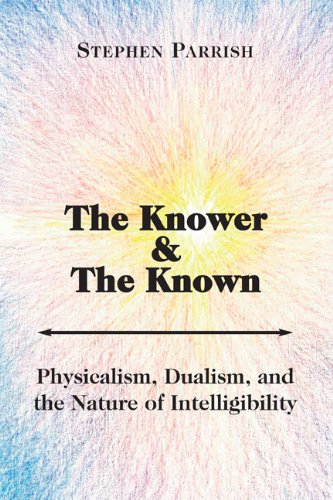 Stephen Parrish’s The Knower and the Known
Thought and Consciousness
What does it mean to have a thought? Parrish notes several aspects which go into the very act of knowing. There must be an object of knowledge; there must be a subject to consider the object; there must be consciousness in order to apprehend concepts and aboutness; there must be a relationship between subject and object and consciousness; there must be understanding of that relationship; and finally there must be a view of the world in which all of this can occur.
Consciousness itself is an extremely complex notion which involves phenomenality: the actual experience of thought; intentionality: the turning of one’s thoughts to consider an object; subjectivity: an agent which is itself the subject of the thought; and rationality: the capacity to order thoughts in such a way as to make sense of them. (206-213).
Consciousness has certain phenomenal properties. That is, when we consider our own thoughts, there is a distinct feeling to them which allows us to differentiate them from simple sense perceptions. There is an aspect of inentionality or attending-to our thoughts which is itself irreducible. Moreover, we are able to comprehend things which are themselves non-physical, such as the nature of a logical argument like modus ponens (226-228).
Consciousness must somehow interact with the physical world. If one is a physicalist, it becomes a matter of reducing consciousness to purely physical explanations, eliminating consciousness, or offering a brute relationship between consciousness and the physical world.
Qualia are also extremely important when considering consciousness. How is it that we are able to see objects as objects with certain properties? What process allows for individual particles/rays of light to manifest themselves in phenomenal consciousness in such a way as to provide a coherent picture of an object? Moreover, “there is more to recognizing qualia than just having color in one’s sensory field; there is also our attention to said qualia, the judgments we make about them, the objects that they represent, and also our memory of them–and these factors can make all of the difference” (257).
Subjectivity is also extremely important to forming a theory of consciousness. It seems that subjects are, in fact, irreducible. For the physicalist, the concept of a subject is extremely difficult. After all, a subject at t1 is going to be different from that subject at t2 in a number of highly relevant physical ways. Their neurons are firing differently from t1 to t2. How is it that subjectivity is maintained. The substance dualist holds that subjectivity is maintained through unity of consciousness which may not be reduced to the physical (291). The unity is preserved through intentionality but more thoroughly through rationality. The use of reason is one of the primary ways to offer continuity of the self. For the subject, S, at t3 is considering both thoughts at t1 and t2 in order to come to a conclusion at t4. Reason itself has aspects of intentionality which cannot be accounted for on a physicalist view of reality, for a physical object is capable of performing mathematical computations but not understanding the aboutness inherent in those computations (266-267).
Our Minds in the World
Parrish grounds his understanding of consciousness in a theistic worldview. There are numerous difficulties with an account of substance dualism which seem to only be soluble on a theistic interpretation. One of these is the problem of the interaction between body and mind. If God exists, then it seems inherently possible that a deity would be capable of forming the world in such a way that mind could interact with body. Parrish addresses several objections to the notion that an immaterial being could interact with a physical universe while also making an argument for non-physical selfs apart from God interacting in the universe (324ff).
The match of our minds with the world is something which must be accounted for. Parrish notes that if we ground ideal objects in an immaterial being like God, the difficulties with such objects existence and subsistence may be solved. Moreover, the glorious match of our mental life with reality is also explained, for a rational being is the source of all which we observe. If that is the case, then we no longer must appeal to simple brute fact to attempt to explain the phenomena of consciousness; instead, we may note that it is exactly as one might expect given theism (337ff).
And Then There was More…
Parrish concludes the work with a brief comparison of physicalism and substance dualism across multiple questions related to consciousness and the physical world. Finally, there are two appendices which address free will/agency and the theory of panpsychism, respectively.
Conclusion
In Part 1 of this review I outlined Parrish’s discussion of physicalism. Here, we have seen the structure of his substance dualism. It seems to me that Parrish’s deconstruction of physicalism is quite powerful. In particular, I noted that he makes a strong argument that physicalist theories ultimately boil down into either epiphenomenalism or mysterianism, neither of which is plausible. Moreover, his use of numerous examples and thought experiments throughout makes the work easier to comprehend while also providing a solid basis for grounding further discussions in philosophy of mind. Finally, the vast amount of research and documentation Parrish provides makes the work invaluable as a reference for physicalist writings alongside its clear value as a thorough critique of those same works.
The second major section, in which Parrish outlines his view of a theistic dualist ontology, is equally important. He provides a large amount of background for understanding how to put together various aspects of consciousness while also noting that, on theism, these observed phenomena cohere within an ontology, while on physicalism they are generally either discredited or ignored. The one thing the work may lack is a bit of cohesion in the section on substance dualism. Parrish has given a broad vision for how to hold a dualist ontology, but sometimes leaves it up to the reader to put the pieces together. The pieces are there, but not always assembled. I should note, however, that even here Parrish has provided an invaluable resource for those who wish to argue for a dualist vision of philosophy of mind.
I have already noted that Parrish’s The Knower and the Known is a tour de force in the realm of analyzing physicalist theories. However, the work is much more than a simple refutation of physicalism. Alongside that critique, Parrish has laid out the groundwork for substance dualism as a cogent alternative. Simply put, it is a must read for anyone with any interest in philosophy of mind. Comprehensive in scope, exhaustively documented, and interesting to read, The Knower and the Known is a must-have.
Source
Stephen Parrish, The Knower and the Known
SDG.
——
The preceding post is the property of J.W. Wartick (apart from citations, which are the property of their respective owners, and works of art as credited) and should not be reproduced in part or in whole without the expressed consent of the author. All content on this site is the property of J.W. Wartick and is made available for individual and personal usage. If you cite from these documents, whether for personal or professional purposes, please give appropriate citation with both the name of the author (J.W. Wartick) and a link to the original URL. If you’d like to repost a post, you may do so, provided you show less than half of the original post on your own site and link to the original post for the rest. You must also appropriately cite the post as noted above. This blog is protected by Creative Commons licensing. By viewing any part of this site, you are agreeing to this usage policy.
Really Recommended Posts 8/9/13
Here we have another go-round of the internet, in which I have found you, dear readers, some great reads. Featured topics this weak include abortion, Jesus, the universe, intelligent design, the teleological argument, and genocide.
Aslan Stumbles– Check out this extremely in-depth review of the recent book about Jesus, Zealot: The Life and Times of Jesus of Nazareth. Here, David Marshall offers a number of criticisms regarding individual assertions within the book, and then offers a critical account of Reza Aslan’s claims about Jesus’ life.
Republican Congresswoman Refuses to Abort Baby Diagnosed with Fatal Condition– The title of this one says quite a bit, but the article is even more interesting. Check out what happened when this republican congresswoman put her beliefs into practice with her child. It truly is a beautiful story.
The Observable Universe– I found this a pretty neat way to put our planet into perspective as far as the size of the universe is concerned.
Flight: The Genius of Birds (Media Review)– a look at the recent film by Illustra Media which makes a case for intelligent design from observations about flight.
Militant Atheists and the ‘Other’ Holocausts– We must know history in order to avoid repeating it. Genocides have occurred throughout human history, and atheists love to allege that religion is to blame. Is that always the case?
Even in the Multiverse, Our Universe is Rare– An argument that the design argument still works even given a multiverse.
Book Review: “The Knower and the Known” by Stephen Parrish – Part 1
What is the mind? Are humans purely physical beings? What are we to make of physicalist/materialist philosophies of the mind? Do these debates have any relevance for the existence of God?
Stephen Parrish seeks to answer these questions (and more) in his work, The Knower and the Known
The work is split into two major sections. The first is an exploration of physicalist/materialist theories of mind; the second is an exploration of consciousness and how theism provides the best explanation for our phenomenal consciousness (among other things). We shall explore these in order. In this post, I shall focus upon Parrish’s critique of physicalism.
Physicalism
Parrish introduces the major physicalist theories related to the mind-body problem. These include reductionism, eliminativism, supervenience, and emergence. In order to make sense of the claim that the mind is a purely physical substance, it is important to come to an understanding of what it means to be “physical,” and Parrish cites numerous philosophers in order to come to a fairly simple working definition: “to be a material object (to be composed of matter) is ultimately to have certain kinds of causal power over certain areas” (69). The definition must, necessarily, be more complex. Thus, various aspects of dimension, space, and the like are explored. Then, KK provides an explanation of the standard materialist/physicalist view of reality, which is essentially that “everything that exists… can be located within space and time…” (85, Parrish’s definition cites that of C. Koons, and is also lengthier, but for the purpose of this review I have left it at this).
The nature of physicalism must also be understood in order to analyze the claims of physicalists. How is it, exactly, that the physical is to account for the mental? Parrish explores numerous ways proposed to explain physically the connection. These are centered around various proposed psycophysical laws, which hold that there are certain ways in which conscious states relate relation to other physical states. There have been many different proposals about how these laws might work.
According to the nomological theory, there is a lawlike correlation between conscious and other physical states. A nomological theorist would note the correlation between neurons firing in the brain and various mental states. The proposal would then lead to a law of correlation (and perhaps causation) for brain states b1, b2, and b3 with conscious states c1, c2, and c3. Parrish notes a number of problems with this theory, however. Most notably is the fact that there are sometimes different patterns of neurons firing for the same thought. Of course, a physicalist could counter that there are different laws for these different patterns as well. In that case, notes Parrish, “there would have to be laws to regulate the relation of every brain state with the relevant phenomenological aspect of thought to which it is correlated” (89-90). Of course, this becomes even more problematic when one considers that there is an infinite set of phenomenological aspects of our consciousness. That is, we can focus our minds around thinking of numbers and continue counting from one to a billion and beyond. For nomological theory to be correct, there must be a specific brain state for each of these thoughts (along with whatever different brain states would need to exist for the variations which can produce the same number). So there would then need to be an infinite set of laws to account for our mental life.
Yet there is another difficulty, for “since it seems possible for different types of brains to have the same conscious phenomenal thought, and every brain is constructed somewhat differently from every other brain, there would have to be even more laws that accounted for conscious items to accommodate all of the brain states of all the different brains” (90). To say that such a theory of mind begins to make a bloated metaphysics seems something of an understatement. And this is not to even begin to consider the possibility of other intelligent life in the universe, which would also need these lawlike relations for governing their conscious states.
And all of this is not to take into account the problems with explaining how and why there could be different patterns for the same thoughts not only across species but also across brains of the same species and also across individuals. A number of other possibilities are examined, including accidental correlation theory, realizability, and identity. Each of these comes with their own set of problems which Parrish elucidates (92-97).
Parrish throws the gauntlet at physicalist theories of mind in the chapter aptly titled “Judging Physicalist Theories of the Mind.” In this chapter, KK provides a thorough critique of all the major physicalist theories of mind. For the purpose of this review, I will only provide the briefest of summaries for each of these critiques. Mysterianism is essentially the notion that we cannot know how consciousness and the brain relate, but we do know that physicalism is true. The problem with this position is that such a position basically pushes the burden of proof unto other physicalist theories of mind as opposed to providing its own explanation, and the theory in fact seems to be just another form of epiphenomenalism.
Eliminativism is a simpler theory in which it is simply asserted that consciousness does not exist (133ff). Such a theory seems patently absurd on its face, yet some physicalist philosophers continue to maintain that despite any appearance to the contrary, “there are no conscious aspects, objects, properties, or events at all” (136). The difficulty with such a position is that it is “self-referentially incoherent” (137). That is, it cannot be consistently believed (whatever it means to “believe” something) that there are on mental state when, in order to have such a belief, one must have some sort of mental state. Parrish further offers a scenario to describe our world in terms of an eliminativist worldview, which would yield a kind of “zombie” world in which our fictional mental states have no relation to the world around us (149-150).
Identity theory basically asserts that consciousness just is identical to the brain. Much work must be done to analyze this theory by noting which theory of identity one might hold to, along with how such a theory of identity might play out. KK provides just such an exploration and comes to conclude that any of these identity theories falls to a number of objections, including the arbitrariness of the connection between the physical and the [identical] consciousness (162-163). Supervenience theory, which holds that somehow the mental supervenes upon the physical, suffers from providing no actual explanation for how this should be the case and thus basically devolves into one of the other physicalist theories.
Functionalism is the theory that “the conscious mind is the brain functioning in a certain manner” (171). Again, the difficulty here is that this seems to boil down largely into a bare assertion and how closely related to (and probably reliant upon) eliminativism it is.
Higher order theories of mind posit that consciousness is something like the brain scanning itself. However, this provides no explanation for how consciousness could arise and thus is again parasitic upon other varieties of physicalism, most notably eliminativism.
Epiphenomenalism is at the core of Parrish’s critique, for throughout the work he shows in numerous ways how the other physicalist theories of mind are ultimately mysterian or epiphenomenal in nature. Epiphenomenalism is basically the view that consciousness is causally inefficacious. Thus, it is the brain which “does the work” while consciousness is some kind of byproduct of brain activity. However, such a theory does not adequately explain how consciousness may itself arise, nor does it provide any attachment for our thoughts to reality. It thus suffers again from self-referential incoherence, for our mental states have no causal attachment to our brain states or reality. They are, again, merely “epiphenomena” which somehow are generated by our brains. If our mental states happen to line up with reality, that becomes a merely happy accident, for our mental states do not control our brain states but are rather generated by them. This is not to imply that mental states must control brain states to give rise to coherency, but rather to note that unless our mental states are causal in some sense, the very process of rational thought is illusory, for our prior mental states have no connection to our past mental states other than to be generated in a certain temporal order.
Conclusion
We have outlined Parrish’s critique of physicalism. Next week, we shall explore his defense of dualism and his case for theism from the nature of intelligibility. However, by way of conclusions for this section, it is important to note the insights which Parrish has offered in KK. The arguments he presented seem devastating to physicalism. In particular, the fact that so physicalist theories of mind all seem to either ultimately appeal to mystery or reduce consciousness beyond causal powers undermine the physicalists’ ability to explain reality sufficiently. If a worldview cannot even account for something as basic as our thoughts, such a deficiency seems to bode ill for the rest of that view. As noted, we shall note a powerful alternative which Parrish argues for in the latter part of the book, theistic substance dualism.
Parrish, of course, offers much more thorough critiques of every position listed here (along with many that were not included in this outline). The work is extremely important in not only its comprehensiveness but also its thoroughness for exploring theories of mind.
Stephen Parrish’s The Knower and the Known
Source
Stephen Parrish, The Knower and the Known
SDG.
——
The preceding post is the property of J.W. Wartick (apart from citations, which are the property of their respective owners, and works of art as credited) and should not be reproduced in part or in whole without the expressed consent of the author. All content on this site is the property of J.W. Wartick and is made available for individual and personal usage. If you cite from these documents, whether for personal or professional purposes, please give appropriate citation with both the name of the author (J.W. Wartick) and a link to the original URL. If you’d like to repost a post, you may do so, provided you show less than half of the original post on your own site and link to the original post for the rest. You must also appropriately cite the post as noted above. This blog is protected by Creative Commons licensing. By viewing any part of this site, you are agreeing to this usage policy.
Really Recommended Posts 8/2/13
After a brief hiatus, “Really Recommended Posts” are back. This go-round I have found for your reading/viewing pleasure a debate on sola scriptura, Buddhism, fear, the Shroud of Turin, and presuppositional apologetics. As always, let me know what you liked/didn’t like! Send me your own recommendations!
Is the Bible the only infallible rule of faith? Tim Staples vs. James White (Video)- A (lengthy) debate between a Roman Catholic and a Calvinist regarding the rule of faith. Should we hold to sola scriptura, or do we need the Magisterium in order to preserve teaching? The debate is really worth listening to.
A Comparison of the Ethical teachings and Impact of Jesus and Buddha– A brief insight into comparative religions between Buddhism and Christianity. What of truth in other religions? I found this a very interesting post.
Fiction and Fear– A really excellent post over at Hieropraxis which notes the importance of an element of fear in fiction. The post ties this back to the relevance of the Christian teaching of Christ’s redeeming work.
Shroud of Turin Blog– I am not convinced that the Shroud of Turin is authentic. However, I do find some of the work being done regarding its authenticity is very interesting. This blog has a constant string of posts related to various evidences in favor of the Shroud’s authenticity. I recommend it for those interested in reading on the topic, with the caveat of my own (hopeful) skepticism.
What is pre-suppositionalism? What is presuppositional apologetics?– Over at Wintery Knight, this interesting post turned up with a critique of presuppositionalism as an epistemology (largely based on this post at The Messianic Drew). I found it interesting, though I do not fully agree with all the critiques leveled therein. For balance, I would also direct readers to Janitorial Musings for a counter-argument to the first major contention against presuppositionalism- Presuppositionalism and Circularity. I think readers should read all the posts involved for a more complete picture. Judge for yourselves what to think of the presuppositional “worldview” (to use Drew’s term–I would lean towards saying “epistemology” instead).



