J.W. Wartick
William Lane Craig vs. Lawrence Krauss-Thoughts and links
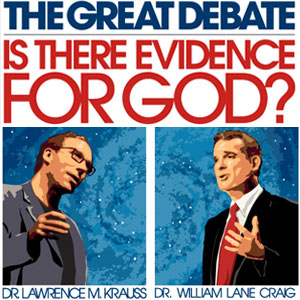 The debate took place on March 30th. I recently watched it and wanted to share my own comments, along with some others’ excellent thoughts.
First, the audio of the debate: here.
Second, William Lane Craig’s “Post Mortem”: here.
Third, Wintery Knight posted an excellent summary of Krauss’ “arguments”. I highly recommend reading it: here.
Fourth, the video is here.
Fifth, cosmologist Luke Barnes writes on Krauss’ misrepresentation of “nothing” here.
Sixth, Craig responds to Krauss’ extensive critique here.
DISCLAIMER: This post has been linked to by PZ Myers as a post which demonstrates the “dishonest distortions of some attendees.” For clarification: I did not attend the debate, but rather watched it online. Further, I answer Myers’ discussion of Bayes in a comment in response to a visitor below. Krauss definitely mistreprents Bayesian theorems in a way which undermines his own position. Finally, Myers’ ad hominem attacks upon Craig do little to back up Krauss’ self-defeating debate. For example, Myers writes that Craig is a “vacuous moron”; he rails against theists who “reject the atheist without thinking”; and he calls me dishonest, though admittedly only through linking to my site. Myers, in other words, uses the same strategy Krauss did in his debate: Calls himself smart, calls his opponents dumb, and declares “win” on the internet.
My thoughts:
Craig Opening
Craig went through his standard 5 arguments set, which remains as powerful as ever. The reason he doesn’t change his opening statement (unless the debate is about something other than the existence of God) is because he doesn’t need to fix what “ain’t broke”.
Krauss Opening
Krauss’ opening statement is simply awful. He starts off by saying Craig is a “professional debater” which is an obvious jab, because Craig is a professional philosopher who is world-renowned in both philosophy of religion and philosophy of time. Krauss goes on to bash logic and philosophy. Against Craig’s argument from contingency, he asserts that some contingent events happen causelessly. For example, he argues that “accidents happen all the time,” and seems to think that this shows that things can happen without cause. Against the Kalam, he argues that the universe is big, and concludes the argument is false. He also says that 2+2=5. He further argues that we can deal mathematically with infinities–something Craig agrees with and in fact deals with in extensive detail in his literature (specifically, The Kalam Cosmological Argument, and elsewhere).
Krauss also seems to argue that Craig’s evidence is not falsifiable, which is strange, considering every argument Craig offered is falsifiable simply by disproving one of the premises. He went on to assert that the universe came into existence out of nothing, for which he provides no evidence. Then he argues that “We don’t know!” if the universe is infinitely old (which runs smack in the face of the Big Bang). We also “don’t know” if there are objective moral values.
So, summing up Krauss’ opening, we have: logic doesn’t work, things pop into existence out of nothing, things can cause themselves, 2+2=5, and we don’t know anything.
Craig 2
Craig pointed out that you can’t deny logic without using logic to come to that conclusion, therefore defeating Krauss’ schoolyard “reasoning”. Craig then destroys Krauss’ argument from Hume, by pointing out Hume didn’t even have access to the probability calculus utilized in arguments from miracles. He goes on to point out that Krauss’ argument that “accidents just happen” as a way to get around causal reasoning is ridiculous–the example of a friend falling out of bed and breaking a leg is not causeless–he broke his leg because he fell out of bed in such and such a way! He also points out that we certainly can add infinites together (again, if Krauss had actually done any research, he’d have known Craig already responded to this argument), but that actual infinites are impossible because it leads to contradictions. Craig goes on to quote George Ellis, a cosmologist, as an expert who disagrees with Krauss.
Craig then pointed out that there’s a difference in terminology between what Krauss said is “nothing” and actual “nothing.” Krauss simply misrepresented what is meant by “nothing” comes from “nothing.” The quantum vacuum, for example, is not “nothing”. He then quoted Krauss on the very topic, pointing out that Krauss clearly intended to distort the meaning of “nothing.” Nothing, Craig explains, means actually nothing–no quantum vacuum, no energy, no matter: nothing. So Krauss has to point out that the universe can come from actual nothing. He then points out that Krauss doesn’t even argue against moral values, and has to go on to quote Krauss’ body of work to point out his only response to the argument, which is that there is no freedom of the will. So Krauss has to argue that there’s no freedom of the will in order to get around Craig’s argument. Finally, Craig nicely shows Krauss how to logically get to God from Christ, since apparently Krauss was unable to make that same inference.
Krauss 2
Krauss starts off by holding that empty space is not empty–something Craig agrees with, which is the entire point of the argument! Craig has been arguing that there was nothing before the universe–something the Big Bang also leads to, but Krauss either can’t fit his mind around this simple concept (before the universe there was actually nothing) or he is blatantly misrepresenting the argument. My bets are on the latter. Krauss says the beginning of the universe is “fascinating” and we should try to understand it, and then argues that it’s possible to not believe in God. (Fantastic reasoning). He then makes another jab at Craig by saying “he’s not an expert” …but well, maybe he is “because he’s read my stuff.”
Krauss interestingly points out there was a time when there was no space and time, and then it came into existence. He holds that this is for no reason, out of nothing.
He goes on to make what I call the “observer’s fallacy”: claiming that because we’re here, we don’t need to explain why we’re here. As with many terrible arguments, the “observer’s fallacy” proves too much–we’re here to observe x, therefore x is probable or had to happen (and therefore we don’t need to speculate about a cause–or there is no cause). Anything can be plugged in. I’m here to observe the hamburger in front of me to eat, therefore it is uncaused!
Krauss’ argument about “empty space” holds that these quantum events happen with different laws at different times. He then concludes that therefore, these are uncaused or undesigned, there is no God. But the obvious flaw in this reasoning is that he already noted that these quantum events happen due to laws, which then precludes his argument against logic in science. He argues that physics has different, random kinds of laws across an unobservable multiverse which we can’t test. Nice bit of metaphysical baggage to add on there.
Krauss also makes the absurd error of equating mathematical probability with epistemic probability. Krauss is correct in saying that if something is 50% likely, that’s just a chance, not a reason to believe it’s true or that it’s the case. However, he misunderstands (I say this because it’s clear so far that he doesn’t know what epistemic probability is) epistemic probability. One example could be drawn from Robin Collins about the thesis of common descent–if I think it is more likely than another theory, I’m not saying that it has a 60% chance, whereas other theories have a 30% or 20% chance… no, I’m saying that given the evidence, it seems as though the thesis of common descent has more epistemic weight than its rivals–it is more likely epistemically. I doubt Krauss will address this in any way through the rest of the debate, because I really do think, judging by his strategy so far, he doesn’t have the philosophical know-how to do so.
In summary, Krauss’ response to Craig’s rejoinder is: “Everything is random! HA! Also, things happen due to causes, but they are uncaused! I’m here to observe things, so they are uncaused!”
Craig 3
Craig now has to get to the point of debating someone who denies logic. Not an enviable position.
Craig starts off by refocusing the debate on whether there is evidence for God or not–“is it the case that God’s existence is more probable” given the evidence presented “than not.” He points out that Krauss didn’t engage Craig’s theses, but rather went off on tangents. For example, Krauss did not deny that he was using the taxicab fallacy–the idea that everything needs an explanation, but once we get to the universe, it needs no explanation. Then Craig argues that the scientific evidence supports the beginning of the universe, using the same paper Krauss argued had nothing to do with God. Craig’s only intent is to use the research to point to a beginning of the universe, so Krauss was again mistaken in his response.
Craig challenges Krauss to present any evidence to suggest the universe is past-eternal. I sincerely doubt Krauss will do anything of the sort, given how evasive he’s been to this point. Craig also challenges Krauss to actually address the fine-tuning argument and present some reason as to why we should believe in the multiverse which we can’t observe. Then Craig points out that most scientists agree the universe is fine-tuned for life, contra Krauss’ denial earlier.
Finally, Craig points out that Krauss misrepresents the moral argument because God’s nature is necessarily such that the divine commands He issues cannot be evil.
Summary: Craig has challenged Krauss to deal with the evidence at hand.
Krauss 3
Not that it is unexpected, but Krauss starts off by outlining just how clear it is that he doesn’t understand epistemic probability. He continues to think that it is reducible to mathematic probability. Plus, his example is simply wrong. Krauss says (paraphrased) “You wanna talk about probability, how bout we ask some scientists if God exists!” He then says that 90% of the National Academy of scientists are atheists. Okay… so how is this probability? It’s a statistic. Apparently Krauss is unaware of the fact that to have a probability, you must, you know, draw a conclusion. He could have said “The chance for me to pull an atheist out of the National Academy of Scientists is 9/10” but simply saying that 90% of them are atheists is not a probability. Not only that, but Krauss is clearly being disingenuous. Also, he clearly doesn’t understand epistemic probability.
Krauss then randomly brought up the “Old Testament God” and says He’s clearly not compassionate.
He hints at the Euthyphro dilemma… but then says “rationality defines morality.” How?
Closing Statements
Craig simply points out Krauss hasn’t refuted any argument.
Krauss resorts to saying “We don’t know x, we don’t know y, we don’t know z.” Then he makes the infamous “We’re all atheists” argument that is the subject of this post and one I will write soon.
Final Thoughts
Imagine a theist/Christian came to a debate and, in order to establish his point, stood up and said “Well logic doesn’t work. Logic isn’t reality. Philosophy is dumb. Theology is better. Theology isn’t governed by logic. Logic is dumb. Logic can’t prove anything about the universe [this latter is a direct quote from Krauss].”
The Christian would be laughed out of the building. But an atheist can stand up and say “logic doesn’t prove anything… Logic isn’t reality… etc.” and people take them seriously. It’s another example of “atheism at any cost.” Rather than acknowledge the existence of God, to which logic and sound reasoning continue to lead us, atheists reject logic and sound reasoning. Krauss, to his credit, did manage to demonstrate this with profound success: atheism is irrational.
SDG.
——
The preceding post is the property of J.W. Wartick (apart from citations, which are the property of their respective owners) and should not be reproduced in part or in whole without the expressed consent of the author. All content on this site is the property of J.W. Wartick and is made available for individual and personal usage. If you cite from these documents, whether for personal or professional purposes, please give appropriate citation with both the name of the author (J.W. Wartick) and a link to the original URL. By viewing any part of this site, you are agreeing to this usage policy.
Ozymandias and the Plight of Atheism
 Ozymandias
by Percy Bysshe Shelley
I met a traveler from an antique land
Who said: Two vast and trunkless legs of stone
Stand in the desert. Near them, on the sand,
Half sunk, a shattered visage lies, whose frown,
And wrinkled lip, and sneer of cold command,
Tell that its sculptor well those passions read
Which yet survive, stamped on these lifeless things,
The hand that mocked them, and the heart that fed;
And on the pedestal these words appear:
“My name is Ozymandias, king of kings:
Look on my works, ye Mighty, and despair!”
Nothing beside remains. Round the decay
Of that colossal wreck, boundless and bare
The lone and level sands stretch far away.
The poem has struck me every time I read it. I am filled with senses of longing, wonder, and terror. Longing, because I want to see the legs of Ozymandias, to know of his Empire, to know how he got to the point of writing the infamous words “Look on my works, ye Mighty, and despair!” Wonder, because he surely must have known his works would pass, as do all things. But maybe he didn’t think they would, maybe he thought he could preserve himself through all time by making a statue… but all that remains is a placard and part of his legs. His works may have been great enough to despair the Mighty, but they’ve passed, and they are nothing but a memory. Terror, because I realize that without God, this is the plight of mankind. We build ourselves up, but we shall pass. In the fullness of time, the world will fade away, the sun will burn out, and our works–which we may think mighty or great–shall pass away.
The poem of Ozymandias describes atheism. Without God, we are each our own Ozymandias–building futile works for a futile purpose. Our writings, our words, our lives all pass away. The best we can hope for is a saying written in rock which may be discovered somewhere by someone, but even then our futility will only be felt with the sting having passed. No matter how great we become, we die, and we pass into nothing. Each one of us is futile, living a meaningless life in a universe without purpose, without a plan. Travelers may come by Earth one day and see the abandoned wreckage of our cities, and make their own poem about the futility of the human race, who thought it had achieved something, but aspired for greatness in a universe without meaning.
So what are we to do? I’m not suggesting that just because the universe is meaningless, we should become adherents to a religion. I’m suggesting two things: first, atheists should think long and hard about their lives. If atheists are living as though there is meaning, they have imported something from a rival worldview. On atheism, the best we can hope for is a poem dedicated to our memory, which will have long since passed away. And that poem will itself have no meaning, for it to shall pass. And it’s not the passage which makes the universe meaningless–it’s the utter meaninglessness of time now, then, and forever. For what does it matter if I am a Mother Theresa or a Hitler? What does it matter if I am a sinner or a saint? If the world remembers me as a tyrant or a benevolent ruler? Here and now, the only meaning we can construct is our own–and that is a facade, an illusion. For our meaning is contradicted by others, and our meaning is self-created. How can one make meaning? Only by believing it is meaning. So it is a fideism, an atheistic faith in meaning.
Second, I’m suggesting people should be open to examining other worldviews. Suppose atheists are wrong, and there is meaning. To continue living life as an Ozymandias is then the greatest tragedy which could befall one’s life. If one is worth something, then to live as though one is worthless is the worst thing that could happen. So I’m suggesting atheists should examine views which don’t imply a universe void of meaning. Why? Not out of fear–but out of hope. It seems as though the entirety of the human experience is based upon the idea that there is meaning. To deny this is to deny part of what it means to be human. Therefore, it seems intuitively possible that there actually is meaning in the universe. Our experience leads us to believe there is. But that meaning cannot be found on atheism, so atheism has intuitive implausibility. Perhaps we should abandon the (un)belief.
Related post: Atheism’s Universe is Meaningless and Valueless.
SDG.
——
The preceding post is the property of J.W. Wartick (apart from citations, which are the property of their respective owners) and should not be reproduced in part or in whole without the expressed consent of the author. All content on this site is the property of J.W. Wartick and is made available for individual and personal usage. If you cite from these documents, whether for personal or professional purposes, please give appropriate citation and provide a link to the original URL. By viewing any part of this site, you are agreeing to this usage policy.
Omniscience, Substance Dualism, and Private Access
 I recently attended a seminar on God and Time with William Lane Craig (view my post on it here). One topic (among many) that caught my interest was Craig’s denial of one of the arguments for substance dualism, namely, the “private access” of some truths.
J.P. Moreland argues for private access in his work The Recalcitrant Imago Dei: Human Persons and the Failure of Naturalism. He argues that mental states have an “ofness or aboutness–directed towards an object” which is “inner, private, and immediate to the subject having them” (20, emphasis his). Basically, the claim is that even were someone else to know everything about J.W. Wartick, they could not say that they know what it is to say “I am J.W. Wartick”, because they are not J.W. Wartick. Certain truths and facts are such that only the knower can know them. I cannot say I am Abraham Lincoln, because I am not him. Nor could I say that I was Abe Lincoln even were I to comprehensively know everything about Abe Lincoln from the events that occurred in his life to the exact synapses in his brain. There is something about a phrase like “I am Abe Lincoln” which only Abe Lincoln can know.
Interestingly, Craig denied that there was such a thing as “private access.” He argued that, were this the case, it would mean God is not omniscient.
Why should it follow that God is not omniscient? Well, Craig defines omniscience as “Knowledge of any and all true statements” (definition from my lecture notes). Due to the fact that God would not know true facts which have private access, argued Craig, there is no such thing as private access. This seemed like an odd way to go about denying private access in regards to substance dualism. The argument seemed to be:
1) Omniscience =def.: God knows any and all true statements.
2) God is omniscient.
3) Truths available only through private access would entail truths God does not know
4) Either God is not omniscient or there are not truths available only through private access (1, 2, 3)
5) God is omniscient (2)
6) Therefore, there are no truths available only through private access (4, 5)
The argument would work, if one agrees with the definition of omniscience in (1). But I find it more likely that omniscience is analogous to omnipotence, which is defined as God’s ability to do anything logically possible. Why should it not be the case that God can only know things which are logically possible to know? On such a view, then, private access would not challenge omniscience whatsoever, because it would be logically impossible for God to know truths only knowable to their subjects.
I brought this up to Craig, and he responded by saying that my definition of omniscience made it into a modal property, and omniscience is not a modal property. I don’t see why omniscience could not be a modal property. In fact, it seems to me as though it is necessarily modal. Omniscience entails that any being which is omniscient would have to know all possible truths about all possible worlds (for any being who did not know truths for all possible worlds could be outdone by a being which knew about more possible worlds), which is clearly a modal claim. So it seems to me omniscience is clearly a modal property, and there is no problem revising Craig’s definition to:
(7) Omniscience=def.: A being is omniscient if it knows everything it is logically possible to know.
Further, a denial of (7) would seem obviously contradictory because one who denies (7) would have to assert:
(7`): Omniscience=def.: A being is omniscient if it knows everything, including things it is logically impossible to know.
And this would lead to contradictions about omniscience. So I don’t see any reason not to revise Craig’s definition of omniscience to note that God can only know that which it is logically possible to know (for a denial of this would imply God’s knowledge could be contradictory). But then private access provides no challenge to omniscience, and Craig’s denial falls apart.
Finally, “private access” seems like an intuitively obvious feature of knowledge. How could one deny that there are truths such as “I am J.W. Wartick”? It seems clear that only I can experience what it is to be J.W. Wartick. So I think it is necessary to modify Craig’s definition and simply deny his argument, both because God cannot know or do the logically impossible, and because “private access” is such a well-established phenomenon.
Edit: See the interesting discussion in the comments below. I am forced to modify the definition I presented in this post in the comments below due to an insightful comment by Midas. Those interested can read below or just read my modification here: “A being is omniscient iff it knows all truths which are not delineated by private access [of others] or experiential knowledge [of others].”
SDG.
———
The preceding post is the property of J.W. Wartick (apart from citations, which are the property of their respective owners) and should not be reproduced in part or in whole without the expressed consent of the author. All content on this site is the property of J.W. Wartick and is made available for individual and personal usage. If you cite from these documents, whether for personal or professional purposes, please give appropriate citation and provide a link to the original URL. By viewing any part of this site, you are agreeing to this usage policy.
More Committed to Truth than God.
 JP Moreland has said that he is “more committed to truth” than he is to God (JP Moreland, “Christianity and the Nature of Science” Lecture).
What he means is that were it shown that belief in God is irrational, he would drop faith belief in God.
I think it is supremely important for all Christians to maintain this attitude. We cannot simply assume the truth of our position, but must rather be willing to follow the evidence where it leads. Notably, the evidence leads us directly to the existence of God.
Such a view is also Biblical. Examine, for the moment, 1 Corinthians 15:14 “If Christ has not been raised, our preaching is useless and so is your faith.” Paul here asserts what Moreland does: if it is shown that what we believe in is false, then our faith is useless. We must remain committed to truth as we examine the universe around us.
It is that commitment to truth which must also leave us unrestrained from examining the deep topics of our faith. We must be open to modifying the doctrinal positions we hold as we scrutinize them with both Scripture and philosophy. There is objective truth, and we are, in some sense, obligated to pursue it–particularly if the alternative is to blindly hold to our position.
Such advice applies not only to believers but also to those who do not believe. Dogmatic atheists who deny God’s existence on principle are no more committed to truth than theists who believe because they “feel it’s right.”
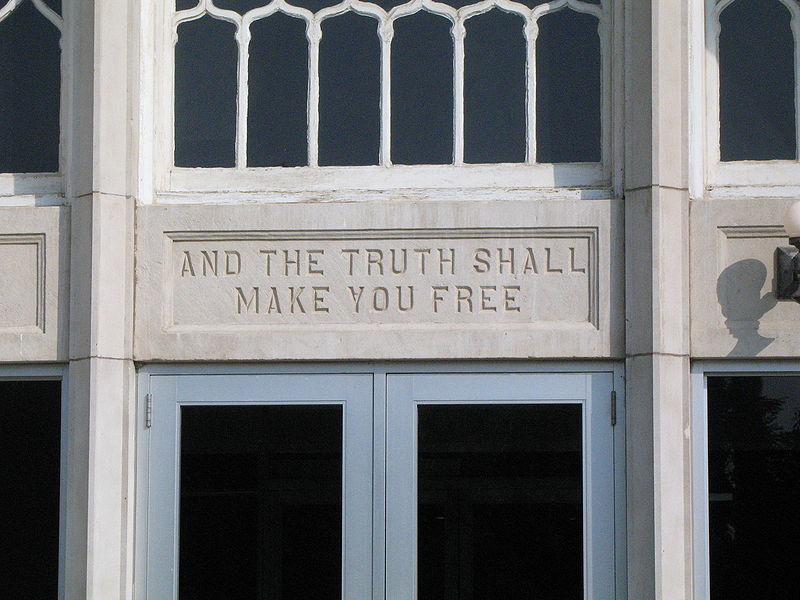
I can put it no better than the words of our Lord: “You will know the truth and the truth will set you free.” -Jesus, John 8:32
SDG.
Image source: http://commons.wikimedia.org/wiki/File:Nwmsu-truth.jpg
———
The preceding post is the property of J.W. Wartick (apart from citations, which are the property of their respective owners) and should not be reproduced in part or in whole without the expressed consent of the author. All content on this site is the property of J.W. Wartick and is made available for individual and personal usage. If you cite from these documents, whether for personal or professional purposes, please give appropriate citation and provide a link to the original URL. By viewing any part of this site, you are agreeing to this usage policy.
Atonement and a Timeless God
 One of my own struggles with Christianity as I began serious contemplation of its core doctrines is the doctrine of atonement. Specifically, I kept wondering how it is that Jesus’ death two thousand years ago could be used as atonement for my sins now. In order to overcome my difficulties figuring this out, I admittedly opted for a fideist type of approach and just assumed that God could do what He wanted, and if He wanted to forgive me because of something two thousand years ago, that was fine.
More recently, however, I’ve been thinking about God’s timeless nature. I touched on these thoughts in my last post, but wanted to get into more depth now.
Consider this: If God is timeless, then God’s existence occurs “all at once”; there is no sequence of events to God, only one eternal “now.” But then it follows that God the Son, Jesus Christ, is eternally crucified, eternally exalted, eternally reigning on high.
In some sense, if God is timeless, then it follows that while I am sinning, Christ is suffering on the cross. As I ask for forgiveness, He is rising from the tomb. As I read Scripture, Christ is speaking. I don’t mean these things temporally, of course, for on this view, god is atemporal–He is without time. Thus, I am not saying that “now”, Christ is dying in a temporal sense; rather, it is meant metaphorically. Christ is crucified in God’s eternal “now”; during which all events are “present.”
What does this mean for atonement? At least in my opinion, it seems to make a lot of sense out of the idea that Christ’s death pays for my sins. For there is no moment at which Christ is not suffering for my sins–a truly horrific thought. On the other hand, there is no moment at which Christ is not glorified with His Father in heaven. All of God’s experience occurs in an instant.
It should be noted again that these considerations are not intended to imply that all events are “simultaneous” in a temporal sense of “occurring at the same time”; rather, they are simultaneous in the sense that from God’s perspective, they have occurred; are occuring; and will occur. All events are eternally present to God. Neither does this mean that God has no sense of the order of events. God’s eternal now sees events in order of logical priority as opposed to temporal progression. Therefore, God knows that one event (x) occurs “before” another (y) in the sense that x is logically prior to y; x had to occur for y to happen. But God experiences all events as “now”; as the changeless, immutable deity, He is eternally crucified, eternally glorified; eternally paying for our sins, and eternally forgiving us for them.
At Communion today (Sunday), I was contemplating the implications of an atemporal God for atonement and justification. I was overcome with emotion as I thought deeply on the issue. As I was eating of the body and blood, Christ was being crucified for my sins; as my forgiveness was declared, Christ was rising.
Powerful thoughts. I think divine temporalists (those who hold that God is temporal) still have to deal with the doctrine of atonement: how does a death thousands of years ago atone for me now? Those who hold God is timeless can answer this question sufficiently: Christ is paying for your sins.
SDG.
———
The preceding post is the property of J.W. Wartick (apart from citations, which are the property of their respective owners) and should not be reproduced in part or in whole without the expressed consent of the author. All content on this site is the property of J.W. Wartick and is made available for individual and personal usage. If you cite from these documents, whether for personal or professional purposes, please give appropriate citation and provide a link to the original URL. By viewing any part of this site, you are agreeing to this usage policy.
“God, Time, and Creation”: A Seminar with William Lane Craig
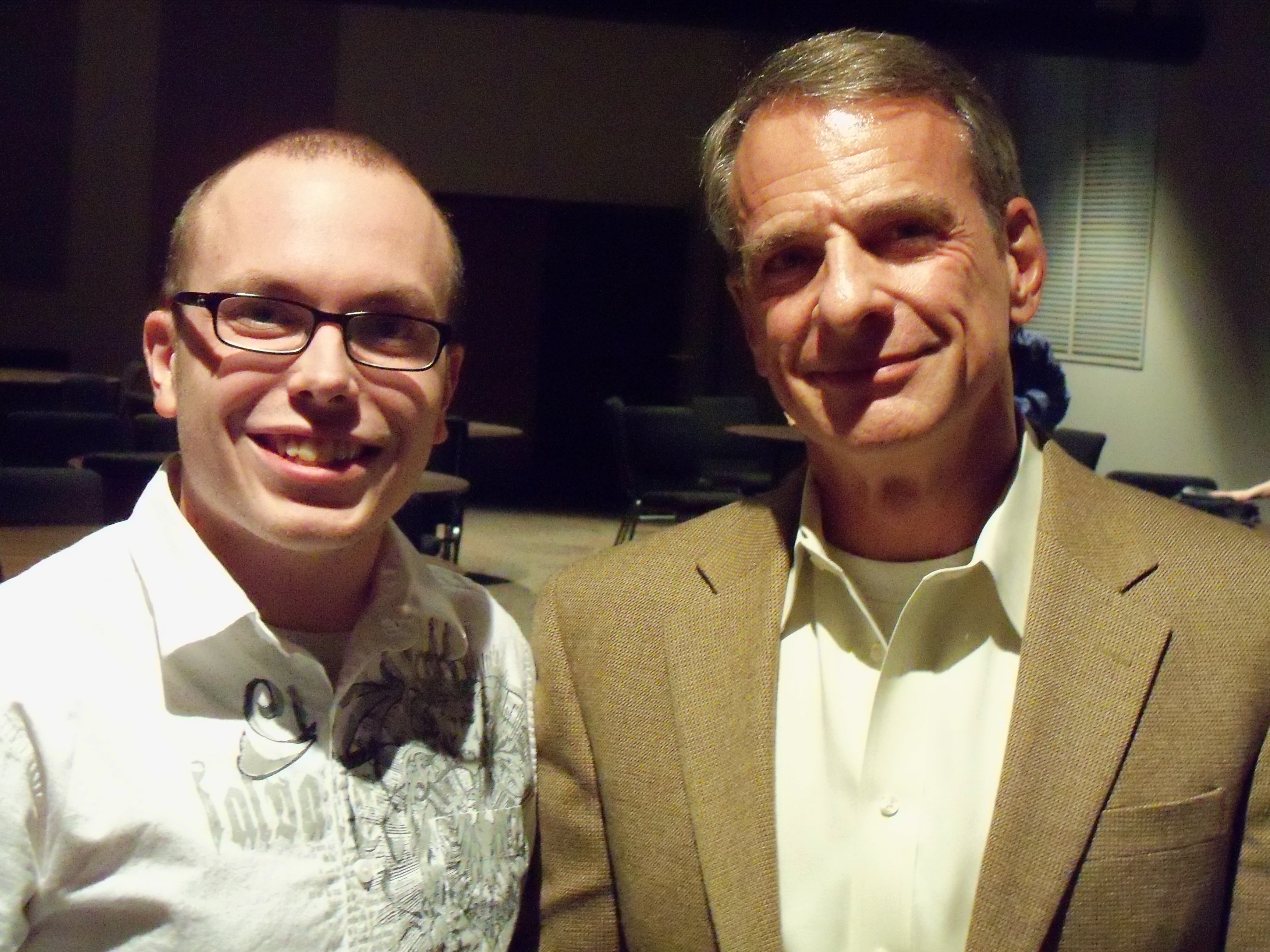 Over the past weekend, I was privileged to spend some time in Georgia (Atlanta area) at the seminar “God, Time, and Creation” with William Lane Craig (in picture next to me). It was part of a class of the same name for the Master of Arts Program with Biola University.
The seminar was a blast. I took approximately 25 pages of notes. Craig’s lecture notes comprised about 440 pages. Awesome!
The seminar focused on God’s relationship to time. Is God timeless, or temporal? Interestingly, Craig holds that God was timeless without creation and temporal subsequent to creation. His book, Time and Eternity, expands on the issues at great length.
First, Craig covered the arguments for and against a timeless God. It seems like a timeless God is not philosophically untenable, and the argument for a timeless God based upon the idea of the imperfection of a temporal life has some plausibility. Then, Craig went over the arguments for and against a temporal God.
After that, we covered the static (B-theory) of time–which holds that all of time and space is a kind of 4-dimensional block–and the dynamic (A-theory) of time–which holds that temporal becoming and passing away is real. It seems that the B-theory of time is, at best, extremely counterintuitive. If the B-theory is correct, our feeling of passing through time is illusory. Further, the theological problems with the view make it really implausible. If time is static, then the J.W. from three hours ago is literally a different entity than the J.W. now, because each is a different “slice” of a four-dimensional “block” of time. So, for example, it would seem as though the J.W. now could not be punished for the sins of a past J.W.–they are, in fact, different entities. Therefore, the doctrines of atonement, justification, sin, etc. seem to be at best vacuous. So a static theory of time, I think, is very implausible for the Christian to hold.
I’m reading through Paul Helm’s Eternal God: A Study of God without Time right now. He holds that God is timeless, and holds that time is static. I’m interested to see if he counters any of these theological issues.
Craig concluded that without creation, God is timeless–there is no change. But once God created, He underwent at least an extrinsic change, which Craig argues means God is temporal subsequent to creation.
This is one of the few areas I disagree with Craig on. I actually think it is more theologically plausible to hold that God is timeless, period. The main problem with this view is that many argue a timeless God entails a static theory of time. If I find on my further study into the area that this is the case, I may be forced to abandon the view that God is timeless. Therefore, I’m looking forward to delving into greater detail on this topic.
I’ve read Brian Leftow’s Time and Eternity and found it extremely interesting and thought-provoking. Craig is highly critical of Leftow’s view and charges that Leftow makes category mistakes throughout his work. As I said, I’m also reading Helm’s Eternal God, so I’ll see how that holds up. This is a very interesting topic which affects the core of study about the nature of God, how God relates to the world, divine providence, and many other areas. I’m excited to continue my research in this area.
On a side note, the Atlanta area is pretty awesome to visit! The weather was gorgeous. It isn’t that much fun driving there, however.
I visited a Christian Bookstore in the area–Lifeway Christian Bookstore–which had a huge sale on CDs. I couldn’t resist picking up some more Christian music (5$ cds!).
SDG.
———
The preceding post is the property of J.W. Wartick (apart from citations, which are the property of their respective owners) and should not be reproduced in part or in whole without the expressed consent of the author. All content on this site is the property of J.W. Wartick and is made available for individual and personal usage. If you cite from these documents, whether for personal or professional purposes, please give appropriate citation and provide a link to the original URL. By viewing any part of this site, you are agreeing to this usage policy.
Book Review: “A Carpenter’s View of the Bible” by Charlie March
 A Carpenter’s View of the Bible (hereafter CVB) by Charlie March is a unique book. It is part memoire, part Bible study, and part an archaeological/carpentry primer.
Throughout the book, there is a palpable sense of wonder with God’s creation. March delights in the hexagonal patterns found throughout nature, from the bee’s hive to the cowfish (7). Moreover, the book is structured around this sense of wonder; filled with the assertion that God is a “builder” (2-3), and our building reflects His.
There is a diversity of topics within CVB, and this sometimes takes away from the cohesiveness of the book, which at a few points seems to flounder. However, March covers the diversity of topics with a flair and insight that keeps it going despite the sometimes disconnected nature of topics.
On the topic of God’s destruction of the peoples of Palestine in the wake of the Hebrews, March writes “God’s perfect justice and righteousness is defined by his treatment toward disobedience and immorality, for which the typical response is his corresponding punishment. He reacts harshly against sin… (28).” He continues on to discuss how Noah’s Ark and the Ark of the Covenant show “divine-human collaboration” which can be seen as a “redemptive act” (29).
The joy of God’s “building” plan interwoven with mankind’s struggles therein is a strand March works throughout CVB. His discussion of the Tower of Babel and idols reflects the kind of interesting interplay between memoir, biblical study, and carpentry I hinted at earlier. The Tower, argues March, can be seen as a kind of attempt at protection from another flood–an attempt to reach above the waters and strike at God. The result is “a humanistic building that challenges God’s law” (41). Rather than reacting with destruction in this case, God confuses the languages, thus resulting in a kind of third chance for mankind as they are forced to rebuild once more. But they fail again, by constructing idols. March points out the strangeness that is an idol: it is something that the craftsman must make himself, and then worship. One might rightly ask, “Dude, how does that chunk of wood you harvested from the forest become a god?” (48).
But humans didn’t always fail. March writes that the construction of altars, ‘heaps’, and standing stones is a “physical act” which serves as a “physical marker in our lives to remind us of the passing of significant events” (49).
The chapter on Jericho is where many of the themes in CVB really come together. March not only makes an interesting argument about the symbolism of the wall, but he also delves into the archaeological research done on Jericho and discusses the faith of Rahab. March argues that the key to the story is the wall (again, the elements of memoir remain as he remembers a show, The Time Tunnel, he used to watch). The wall is a symbol of our lives as well as the kind of barriers we can put up to God (62), but they also symbolize strength. March makes an interesting argument that perhaps the entire purpose of God’s rerouting to Jericho wasn’t so much to eliminate a threat to His people (a plausible argument) as it was a specific salvific act. He argues that God was rescuing the “little lamb who was caught up in the thicket”–Rahab, among the people in Jericho. “[S]imilarly,” argues March, God would “divert the course of history for you and me” (75). One could draw out the implications here and say God did do this in Christ.
Again, March’s discussion of archaeology in conjunction with Sodom is enlightening, and readers will find his discussion there interesting. But March doesn’t leave it with archaeology, he goes on to note that it is important to realize that Sodom was not some ugly town, but a “cool” one which would have the kind of appeal for God’s people that other sinful locales may have for His people today (111-112).
Thinking about Jesus is, of course, a central task of CVB. He is the savior, but we should not forget that “the principle of redemption is not only an event of salvation but an ongoing lifestyle program” (136).
CVB is a fresh, if sometimes disjointed, look at the Bible. March draws from his own life, detailed analysis of archaeology and history, and Scripture in order to weave together an enriching work on the Bible. Interestingly, the book’s central purpose is withheld until it is almost over. March writes that “To live a full life is to build according to the precepts of Scripture drawn to our scale by the Great Architect who set the code from which we should build our lives.” This is the theme throughout the book: our lives are a work in progress, and it is not just God’s work but our own. The book is filled with wonder at God’s creation and insightful parallels between His and our creative acts. Choose wisely how to build.
Disclaimer: I was provided a review copy of this book by WinePress publishing.
SDG.
The Life Dialogue: Geocreationism and Original Sin
This is a guest post by Mike Trutt on Geocreationism. Check out other posts on the “Life Dialogue” within Christianity here. Check out his other posts on Geocreationism here and here.
Mike Trutt is an evangelical Christian with a Jewish background. He believes the Bible is inspired by God, recorded by man, and given its life by the Holy Spirit. You can read about and discuss his Old Earth views on scripture, science, history, and other topics at his blog,http://geocreationism.com.
Original Sin
Whether you believe Adam was physically born or formed directly from dust, most Old Earth Creationists have the following belief in common: animals, plants, and people were alive and dying long before Adam and Eve ate of the apple. Why is this important? Because Original Sin introduced “death” into the world, and Evolution requires you to believe physical death existed before Original Sin.
Consider the following two passages, commonly used by Young Earth Creationists (YECs) to demonstrate that if the Word of God is true, then there was no physical death before Original Sin (emphasis added)…
Romans 5:12 – Therefore, just as sin entered the world through one man, and death through sin, and in this way death came to all people, because all sinned.
1 Corinthians 15:21-22 – For since death came through a man, the resurrection of the dead comes also through a man. For as in Adam all die, so in Christ all will be made alive.
In other words, so the argument goes, physical death could not precede Original Sin because physical death entered the world through Original Sin. It is in part why Christ Himself died for us. Looking at these passages, could it be any clearer? Allow for physical death before Adam, and it means either Christ had no reason to die, or the Word of God is wrong. It makes Old Earth Creationists (OECs) appear not to take the scripture very seriously.
= = =
Christians generally agree that Adam’s body began to deteriorate immediately after the Original Sin, and it eventually led to his physical death. But, is it the corrupting nature of sin that caused the deterioration, and hence death? Not according to 2 Corinthians 5 (emphasis and (comments) added)…
4 For while we are in this tent (i.e., earthly body), we groan and are burdened, because we do not wish to be unclothed but to be clothed instead with our heavenly dwelling, so that what is mortal may be swallowed up by life. 5 Now the one who has fashioned us for this very purpose is God, who has given us the Spirit as a deposit, guaranteeing what is to come.
In other words, God designed us to physically die so that our earthly mortality can be swallowed up by our heavenly immortality. Knowing that God designed us to be mortal while on earth, that same design should be found in Adam, even before his sin. In fact, it is found in Genesis 2:9 (emphasis added)…
The LORD God made all kinds of trees grow out of the ground—trees that were pleasing to the eye and good for food. In the middle of the garden were the tree of life and the tree of the knowledge of good and evil.
Why provide sinless Adam with the Tree of Life, unless his body was otherwise mortal? Without that tree, Adam would die; with the tree, he would live forever. Even after Adam’s sin, God placed angels and a flaming sword to guard the Tree of Life from him, lest he “reach out his hand and take also from the tree of life and eat, and live forever.” (Genesis 3:22b) In other words, before the Original Sin and after, Adam’s immortality depended on the Tree of Life. Like Paul said, Adam was designed to die.
= = =
We could just leave it at that, but there are a few scriptures we should address. For example, if Original Sin was merely the occasion of Adam’s physical death, never the instrument, then what was God warning Adam of when he said not to eat from the Tree of the Knowledge of Good and Evil?
Genesis 2:17b – …for when you eat from [the Tree of the Knowledge of Good and Evil] you will certainly die.
The most straightforward reading of this verse implies that eating the apple would immediately physically kill Adam. In fact, when Eve repeated God’s warning back to Satan in the Garden, she clearly thought God meant immediate physical death. But then Satan corrected her…
Genesis 3:4-5 – “You will not certainly die,” the serpent said to the woman. “For God knows that when you eat from it your eyes will be opened, and you will be like God, knowing good and evil.”
In the Gospels, Satan always tempted Jesus with the truth. That is what made it tempting. Is it not then reasonable to consider that Satan was telling Eve the truth about physical death, even while he deceived her in regards to God’s meaning? After all, when Eve ate the fruit, she did not immediately physically die. In fact, just as Satan predicted, Adam’s and Eve’s eyes were opened to knowing good and evil… and they knew what they did was evil.
What then was Satan’s deception? For one thing, he left out what God really meant by “die”, by making “death” seem like a “coming alive”. Before the Fall, Adam and Eve were in a state of sinless perfection; afterwards they were not. Before the fall, they were naked and did not think twice about it; afterwards they were self-conscious and covered themselves up. The moment they both sinned, they went from being blameless to being in need of redemption. It was a dramatic change, as sudden and jarring as Genesis 2:17 makes it sound. In a very significant and spiritual way, they both died that day.
By the same token, there was another deception. Assuming Eve realized the fruit was keeping her alive, she really had no idea that God was going to punish her by depriving her of it. God may have been promising spiritual death for her sin, but Eve was in fear of physical death. Satan knew God would not immediately kill her physical body, but he failed to tell her that she would eventually die. One possibility is that he didn’t know.
So now we see that both spiritual death and physical death indeed resulted from the Fall. However, it is the immediacy of Adam’s and Eve’s spiritual death that demonstrates the meaning of God’s promise in Genesis 2:17. Yes, they physically died… eventually. Yes, it was a result of their sin. However, the mechanism of their death was through deprivation of the Tree of Life; their tendency to deteriorate was designed into them.
= = =
When Adam and Eve sinned, they died a spiritual death. Original Sin deprived them of the Tree of Life, but the design of their bodies did not actually change. It is in this context that we can review the first proof verse on Original Sin…
Romans 5:12 – Therefore, just as sin entered the world through one man, and death through sin, and in this way death came to all men, because all sinned.
As a proof verse against evolution, YECs are essentially viewing the verse as if it says the following…
Therefore, just as sin entered the world through one man, and mortality through sin, and in this way mortality came to all men, because all sinned.
But, Paul also wrote 2 Corinthians 5:5, which says that mortality is designed into us, providing our path toward immortality with God. Therefore, mortality did not enter the world through sin. Now, Romans 5:12 is clearly a reference to the death in Genesis 2:17b, and we saw above that it was speaking of spiritual death. It is spiritual death that entered the world through sin.
= = =
The other proof verse is similar…
1 Corinthians 15:21-22 For since death came through a man, the resurrection of the dead comes also through a man. For as in Adam all die, so in Christ all will be made alive.
Similar to Romans 5:12, YECs use this verse as follows…
For since mortality came through a man, immortality comes also through a man. For as in Adam all are mortal, so in Christ all will be made immortal.
However, not only is this verse not discussing mortality and immortality, it isn’t even discussing Christ’s saving grace. According to 1 Corinthians 15:12 verses 21 and 22 are trying to explain the resurrection, which the Corinthians were on the verge of rejecting. Daniel explained the resurrection as follows…
Daniel 12:2 – Multitudes who sleep in the dust of the earth will awake: some to everlasting life, others to shame and everlasting contempt.
In other words, both saved and unsaved will be resurrected through Christ. To be sure, judgment will follow, but Paul was only talking about the resurrection itself. To paraphrase our proof verse…
For since spiritual death came through a man, the resurrection of the dead comes also through a man. For as in Adam all earn judgment, so in Christ all will resurrect to face that judgment.
In closing, Original Sin introduced spiritual death, but we were always designed to die.
———
The preceding post is the property of Mike Trutt (apart from citations, which are the property of their respective owners) and should not be reproduced in part or in whole without the expressed consent of the author. All content on this site is the property of J.W. Wartick and is made available for individual and personal usage. If you cite from these documents, whether for personal or professional purposes, please give appropriate citation and provide a link to the original URL. By viewing any part of this site, you are agreeing to this usage policy.
Abortion: Is It Justified as Non-intentional Killing?

A recent innovation within the pro-choice repertoire of arguments doubles as perhaps the most chilling argument to date: namely, that abortion is justified as non-intentional killing of an infant.
Judith Jarvis Thomson is a proponent of this view. She argues that while the fetus has a right to life, that does not mean that permissibly kill it (“A Defense of Abortion”, 174-175). She argues that “[t]here is a distinction between intentional killing… and bringing about death as a side effect, and instances of choosing not to make a great sacrifice [carrying the fetus to delivery], rather than refusing to make a small one. Thus, many abortions are morally right” (Patrick Lee, 11o).
Thomson infamously uses an analogy of a violinist and the violinist appreciation society. Suppose there is a famous violinist who is dying, and the violinist appreciation society discovers you are the only living match for her blood type. While you’re sleeping, they hook your vitals up to the violinists in order to keep you both alive. You only need to stay in this bedridden state for 9 months, and then she’ll have recovered. Would you be culpable for cutting off the treatment?
Intuitively, the answer seems to be no. The problem is when Thomson uses this analogy for pregnancy. For one, pregnancy is the result of a choice (other than in the case of rape), whereas the violinist was hooked up against someone’s will. Second, mothers have a duty to protect their children. Thomson agrees that the fetus is a human person, but then seems to think that the mother has no duty to protect this human person. Third, “…the child is committing no injustice against [the mother]. The baby is not forcing himself or herself on the woman, but is simply growing and developing in a way quite natural to him or her. The baby is not performing any action that could in any way be construed as aimed at violating the mother” (Patrick Lee, 129).
There are other problems with this view, of course. For example, what if caring for a three year old is deemed a “great burden”; perhaps even a burden which is as great as pregnancy. Should mothers and fathers be allowed to cut off care, thus leading to the “side-effect” death of the toddler?
Another problem is that Thomson’s view depends totally upon the distinction between “intentional killing” and causing death as a “side-effect.” Thomson argues that it is permissible to bring about death as a “side effect” as opposed to intentionally killing an infant. There are two ways to argue against Thomson. The first is to deny her major premise, namely, that abortion is non-intentional killing. One could argue that in every case, abortion brings about the intended death of an infant. Such an argument has initial plausibility, but mostly falls apart when one considers that in at least some cases the death of the infant really is a “side-effect.” Consider the case in which a woman “dislikes the prospect of bodily changes due to pregnancy” (Lee, 115). In such a case, the woman’s intent is to prevent the bodily changes. That the infant is killed in the process is an unintended, but known side-effect of terminating the pregnancy.
In light of this, a more fruitful counter is to deny that Thomson’s conclusion follows from her argument. One could argue that abortion is morally wrong for, among other reasons: 1) the parent has a responsibility to the child (again, contra Thomson’s scenario) and 2) the harm of destroying one’s life is significantly greater than the harm of things such bodily changes.
Justifying 1) should be intuitively obvious, but consider Patrick Lee’s example in Abortion and Unborn Human Life:
Suppose I am in a motorboat in a lake and speeding past the pier I knock… four children into the lake…. I am responsible for their being in a dependency condition [like that of the fetus upon the mother], and… I owe it to them to go back and try to help them out of the water, lest they drown. However… I might also claim that I was only responsible for their being in the water, not for their being in an imperiled condition. It is not my fault… that they do not know how to swim… But clearly, it is specious to distinguish between my causing them to be in the water (for which I am responsible) and their being in a dependency condition due to their inability to swim… (Patrick Lee, 122-123)
Thomson would have us believe that we should draw such distinctions, which are indeed specious. The mother is responsible for her child.
Similarly, 2) also defeats Thomson’s argument. Lee points out that “Death is not just worse in degree than the difficulties involved in pregnancy; it is worse in kind” (128). To kill an infant in order to avoid pregnancy is to confuse not only the degree of “difficulty” but also the kind of difficulty involved.
If either 1) or 2) is correct, Thomson’s argument fails. In order to deny 1), the advocate of abortion must deny that parents have responsibility for their children. In order to deny 2), the advocate of abortion must show that killing someone is no better or worse than putting them in the state of pregnancy. Either alternative is totally implausible. Therefore, abortion is not justified as non-intentional killing.
Sources:
Judith Jarvis Thomson, “A Defense of Abortion” in The Problem of Abortion, ed. Joel Feinberg (Belmont, CA: Wadsworth, 1984), 173-187.
Patrick Lee, Abortion and Unborn Human Life, 2nd edition (Washington, D.C.: Catholic University of America, 2010).
———
The preceding post is the property of J.W. Wartick (apart from citations, which are the property of their respective owners) and should not be reproduced in part or in whole without the expressed consent of the author. All content on this site is the property of J.W. Wartick and is made available for individual and personal usage. If you cite from these documents, whether for personal or professional purposes, please give appropriate citation and provide a link to the original URL. By viewing any part of this site, you are agreeing to this usage policy.
Awesome Person of the Bible: Michael
 There are few persons (using the word “person” here in the broad sense as opposed to meaning simply “humans”) in the Bible more awesome than Michael the Archangel. He only shows up a few times, but those times in which he does appear, he is one bad (read: good) dude. Seriously, check out the three major places he shows up:
1) Daniel 12:1: “At that time Michael, the great prince who protects your people, will arise. There will be a time of distress such as has not happened from the beginning of nations until then. But at that time your people—everyone whose name is found written in the book—will be delivered.”
You read that right. The archangel Michael is the prince of God’s chosen people. And by prince, we don’t mean that sissy version of a prince who’s always running around wishing he wasn’t king or being stupid. We mean he’s the ruler, protector, and guide of Israel. He protects them until God’s chosen people are delivered, according to God’s plan.
I know, “So what? There are a bunch of princes out there. Big deal.” Fine, but what about:
2) Jude 1:9: “But even the archangel Michael, when he was disputing with the devil about the body of Moses, did not himself dare to condemn him [the devil] for slander but said, ‘The Lord rebuke you!'”
Oh yeah, that’s right. The archangel Michael fought with SATAN over Moses’ body. Not only that, but he won the fight. How did he win? By invoking the name of the Lord, YHWH. You may be saying “Wow, that’s not a very big deal. I could probably do that.” Think so? How about:
3) Revelation 12:7-9: “Then war broke out in heaven. Michael and his angels fought against the dragon, and the dragon and his angels fought back. But he was not strong enough, and they lost their place in heaven. The great dragon was hurled down—that ancient serpent called the devil, or Satan, who leads the whole world astray. He was hurled to the earth, and his angels with him.”
Uh huh. Try that one on for size. First off, Michael’s an archangel. That, on its own, makes you awesome. But Michael isn’t just some rank-and-file archangel, he is an archangel out to kick some massive tail. Michael is just chilling out in heaven one day, picking his teeth with a toothpick made of demon’s bone, when suddenly war breaks out between God and Satan. I don’t know about you, but I’d be running the opposite direction. What does Michael do? He gets his gang of burly warrior-angels and fights Satan and the demons. And notice what the text tells us about Michael: “[Satan] was not strong enough, and they lost their place in heaven.” Yup, Michael is more powerful than Satan himself. He comes along and literally hurls Satan out of heaven and down to the earth. I don’t know about you, but I think that is pretty awesome.
Archangel Michael, you are a certified “Awesome Person of the Bible.”
SDG
———
The preceding post is the property of J.W. Wartick (apart from citations, which are the property of their respective owners) and should not be reproduced in part or in whole without the expressed consent of the author. All content on this site is the property of J.W. Wartick and is made available for individual and personal usage. If you cite from these documents, whether for personal or professional purposes, please give appropriate citation and provide a link to the original URL. By viewing any part of this site, you are agreeing to this usage policy.



