J.W. Wartick
“The Christian Delusion” Rebutted
Those interested in whether “The Christian Delusion” actually has anything useful to say (hint: it doesn’t) should check out “The Infidel Delusion,” a free book which rebuts it point-by-point. By the end of “The Infidel Delusion,” the atheistic “Christian Delusion” has been totally destroyed. Not that this was any surprise to me. The authors of “The Infidel Delusion” do a fantastic job, and it is a very, very worthy read.
The Life Dialogue: Young Earth Creationism 4
 This is part of a series of posts on the “Life Dialogue” within Christianity. Check out other posts in the series here.
In my last post on Young Earth Creationism (hereafter YEC), I examined the case for the literal 24 hour periods in the Genesis account from the YEC perspective. Now I want to turn to YEC’s case against God using evolution. It should be clear to those following this debate that this post is therefore oriented towards the theological aspect of the dialogue rather than the scientific aspect.
Often, YECs argue against other beliefs in the dialogue by pressing that God would not have used evolution to bring about mankind. (This objection cannot apply to some forms of Old Earth Creationism, in which God does specially create man.) Essentially, the argument goes, “God’s character comes into question” if He used death to bring about these species (Ham, 35). They ask, “How could a God of love allow such horrible processes as disease, suffering, and death for millions of years as part of His ‘very good’ creation?” (Ham, 36).
Such questions make up some of the strong theological arguments for the YEC position. There are only a few ways I know to answer this line of reasoning. 1) One can affirm that the death which entered at original sin has the consequence of spiritual death as opposed to physical death [thus, when sin entered the world, all were condemned to hell through it, but they already died]; 2) God specially created mankind, and humans would not have died if they had not sinned; 3) Deny that such questions actually call God’s character into question.
1) seems a bit implausible from Scripture, though I suppose it is possible to hold this position (many do)
2) allows one to be more in-line with Scripture in my opinion, though one has to sacrifice some of the main reasons to hold a view other than YEC to affirm this (one can’t argue that all life evolved whether guided or not if one affirms special creation of man)
3) This may actually be the most fruitful path, though it must be combined with one of the above reasons. Just as God’s character is not called into question by the fact of death and suffering post-fall, so too is God’s character not called into question on such things pre-fall. One could argue this in a number of ways. Perhaps the possible worlds were limited to those in which God could only bring about mankind through a long process.
Does this YEC position work as intended? I think it does to some extent. It undermines some of the theological foundation of the other positions, while showing that YEC has an answer for the same problem. If there are no good answers to these challenges posed by advocates of YEC, YEC itself gains some strong theological credibility. The options above are capable of handling the challenge, but at what cost? I’ll have to see if there are better answers to be found before I give my final verdict.
——
The preceding post is the property of J.W. Wartick (apart from citations, which are the property of their respective owners) and should not be reproduced in part or in whole without the expressed consent of the author.
Alexander Pruss on Open Theism
Open Theism is basically the view that God does not know the future. The Evangelical Philosophical society recently tweeted this post by Alexander Pruss on the topic. I found it very interesting. The argument he presents is (quoted word for word from his blog):
- (Premise) If p is overwhelmingly probable on the balance of God’s evidence, then God believes p.
- (Premise) If open theism is true, then some of the propositions that are overwhelmingly probable on the balance of God’s evidence are false.
- Therefore, if open theism is true, God believes some falsehoods.
- (Premise) God believes no falsehoods.
- Therefore, open theism is false.
I think that perhaps the best way for the open theist to avoid this argument may actually be to deny (4), for which Pruss does not argue. The open theist could hold that: (4`) Possibly, God believes falsehoods. I doubt that many open theists would be perturbed by accepting this premise, but I may be wrong. If I’m right, however, Pruss’s neat argument doesn’t work. Again, check it out.
The Past, Probability, and Teleology
 This post has been expanded, edited, and published in the journal Hope’s Reason. View it in full here.
I have run into the idea more than once recently that we should discount things like the teleological argument due to the fact that it happened in the past. The thinking goes that, because an event (the existence of the universe, for example), has happened, the probability of that event happening is 1/1. Thus, people like Dawkins can say, “The fact of our own existence is perhaps too surprising to bear… How is it that we find ourselves not merely existing, but surrounded by such complexity, such excellence, such endless forms so beautiful… The answer is this: it could not have been otherwise, given that we are capable of noticing our existence at all and of asking questions about it” (here).
There are a number of ways to take such sentiment. The first is quite trivial. Of course, if an event e happened, the probability e having happened is 1/1. That’s, as I said, trivially true.
The problem is when people try to use this thinking against something like some forms of the teleological argument. Statistically, some people assert, the odds that the universe would be life-permitting (like the one we observe) must be 1/1, because, we are here, after all, to observe it!
Now, imagine the following:
d: The chances of any one side coming up are (granting a fair die and surface) 1/6. I toss a die (I really just did here) and get a 1.
Now, the equivalent claim of saying that the universe must have been life permitting because we are here to observe it is saying that d must happen, given that it is what did happen. Some people have no problem with asserting this, and indeed say that this should be the case. The fact that something is true, they may argue, means that the probability that it would happen was 1/1.
We can, in fact, reduce this whole discussion to symbolic logic. It is the case that:
□(p⊃p)
Which tells us that, if p is the case, then necessarily p is the case. Those who are arguing as above, however, need a much stronger conclusion, namely, □p. But this simply doesn’t follow from reality. It is the case that p, therefore, necessarily, p. But it is not the case that necessarily p.
The distinction is a simple de re verses de dicto fallacy. It is an elementary error philosophically, but it is easy to commit. I’ve done so in the past (see here for a post in which I caught myself in this confusion). Now, de dicto necessity is “a matter of a proposition’s being necessarily true” while de re necessity is “an object’s having a property essentially or necessarily” (Plantinga, v). De dicto necessity ascribes necessity to a proposition, while de re necessity argues only that each “res of a certain kind has a certain property essentially or necessarily” (Plantinga, 10).
Returning to the idea of past events, such as the universe coming into existence or rolling a die and having it come up as a 1, we can see where this error occurs. Those who deny with Dawkins that we can work out the prior probabilities of the universe being life-permitting because “it could not have been otherwise” are actually committing this basic error. They have assigned the proposition that the universe exists de re necessity, when in reality it is only a de dicto necessity. It is, in other words, true that whatever has happened, necessarily has happened. It is not true that whatever has happened has happened necessarily.
(This post is a very miniature version of a journal article I have under review for Hope’s Reason right now.)
Sources:
Plantinga, Alvin. The Nature of Necessity. Oxford University Press. 1979.
Image: http://commons.wikimedia.org/wiki/File:God-dice.jpg
Thanks to Dr. Timothy Folkerts and Dr. Stephen Parrish for some enlightening correspondence on the above points.
——
The preceding post is the property of J.W. Wartick (apart from citations, which are the property of their respective owners) and should not be reproduced in part or in whole without the expressed consent of the author.
The Leibnizian Cosmological Argument
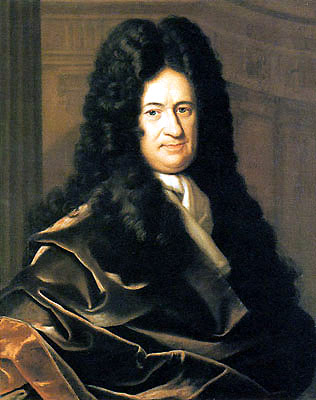 One of my personal favorite areas of philosophy of religion is studying the arguments for existence of God. One type of argument for God is the Cosmological Argument, and one of these arguments was developed by Gottfried Wilhelm Leibniz.
The Argument
A simple version of the argument, in syllogistic form, goes as follows:
1) Everything which exists has an explanation of its existence
2) If the universe has an explanation for its existence, that explanation is God
3) The universe exists
4) The universe has an explanation of its existence
5) Therefore God exists (Craig, 54ff)
Now I think this outlining of Leibniz’s argument is a little forward. Premise 2 may be a bit strong. I’ve edited it some, though I’m sure many others have outlined it similarly, to become:
1) All entities which exist have explanation of their existence. This explanation is either their own necessity or (for contingent entities) an external cause. (P1)
2) The universe exists (Axiom [A] 1)
3) The universe’s existence is not found in its own necessity (P2)
4) Therefore, the universe has an external cause (P1, P2)
5) There cannot be an infinite series of non-necessary causes (A2)
6) Therefore, the cause of the universe is transcendent (external) to it and necessary (4, A2 [I’m skipping a few steps here, but it would end up here eventually, as follows from 4 and A2])
What the Argument Demonstrates
I’m content with settling for the conclusion found in 6). Demonstrating that an external, necessary entity caused the universe is as close as to God as many arguments can go. A being which causes the universe would obviously be exceedingly powerful, the argument itself states it is transcendent to the universe, and the being exists necessarily. Many (most?) theists tend to agree that the other attributes Classical Theism has generally assigned to God follow quite easily from the acknowledgement that such a being exists.
The question must now turn towards reasons why we should believe that this valid argument is true.
Defense of the Premises
1) seems as though it should be accepted simply as a given. I don’t think I should need to defend 1). If we abandon the idea that everything which exists has an explanation (either contingently–from something outside of itself, or necessarily–from its own necessity), then we should expect any number of utterly random things to pop into and out of existence for no reason whatsoever! After all, it would be the height of self-delusion to think that, while all things require reasons to exist, it just so happens (how fortuitously!) that our universe is the only thing which exists for no reason. I’ll leave it at that for now… such ideas are more important for the Transcendental Argument, after all.
2) simply doesn’t need a defense.
Step 3) is alongside step 1) as the only two premises which are capable of being denied (for 2 is, again, obvious, and 4) follows simply from the first 3; we will discuss step 5 shortly) to avoid the conclusion. Denying step 1), I think, is clearly unacceptable, so denying step 3) is really the only way to go for the anti-theist. But what reasons do we have for thinking the universe exists necessarily? I think this is patently not the case. After all, everything which exists necessarily exists (necessarily) forever! Therefore, a necessary universe must have existed for an infinite amount of time (for time is part of the universe). But if this is the case, we run into the insurmountable problems which an infinite past brings up (these problems are also important for the Kalam Cosmological Argument).
I’ll pick just one problem to demonstrate: if the past is actually infinite (as it must be, granting a necessary universe), then we could never get to the present moment, for we would have had to traverse an actually infinite amount of time to get here! Not only that, but as time passes, there is no time being “added” to what came before. Infinity is infinity and it cannot be increased by adding to it or decreased from taking away from it. Therefore, every second which seems as though it is lengthening our lives is actually not doing anything of the sort, despite every commonsense notion with which we have lived out whole lives saying otherwise! The universe, on this view, is a deceptive place, in which nothing is as it seems.
Not only that, but if the universe were necessary, then it seems as though hard determinism–that is, the view that there is no freedom of the will whatsoever–must be the case. For, if the universe exists necessarily, then it has possessed all of its parts necessarily, forever.
Furthermore, there doesn’t seem to be any reason as to why the universe could not have been different. To assert the universe exists necessarily, once again, means to assert that no part of the universe could have failed to exist. Think of it this way: the universe in which I ate breakfast this morning (as opposed to this universe, in which I did not [shame on me, I know]) is logically impossible. Why? Because things which exist necessarily cannot change!
Worse yet, the explanation of a necessary universe leads to the question of why exactly everything is as it is. The anti-theistic view of such a universe is that, necessarily, the universe exists as it does, which happens to have an extraordinary amount of order, laws of nature which happen to allow for life, etc. (this objection was brought to my attention through Stephen Parrish’s God and Necessity, 241).
Thus, even if we grant that it is possible the universe exists necessarily, the individual properties of the universe still call out for explanation: why is it that the universal constants are what they are, and don’t deviate by the infinitesimal amount which would have prevented the existence of life? Ultimately, then, the necessary universe theory falls victim not just to objections against the idea of a necessary universe, but it also falls victim to the objections against the universe existing for no reasons whatsoever.
This means that we have established 1-4. Step 5 is an axiom which I have proposed, because it seems to me quite clear that an infinite regress of contingent causes is a vicious regress–an impossibility. Everything in such a chain would have to, by 1), have a cause outside of itself. If we take C1 to be caused by C2, but both are contingent, then C2 calls for an explanation, C3, which calls for C4, which calls for C5… ad infinitum. I don’t see any reason to deny that this regress is vicious.
Thus, 1-5 have been established. If this is the case, however, then 6 follows, simply because at some point the series of causes C1…C5… would have to be terminated in N1 (a necessary cause). Furthermore, this cause would be external to the universe, from step 1). Thus, the Leibnizian Cosmological argument provides us with powerful reasons to think that a transcendent, powerful, necessary entity brought the universe into existence. I don’t see any reason to call this entity anything but God. There are many reasons to think that an entity with these properties (namely, necessary existence, transcendence, omnipotence) would possess many or all the other properties generally assigned to God.
Therefore, God exists.
Sources:
Craig, William Lane. On Guard. David C. Cook Publishers. 2010.
Parrish, Stephen. God and Necessity. University Press of America. 1997.
——
The preceding post is the property of J.W. Wartick (apart from citations, which are the property of their respective owners) and should not be reproduced in part or in whole without the expressed consent of the author.
Process Philosophy and the Christian (Series)
This post features links to the other posts in my series on Process Philosophy, as well as maintaining a permanent reference for the central doctrines of this Philosophy (at end).
Posts: Book Review: Reenchantment Without Supernaturalism: A Process Philosophy of Religion.
Process Philosophy: The Unity of Science and Religion
Process Philosophy: Nonsensationalism
The central doctrines of Process Philosophy are (quoted at length):
1) “The integration of moral, aesthetic, and religious intuitions with the most general doctrines of the sciences into a self-consistent worldview as one of the central tasks of philosophy in our time” (5)
2) “Hard-core commonsense notions as the ultimate test of the adequacy of a philosophical position” (5)
3) “Whitehead’s nonsensationist doctrine of perception, according to which sensory perception is a secondary mode of perception, being derivative from a more nonsensory ‘prehension’”(5)
4) “Panexperientialism with organizational duality, according to which all the true individuals… have at least some iota of experience and spontaneity (self-determination)” (6)
5) “The doctrine that all enduring individuals are serially ordered socieities of momentary ‘occasions of experience’” (6)
6) “[A]ll actual entities have internal as well as external relations” (6)
7) “[N]aturalistic theism, according to which a Divine Actuality acts variably but never supernaturally in the world” (6)
8 ) “Doubly Dipolar Theism” (7)
9) “The provision of cosmological support for the ideals needed by contemporary civilization as one of the chief purposes of philosophy in our time” (7)
10) “A distinction between verbal statements (sentences) and propositions and between both of these and propositional feelings” (7)
Source:
Griffin, David Ray. Reenchantment Without Supernaturalism: A Process Philosophy of Religion. Cornell University Press. 2001.
Process Philosophy: The Unity of Science and Religion
 This post is part of a series on Process Philosophy. View other posts in the series here.
Perhaps the highest goal of Process Philosophy is the attempt to unite science and religion into a cohesive whole.
There are, according to David Ray Griffin (author of Reenchantment Without Supernaturalism, review here) two major sources of conflict between science and religion: 1) religion’s association with supernaturalism, on which the natural process can be interrupted for any reason by a deity, and 2) science’s association with atheistic, sensational materialism, on which God is methodologically rejected (Griffin, 23).
Process Philosophy seeks to eliminate these conflicts by proposing naturalistic theism, which seeks to be “supportive of the necessary presuppositions” of both “scientific and religious communities” (29). Part of this program is to appeal to our “hard-core commonsense notions”–our most basic assumptions under which we must function in order to make sense of reality. As such, anything which defies these notions is to be rejected, which means that “[a]ny scientific, philosophical, or theological theory is irrational, accordingly, to the extent that it contradicts whatever notions we inevitably presuppose in practice” (30, emphasis his).
This notion, according to Process Philosophy, builds the bridge to unite science and religion. Science, it is argued, cannot operate under the atheistic variety. It must, furthermore, assume mathematical and logical truths, which science cannot ground in sensory experience. This opens up the possibility, for one, of religious experience. This religious experience, which is nonsensational in nature (I’ll be writing on this in an upcoming post) is not to be ruled out, for the ground of all things, on Process Philosophy, is experience, not sensation.
Science also must allow the possibility of a naturalistic form of theism, for the “basic order of the world, the upward trend of the evolutionary process, the novelty that has appeared in this process, the world’s ‘excessive’ beauty, and the objectivity of normative ideals and other ideal (nonactual) entities, such as those of mathematics and logic…” must appeal to naturalistic theism in order to explain their existence (48, 169ff).
This relationship must, however, be mutually beneficial, and religion cannot operate without allowing modifications to come from science. There must be “mutual modification” (51, emphasis his).
Now, it is of vast importance at this juncture to explain exactly what naturalistic theism is, on Process Philosophy. The God proposed by Process Philosophy is in the world, not outside of it. As such, God is part of the processes of all things. God, as it were, is the prime mover and prime motivator. Because of the basis of all things in experience, God is seen as interacting with all things in a non-coercive way–God acts through persuasion to bring about good, and to bring order from chaos (129ff). Thus, God is, in some sense, natural–God is part of the order of all things.
Now I turn to the question I always ask of anything I read: What can the Christian learn from this?
Initially, it may seem the proper answer is “nothing,” however I do think we can learn some things from Process Philosophy here. First, it is important to note that the two problems which cause clashes between science and religion are real problems which need to be addressed by the thinking Christian. Second, God, on classical Christian theism, can be seen in some sense as working through nature to bring about those things which we call miracles. The parting of the Red (Reed?) Sea is often seen as one example of this–gale force winds which parted the sea are often cited. Similarly, the plagues on the Egyptians are often seen as having natural explanations, but these explanations do not exclude God from the equation. Perhaps the lesson Christians can learn here is that God does indeed utilize the physical process to bring about many of His goals. Christianity, however, must almost certainly reject any notion which says that God cannot interrupt the natural process, unless one argues that it is logically impossible so to do (the definition of God’s omnipotence is almost universally acknowledged to mean God can do what is logically possible). Thus, at best, Process Philosophy’s view of Deity can show how God generally works, but it oversteps its bounds in suggesting that God cannot do otherwise.
The idea of God acting persuasively rather than coercively has much to commend it, particularly in light of recent trends in Christian philosophy of religion. Namely, this idea is highly beneficial to the freedom of the will theodicy, as well as in versions of Christianity which are non-deterministic. This is one of the great interactions Christians can have with Process Philosophy–a dialogue about human freedom and divine interactions with the world.
What of science and religion in mutual modification? I must admit I am more friendly to this idea than some–perhaps even most–but I am wary of how Process Philosophy wields this idea. Process Philosophy explicitly denies any kind of special revelation in the form of Scripture (257), which Christians cannot accept, in my opinion, for it undermines the central beliefs of Christianity. I don’t think Process Philosophy is even capable of arguing for their denial of special revelation (and oddly enough, many process theologians argue for the uniqueness of the incarnation of Christ). Science cannot operate over and above religion, rather, the truths of God and His unique Revelation describe reality as such. Science serves to explain how this reality operates.
The Christian has much to learn from those who are outlining Process Philosophy and Theology. We learn to sharpen our intellect and better defend our beliefs. Process Philosophy offers some insights about how God works, though it also features many ideas about God that Christians explicitly reject. I think we have some things to learn here, but we must be careful to analyze these things in light of the truth revealed in Scripture.
Source:
Griffin, David Ray. Reenchantment Without Supernaturalism: A Process Philosophy of Religion. Cornell University Press. 2001.
Image source:
http://en.wikipedia.org/wiki/File:Raindrop_on_a_fern_frond.jpg
——
The preceding post is the property of J.W. Wartick (apart from citations, which are the property of their respective owners) and should not be reproduced in part or in whole without the expressed consent of the author.
Book Review: Reenchantment Without Supernaturalism by David Ray Griffin
 Reenchantment Without Supernaturalism: A Process Philosophy of Religion by David Ray Griffin (hereafter RWS) is a vast work. because of the nature of this book–namely, its place as, essentially, an outlining and explication of a religion–I feel it is necessary to continue discussion of this work past the present review. I’ll be doing a series on Process Philosophy.
RWS covers an incredibly broad range of topics. Summing up a work of this scope would take too much space, so I’ll give only a brief outline. The central doctrines of Process Philosophy are (quoted at length):
1) “The integration of moral, aesthetic, and religious intuitions with the most general doctrines of the sciences into a self-consistent worldview as one of the central tasks of philosophy in our time” (5)
2) “Hard-core commonsense notions as the ultimate test of the adequacy of a philosophical position” (5)
3) “Whitehead’s nonsensationist doctrine of perception, according to which sensory perception is a secondary mode of perception, being derivative from a more nonsensory ‘prehension'”(5)
4) “Panexperientialism with organizational duality, according to which all the true individuals… have at least some iota of experience and spontaneity (self-determination)” (6)
5) “The doctrine that all enduring individuals are serially ordered socieities of momentary ‘occasions of experience'” (6)
6) “[A]ll actual entities have internal as well as external relations” (6)
7) “[N]aturalistic theism, according to which a Divine Actuality acts variably but never supernaturally in the world” (6)
8 ) “Doubly Dipolar Theism” (7)
9) “The provision of cosmological support for the ideals needed by contemporary civilization as one of the chief purposes of philosophy in our time” (7)
10) “A distinction between verbal statements (sentences) and propositions and between both of these and propositional feelings” (7)
Whew! And that is just the introduction of a 425 page work!
These doctrines I’ll let speak for themselves, but it is immediately clear that Process Philosophy can be identified as a religion, either on its own, or in conjunction with another religion of the world. These doctrines are enough to support a robust naturalistic theism which differs in many ways from classical theism.
Process Philosophy affirms that sense experience is not primary (see esp. 55). It also rejects both physicalism and dualism, calling instead for panexperientialism, which is the idea that everything in the universe–down to the smallest entity, has experience of some sort. In other words, the basic units of “stuff” in our universe are neither ideal (as in some forms of dualism) or material (as in materialism and other forms of dualism), but experiential (94ff).
God, on Process Philosophy, is in the world. It is panentheistic as opposed to theistic or pantheistic. God is not supernatural, but is rather a necessary part of the universe (131ff). God created the world not ex nihilo, but out of chaos, which Griffin argues is the correct reading of the Hebrew Scriptures, particularly Genesis (I disagree strongly here, for it seems like there is much evidence for the use of bara to refer to creation ex nihilo).
I can’t resist veering off the summary path here and critiquing this view specifically. The problem with affirming that God created the world out of some existent finite entities (see 216) is that that leaves both God and these finite entities with no explanation for their existence. God, argues Griffin, exists necessarily, but there is no reason I could find given for this. Furthermore, there is absolutely no explanation of how these other finite entities came into being. It seems as though they are asserted to simply exist forever, but this runs into the many problems with an infinite past. I simply don’t think Griffin has adequately defended this doctrine of Process Philosophy, and most of it hinges around this idea. I’ll get into this more as I continue my series, however.
Not only that, but Process Philosophy upholds the idea that there are two distinct “ultimate realities” in our universe; namely, a personal deity, and an impersonal, “creativity”. This is one of the more interesting affirmations of Process Philosophy: that all major religions are true in a qualified sense (247ff). In affirming that all major religions are in some sense true, Process Philosophy also argues that they must all learn from each other to work towards a religion that more adequately reflects reality (more on this later in the series).
Process Philosophy affirms the possibility of an afterlife, but doesn’t seem to take it as terribly likely (204ff). Furthermore, it asserts that morality can be done from the point of an “ideal observer”, namely, God (314-316).
Thus, Process Philosophy is a religion distinct from the others I have read about in some very important ways. The affirmation of both naturalistic (but not atheistic) science and theism is very interesting. Furthermore, Process Philosophy, according to Griffin, can be allies with the major religions of the world. He favors Christianity as walking hand-in-hand with this philosophy.
I personally don’t think this is a live option for Christian theists, however, because it involves rejection of, among other things: creation ex nihilo, omnipotence in the traditional sense, the ability of God to interfere with nature, the primacy of Christ in world religions, the life after death–which entails a rejection of the resurrection (though, as above, Griffin says this is possible)… furthermore, it means Christians must accept, among other things: the idea that Christianity is true, but only in some sense compared to to other religions, that God is only the arranger, not the creator (in the traditional sense) of the world, an entirely different ultimate reality that is similar to the impersonal, immutable Brahma as existing alongside of and coequal to God.
So what can the Christian take from RWS? That is a question that will take me some time to think about and digest. I hope the further posts in this series will help outline this more. I think there are valuable insights in what Griffin has to say, but it is more probable, in my opinion, that the Christian will find, not a “Reenchantment” so much as a chance to sharpen their philosophical blades against arguments which undermine the central tenants of the faith.
That said, RWS is a fantastic read. Griffin covers a simply massive range of topics with clarity from the perspective of Process Philosophy. The book is a page-turner. Like a fantastic novel, it exposes new ideas and forces the intellect to work in new ways. It is a work that essentially outlines the creeds of a different religion, albeit a religion which is syncretistic by nature. It touches on nearly every area of philosophy of religion, from religious language to natural theology. I highly recommend this book, if one has a good background in classical theism. The reason is because the ideas are alluring, but faulty. One can expose the faults, but only if one is grounded in truth. It’s a thought-provoking book, but I regret to find it so off the mark.
Source:
Griffin, David Ray. Reenchantment Without Supernaturalism: A Process Philosophy of Religion. Cornell University Press. 2001.
——
The preceding post is the property of J.W. Wartick (apart from citations, which are the property of their respective owners) and should not be reproduced in part or in whole without the expressed consent of the author.
The Life Dialogue: Theistic Evolution 4
This is part of a series of posts on the “Life Dialogue” within Christianity. Check out other posts in the series here.
 I recently read a very interesting article on theistic evolution by Loren Haarsma and Terry M. Gray entitled “Complexity, Self Organization, and Design.” Interestingly, I found what I think are some of the most interesting arguments for the theistic evolutionist position, but I also found some of the hardest objections to the position (scientifically) that I have stumbled across.
I’ll start with the interesting evidence for their position. First, they note that the word “design” doesn’t belong exclusively to the Intelligent Design theorists, because theistic evolutionists argue that God designed the initial laws which gave rise to evolution and eventually humanity. In other words, God foreknew and intended for mankind to evolve, and set up the laws such that we would (or at least that some sentient beings with which God intended to interact would arise, 289).
They further argue that “With the right set of rules, a random, iterative process can start with a simple environment and self-assemble a complex environment” (293, emphasis theirs). The arguments for this position are interesting to me, and I am no scientist, but it seems to me that the three ways from which they argue for this possibility make more sense to me if there is some kind of intelligence behind the process.
The three strategies for self-organized complexity they argue are:
1) Preprogrammed self assembly– “…pieces are designed so that random interactions between them eventually lead to assembly of the desired complex object(s)”
2) Information transfer from the environment– objects incorporate information from the environment through “a process of random exploration and feedback”
3) Interaction among agents– “random interactions and feedback” lead to “increased productivity or survivability” (290)
It seems to me that 1) could be simply incorporated into laws at the beginning of the universe (but these laws would have to be designed, as the authors point out). 2) seems to me as though it simply couldn’t be totally random. For evolution to work, on the understanding I’ve gleaned from my readings, the complexity would have to aid the survivability of the entity. I think a problem here is that there is no way to determine when/why/how the random interactions suddenly latch onto those things which are helpful. If it truly is a random process, then it would randomly continue to select for characteristics, casting off old ones and making room for new ones.
Incorporating natural selection doesn’t seem like it would help much here either, because then those random selections which are negative would terminate the species. So my problems with 2) are twofold (even granting that God Designed the laws such that these interactions would occur): 1. there doesn’t seem to be an explanation for the process stopping the random selections (and therefore keeping the trait); 2. we aren’t talking about computer algorithms here, we’re talking living entities–if they select the wrong traits, they die.
Ultimately I found these arguments interesting reading, but I just don’t see how they support Theistic Evolutionism more than, say Intelligent Design. The authors do make the interesting point that it could have been the case that God set up/designed the laws such that life would arise, but the ways that complexity is integrated into the process seems to me, at least, to demand further explanation.
Source:
Haarsma, Loren and Terry M. Gray, Complexity, Self-Organization, and Design, in Perspectives on an Evolving Creation, edited Keith B. Miller, p. 288-309.
——
The preceding post is the property of J.W. Wartick (apart from citations, which are the property of their respective owners) and should not be reproduced in part or in whole without the expressed consent of the author.
Original Sin and the Metaphysics of the Soul
Original Sin Defined
The writers of the Augsburg Confession (found in the Book of Concord) defined Original Sin as the belief that “…since the fall of Adam all human beings who are propagated according to nature are born with sin, that is, without fear of God… [we] teach that this disease or original fault is truly sin, which even now damns and brings eternal death to those who are not born again through baptism and the Holy Spirit” (BOC, 39).
One Objection
Ezekiel 18:20a states, “The soul who sins is the one who will die. The son will not share the guilt of the father, nor will the father share the guilt of the son.”
The word used for “soul” in this passage is the Hebrew word, nephesh. This passage leads to the objection that original sin cannot be true as I have outlined it, because it involves the son inheriting the guilt of the father.
The Question of the Soul: A Metaphysic of Original Sin
Three views of the soul are prevalent in Christianity. All of them presuppose metaphysical dualism. They are:
1) Our soul is constructed just as our physical body: Our soul is a half-and-half combination of the souls of our mother and father.
2) God specially creates each soul for each person when he/she is conceived/born/etc. Alternatively, God has already created every soul for everyone who will ever live, and puts them in a body when one is needed. The main problem with this view is that it would seem that if original sin is true (in the sense I have outlined it above), then God creates sinful souls for us.
3) Our soul is from Adam. There are no new souls for mankind, rather, we all share, in some sense, Adam’s soul.
I tend to favor 1) (now, anyway). But I favor a version of 1) which is not so much a half-and-half combination of souls, but a union of the totality of the souls we inherit. I originally wrote this post for my new site, but an insightful commentator lead me to heavily edit my views here. Just as we become one in the union of sex, so do our souls become one when we conceive a child.
What this means, then, is that the soul we inherit from our ancestors includes the inheritance of the guilt of sin. I must note the distinction here between sins which require action and those that do not. I have been pondering this idea for some time–is it possible to have sins for which we are guilty that we don’t commit? The answer I lean toward is “No”, but that doesn’t preclude original sin. The reason is that through the soul, we have literally participated in the original sin of Adam. When we are told that we have the “Old Adam” in us, this should be taken in a more literal sense than it often is.
We are told by Paul that there is a natural and spiritual body (1 Corinthians 15:44). These are both the inheritance of our ancestors. In a literal sense, then, there is the “old self” (Romans 6:6) and the Old Adam (1 Corinthians 15:45) which, from birth, enslave us to sin (Romans 6:6). Metaphysically I think this means that our soul has literally participated in, and is therefore held accountable for, the original sin. Original sin is a substantive entity–it corrupts our very nature. This is no mere inclination to sin, but a bondage to sin and a separation from God. It only makes sense to me on a metaphysical level to argue that this sin is inherited through our soul, which, like our body, maintains the union with Adam himself.
So how does this answer the objection from Ezekiel 18:20? Initially, one may argue it seems to purge the passage of all meaning. This is not the case, however. What Ezekiel is referring to is the sin of commission. That is, it refers to a sin which requires an action. Ezekiel is telling us that the actions of the father do not condemn the actions of the son. This does not, however, preclude the original sin in the metaphysical sense in which I have outlined it, because we have each participated in the action which causes original sin.
One final note is required, however. This is again a modification of my original thoughts due to enlightening discussion with my good friend’s comments. We must remember that this stain of sin, this original sin, has passed away for those who have faith in Christ. For, though the passages I quoted above discuss the nature of our original guilt, they immediately turn to salvation which is through Christ. Our New Adam replaces the Old (1 Corinthians 14:42-57), and our enslavement to sin is no more (Romans 6:6-14). Our original guilt, received through our sharing in the action of Adam, and our shared spirit with him, is no more.
Source:
The Book of Concord. Augsburg Fortress. 2000.
——
The preceding post is the property of J.W. Wartick (apart from citations, which are the property of their respective owners) and should not be reproduced in part or in whole without the expressed consent of the author.



