J.W. Wartick
Morality and Atheism
I am continually baffled by atheistic accounts of morality.* What, on atheism, gives us the grounds for stating that an action is wrong?
Morals can be either objective or subjective. The thrust of the following argument is intended to show that atheism cannot have objective morals. In other words, an atheist has no way to condemn some action as wrong, other than that it is wrong “in my opinion”.
There are only a few ways I have seen it argued that atheism can have objective moral values. These are:
1) Platonistic Atheism- Morals exist necessarily independently, as abstract objects (such as numbers).
2) Humanism- Humanity first. Humans are to be valued objectively, so morals can be based on what benefits the human race.
3) Science can answer moral questions, somehow.
There are horrendous difficulties with all three of these views.
Platonism about morality could be the best way for atheists to have a “way out”, if you will, for accepting objective morality. The existence of moral values such as “Justice” can be posited as brute facts of our existence. They just exist, and that’s all. The problems with this view are numerous.
First, on this view, the moral values of “Sloth”, “Hedonism,” “Masochism” are also platonic forms existing as brute facts. What reason can be given for choosing to prefer “Justice,” “Uprightness”, etc. over “Masochism,” “Hedonism,” etc.? If all of these things are simply brute facts, then why is it that some should be preferred over others? I see no non-question begging method for determining which values should be favored.
There is no reason, on atheism, to value one over the other. Second, how is it that (granting naturalist evolution) natural selection managed to line us up so wonderfully with what appears to be correct moral cognitions? Again, given that the morals themselves are brute facts of existence, it is utterly remarkable that we evolved in such a way as to line up with what appears to be the “good side” of the moral values (one might object by arguing that we don’t know either way, but then they would have to accept that somehow being a sadomasochist could be a moral good. I doubt very much this is a position worth even considering). Third, there is the thus-far ignored question as to what makes the idea of moral facts existing by brute fact even close to intelligible?
Given the huge problems with 1), and the fact that I consider this the strongest position for the atheist wishing to argue for objective morality, it seems these are dire straits indeed for the atheist ethicist.
2) is equally problematic, however, for a number of reasons. First is that humans often do not agree on what exactly is best for humanity. Which humans are allowed to determine what is right for the whole of society? Furthermore, 2) doesn’t actually provide objective morality at all. It merely sets an arbitrary line for morality–it is moral to act for the good of humanity. What basis is there for taking this assertion as truth? We are humans, but this doesn’t, on atheism, entitle us to any kind of superior ethical or cognitive status. Why is it that humans are objectively valued? It just pushes the problem of objective morality up one level.
FInally, 3) is utterly bankrupt as an explanation for objective morality. I have discussed this position before in more detail (see my discussion of Sam Harris’ attempt at articulating this unintelligible position). 3) basically asserts that somehow, we can empirically detect what is moral by figuring out what makes people happy. Surely, this is no way to detect objective morals, for even if the pool of test subjects is the entire human race, one day the entire human race may determine it makes us happy to kill other humans at will, and then this would be objectively, empirically, moral. It makes us happy, so it is moral! Clearly this is no way to save objective morality, for 1) it makes moral values arbitrary, which is clearly not objective, and 2) it falls victim to the same problems of either position 1) or 2) above, for it must grant one of these positions to pursue some background for determining reality. Sam Harris, in his discussion of this position, simply asserts that “Values are… facts” (see video cited in my link above). Wonderful! I agree that values are facts. But simply saying this doesn’t magically explain their existence.
The massive problems with any atheistic position which attempts to give credence to objective moral values show that the atheist really only has two positions open to him/her: 1) abandon the existence of objective moral values (a route not often taken, but when it is traveled, it leads to subjectivity of morals–which of course means we cannot condemn any action as “wrong” other than as a preference) or 2) abandon atheism and accept a position with better explanatory power for the objective moral facts. I suggest theism as one clear possibility.
*I am not suggesting that atheists cannot be moral people. Indeed, some great examples of moral people are friends of mine who are atheists. The point of this post is, instead, that atheism has no grounds for morality, other than total relativism.
——
The preceding post is the property of J.W. Wartick (apart from citations, which are the property of their respective owners) and should not be reproduced in part or in whole without the expressed consent of the author.
Do we have epistemic “oughts”?
I’ve been contemplating for a while about the “oughts” within epistemology. It is often said that we should do something, or that we are obligated to consider certain types of evidence. But what exactly does this mean? Specifically, I don’t see that it can have any meaning given an atheistic perspective.
Take a recent example. I was talking to a friend of mine who asserted that we “ought” to be skeptical about all things.* The friend was referring to the existence of God as an example, and continued to argue that there are specific things we epistemically should or should not do. We should, for example, approach the question of God’s existence with skepticism. We should take empirical evidence above any other type of evidence. The examples could be multiplied.
The question that came to mind, however, is what kind of justification does an atheist have for arguing that we have epistemic “oughts”? In other words, what is it about people that means we owe it to… well, something… to fully investigate the universe? For, on atheism, there cannot be meaning to our lives other than a “noble lie” which we tell ourselves in order to try to infuse our lives with meaning(Dr. L.D. Rue–cited in On Guard by William Lane Craig, 46). The universe is on a countdown until cosmic heat death. Any actions we take are ultimately utterly devoid of meaning, for no matter how much we impact the human race for good or evil (and who knows what those terms mean, on atheism!?), the human race will, inevitably, fade into non-existence, along with the rest of the universe.
But then what does it matter what our beliefs are? How is it that we can have “oughts” about what we do or don’t believe? What kind of justification is there for thinking that we should or should not try to discover the truth about the universe? Ultimately, my actions, on atheism, do not matter. In the grand scheme of things, I am just more matter in motion, on a big hunk of matter in motion, in a universe filled with matter in motion, which will, itself, fade away.
It is because of this that I cannot think of any reason that there could be epistemic “oughts” on atheism. I think that atheistic philosophy (and indeed anything, on atheism) is an ultimately pointless endeavor, trying to infuse meaning into a universe which is utterly devoid of meaning.
There cannot be epistemic “oughts” on atheism. The very idea is a fiction, another “noble lie” invented to try to keep us from despair.
*I have the friend’s permission to write about this on my blog.
——
The preceding post is the property of J.W. Wartick (apart from citations, which are the property of their respective owners) and should not be reproduced in part or in whole without the expressed consent of the author.
The Life Dialogue: Intelligent Design 3
This is part of a series of posts on the “Life Dialogue” within Christianity. Check out other posts in the series here.
Intelligent Design (hereafter ID) is a theory that suffers a lot of critique from all sides of the life dialogue within Christianity, as well as the secular world. Just a google search can bring up thousands of images ridiculing the theory, both from an evolutionist standpoint (often calling it creationism in disguise) and from a creationist standpoint (calling it evolutionism in disguise). I find that, too often, those criticizing the ID movement present a caricature of its arguments, without ever addressing the relevant issues it raises.
Creationists often attack ID for trying to sneak some kind of atheism into theology. I simply don’t find this to be true. The ID movement would have many theological implications, but atheism is definitely not one of these. Theistic Evolutionists criticize ID for being just creationism in disguise. I simply can’t see this as anything but a non sequitur of the greatest proportions.
Recently, an article in Philosophia Christi (cited below) by Warren Shrader discussed ID’s mechanisms of detecting intelligence. Shrader writes that the Explanatory Filter utilized by Dembski (discussed briefly here) can be strengthened by considering the epistemological tools of cognitive abilities in determining whether there is a specification condition (which would therefore justify a “design inference”).
The way we can utilize epistemology within the ID hypothesis is “…given an event E and a pattern D, we say that D is a specification of E if and only if the following conditions are satisfied.” These conditions are: 1) Tractability (essentially meaning it is possible for a cognitive agent to produce the pattern D), 2) The probability of E given H (“the hypothesis that the event in question was a product of chance” 383) and J (information) = the probability of E given H “for any information J generated by I“, and 3) D delimits E (392-393).
Armed with this capacity for determining design, ID avoids the objection that patterns can be replicated by computers. This is done by criterion 1), which restricts patterns to our finite cognitive abilities. This of course means that it is very possible that many “positive” results will be thrown out, but this only strengthens those positives that do result, because they are irrefutable evidence for ID. In other words, when we tighten the design criteria such that we guarantee the patterns were produced by a cognitive agent, we have guaranteed that intelligence has been detected.
Combine these tools with those mentioned in my previous posts on ID, and there is a functional system for detecting intelligence in biology, cosmology, etc. Reading about ID has me excited to read more. I cannot emphasize enough how much readers who have not explored the issue themselves should try to do so.
Source:
Shrader, Warren, “Dembski’s Specification Condition and the Role of Cognitive Abilities,” Philosophia Christi, volume 11, number 2, 2009, 377-396.
The Life Dialogue: Matt Moss Guest Post 5
This is part 5 of a series of guest posts by Matt Moss on the Genesis Creation account. Check out the first post here, the second here, the third here, and the fourth here.
Thesis 6: The Fall of Man into Sin destroys the order of God’s Cosmic Temple.
This destruction and disarray can be seen firstly in this: Man has tried to make himself God. This is what the deceiver promised in 3:5- “eat of the tree of which you were commanded not to eat and you will be like God.” Man has separated himself from communion with God in this Cosmic Temple. The price for his rebellion is expulsion from the Cosmic Temple, man and woman are cast out, East of Eden (this will be important in a moment).
A brief note on “sin:” I must say that one of the worst parts of Walton’s book is when he tries to address the place of death in creation before the 7 days of functional ordering and how it fits in after the Fall. I think this happens because Walton suffers from the same fate as most reformed evangelicals who deny any hereditary original sin that is a condition plaguing all mankind and even causing detriment to the world around us. Surely he would hold that all are sinful, but his language in the book leaves the door open for someone to think that he defends natural disasters and animal attacks on humans as if that’s always the way it was meant to be. He gives no indication that sin is a condition of chaotic disorder in this world. For him, sin is simply a wrong action we commit (or good we omit).
In retrospect I think Walton would find that a Lutheran understanding of Sin would actually HELP the case he tries to make in the book and even make sense of some of the loose ends that he leaves untied. Allow me to explain how a Lutheran understanding of Sin fits into this Genesis 1 Cosmic Temple. The word for sin in Hebrew is hta. Many have said that this is the word for when an arrow misses its mark. That is true, but it is not speaking of the ACTION of missing the mark (sin as an action would be what Walton and the reformed hold as do Lutherans although we do not limit it to that).Hta is the condition that things are not as they are intended to be! Sin is not, “oops I missed the target” (an act of committing wrong). Hta is “I shot the arrow straight down and now gravity is going UP!” or better yet, “I shot at the target and now the arrow is facing the opposite way, impaling my heart!” The correct condition is that the arrow is where it belongs: in the target. The hta is the condition where the arrow is completely confounded and misplaced.
When it comes to the Cosmic Temple then, the entrance of SIN (hta), as this condition of chaos, reverts the perfect, ordered, functional Cosmic Temple to the chaos of 1:2a. God spent seven days ordering this Cosmos into a Temple of communion between God and man and now man has rejected this Temple and sent all of creation back into tohu andbohu, purposelessness and functionlessness, worse than that! The world is now a place of rebellion and death. The ground of the earth is cursed (3:17-18) and as man and woman are expelled from the Cosmic Holy of Holies they are sent into the wilderness where animals, weather, and nature itself are now hostile to them! Throughout the OT and even into the NT the wilderness is viewed as the land of desolation, tohu and bohu, and separation from God. And yet, God is not about to let their chaotic overturn of His creation be the final word on the matter!
Thesis 7: God’s establishment of the Israelite Tabernacle/Temple serves to return mankind to the divine order of the Cosmic Temple: communion with God.
Finally we get to the point of all these temple comparisons. What was the point of all those tabernacle/temple regulations in Exodus and Kings? Why was God so specific? Because God wanted to show them in explicit visual detail that He was opening a new Eden by which the Israelite sinners could return to communion with their God! However, one thing had changed. Man was no longer pure and clean. Man was sinful and defiled and would need atonement to come before God. This is why the ONLY thing that differs between the Cosmic Temple and the Israelite Temple is the sacrificial system.
Allow me to quickly go through some of the aspects of the Temple that reminded Israelites that they were returning to God’s Holy Eden- the pleasure of His presence. First, recall that the man and woman were banished EAST of Eden. The Tabernacle and Temple of Israel each had the Ark of the Covenant, the Holy of Holies positioned in the West and the worshipers would enter through the East gate. By going from East to West they are coming home from the way God banished them.
Second, we recall the rivers of Eden: the Pishon, the Gihon, the Tigris and the Euphrates. In addition to the water basins looked at above, it is also of remarkable note that there stands a spring just south of Solomon’s temple, in the Kidron Valley which was named, “The Gihon Spring.” Hmm. Very Interesting!
Once inside the main gate the Israelite worshiper walks among the courts, surrounded by wooden walls and looking at the pillars of the Holy Place with their decorated tops made to look like trees. Even to this day Cathedrals all throughout the world use pillars with decorated tops to act as trees leading to the centre of the Garden: the Holy of Holies in the Temple and the Chancel of the Cathedral!
Inside the Holy Place you have your lampstands to mark the minor lights just like the large menorah in the outer court acts as a greater light! Finally, you find behind the curtain of the Holy Place the Holy of Holies where God Himself sits on the Mercy seat. For Israel worship at the Temple is a return to the divine order of Creation as God intended, the sinful corruption of the world is made right. And yet, all of this was incomplete. The sacrifices all looked forward to a final sacrifice. Through the Israelite Temple worship God was reconciling His people, but through the final redemption, all the Earth would be restored to the Cosmic Temple God created.
Thesis 8: Jesus Christ finalizes the restoration of the Cosmic Temple.
Hebrews 10:1-18 is worth your read right now! Once you’re done, come back and read on.
Christ is the finale of the sacrificial system as surely as he is the only true sacrifice. More than this, the tearing of the Temple curtain at his crucifixion speaks of this restoration. Through Christ Jesus man is reunited to God and the Cosmic Temple is restored. Likewise, going back to our seven days of creation, there is now an eighth day of creation. Just as God rested on the seventh day, so Christ rested in the tomb on the seventh day. Then on the eighth day Christ was raised from death to life and established a NEW Creation through Resurrection!
“It doesn’t look so new,” you might say. “There is still death and disaster, pain and suffering.” Yes indeed. We live in a period of “now and not yet.” We are saved yet we are not in heaven yet. Sin has been defeated, yet we live in a fallen world. As Paul writes in Romans 8:18-30 (do look it up and read it, I won’t post it all here, the post is long enough) we and the whole of creation await the future glory. I find it marvellous that in the last two chapters of Revelation we find an undoing of the seven days of creation. In Revelation 21 – 22 we read of the New Heaven and the New Earth and we see an unravelling of what was created in Genesis 1. The sea is no more but all will drink from the spring of the water of life (cf. John 4; 7:37-39- the latter occurring in the Temple during the Feast of Booths where water is poured out as libation). The sun and the moon are no more because Christ the Lamb is their light (cf. John 8 “I am the Light of the world”- said while he was in the Temple for the Feast of booths, standing by the menorah)! In every way the New Heaven and New Earth are much greater than the pre-Fall Cosmic Temple.
To summarize what the last posts have addressed: Genesis 1 – 3 is an ancient Temple Cosmology that does not specifically address the questions of how or when God did His material creating work. Beyond that Genesis 1 – 3 serves as a Liturgical text, a Temple text, a Christological text, a Trinitarian text, a Redemption text, a Sacramental text, a Teleological text, and an Eschatological text, but NOT a 21st century scientific treatise. As I have told many people before, there is such a wealth and richness to these initial chapters that we simply miss the point of the text when we try to force it into modern scientific debates and attempt to answer questions that God did not deem important enough to address in His revelation to ancient Israel. What God does answer in these chapters is why He has made creation work the way it does, how man has thrown it into chaos, and how He will restore it to an even greater glory.
“The Shack” Reviewed by a Conservative (With Poll)
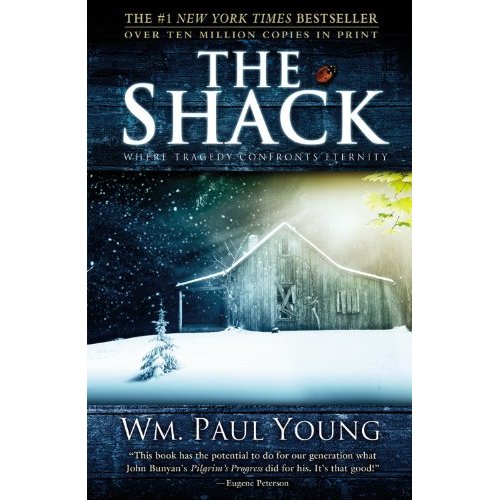
The Shack
I went in with some strong biases against the book. I’d heard from others that it is pretty terrible theology and borderline (or actual) heresy. Needless to say I wasn’t expecting to enjoy it, but, like any good work will do, The Shack proved my biases wrong.
The plot is fairly simple. A man, Mackenzie, has a horrific tragedy happen to his daughter; this tragedy affects his whole family in negative ways; then he receives a letter from God (?) asking him to come to the place the tragedy happened to talk about things. The rest of the narrative revolves around this discussion. One note I should make as a reviewer is that Young’s prose is fantastic. His descriptions of everyday events and locations inject a reality into the story that is necessary to get readers hooked, and he writes about the uncommon and the supernatural with stunning beauty.
The plot serves as just the background for what the book seems (to me) to be; The Shack is a stirring work of philosophical and theological investigation of the nature of God, the problem of evil, and our hope in Christ.
Readers who have read the work or read anything about it probably already know that God is portrayed in the work as three “persons” in a very literal way. The Father, “Papa”, is a motherly black woman, Jesus is a plain-looking middle-eastern workman, and the Holy Spirit changes her (?) form throughout the work. I feel it is necessary to address this, because this is perhaps the most controversial part of the book. It seems to me, at least, that the idea of God coming to people where they are should not be such a hot issue. Christ Himself describes God’s action in terms of a hen gathering chicks beneath her wings (Luke 13:34). God appeared in various forms throughout the Old and New Testaments (burning bush, still voice in the wind, incarnate Christ, etc.). I find it dubious at best to claim that God does not/can not appear otherwise to individuals–perhaps as a mother to those in need (and this would line up well with the Christian background of religious experiences, cf. Perceiving God by William Alston).
These three persons serve to drive the narrative of The Shack while also making claims about the various works of the persons of God. There are many points throughout the book where I found myself nodding as Young wrote a wonderful insight about the work of God. Young’s answers to some of the most poignant questions of humanity resound throughout the work. One of the most stirring moments is a chapter in which Mackenzie is asked to decide which of his children goes to hell. This is meant to reflect the way Mackenzie (and some Christians) seem to put God in the judgment seat, arbitrarily determining who goes to heaven and who is damned to hell. Mackenzie begs to be condemned instead of his children, and in a powerful turnabout, he is told that this is exactly how God feels. He became incarnate to die for our sins, to give the opportunity for all to be saved, loving all God’s children perfectly (p. 165). Moments like this occur throughout The Shack.
Another thing I must share is The Shack‘s answer to religious diversity. Jesus says that those who love Him come from every background, including other religions. This leads Mackenzie to ask, “Does that mean… that all roads will lead to you?” Jesus answered, “Not at all… Most roads don’t lead anywhere. What it does mean is that I will travel any road to find you” (184). Should Christians agree with this answer? I leave it open to the reader to answer this question. Suffice to say that The Shack will challenge readers from all walks of Christian life.
I finished the book in the span of a day. I set it down late at night, realizing I couldn’t be the same Christian I was before. The Shack grabbed me and wouldn’t let go. The questions Young asks through Mackenzie are questions all Christians must face, and the answers he provides focus on one thing: the Love of God. There are definitely things that made me uncomfortable while reading The Shack, but there are other things I realized were suddenly made clear. Treating The Shack like a theological treatise is unfair. It’s not a doctrine book, it’s a work of Christian fiction, and it excels in its niche, asking questions, giving answers, and leaving it to the reader to decide whether he/she agrees or disagrees. This is a fantastic work and I highly recommend it to my readers. You don’t have to agree with what Young says in The Shack to make the book worth reading, but you should read it.
The Shack
Engaged!
Those of you who are avid readers of my blog (and perhaps I kid myself into thinking I have such fans!) would know that I sometimes update on exciting life events. This time, I have gotten engaged to my wonderful fiancee, Beth. She is in the picture that shows up when I comment on things. We are both extremely excited and we are so thankful that God has blessed us in this very wonderful way. We look forward to the next year of planning!
Abortion: The Minority Rules
A Gallup Poll last year indicated that more Americans self-identify as pro-life than pro-choice. The more interesting results, however, indicate that 40% of all those surveyed believe that abortion should only be legal in a “few circumstances”. I would be interested to see a breakdown of specific circumstances and see where those who hold this view would restrict abortion.
Those who favor the pro-choice stance should be alarmed by these results, however. In a society that is increasingly utilitarian as far as ethical values are concerned, it appears as though the pro-life stance is gaining steam (interestingly enough, the Gallup Poll linked above suggests this may be due to President Obama’s stance as a firm advocate of the “pro-choice” side). We live in a democratic society, and it is clear that for some reason, the minority rules when it comes to abortion. The tides are turning.
But the problem with an issue like abortion isn’t so much getting a majority when it comes to voting, it comes down to what is right and wrong. Again, a utilitarian society has trouble acknowledging this, but the bottom line is that abortion commits murder. It is the willful destruction of a human being. I’ve issued challenges before for any pro-choice advocate to provide some kind of logical argument for abortion which can stand up under scrutiny. Despite hundreds of views, I have yet to have one solid argument for the pro-choice side advocated. Mostly, it boils down to name-calling and appeals ad misericordiam. In light of strong arguments against abortion and the failings of arguments for abortion (noted here, here, and here, for some examples), the pro-choice position falls by the wayside.
So it appears to me that the pro-choice position is the rule of the minority in more ways than one. On the one hand, the position is losing popular support, and on the other, it lacks logical justification.
[Author’s Note: I will be away for about a week, so any new comments will be approved when I get to them]
The Life Dialogue: Young Earth Creationism 3
This is part of a series of posts on the “Life Dialogue” within Christianity. Check out other posts in the series here.
I wrote in my last post on Young Earth Creationism (hereafter YEC) that I had missed one of its primary tenets, which is that the theological, not the scientific, should be the focus of the “origins” debate. This key point means that the challenge to YEC that it doesn’t have a fully developed scientific model doesn’t seem to be as much of a challenge as one may think, for YEC is grounded in theology, not science.
The problem with this is that this makes YEC hard to evaluate in light of the other views (Old Earth Creationism, Intelligent Design, and Theistic Evolutionism) because its advocates rarely try to put forward a competing scientific model. Instead, YEC tends to be a view which focuses on pointing out flaws the arguments of its opponents rather than constructing its own models. While YEC does have some views which are offered for explanations of the world we observe (a catastrophic global flood is one possibility, though one visitor to this site commented on the scientific impracticalities of testing this), its case is largely built on attacking the other views as invalid.
It is to this that we shall now turn. For now, let us focus on YEC’s case against the other Christian views of the age of the earth. First, YEC, because of its theological nature, is absolutely tied to the belief that the Genesis creation account of six days explicitly means six literal 24 hour periods. Ken Ham gives several reasons for taking this belief seriously in The New Answers Book 1. These reasons include the context of Genesis 1, the genealogies of Genesis 5 and 11, Exodus 20:9-11 pointing to six literal days, and that “Jesus was a young-earth creationist”. I’ll outline and critique these arguments below.
The argument about the context of Genesis 1 focuses on the light/dark cycle for the meaning of days (26). This argument has some merit, though I think one of the key problems is that there was no sun for a few of the light/periods, meaning that at least something else must have been going on here. I do think that this argument has some merit, however.
The genealogies of Genesis 5 and 11 would seem to point to the dates that Ken Ham and YECss tend to affirm (though Ham says it is about 6000 years, contrary to other YECs I have read who tend towars 10-15,o00). The problem with this is that it is that semitic genealogies tended to list only key people. Also, the individuals listed could refer to entire families or separate genealogies. I don’t think that the genealogies make a strong case for the YEC view.
Exodus 20:9-11 states (ESV), “Six days you shall labor, and do all your work, but the seventh day is a Sabbath to the LORD your God. On it you shall not do any work, you, or your son, or your daughter, your male servant, or your female servant, or your livestock, or the sojourner who is within your gates. For in six days the LORD made heaven and earth, the sea, and all that is in them, and rested on the seventh day. Therefore the LORD blessed the Sabbath day and made it holy.”
This is a fairly strong argument for the YEC, in my opinion. The parallel meaning of six literal days because of creation order tends to point to a more literal reading of Genesis 1. The only problem I see with this argument is that the 7th day clearly is longer than one 24-hour day according to all the Christian theology I know. What response could non-YECs give? I think one could argue that Exodus 20 is pointing metaphorically or figuratively back to Creation, and that the literal reading is at least slightly weakened by the 7th day.
Finally, was Jesus a YEC? I must say I find it incredibly anachronistic to apply a position in a modern debate over the creation accounts to Jesus. Ham presents the evidence as, among other verses, Jesus saying in Mark 10:6, “But from the beginning of creation, ‘God made them male and female.'” This has some initial plausibility for pointing to a Young Earth, but one immediate problem I see with taking this as literally as Ham wants to is that Jesus says “beginning of creation”, which, if one were to take it very literally, means that Jesus is asserting that man and woman were created first, contrary to the creation account in the Bible. I still do find this verse an extremely strong argument for YEC, however.
So, where does this leave us? I still think the YEC position has the strongest theological stance due to the ability to more easily read the accounts as six literal days. It seems to me, however, that other views have plausibility due to a day being as a “thousand years” for the Lord (2 Peter 3:8). YEC counters to this have not persuaded me that this could not mean that the Genesis account is longer than a literal week. The question I put forth is whether or not the Genesis account was intended as incredibly literal as the YEC position insists.
Source:
Ham, Ken. The New Answers Book 1. Master Books. 2006.
——
The preceding post is the property of J.W. Wartick (apart from citations, which are the property of their respective owners) and should not be reproduced in part or in whole without the expressed consent of the author.
The Life Dialogue: Matt Moss Guest Post Part 4
This is part 4 of a series of guest posts by Matt Moss on the Genesis Creation account. Check out the first post here, the second here, and the third here.
It would now be my contention that day two and its parallel day four are the building and filling of the Cosmic Temple. In the religious Tabernacle/Temple of Israel this comes off a bit differently because of the Fallen status of the world. Day 2’s establishment of the expanse parallels the setting up of the tent of the Tabernacle and the walls of the Temple. Notice then that day 5 is the creation/assignment of the birds of the sky (above the tent’s curtain) and the sea creatures (below the tent’s foundation). What fills the temporal Temple will come on days 3 and 6.
For now I would like to add one more decorative indicator of Temple cosmology. If you remember your temple diagrams that you’ve seen and the Levitical procedures you may have read about in various OT courses/studies, you will surely remember the pools and the washings! Priests had to regularly wash themselves and their robes before proper use in the Temple. For the Tabernacle, see Exodus 30:17-21. And for the Temple see 1 kings 7:23-26; 2 Chron 4:2-5. As with the lampstand above, these serve a symbolic purpose as well as a practical one! They are part of the Temple precisely because they are part of the Cosmic Temple in Genesis 1!
Genesis 1:11-13 and 24-25, “And God said, “Let the earth sprout vegetation, plants yielding seed, and fruit trees bearing fruit in which is their seed, each according to its kind, on the earth.” And it was so. 12 The earth brought forth vegetation, plants yielding seed according to their own kinds, and trees bearing fruit in which is their seed, each according to its kind. And God saw that it was good. 13 And there was evening and there was morning, the third day… [day 6] And God said, “Let the earth bring forth living creatures according to their kinds—livestock and creeping things and beasts of the earth according to their kinds.” And it was so. 25 And God made the beasts of the earth according to their kinds and the livestock according to their kinds, and everything that creeps on the ground according to its kind. And God saw that it was good.”
As foreshadowed above, on day 3 we have a further establishment of the Cosmic Temple and on day 6 we have the first part of the filling of the Cosmic Temple. First I will deal with day 3. While travelling through the wilderness, the Israelite Tabernacle did not uproot and replant trees in the Tabernacle every where they went. However! You will read and see Acacia wood being used in everything from the Ark of the Covenant to the pillars that hold up the curtain and the walls of the Holy Place (see The Lutheran Study Bible page 141 for a great breakdown of materials used). The tent posts all the way around the outer court too serve as a garden image with all their rich colours. Later in the Solomonic Temple, there is a similar tree-like architectural feature. First we note that cedar and cypress timber from Lebanon was used (1 Kings 5:8-9; 6:14-18). Just as the trees and vegetation of day 3 served to decorate the Cosmic Temple, so also the acacia, cedar and cypress wood are used to decorate Israel’s Tabernacle & Temple.
As for day six, I have isolated the first part from the second part (mankind) simply because man deserves a bit of time on his own. Much like the birds and fish are to fill the Cosmic Temple but are kept out of the temporal Tabernacle/Temple, so too these animals are included in the Cosmic Temple BUT are only brought into the Israelite Tabernacle/Temple to be sacrificed (more on this later!).
Genesis 1:26-31- “Then God said, “Let us make man in our image, after our likeness. And let them have dominion over the fish of the sea and over the birds of the heavens and over the livestock and over all the earth and over every creeping thing that creeps on the earth.”
27 So God created man in his own image,
in the image of God he created him;
male and female he created them.
28 And God blessed them. And God said to them, “Be fruitful and multiply and fill the earth and subdue it and have dominion over the fish of the sea and over the birds of the heavens and over every living thing that moves on the earth.” 29 And God said, “Behold, I have given you every plant yielding seed that is on the face of all the earth, and every tree with seed in its fruit. You shall have them for food. 30 And to every beast of the earth and to every bird of the heavens and to everything that creeps on the earth, everything that has the breath of life, I have given every green plant for food.” And it was so. 31 And God saw everything that he had made, and behold, it was very good. And there was evening and there was morning, the sixth day.”
I’ll cut right to the chase. Man is the priest of the Cosmic Temple. This becomes even more explicitly clear in 2:15, “The LORD God took the man and put him in the garden of Eden to work it and keep it.” These two tasks, “to work it and keep it” (avad and shamar) are only used together in reference to the Levitical priesthood. Upon God’s resting of day seven, the Cosmic Temple is fully ordered and filled, that is, it is fully functional! God is present and he places His man in the Garden of Eden, the Holy of Holies of this Cosmic Temple, to be the High Priest who serves God by working and keeping this Temple. And at the centre of this Cosmic Temple stands the Tree of Life and the Tree of the Knowledge of Good & Evil. Man is given one command by which he might serve and love the gracious Creator, “You may surely eat of every tree of the garden, but of the tree of the knowledge of good and evil you shall not eat, for in the day that you eat of it you shall surely die (Gen 2:16-17).”
Despite avoiding material creation questions throughout his book, Walton appears to lean toward the special creation of mankind. He therefore rejects the evolution of man even though he allows room for evolution of animals. For him, Genesis 2 allows us to have a material understanding of man’s formation/creation (out of the dust). I don’t think it’s the strongest part of his book, but for now I am too fixated on the notion of the man as priest of the Cosmic Temple.
God then makes a suitable helper for the man (gender roles, order of creation, marriage, and the like are topics for further discussion in other forums). We all know what happens next. The perfect, complete, finished, and functional Cosmic Temple, perfectly and wonderfully ordered by God that He might live in communion with His creation, is disturbed. No, that’s too weak a description. The fully ordered creation is hurled into disorder, chaos, and disarray. SIN enters in 3:7.
The next post will discuss Thesis 6.
Methodological Naturalism: A Practice in Self-Affirmation?
I recently read a fantastic article in the latest Philosophia Christi by Stephen C. Dilley entitled “Philosophical Naturalism and Methodological Naturalism: Strange Bedfellows?” and I just had to share its central thesis here.
Dilley argues that “philosophical naturalists who draw epistemic support from science for their worldview ought to set aside methodological naturalism in certain historical science” (118).
Methodological Naturalism (MN) is generally the position that within science, one should never appeal to a supernatural explanation. Philosophical Naturalism (PN) is broadly defined as the belief that the world consits only of the natural, that is, that there are no supernatural entities (and thus theism is false). Here, of course, astute readers will almost instantly notice the problem with utilizing such a position to try to gain epistemic support for PN. The problem is, as Dilley points out, that using MN to epistemically justify PN is circular.
Let us examine this problem more fully. One consequence of MN is that “God hypotheses… cannot receive evidential confirmation within the context of science” (127). Of course, this doesn’t mean that “…God hypotheses do not receive scientific confirmation… but that they cannot… No possible emphasis can confirm God hypotheses within a scientific context, no matter what the evidence actually is. That is just what MN entails” (127, emphasis his).
Again, readers will probably already see where this is going. The problem of circularity here rears its ugly head. On the one hand, hypotheses which would disconfirm PN are ruled out a priori from scientific investigation. On the other hand, adherents of PN seem to want to utilize scientific evidence to confirm PN and disconfirm rival hypotheses. But then, while MN is in effect, PN cannot be criticized scientifically (129). This is because the central thrust of MN is to rule out supernatural hypotheses, which, in turn, rules out any kind of rival position for PN. Again, this doesn’t even appeal to any kind of scientific evidence for God or lack thereof, because such evidence isn’t even considered, a priori.
And then, following from this, PN will always receive confirmation from MN, because it cannot be otherwise. This is because MN rules out any rival hypotheses by definition. Again, it doesn’t even matter if naturalistic explanations would be superior to theistic explanations, because, given MN, there cannot even be a side-by-side comparison!
Thus, those who wish to utilize MN as some way to draw epistemic support for PN are sadly misguided. It simply cannot be done, because MN can’t even consider rival hypotheses. Instead, the joint usage of PN and MN show just another reason that naturalism is a practice in self-affirmation. Obviously, naturalism is going to appear superior to theism if we rule out theism before we even begin to investigate! Clearly, those who wish to justify PN cannot utilize MN to do so.
Source:
Dilley, Stephen C, “Philosophical Naturalism and Methodological Naturalism: Strange Bedfellows?” Philosophia Christi, 12-1, 2010, p. 118-141.
——
The preceding post is the property of J.W. Wartick (apart from citations, which are the property of their respective owners) and should not be reproduced in part or in whole without the expressed consent of the author.


