J.W. Wartick
Book Review: “Bloody, Brutal, and Barbaric? Wrestling with Troubling War Texts” by William J. Webb and Gordon K. Oeste
 The question of genocide in the Bible is a serious one, and one which frequently is brought up in discussions with non-Christians. Christians who think seriously about the question no doubt also feel severe discomfort as they attempt to understand these war texts. William J. Webb and Gordon K. Oeste address the most difficult questions presented by the biblical texts in their book Bloody, Brutal, and Barbaric? Wresting with Troubling War Texts.
The book has disturbing content related to violence, sexual violence, torture, and violence against children. For this review, I will not be delving deeply into the content in these parts, but it is important to note that there are graphic descriptions from the ANE related to these horrific acts. They are relevant to the point of the book.
After an introduction providing an overview for the course of the book, the authors turn to the hard questions found in the biblical text: questions related to genocide and war rape. The authors are refreshingly honest when it comes to the text, showing how the traditional answers given to the question of genocide in the war texts often fail. The traditional answers are answers like “God as source of holy war commands”–just having God command something makes it justice. Another traditional answer is the good purposes for holy wars. Along with this, the non-innocent status of the Canaanites and their own atrocities are often given as one of the traditional answers–these wars were God dispensing justice against the wickedness of the Canaanites. A final answer is that the wars are a foreshadowing the eschatological war. The problems with these traditional answers are provided in brief discussions of each. For example, the answer of the wickedness of the Canaanites cannot account for the awfulness of genocide and war rape: “The evil nature of any crime, no matter how insidiously evil it is, does not legitimize any and every sort of punishment action taken against the perpetrator” (42).
The authors do note, however, that the traditional answers can do some of the heavy lifting regarding questions of the war texts, but it depends on the type of question being asked. The questions being asked in the texts aren’t about military ethics but rather about the justice of various acts in question–such as driving others out of a land. Those questions are questions the traditional answers can do work on, but they don’t work for many contemporary ethical questions. In order to answer questions of modern ethical concern, one must approach Scripture holistically and also seeing how better answers can come from reading the Bible redemptively in conjunction with other answers.
Reading the Bible redemptively implies that there is movement within the biblical text that directs readers towards drawing ethical conclusions in the future. This isn’t a reductionist approach that says this is all there is to the war texts (82) but rather an argument that movement is a crucial meaning for the text. Alongside this, the authors focus quite a bit both on the argument that the “genocide” aspect of the texts includes quite a bit of hyperbole (and answering objections to this thesis). The most obvious argument in favor of the notion of hyperbole in the text is that in the texts themselves one sees statements that none were left alive set right alongside statements of people being left alive. Accompanying this, there is broad evidence from the Ancient Near East that hyperbole regarding military conquest and victories was the norm rather than a modern invention. But these answers still don’t quite get at the heart of the push for real ethical responses to questions on things like war rape.
To answer the awful questions related to war rape, the authors explore the broad evidence for the practice in the Ancient Near East alongside the way that Israel was not allowed to engage in the practices typical for their time and region. Along with this, the authors closely examine the texts noting that arguments for implied war rape don’t seem to align with the evidence from the entire stories. Deuteronomy 21:10-14 [the book references this as Deuteronomy 21:4-10 on more than one point, but that reference is contextually not what they meant] is one of the most awful passages in the Bible. Webb and Oeste note the many ways this diverges from the broad ANE behavior regarding war rape, and how it provided for time to grieve, acknowledging the intensity of grief, providing rights, and protecting the woman’s honor. None of these, of course, undermines how brutal and awful this text still is, but the providing of strictures that go well beyond anything in the ANE shows a counter-cultural, surprising ethic for its time. Combining answers like this with the argument that the Bible shows a redemptive movement towards a better ethical standard provides a more holistic approach to the text that both acknowledges its horrors while also not downplaying its counter-cultural standards.
There is much, much more detail related to the biblical text, as well as examination of counter-proposals and evidence found throughout the book. Webb and Oeste do a better job than almost any book I’ve seen that tries to provide an answer to the questions of genocide and war rape from a position that does not simply write off the passages as irredeemable. They don’t completely ignore the texts, nor do they try to say nothing in them is awful. The redemptive-movement hermeneutic allows them to do this while also arguing for a cohesive text.
A final part of the authors’ argument is to argue that God is uneasy with war and that several verses show that God is uneasy with war and moving towards redemption. The crown of this argument is, of course, Christ. The authors argue against others who have strong discontinuity between the Hebrew Scriptures and the New Testament. Their own approach sees Jesus as apocalyptic warrior who brings the Kingdom of God.
Bloody, Brutal, and Barbaric? is a challenging book that will force readers to think about some of the most terrifying topics in the Bible. The authors do an admirable job of not shrinking from the horrors in Scripture while also seeking a holistic understanding that honors the notion that the text is God’s Word.
Disclaimer: I was provided with a copy of the book for review by the publisher. I was not required to give any specific kind of feedback whatsoever.
Links
Be sure to check out the page for this site on Facebook and Twitter for discussion of posts, links to other pages of interest, random talk about theology/philosophy/apologetics/movies and more!
Book Reviews– There are plenty more book reviews to read! Read like crazy! (Scroll down for more, and click at bottom for even more!)
SDG.
——
The preceding post is the property of J.W. Wartick (apart from quotations, which are the property of their respective owners, and works of art as credited; images are often freely available to the public and J.W. Wartick makes no claims of owning rights to the images unless he makes that explicit) and should not be reproduced in part or in whole without the expressed consent of the author. All content on this site is the property of J.W. Wartick and is made available for individual and personal usage. If you cite from these documents, whether for personal or professional purposes, please give appropriate citation with both the name of the author (J.W. Wartick) and a link to the original URL. If you’d like to repost a post, you may do so, provided you show less than half of the original post on your own site and link to the original post for the rest. You must also appropriately cite the post as noted above. This blog is protected by Creative Commons licensing. By viewing any part of this site, you are agreeing to this usage policy.
Book Review: “Including the Stranger: Foreigners in the Former Prophets” by David G. Firth
 What does the Bible have to say about the “stranger” or the “foreigner”? It’s an expansive question, but one that should inform Christians as they explore modern issues of immigration or refugees. David G. Firth, in Including the Stranger: Foreigners in the Former Prophets, examines texts related to these questions as found in the Former Prophets–Joshua, Judges, 1 & 2 Samuel and 1 & 2 Kings.
Firth’s brief introduction argues that we can use narrative texts for normative values. Reading the text as such requires being attentive to the ways the narrator speaks of the events being narrated, as well as being aware of the ANE context in which the texts were written that comes with different expectations about how to read a text. The reader must also be aware of the assumptions they are bringing to the text and work to see how their own preconceptions can shape the way they interpret the text (3).
The next four chapters go over each of the former prophets in turn, giving an orientation to the reader for the text and then diving into the major questions of foreigners in the text. Joshua is a fascinating place to start here, because most would expect the book’s view of the foreigner to be universally negative, given the conquest narratives therein. However, Firth points out the fact that even upon entering the land, the first kindness was shown by a stranger (Rahab). Going from there, other texts invite larger examination of the notion of the “foreigner” in Joshua, as, for example, a threefold view of foreigner/stranger is found in the text: strangers as neutral/threat/positive. This means, argues Firth, that “Ethnicity itself is not the issue. Rather, the concern is with the possible religious impact of these peoples…” (38). The setting up of cities of refuge helps reinforce this impression.
Judges is one of this reader’s own favorite books of the Bible, and Firth highlighted some aspects of great interest. For example, Shamgar (Judges 3:31) appears to be little more than a sidenote in Judges, and is not, in fact, even listed as having judged! But Firth notes there is more to Shamgar’s story than a single verse may seem to convey. First is the fact that Shamgar’s name is not an Israelite name, being composed of four root letters rather than three. Second, it seems clear Shamgar was not a Yahwist, for the denotation as “Son of Anath” suggests Shamgar followed the Canaanite goddess of the same name. And this, then, could explain why Shamgar is not given the title of “judge,” for the book’s concern with enforcing Yahwist worship leads the author not to give that title to Shamgar. And, moreover, this highlights the significance of Shamgar’s inclusion, for it shows that God has “no problem in using a foreigner to deliver Israel… but he does not grant them positions of leadership” (72). Along with other examples, Shamgar highlights a theme in Judges that God uses foreigners for God’s will as well, and that the Israelites’ own divisions among themselves (Judges 17-21) raises questions of “how Israel can function as the people of God” (92).
Samuel’s central theme related to foreigners, argues Firth, is seeing them as means for assessing Israel. For example, in Samuel, David’s legitimacy as ruler is mediated through an Amalekite rather than an Israelite (113-114). Time and again, foreigners are used as examples to highlight the actions of Israelites, often as a contrast–a foreigner being more true to God/word than an Israelite. The book also shows how encounters with foreigners can lead to integration rather than devastation. Kings deals more with foreigners beyond the borders of Israel, and shows once more that the central value was not about ethnicity or nation, but rather about worship of Yahweh (172).
Firth’s closing words, in a summary and concluding chapter about including the stranger, are words that call readers to action. “In a world that builds walls between communities, or makes the environment hostile for foreigners, this was an example of what the people of God can be: a community that does not discriminate on the basis of ethnicity, because we serve a God who does not do so. This is an ethic that is easily talked down in political discourse, but therefore one that is more important for the church, as the people of God, to live out and show a different way of life” (185-186).
David G. Firth’s exploration of the place of the “stranger” or “foreigner” in Including the Stranger will provide readers with a wealth of resources for learning about the biblical view of those from elsewhere.
Disclaimer: I was provided with a copy of the book for review by the publisher. I was not required to give any specific kind of feedback whatsoever.
Links
Be sure to check out the page for this site on Facebook and Twitter for discussion of posts, links to other pages of interest, random talk about theology/philosophy/apologetics/movies and more!
Book Reviews– There are plenty more book reviews to read! Read like crazy! (Scroll down for more, and click at bottom for even more!)
SDG.
——
The preceding post is the property of J.W. Wartick (apart from quotations, which are the property of their respective owners, and works of art as credited; images are often freely available to the public and J.W. Wartick makes no claims of owning rights to the images unless he makes that explicit) and should not be reproduced in part or in whole without the expressed consent of the author. All content on this site is the property of J.W. Wartick and is made available for individual and personal usage. If you cite from these documents, whether for personal or professional purposes, please give appropriate citation with both the name of the author (J.W. Wartick) and a link to the original URL. If you’d like to repost a post, you may do so, provided you show less than half of the original post on your own site and link to the original post for the rest. You must also appropriately cite the post as noted above. This blog is protected by Creative Commons licensing. By viewing any part of this site, you are agreeing to this usage policy.
Book Review: “Reading Buechner” by Jeffrey Munroe

Reading Buechner is a call to engage with the writings and thought of Frederick Buechner. I have to admit, I was somewhat skeptical of the project. I’d heard Buechner’s name occasionally, but nothing from or about him had ever stuck. Munroe’s introduction, however, grabbed me from the beginning, and his impassioned call to engage with this Christian thinker has me going to the library to find at least one book to read.
What was it that Munroe managed to do in this book? Simply put, he offered a genuine, enthusiastic look at the breadth and depth of work of Frederick Buechner. Four parts divide the book into looking at Buechner as a memoirist, a novelist, a popular theologian, and preacher. Each section has its own intriguing way of introducing Buechner’s thought to readers, along with a guide for suggested reading from Munroe. It’s a simply fantastic way to introduce an author with such a broad array of works while also letting readers in on his own love of the subject and his personal reflections on the works. It’s nearly impossible to not pick up on at least some of Munroe’s enthusiasm.
Reading Buechner was a surprising read for me. Something about the way Munroe called to me as a reader, and it is hard to completely ignore his enthusiasm for his subject. I recommend it.
Disclaimer: I was provided with a copy of the book for review by the publisher. I was not required to give any specific kind of feedback whatsoever.
Links
Be sure to check out the page for this site on Facebook and Twitter for discussion of posts, links to other pages of interest, random talk about theology/philosophy/apologetics/movies and more!
Book Reviews– There are plenty more book reviews to read! Read like crazy! (Scroll down for more, and click at bottom for even more!)
SDG.
——
The preceding post is the property of J.W. Wartick (apart from quotations, which are the property of their respective owners, and works of art as credited; images are often freely available to the public and J.W. Wartick makes no claims of owning rights to the images unless he makes that explicit) and should not be reproduced in part or in whole without the expressed consent of the author. All content on this site is the property of J.W. Wartick and is made available for individual and personal usage. If you cite from these documents, whether for personal or professional purposes, please give appropriate citation with both the name of the author (J.W. Wartick) and a link to the original URL. If you’d like to repost a post, you may do so, provided you show less than half of the original post on your own site and link to the original post for the rest. You must also appropriately cite the post as noted above. This blog is protected by Creative Commons licensing. By viewing any part of this site, you are agreeing to this usage policy.
Book Review: “Beyond Hashtag Activism: Comprehensive Justice in a Complicated Age” by Mae Elise Cannon
 How can we best actually practice activism and seek justice beyond the hashtags? It’s a question that seems loaded–possibly discounting the fact that social media has been used to highlight a great deal of injustice which had not been spotlighted before. But Mae Elise Cannon, in Beyond Hashtag Activism: Comprehensive Justice in a Complicated Age, isn’t downplaying those important acts; instead, she presents a way to learn about major issues of social justice in today’s world and how to combat injustice.
The topics discussed in the book are quite broad. It’s divided into 5 Parts: Biblical Justice and the Gospel, which highlights passages in the Bible about justice and how politics might become involved in the same; Poverty, in which Cannon notes both global and domestic questions of poverty and how we might faithfully combat it; Race, in which Cannon highlights a number of current issues both in the United States and across the globe; Gender, which discusses the many ways gender is used divisively while looking for healing in the body of Christ; and Twenty-First-Century Divides, which addresses issues of sexuality, Israel/Palestine, and religious freedom.
Cannon, as noted before, isn’t dismissive of the notion of “Hashtag Activism.” Instead, she writes “These movements have accomplished much in raising awareness about important justice issues like global poverty and gender discrimination… Hashtag activism is a great place to start, but our social justice advocacy must move beyond the limits of likes, sharing, and click rates” (1). Where to go from there is through the parts discussed above, wherein real world solutions and activism are outlined related to many differing topics. Each part has chapters that both highlight the exact issues that are being discussed while ultimately presenting ways for both individuals and churches to be involved in bringing real-world justice related to the topic.
There are different types of advocacy, and at the beginning of the book, Cannon draws these out. Protest and resistance is a direct way to fight against injustice, whether through things like sit-ins and marches or directly identifying laws or acts as unjust. Prophetic advocacy is the work to “transform… attitudes, hearts, and behaviors on an individual level as well as on a systemic level” (16). Spiritual advocacy seeks out God’s will in behalf of others and the world (17, paraphrased). “Social advocacy is the process of standing with, walking with, and accompanying those who are victims of injustice…” along with “speaking up when someone in your presence makes a comment that is offensive…” (18). This reader has seen the benefit of the latter approach, as it can lead to greater conversations about justice and the use of language. Legal advocacy is working within the legal system to bring about change or justice for individuals. Political advocacy “seeks to shift regional, state, and national policies” in order change unjust policies and practice. Economic advocacy includes seeking to make investments that better align with just use of resources, boycotting unjust businesses, and the like (20ff). Along with these various approaches, Cannon notes that there are four best practices for making a difference: having a clearly defined goal; being pragmatic in efforts to accomplish the goal; getting the facts right; and having fortitude, persistence, and longevity in the pursuit of justice (22ff).
One of the best parts of the book is that Cannon presents evidence in an evenhanded way on a surprising topic: Christianity and homosexuality. Moving past the polemics that are often involved in such discussions, she presents factual arguments in a way that lets readers evaluate each position. Cannon presents direct quotes from major scholars on both sides of the debate, concluding that “Well-meaning, intelligent, and godly men and women disagree strongly about the question of whether or not same-sex monogamous relationships are biblical… Regardless of what we each conclude as individuals… I believe the study of the Word of God and the wrestling with the possible interpretations and relevant implications is critical work that must be done within the body of Christ” (209-210). What is important about this is that Cannon gives an opportunity for people on each side to actually read and try to understand what the “other side” is saying in their own words. However brief that is, it is good for people to know why people disagree.
There is so much content in the book that it is impossible to even give an adequate survey over the course of a review. There are recommended additional readings at the end of each chapter for those wishing to pursue a topic further. There are questions for discussion so the book can be used in small groups–though many of the questions would work well for individuals to reflect upon as well. There is a wealth of content in this book, to the point it could become a reference for readers who want to explore many topics more broadly while also trying to work against many forms of injustice.
Beyond Hashtag Activism is a fantastic read. It presents a huge amount of factual information about injustice while also providing a way forward–something many books don’t do–to combat those same injustices. Christians will be invigorated to work for biblical justice across the world by this book. It could be used in small groups, for individuals, for college courses, and more. It is highly recommended.
Disclaimer: I was provided with a copy of the book for review by the publisher. I was not required to give any specific kind of feedback whatsoever.
Links
Be sure to check out the page for this site on Facebook and Twitter for discussion of posts, links to other pages of interest, random talk about theology/philosophy/apologetics/movies and more!
Book Reviews– There are plenty more book reviews to read! Read like crazy! (Scroll down for more, and click at bottom for even more!)
SDG.
——
The preceding post is the property of J.W. Wartick (apart from quotations, which are the property of their respective owners, and works of art as credited; images are often freely available to the public and J.W. Wartick makes no claims of owning rights to the images unless he makes that explicit) and should not be reproduced in part or in whole without the expressed consent of the author. All content on this site is the property of J.W. Wartick and is made available for individual and personal usage. If you cite from these documents, whether for personal or professional purposes, please give appropriate citation with both the name of the author (J.W. Wartick) and a link to the original URL. If you’d like to repost a post, you may do so, provided you show less than half of the original post on your own site and link to the original post for the rest. You must also appropriately cite the post as noted above. This blog is protected by Creative Commons licensing. By viewing any part of this site, you are agreeing to this usage policy.
Book Review: “A Week in the Life of a Greco-Roman Woman” by Holly Beers
 A Week in the Life of a Greco-Roman Woman by Holly Beers is a part-historical fiction, part-nonfiction fusion that explores what the life of a Greco-Roman woman who was encountering Christianity may have looked like. It’s part of the “A Week in the Life of…” series from InterVarsity Press (See reviews of other entries in this series here–scroll down for more), and it’s another success. Each of these books is a standalone, providing unique historical background and individual narratives.
Beers writes the fictional portions about Anthia, a young woman and wife who encounters in just one week many of the struggles of people in the ancient world. Beers’s narrative is deeper than one might expect for a kind of slice-of-life narrative. Anthia’s story immediately drew me in as a reader due to the compelling, sympathetic way she is portrayed. She’s not simply a foil for background information; no, she reads as someone who lives and breathes in the ancient world, and who experienced everyday tragedy. Fears of childbirth and its dangers, navigating the strictures of society, and the simple pleasures of warm water are just some of the insightful character-building Beers weaves throughout the narrative.
The historical information included throughout is just as fascinating as in other entries in the series. These are usually presented in boxes throughout the text, which highlight numerous aspects of ancient society and life. One of the most fascinating of these for this reader was the look at associations in the Greco-Roman world and how that was also integrated into the plot. The text box on p. 23 shows the importance of associations and how membership was usually gained. Other information about “urban sanitation” (read: toilets), living in apartments, and perfume were also highlights.
A Week in the Life of a Greco-Roman Woman is a deep look at what the lives of women would have been like in ancient Rome. It provides readers with a compelling main character to go along with a number of important insights into the day-to-day lives of people of the time that will enrich readers who are interested in the history of Christianity or of the ancient world. Recommended.
Disclaimer: I was provided with a copy of the book for review by the publisher. I was not required to give any specific kind of feedback whatsoever.
Links
Be sure to check out the page for this site on Facebook and Twitter for discussion of posts, links to other pages of interest, random talk about theology/philosophy/apologetics/movies and more!
Book Reviews– There are plenty more book reviews to read! Read like crazy! (Scroll down for more, and click at bottom for even more!)
SDG.
——
The preceding post is the property of J.W. Wartick (apart from quotations, which are the property of their respective owners, and works of art as credited; images are often freely available to the public and J.W. Wartick makes no claims of owning rights to the images unless he makes that explicit) and should not be reproduced in part or in whole without the expressed consent of the author. All content on this site is the property of J.W. Wartick and is made available for individual and personal usage. If you cite from these documents, whether for personal or professional purposes, please give appropriate citation with both the name of the author (J.W. Wartick) and a link to the original URL. If you’d like to repost a post, you may do so, provided you show less than half of the original post on your own site and link to the original post for the rest. You must also appropriately cite the post as noted above. This blog is protected by Creative Commons licensing. By viewing any part of this site, you are agreeing to this usage policy.
Yes, Christians (and I’m looking at you, apologists) should affirm that Black Lives Matter, and here’s why
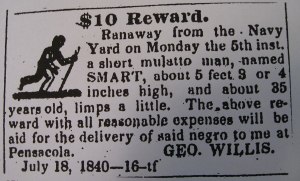
Image Credit: By George Willis, Navy Agent Pensacola Navy Yard placed July 18 1840. – Pensacola Gazette, runaway slave reward for “SMART” dated July 22 1840,p.3 National Archives and Records Administration Washington DC, Public Domain, https://commons.wikimedia.org/w/index.php?curid=68445221
When justice is done, it is a joy to the righteous,
but dismay to evildoers.
I have an MA in Christian Apologetics. Because of the circles I run in due to my interest in apologetics, I’ve seen dozens, if not hundreds of posts bemoaning Christians supporting the Black Lives Matter movement. These posts often center around the notion that the organization Black Lives Matter is inextricably tied to critical race theory, which itself is alleged to be completely anathema to Christianity.
I’m going to suggest the opposite. I’m going to say Christians absolutely must support Black Lives Matter as a movement because black lives do matter. Full stop. And this argument doesn’t need to be over whether critical race theory may be used by Christians or not. I don’t need to wade into those waters for my point.
If you’re asking the question “Should Christians support ‘Black Lives Matter’?” the first thing you should ask immediately following that question is a simple one. Do black lives matter? If they do, then you’ve answered the question. And the reason I’m saying this is because the answer needs to be simplified. People have been, intentionally or not, conflating the entire movement with one organization with which they disagree. I’ve directed this post somewhat at apologists because I’m an insider there, and I’m quite frustrated. We need to do better, fellow apologists, at leading the way as people who want to be thought leaders in Christianity. We need to do better. We need to express more care with our thinking, while also expressing more care for following what the Bible actually tells us to do.
You see, no Christian apologist worthy of the name would agree that if an organization arose that went around saying #JesusisLord, every Christian ever has to agree with everything that person or organization says or does. yet it is a fact that Jesus is Lord. Right? Right? But it would be absolutely absurd to insist that every single person who ever has said anything like “Jesus is Lord” or #JesusisLord must therefore be intrinsically tied up in whatever the organization or person who made the phrase popular said or did. Indeed, looking at the history of Christianity, we better be very, very careful to make the point that support of a statement–even one made by members of an organization with the same name as a movement–does not entail support of everything in that movement or organization. If that were true, then all Lutherans must agree with Luther’s antisemitic statements; all Southern Baptists need to agree with the many, many antebellum Baptists who preached pro-slavery sermons; all Christians have to be indicted by the raping that occurred during the Crusades; and the sad, awful, and sordid history of every aspect of Christianity anywhere done by anyone who has ever said “Jesus is Lord” would be applied to every single one of us.
But that’s wrong, because that’s not how reality works. I can affirm Jesus is Lord without also affirming everything even every other modern Christian says. In fact, I’m sure you do the same thing. That’s because we realize that Jesus is Lord is true, but not everything said or done by Christians is true or good. Guess what: the statement “black lives matter” is true. It is.
None of this is to say that the specific Black Lives Matter organization is right or wrong about any- or everything. But I’ll tell you one thing: they are 100% totally correct in saying that black lives matter. And if you disagree with that, the problem is with you, not with the organization, not with people who you see as rioting, and not with anything else. It’s with you.
If we’re Christians, we believe the Bible speaks to us today. It teaches us to this day. The quote with which I started this post was from Proverbs 21:15. It is just one of a great many Bible passages that urge us to seek justice. And believe it or not, the way God’s justice comes is sometimes surprising. Sometimes, even the chosen people of God get things wrong. That’s why, for example, Jonah’s anger over God’s justice speaks so clearly to some of us today. We are too often like Jonah, fleeing rather than trying to bring God’s loving forgiveness to people with whom we disagree. But God is a God who works in ways we don’t always understand. God used even the ungodly to bring justice. Be careful, lest we stand in the way of God’s justice in a moment in which we as Christians should be standing up and also declaring that yes, black lives matter and yes, we should seek justice for them.
Learn to do good; seek justice, correct oppression; bring justice to the fatherless, plead the widow’s cause. – Isaiah 1:17
It’s a powerful thing when we can sit and listen to our neighbors who say they are oppressed without rushing to explain it away as an aspect of critical race theory or some other straw man we’ve set up so that we don’t have to do what the Bible tells us to do. Yes, those are strong words, and they are so needed right now, however unfortunate that is. Think about it. If you’re a Christian apologist- which have you spent more time doing of late: critiquing critical race theory and trying to correct people about the Black Lives Matter movement or actually seeking to learn from those who are crying out for help? Which do you think is more valuable for the building of God’s Kingdom?
What about lawbreakers? I chose the picture for this post for a reason. It’s from an 1840 advertisement for capturing a fugitive slave. This ad was before the Fugitive Slave Act of 1850, but it is still a fact that trying to escape from slavery was unlawful. These fugitive slaves were lawbreakers. But who was in the right–the “fugitive” or the enslaver? Let’s practice some extreme, tremendous care that we do not align our Christian morality to that of the law of the state. Laws change, but God’s will and justice never change. Justice came for those evildoers who enslaved others in the United States. We should pray that justice continues to roll from God to our nation to this day.
Finally, we as apologists need to practice better care for our thoughts. When confronted by a new idea, our tendency is to analyze it, break it apart, and see how it fits together. Too often, this also becomes a practice in self-affirmation. Is it any wonder that so many apologists who were unconcerned about racism in the United States before the recent protests are suddenly up in arms about Critical Race Theory and calling on other Christians to disavow any kind of “social justice movement.” We need to think long and hard about that. Why was that our instinct–including my own? How do we break out of it? For me, it was going and actually reading books about racial injustice and disparities in the United States. Yep, we have to do that thing that apologists love doing: read books. But there’s a big caveat here: not just books that support our own views. We need to humble ourselves and acknowledge we might just be wrong on this topic, and do the work to learn about it. Because we absolutely cannot and must not make new stumbling blocks for Christianity. In my apologetics classes, I remember hearing time and again how “Christianity is offensive enough.” How do you think people feel when they see people like us–trained apologists–lining up to explain how Christians cannot support the Black Lives Matter movement, conflating it entirely with the organization? Is that actually a good witness? Is it even a good use of our time? No. It’s not. Why not? I’ll tell you:
Black. Lives. Matter.
It’s time to be humble; to act justly; and to love mercy. It’s time for apologists to do what the Bible says.
He has shown you, O mortal, what is good. And what does the LORD require of you? To act justly and to love mercy and to walk humbly with your God. – Micah 6:8
Links
Book Review: “Rethinking Incarceration: Advocating for Justice that Restores” by Dominique DuBois Gilliard– Learn about our criminal justice system and how it needs to be reformed.
“Frederick Douglass: Prophet of Freedom” by David W. Blight– A prophet for then and now- Learn about Frederick Douglass, a powerful Christian voice who helped speak for justice in ways that continue to resonate into our own time.
“How to be an Antiracist” by Ibram X. Kendi– I review and summarize major aspects of this book on antiracism on my other site.
SDG.
——
The preceding post is the property of J.W. Wartick (apart from quotations, which are the property of their respective owners, and works of art as credited; images are often freely available to the public and J.W. Wartick makes no claims of owning rights to the images unless he makes that explicit) and should not be reproduced in part or in whole without the expressed consent of the author. All content on this site is the property of J.W. Wartick and is made available for individual and personal usage. If you cite from these documents, whether for personal or professional purposes, please give appropriate citation with both the name of the author (J.W. Wartick) and a link to the original URL. If you’d like to repost a post, you may do so, provided you show less than half of the original post on your own site and link to the original post for the rest. You must also appropriately cite the post as noted above. This blog is protected by Creative Commons licensing. By viewing any part of this site, you are agreeing to this usage policy.
July 4: Frederick Douglass’s indictment of American Christianity’s links with oppression, and a call to stand for justice
 “What, to the American slave, is your 4th of July?
“Many of its [the church’s] most eloquent Divines… have shamelessly given the sanction of religion and the Bible to the whole slave system…
“For my part, I would say, welcome infidelity! welcome atheism! welcome anything! in preference to the gospel, as preached by those Divines! …[Theirs] is a religion for oppressors… a religion which favors the rich against the poor; which exalts the proud above the humble…
“The American church is guilty, when viewed in connection with what it is doing to uphold slavery; but it is superlatively guilty when viewed in its connection with its ability to abolish slavery.
“…Let the religious press, the pulpit, the Sunday School, the conference meeting, the great ecclesiastical, missionary, Bible and tract associations of the land array their immense powers against slavery, and slave holding; and the whole system of crime and blood would be scattered to the winds, and that they do not do this involves them in the most awful responsibility of which the mind can conceive.”
-Frederick Douglass, Frederick Douglass: Selected Speeches and Writings, 196, 200-201
When we sit today, and we think about the fact that people continue to deny the reality of systemic racism; that black people are disproportionately imprisoned, stripped of the right to vote due to being deemed “felons,” and disproportionately sentenced to death; that so many feel a compulsive need to make self-declarations against “Black Lives Matter”; we must acknowledge that America’s Original Sin remains, and continues to divide us.
Let the people of Christ stand up against oppression! Let God come and break the rod of the oppressor, as in the days of old (Isaiah 9:4). Let us condemn practices that exalt the rich over the poor; and the proud above the humble. Let us confess where we have done wrong, and pray for guidance to bring justice. Let us stand up with people of color and denounce religious, political, and societal practices that work to divide us. Christianity ought to be a religion which lifts up the oppressed and downtrodden–may it ever be!
Book Review: “Unsettling Truths: The Ongoing, Dehumanizing Legacy of the Doctrine of Discovery” by Mark Charles and Soong-Chan Rah
 Unsettling Truths is an examination of the impact of the “Doctrine of Discovery” that goes beyond a survey and into the consequences of this doctrine across theological sociological, and historical lines.
The Doctrine of Discovery is a deeply problematic idea in the history of the world, and Mark Charles, a Navajo/Dutch man notes at the beginning that the problems start with the name. “You cannot discovery lands already inhabited” (13). The Doctrine of Discovery itself as a historical reality emerged from European powers as they sought to consolidate power overseas. Tied with a number of papal bulls, this doctrine provided legal precedents that continue to govern in some ways how we view native rights (15). Of course, the doctrine is also deeply rooted in views that see Europeans as superior to other peoples, for it undermines the rights of native peoples and implies that their claims to the land and even life are not germane to the “discovery” of those same lands by European powers.
Discovery as a kind of founding belief in the United States helped guide the shape of the country, from the Constitution to current court cases as well. This may seem a sweeping claim, but the authors support it with data. For example, the Doctrine of Discovery is cited in court cases from 1954, 1985, and 2005. In the latter, City of Sherrill, New York v. Oneida Indian Nation of New York, the doctrine of discovery is explicitly cited as reason to deny the Oneida Indian Nation sovereignty over land they had purchased, despite it being land that was, in part, to have been given to their people by treaty with the United States. Moreover, the 2005 opinion cited precedent from an 1823 opinion in which the Native tribes were called “savages” (though the 2005 opinion omitted the term) and said that the increased value of the land because it was converted from “wilderness” into cities was another reason cited to rule against the Oneida Indian Nation of New York (126-127). The implication is, of course, that when Native groups owned the land, it was “wilderness” ( = not civilized/savage) but now that it has been turned into cities ( = civilization/Western), it is more valuable and, more importantly, able to be determined by U.S. courts instead of treaties. The repeated breaking of treaties and use of courts to bolster non-Native American ownership of land and property should be something to alarm any American, especially Christians who are taught to treat others as they would be treated.
The authors also bring to light many practical applications that are derived from the historical and modern background in the book. For example, one early chapter on “The Power of Narratives and the Imagination” goes over how false narratives of discovery can help construct realities of institutional, internalized, and externalized power imbalances. These power imbalances play out in our prison systems, in our courts, and in everyday life, as the authors demonstrate time and again throughout the book.
Unsettling Truths is a good introduction to the problems with the Doctrine of Discovery and, more importantly, how that doctrine has impacted society to this day.
Disclaimer: I was provided with a copy of the book for review by the publisher. I was not required to give any specific kind of feedback whatsoever.
Links
Be sure to check out the page for this site on Facebook and Twitter for discussion of posts, links to other pages of interest, random talk about theology/philosophy/apologetics/movies and more!
Book Reviews– There are plenty more book reviews to read! Read like crazy! (Scroll down for more, and click at bottom for even more!)
SDG.
——
The preceding post is the property of J.W. Wartick (apart from quotations, which are the property of their respective owners, and works of art as credited; images are often freely available to the public and J.W. Wartick makes no claims of owning rights to the images unless he makes that explicit) and should not be reproduced in part or in whole without the expressed consent of the author. All content on this site is the property of J.W. Wartick and is made available for individual and personal usage. If you cite from these documents, whether for personal or professional purposes, please give appropriate citation with both the name of the author (J.W. Wartick) and a link to the original URL. If you’d like to repost a post, you may do so, provided you show less than half of the original post on your own site and link to the original post for the rest. You must also appropriately cite the post as noted above. This blog is protected by Creative Commons licensing. By viewing any part of this site, you are agreeing to this usage policy.
The Fugitive Slave Act and Sanctuary Cities: An historical precedent for a modern practice
I’m reading through Frederick Douglass: Selected Speeches and Writings and am continually struck by how relevant and fresh Douglass’s work feels to this day. Early on, the editor described a situation leading up to the writing of a letter by Douglass that reminded me of our modern discussion of sanctuary cities.
Douglass sent a letter to William Lloyd Garrison, a major abolitionist figure, about the case of George Latimer, a fugitive slave. Latimer had been captured and a judge had refused the writ of habeas corpus to him, basically condemning him into slavery. But Bostonians went “wild with excitement” (see editorial note in the book cited above, p. 5) and raised enough money to purchase Latimer’s freedom. After this case, Bostonians rallied and got the state legislature to pass laws prohibiting state officials from assisting people trying to arrest fugitive slaves and also making other limits on state entities for cooperation with marshals and others attempting to enforce the Fugitive Slave Act.
One thing noticeable as one reads contemporary debates about the Fugitive Slave Act is how Southerners and those who supported slavery in the North did not go around calling for “states’ rights” at that point. Indeed, they were calling for the federal government to toss aside states’ preferences and laws in order to enforce slavery. It’s demonstrable that many states made this explicit in their articles of secession. This, in turn, shows the Civil War was manifestly about slavery.
But what does this have to do with sanctuary cities? Well, sanctuary cities are, once again, local and states’ rights being contrasted with the laws of the federal government. But time and again, you don’t see those groups who are calling for “states’ rights” standing up and crying out when the federal government attempts to impinge on states’ rights to make sanctuary cities. Nor do you see people complaining when the President tweets about how he wants to ban sanctuary cities or complains about his ban being blocked in the courts.
Douglass wrote of Latimer: “Slavery, our enemy, has landed in our very midst, and commenced its bloody work. Just look at it; here is George Latimer a man–a brother–a husband–a father, stamped with the likeness of the eternal God, and redeemed by the blood of Jesus Christ, out-lawed, hunted down like a wild beast, and ferociously dragged through the streets of Boston, and incarcerated within the walls of Leverett-st. jail… what crime had George Latimer committed? He had committed the crime of availing himself of his natural rights…” (6).
Sanctuary cities seem to parallel this in so many ways, and as Christians our call for justice for those who are being given sanctuary ought to echo his. For the immigrant also has natural rights. One might protest and say–ah, but “illegal” immigration -is- a crime by the laws of the United States! But how much moreso could others have claimed that violation of the Fugitive Slave Act was a crime or that running away from slavery was criminal! Yet Douglass cuts through that rhetoric and points out the true nature of the crime: that people are attempting to exercise their natural rights as human beings.
The immigrant is also stamped by the likeness of the eternal God and redeemed by the blood of Jesus Christ. Sanctuary cities offer solace for these fellow image-bearers. Douglass’s words ring as true today as they did then.
SDG.
“Passing Through Gethsemane” – Babylon 5 and the Fragility of Humanity

A very fragile human moment.
I’ve never watched Babylon 5 before, but I got the whole series on a great sale and have been watching it from the beginning. In this post, please do not SPOIL anything past the episode discussed. There will, of course, be major spoilers for this episode.
Babylon 5 and the Fragility of Humanity- “Passing Through Gethsemane”
There are moments when you’re watching something on TV or a movie when you realize it’s a transcendent time. Something about what’s happening on the show clicked; one of those moments where everything aligned. “Passing Through Gethsemane” was one of those episodes for me. It may be the first time TV has ever touched me on such a spiritual level.
Near the beginning when we see Brother Edward, a Trappist Monk, talking about the Garden of Gethsemane. He says that there, Jesus could have chosen to leave, postponing the inevitable. It was a “very fragile human moment” that resonates so deeply with Brother Edward. Later in the episode, we discover that Edward has been mind wiped and is, in fact, a notorious killer. He himself starts to discover this as a telepath reawakens his memories–apparently as a step of a plot to get revenge from families of the victims. Edward finds himself in a kind of broken psyche, realizing who he was, but also that his entire life and outlook on the universe has changed. Who is he, now?
Edward asks whether there is “enough forgiveness for what I’ve done” as he contemplates his former life, and the implications of being that same person. The answer, provided by Brother Theo of the Trappist Monks, is simple: “Always. Always.” Edward’s killed by the families of his victims, but he chooses to go to his death, knowing what they will do. He sees it as his own “passing through Gethsemane” and the fragility of the human condition one finds there. He apparently saw justice and forgiveness align and chose that path.
One astute reader pointed out the problematic nature of seeing Edward as a good man, since he was, in a sense, made that way. As a viewer, I viewed Edward-as-he-is as a completely new and different person than Edward-as-he-was, the murderer. This is aside from the moral question of the mind-wipe as punishment which seems highly questionable at best. (Feel free to comment on that below, I’d love a discussion on that, too.) As I reflected on this, it reminded me (as a Lutheran, particularly) of baptism. Edward’s old self was like the Old Adam, which we drown in the waters of baptism, creating a rebirth and, in a sense, a New Adam/self washed clean by Christ. The metaphysics of this metaphor playing out become quite complex as one thinks about it, because here the question of the morality of a mind wipe is writ large. But I’m thinking of the outcomes, not in a consequentialist way, but in a pragmatic one. If Edward has been created anew, however that happened, he seems a new man. For the baptism analogy, this plays out quite well and, while likely unintentional, makes me think even more on that sacrament.
Theo and Sheridan have a conversation about “Where does revenge end and justice begin?” and Sheridan makes a point that forgiveness is a “hard thing”–likely himself thinking about his wife. But then, we discover Malcolm–one of the men who committed the vigilante act against Edward–is mind wiped and himself one of the Trappists. And Theo turns Sheridan’s words back on him. Knowing Sheridan is enraged by this vigilante killing, Brother Theo says that Sheridan himself just made a comment about forgiveness being a hard thing. Sheridan pauses in his rage and shock, and finally shakes the new Brother Malcolm’s hand.
It’s not often that you get to see full on theologizing in a television series, but this episode presents just that. Of course, it never fully realizes the whole of the Christian message, but it is powerful and compelling for Christians all the same. It may also speak to those who aren’t Christian, due to the beauty of the moment. And I suspect that’s what the writer(s) was going for. Christ, here, is seen as facing a “very fragile human moment,” but the total importance of it is made to sound more like an ethical moral choice than something about the fate of humanity. However, there is no question that this episode beautifully shows the humanity of that moment. Yes, Jesus Christ is God the Son, but we must not forget that he was the God-man, fully human as well. I was struck deeply by how this episode made that point so clearly. To humanity as turning on this moment with Christ in Gethsemane, able to “delay the inevitable” but choosing instead to pass through Gethsemane. It’s beautiful.
The other ethical-theological aspect here is the notion that individual humans can also “pass through Gethsemane” with their own trials/temptations. We have our own fragile human moments, and those can define who we are. Babylon 5 doesn’t portray the help we receive from the Holy Spirit here, but I still think it is to be commended both for the genuine look at the humanity of Christianity and the beauty of its story.
Appendix: A number of comments on Facebook when I shared this post raised questions about the death penalty and the justice of the mind wipe. I’m opposed to the death penalty, and I think that the book and movie of “Just Mercy” help explain some of the issues surrounding that. They’re highly applicable to discussions of the mind wipe as well.
Links
Babylon 5 Hub– My “Eclectic Theist” site features a number of posts discussing my first watch-through of Babylon 5. Check them out here!
Be sure to check out the page for this site on Facebook and Twitter for discussion of posts, links to other pages of interest, random talk about theology/philosophy/apologetics/movies and more!
Also see my other looks into television (scroll down for more).
SDG.
——
The preceding post is the property of J.W. Wartick (apart from quotations, which are the property of their respective owners, and works of art as credited; images are often freely available to the public and J.W. Wartick makes no claims of owning rights to the images unless he makes that explicit) and should not be reproduced in part or in whole without the expressed consent of the author. All content on this site is the property of J.W. Wartick and is made available for individual and personal usage. If you cite from these documents, whether for personal or professional purposes, please give appropriate citation with both the name of the author (J.W. Wartick) and a link to the original URL. If you’d like to repost a post, you may do so, provided you show less than half of the original post on your own site and link to the original post for the rest. You must also appropriately cite the post as noted above. This blog is protected by Creative Commons licensing. By viewing any part of this site, you are agreeing to this usage policy.

 J.W. Wartick - Reconstructing Faith