J.W. Wartick
Really Recommended Posts 8/12/16- Luther, Strauss, and more!
 I’m a little late in the day, but I still managed to get a post together for you, dear readers, full of reads that are worth tracking down across the web. This week we have Luther, Strauss, 1 Timoth 2:12, and Left Behind theology.
Left Behind and the dark side of rapture theology– I don’t agree with everything said here, but this is an interesting look at rapture theology and a potential difficulty with it.
Revisiting the Clarity of 1 Timothy 2:12– an extensive examination of the meaning of 1 Timothy 2:12, particularly in regards to gender.
Christian Thinkers 101: A Crash Course on Martin Luther– A great primer on the basics of Martin Luther, including a helpful infographic that is easily shared.
The New Faith of Strauss– Strauss was one of the historical critical scholars who effectively mythologized the Bible. Historical criticism is not itself a bad thing–indeed, it is a very good thing–but when someone takes it to the extremes Strauss did, it becomes something else. Here is a commentary from a contemporary on the “new faith” of Strauss.
“Her Dangerous Visions” by Brandon Barr- Prophecy, Evil, and Hope
 Brandon Barr’s Her Dangerous Visions is a science fiction/fantasy drama that will suck you in and not let go. Here, I’ll offer a brief review of the book alongside a few comments on themes found therein. The shortest possible review is: get the book, it’s great.
Review
Barr’s writing style is direct, but has depth. There is an enormous amount of political drama, tension around love, and action packed into each page of the book. Moreover, Barr seamlessly combines elements of science fiction and fantasy, such that it is difficult to categorize the book neatly. But that combination works remarkably well here, as Barr moves from farms to space with ease.
This first entry in the series offers glimpses of a broader universe, leaving readers wanting more from future installments. The focus is on the planets that are involved in a conflict, Loam and Hearth, that is apparently much more than any of their inhabitants realize.
Barr’s style is driven by characters. The characters are all remarkably deep. They have qualities that make readers get immediately invested, and faults that make readers want to scream at the pages as they watch favorite characters make foolish choices time and again. Meluscia was my favorite character–a woman whose ailing father is debating whom to appoint as his successor. She works to become that successor, but her desires in other areas could throw her off her apparently single-minded quest. Winter, another character, is said to be a seer, but the visions she sees continue to show sickening danger. Does she share the visions to try to prevent what they foretell, or keep them silent in the hopes that sharing them will not cause them to happen? Each character, as I said, is full of depth and develops of the course of the story. They feel very real–with motivations, aspirations, and faults that drive them.
The plot itself is complex, with layers peeled away through the course of the book and in interludes between sections. The pace never lets up, and once readers start, they won’t be able to put it down.
Overall, Her Dangerous Visions is a simply phenomenal read. I highly recommend it, just be ready to read for a while, because you’ll want to dive into the next book ASAP.
There will be SPOILERS in what follows.
Prophecy
Prophecy is clearly an important part of the book and the whole series. Winter’s gifting as a Seer means that she must try to understand what it means and come to comprehend it. There are portions where scenes with Winter remind me of biblical prophets and their own struggles. Think about it: how many prophets truly had it easy in the Bible? Nathan had to tell the King he’d committed great evil; Elijah was hunted for much of his career; John the Baptist ate bugs in the wilderness; etc. Similarly, Winter doesn’t have it easy, and finds herself questioning the wisdom of deity in this book. There is more to be explored in the coming books in the series, but at the end of Her Dangerous Visions, it is difficult to see where Winter may end up on her journey.
Evil
Evil is not often black-and-white in the real world, but there are some clear instances of it being such (i.e. Stalin/Hitler). Similarly, Barr’s book shows evil at times being black-and-white, but at other times it is much more subtle. Much of the evil in the book is from the characters themselves–finding themselves motivated wrongly by lust or vengeance rather than by virtues. It is a dimension that, as I said, makes the characters feel very real, and causes reflection in readers.
Hope
In our world, hope may be found in Christ, no matter how bad the darkness gets. Similarly, in Her Dangerous Visions, hope is found in trusting in others and the goodness of God. The spiritual realm in the novel is not fully revealed yet, so it will be interesting to see how it comes to be shaped over time.
Conclusion
I’d recommend readers pick up Brandon Barr’s book. He’s a man of faith who has written a phenomenal set of novels that are thought-provoking and thrilling.
Links
Be sure to check out the page for this site on Facebook and Twitter for discussion of posts, links to other pages of interest, random talk about theology/philosophy/apologetics/movies and more!
Popular Books– Read through my other posts on popular books–science fiction, fantasy, and more! (Scroll down for more.)
SDG.
——
The preceding post is the property of J.W. Wartick (apart from quotations, which are the property of their respective owners, and works of art as credited; images are often freely available to the public and J.W. Wartick makes no claims of owning rights to the images unless he makes that explicit) and should not be reproduced in part or in whole without the expressed consent of the author. All content on this site is the property of J.W. Wartick and is made available for individual and personal usage. If you cite from these documents, whether for personal or professional purposes, please give appropriate citation with both the name of the author (J.W. Wartick) and a link to the original URL. If you’d like to repost a post, you may do so, provided you show less than half of the original post on your own site and link to the original post for the rest. You must also appropriately cite the post as noted above. This blog is protected by Creative Commons licensing. By viewing any part of this site, you are agreeing to this usage policy.
Sunday Quote!- Why invite sinners?
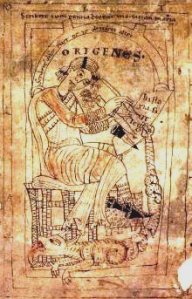
Image credit: https://commons.wikimedia.org/wiki/File:Origen3.jpg – Public Domain
Every Sunday, I will share a quote from something I’ve been reading. The hope is for you, dear reader, to share your thoughts on the quote and related issues and perhaps pick up some reading material along the way!
Why Invite Sinners?
Origen is one of the greatest thinkers in the history of Christianity. In one of his works, Contra Celsum (available in an excellent Kindle edition of his works), he replies to the skeptic, Celsus, who charged Christians with effectively dismissing sin and inviting the unrighteous into Christianity instead of the righteous. Origen replied in Book III, Chapter LXI:
Not to participate in mysteries, then, and to fellowship in the wisdom hidden in a mystery, which God ordained before the world to the glory of His saints, do we invite the wicked, and the thief, and the housebreaker, and the prisoner, and the committer of sacrilege, and the plunderer of the dead, and all those others whom Celsus may enumerate in his exaggerating style, but such as these we invite to be healed.
Origen’s point is that Christianity is a religion that does call sinners of all varieties, but it does not call them to a kind of “free pass”- it calls them to the healing that can only be had through the washing by the Lord Jesus Christ.
Links
Be sure to check out the page for this site on Facebook and Twitter for discussion of posts, links to other pages of interest, random talk about theology/philosophy/apologetics/movies and more!
On Christian Music– I wrote a post about the label “Christian music” and how that can lead to a number of difficulties with discernment.
Christian Discernment Regarding Music: A Reflection and Response– I reflect in depth on how we can use our discernment properly when it comes to music.
Sunday Quote– If you want to read more Sunday Quotes and join the discussion, check them out! (Scroll down for more)
Eclectic Theist– Check out my other blog for my writings on science fiction, history, fantasy movies, and more!
SDG.
Book Review: “Modern Art and the Life of a Culture” by Jonathan Anderson and William Dyrness
 Jonathan Anderson and William Dyrness analyze how modern art reflects the cultural mindset in Modern Art and the Life of a Culture, the inaugural entry in a new series on Studies in Theology and the Arts from InterVarsity Press. The most important thing is whether the book will be of interest to those who have little-to-no training in arts or theology. That is, can the book really bridge the gap between these fields? As one trained in theology, but with only the most introductory (read: general studies requirements) knowledge of art, from that side, I’d say the answer is a resounding yes.
Anderson and Dyrness explore modern art through the lens of H.R. Rookmaaker’s Modern Art and the Death of a Culture. However, they are not uncritical of this source material. Rookmaaker, they argue, was too quick to see more points of contact between Christianity and modern art than might be intended. However, Rookmaaker also provided a paradigm for viewing works of art as the basis for critical interaction rather than the life of or intentions of the artists themselves. This paradigm is quite useful, but it would be remiss to completely ignore the intent or life of the artist when looking at a work of art. It is this latter point which carries throughout the book, as the authors look at individual works of art, critically reflecting on them while also giving a holistic view of the artists themselves.
These descriptions are never boring or overdone. The authors write in an engaging style that weaves theology and art together in ways that are often surprising and frequently thought-provoking. The artists included are from a range of theological background and understandings. Thus, the book provides a broad look at different geological regions and their art from about the 1800s on (with some dabbling into earlier periods) that will give readers a working understanding of how the development of these styles interacted with the surrounding culture. At times, these stories are fascinating–how did the aristocracy or church react to differing depictions of icons in Russia, for example–and they always provide needed background and concrete examples.
The book also includes a number of full-color pictures to examine which are integrated into the text in useful ways. They are beautiful and often haunting. If there is one critique I may offer of the book, it is that more pictures would have been helpful. Some chapters have almost no images. Some have only black-and-white pictures. It is great to have more pictures, but the black-and-white ones make it a little difficult to discern details. More pictures would have helped readers like me–untrained in the arts–to get a better grasp on what some parts of the text were discussing. I looked up multiple paintings and images online to get a better understanding, but having them included in the text would have made it an even more excellent resource.
What is perhaps most important in the book, however, is the critical perspective the authors offer. It is impossible to give a wholesale acceptance or rejection of a field of art, and the authors provide ways to engage with both individuals and single pieces of art in ways that go beyond simply looking at the painting. It can be said, honestly, that the book will make readers want to go out, look at art, and let it speak to them in new and more profound ways. To say that about a book intended to get Christians thinking theologically about art is to give it the highest praise.
Modern Art and the Life of a Culture provides an excellent way to kick off a series on theology and the arts. It is engaging, eye-opening, and beautiful. Readers from many fields will find things of interest, and the authors provide numerous points of contact for future study. It is a highly recommended work.
The Good
+Introduces reader to an array of topics
+Critical interaction with source material
+Provides example of art criticism from Christian perspective
+Draws from international sources
+Includes beautiful color artwork
The Bad
-Difficult to discern some details in the black and white pictures
Disclaimer: I received a review copy of this book from the publisher. I was not required to provide any specific kind of review whatsoever.
Source
Jonathan Anderson and William Dyrness, Modern Art and the Life of a Culture (Downers Grove, IL: InterVarsity, 2016).
Links
Be sure to check out the page for this site on Facebook and Twitter for discussion of posts, links to other pages of interest, random talk about theology/philosophy/apologetics/movies and more!
Book Reviews– There are plenty more book reviews to read! Read like crazy! (Scroll down for more, and click at bottom for even more!)
Eclectic Theist– Check out my other blog for my writings on science fiction, history, fantasy movies, and more!
SDG.
——
The preceding post is the property of J.W. Wartick (apart from quotations, which are the property of their respective owners, and works of art as credited; images are often freely available to the public and J.W. Wartick makes no claims of owning rights to the images unless he makes that explicit) and should not be reproduced in part or in whole without the expressed consent of the author. All content on this site is the property of J.W. Wartick and is made available for individual and personal usage. If you cite from these documents, whether for personal or professional purposes, please give appropriate citation with both the name of the author (J.W. Wartick) and a link to the original URL. If you’d like to repost a post, you may do so, provided you show less than half of the original post on your own site and link to the original post for the rest. You must also appropriately cite the post as noted above. This blog is protected by Creative Commons licensing. By viewing any part of this site, you are agreeing to this usage policy.
“Harry Potter and the Cursed Child”- A Christian Perspective- Re-enchantment, Grace, and Loyalty
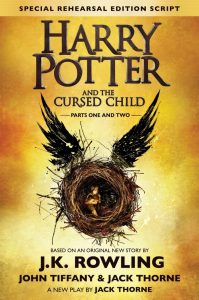 The new Harry Potter book is out, and people all over the world are diving back into the series. What kind of world does the latest adventure depict? How might Christians interact with the book? There will be SPOILERS in what follows. There will also obviously be SPOILERS for any other books in the series.
Harry Potter and Christianity… what?
Some may immediately object to the notion that Christians can or should interact with something like Harry Potter. What I say likely won’t convince anyone. But what I would say is that Harry Potter helps re-enchant the world, and our world is in great need of re-enchantment. The Bible speaks of a world created by God, inhabit by angels and demons, and full of the miraculous. The world we most often observe is utterly mundane in comparison: a world which we often think we have entirely figured out.
Harry Potter, however, opens the door to re-enchantment. The world of Harry Potter is magical–and the wonder of magic is similar to the wonder that readers have the first time they enter that certain Wardrobe from the Spare Room or see the White Wizard reappear. It’s a world that moves beyond the mundane and speaks to something more. And Christianity teaches that there is something more. The world is not just what we see with our eyes–it is a world that is utterly enchanted, full of mystery, and created by a loving God.
What’s more, the Harry Potter story so far ended in a kind of re-telling of the Messianic story. Potter laid down his life for his friends, was resurrected, and saved them. It’s a familiar story with different trappings, but one that each generation must learn anew.
Grace
One of the most important themes in “Cursed Child” is grace. Harry must have the grace to love his son, Albus, despite the imperfections. Albus must forgive his father and show grace to him to begin healing their relationship. Albus must learn the lesson Harry learned long before–that grace can defeat evil. He spares Delphi, an act of grace, despite her deserving great punishment. It’s a lesson that is brought forward time and again. In every relationship mentioned in the book, grace is needed to help heal wounds of doubt, of barbed words, and more.
Loyalty
Loyalty is another theme that shows up time and again throughout the series, and Serverus Snape’s loyalty to Lily and Dumbledore is perhaps the greatest example. Even in the alternative future that Albus visits, Snape remains loyal to the memory of Lily and his promises to Dumbledore. He fights alongside those who, in some cases, he has every reason to despise, at least historically.
That history is another major theme of the book: does one’s past determine one’s present and future? Delphi felt as though she must follow a prophecy that would allow her to be reunited with her father. Snape had to get beyond the history that he had with Harry’s father to continue the fight against darkness in an alternative future. Harry and his son Albus’ relationship is strained both by their own history and by the history of Harry. Who you are, it seems near the beginning, is determined by what you–or your parents–were. But that myth is dispelled as it becomes apparent that current action and decisions can break away from the bonds of history. Through the power of grace, as already mentioned, relationships may be healed, people may move forward.
But is it good?
Okay, okay, we get it. There are themes that interact with Christianity in Harry Potter. Is the new book worth reading?
I’d say absolutely, for fans of the series already. It’s not as detailed as the novels are, because it’s a script. But it is a good script, and the characters do develop quite a bit. There are some moments that will make you gleeful as you pick up references to previous books. The main complaint I’d have is that because it is a script, there is so little description of the environment and the characters’ internal struggles–something Rowling excels at. It’s a good entry in the series that won’t make you completely disappointed, but it isn’t as fabulous as the previous books in the series.
Links
Be sure to check out the page for this site on Facebook and Twitter for discussion of posts, links to other pages of interest, random talk about theology/philosophy/apologetics/movies and more!
Popular Books– Read through my other posts on popular books–science fiction, fantasy, and more! (Scroll down for more.)
SDG.
——
The preceding post is the property of J.W. Wartick (apart from quotations, which are the property of their respective owners, and works of art as credited; images are often freely available to the public and J.W. Wartick makes no claims of owning rights to the images unless he makes that explicit) and should not be reproduced in part or in whole without the expressed consent of the author. All content on this site is the property of J.W. Wartick and is made available for individual and personal usage. If you cite from these documents, whether for personal or professional purposes, please give appropriate citation with both the name of the author (J.W. Wartick) and a link to the original URL. If you’d like to repost a post, you may do so, provided you show less than half of the original post on your own site and link to the original post for the rest. You must also appropriately cite the post as noted above. This blog is protected by Creative Commons licensing. By viewing any part of this site, you are agreeing to this usage policy.
Really Recommended Posts 7/29/16- Open Theism, Jason Bourne, and more!
 Hello dear readers! Thanks for stopping in! Check out the latest round of “Really Recommended Posts,” brought to you by me! This week we have posts that argue against open theism–do the arguments work, though?, the Bourne movies, Mary and women in the church, objective truth for kids, and young earth creationism and geology of Egypt. As always, let me know what you think, and be sure to let the authors know as well!
The Open Future Precludes Present Motion– Alexander Pruss, one of the most interesting philosophers to follow, in my opinion, presents here an argument that open theism entails premises which mean present motion is impossible. I commented on the post arguing that most open theists allow for certain parts of the future to be knowable; just not those impacted by free will. I haven’t seen that comment pop up yet. Pruss followed with a post about how open theism eliminates the possibility to speak truthfully that is an even more intriguing argument. What do you think?
Surveillance and Revelation in the Bourne Movies– The Jason Bourne movies have much going on in them to reflect upon from a Christian perspective. Here’s a post exploring some of these dimensions.
Mary’s Truth– Women were the first evangelists. Mary was one of these first evangelists. We ought not to strip away the legacy such women left behind.
Truth in a Box– How might you discuss objective truth with kids? Here’s a way to use a concrete example to introduce the notion of truth no matter what anyone thinks about it.
Squeezing the Lost Grand Canyon of Egypt into the Young Earth Paradigm: An Impossible* Task– How do young earth creationists account for things like a canyon as large as the Grand Canyon that has been completely covered with sediment since its formation? Check out this post to see how YEC fails to account for certain physical realities.
Practical Lutheranism: What is Sabbath?
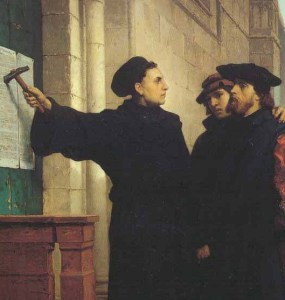 I have been reading through the Book of Concord. I think it is vitally important for one who, like me, claiming to be Lutheran to be familiar with the Lutheran Confessions. That is, after all, what we believe and confess. I have been writing a series of posts on Practical Lutheranism based on the Book of Concord. These teachings remain viable and valuable today.
What is Sabbath?
One of the debates that has raged within Christianity (with different levels of flame behind this raging, whether it be a mere flickering candle or a roaring fire) has been the meaning of “Sabbath” and how it is integrated into the Christian life. Volumes have been written, multi-view books published, denominations split or created, and the like on this topic.
Luther’s Large Catechism offered a way forward in this debate, offering an understanding of keeping the day holy that could be lived by the Christian. He wrote:
Accordingly, when you are asked what “You are to hallow the day of rest” means, answer: “Hallowing the day of rest means to keep it holy.” What is meant by “keeping it holy”? Nothing else than devoting it to holy words, holy works, and holy living… [The Sabbath Day] becomes holy or unholy on your account, depending on whether you spend it doing something holy or unholy. How does such sanctifying take place? Not when we sit behind the stove and refrain from hard work, or place a garland on our head and dress up in our best clothes, but… when we make use of God’s Word and exercise ourselves in it. [The Large Catechism, Part I, 87-88, cited below]
Yet Luther, as is so often the case for Luther (and Lutherans), was not content to leave it there. In the spirit of the Lutheran both/and, he expanded this notion of making holy to the whole of Christian life:
Truly, we Christians ought to make every day such a holy day and devote ourselves only to holy things, that is, to occupy ourselves daily with God’s Word and carry it in our hearts and on our lips… For non-Christians can spend a day in rest and idleness, too… but without keeping a single day holy, because they neither preach nor practice God’s Word… [Large Catechism, I:89-90]
Thus, for Luther, we ought to remember Christ’s words: we were not made for Sabbath, but Sabbath for us. Moreover, Sabbath is part of the overall Christian life instead of being relegated to merely one part of the week. Making the day holy is something we ought always be doing: reflecting on God’s Word, singing Psalms, and praying.
Source
Robert Kolb and Timothy J. Wengert, eds. The Book of Concord: The Confessions of the Evangelical Lutheran Church (Minneapolis, MN: Fortress, 2000).
Links
Be sure to check out the page for this site on Facebook and Twitter for discussion of posts, links to other pages of interest, random talk about theology/philosophy/apologetics/movies and more!
Adhering to the Book of Concord “In So Far As” or “Because” it Agrees with Scripture?– I argue that Lutherans must hold the position that we adhere to the Book of Concord In So Far As it Agrees with Scripture.
Eclectic Theist– Check out my other blog for posts on Star Trek, science fiction, fantasy, books, sports, food, and more!
SDG.
——
The preceding post is the property of J.W. Wartick (apart from quotations, which are the property of their respective owners, and works of art as credited; images are often freely available to the public and J.W. Wartick makes no claims of owning rights to the images unless he makes that explicit) and should not be reproduced in part or in whole without the expressed consent of the author. All content on this site is the property of J.W. Wartick and is made available for individual and personal usage. If you cite from these documents, whether for personal or professional purposes, please give appropriate citation with both the name of the author (J.W. Wartick) and a link to the original URL. If you’d like to repost a post, you may do so, provided you show less than half of the original post on your own site and link to the original post for the rest. You must also appropriately cite the post as noted above. This blog is protected by Creative Commons licensing. By viewing any part of this site, you are agreeing to this usage policy.
“Star Trek: Beyond”- A Christian perspective- Humanism, Unity, and Fear of the Unknown
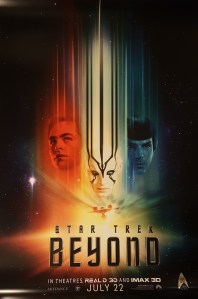
An official movie poster. Used under fair use.
Star Trek: Beyond has just released, and it is garnering critical praise. Full of special effects, the film has more heart and humor than might be expected. I quite enjoyed the movie. Here, I will discuss the movie from a Christian perspective. There will be SPOILERS for the film in what follows.
Humanism
One of the earliest scenes of the movie is a breathtaking view of a space station, Yorktown. The space station has rings encircling the interior and intersecting each other, with gravity presumably holding people down in a kind of inverted globe with trains and other vehicles zooming past. Huge crowds are observed milling about. It is a kind of utopic vision of the future. One can’t help but sit back and think: look what we could accomplish if we just set our minds to it!
Star Trek has always been about offering a kind of humanist vision of the future. Of course it goes beyond humanism and into a kind of inter-species unity in which we can hopefully learn to interact without conflict. What is striking, however, is how swiftly this vision falls.
Unity vs. Conflict
The most prominent theme in the movie, one that is repeatedly emphasized, is that of unity vs. striving and conflict. Krall is obsessed with the idea that humanity has grown weak through unity. It has made humans complacent and taken away their drive. He seeks to push humanity to new heights through conflict, bringing destruction in his wake. As he put it, the Federation has been pushing into the frontier, but now “the frontier pushes back!”
Of course, this shows a significant contrast with the vision of humanism offered early in the film. Indeed, Kirk and others do everything they can to show that unity is strength rather than weakness. Ultimately, they succeed, but only through striving and conflict.
Is it therefore possible that Krall actually succeeded in his plan, in some way, after all? He did force conflict–he brought it to the Federation–and in doing so, he made Kirk and others strive for something further, seeking new solutions and pushing new heights. It’s a subversive way to interpret how the film ended, but the implications are interesting to pursue. Krall’s vision is one that is so similar to the humanist vision it is difficult to pull them apart. When we make humanity the measure of all things, we inevitably must strive to continue to better ourselves. We will never find a limit beyond which we cannot or should not push.
Unity is a worthy goal, but without something to unite us, it is a vain hope.
Fear of the Unknown
The message of exploring the frontiers and having the frontiers push back is particularly poignant in this film. We approach a time–and are in many ways already in that time–in which changing DNA is possible, we push more and more boundaries every day. How long until we push a boundary and find that we have delved too deeply? Such a fear of the unknown ought not to forestall any advancements, but it should serve as a cautionary reminder that we should not rush blindly into the beyond.
Women
One thing I have really appreciated about the new Trek movies, and Beyond in particular, is their treatment of women. Lieutenant Uhura is assertive, decisive, and intelligent. Jaylah is a character who offers the kind of complexity that is too rarely seen in female leads in film. Moreover, her innovation and power help to save the day on multiple occasions. I hope that she continues to show up in future iterations of the franchise.
Conclusion
Star Trek: Beyond is a phenomenal film that will make viewers think. There are many more avenues to explore that I haven’t even touched upon here. What I think is most interesting, though, is the idea that unity is what we ought to strive for. I agree it is a worthy goal, but it is one that requires something around which we can all unite. Christ, I believe, has provided that something- we may guide our lives by his commands, and rely upon God’s grace when we fail.
Links
“Star Trek: Into Darkness”- A Christian Perspective– I take a look at the previous film
Be sure to check out the page for this site on Facebook and Twitter for discussion of posts, links to other pages of interest, random talk about theology/philosophy/apologetics/movies and more!
Read more movie reflections (scroll down for more).
Eclectic Theist– Follow my “other interests” blog for discussion of sci fi, fantasy, movies, sports, food, and much, much more.
SDG.
——
The preceding post is the property of J.W. Wartick (apart from quotations, which are the property of their respective owners, and works of art as credited; images are often freely available to the public and J.W. Wartick makes no claims of owning rights to the images unless he makes that explicit) and should not be reproduced in part or in whole without the expressed consent of the author. All content on this site is the property of J.W. Wartick and is made available for individual and personal usage. If you cite from these documents, whether for personal or professional purposes, please give appropriate citation with both the name of the author (J.W. Wartick) and a link to the original URL. If you’d like to repost a post, you may do so, provided you show less than half of the original post on your own site and link to the original post for the rest. You must also appropriately cite the post as noted above. This blog is protected by Creative Commons licensing. By viewing any part of this site, you are agreeing to this usage policy.
Really Recommended Posts 7/22/16- atheist converts, Ben Hur, and the NIV Zondervan Study Bible!
Hello all! I have another round-up of really recommended posts for you to enjoy! Sorry these are shorter than normal but we’ve had some difficulties with illness recently.
Ben Hur and Joseph: Making the Right Choice– My favorite film of all time, Ben Hur (see my look at the movie), is compared with the biblical narrative of Joseph as an exercise in making the right choice in this intriguing post.
The NIV Zondervan Study Bible: A Comparison of Study Notes– An evaluation of the way that the NIV Zondervan Study Bible’s notes lean towards eternal functional subordination of God the Son.
Why Atheists Change Their Minds: 8 Common Factors– Here are 8 common reasons that atheists convert to Christianity. It’s a fascinating post with multiple real-life examples including some names you’ve probably heard of. I found this post on The Poached Egg, which is a site you should be following. Please follow them!
Book Review: “The Earliest Christologies” by James L. Papandrea
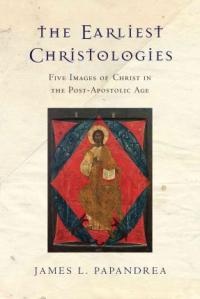 James L. Papandrea’s The Earliest Christologies is an introduction to examination of five views of who Christ was in the earliest church. Papandrea examines views of Christ as angel, prophet, phantom, cosmic mind, and Word/Logos.
The strongest point of the book is that it provides a reasoned, non-sensationalist accounting of the diversity of Christological positions in the early church. Too often, authors try to play up great conflict in the early church and what became orthodoxy as merely whatever view happened to have the most powerful adherents. None of that exists in The Earliest Christologies, which instead gives an overview of each position and shows that orthodoxy was superior in key ways.
Readers will get a broad overview of each of the five positions examined, along with multiple directions they could take further study, should they desire. It’s a solid introductory text.
Two primary difficulties face the book, and they are interlinked. The book is quite short, and so is necessarily brief on multiple important points, offering little by way of analysis. Papandrea notes throughout that the looks at Christology provided herein are “neater, cleaner, and more well-defined than they would have been in ‘real life'” (105). This brevity isn’t necessarily a major drawback, as it is intended as a work that introduces readers to the various positions on Christology in the earliest church, but it may leave some readers wanting more.
Well-written and stuffed with information, The Earliest Christologies provides a much-needed introduction to historical views of Christ. Although its brevity may limit its usefulness to introductory reading, such a work is necessary and it comes recommended. It would serve as an excellent text for a class on Christology or a high-level Bible study group.
The Good
+Provides a reasoned voice in examining early Christology
+Wealth of information in an accessible format
The Bad
-Extremely brief on multiple points
-Little by way of analysis
Disclaimer: I received a review copy of this book from the publisher. I was not obligated to provide any specific feedback whatsoever.
Links
Be sure to check out the page for this site on Facebook and Twitter for discussion of posts, links to other pages of interest, random talk about theology/philosophy/apologetics/movies and more!
Book Reviews– There are plenty more book reviews to read! Read like crazy! (Scroll down for more, and click at bottom for even more!)
Eclectic Theist– Check out my other blog for my writings on science fiction, history, fantasy movies, and more!
SDG.
——
The preceding post is the property of J.W. Wartick (apart from quotations, which are the property of their respective owners, and works of art as credited; images are often freely available to the public and J.W. Wartick makes no claims of owning rights to the images unless he makes that explicit) and should not be reproduced in part or in whole without the expressed consent of the author. All content on this site is the property of J.W. Wartick and is made available for individual and personal usage. If you cite from these documents, whether for personal or professional purposes, please give appropriate citation with both the name of the author (J.W. Wartick) and a link to the original URL. If you’d like to repost a post, you may do so, provided you show less than half of the original post on your own site and link to the original post for the rest. You must also appropriately cite the post as noted above. This blog is protected by Creative Commons licensing. By viewing any part of this site, you are agreeing to this usage policy.

 J.W. Wartick - Reconstructing Faith
