J.W. Wartick
Really Recommended Posts 6/17/16- horror movies, The Gospel Coalition, and more!

A picture of a goldfinch I took. All rights reserved.
Another week, another round of posts for you to enjoy, dear readers! This week has an exciting lineup–hopefully with some posts that will get you thinking and talking! This week, we have horror movies and Christianity, the Gospel Coalition’s (non-)engagement with culture, apologetics for kids with elephants and waterfalls, debate over the relation between the Father and Son in the Trinity, and the topic of the use of guns. As always, I’m curious to read your thoughts. I don’t always agree with 100% of everything I link, but try to choose posts that get me thinking and that I hope will get you thinking as well! [EDIT: I accidentally had one link to the wrong post. My apologies! It is fixed now.]
Why Horror Movies Make Me a Better Christian– I don’t like horror movies at all. Unless by “horror movies” you mean black-and-white horror movies with monsters that are hilarious now due to special effect differences (i.e. Creature from the Black Lagoon, etc.), then I love them. Can horror movies, with all their gore and violence, really have any redeeming qualities? This post made me think about that in a fresh light. What do you think?
The Gospel Colition and How Not to Engage Culture– Can The Gospel Coalition really claim to be about engaging with culture when they continually silence critics on social media? Check out this post for more information on this issue.
How Elephant is a Waterfall– How do you get kids thinking in different categories? What is concrete/abstract? What is a contradiction? Here’s a post from an exciting new site about apologetics for kids.
The Coming War: Nicene Complementarians vs Homoian Complementarians– There is a debate raging within complementarian camps over the subordination of the Son to the Father in the Trinity. Here is an outline of that debate. Read the follow-up posts as well for more. I’ve written on one side of this debate before- “Is the Son ‘Equal to God‘?”
Actually, Guns do kill people (Think Christian)– Think Christian is a great site for engaging culture and getting us thinking about topics we might not normally. This post is, I think, thought provoking regarding issues related to gun violence. It doesn’t offer solutions, but rather a way to conceptualize. What do you think about this issue? How might Christians engage with the topic of gun violence–or should we?
Book Review: “Wesley and the Anglicans” by Ryan Nicholas Danker
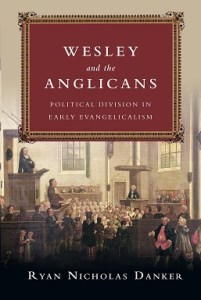 Wesley and the Anglicans by Ryan Nicholas Danker is an historical project about the developing split between John Wesley and the Methodists on the one hand and the Anglicans and Evangelicals on the other. Danker’s work offers a mixture of data and correction, exploring the topic in a way that brings new insights.
Danker does an excellent job interweaving different disciplines into his approach to the issues at hand. Instead of taking a purely theological approach to the reasons Wesley and the Anglicans split, he argues forcefully that sociological and political issues were just as–if not more–important to the division than the theological reasons. Indeed, theologically there was an Evangelical movement with Anglicanism (Danker uses Evangelical to refer to those within the Anglican church and evangelical to refer to those either immediately or ultimately outside of it). There were plenty of theological sympathies to be had for Wesley’s movement within the Anglican communion, but John Wesley (and Charles Wesley, his brother) ultimately pushed against the political and sociological hierarchy too hard to maintain unity.
Indeed, for Wesley, his commitment to aspects of the Anglican Church made the pushback from Evangelicals (and others) within the church more surprising to him. These ideas are developed through a number of case studies. For example, because of Wesley’s commitment to evangelism, he continued to encourage lay preaching. When confronted about how this may lead to laity taking over the Sacraments and the like, Wesley was (to sum up Danker’s argument) surprised; after all, he was not encouraging these lay preachers to make their own church buildings or orders of hierarchy–how could this therefore be seen as a challenge to the Anglican Church? Wesley’s own intriguing mixture of old and new made it difficult both for him to understand why he was being criticized so harshly and for those within the Anglican Church to see why he was being so divisive.
Political pressures were also brought to bear on the topic, and much of this was due to hierarchy within the church and concerns over how Wesley’s teaching might lead to a collapse of this hierarchy and unity of belief. Thus, laws were passed which began to make lay preaching more and more difficult, for small groups were suddenly considered rivals to official church business by law. Further pressure came from the laity, which began to push back and wonder why they couldn’t do things like administer the Sacraments. All of this came to a head over the course of several meetings of the Methodists, and ultimately led to the split with the Anglican Church we see today.
Danker does an admirable job uniting so many divergent threads into one continuous stream, but he does so in a way that sometimes leaves a bit to be desired. Perhaps the main downside of the book is that it reads very dryly. It doesn’t so much bring life to the historical persons and events as it does describe them. This does an adequate job of presenting the ideas and important topics, but it makes it less exciting to read than some other historic works. It conveys information, but doesn’t necessarily awaken a love of the topic in the reader.
Wesley and the Anglicans is an interesting read about a vital point in church history. Danker also demonstrates that church history ought to incorporate broader studies into its approach than just theology or history. It isn’t the most exciting history book, but it presents readers with a great deal of information on a topic of interest.
The Good
+Sheds light on an important time in church history
+Multi-disciplinary approach that incorporates sociology and politics into theology
+Full of information
The Bad
-Dryly presented
Disclaimer: I received a review copy of this book from the publisher. I was not obligated to provide any specific kind of feedback whatsoever.
Source
Ryan Nicholas Danker, Wesley and the Anglicans (Downers Grove, IL: InterVarsity, 2016).
Links
Be sure to check out the page for this site on Facebook and Twitter for discussion of posts, links to other pages of interest, random talk about theology/philosophy/apologetics/movies and more!
Book Reviews– There are plenty more book reviews to read! Read like crazy! (Scroll down for more, and click at bottom for even more!)
Eclectic Theist– Check out my other blog for my writings on science fiction, history, fantasy movies, and more!
SDG.
——
The preceding post is the property of J.W. Wartick (apart from quotations, which are the property of their respective owners, and works of art as credited; images are often freely available to the public and J.W. Wartick makes no claims of owning rights to the images unless he makes that explicit) and should not be reproduced in part or in whole without the expressed consent of the author. All content on this site is the property of J.W. Wartick and is made available for individual and personal usage. If you cite from these documents, whether for personal or professional purposes, please give appropriate citation with both the name of the author (J.W. Wartick) and a link to the original URL. If you’d like to repost a post, you may do so, provided you show less than half of the original post on your own site and link to the original post for the rest. You must also appropriately cite the post as noted above. This blog is protected by Creative Commons licensing. By viewing any part of this site, you are agreeing to this usage policy.
Really Recommended Posts 6/10/16- Patrick Stewart, evidence for God, and more!
A picture of a goldfinch I took. All rights reserved.
Thanks for coming by and checking out this week’s “Really Recommended Posts!” This time around, we have a look at what we should expect in evidence for God’s existence, a response to the “9 Marks of Complementarianism,” Patrick Stewart on domestic violence, the “hyperbole” argument regarding the Canaanites, and Aquinas’s metaphysics and arguments for God. Let me know what you think in the comments!
A Look at God’s Existence: Evidence We Want vs. Evidence We Should Expect– We often ear or read about there not being enough evidence for God. How much of that is set up by expectations about what kind of evidence God should provide?
Kevin DeYoung’s 9 Marks of Complementarianism– Recently, Kevin DeYoung posted about what ought to be the 9 marks of complementarianism. Scot McKnight offered a response to these marks from a different perspective.
Patrick Stewart on what he is most proud of– Patrick Stewart is perhaps best known for playing Captain Picard on Star Trek: The Next Generation. A fan at a recent conference asked him what he was most proud of outside of acting, and his response was powerful- working against domestic violence. This is a beautiful video worth watching. Ignore the clickbait title (which I amended here).
Misunderstanding the Canaanite Hyperbole Argument– Clay Jones, a professor at Biola University, notes that there are several misconceptions about what exactly is answered regarding the argument that the “genocide” of the Canaanites is hyperbolic.
Four Causes and Five Ways– Edward Feser outlines a brief look at Aquinas’s metaphysics and its link to his Five Ways (six arguments).
William Lane Craig vs. James White- Idols and Demons
All rights reserved.

The following are derived from actual statements I saw online from fans of each theologian:
William Lane Craig is an apostate.
Just use “white out” on everything James White has written.
Craig is an embarrassment to Christianity.
James White is a wicked Calvinist!
A lot of discussion has been centered on the critique James White offered of William Lane Craig’s alleged appeal to a “lowered bar” regarding conversion to Christianity. Immediately, people began throwing barbs at or rushing to the defense of one or the other.
Here’s another quote, one that I think has great relevance for this controversy.
“For when one says, ‘I follow Paul,’ and another, ‘I follow Apollos,’ are you not mere human beings?” 1 Corinthians 3:4 (NIV)
The reality is that we ought not elevate either William Lane Craig or James White to a position such that any criticism of their method, or views, or the like becomes a reason to immediately insult and mock whomever initiated that critique. James White and William Lane Craig have both been wrong about things before, and will be again.
We don’t need to–and should not–idolize a favorite theologian, nor should we demonize another who critiques our favorite. It is okay to have heroes of faith. It is not permissible to make those heroes into idols. It is not permissible to demonize those with whom we disagree. Can we offer criticism? Of course! But when that criticism turns into turning someone’s name into an insult, or declaring someone to be an embarrassment, it becomes sinful.
Don’t turn favorite theologians into idols; do not turn those with whom you disagree into demons.
Links
Be sure to check out the page for this site on Facebook and Twitter for discussion of posts, links to other pages of interest, random talk about theology/philosophy/apologetics/movies and more!
SDG.
——
The preceding post is the property of J.W. Wartick (apart from quotations, which are the property of their respective owners, and works of art as credited; images are often freely available to the public and J.W. Wartick makes no claims of owning rights to the images unless he makes that explicit) and should not be reproduced in part or in whole without the expressed consent of the author. All content on this site is the property of J.W. Wartick and is made available for individual and personal usage. If you cite from these documents, whether for personal or professional purposes, please give appropriate citation with both the name of the author (J.W. Wartick) and a link to the original URL. If you’d like to repost a post, you may do so, provided you show less than half of the original post on your own site and link to the original post for the rest. You must also appropriately cite the post as noted above. This blog is protected by Creative Commons licensing. By viewing any part of this site, you are agreeing to this usage policy.
Book Review: “Representing Christ: A Vision for the Priesthood of All Believers” by Uche Anizor and Hank Voss
 The doctrine of the “priesthood of all believers” is one that is easily misunderstood but joyfully affirmed by a number of Christian groups across denominational lines. Uche Anizor and Hank Voss’ book, Representing Christ: A Priesthood of All Believers is an attempt to hash out the particulars of this challenging, freeing doctrine.
The authors note the potential pitfalls of the doctrine while also showing the ways that the notion of the priesthood of all believers can be applied to many different situations. After some excellent introductory remarks–including a look at how priesthood is viewed in different theological traditions–they dive into chapters on the Scriptural basis for the doctrine, Martin Luther’s contribution to recovering the doctrine, the Trinity and our priesthood, the practices of the priesthood of all, and the overall implications and applications of the doctrine.
The doctrine of the “priesthood of all believers” has long been credited to Martin Luther, though he did not use the specific phrase and some Luther scholars (cited by Anizor and Voss) dispute that this doctrine can be derived from his writings. Despite these apparent challenges, the authors demonstrate not only the roots of the teaching in Luther’s writings, but also the fruit that such a doctrine bore for him. As a Lutheran myself, it was refreshing to see Luther’s contribution highlighted rather than ignored. Indeed, Luther’s notion of the functions of the believer–preaching and teaching the word, baptizing, administering the Lord’s Supper, binding and loosing sins, prayer, sacrifice, judging doctrine–is used as a basis for the ongoing discussion.
These 7 points are developed later in the book and serve as a great, applicable portion of the book. The authors rightly note the importance for the church of both baptism and the Lord’s Supper, and do so in ways that show how their importance comes in part from the way they create a fellowship of believers. The other aspects of this priesthood of all believers are equally insightful. Something like “binding and loosing sins” may seem quite abstract, but Anizor and Voss manage to make such a notion relevant and practical.
Highlighting the life of the Trinity and Christ’s role as great high priest was another strong point of the book. However, in this section there was a continued emphasis on the notion that it is “especially appropriate” to worship the Father in the name of Jesus by the power of the Spirit (100, cited below). Now I’ll not dispute that this is indeed one way that we ought to direct worship- praise to the Father in the name of Christ by the power of the Holy Spirit. But the authors belabored this point so much that I wondered why this was the case. After all, they clear agree that it is appropriate to worship the Son and the Spirit. If that is the case, then what basis is there for the claim of “especial” appropriateness regarding worship of the Father? We need to be careful in Trinitarian doctrine to not establish a hierarchy within the Trinity, and indeed the ancient Athanasian Creed states, “And in the Trinity none is before or after another; none is greater or less than another, but all three Persons are co-eternal together and co-equal. So that in all things, as is aforesaid, the Unity in Trinity and the Trinity in Unity is to be worshiped.” This creedal statement which has historically been defining for the whole Christian church makes it clear that all three persons are to be worshiped in unity, and although the formula Anizor and Voss put forward is Trinitarian, I wonder why the emphasis is on worship being directed to the Father. No person of the Trinity is more worthy of worship than any either, and our worship ought to be directed towards the Triune God, not “especially” towards one person.
One aspect missing from the discussion in the book is the notion of both men and women in this role as priests. Indeed, the point where this could have most easily been highlighted is in the Garden of Eden, where Voss and Anizor note the way the Garden of Eden is like a type of temple (28) and Adam is a kind of priest-king in the Garden (26ff). Someone is notably absent in this discussion: Eve. Eve was placed alongside Adam in Eden and also given the charge to have dominion over it; why should she be excluded from the discussion of priestly act in the Garden? It seems it would have been quite appropriate to include such a discussion here, and I wonder whether the lack of her inclusion is an attempt to restrict the priesthood of all believers after all. There remain many church bodies who exclude women from the role of representing Christ, and often this teaching is reinforced by keeping some parts of Scripture silent on the topic. In Representing Christ, we see no explicit mention of Eve as serving alongside Adam in these functions, despite reference to sections in which she appears. The priesthood of all believers is an explosive doctrine that frees both men and women, and to ignore this aspect of the doctrine does it disservice.
Representing Christ is an important look at a doctrine that is too often misunderstood or abused. The priesthood of all believers is a freeing doctrine, but not one that throws any kind of order in the church out the window. The authors do a fair job of pointing this out, but I cannot help but wonder why they didn’t go even farther and show how this priesthood of believers can free not only “us” in the general sense, but also, to take from a well-informed author, show that “there is neither Jew nor Greek, slave nor free, no male and female, for we are one in Christ” (Galatians 3:28).
The Good
+Highlights importance of Luther’s contributions
+Provides Scriptural basis for the doctrine
+Gives practical examples for applying content
The Bad
-Where’s Eve?
-Avoids some of the apparent implications of the doctrine regarding women
-Awkward wording of some Trinitarian discussion
Disclaimer: I was provided with a copy of this book for review by the publisher. I was not obligated to provide any specific kind of feedback whatsoever.
Source
Uche Anizor and Hank Voss, Representing Christ: A Vision for the Priesthood of All Believers (Downers Grove, IL: InterVarsity, 2016).
Links
Be sure to check out the page for this site on Facebook and Twitter for discussion of posts, links to other pages of interest, random talk about theology/philosophy/apologetics/movies and more!
Book Reviews– There are plenty more book reviews to read! Read like crazy! (Scroll down for more, and click at bottom for even more!)
Eclectic Theist– Check out my other blog for my writings on science fiction, history, fantasy movies, and more!
SDG.
——
The preceding post is the property of J.W. Wartick (apart from quotations, which are the property of their respective owners, and works of art as credited; images are often freely available to the public and J.W. Wartick makes no claims of owning rights to the images unless he makes that explicit) and should not be reproduced in part or in whole without the expressed consent of the author. All content on this site is the property of J.W. Wartick and is made available for individual and personal usage. If you cite from these documents, whether for personal or professional purposes, please give appropriate citation with both the name of the author (J.W. Wartick) and a link to the original URL. If you’d like to repost a post, you may do so, provided you show less than half of the original post on your own site and link to the original post for the rest. You must also appropriately cite the post as noted above. This blog is protected by Creative Commons licensing. By viewing any part of this site, you are agreeing to this usage policy.
Manual of Christian Evidences: Fisher Chapter 2 Guided Reading
 I am leading a guided reading of the Manual of Christian Evidences by George Park Fisher. It is freely available online and will serve as a base for discussing Christian apologetics throughout this series. The chapters are short and readable. I encourage you to join in by reading the chapters and commenting with your thoughts. When I discuss the book, I will be citing page numbers from the edition linked above.
Chapter 2
In this chapter, Fisher begins his defense of the possibility of miracles. Join me for a reflection on some of the key issues that come up in this chapter.
First, the question of defining miracles. Do you think that Fisher’s definition(s) are adequate? I ask this because I wonder whether there is potential for a false dichotomy between natural/supernatural phenomena. That is, I wonder if defining miracle as “an event which the forces of nature–including the natural powers of man–cannot of themselves produce and which must, therefore, be referred to a supernatural agency” (11) means that any storm, wind, etc. could not be referred to as miraculous. Clearly a wind that arises “out of nothing” without natural possibility of occurring as it did would be miraculous as defined here, but would it be if God just used a “natural” event? I’m not endorsing this theory, but suppose the turning of the Nile to “blood” is a reference to the color of the water being reddened by red mud that ran down the Nile from upriver. The timing was perfect, but the event was natural in this case. Does that make it natural rather than miraculous? Does the timing not factor at all? Would such an explanation remove the Nile turning to blood from the realm of the miraculous?
I don’t propose any specific answer to these questions, but my gut says that such an event would still be miraculous in at least some sense. And if that’s the case, the definition of miracle used here does create the false dichotomy I noted. Am I wrong on this? If so, why?
Second, the question of free will. Let’s not start a debate on the meaning of free will or anything of the sort. What I want to point to is Fisher’s use of free will as a “miracle” (12-13). He notes that the will moves physical forces yet it cannot be detected in a physical way. I think this is an intriguing example, and I wonder if others agree that this may be seen as “miraculous.”
However, I also wonder if his definition of miracles works against his example. After all, there is a clause he puts above: “including the natural powers of [hu]man[s].” Is free will in his example a natural power of humanity? I would think so. But in that case, it is not miraculous by his own definition. Is my reasoning fault here?
Links
Be sure to check out the page for this site on Facebook and Twitter for discussion of posts, links to other pages of interest, random talk about theology/philosophy/apologetics/movies and more!
Apologetics Read-Through: Historical Apologetics Read-Along– Here are links for the collected posts in this series and other read-throughs of apologetics books (forthcoming).
Dead Apologists Society– A page for Christians interested in the works of historical apologetics. There is also a Facebook group for it.
SDG.
——
The preceding post is the property of J.W. Wartick (apart from quotations, which are the property of their respective owners, and works of art as credited; images are often freely available to the public and J.W. Wartick makes no claims of owning rights to the images unless he makes that explicit) and should not be reproduced in part or in whole without the expressed consent of the author. All content on this site is the property of J.W. Wartick and is made available for individual and personal usage. If you cite from these documents, whether for personal or professional purposes, please give appropriate citation with both the name of the author (J.W. Wartick) and a link to the original URL. If you’d like to repost a post, you may do so, provided you show less than half of the original post on your own site and link to the original post for the rest. You must also appropriately cite the post as noted above. This blog is protected by Creative Commons licensing. By viewing any part of this site, you are agreeing to this usage policy.
Really Recommended Posts 6/3/16- Historical Apologetics, creationism, and more!
A picture of a goldfinch I took. All rights reserved.
The arrival of another Friday gives me the chance to give you, dear readers, another round of reading from across the web. I’ve been extremely busy this week and so it is a shorter RRP, but these are some goodies. Let me know what you think.
Tim McGrew’s Recommended Apologetics– Dr. Tim McGrew is a household name for those of us who are interested in historical apologetics. He founded The Library of Historical Apologetics and has dedicated much of his life to researching these topics. Here is a list of his recommended apologetics, which include many free resources from historical works.
What We Can Learn from Christianity Today’s Interview with Saeed Abedini– A specialist in domestic abuse analyzes Saeed Abedini’s interview with Christianity Today. I didn’t find this a comfortable read, but it has made me think quite a bit.
Cave Structures Made from Stalagmites Another Problem for Young Earth Creationism– A recent discovery in a cave of structures made from stalagmites presents a difficulty with YEC timelines for the existence of Neanderthals and spread of the same.
Book Review: “Political Church” by Jonathan Leeman
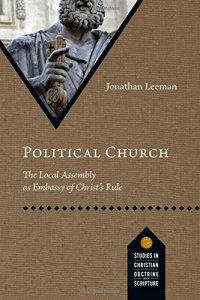
Jonathan Leeman’s Political Church: The Local Assembly as Embassy of Christ’s Rule is a detailed study of the interaction between Christianity and the public sphere. Leeman’s central thesis is that the church, as the local assembly, acts as an embassy–a political place in which Christ’s rule on earth is present.
The book is broken up into 6 lengthy chapters, each building on the last, as Leeman argues for his thesis. The first two chapters address the questions “What is politics?” and “What is an Institution?” From there, Leeman builds on politics of creation, the Fall, the New Covenant, and the Kingdom.
One of the most critical areas of the book is that there is no such thing as a totally neutral ground from which to build a political system. There is no religiously neutral political philosophy. To make the case for this central point, Leeman draws extensively from people like William Cavanaugh and Stanely Hauerwas. Essentially, the point is that because one’s religious beliefs (or alleged lack thereof) govern, effectively, all areas of one’s thought, one cannot excise them without effectively abandoning those beliefs, thus going against them. There is much more to this argument, but it is one of the many fascinating areas Leeman highlights.
Exactly how does the church act as an embassy for Christ? The sixth chapter, “The Politics of the Kingdom,” presents a number of fascinating insights into this question. Leeman takes a deep look at the notion of the “Keys of the Kingdom,” drawn from Matthew 16 (334ff). This discussion draws from multiple commentaries and spans questions from “what is the church?” to “how ought we perform church discipline?” to whether the church ought to function as a kind of civil magistrate. These kind of deep questions permeate the pages of Political Church such that readers will want to spend a great deal of time poring over the text and reflecting on the points therein.
There are a few areas worth critiquing in the book. First, much discussion time is spent on the notion of how exactly God’s covenant went from old to new covenant, but this all plays out on a kind of amorphous theological backdrop such that it is difficult to determine exactly what Leeman is saying. Is he pushing a kind of dispensational theology? At points it seems so, but other times it does not. Because the theological point here is not central to his book, Leeman doesn’t give readers enough to see where he’s coming from, particularly in chapter four’s (The Politics of the Fall) discussion of different covenants.
Another difficulty is, admittedly, drawn from a minor point in the book. Leeman states explicitly that, “if membership in the new covenant requires both the activity of the Spirit and the assent of the individual to God… then membership in… the church… should… be restricted to those who give their assent. To place infants born into a ‘Christian’ nation onto church roles misidentifies God’s presence, reputation, righteousness and justice…” (272). On the one hand, his notion that membership in the church requires both the Spirit and assent is explicitly tied to his understanding of the body of the church as a political one. On the other hand, although he stresses that exact point, it is never clear exactly what that means in terms of justification. This takes us away from the purpose of his book, but given statements like these it seems clear that justification is at least some part of what he is referring to. Justification is the work of the spirit, saving people who are dead slaves to sin who cannot free themselves. But if that’s the case, then his objection to infants being placed on church rolls seems to fall apart, for although infants cannot express consent, that does not seem to be required for the doctrine of justification. As a Lutheran particularly, I affirm that infants may have faith, because faith is a gift of the Spirit rather than an act of humans. Yet even here, Leeman might object noting that he is speaking in political terms rather than in the terms I am using.
A final difficulty is with Leeman’s reading of Luther’s Two Kingdoms model. Although he does avoid the most egregious misinterpretations of Luther on this point, Leeman argues that Luther’s model turns God’s people/not-God’s-people into church/state or Word/state. Then, he argues that the Bible and the church have words for those who are not God’s people as well and the state rules over God’s people (274-275, for example). But this is not what Luther’s model entails. It’s not that church/state on Luther’s model never interact; indeed, Leeman’s own conception seems to be extremely close to the core of what Luther was getting at in his doctrine of Two Kingdoms. He constructs it around the idea that there are two ages rather than two kingdoms, and that there are two kinds of life- secular and eternal (275). Yet even this speaking of two ages ultimately comes back to noting that there is “present simultaneity of the ages,” leading one to wonder how far from “two kingdoms” that exist simultaneously Leeman’s own argument truly is. This does go beyond Luther, but I think it’s the direction Luther’s own teaching was aiming towards, and it is interesting that Luther draws frequent mention as being close, but mistaken (29-31; 177; 275; etc.).
These minor points, though I have labored over them, do little to take away from the monumental importance of this work. Leeman has done a tremendous service to those interested in delving deeply into a theological vision of church and state. Each chapter brings together exegesis, philosophy, and sociology in informative, often surprising ways.
Political Church: The Local Assembly as Embassy of Christ’s Rule is an important work that is sure to influence all who read it, whether they agree with the contents or not. It is essential reading for those curious about the interplay between Christianity and politics. I highly recomend it.
The Good
+Engages with multiple voices throughout church history
+Generally offers balanced, ecumenical perspective
+Blends exegesis, systematics, sociology, and more
+Extensive interaction with experts in related fields
The Bad
-Wrongfully excludes children and infants from Christ’s Kingdom
-Somewhat vague on some theological points
Source
Jonathan Leeman, Political Church: The Local Assembly as Embassy of Christ’s Rule (Downers Grove, IL: InterVarsity, 2016).
Links
Be sure to check out the page for this site on Facebook and Twitter for discussion of posts, links to other pages of interest, random talk about theology/philosophy/apologetics/movies and more!
Book Reviews– There are plenty more book reviews to read! Read like crazy! (Scroll down for more, and click at bottom for even more!)
Eclectic Theist– Check out my other blog for my writings on science fiction, history, fantasy movies, and more!
SDG.
——
The preceding post is the property of J.W. Wartick (apart from quotations, which are the property of their respective owners, and works of art as credited; images are often freely available to the public and J.W. Wartick makes no claims of owning rights to the images unless he makes that explicit) and should not be reproduced in part or in whole without the expressed consent of the author. All content on this site is the property of J.W. Wartick and is made available for individual and personal usage. If you cite from these documents, whether for personal or professional purposes, please give appropriate citation with both the name of the author (J.W. Wartick) and a link to the original URL. If you’d like to repost a post, you may do so, provided you show less than half of the original post on your own site and link to the original post for the rest. You must also appropriately cite the post as noted above. This blog is protected by Creative Commons licensing. By viewing any part of this site, you are agreeing to this usage policy.
Star Trek: The Next Generation “Rightful Heir” – Faith in the Future

The Klingon Jesus. I’m serious.
Star Trek: The Next Generation is one of my favorite TV shows. I have been watching through the series with my wife, Beth. One episode we watched recently, “Rightful Heir,” had some clear worldview-level implications. There will be SPOILERS for the episode in what follows. A plot summary can be found here.
Defining Faith
Data and Worf have a couple conversations about faith that are worth commenting on. The definition of faith that is provided in the episode is interesting and seems to be that faith is belief in something that is not necessarily confirmed by empirical data. Worf states that Kahless “is not an empirical matter… it is a matter of ‘faith.'”
Data is particularly curious about this and asks Worf how he can determine whether Kahless is the “real” one or not in the absence of empirical data. Data goes on to describe his own experience that he was told he was merely a machine, but he realized that he had to trust in his own capacity to go beyond his programming. So, he says, “I chose to believe… that I was a person… that I had the potential to be more than a collection of circuits and subprocesses… I made a leap of faith.”
What is interesting about Data’s position is that it is effectively confirmed earlier in the series, “The Measure of a Man” (see my post on the worldview issues therein) in which Data is confirmed to be a “person.” Thus, the faith that is described here is ultimately vindicated.
The definition itself–something that is outside of empirical evidence–is interesting as much for what it reveals as for what it does not. It reveals that the concept of faith here is something that is presumably in something non-physical (for it is outside of empirical evidence), but it also implicitly reveals that there can be some kind of non-physical realm, even in the Star Trek universe. Faith is not denigrated, nor is it endorsed wholeheartedly. Instead, it is something that people–even Data–have. It is a facet of a complete person.
Kahless and Jesus
Kahless is effectively the Klingon’s parallel of Jesus. Ron Moore, the teleplay writer for the episode, said of the episode:
It was intriguing to me because of the religious stuff… What would happen if you could bring Jesus back? What would it do to the faith of his followers? What’s true and what’s not, what’s authentic and what’s not? …They [the Klingons] worship [Kahless] in a literal sense. So what would bringing him back do to his people?
The quote can be found in Star Trek: The Next Generation 365, a most excellent book for the Star Trek fan (like me).
Rick Berman, a writer/producer for TNG also noted the religious parallels in the episode:
Rick Berman recalled, “I had a lot of fights with Ron about this. The character of Kahless and the backstory and the dialogue of Kahless were all a little bit too on the nose Christ-like for me. We had a lot of long debates and eventually it was modified by Ron in a way that I think made it much better. I think he not only solved my problems but made the [episode] better. Kevin Conway’s performance is great and it’s a wonderful episode.” (quoted here)
There are many parallels between Kahless and Jesus, but it is what is missing that is perhaps even more intriguing. Kahless is effectively just the epitome of Klingon values. His promise to return is a promise to reinstate those values. Yet Jesus Christ is not merely an example or a lawgiver. Instead, Jesus is the Incarnate God–king of the universe. Jesus sacrificed himself for us, and this isn’t just a general statement but applies to each individual. It is for my sin that Jesus died. There is no true parallel found in a figure like Kahless who is, however admirable, merely a moral example.
The Questions
The episode, as noted in the quotes from those involved with it above, does bring up some serious questions. What would happen if we could bring Jesus back? As one of the Klingons note, who is to say the cloning was not the way by which Kahless was meant to return? Thankfully, this will remain a complete hypothetical, because we will never have genetic material from Christ from which a clone could be made.
On a deeper level, a clone is not the original thing that is cloned, but a copy. There is a true difference here. Even though Kahless received some of the memory patterns from the original, he was not the same person. Similarly, a cloned person is not the same as that from which he or she is cloned. Any different experience shapes people, and so they would not be the same person. Simply appealing to the law of identity is another way to point this out. If Kahless is not the original, then by no means could we fairly say that this clone is identical with the original. Similar? Yes. Intriguing? Certainly. Faith-shattering? No.
Conclusion
“Rightful Heir” is an interesting episode that raises a few questions for Christians to ponder. Yet, upon thinking about it in depth, it turns out that the self-examination the episode calls for is largely surface-level. Kahless is not a true parallel for Jesus, and the question of cloning and return is answered through the concept of identity. I’d love to read your thoughts on this episode in the comments. Don’t forget to look for the worldview behind anything you read or watch!
Links
Be sure to check out the page for this site on Facebook and Twitter for discussion of posts, links to other pages of interest, random talk about theology/philosophy/apologetics/movies and more!
Television– read my other posts on TV and worldview (scroll down for more).
The photo in this episode was a screenshot capture of the episode. I claim no rights to it and use it under fair use.
SDG.
——
The preceding post is the property of J.W. Wartick (apart from quotations, which are the property of their respective owners, and works of art as credited; images are often freely available to the public and J.W. Wartick makes no claims of owning rights to the images unless he makes that explicit) and should not be reproduced in part or in whole without the expressed consent of the author. All content on this site is the property of J.W. Wartick and is made available for individual and personal usage. If you cite from these documents, whether for personal or professional purposes, please give appropriate citation with both the name of the author (J.W. Wartick) and a link to the original URL. If you’d like to repost a post, you may do so, provided you show less than half of the original post on your own site and link to the original post for the rest. You must also appropriately cite the post as noted above. This blog is protected by Creative Commons licensing. By viewing any part of this site, you are agreeing to this usage policy.
Really Recommended Posts 5/27/16- Jesus and Horus, to faith and back, and more!
 Hello all! Thanks for waiting it out as I skipped last week because I was on vacation in Kansas. This week I provide you with some very deep reading in three lengthy posts that are each well-worth your time. I hope you’ll take that time to read them and engage with them.
A Pilgrim’s Regress: George John Romanes and the Search for Rational Faith– The story of how a deep 19th century thinker and contemporary of Charles Darwin fell away from faith only to find it again as he searched for the rationality of faith.
Is Jesus like a copy of Horus?– An extensive, expandable examination of the idea that Jesus is a myth based upon Horus. This is a very valuable resource with many cited sources and many avenues for further reading.
A Very Challenging Task: Answering Jewish Objections to Jesus– A serious look at a number of objections to Jesus as the Messiah from Jewish scholars and thinkers.


