Book Reviews
Book Review: “Rediscovering Jesus” by David B. Capes, Rodney Reeves, and E. Randolph Richards
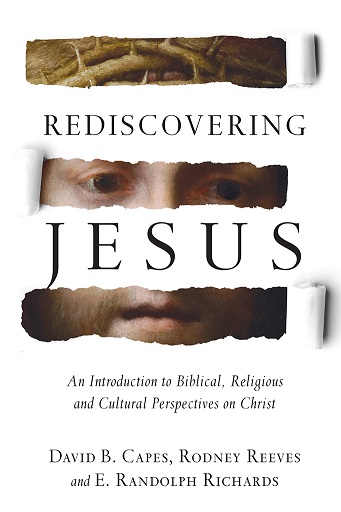 Rediscovering Jesus is part project of unearthing aspects of Jesus which are often ignored, part recovery of the biblical portrait of Jesus, and all intriguing.
The book is structured such that each chapter presents a specific portrait of Jesus. Each chapter has a brief introductory section that gives an overview of that specific Jesus, an exposition of how the specific work presents Jesus, how that Jesus is different or unique, and what we would believe about Jesus if that were the only information about Jesus we had.
The first part focuses on biblical images of Jesus, but does so by looking at individual books of the Bible (though a few writings are lumped together). Thus, rather than seeing a composite Jesus made up of all four Gospels put together–not itself a bad thing, necessarily–the chapters provide a deeper look at the individual focus of each Gospel or book. Thus, readers are confronted by a Jesus who is a man of action in Mark, a priest in Hebrews, and an apocalyptic judge in Revelation.
The second part examines pictures of Jesus outside the Bible: the ones examined are the Gnostic, Muslim, Historical, Mormon, American, and Cinematic Jesus.
The primary value of the work is how it challenges readers to rethink how they have viewed Jesus. If their Jesus has been shaped predominantly by cultural and non-biblical portraits, the book serves as a call to return to the biblical portrayal. But it does not do so at the expense of all extrabiblical imagery. The authors carefully outline how there might be truth found in various images of Jesus. If our Jesus has been shaped by biblical imagery, the authors challenge us to see how we might have glossed over specific emphases of the different authors of the New Testament.
Each chapter is filled with insights and things to explore. Readers will be continually challenged in how they may have a deficient or composite view of Jesus that does not match the Jesus of the Bible. It is a book which calls us, primarily, to learn about our Lord Jesus Christ. It does so in a way that is constantly exciting and invigorating.
I recommend Rediscovering Jesus wholeheartedly. It was a phenomenally interesting read, and one which will challenge you to rethink how you have conceived of Jesus, while calling readers back to biblical portrayals. I can’t really recommend it highly enough.
The Good
+Illuminates a number of aspects of the biblical Jesus that we often miss
+Great chapter organization
+Excellent information found throughout the book
The Bad
-Very brief on several points
Disclaimer: I received a review copy of the book from the publisher. I was not required to leave any specific kind of feedback whatsoever.
Links
Be sure to check out the page for this site on Facebook and Twitter for discussion of posts, links to other pages of interest, random talk about theology/philosophy/apologetics/movies and more!
Book Reviews– There are plenty more book reviews to read! Read like crazy! (Scroll down for more, and click at bottom for even more!)
Source
David B. Capes, Rodney Reeves, and E. Randolph Richards, Rediscovering Jesus (Downers Grove, IL: InterVarsity, 2015).
SDG.
——
The preceding post is the property of J.W. Wartick (apart from quotations, which are the property of their respective owners, and works of art as credited; images are often freely available to the public and J.W. Wartick makes no claims of owning rights to the images unless he makes that explicit) and should not be reproduced in part or in whole without the expressed consent of the author. All content on this site is the property of J.W. Wartick and is made available for individual and personal usage. If you cite from these documents, whether for personal or professional purposes, please give appropriate citation with both the name of the author (J.W. Wartick) and a link to the original URL. If you’d like to repost a post, you may do so, provided you show less than half of the original post on your own site and link to the original post for the rest. You must also appropriately cite the post as noted above. This blog is protected by Creative Commons licensing. By viewing any part of this site, you are agreeing to this usage policy.
Book Review: “The Reformation Study Bible”
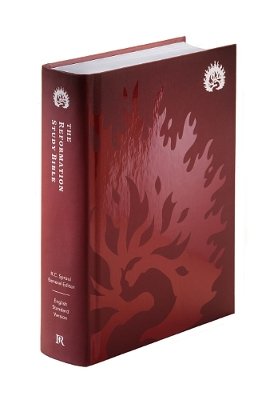 A few months ago I was sent a review copy of The Reformation Study Bible. Given the title, I kind of expected there to be study notes from Luther, Calvin, Zwingli, and the like. I mean, it’s the “Reformation” Study Bible, right? What it actually is is a Reformed Study Bible. I’ll be reviewing it from that perspective as well as I can, but I wanted to be sure readers wouldn’t be confused, as I was.
The Bible is extremely robust, with notes often taking up half or more of the actual pages of the text. Each book has a brief introduction that does a good job outlining key details and theological themes. There are extensive maps and additional notes found throughout the text. Notes range from theological exposition to apologetics-oriented. At times they focus on a pastoral perspective or draw out inter-canonical readings of the texts. There is little that passes without comment.
I received the edition pictured here. The cover is beautiful and also very solid. The binding clearly will hold up quiet well under lengthy use. There are, of course, other bindings available including leather. The pages are extremely thin, however, and it is easy to see the text through the page. The font is small, though readable. As with most other modern study bibles, there is very little space in the margins for writing notes (apart from sections of biblical poetry).
The extent to which readers will enjoy this Bible is going to be almost entirely based on how much they align with Refromed theology. In some places (such as interpretation of Genesis 1), there is leeway granted in the notes for a spectrum of views. In others (such as the discussion over men and women in the church), a specific perspective (complementarianism) is heavily endorsed. Discussions of sacraments, foreknowledge, predestination, election, and the like are all explicitly Reformed in their perspective. This is not a strike against the study Bible–it is, after all, effectively a Reformed Study Bible–but readers must realize that they will get exactly that.
In order to write this review, I went through several books in their entirety, along with reading the notes and the like. These included Ruth, Genesis, John, and 1 Corinthians. In addition, I read selections from every other book. The tone and notes are consistent throughout. As already noted, the notes are also fairly extensive.
The bottom line is that you’re going to get out of The Reformation Study Bible exactly what you would expect from a conservative Reformed study Bible. It is excellent in that regard–and could even serve as a resource if you are interested in researching Reformed perspectives on various passages–but if that is not what you want, you should look elsewhere for a study Bible.
The Good
+Extensive notes with deep discussion of inter-related texts
+Good format
+Readable introductions with inter-canonical perspective noted
The Bad
-Confusing title
-Lots of notes will be largely disregarded if you have a different theological bent
Disclaimer: I was provided with a review copy of this book by the publisher. I was not obligated to write any specific kind of feedback whatsoever.
Book Review: “Owen on the Christian Life” by Matthew Barrett and Michael Haykin
 Owen on the Christian Life provides a broad-spectrum approach to John Owen’s theological insights into the Christian life. It is part of the “Theologians on the Christian Life” series from Crossway (see my other reviews in this series here).
John Owen was a Puritan. Yes, one of “those people.” The word “puritan” has something of a bad connotation nowadays, but the theological movement was actually remarkably broad. Moreover, many insights can be gleaned from reading through the works of these theologians who emphasized a Christian life lived.
The authors outline Owen’s theology through a number of chapters that build on each other, including chapters on the Trinity, penal substitution, justification, and more. Readers also learn about Owen’s transition towards congregationalism, discussions about church and state, and more.
Central to Owen’s theology are the Trinitarian relations, which can help us to learn about divine-human and human-relations as well. Owen emphasized the importance of religious experience for the Christian life. This experience was never taken to trump the authority of the Bible–far from it. Instead, it was taken to be a bulwark in times of doubt and need. Justification in Owen’s view provides a way to be assured of one’s salvation, for God completes that which God has set out to do. Sanctification is where I believe Owen’s main contributions might be found, though I will outline that more below.
The primary critique I have of the book is that it doesn’t seem to focus on Owen’s specific views of the Christian life as the other works in the series have. As I outlined above, there are chapters emphasizing various aspects of Owen’s theology, but these only get tied into the Christian life in what seems like offhand fashion at times. This makes the book read more like an exposition of Owen’s broader (largely Calvinistic) theology than a specific look at his doctrine of the Christian life. Particularly surprising to me was how Owen’s insights on sanctification and overcoming sin and temptation were lumped in with discussions of the power of prayer and the indwelling Spirit. Perhaps this is at least partially my own bias, having been edified greatly by his works on sin and temptation, but I think that more space dedicated to his work in this area would have been on point in a book on the Christian life.
That said, the authors do a good job summarizing Owen’s approach to overcoming sin and putting it to death in our lives. Owen argues for several steps a Christian can take to battle sin and temptation in their lives. This is a proactive approach which views the Christian life as a Spirit-empowered battle against the temptations we face. Steps Owen describes include the envisioning of the consequences of sin, reflection on the Bible, and realizing the fact of the suffering our sin causes Christ.
Owen on the Christian Life provides insight into the whole of Owen’s theology, with a focus on his theology of Christian living. It’s not necessarily as focused on the topic at hand as some other books in the series, but it is a worthy read that provides an introduction into the thought of this theological giant.
The Good
+Excellent insights into the Christian life
+Provides broad overview of Owen’s work
+Great insights into doctrine of the Holy Spirit, sanctification, and more
The Bad
-Doesn’t seem to focus entirely on the Christian Life
Links
Be sure to check out the page for this site on Facebook and Twitter for discussion of posts, links to other pages of interest, random talk about theology/philosophy/apologetics/movies and more!
Book Reviews– There are plenty more book reviews to read! Read like crazy! (Scroll down for more, and click at bottom for even more!)
Book Review: “Overcoming Sin and Temptation” by John Owen– I review a book from John Owen which has positively impacted my spiritual life in many ways.
Source
Matthew Barrett and Michael Haykin Owen on the Christian Life (Wheaton, IL: Crossway, 2015).
SDG.
——
The preceding post is the property of J.W. Wartick (apart from quotations, which are the property of their respective owners, and works of art as credited; images are often freely available to the public and J.W. Wartick makes no claims of owning rights to the images unless he makes that explicit) and should not be reproduced in part or in whole without the expressed consent of the author. All content on this site is the property of J.W. Wartick and is made available for individual and personal usage. If you cite from these documents, whether for personal or professional purposes, please give appropriate citation with both the name of the author (J.W. Wartick) and a link to the original URL. If you’d like to repost a post, you may do so, provided you show less than half of the original post on your own site and link to the original post for the rest. You must also appropriately cite the post as noted above. This blog is protected by Creative Commons licensing. By viewing any part of this site, you are agreeing to this usage policy.
Book Review: “Rescuing the Gospel from the Cowboys” by Richard Twiss

Rescuing the Gospel from the Cowboys by Richard Twiss presents a broad, far-reaching analysis of the contact and sometimes conflict between Christianity and Native cultures.
Conflict is a major theme of the book, as Twiss traces the history of interactions between Western Christians and Native peoples. This history involves much wrongdoing, from wanton destruction of Native peoples through disease (which was at some points compared to the plagues on Egypt attacking the Native peoples), to continued missiology that refuses to adapt to new insights from anthropology.
A central question asked time and again through the book is why, in order to be Christian, people must give up all their cultural background and embrace a Eurocentric version of religious practice. The example often used is that of drums in worship. Many argue that this is an example of potentially dangerous syncretism–the incorporation of anti-Christian ideology into allegedly Christian worship. They allege that because drums have been used in spiritual fashions that are non-Christian, they must be tied to non-Christian beliefs. Twiss argues that, instead, it is an example of critical contextualization–integrating the Christian faith by means of cultural expressions. He notes that this is allowed in all kinds of ideas and expressions in Western cultures. He mentions the integration of Platonic and Aristotelian thought into Creedal expressions as one example. Another example could be the general allowance for Christmas trees–themselves once expressions of pagan practices.
Thus, a major aspect of Twiss’ project is to demonstrate that Native peoples must be allowed to develop their own understanding of how to follow the Jesus way. Just as in Western churches, incense, organs, Christmas trees, specific candle lightings, and the like are allowed and even endorsed; so too should Native expressions and critical incorporation of their own practices be allowed in worship. Only then, argues Twiss, can the Gospel be truly integrated into Native life and communities.
Twiss also outlines various ways missions have been done to Native peoples and notes that these have largely changed and adapted in response to new insights from anthropology, but these adaptations have been adapted abroad, not in Native mission fields. This means a continued colonializing is taking place as Native peoples are expected to change everything, without being allowed to keep their own religious expressions. He summons much data to support these claims.
A major chapter in the book features his amalgamation of stories into a fictional sweat lodge ceremony in which nine different Native men are talking about their struggles with following Christ in a Native culture. These provide great insights into the ways in which Native people have worked to integrate their culture and faith together and met enormous resistance.
By the time I finished the book, I realized that I’d had to be fairly introspective and consider my own faults along with all that I had learned. I had, at least in my head, thought of various practices like integrating Native dancing into worship as being some kind of syncretism. I hadn’t thought about how plenty of the things I do (Christmas trees, for example) had sprung from a cultural milieu and come to be accepted in Western Christianity. I had been convicted by Twiss, but also enlightened.
The few critiques I have to offer of the book pale in comparison to its insight, but I’ll note them here. First, there are a couple times in which it seems to repeat the same point more than once–sometimes even with the same quote or citation. I’m sure this is due to it having been finished posthumously, and so the editors drew together works from Twiss’ other materials, but it remains disconcerting at points. Another issue is that there are several points at which Twiss lists a whole slew of relevant scholars and a major work or two from each. It’s the kind of thing that could have been more easily relegated to endnotes in order to clean up the text a bit, but this is a minor nitpick.
The appendices are quite useful, including a list of various words or phrases used to refer to Native American peoples, as well as when they were first used and how they’ve come to be used now.
I recommend Rescuing the Gospel from the Cowboys as highly as possible. It is filled with excellent information, convicting insights, and hope. Pick it up and read it.
The Good
+Touches on a number of important topics
+Deep insights with convicting but guiding words
+Awesome cover
+Excellent use of stories to illustrate important points
+Provides hope and applicable insights
+Useful appendices
The Bad
-Occasionally repetitive
-Large lists of scholars at points with little context
Disclaimer: I received a review copy of this book from the publisher. They did not require any specific kind of feedback whatsoever.
Links
Be sure to check out the page for this site on Facebook and Twitter for discussion of posts, links to other pages of interest, random talk about theology/philosophy/apologetics/movies and more!
Book Reviews– There are plenty more book reviews to read! Read like crazy! (Scroll down for more, and click at bottom for even more!)
Source
Richard Twiss, Rescuing the Gospel from the Cowboys (Downers Grove, IL: InterVarsity, 2015).
SDG.
——
The preceding post is the property of J.W. Wartick (apart from quotations, which are the property of their respective owners, and works of art as credited; images are often freely available to the public and J.W. Wartick makes no claims of owning rights to the images unless he makes that explicit) and should not be reproduced in part or in whole without the expressed consent of the author. All content on this site is the property of J.W. Wartick and is made available for individual and personal usage. If you cite from these documents, whether for personal or professional purposes, please give appropriate citation with both the name of the author (J.W. Wartick) and a link to the original URL. If you’d like to repost a post, you may do so, provided you show less than half of the original post on your own site and link to the original post for the rest. You must also appropriately cite the post as noted above. This blog is protected by Creative Commons licensing. By viewing any part of this site, you are agreeing to this usage policy.
Book Review: “Bavinck on the Christian Life” by John Bolt
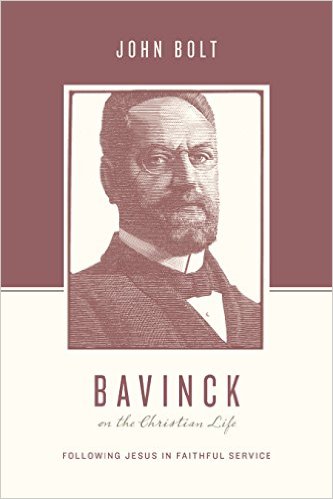
Bavinck on the Christian Life is another entry in the “Theologians on the Christian Life” series from Crossway. Check out my other reviews in the series.
The chapter on union with Christ is particularly insightful. Bolt draws out Bavinck’s insights into Christology, which include going beyond redemption and looking to eschatology and creation as important aspects of Christology as well. Union with Christ is explored from various angles, including penetrating looks at deism and pantheism alongside an examination of the Orthodox doctrine of theosis. This latter portion is particularly interesting both because it allows for some evangelical-Orthodox dialogue and because it clarifies some important distinctions Orthodox distinctions make that allow them to avoid pantheism or panentheism in regards to divinization.
I also appreciated the extensive biographical background to set the stage for Bavinck’s theology by showing how he interacted with the controversies of his time. The overview provided herein of Bavinck’s thought is also insightful. He was thoroughly Calvinist. His view of the world was tied up in Trinitarianism, and he grounded not only his view of reality but also of various aspects of reality in the Trinity. An important insight from Bavinck is the way in which work is part of the human vocation and living out of the image of God. As a Lutheran I particularly enjoyed the emphasis on work as being part of God’s plan for humanity.
One criticism I have is that the author seemed to have a bit of a political axe to grind. In chapter 3, for example, welfare is mentioned at least twice and referenced off hand a third time. Bolt seems keen to point out that Christians can differ on this subject, writing at one point “The Bible is quite clear about the responsibility of God’s children to help those who are poor and needy. Whether or not this commitment to the poor demands support for higher taxes and greater government welfare is quite another matter” (Kindle location 1211-1221). The 10th chapter of the book returns to this issue and places it in Bavinck’s own context with debates over the social gospel and the meaning of the Kingdom (see especially Kindle location 4300 and following). This at least places the whole discussion in Bavinck’s own day.
Yet, remarkably, Bavinck’s response to social inequality seems, according to Bolt, to simply shift the problem elsewhere. Bavinck casts inequality and social injustice squarely into the realm of divine sovereignty: “God’s preordaining was the final, most profound cause of all differences among creatures… It is neither the free will of man, nor merit and worth, nor culture or even nature that is the source… but God’s almighty and all-powerful will…” (4540). I’m not saying this is inherently mistaken. What I’m saying is this doesn’t even begin to answer the question raised: how should we deal with injustice? Sure, a Calvinist would argue that all that happens is sovereingly decreed by God, but how does just saying that in any way answer the preceding question? It just moves it up a (or several) level(s).
Bavinck was also someone who “ascribe[d] to women a primary calling in the home, and he point[ed] to human history, as well as the narratives and laws of the Old Testament, as evidence for a patriarchal structure of human society” (Kindle location 3001). Yet, he also argued that no man is complete without some aspects of femininity and no woman is complete without some aspects of masculinity. How that plays out is largely left up for interpretation, though Bolt argues that this demonstrates that although Bavinck would align with “complementarianism”–the view that men and women have different roles in church and home–he would not ascribe to some of the “will-to-power, macho masculinity and eroticized or subservient, passive femininity” (Kindle loc 3076). Bavinck also challenged some of the patriarchal views of his own society. One way he did this was supporting women’s suffrage. These are admirable qualities He emphasized the role of children and family as the calling of humanity, but one wonders what this might say to those who remain single or childless.
A final, though minor, critique is that there are many portions of the book in which the overall outline of the book is walked back through, or references are made to previous chapters alongside a brief description of why such a reference is relevant in context. It’s a minor thing to point out, but it was distracting at points and gave an impression that the book wasn’t always organized logically.
Bavinck on the Christian Life provides perspective on Bavinck’s thought, life, and context. It isn’t quite as polished as the other books in the series, but it remains a worthy read.
The Good
+Interesting insight into the theological context of Bavinck’s day
+Good cautionary words on worldview analysis
The Bad
-At some points too concerned with modern controversies
-Too many words spent explaining why the book was organized in the fashion it was
-Expresses commitment to “patriarchy”
Disclaimer: I was provided with a review copy of the book from the publisher. I was not asked to give any specific kind of feedback whatsoever.
Links
Be sure to check out the page for this site on Facebook and Twitter for discussion of posts, links to other pages of interest, random talk about theology/philosophy/apologetics/movies and more!
Book Reviews– There are plenty more book reviews to read! Read like crazy! (Scroll down for more, and click at bottom for even more!)
Source
John Bolt, Bavinck on the Christian Life (Wheaton, IL: Crossway, 2015).
SDG.
——
The preceding post is the property of J.W. Wartick (apart from quotations, which are the property of their respective owners, and works of art as credited; images are often freely available to the public and J.W. Wartick makes no claims of owning rights to the images unless he makes that explicit) and should not be reproduced in part or in whole without the expressed consent of the author. All content on this site is the property of J.W. Wartick and is made available for individual and personal usage. If you cite from these documents, whether for personal or professional purposes, please give appropriate citation with both the name of the author (J.W. Wartick) and a link to the original URL. If you’d like to repost a post, you may do so, provided you show less than half of the original post on your own site and link to the original post for the rest. You must also appropriately cite the post as noted above. This blog is protected by Creative Commons licensing. By viewing any part of this site, you are agreeing to this usage policy.
Book Review: “Theology as Retrieval” by W. David Buschart and Kent D. Eilers
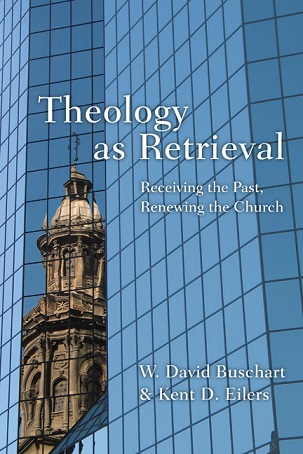
Theology as Retrieval is an exploration of how theologians might look to the past to gain applicable insights into today’s challenges. It is more than that, though. There are several specific aspects of theological retrieval that are addressed in the book from a variety of angles.
After a robust introduction that outlines what is meant by retrieval of theology and the different ways this is being brought about, there are individual chapters on various topics around which retrieval is centering. These are scripture, theology (broadly), worship, spirituality, mission(s), and cosmos. Each chapter has a question that is being addressed by many of the projects, examples of how retrieval is taking place in this specific area, and some of the results of retrieval in that field.
For example, the chapter on worship asks the question “Whose House is This?” Then, it traces various responses to the question, whether various Protestant positions or a Roman Catholic perspective. Next, specific examples of how churches went about creating worship spaces alongside their own explorations of Christian thought from the past about the place of worship. Finally, a few concluding remarks are offered about how retrieval is being done in the area of worship.
The layout thus allows for readers to pick and choose sections to read while continuing to gain different insights into how retrieval is being done. I found the chapters on worship and spirituality to be particularly enlightening. Buschart and Eilers offer not only examples of retrieval but also serve these up almost as morsels to whet the appetite for more. Throughout the book, there is a sense that there is a vast wealth of knowledge waiting to be retrieved and that the work is only being begun. I think this is an accurate portrayal of the state of theological recovery.
After the meaty introduction, the authors tend to take a kind of show, don’t tell approach to the activity of theological retrieval. The examples used are often quite robust, but I was left at times wondering whether it would have been more helpful to add another chapter on how exactly readers might go about their own activity of theological retrieval. The basics are provided in the introduction, and the examples also give several ways of how others have done so, but it would have been nice to have a more substantive overview of methodology.
Theology as Retrieval is a good read with plenty of avenues to explore. Readers will likely experience a yearning to enter into conversation with theologies of the past, and the authors provide some avenues to pursue this research. As far as methodology, however, readers will have to develop their own or try to adapt one from the glimpses provided in the book.
The Good
+Uses plenty of examples to highlight areas of retrieval
+Suggests ways to apply the concepts from the book to the church
+Highlights importance of past theologians
The Bad
-Use of examples sometimes extremely brief
-Could have used more conceptual framework
Disclaimer: I was provided with a review copy of the book from the publisher. I was not asked to give any specific kind of feedback whatsoever.
Links
Be sure to check out the page for this site on Facebook and Twitter for discussion of posts, links to other pages of interest, random talk about theology/philosophy/apologetics/movies and more!
Book Reviews– There are plenty more book reviews to read! Read like crazy! (Scroll down for more, and click at bottom for even more!)
Source
W. David Buschart and Kent D. Eilers, Theology as Retrieval (Downers Grove, IL: InterVarsity, 2015).
SDG.
——
The preceding post is the property of J.W. Wartick (apart from quotations, which are the property of their respective owners, and works of art as credited; images are often freely available to the public and J.W. Wartick makes no claims of owning rights to the images unless he makes that explicit) and should not be reproduced in part or in whole without the expressed consent of the author. All content on this site is the property of J.W. Wartick and is made available for individual and personal usage. If you cite from these documents, whether for personal or professional purposes, please give appropriate citation with both the name of the author (J.W. Wartick) and a link to the original URL. If you’d like to repost a post, you may do so, provided you show less than half of the original post on your own site and link to the original post for the rest. You must also appropriately cite the post as noted above. This blog is protected by Creative Commons licensing. By viewing any part of this site, you are agreeing to this usage policy.
Book Review: “Talking Doctrine: Mormons and Evangelicals in Conversation” edited by Richard Mouw and Robert Millet
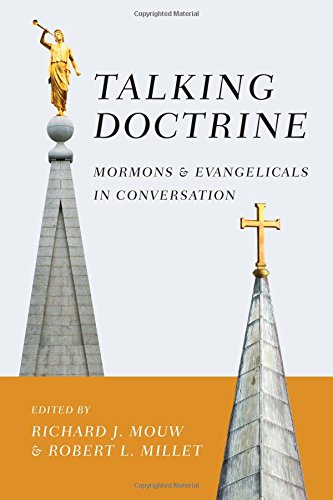
Talking Doctrine: Mormons and Evangelicals in Conversation is a collection of essays from both Mormon and evangelical scholars about the areas of convergence and divergence in their beliefs.
The essays touch on a broad array of topics, though they are organized under two general headings: the nature of the dialogue and specific doctrinal discussions. Each grouping has a diverse set of essays, from a series of reflections on Mormon-evangelical dialogue to the exploration of sacred space under the “nature of the dialogue” to the question of the Trinity and the nature of authority under “specific doctrinal discussions.”
It is quite interesting to see how Mormon and evangelical thought has developed through this dialogue and what areas are left open to explore. Some essays hint at convergence of the belief systems (the nature and efficacy of grace, for example), while others show how wide the divide remains (specifically the discussions on the Trinity and issue of theological anthropology).
I appreciated the calls to honesty in the dialogue on both sides, as well as the tone of each essay which suggested mutual respect even amidst a struggle to understand each other.
One thing that I am really left wondering is how much the Mormon side in this dialogue represents the “Mormon on the street.” That is, would the average Mormon hold to similar beliefs as those writing the essays herein? Often, it seems that the Mormons do not sound all that far from evangelicalism on some issues, but on others the chasm is very wide indeed.
Several of the essays were, frankly, overly optimistic. Sarah Taylor, in “An Evangelical at Brigham Young University,” has a conversation with a Mormon friend in which the Mormon friend affirms the possibility that God the Father sinned, but argues that Christ’s atonement would have canceled out even that sin. Shockingly, Taylor’s conclusion is that the Mormon friend was “the same amount Christian” as she is (emphasis hers) despite the affirmation of God’s sinning. Other head-scratchers like this are found throughout, such as when Brian Birch in “Divine Investiture: Mormonism and the Concept of Trinity” concludes that because Mormonism is similar in some ways to Arianism(though radically dissimilar in others), it can be seen as akin to some form of the Christian tradition (but why should a condemned heresy be concluded to be part of the Christian tradition? how broadly are these scholars painting to be inclusive?).
However, each essay has several intriguing points to take away alongside various insights and challenges. Whether you are an evangelical looking to broaden your understanding of Mormonism or an apologist looking to see some of the most challenging contrasts to evangelicalism found in Mormon thought (or anywhere in between), this is a book that will benefit you.
Talking Doctrine is a fascinating book with many challenging essays and avenues to explore. Frankly, if one is interested at all in apologetics and Mormonism, one should read this book. Whatever shortcomings it has are outweighed by the amount of information found herein. Just be aware of some of these shortcomings.
The Good
+Interesting set of essays
+Tackles some of the tough questions
+Great concern with accurate representation of “others'” beliefs
+Provides insight into both sides of the dialogue
The Bad
-Very minimal space given to each essay
-Some difficult topics seemed to be skirted around or ignored
-Downplays some rather major areas of disagreement
Disclaimer: I received a review copy of this book from the publisher. I was not asked to provide any specific kind of feedback whatsoever.
Links
Be sure to check out the page for this site on Facebook and Twitter for discussion of posts, links to other pages of interest, random talk about theology/philosophy/apologetics/movies and more!
Book Reviews– There are plenty more book reviews to read! Read like crazy! (Scroll down for more, and click at bottom for even more!)
Source
Talking Doctrine: Mormons and Evangelicals in Conversation edited Mouw and Millet (Downers Grove, IL: InterVarsity, 2015).
SDG.
——
The preceding post is the property of J.W. Wartick (apart from citations, which are the property of their respective owners, and works of art as credited) and should not be reproduced in part or in whole without the expressed consent of the author. All content on this site is the property of J.W. Wartick and is made available for individual and personal usage. If you cite from these documents, whether for personal or professional purposes, please give appropriate citation with both the name of the author (J.W. Wartick) and a link to the original URL. If you’d like to repost a post, you may do so, provided you show less than half of the original post on your own site and link to the original post for the rest. You must also appropriately cite the post as noted above. This blog is protected by Creative Commons licensing. By viewing any part of this site, you are agreeing to this usage policy.
Book Review: “Packer on the Christian Life” by Sam Storms
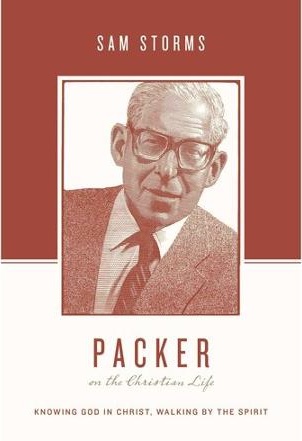 Packer on the Christian Life by Sam Storms summarizes much of J.I. Packer’s thoughts that answer the question “How now shall we live?” I’ve enjoyed Storms’ works before and have been curious to learn more about Packer, so I was looking forward to this read.
The book starts with some brief biographical information on Packer. Then, we are quickly thrust into core aspects of his theological framework. In particular, Packer emphasized the atonement as central to any Christian understanding of life or doctrine. The Bible is seen as the authority for the Christian life. These early chapters are used to set the stage for a more holistic approach found afterwards.
Packer’s stance is heavily influenced by Puritanism. The Puritans have suffered from a bit of a bad reputation, and some of it has been deserved. However, the insights the Puritans gave into living purely (sorry) are worth reading about, and Packer’s view of the Christian life highlights them throughout. The battle against indwelling sin, the definitions and search for holiness, and the like; all are colored with Puritan lenses, and this provides a different approach than some of the other books in the series.
After the holistic approach found in the middle section of the book, individual topics are addressed. These include the work of the Holy Spirit, prayer, discerning God’s will, and enduring suffering. The chapters on prayer and enduring suffering are particularly edifying. Packer offers biblical answers to perceived unanswered prayers as well as insight into how to pray and why and when (always). His approach to enduring suffering leans heavily towards a Calvinistic response, and Storms presents it in a pastoral, applicable manner.
Storms admirably handles Packer’s view on spiritual gifts. Packer is a cessationist but seems to have a rather moderating position, whereas Storms has been an outspoken continuationist. He fairly presents Packer’s view on the topic of miraculous gifts without criticism–an appropriate stance given the purpose of the book.
Packer on the Christian Life is another good entry into the “Theologians on the Christian Life” series. I enjoyed it quite a bit, though I think the entries on Luther and John Newton were slightly better. It comes recommended.
The Good
+Good insight on varied practical topics, including prayer
+Makes accessible, in one place, much of Packer’s work
+Highlights contributions possible from Puritanism
The Bad
-Could use more exposition in addition to all the quotes
Disclaimer: I received a review copy of this book from the publisher. I was not required to provide any specific kind of feedback whatsoever.
Source
Sam Storms, Packer on the Christian Life (Wheaton, IL: Crossway, 2015).
SDG.
——
The preceding post is the property of J.W. Wartick (apart from quotations, which are the property of their respective owners, and works of art as credited; images are often freely available to the public and J.W. Wartick makes no claims of owning rights to the images unless he makes that explicit) and should not be reproduced in part or in whole without the expressed consent of the author. All content on this site is the property of J.W. Wartick and is made available for individual and personal usage. If you cite from these documents, whether for personal or professional purposes, please give appropriate citation with both the name of the author (J.W. Wartick) and a link to the original URL. If you’d like to repost a post, you may do so, provided you show less than half of the original post on your own site and link to the original post for the rest. You must also appropriately cite the post as noted above. This blog is protected by Creative Commons licensing. By viewing any part of this site, you are agreeing to this usage policy.
Book Review: “God’s Crime Scene” by J. Warner Wallace
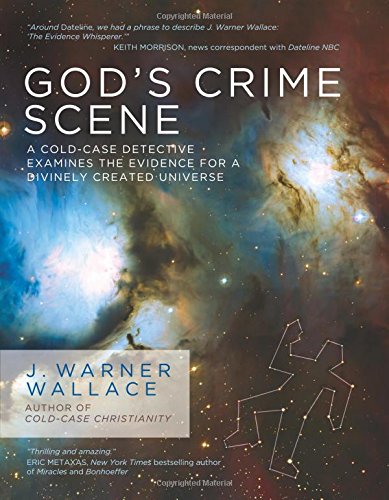 J. Warner Wallace is the a homicide detective and the author of Cold Case Christianity, one of my favorite introductory apologetics books (see my review). He recently came out with his second apologetics book, God’s Crime Scene. The former work focuses on the evidence for the resurrection and the reliability of the New Testament. In God’s Crime Scene, Wallace makes a convincing case presenting evidence for the existence of God.
The first question I think readers will ask is: “What separates this introductory apologetics book from the pack?”
That’s a valid question. There really are a rather large number of intro-to-apologetics books on the market now (thank goodness!). God’s Crime Scene is different from the rest in that it makes real-world examples central to the case that is made therein. That is, Wallace uses examples of crime scenes that he has experienced throughout the book (sans much of the gory details) to set the stage for each exploration of a different argument for the existence of God.
The way this works is simple: each chapter begins with a story that reads much like a mystery novel. Then, Wallace asks a question like “How might we figure out the evidence inside the room with the victim?” After he presents an answer to that question, he shows how similar evidence inside our own “room” (the universe) points to a being outside the room (aka a transcendent being) as the explanation. This makes the book eminently readable while also being almost immediately applicable.
The arguments that Wallace surveys are the cosmological argument, the fine-tuning argument. an argument from the origin of life, a biological design argument, the argument from consciousness, the argument from free will, and the moral argument. Then, he examines the problem of evil before summing up the case. Each chapter presents a look at the evidence, non-theistic explanations (with critiques), and an argument for why a theistic explanation is superior. The chapters then end with what this evidence tells us about God.
Wallace does a great job summing up many of the arguments involved in some of the standard theistic proofs. Each is analyzed briefly, but with a sometimes astonishing amount of information packed into a tight space. Thus, careful reading is required, and the benefit from a careful read is immense.
There are many illustrations and sidebars found throughout the book. These illustrations are always helpful rather than distracting, and highlight key parts of the arguments that Wallace makes. The sidebars are often discussions of how to weigh evidence according to the U.S. Criminal Justice system or Expert Witnesses that are either for or against the presented argument (this latter point is worth highlighting: Wallace does not only appeal to those with whom he agrees–he fairly presents the opposition’s viewpoint and even references their works directly).
There are a few criticisms I would offer. The first is that it seems like some conclusions are reached rather hurriedly, which is addressed in part through the excellent appendices that add more detail to the cases. Even there, however, one gets a sense that the sheer volume of material to cover is at times a stretch, with some objections only given two or so sentences as rebuttals. The other, admittedly nitpicky issue is that it does seem a little bit weird to have the analogue of the criminal being God. That is, the analogy being used is that just like we can detect a criminal through investigation of a murder scene, so to could we detect God through investigation of the universe. It just seems a little weird. It works; but it’s worth mentioning.
God’s Crime Scene is a valuable resource for those interested in apologetics. The way it is written makes it exciting rather than a chore, and the huge amount of information and argumentation contained therein is well worth the price of entry. I highly recommend it.
The Good
+Great use of criminal investigations to highlight points
+Clear exposition of arguments
+Good illustrations that add to what is written
+Real-world situations increase possibility of retaining information
+Includes experts who are not only theists but also anti-theists
The Bad
-Conclusions at times feel rushed
-A bit weird to have analogue of criminal as God
Disclaimer: I received a review copy of this book from the publisher. They did not require any specific kind of feedback whatsoever.
Links
Be sure to check out the page for this site on Facebook and Twitter for discussion of posts, links to other pages of interest, random talk about theology/philosophy/apologetics/movies and more!
Book Reviews– There are plenty more book reviews to read! Read like crazy! (Scroll down for more, and click at bottom for even more!)
Source
J. Warner Wallace, God’s Crime Scene (Colorado Springs, CO: David C. Cook, 2015).
SDG.
——
The preceding post is the property of J.W. Wartick (apart from quotations, which are the property of their respective owners, and works of art as credited; images are often freely available to the public and J.W. Wartick makes no claims of owning rights to the images unless he makes that explicit) and should not be reproduced in part or in whole without the expressed consent of the author. All content on this site is the property of J.W. Wartick and is made available for individual and personal usage. If you cite from these documents, whether for personal or professional purposes, please give appropriate citation with both the name of the author (J.W. Wartick) and a link to the original URL. If you’d like to repost a post, you may do so, provided you show less than half of the original post on your own site and link to the original post for the rest. You must also appropriately cite the post as noted above. This blog is protected by Creative Commons licensing. By viewing any part of this site, you are agreeing to this usage policy.
Book Review: “Renewing Moral Theology” by Daniel Westberg
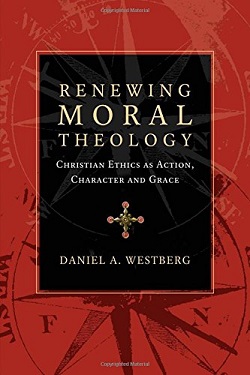 How might we integrate the study of ethics and theology? In Renewing Moral Theology
The book is not, like many, a handbook for discussing various moral issues. Some hot-button topics are raised, but they are not the focus. Westberg’s focus is, instead, much broader. He provides here a metaphysical basis for ethical reasoning, while addressing some of the main questions that come up regarding that framework. Thus, this is a book that encourages further reasoning and research rather than trying to answer some laundry list of moral questions (such as questions of sexuality, abortion, capital punishment, and the like). The focus is on giving an overarching metaphysical basis for using one’s reasoning in ethical situations, not handing the answers to such questions to the readers. This alone makes it valuable because many books on ethical reasoning unfortunately do not address the pressing metaphysical or metaethical questions that come up in thinking about morality.
Thomism has much to offer when it comes to moral theology. The system gives a framework for analyzing things like “being,” “right and wrong,” motivations, emotions, and more.
Westberg provides valuable insights into a number of key issues for ethics from a Christian perspective. Incorporating the holistic approach of Thomism into ethics, he notes that emotions do play a vital role in our practical reasoning and the way we approach moral questions. Emotions are often ignored or treated as frivolous in treatments of objective morality, and to have them incorporated into the study was a much-needed corrective.
He also gives excellent illustrations of and counters objections to the “double-effect” principle, which is the notion that moral actions can have two outcomes, one intended and one not, which allows for right action to be taken even if a wrong outcome will occur or is known to occur. Thus, for example, he treats the notion of a surgery which would kill an unborn child but save the mother. The intent of the surgery is to save the mother, not kill the child, but both are “effects” (hence double-effect) of the procedure. There are some key objections to using this principle to allow for certain moral actions, such as the apparent parsing down of moral choices into separate spheres of decision and intent, but Westberg counters them deftly. In doing so, he provides a strong defense of this critical ethical principle.
Examples are abundant throughout the book, and they constantly are used in ways that helpfully illustrate the point at hand. Some of the more obscure-seeming aspects of how an Aristotelian-Thomistic metaphysics might impact ethics are made much more clear by Westberg’s clarifying examples.
This is inherently a work of moral theology and so Westberg spends a good amount of time outlining how theology might impact one’s moral outlook. Aquinas had much to contribute here, and again the Thomistic system is incorporated into the discussion, allowing for a robust metaphysics to back up the ethical reasoning placed herein.
Renewing Moral Theology
The Good
+Strong Thomistic look at ethics
+Good use of examples to illustrate principles
+Excellent analysis of “double-effect” principle
+Rightly emphasizes some key areas of moral decision-making
The Bad
-At times it skips too quickly to conclusions
Disclaimer: I was provided with a review copy of the book from the publisher. I was not asked to give any specific kind of feedback whatsoever.
Links
Be sure to check out the page for this site on Facebook and Twitter for discussion of posts, links to other pages of interest, random talk about theology/philosophy/apologetics/movies and more!
Book Reviews– There are plenty more book reviews to read! Read like crazy! (Scroll down for more, and click at bottom for even more!)
Source
Daniel Westberg, Renewing Moral Theology
SDG.
——
The preceding post is the property of J.W. Wartick (apart from quotations, which are the property of their respective owners, and works of art as credited; images are often freely available to the public and J.W. Wartick makes no claims of owning rights to the images unless he makes that explicit) and should not be reproduced in part or in whole without the expressed consent of the author. All content on this site is the property of J.W. Wartick and is made available for individual and personal usage. If you cite from these documents, whether for personal or professional purposes, please give appropriate citation with both the name of the author (J.W. Wartick) and a link to the original URL. If you’d like to repost a post, you may do so, provided you show less than half of the original post on your own site and link to the original post for the rest. You must also appropriately cite the post as noted above. This blog is protected by Creative Commons licensing. By viewing any part of this site, you are agreeing to this usage policy.

 J.W. Wartick - Reconstructing Faith