Book Reviews
Book Review: New Proofs for the Existence of God by Robert Spitzer
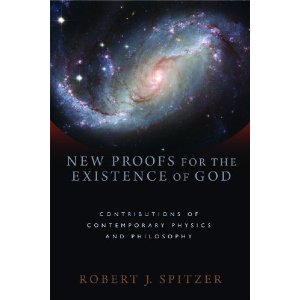
Robert Spitzer’s New Proofs for the Existence of God (hereafter NPEG) presents in rigorous detail, five arguments for the existence of God, a section discussing the plausibility of multiverse/string universe scenarios, and some philosophical discussion on methodology.
Before continuing the review, I should note that the “New” in NPEG is nuanced. Spitzer notes this himself (my guess is that it was a marketing technique. “New” refers to the evidence from cosmology and further research in philosophy which lend new power for these arguments.
Chapter 1 presents a cosmological argument. Spitzer cogently argues that “(1) If there is a reasonable likelihood of a beginning of the universe… and (2) if it is apriori true that ‘from nothing, only nothing comes,’ then it is reasonably likely that the universe came from something which is not physical reality” (Spitzer, 45). This conclusion is supported by explorations of current cosmological theories about the origins of the universe.
Chapter 2 presents the teleological argument, which Spitzer bases on the universal constants. The argument leads to the conclusion that “the odds against an anthropic condition occurring are astronomically high, making any life form… exceedingly improbable.” It is a probabilistic argument, the likes of which I defend in my article Past, Probability, and Teleology (Hope’s Reason 2011-1).
Following chapter 2 is a chapter which discusses the possibilities of inflationary cosmology and the string multiverse written by Bruce Gordon. It is extremely technical and will provide readers with cogent arguments against the possibility of a multiverse scenario circumventing the previous arguments.
Chapter 3 presents Spitzer’s metaphysical argument for the existence of God, which is full of sound argumentation along with some interesting Thomistic Philosophy wherein he discusses God’s simplicity in the most coherent way I have read. I greatly encourage readers to look into this chapter, if only for the discussion of this oft-neglected doctrine.
Spitzer follows this with Chapter 4’s metaphysical argument derived from Bernard Lonergan’s Insight, which is a subtle version of the argument from reason. This chapter was particularly good because it focuses on a little-used type of arguments for the existence of God–that if our universe is intelligible, that can only be explained by God’s existence.
Chapter 5 is an argument from contingency similar to the Leibnizian cosmological argument.
Chapter 6 engages the question of method in philosophy along with whether atheism is actually rational. I was intially put off by the title of this chapter (“Methodological Considerations and the Impossibility of Disproving God”), but happened throughout the book, I was pleasantly surprised by the rigorous arguments and enlightening conclusions Spitzer laid out.
Finally, the last two chapters outline some more considerations about the universe and the relation of humans and God.
NPEG was a surprising read for me. I went in with neutral expectations, and those were blown away. Spitzer’s knowledge of the topics in the work runs deep, and his writing style is clear and cohesive. It is genuinely exciting to read. Readers will be challenged by the arguments for the existence of God, and engaged in the details and philosophical explanations of these arguments. I highly recommend this work to those interested in advanced books on arguments for God’s existence.
——
The preceding post is the property of J.W. Wartick (apart from citations, which are the property of their respective owners) and should not be reproduced in part or in whole without the expressed consent of the author. All content on this site is the property of J.W. Wartick and is made available for individual and personal usage. If you cite from these documents, whether for personal or professional purposes, please give appropriate citation and provide a link to the original URL. By viewing any part of this site, you are agreeing to this usage policy.
Book Review: Theism and Ultimate Explanation by Timothy O’Connor
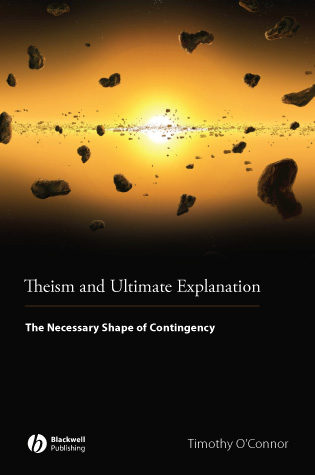 Timothy O’Connor’s brief Theism and Ultimate Explanation has already garnered much discussion since its publication in 2008. Notably, the most recent edition of Philosophia Christi features a book symposium on the work. What is all the fuss about?
Theism and Ultimate Explanation is broken into two parts. Part I addresses “The Explanatory Role of Necessity” while Part II addresses “The Necessary Shape of Contingency.”
Part I contains some fantastic arguments. O’Connor outlines various views on modality and seeks to defend modal realism, which takes modal truths to be actual truths about our world (and other worlds). Further, he defends the possibility of a priori truths against attacks from those who argue that all such truths need to be established empirically.
There are some who argue that empirical evidence (such as quantum mechanics) helps to undermine belief in some methods of reasoning, such as the law of non-contradiction, but O’Connor counters this by pointing out that those who make the argument that the “odd” data which may seem to contradict the method of reasoning against which their argument is directed are using the very methods of reasoning which they are trying to undermine. Another possibility is that the empiricist making this claim has switched to a different method of reasoning in order to critique that which holds to things like the law of non-contradiction, but O’Connor points out that a critique from such a method is “underwhelming” at best (46).
In Part II, O’Connor argues that it is coherent to ask the question, “Why is there anything (contingent) at all?” (65). He further argues that the only possible answer to this question is a termination in a necessary being. “If the universe truly is contingent, the obtaining of certain fundamental facts or other will be unexplained within empirical theory, whatever the topological structure of contingent reality… it will have to ground in some way… in a necessary being, something which has the reason for its existence within its own nature” (76).
He then turns to the question of what the nature of that necessary being may be, by examining two possibilities: “chaos” and “logos“. Logos is the view which calls the necessary being God, whilst chaos argues that it is a random being or a brute fact. O’Connor argues that logos is the most rational view to hold.
Finally, in chapter 6, O’Connor turns to theological reflections on the argument thus far. He argues that the concept of an immutable, timeless being seems contradictory to things like the trinity, but maintains that a less restricted of both of these views is plausible. He argues against molinism briefly, by stating that the counterfactuals involved would have no truthmakers.
O’Connor’s book weighs in at about 144 pages of text, but he makes use of every word. My biggest complaint about the book is how short it is. Often, it seems as though O’Connor simply doesn’t take the time to address the issues he is discussing in enough detail. Part I and the argument for the necessary being do seem to be adequately established, but chapter 6 in particular doesn’t do justice to opposing views. For example, the molinist could respond to O’Connor’s argument by saying that the “truthmaker” of such counterfactuals is simply existence in the mind of God. This could lead to an argument for determinism on molinism, but then the molinist could point to the distinction between de re and de dicto necessity. The arguments leveled against a timeless deity or an immutable one suffer similarly from limitations of space. I think O’Connor should have used the space of this chapter to expand the other ideas already present in his work.
As it stands, Theism and Ultimate Explanation is a fantastic work which is great reading for the philosopher of religion. It can be finished in one sitting, but the ideas therein will keep readers contemplating the work for quite a while afterwards. It comes recommended, but with the stipulation that readers may be left wanting more.
SDG.
——
The preceding post is the property of J.W. Wartick (apart from citations, which are the property of their respective owners) and should not be reproduced in part or in whole without the expressed consent of the author. All content on this site is the property of J.W. Wartick and is made available for individual and personal usage. If you cite from these documents, whether for personal or professional purposes, please give appropriate citation and provide a link to the original URL. By viewing any part of this site, you are agreeing to this usage policy.
Book Review: Abortion and Unborn Human Life by Patrick Lee
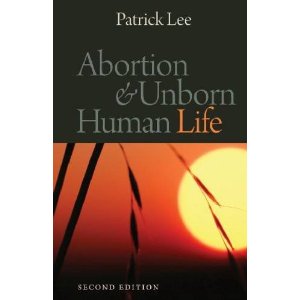 There are few ethical topics more controversial than abortion.Finding books on the topic is not very difficult, one needs only to search “abortion” on Amazon to find more than 10,000 results in the books category. Patrick Lee’s Abortion & Unborn Human Life (hereafter AUHL) stands out as one of the better pro-life books I have read, despite one major flaw.
AUHL starts with a syllogism:
1) Intentionally killing an innocent person always is morally wrong
2) Abortion is the intentional killing of an innocent person
3) Therefore, abortion is always morally wrong.
The rest of the book (164 pages of content) serves to defend this syllogism.
Chapter one argues against the idea that unborn human beings become persons after birth. Lee’s arguments are very good until he starts to argue by going against substance dualism to make his case. I think that this is a major flaw of Patrick Lee’s book. Substance dualism serves as a powerful argument against abortion. Not only that, but to argue against substance dualism primarily for the sake of an ethical position doesn’t make a lot of sense. Lee does introduces several philosophical arguments against dualism, but they fail to make a sufficient case against the position. This makes the rest of his case seem weaker than it is, had it been bolstered by substance dualism rather than arguing against it. It is really unfortunate, because readers may walk away thinking that the case against humans becoming persons after birth is weaker than it is.
In chapter two, Lee argues against the idea that human beings become persons during gestation. This chapter is particularly strong, and Lee introduces many arguments I hadn’t thought about before. Particularly important to this argument is what it means to have “moral standing.” Often, pro-life advocates forget that we sometimes don’t share the same basic presuppositions as the pro-choice advocates. Lee helps to bring the focus back to the basics (I have focused on this elsewhere myself, see here).
Lee argues in chapter 3 that individual human beings come to be at the moment of fertilization. This is another very strong chapter in which Lee offers scientific and philosophical reasons to accept this position.
Chapters 4 and 5 address the particularly chilling (and more recent) arguments that abortion can be justified as non-intentional killing of human beings (4) or that preventing certain consequences permit the killing of human beings (5).
Overall, AUHL is a fantastic read. Lee produces a compelling and powerful case that abortion is morally wrong, no matter what. Despite the rather large flaw of arguing against substance dualism, the book is a must-read for those interested in a philosophical defense of the pro-life position.
Abortion and Unborn Human Life
——
The preceding post is the property of J.W. Wartick (apart from citations, which are the property of their respective owners) and should not be reproduced in part or in whole without the expressed consent of the author. All content on this site is the property of J.W. Wartick and is made available for individual and personal usage. If you cite from these documents, whether for personal or professional purposes, please give appropriate citation and provide a link to the original URL. By viewing any part of this site, you are agreeing to this usage policy.
Book Review: Reenchantment Without Supernaturalism by David Ray Griffin
 Reenchantment Without Supernaturalism: A Process Philosophy of Religion by David Ray Griffin (hereafter RWS) is a vast work. because of the nature of this book–namely, its place as, essentially, an outlining and explication of a religion–I feel it is necessary to continue discussion of this work past the present review. I’ll be doing a series on Process Philosophy.
RWS covers an incredibly broad range of topics. Summing up a work of this scope would take too much space, so I’ll give only a brief outline. The central doctrines of Process Philosophy are (quoted at length):
1) “The integration of moral, aesthetic, and religious intuitions with the most general doctrines of the sciences into a self-consistent worldview as one of the central tasks of philosophy in our time” (5)
2) “Hard-core commonsense notions as the ultimate test of the adequacy of a philosophical position” (5)
3) “Whitehead’s nonsensationist doctrine of perception, according to which sensory perception is a secondary mode of perception, being derivative from a more nonsensory ‘prehension'”(5)
4) “Panexperientialism with organizational duality, according to which all the true individuals… have at least some iota of experience and spontaneity (self-determination)” (6)
5) “The doctrine that all enduring individuals are serially ordered socieities of momentary ‘occasions of experience'” (6)
6) “[A]ll actual entities have internal as well as external relations” (6)
7) “[N]aturalistic theism, according to which a Divine Actuality acts variably but never supernaturally in the world” (6)
8 ) “Doubly Dipolar Theism” (7)
9) “The provision of cosmological support for the ideals needed by contemporary civilization as one of the chief purposes of philosophy in our time” (7)
10) “A distinction between verbal statements (sentences) and propositions and between both of these and propositional feelings” (7)
Whew! And that is just the introduction of a 425 page work!
These doctrines I’ll let speak for themselves, but it is immediately clear that Process Philosophy can be identified as a religion, either on its own, or in conjunction with another religion of the world. These doctrines are enough to support a robust naturalistic theism which differs in many ways from classical theism.
Process Philosophy affirms that sense experience is not primary (see esp. 55). It also rejects both physicalism and dualism, calling instead for panexperientialism, which is the idea that everything in the universe–down to the smallest entity, has experience of some sort. In other words, the basic units of “stuff” in our universe are neither ideal (as in some forms of dualism) or material (as in materialism and other forms of dualism), but experiential (94ff).
God, on Process Philosophy, is in the world. It is panentheistic as opposed to theistic or pantheistic. God is not supernatural, but is rather a necessary part of the universe (131ff). God created the world not ex nihilo, but out of chaos, which Griffin argues is the correct reading of the Hebrew Scriptures, particularly Genesis (I disagree strongly here, for it seems like there is much evidence for the use of bara to refer to creation ex nihilo).
I can’t resist veering off the summary path here and critiquing this view specifically. The problem with affirming that God created the world out of some existent finite entities (see 216) is that that leaves both God and these finite entities with no explanation for their existence. God, argues Griffin, exists necessarily, but there is no reason I could find given for this. Furthermore, there is absolutely no explanation of how these other finite entities came into being. It seems as though they are asserted to simply exist forever, but this runs into the many problems with an infinite past. I simply don’t think Griffin has adequately defended this doctrine of Process Philosophy, and most of it hinges around this idea. I’ll get into this more as I continue my series, however.
Not only that, but Process Philosophy upholds the idea that there are two distinct “ultimate realities” in our universe; namely, a personal deity, and an impersonal, “creativity”. This is one of the more interesting affirmations of Process Philosophy: that all major religions are true in a qualified sense (247ff). In affirming that all major religions are in some sense true, Process Philosophy also argues that they must all learn from each other to work towards a religion that more adequately reflects reality (more on this later in the series).
Process Philosophy affirms the possibility of an afterlife, but doesn’t seem to take it as terribly likely (204ff). Furthermore, it asserts that morality can be done from the point of an “ideal observer”, namely, God (314-316).
Thus, Process Philosophy is a religion distinct from the others I have read about in some very important ways. The affirmation of both naturalistic (but not atheistic) science and theism is very interesting. Furthermore, Process Philosophy, according to Griffin, can be allies with the major religions of the world. He favors Christianity as walking hand-in-hand with this philosophy.
I personally don’t think this is a live option for Christian theists, however, because it involves rejection of, among other things: creation ex nihilo, omnipotence in the traditional sense, the ability of God to interfere with nature, the primacy of Christ in world religions, the life after death–which entails a rejection of the resurrection (though, as above, Griffin says this is possible)… furthermore, it means Christians must accept, among other things: the idea that Christianity is true, but only in some sense compared to to other religions, that God is only the arranger, not the creator (in the traditional sense) of the world, an entirely different ultimate reality that is similar to the impersonal, immutable Brahma as existing alongside of and coequal to God.
So what can the Christian take from RWS? That is a question that will take me some time to think about and digest. I hope the further posts in this series will help outline this more. I think there are valuable insights in what Griffin has to say, but it is more probable, in my opinion, that the Christian will find, not a “Reenchantment” so much as a chance to sharpen their philosophical blades against arguments which undermine the central tenants of the faith.
That said, RWS is a fantastic read. Griffin covers a simply massive range of topics with clarity from the perspective of Process Philosophy. The book is a page-turner. Like a fantastic novel, it exposes new ideas and forces the intellect to work in new ways. It is a work that essentially outlines the creeds of a different religion, albeit a religion which is syncretistic by nature. It touches on nearly every area of philosophy of religion, from religious language to natural theology. I highly recommend this book, if one has a good background in classical theism. The reason is because the ideas are alluring, but faulty. One can expose the faults, but only if one is grounded in truth. It’s a thought-provoking book, but I regret to find it so off the mark.
Source:
Griffin, David Ray. Reenchantment Without Supernaturalism: A Process Philosophy of Religion. Cornell University Press. 2001.
——
The preceding post is the property of J.W. Wartick (apart from citations, which are the property of their respective owners) and should not be reproduced in part or in whole without the expressed consent of the author.
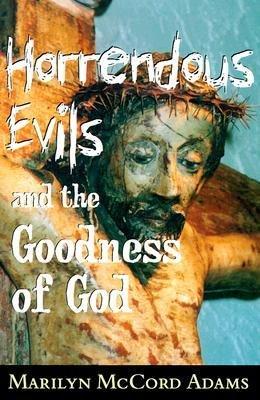
Book Review: Horrendous Evils and the Goodness of God
 The problem of evil is often seen as the greatest threat to theistic belief. Analytic Philosophers have struggled with the issue on both sides of theism–from Plantinga’s innovative “Free Will Defense” to the claim of the positive irrationality of theism issued by the late J.L. Mackie. This issue doesn’t show signs of slowing down, either. It has dominated philosophy of religion for millenia.
In Horrendous Evils and the Goodness of God
Adams’ account has the kind of honest, penetrating discussion of real evil in our world about which philosophy would do well to take notice. The little child kidnapped and murdered; the innocent family killed by the drunk driver; the millions murdered by Hitler; these examples all demand answers for the individual occurrences of evil, according to Adams (see her discussion on pages 17ff). Specifically, she writes that “At a minimum, God’s goodness to human individuals would require that God guarantee each a life that was a great good to him/her on the whole… God would have to… [give each person’s life value]… by giving it positive meaning through… great enough good within the context of his/her life” (31, emphasis hers). This stunning claim will likely make the theistic philosopher rock back on his/her heels for a moment. Surely, we cannot be called to account for every individual evil!
Adams believes that the Christian theist can indeed do so, not by taking the unconvincing (in my opinion) route of arguing that such persons are having their character built by suffering, but by appealing to God’s goodness to each individual person (55). Specifically, this goodness of God is demonstrated within Christianity by Jesus Christ. After a penetrating discussion of purity and defilement on Christianity and Judaism (see 86ff), Adams argues that in Christ, God “takes the… approach of joining us in our defilement [that is, our suffering of horrendous, individual evils]” (98). This act of Christ means that our defilement from sin, evils, and even horrendous evils has the possibility of becoming holiness (99). Thus, through Christ, and the power of the Holy Spirit’s redefining rebirth of baptism, God offers the greatest good to every individual (102).
Through this self-defilement which leads to holiness, God invests meaning by “…being good to all created persons–that is, in seeing to it that each gets a life that is a great good to him/her on the whole, one in which any participation in horrors is not merely balanced off but defeated” (126, emphasis hers). Adams’ thesis, then, is that in Christ, God provides the defeater for horrendous evils by ensuring that each person’s life is a great good. Here Adams rides a fine line of universalism (it seems as though she may be saying every person is indeed saved through Christ, eventually), but her account can be easily modified by those who reject universalism–for one can argue that God provides the defeater simply by offering the possibility of such goods to each person. And God is good to each person by providing such an opportunity.
Adams uses the rest of her work to argue further how God’s participation in suffering demonstrates that God has been immeasurably good to each individual.
I find Adams’ argument particularly enlightening. Her emphasis on the individual evils of the world is a breath of fresh air as well as a new challenge to Christian philosophers. We do need to address individual atrocities. This doesn’t mean we need to go through, case-by-case, and provide theodicies for each event. Rather, as Adams urges, we can address this by arguing that God is good to every individual through his redemptive act by Jesus Christ.
My main critique of Adams in this work is that while I find her issues with abstracting the problem of evil to hit the mark some of the time, I think she underestimates the value of some of the analytic responses to the problem of evil. Certainly, taking evil as a sum total and arguing that God could have some reason for permitting this much evil to occur downplays the importance pf the evil actions towards individuals , but there is a place for such defenses within philosophy. Rather than jettisoning these types of answers, then, I think we would be best suited adding Adams’ defense to the many-faceted response to the problem of evil from Christian philosophers of religion.
Source:
Adams, Marilyn McCord. Horrendous Evils and the Goodness of God
——
The preceding post is the property of J.W. Wartick (apart from citations, which are the property of their respective owners) and should not be reproduced in part or in whole without the expressed consent of the author.
“The Shack” Reviewed by a Conservative (With Poll)

The Shack
I went in with some strong biases against the book. I’d heard from others that it is pretty terrible theology and borderline (or actual) heresy. Needless to say I wasn’t expecting to enjoy it, but, like any good work will do, The Shack proved my biases wrong.
The plot is fairly simple. A man, Mackenzie, has a horrific tragedy happen to his daughter; this tragedy affects his whole family in negative ways; then he receives a letter from God (?) asking him to come to the place the tragedy happened to talk about things. The rest of the narrative revolves around this discussion. One note I should make as a reviewer is that Young’s prose is fantastic. His descriptions of everyday events and locations inject a reality into the story that is necessary to get readers hooked, and he writes about the uncommon and the supernatural with stunning beauty.
The plot serves as just the background for what the book seems (to me) to be; The Shack is a stirring work of philosophical and theological investigation of the nature of God, the problem of evil, and our hope in Christ.
Readers who have read the work or read anything about it probably already know that God is portrayed in the work as three “persons” in a very literal way. The Father, “Papa”, is a motherly black woman, Jesus is a plain-looking middle-eastern workman, and the Holy Spirit changes her (?) form throughout the work. I feel it is necessary to address this, because this is perhaps the most controversial part of the book. It seems to me, at least, that the idea of God coming to people where they are should not be such a hot issue. Christ Himself describes God’s action in terms of a hen gathering chicks beneath her wings (Luke 13:34). God appeared in various forms throughout the Old and New Testaments (burning bush, still voice in the wind, incarnate Christ, etc.). I find it dubious at best to claim that God does not/can not appear otherwise to individuals–perhaps as a mother to those in need (and this would line up well with the Christian background of religious experiences, cf. Perceiving God by William Alston).
These three persons serve to drive the narrative of The Shack while also making claims about the various works of the persons of God. There are many points throughout the book where I found myself nodding as Young wrote a wonderful insight about the work of God. Young’s answers to some of the most poignant questions of humanity resound throughout the work. One of the most stirring moments is a chapter in which Mackenzie is asked to decide which of his children goes to hell. This is meant to reflect the way Mackenzie (and some Christians) seem to put God in the judgment seat, arbitrarily determining who goes to heaven and who is damned to hell. Mackenzie begs to be condemned instead of his children, and in a powerful turnabout, he is told that this is exactly how God feels. He became incarnate to die for our sins, to give the opportunity for all to be saved, loving all God’s children perfectly (p. 165). Moments like this occur throughout The Shack.
Another thing I must share is The Shack‘s answer to religious diversity. Jesus says that those who love Him come from every background, including other religions. This leads Mackenzie to ask, “Does that mean… that all roads will lead to you?” Jesus answered, “Not at all… Most roads don’t lead anywhere. What it does mean is that I will travel any road to find you” (184). Should Christians agree with this answer? I leave it open to the reader to answer this question. Suffice to say that The Shack will challenge readers from all walks of Christian life.
I finished the book in the span of a day. I set it down late at night, realizing I couldn’t be the same Christian I was before. The Shack grabbed me and wouldn’t let go. The questions Young asks through Mackenzie are questions all Christians must face, and the answers he provides focus on one thing: the Love of God. There are definitely things that made me uncomfortable while reading The Shack, but there are other things I realized were suddenly made clear. Treating The Shack like a theological treatise is unfair. It’s not a doctrine book, it’s a work of Christian fiction, and it excels in its niche, asking questions, giving answers, and leaving it to the reader to decide whether he/she agrees or disagrees. This is a fantastic work and I highly recommend it to my readers. You don’t have to agree with what Young says in The Shack to make the book worth reading, but you should read it.
The Shack
Book Review: “On a Complex Theory of a Simple God” By Christopher Hughes
Christopher Hughes’ work, On a Complex Theory of a Simple God: An Investigation in Aquinas’ Philosophical Theology (hereafter CTSG), is part of a series of books (on independent topics by different authors—meaning one can jump in on whichever book one wants) called the “Cornell Studies in the Philosophy of Religion.” It is the first book in the series which I have read (though I have 5 more sitting on my shelf), but if it is any indicator of things to come, I highly recommend this series.
CTSG mostly focuses on Thomistic Philosophy, but it specifically highlights St. Thomas Aquinas’ arguments for Divine Simplicity and his discussions of the Trinity and the Incarnation. I must admit that initially I found it hard to maintain interest in this work. Thomistic Philosophy is by no means a specialty of mine, and I got the book mostly because I was vaguely interested in whether or not Divine Simplicity—that is, the idea that God is “omnino simplex”, altogether simple, and “in no way composite” (Hughes, 4). Hughes, however, manages to make a topic in which I displayed only a passing interest into a page-turner of a philosophical work.
Divine Simplicity was appealing for a few reasons. First, if God is composite in no way, then it seems as though many objections to the compatibility of properties of God—say, of omnipotence and omniscience—fail to be objections at all. For if God is absolutely simple, omnipotence just is omniscience (following the example) and vice versa, and if this is the case then to object that omniscience and omnipotence are incompatible would be to object that two things which are identical are incompatible. Aquinas holds to this very view. On Aquinas’ view, “His [God’s] existence is also His goodness, wisdom, justice, omnipotence, and so on” (22). Second, if God is perfectly simple, then it seems as though God as a hypothesis, if you will, increases in merit, granting Occam’s Razor. For, if God is absolutely simple, then to object to God’s existence as being too complex (as some do) is entirely specious, as God is not complex at all. Third, philosophical interest in Divine Simplicity had me longing to learn more about it.
Hughes’ analysis and critique of the arguments for Divine Simplicity are fantastic. His capabilities in discerning and detailing the complexities involved in Thomistic Philosophy are spectacular. It is his unbiased analysis, however, which most characterizes CTSG. Throughout pages 28-57, he destroys (in my opinion) Aquinas’ arguments for Divine Simplicity. Then, he argues that God cannot be identical to His insular attributes, which counters the argument in defense of Divine Simplicity that, roughly, ‘omnipotence and omniscience may appear to be different, but perfection of either quality shows that they are actually the same’ (60-68).
Yet despite his rather convincing arguments against Divine Simplicity as drawn out by most proponents, Hughes also outlines a possibility for a defense for that very idea. For if 1) God exists necessarily in the logical sense, and 2) if all things are contingent upon God’s existence (two premises Hughes disagrees with, but does not offer an argument to refute per se—instead he refers to Humean thinking as a reason not to accept 1)), then
“[b]y 2), any individual substance in world w distinct from B exists there only at the sufferance of B, and would not have existed if B had exercised its will in a way it might have. By 1), we know that there is an individual substance—the individual in our world which is (a) God—which exists in w, and does not exist at the sufferance of B, that is, could not have failed to exist through any possible exercise of B’s will. It follows that the individual who is a God in our world is identical to B. Since B and w were chosen arbitrarily, we may conclude that nothing actual or possible could have the specific nature Deity without also being the very same individual as God. In other words, God’s individual essence is no different from His specific essence” (99).
This allows the defender of Divine Simplicity a “way out,” if you will. For she can hold that 1) and 2) are both true, and then argue (though, as Hughes notes, in “a flavor more Leibnizian than Thomistic” [100]) that God exists and his specific and individual essence must be identical. This allows for a modification of Divine Simplicity which avoids the downfalls Hughes points out in the other formulations.
Another fantastic section of Hughes’ work is his defense of omniscience. He suggests (following David Lewis) that omniscience can be defined as “X is omniscient if and only if X knowingly (that is, in such a way as to satisfy the conditions for knowledge) self-ascribes all and only those properties that X exemplifies” (126). This suggested definition of omniscience has much to recommend it. First, it clearly avoids any problems with the supposed incompatibility of a timeless deity and knowledge, thus allowing those who favor Divine Timelessness (such as myself) to have an adequate, defensible view of omniscience. Second, it allows for the compatibility of a timeless, changeless, and omniscient deity (127).
The rest of CTSG is made up of Hughes analyzing Aquinas’ view of the Trinity and the Incarnation. This covers approximately half the work, but I feel the need to sum up Hughes wonderful analysis simply by saying that it seems he has shown there are serious problems with Aquinas’ formulation of the Trinity, granting Aquinas’ presuppositions about identity, simplicity, etc., but it seems that Hughes “way out” for the defender of Divine Simplicity outlined above could potentially be a “way out” for those desiring to defend the Trinity and the Incarnation on a modified account. Hughes himself offers possibilities for defending each of these doctrines which may not necessarily require abandoning Simplicity (cf. 251-253 for one example). As it stands, however, it seems that Aquinas himself has not provided an adequate defense of the propositions he wishes to claim as “compossible.” Rather, defenders of Thomistic philosophy must turn outside of that realm–towards analytic or Liebniz–to reconcile those doctrines which Aquinas wishes to defend.
Hughes does a simply fantastic job of outlining Aquinas’ arguments, analyzing them, critiquing them, supplementing them, and then providing a final analysis. Hughes remains fair and, I would say, unbiased throughout his work. He allows for the possibilities that central theses of Aquinas’ “philosophical theology” are indeed correct, granting formulations Hughes himself does not share. I, however, do share many of the premises of those who can defend Divine Simplicity, and therefore continue to find it a “bruised, not beaten” doctrine. Hughes’ insightful work should command a place of care on any philosopher of religion’s bookshelf, as he has not only written a wonderfully compelling investigation into Aquinas’ philosophical theology, he has also contributed to modern Thomistic and analytic philosophy, but most of all he demonstrated a willingness to concede possibilities on the “other side” of the debate and a rigorous approach to analytic philosophy of religion which one can only hope will be emulated.
Source:
Hughes, Christopher. On a Complex Theory of a Simple God: An Investigation in Aquinas’ Philosophical Theology. Cornell University Press. 1989.
——
The preceding post is the property of J.W. Wartick (apart from citations, which are the property of their respective owners) and should not be reproduced in part or in whole without the expressed consent of the author.
Book Review: “Revelation” by Richard Swinburne
“Revelation: From Metaphor to Analogy” by Richard Swinburne is one of those rare books which forces one to think about and analyze every argument it contains, whether one agrees or disagrees with the conclusions. It addresses claims of revelation. Can it be true that a religion’s books or creeds contain truth?
The book starts off with a section on “Meaning” which analyzes terminology, presupposition, analogy and metaphor, and genre in turn. This section is fantastic reading for the philosopher of religion as it takes some higher notions found in philosophy of language and applies them to religious studies. The chapter on presupposition was the first part I found particularly striking. It is here that Swinburne first begins to lay the groundwork for his overarching argument about the Christian Revelation and Scripture. He argues that presuppositions are not contained in the message conveyed in spoken or written word. He writes, “In order to separate statement from presupposition, we must ask, whatever the speaker’s actual beliefs, are there any common beliefs of the clture presupposed in the utterance which can be siphoned off, leaving what the culture would naturally suppose to be its message intact?” (30). This “siphoning” of meaning is necessary because “[a]lthough speakers may use declarative sentences for many different purposes… the paradigm job of such sentences is to convey information, to ad to the hearer’s stock of beliefs” (29). Swinburne offers the following example to demonstrate his argument. Suppose a Roman historian wrote that “The divine Augustus traveled to Brindisi.” This sentence is not intended to convey the information that Augustus is divine. That Augustus is divine is presupposed by the author of the sentence. Rather, the sentence is intended to tell the reader that Augustus traveled to Brindisi (29). Swinburne also outlines and describes various genres and how they can relate to a religious revelation.
The next part of the book argues for four possible tests to determine whether a divine revelation has occurred. These tests are 1) whether the content is the “kind of thing which God would have chosen to reveal to humans” 2) “whether the method of expression is one to be expected of God, 3) whether “the church has developed the original revelation in a way which plausibly brings out what was involved in it …”, and 4) “whether the interpretations provide the sort of teaching which God would have chosen to give to humans” (107-108). He argues convincingly for each of these tests applying to the Christian Revelation.
The third part of “Revelation” examines the Christian Revelation specifically. Swinburne argues that Jesus and His message were the “original revelation” provided to believers (145ff). It is in his discussion of the Church and the Bible, however, wherein he forwards his most controversial claims.
The Church, argues Swinburne, is responsible for more than simply establishing the canon of Scripture. He argues that the Church has a central place alongside Scripture in the Christian Revelation, for without the church, interpretation could not happen. The creedal statements central to Christian faith may not have been derived had it not been for the Church (see page 189ff). Further, the Church acts as a method for assessing “rival interpretations” of various Scriptural truths (200). It is undeniable that Swinburne advocates the Church as a high authority–perhaps even on a higher level than Scripture, for he argues that many conflicting interpretations of Scripture can receive almost equal footing on Scripture alone, so the Church is required to determine which of these should be approved (again see p. 200 for an example of this). Swinburne’s view of the Church is one of the most important things in this book, in my opinion, for the Christian to read and digest, regardless of whether one agrees or disagrees. For one’s view of the authority of a church body is vastly important with regards to how one views other doctrines. As Swinburne writes, “Which doctrines are to count as central Christian doctrines… depend[s] very much on which ecclesial bodies we judge to be part of the Church. The wider our Church, the fewer such doctrines there will be” (214). This is undoubtedly true, for if one takes only the Roman Catholic Church, for example, as a valid ecclesial body, then one’s net of central Christian doctrines can include everything sanctioned by the Roman Catholics. But let us say that one takes both the Lutheran Church and the Roman Catholic church to be authoritative, or perhaps they take the Orthodox, Roman, and Reformed churches as authoritative. Well then it seems that only those doctrines which all these bodies agree on can be regarded as central, or essential to, true faith. For if one church contains a doctrine which the others do not, it cannot be regarded as absolutely essential if the other churches are still legitimate. If it were essential and the other bodies disagreed, then those other bodies would not be legitimate, by the criterion of not agreeing on an essential Christian doctrine.
This then provides a valuable springboard for thought about central Christian teaching and what doctrines and ecclesial bodies one regards as valid or central. Swinburne’s discussion on this topic cannot be downplayed. He goes into various criteria which can be used to determine whether a Church body is legitimate. These arguments are incredibly in-depth and interesting. His arguments force the reader to consider his ideas.
The Bible is the final major topic Swinburne addresses in “Revelation.” Here we see all the groundwork laid in Part 1 come into play. What do genre, presuppositions, etc. tell us about the meaning and interpretation of Scripture? This section is another which the Christian would do well to ponder. Swinburne argues that we must take Scripture as being entirely true, but he qualifies this claim by arguing we must also realize what Scripture is–a collection of books written with divine approval but by human hands. Thus, he argues, we should take great care to realize the difference between presupposition and message, history and allegory, etc. While I do not agree with Swinburne on every point, I find his insights particularly interesting. He notes that “[t]he falsity of the presuppositions does not, therefore… affect the truth-value of a sentence which uses them” (244). This kind of argument can be of direct worth to the apologist, for example. He utilizes Genesis 8:2(“The fountains of the deep and the windows of the heavens were closed, the rain from the heavens was restrained” ESV) as an example: “The sky has no windows out of which the rain comes, but the quoted sentence is just the author’s way of saying, within the presuppositions of his culture, that the rain ceased” (244-245). This is a different approach apologetically than the one I would tend to favor, which would argue that the word “window” is used here in a metaphorical or analogous way.
Swinburne’s high view of the church is necessary alongside his view of Scripture. Swinburne writes that “The slogan of Protestant confessions , ‘the infallible rule of interpretation of Scripture is the Scripture itself’, is quite hopeless” (255). For it is the Church which determines acceptable interpretations of Scripture. He writes that “Scripture belongs to the Church” (256). Reading and interpreting Scripture requires a guide. This guide “…is the Church’s theological definitions and other central teaching, its tradition of the proper way to interpret the Bible, and its tradition of how particular passages should be interpreted” (256).
Swinburne’s final chapter seeks to discuss and interpret moral teaching found in Scripture.
Swinburne’s central argument is strong. God has given us a Revelation and has given us the tools to discover what it means. This Revelation is found in Scripture and historically in the life, death, and resurrection of Christ. It is the nuances of Swinburne’s argument which make the book so wonderfully useful. I found myself at times nodding, agreeing with everything Swinburne wrote. At other times I shook my head, jotting rebuttals alongside his text. But the vast majority of the book found me engaged on a new level with topics I thought I had addressed and laid to rest. While I disagree with details of Swinburne’s argument (i.e. he accepts the JEDP view of Scripture, denies the historicity of the person of Jonah, etc.), I found his core arguments compelling. We do need to remember the genre(s) we read as we read Scripture. We need to realize that the ultimate author of Scripture is God, but that Scripture was written within a set of presuppositions distinct from our own.
Swinburne’s analysis of the authority of the church was equally compelling. While he holds a higher view of church authority than I do, his view intertwines the Church with Scripture in compelling ways which absolutely must be considered.
It has been over a month since I finished this work by Swinburne, yet I have found myself consistently turning back to it, and even while writing this review, I found myself contemplating his arguments and drawing truths from him while still disagreeing with him on other areas. I reiterate that I find this work absolutely essential reading for the Christian philosopher. It will challenge and reward the reader in ways that may be entirely unexpected.
Source:
Swinburne, Richard. Revelation: From Metaphor to Analogy. 2nd Edition. Oxford. 2007.
——
The preceding post is the property of J.W. Wartick (apart from citations, which are the property of their respective owners) and should not be reproduced in part or in whole without the expressed consent of the author.
Book Review: “The Making of an Atheist” by James S. Spiegel
The Making of an Atheist by James S. Spiegel is a dangerous book. The subtitle illustrates this well: “How Immorality Leads to Unbelief”. Spiegel’s thesis is that “Atheism is not at all a consequence of intellectual doubts. Such doubts are mere symptoms of the root cause–moral rebellion. For the atheist, the missing ingredient is not evidence but obedience” (11, his emphasis). Just above this statement is this similarly strongly worded proposal: “Perhaps we should consider the possibility that skeptical objections are the atheists’ facade, a scholarly veneer masking the real causes of their unbelief–causes that are moral and psychological in nature” (11, his emphasis).
I call the book dangerous for a few reasons. It is dangerous because Spiegel dares to assert something that Scripture holds to be quite true: there are cognitive consequences of sin. It is dangerous because the book unapologetically argues that atheism’s core tenants can be turned about; rather than atheism being a rationally superior view to theism, Spiegel argues that atheists are subject to the very objections they often raise against theism: it arises from psychological and moral deficiencies. Spiegel knows this book is dangerous. He writes “My thesis is an uncomfortable one. To suggest that religious skepticism is, at bottom, a moral problem will likely draw the ire of many people” (16).
Anyone who makes claims like these had better be prepared to back them up. Spiegel points to the oft-quoted passage from Thomas Nagel as a beginning for this discussion. Nagel writes “I want atheism to be true and am made uneasy by the fact that some of the most intelligent and well-informed people I know are religious believers. It isn’t just that I don’t believe in God, and, naturally, hope that I’m right about my belief. It’s that I hope there is no God! I don’t want there to be a God; I don’t want the universe to be like that” (quoted in Spiegel, 10-11). This powerful quote serves as a backdrop for much of the book.
Spiegel starts off with an analysis of atheism. He points out that the “objection from evil” (the problem of evil) may not be so strong after all. He (rightly, I think) notes that “from a naturalist standpoint the objection from evil is incoherent” (27). This is because naturalism cannot have objective right and wrong. For this and other reasons, the most “powerful” objection to theism is dismissed and avoided.
This chapter has an important concession on Spiegel’s part. He notes that some of the things atheists point out (immoral activity in the church is one example) are indeed problems. Malpractice of believers is indeed something to point out and condemn. But the point is that these things are not objections to theistic belief, rather commentaries on the believers (38).
After a brief argument against atheism and an introductory level explanation of the teleological argument, Spiegel gets into the meat of his book: the causes of atheism. Following Paul C. Vitz, Spiegel argues that one psychological reason for the rejection of theism is a broken relationship with one’s earthly father (64). Spiegel forwards this as a kind of psychological argument against atheism. Just as Freud (and others) would like to argue that theism is mere wish-fulfillment put into practice with the “father figure in the sky”, so, here, Spiegel argues that atheism could be (in some cases) due to a rejection of that true father figure in the sky, as broken relationships are projected onto (and against) the Heavenly Father. “Human beings were made in God’s image, and the father-child relationship mirrors that as God’s ‘offspring'” (69).
Spiegel follows this interesting argument with an equally enlightening discussion in the (im)morality of many top atheistic scholars. He quotes Aldous Huxley, who states “Those who detect no meaning in the world generally do so because… it suits their books that the world should be meaningless” (73). This rejection of meaning allows immorality. If God exists, there is clearly an objective moral standard. Thus, by rejecting God, this standard doesn’t exist. Immorality can proceed freely.
There is another important point later in this same chapter: “one may willfully refuse to believe certain truths, even when there is strong evidence for them” (83). This is followed by an exploration of what this can mean. He quotes William James, who states, “If your heart does not want a world of moral reality, your head will assuredly never make you believe in one” (84). Ultimately, Spiegel argues, atheists choose not to believe (86).
This choice is made against a presupposed backdrop. Simply put, everyone has a kind of “paradigm” of background beliefs that filters and limits their selection of propositions to believe. Spiegel demonstrates that this happens even among the venerated field of science. There is no such thing as a truly objective human being (92-93). What this means to his thesis, then, is that by selecting a paradigm in which the standard of truth is such that it excludes theism, an atheist will never accept theism on any amount of evidence. Rather, they must make a complete paradigm shift that allows for such a reality (100ff).
This section of the book ends with Spiegel’s assertion that the descent into atheism is a willful rejection of God, made apart from evidence (or a perceived lack thereof). Further, sin can harden one’s heart against God, thus enforcing a paradigm that is anti-theistic in nature (113-114).
The Making of an Atheist closes with a section on the “Blessings of Theism.” Here, Spiegel simply lays out the blessings spelled out in Scripture that are ours in theism. He argues we should live a virtuous life. We have the right to thank and praise God. We can live as humble believers in Christ. I wish that Spiegel had included some of the blessings of Christ in this section, but I suppose that’s not the thesis of his book. One final important point Spiegel makes actually takes place in the endnotes in this last section. Spiegel states that “we should constantly examine and reform these beliefs in light of Scripture and sound reasoning” (141). I think this is an excellent point.
Overall, The Making of an Atheist is a fast read. It’s definitely written for the lay person, though it has enough philosophy in there to keep those looking for a bit of a deeper read engaged. It’s short (less than 150 pages), so it won’t take long to finish. Spiegel’s points are solid and I will explore his conclusions further. Spiegel’s “dangerous book” is very successful.
Book Review: The Elusive God by Paul K. Moser
I’m going to write more on the ideas present in this book, as I find them vastly important, but because of time constraints and the fact that I want to put up a normal review for this book, I figured I would post a review first.
The Elusive God by Paul K. Moser was, for me, an exercise in frustration. I was very excited to get a hold of the book, as I felt the topic it explored would be truly interesting. I had very high expectations. It was certainly interesting and Moser makes some good points throughout the book. The Elusive God seems repetitive in some aspects and misses the mark on some vital theological issues, but, ultimately, it is worth a read by anyone interested in this question within theism.
Moser attempts to tackle the rather impressive problem of why God, if He exists, is not obviously evident at all times. He argues that evidence of God’s reality would be “purposively available” to humans, which means “available in a manner and only in a manner suitable to divine purposes in self-revelation” (2). Moser’s key point is that such questions as “Do we humans know God exists?” must be rephrased because if that (perfectly loving, etc.) God exists, then we should consider how God would interact with humans (4). Thus, argues Moser, such questions should be rephrased as “Are we humans known by God in virtue of (among other things) our freely and agreeably being willing (i) to be known by God and thereby (ii) to be transformed toward God’s moral character of perfect love as we are willingly lead by God in volitional fellowship with God, thereby obediently yielding our wills to God’s authoritative will?” (4, Moser’s emphasis). But even this question must be seen in light of a third rendering of the question “Do we humans know God Exists?” which is “Are we humans known by God in virtue of… our freely being willing to receive an authoritative call to… fellowship with God…?” (4). This page has most of what Moser will expand on for the rest of the book.
From these modifications of the question “Does God exist?” (my rendering of the question), one can essentially draw out what Moser’s argument is. God, if God exists, is a morally perfect, loving being, so rather than asking why God doesn’t simply reveal himself to us indiscriminately, we should model ourselves to be agents capable of receiving His authoritative call. Thus, the question “Does God exist?” can only be answered if we humans cease asking this question as a kind of non-interactive, sterile question, but instead ask it in the terms of being a truly life changing or reinventing question.
Moser argues that “…we gain evidentially and thus cognitively as we turn from (that is, “repent” of) our selfish ways in order to get in line with a perfectly loving God…” (27, Moser’s emphasis). Central to Moser’s argument is the idea that evidence of God’s existence as God allows for it would have to be capable of being rejected (39). In other words, God would not force people to believe in Him or coerce them into belief by doing something as blatant as writing “BELIEVE IN ME- GOD” in the sky or something of the sort (he refers to this as “spectator evidence”–evidence that doesn’t ultimately mean anything in the life-changing way, which, Moser argues, is necessary for God’s loving purposes [see p.47, 35, 149, 93, etc.]). God would be “…a God of intended redemption as reconciliation of humans to God” (47).
Further, argues Moser, there is no reason that God should provide us with the kind of “spectator evidence” (see above) that we may desire for evidence, but rather, God, being the absolute authority in the universe, could make demands with authority, as well as making demands about the state of being that those whom He would reveal himself are in.
Moser seems to really avoid any kind of analytic nature to his philosophizing (which is greatly aggravating to me, as I vastly prefer arguments to be laid out analytically and then expanded on, but this is a mere preference), but he does present an argument for the existence of God in an analytic fashion:
“The transformative gift [is defined as] via conscience, a person’s (a) being authoritatively convicted and forgiven by X of all that person’s wrongdoing and (b) thereby being authoritatively called and led by X both into noncoerced volitional fellowship with X in perfect love and into rightful worship toward X as wrothy of worship and, on that basis, transformed by X from (i) that person’s previous tendencies to selfishness and despair to (ii) a new volitional center with a default position of unselfish love and forgiveness toward all people and of hope in the ultimate triumph of good over evil by X” (134-135) Which leads to:
“1. Necessarily, if a human person is offered, and unselfishly receives, the transformative gift, then this is the result of the authoritative leading and sustaining power of a divine X of thoroughgoing forgiveness, fellowship in perfect love, worthiness of worship, and triumphant hope (namely, God).
“2. I have been offered, and have willingly unselfishly received, the transformative gift.
“3. Therefore, God exists” (135).
Central to his discussion of this argument is the assertion that “We… can’t separate God’s existence… from God’s… character” (135).
While I don’t personally find this argument to have any evidential value for anyone but the subject of such a transformative gift, I am still pondering whether it is useful in the field of apologetics at all. I think this is a large part of the problem with most of Moser’s work: it doesn’t seem as though it will do anything to convince anyone who is not already sure that God exists.
Not only that, but the book is exceedingly repetitive. It weighs in at about 280 pages, but it honestly could probably have been reduced to about 1/10th that, 28 pages, and still have been as effective in getting the point across. Even as I was writing this review, going over the parts I underlined or wrote notes on, it is very clear that certain points are simply repeated many, many times throughout the book.
One may note that I didn’t even write about most of the last part of the book. This is because the latter part of the book involves Moser outlining what he thinks philosophy should be now that one acknowledges the existence of God. I’m not sure I stand convinced. Certainly Christian philosophy should be oriented around theistic beliefs and what it means if God exists and the promise of Christ is true, but that doesn’t mean that other pursuits are somehow excluded from usefulness. I think that if God does indeed exist (as I believe He does, very strongly), then, necessarily, any knowledge at all would relate to God in some way. Thus, any philosophical pursuit would be essentially related to God.
A final note I’d like to make before my conclusion is that Moser’s view of Christ seems wrong. He appears to downplay the divinity of Christ (though he does refer to him as Lord in a couple places), but he also apparently argues for some kind of belief that those outside of Christianity are saved. On page 198 he claims that people of other faiths may be worshiping the same God as we are, which is absolutely contrary to Scripture (Jesus answered, “I am the way and the truth and the life. No one comes to the father, except through me.” John 14:6). He also criticizes N.T. Wright for his (in my opinion, phenomenal) work on the historicity of Christ. Moser suggests that Wright doesn’t give us any reason to think that Jesus is good news now. I honestly don’t see this at all from Wright’s work. I think that Moser is reading into it in a rather large way. Wright’s task in such works as “Jesus and the Victory of God” seems to be more focused on what happened historically, from a historian/apologist’s viewpoint, than on an evangelical witness. Wright does, however, provide ample reasons for thinking that Jesus is good news now in his work “The Resurrection of the Son of God” and “The Challenge of Jesus.”
Overall, I think that Moser makes some interesting points, but many of them smack in some ways of “choice theology” which I firmly oppose (i.e. somehow making ourselves acceptable to God’s call). I do, however, believe that Moser has some things that can be used effectively by the apologist here. I would rework some of what he says for my own use, but that’s a task that I will tackle some other day. I think that The Elusive God is an okay read, but its redundancy is frustrating and his argument doesn’t seem at first glance as though it is going to be useful for the average apologist without some extensive effort. One who wants to get the main points Moser makes in this book could just as easily pick up the work “God is Great, God is Good” edited by Craig and Meister, as Moser presents a condensed version of the argument therein.
The Elusive God is, however, an essential read, in my opinion, for the Christian philosopher. It addresses a question not often discussed in philosophical discourse, and while I’m still unsure of how useful the book will be, it has forced me to think about the major points for several weeks now. I think Moser really has something with his concept of “purposively available evidence” but I’m trying to figure out whether it is question begging.

 J.W. Wartick - Reconstructing Faith