Popular Books
“Ender’s Game” by Orson Scott Card: A Christian reflection
 Ender’s Game
The Children
Ender himself is a child. Yet throughout the book he ranges from trying to simply be a child to an admiral. He has a calculating, almost “killer” mentality and cannot bear to lose. He insists on excellence. Yet he is shaped by his past, while trying to avoid it. When he is confronted with a situation of survival–or at least one he perceives as such–he reacts with the cold efficiency of a practiced soldier. He escalates the scenario to the point that the “enemy” can never cause harm to him again.
Ender has been selected to be the future leader of Earth’s International Fleet, which is heading off to the worlds of the “Buggers” (also known as the “Formics”) to destroy them. The Buggers are a race of sentient creatures who have attacked Earth twice and almost destroyed humanity both times.
Ender’s brother, Peter, is a sadist. There is no other way to describe him. He loves to inflict pain and scare people. He uses his power to attack the powerless. The scenes in which Peter abuses his brother and sister, Valentine, are disturbing. He also tortures animals. He is evil… or is he?
Valentine is perhaps the paradigm of good in the book. She was “too soft” to be the commander of the International Fleet. She ends up reforming Peter to some degree, though she loses some of herself in that process.
There are a number of children with whom Ender interacts with in Battle School, and they range from friends to enemies. He ends up killing one of them, Bonzo, in self-defense, though he doesn’t learn he actually killed him until much later.
Death, Evolution, and Ethics
The death of Bonzo leads to a number of interesting moral issues. Did Ender step over the line? He continually thinks in terms in which he needs to destroy any possibility of an “enemy” coming back to hurt him, but this mentality is fostered by those who have trained him. Ender has to learn to become a military leader, and he is guided in this learning by Colonel Graff and Mazer Rackham. They guide him, but they do so with a distinctly hands-off approach in which they try to teach him he can rely on no one but himself. This gives Ender a kind of do-or-die mentality that becomes literal a number of times throughout the book.
Bonzo’s death is viewed by Graff as a necessary sacrifice for the fate of humanity. Both Ender and Graff reflect a kind of evolutionary morality wherein the strong survive. They view the war with the Buggers as yet another aspect of this morality. If it comes down to it, it may be that either the Buggers or humans can survive. Graff and Ender seem to agree that this means that humans must be the ones to survive; they are tied to their evolutionary mentality. They must choose to survive.
Yet the book does not seem to actually endorse that kind of morality, for it leads to an untold amount of suffering and indeed the destruction of an entire species of sentient beings. Not only that, but when Ender encounters more knowledge about the Buggers later, he mourns with the Buggers who lamented over the fact that the two species could not reconcile.
Just War and Genocide/Xenocide
The fact that the Buggers did not know what they were doing gives Ender’s Game
Was this lack of effort a realization that humans were sentient? Was it an offer of peace?
Card seems to write that it is, though he never makes it explicit in the book. Yet humans have been attacked and nearly destroyed twice by these aliens, so they mount a counter-offensive. Ultimately, this counter-offensive destroys the Buggers entirely. It is an act of genocide–in fact, it is xenocide, the destruction of an entire species.
However, Ender continues to think that what he is doing when he is commanding the International Fleet is just a game. They never inform him that he is commanding the real army. He ends up making a decision which destroys the Bugger homeworld, and with it, their entire civilization. It kills all the Buggers [except one, as we will see].
One is forced to grapple with the questions that this raises. The fact is that the Buggers attempted to exterminate humanity in order to populate Earth as another colony. But it is possible that they didn’t know what they were doing, and stopped once they seemingly realized humans were sentient. Conversely, humans didn’t know what the Buggers were doing in not attacking. For all the humans knew, the Buggers could have been preparing themselves to attack again with better weapons and even more superior numbers.
I think this book would be a great one for bringing up discussions of Just War, because it doesn’t portray it as a black-and-white issue. Is it possible for war to be just? The issues Card raises here will foster some great discussion of that very question.
Redemption
Yet the book does not end with the destruction of the buggers. Ender goes to colonize one of the planets, now devoid of intelligent life, which make perfect colony worlds for Earth’s overflowing population. The realization that he has destroyed an entire species haunts Ender, but he chooses to go to one of the colonies with his sister.
While he is the governor of this colony, he discovers that one Bugger has survived. A queen larva had been hidden by the Buggers in such a way that only Ender could find her. She shares the memories of the Buggers with him. Here we see one of the most poignant scenes in the book:
If only we could have talked to you, the hive queen said in Ender’s words. But since it could not be, we ask only this: that you remember us, not as enemies, but as tragic sisters, changed into a foul shape by fate or God or evolution. If we had kissed, it would have been the miracle to make us human in each other’s eyes. Instead, we killed each other. (322, cited below)
Ender publishes a work which reflects on the Buggers.It begins a new spiritual/religious movement, which has someone called a “Speaker for the Dead,” who speaks the truth about people who died, no matter how painful it would be. The teachings of this faith are from Ender’s book, which reflects the need for harmony and truth.
Ultimately, redemption is left open. Ender travels the stars in search of a place that the Buggers can be planted such that they live on. He seeks to undo the evil he caused. We are left with the last line of the book: “He looked for a long time” (324).
Other Themes
The concept of overpopulation is found throughout the book. People are limited to only two children. Ender, however, is a “third,” which means that the government had to explicitly let his family have another child. The complexities of this issue are only touched upon, but couuld help drive discussion in a small group or reflection for an individual.
Religion only makes a few passing mentions in the book. It is largely feared/suppressed in the book, though the “Speaker for the Dead” becomes a new religion or kind of spirituality. It is unclear of how this religion is specifically apart from any other religion, but it seems like it is because the teachings come from the “Speaker for the Dead” as a kind of religious text.
 Conclusion
Ender’s Game
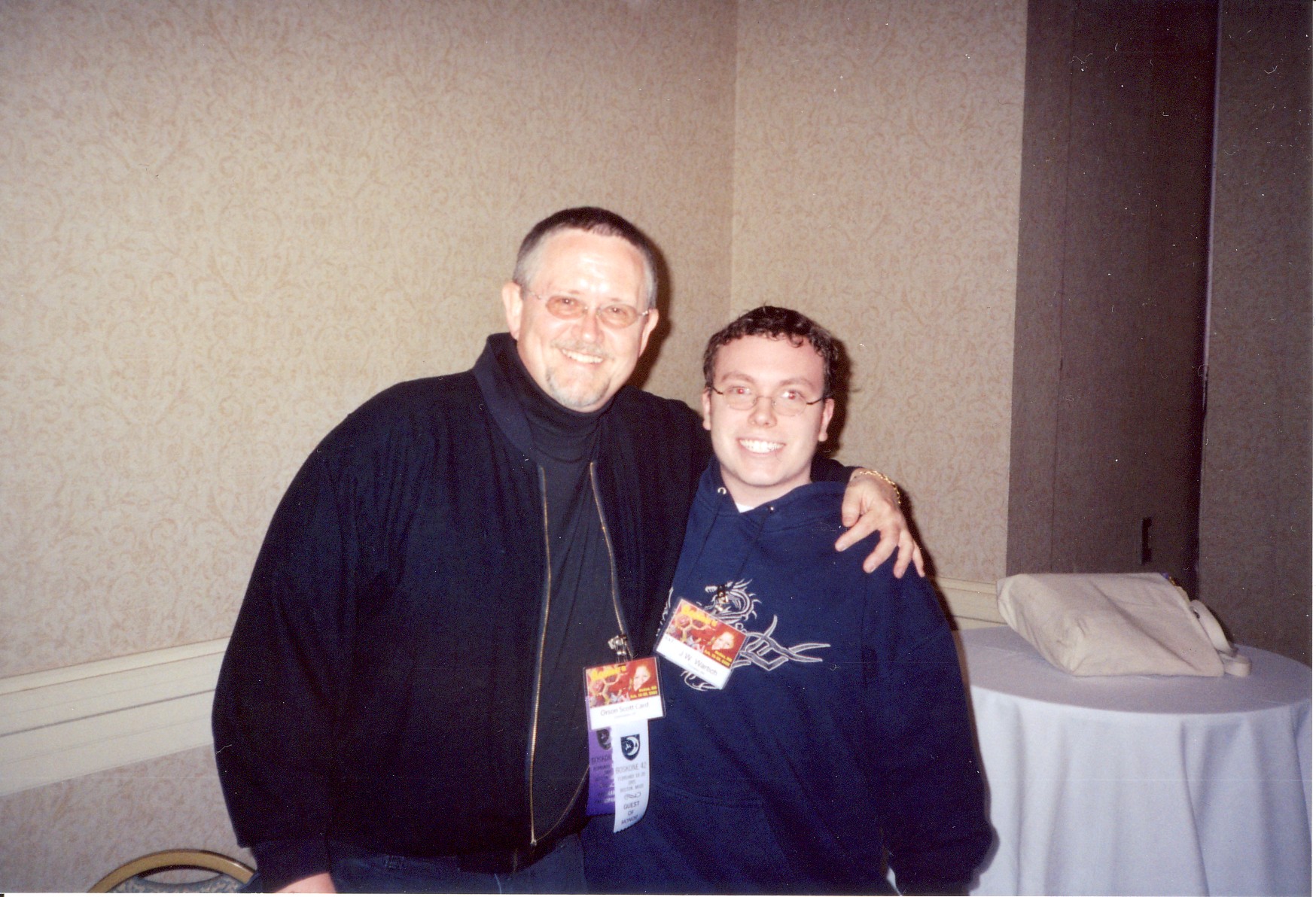
I can’t help but share the picture on the right of me (about 7-8 years ago) with Orson Scott Card. It was one of the most exciting experiences of my life. I found Card to be a gracious, wonderful man who was perfectly willing to sit down with a fanboy teenager and discuss heady issues about philosophy, teaching children about moral issues, and science fiction.
Be sure to check out my look at the movie.
Source
Orson Scott Card, Ender’s Game
Links
Religious Dialogue: A case study in science fiction with Bova and Weber– I take a look at how science fiction has dealt with theological topics, with a particular focus on dialogue about religion.
Be sure to check out my other looks at popular books [scroll down on this link for a number of posts].
Also look into my reviews of several popular movies.
There is No Combat Without Movement– A very different look at Ender’s Game which explores the use of military tactics in the book.
SDG.
——
The preceding post is the property of J.W. Wartick (apart from citations, which are the property of their respective owners, and works of art as credited) and should not be reproduced in part or in whole without the expressed consent of the author. All content on this site is the property of J.W. Wartick and is made available for individual and personal usage. If you cite from these documents, whether for personal or professional purposes, please give appropriate citation with both the name of the author (J.W. Wartick) and a link to the original URL. If you’d like to repost a post, you may do so, provided you show less than half of the original post on your own site and link to the original post for the rest. You must also appropriately cite the post as noted above. This blog is protected by Creative Commons licensing. By viewing any part of this site, you are agreeing to this usage policy.
Abortion, fundamentalists, physicalism, and evolution: Sawyer’s “Calculating God” and some contentious issues
 I have already written on Sawyer’s Calculating God
Fundamentalism, Religion, and Abortion
Sawyer lumps fundamentalism in with the discussions about abortion. Unfortunately, fundamentalism is portrayed in the worst possible light, not unlike in the work of Ben Bova. The religious fundamentalists here are extremists bent on destroying anything that counts as evidence against their worldview. As such, they are first introduced as blowing up an abortion clinic (86-87). Frequent readers of my site know that I write often from a pro-life perspective but also that I am very much opposed to violence in this opposition. Unfortunately, such principled opposition is not portrayed as an option in Sawyer’s work.
Interestingly the discussion of abortion in the book–intentionally or not–reveals some important details about the abortion debate. The alien, Hollus, notes the irony in being “pro-life” while also killing people who perform abortions. Yet in this discussion, Hollus reveals something of note:
Hollus looked at me [Tom Jericho, the main character] for the longest time. “These–what did you call them? Fundamentalist extremists? These fundamentalist extremists believe it is wrong to kill even an unborn child?”
“Yes” [Tom responded].
It may take a moment, but think about it: Sawyer expresses incredulity at this notion through the alien Hollus, yet in what may have been a Freudian slip, calls the unborn “children.” Yes, of course I’m opposed to killing an unborn child! In fact, this dialogue reveals exactly what is at stake in the abortion debate: if the unborn is not a human person, then who cares what you do with it? But if it is, then what relevant status difference is there between a child who is located inside the mother as opposed to outside the mother? Again, I’ve written more on this issue elsewhere, but it is important to note that even in expressing incredulity about this, there is a revealing phrase: child. It is an unborn child killed in abortion.
Disturbingly, the book touches on an issue very relevant to the personhood debate: children who are screened for disabilities. In one scene, Hollus is confronted by a child with Down’s Syndrome. He notes nonchalantly that a similar disease is almost always “screened for” in the wombs of the alien mothers (115-116). Unfortunately, this exact thing is happening right now. Unborn children who are shown as having Down’s Syndrome are being aborted inside their mothers at an alarming rate. I can’t help but see this as a modern eugenics movement: killing those we deem unworthy of life for a genetic reason. The logic that this entails is even more disturbing.
Of course the same fundamentalists who bombed the abortion clinic were also out to destroy any evidence for evolution. They sought to destroy a fossil exhibit which they saw as an affront to God. Thus, I can’t help but think that the way Sawyer presents fundamentalists is a bit disingenuous. Not all fundamentalists are incapable of reason and violent. Indeed, almost no fundamentalists are like this! Thankfully, there are positive examples of religious persons in Calculating God, including Tom’s wife.
In one poignant scene, Tom–who is dying from cancer–struggles with the fact that he has been confronted with evidence for the existence of a god. He considers famous atheists who purportedly went to death, all the while denying God’s existence to the end. Yet Tom himself gets down on his knees to pray. When he does so, though, he considers the words of someone from his past: “The Lord works in mysterious ways.” He can’t help but react violently against this:
Such bull. Such unmitigated crap. I felt my stomach knotting. Cancer didn’t happen for any purpose. It tore people apart; if a god did create life, then he’s a shoddy workman, churning out flawed, self-destructing products. “God,” [he prayed] “I wish–I wish you had decided to do some things differently.” (230-231)
Interestingly, in the book, cancer turns out to actually have a purpose… in the sense of being a side-effect of something great: the ability to fuse genetic codes with other intelligently designed species. Here it seems Sawyer has employed a great deal of imaginative techno-babble to explore the notion of a physical god, but it also has hints of a greater good theodicy akin to that of Swinburne.
Physicalism
The discussion of physicalism in Sawyer’s work is very brief, but enlightening. There is a variety of substance dualism here in the sense of emergence. That is, in Sawyer’s fictional world, intelligence and “mind” emerges from matter once complexity reaches a certain threshold. This is similar to the theories of emergence theorists like William Hasker. I can’t help but find this a bit strange. The people who argue for this type of theory are frequently the same who are very hostile to the notion of anything beyond the physical realm, yet they argue that something aphysical can indeed “emerge” from matter itself. Surely this is a leap of the imagination! That matter has creative force simply because it can reach a certain level of complexity seems to me patently absurd.
Not only that, emergence suffers from a second major problem. Namely, if our “mind” is simply a product of complexity in matter, then our “intelligence” is entirely supervenient upon physical complexity. Indeed, our intelligence is a product of that complexity and therefore cannot operate independently of that matter. Therefore, it is hard to see any kind of properties that our minds would have that would be capable of maintaining free will or even rational thought on this theory. Indeed, I have trouble seeing how this theory would be any different from physicalistic monism.
Evolution
The simple notion of evolution is a given in the book. No, it is not friendly to any who are unwilling to accept the notion of “macroevolution,” as the term is used in relevant literature. All the intelligent beings depicted in the book had evolved from a (potentially distinct) distant ancestor.
Darwinian evolution is simply assumed as truth in Calculating God. Or is it? The deity presented in the book is not very conducive to undirected evolution via natural selection and chance. It is portrayed as hurling asteroids at the planets where life was developing in order to press a “reset” button on the creatures that were currently dominant there. It also shown that this deity prevented other catastrophes from happening on these planets, thus interfering with natural selection. Indeed, the evolution depicted here is eerily similar to intelligent design, wherein the process is guided by a deity with a specific aim.
Indeed, one could argue that the entire book is an argument for intelligent design, albeit divorced from much of the theological framework that many of that movement’s frameworks operate within. Yet I can’t help but find this part of Sawyer’s argument (if, indeed, the intention is to make the argument that theists have it all wrong) is completely off. After all, the “god” of Sawyer’s universe is imperfect and concrete in the sense of physically existing. But this works against his concept of deity as being capable of coordinating the events it brings about. Granted, he could perhaps continue to increase the power of this deity beyond what is clearly outlined in the book, but there are hints that the deity is capable of knowing what is happening on places where it is not present, that it is capable of knowing what will happen with certain directions for evolution, and what will happen at the end of the universe. These work against the notion of God as a kind of blundering physical entity that just happens to be supremely powerful. Indeed, the god of calculating God may not be as hostile to Christianity as it initially seems. It serves as a pointer towards the true God of spacetime.
Links
Like this page on Facebook: J.W. Wartick – “Always Have a Reason”
Check out my other post on this book: Aliens that believe in God: The theological speculations of Robert Sawyer’s “Calculating God”
I have discussed the use of science fiction in showing how religious persons act. Check out Religious Dialogue: A case study in science fiction with Bova and Weber.
What would it mean if we discovered life? I have reflected on the possibility: Alien Life: Theological reflections on life on other planets.
Our Spooky Universe– I make the case for the intelligent design argument for the existence of God, which is heavily used throughout Calculating God.
Check out my other looks at popular level books. (Scroll down to see more!)
Source
Robert Sawyer, Calculating God
SDG.
——
The preceding post is the property of J.W. Wartick (apart from citations, which are the property of their respective owners, and works of art as credited) and should not be reproduced in part or in whole without the expressed consent of the author. All content on this site is the property of J.W. Wartick and is made available for individual and personal usage. If you cite from these documents, whether for personal or professional purposes, please give appropriate citation with both the name of the author (J.W. Wartick) and a link to the original URL. If you’d like to repost a post, you may do so, provided you show less than half of the original post on your own site and link to the original post for the rest. You must also appropriately cite the post as noted above. This blog is protected by Creative Commons licensing. By viewing any part of this site, you are agreeing to this usage policy.
Aliens that believe in God: The theological speculations of Robert Sawyer’s “Calculating God”
The interplay between worldviews and science fiction is very strong. In any writing, an author’s viewpoint will show through, but I think that it is particularly true in sci-fi. For in science fiction, the author is most frequently presenting a view of the world as it should be or as it should not be. The speculative future can be used as a foil through which the reader views reality in a new way. Often, science fiction will touch upon theological issues.
Robert Sawyer’s Calculating God
Fine Tuning
The most immediately striking and pervasive theme of Calculating God is that aliens show up on earth, and they believe in God. In fact, they take the existence of God to be a scientific certainty. The main character of the book, a paleontologist named Tom Jericho, is very skeptical throughout. Here’s the kicker, though, the aliens have been convinced of the existence of God through the evidence–specifically, the fine-tuning argument. Said argument is presented throughout the course of the book in interactions between Tom and Hollus, an alien paleontologist.
What is surprising is how much depth the book goes into while exploring the argument. Yes, Sawyer does fudge the argument a bit by allowing the aliens the possibility of a grand unified theory of science as well as a few other fictionalized aspects of the argument, but overall the fine-tuning argument he presents is very similar to the modern fine-tuning argument.
Not only that, but the characters Sawyer created go to great lengths to explore objections to and defenses of the fine tuning argument. For example, there is a discussion on p. 144ff (mass market paperback edition) in which Hollus and Tom discuss some objections to fine tuning. Tom is arguing against the probability of God:
“All the actions you ascribe to God could have been the doing of advanced aliens” [said Tom].
“There are… problems with your argument,” said Hollus, politely. “[E]ven if you dispense with the need for a god in recent events–events of the last few billion years; events after other conscious observers had emerged in this universe–you have done nothing to dispense with the relative strengths of the five fundamental forces [its science fiction, so there is an extra force], who designed the thermal and other properties of water, and so on. And therefore what you are doing is contrary to the razor of Occam you spoke of: you are increasing, not reducing the number of entities that have influenced your existence…”
The book is replete with debates like this, and the inevitable conclusion is that, shock of all shocks, God exists. I don’t say that sarcastically, I mean that I was genuinely surprised that the book affirmed God exists. But what kind of God?
God Exists… but?
It should be clear that in Calculating God, God is nowhere near the God of classical theism. In fact, one could almost argue that what Sawyer has offered here is a materialistic supplanting of God. The “god” of this work is essentially a super-powerful alien which is capable of swallowing the enormous energy output of a supernova, while also capable of designing our biology and fixing the constants of the universe during the early stages of the Big Bang.
God’s action is described purely in non-transcendent language. For example, the aliens confirm that god caused ice ages and mass extinctions on all the planets with intelligent life. The way this was accomplished was a matter of some speculation–perhaps God generated a dust cloud by using particles from across the galaxy to shield the planets from light and lower the temperature, or perhaps God redirected an asteroid or two to send them hurtling at the planets with life that needed a ‘jump start’ of evolution (146ff).
So why think that this is an image of god supplanting the classical theistic God? Well, clearly many who use the teleological argument are intending for it to point towards a creator God. What Sawyer has offered is a more naturalistic explanations of these events. Yes, there is a ‘god’ in the sense of a being capable of tampering with the very fabric of our universe, but that ‘god’ is itself trapped within the spatio-temporal boundaries of the known universe. In fact, god is said to subsist by recreating itself via a kind of reproductive method and passing one generation through a Big Crunch (think of a bouncing universe model).
Now what?
Calculating God offers a unique look at theology from a science fiction perspective. The fine tuning argument is presented in full force–even enhanced by some fudging of the science–and it leads to the inevitable conclusion that god exists. Yet this ‘god’ is not at all amenable to the god of Christianity or classical theism. So what should we do with this book?
Well, it is important to note that it is a work of fiction. The author clearly adds in some extra ‘fluff’ to make the fine tuning argument more powerful than it is (and I think it is quite powerful as it stands). And really Sawyer’s shoehorning in of a materialistic entity that is able to fiddle with physics boils down to hand-waving. Again, it is fiction, but it is important to note that Sawyer’s attempt to supplant the God of classical theism simply doesn’t work. Think of it this way: how would a purely physical being, however powerful, manage to transcend the physical universe in such a way as to literally rewrite the laws of physics? Extremely interesting science fiction? Yes. Compelling argument? No.
So where are we left? Sawyer does present the fine tuning argument in a way that is quite compelling, even when one strips away all the layers of fiction over it. It seems to me that, at a minimum, readers are left with a rock in their shoe: how do we explain away all this fine tuning without going beyond the cosmos? Sawyer’s own proffered answer, while entertaining fiction, remains that: fiction.
Other Issues
I have not yet even begun to delve into the depths of Sawyer’s Calculating God. The book covers an extremely broad array of topics related to science and faith as well as the secular-religious [false] dichotomy. For example, he discusses abortion in a few places, and I think the view the characters favor is very inconsistent. There is also some clear portrayal of the religious “other” as only a fundamentalist who seeks to halt scientific advancements. Yes, Sawyer panders to Christians in a few places, but the overall look at religious persons seems to be fairly negative (apart from Tom’s wife). I wish I could do justice to each of these topics, so I think I may follow this post up with another touching on more. For now…
Conclusion
Ultimately, Sawyer’s work is a simply phenomenal read. The amount of scientific, ethical, and religious issues upon which it touches is stunning, and readers will be forced to deal with the argument. Sawyer has done an excellent job using fiction for what I think it is called to do: inspire, entice, and force thought. Readers will be uncomfortable. The work will challenge people to really think about the arguments, and to think about the offered solutions.
Links
I have discussed the use of science fiction in showing how religious persons act. Check out Religious Dialogue: A case study in science fiction with Bova and Weber.
What would it mean if we discovered life? I have reflected on the possibility: Alien Life: Theological reflections on life on other planets.
Our Spooky Universe– I make the case for the intelligent design argument for the existence of God, which is heavily used throughout Calculating God.
Check out my other looks at popular level books. (Scroll down to see more!)
Source
Robert Sawyer, Calculating God
SDG.
——
The preceding post is the property of J.W. Wartick (apart from citations, which are the property of their respective owners, and works of art as credited) and should not be reproduced in part or in whole without the expressed consent of the author. All content on this site is the property of J.W. Wartick and is made available for individual and personal usage. If you cite from these documents, whether for personal or professional purposes, please give appropriate citation with both the name of the author (J.W. Wartick) and a link to the original URL. If you’d like to repost a post, you may do so, provided you show less than half of the original post on your own site and link to the original post for the rest. You must also appropriately cite the post as noted above. This blog is protected by Creative Commons licensing. By viewing any part of this site, you are agreeing to this usage policy.
“Fitzpatrick’s War”- Religion, truth, and forgiveness in Theodore Judson’s epic steampunk tale
The roar of our guns was more than my ears could hear. The slaughter in the two rivers was more than one man’s mind could absorb… A sort of madness over came us; we had an infinity of bullets and an infinity of Chinese before us. Every one of our men felt he was killing thousands… Death ran wild. How terrible it is, I thought, that the Yukons should be so good at this. (Judson, 319-320)
Fitzpatrick’s War
Brief Overview of the Plot
Fitzpatrick’s War is written as an autobiographic tell-all from the perspective of Sir Robert Mayfair Bruce. He is writing about Lord Isaac Prophet Fitzpatrick, a man who, like Alexander the Great, had conquered the world at a young age and also died young. Bruce was a close friend of Fitzpatrick (whom he calls Fitz) and so reveals a number of less-than-flattering aspects of his personality in his account of the life of the former ruler. It describes Fitzpatrick’s rise to power, his preparations for war during behind his father’s back, and his post-war rule.
Fitzpatrick is revealed as a man who lusted for power and ruled ruthlessly. He participated in assassinations, set up deaths, and mercilessly slaughtered his enemies. He used biological and chemical weapons and burned his enemies to the ground, all simply because of a desire to conquer the world. He had delusions of grandeur, envisioning himself as a kind of modern Alexander who would outdo the other man in every way.
The Timermen are another major player throughout the book. They are mysterious in their motivations and have supreme power over all space travel and most communications. Bruce reveals a number of unflattering details about these people as well.
The book has been edited by Doctor Professor Roland Modesty Van Buren, who is hostile to Bruce’s recounting of the events. Van Buren does not believe that Bruce is telling the truth about the great Fitzpatrick and believes he is instead attempting to make his own name live on through his lies. Thus, the book is footnoted throughout with Van Buren’s corrections to Bruce’s “lies.”
Religion
Religion is pervasive throughout Judson’s work. The characters constantly quote from the Bible to justify their positions which frequently seem unbiblical and evil. Although the society at large seems to think highly of the Bible, the United Yukon Church itself seeks to take over all religion and has repressed other expressions of religion for quite some time.
Yet Bruce is fully aware of how the Christian faith is being abused throughout the work for evil ends. In one scene, he is speaking privately with Fitzpatrick, who asks Bruce whether God can love someone who will wreak such evil on the world. Specifically, he asks about King David in the Bible. Fitzpatrick wants to know whether he himself is like King David and why God would love someone who so frequently strayed from righteousness. Bruce realizes that it is here that he could have influenced Fitzpatrick to turn from the great evils he would perpetuate. Yet, coveting power, Bruce makes the decision he would regret for the rest of his life and backs Fitzpatrick’s notions of glory and God. He writes:
I would today give up my soul if I could go back to that moment and tell Fitz he could still turn back from his awful destiny. I grant that he had at this date already committed murder. It was equally true that he had not yet made his oceans of blood… The world could have still been saved from his wrath… (204)
Instead, Bruce caves into his own lust for power and desire to please Fitzpatrick. He tells Fitzpatrick:
God loves you… There are a few special men… who, like David, walk through History as Angels walk through thunderstorms. Those about them become wet with sin, while they remain untouched. They may seem to be bad men, these special ones. If we judge them by the standards we hold ordinary men to, they are the worst of men. Ordinary standards do not apply to them. They are doing God’s work here on earth, and as we do not know God’s motives or His ends we cannot judge His servants… You [Fitzpatrick] will be said to be God’s beloved. (204-205)
Bruce regrets this discussion with Fitzpatrick for the rest of his life and struggles with the notion that he can be redeemed.
Fitzpatrick himself seeks a kind of syncretism of all religions, but realizes that it will not ultimately work. He keeps his old tutor, Dr. Flag, around mostly to feel superior about himself. But he had initially attempted Dr. Flag’s project of making all faiths equally valid. One discussion in the book is particularly revealing. Dr. Flag is expounding upon the notion that all religions are essentially the same, but Marshal Jeremiah Truth Hood challenges him on this notion:
“Sir, am I to understand you believe all major religions profess the same core beliefs?” [Hood Asked]
“Yes…” [replied Flag]
“Then that would mean, let us say, that the Chinese and the Arabs share the same beliefs on marriage and family?” asked Hood… “Can we say,” asked Hood, “that Arabs and the Chinese value life to the same degree? Or is human life another secondary question?”
“I mean specific, general matters. You see, such as treating others well.” [Responded Flag]
“You say cultures are essentially the same,” continued Hood. “How would you explain, sir, the different Histories of North and South America? Both continents are inhabited by Christians. The majority in both continents are of European descent…” (364-366)
Hood’s point is well taken. The fact of the matter is that all religions are not the same and to say otherwise devalues the religious persons themselves. The way that Judson presents this dialogue allows for some real insight into the issue: how is it possible to say that, at their core, all cultures or religions are the same when they are so radically different?
Evil, Repentance, and forgiveness
There is great evil in the world, and Bruce’s world is no different. Much of the evil is caused by Fitzpatrick and the war which he created in his lust for power.
Ultimately, Fitzpatrick is reduced to a broken, suspicious man who becomes incapable of even doing the simplest tasks on his own. Marshal Hood is greatly distressed over his own incapacity to make amends for the evils he had done during the War. Hood is sitting with Fitzpatrick and several other Lords when they watch a video from an aerial shot of China and see the destruction their war had done to the country. The bodies were strewn about and death was everywhere. Bruce, too, feels the need for repentance: “There were no words in my vocabulary I could utter that could justify this abomination, no act of contrition that could ever take away what I had done” (410). Hood himself begins quoting from the Bible, Joel chapter 1. He relates the evils they have done to the crimes that Joel cries out against. Later, Hood is found among the Chinese, trying to help them by growing food and feeding them. It was his way of making amends.
Bruce himself finds forgiveness only through his wife, who speaks with clarity on God’s will and his grace. It seems to me that this theme of forgiveness is grounded thoroughly in the Christian notion wherein people are to forgive each other. We act as God’s agents here on earth, and so we are called to repentance and forgiveness.
Charlotte
Bruce’s wife, Charlotte, is a paradigm example of a powerful, spiritual, loving woman. Van Buren, the hostile editor of the book, has several choice words to describe Charlotte, whom he believes is overstepping her bounds by attempting to be equal to Bruce. She often seems overbearing, but ultimately she strives to be equal to Bruce, and to temper the poor qualities of Bruce’s character. Charlotte is Roman Catholic, a religion which is violently oppressed in Yukon, until Fitzpatrick allows for religious freedom to endorse his own pluralism. Charlotte’s character is important throughout the work as one who provides the positive example of womanhood and the equality of men and women.
History and Doing History
History (always with a capital “H”) is an area of extreme interest in the world of Fitzpatrick’s War. Fitzpatrick himself continues to utter a recurring theme: History is written by the winners. Above, there was a discussion of King David. Fitzpatrick in that same conversation presses the notion that King David rewrote the history books in order to paint him in the most positive light. Later, in his own life, Fitzpatrick would do the same thing. He had the greatest poets and historians of his age come and write histories about him which were highly favorable in their portrayals of himself.
There is active repression of historical knowledge due to the fact that the culture at the time the book is set in believes that the “Electronic Age” (20th and 21st centuries) was a blight upon all History. During one scene, Bruce is being questioned about the Electronic Age and readers discover that only one history exists from that period. The reason is because “[A]ll other Histories of that era were perverted by the strange ideologies of the day…” (35).
As one who has studied historiography (and written on the method regarding Jesus), I can’t help but think of all the issues these discussions raise throughout the book. Interested readers should check out the post linked in the parentheses for one brief account of historiographic method.
Conclusion
I have read few books which have had such a great depth of knowledge about so many subjects as is demonstrated in Fitzpatrick’s War. The book is just phenomenal, and it touches upon so many areas of great importance for Christians and non-Christians alike. As with all great fiction, it does this without becoming overbearing, but instead focuses upon the story. Judson develops wonderful characters whom the reader can relate to, love, or loathe. He explores heady themes with wit and precision. I highly recommend this book to my readers.
Links
Religious Dialogue: A case study in science fiction with Bova and Weber– I explore two excellent science fiction books alongside each other to see how they speak to religious dialogue.
The Presumption of Pluralism: How religious pluralism devalues all religious persons– I discuss religious pluralism, a topic which is brought up throughout Fitzpatrick’s War and show how it fails.
Check out more of my looks at popular level books. (Just scroll down to see more!)
Hieropraxis is an excellent site which focuses upon a number of cultural issues and how they relate to Christianity. I really cannot recommend this site highly enough.
Empires and Mangers– Another phenomenal site which looks at many popular level works from a Christian perspective. The posts are consistently fantastic. I encourage you to follow this site closely.
SDG.
——
The preceding post is the property of J.W. Wartick (apart from citations, which are the property of their respective owners, and works of art as credited) and should not be reproduced in part or in whole without the expressed consent of the author. All content on this site is the property of J.W. Wartick and is made available for individual and personal usage. If you cite from these documents, whether for personal or professional purposes, please give appropriate citation with both the name of the author (J.W. Wartick) and a link to the original URL. If you’d like to repost a post, you may do so, provided you show less than half of the original post on your own site and link to the original post for the rest. You must also appropriately cite the post as noted above. This blog is protected by Creative Commons licensing. By viewing any part of this site, you are agreeing to this usage policy.
“Cross Roads” by Wm. Paul Young- An Evangelical’s Perspective
 One of the biggest publishing phenomena of late, The Shack

Free Will
The notion of crossroads is a major theme throughout the work, and Young utilizes the imagery to discuss free will metaphorically. Anthony Spencer (Tony), the main character, finds himself inside his mind, which is portrayed as a kind of land with various roads and places inside it. Initially, he begins exploring this land and finds himself coming to numerous forks in the road. He continues to find these forks and realizes that as he continues to make choices, “it occurred to Tony that the number of direction decisions was diminishing; options were significantly decreasing” (35). Young doesn’t expand on this much, but it seems like a vivid illustration of libertarian free will, wherein one’s choices in the past do indeed influence their choices in the future. As Tony makes choices on his path, he finds that the choices available to him decrease. The reason, it seems, is because his choices have started to form his world. It seems to me that this is a great way to show libertarian free will in literature.
Church
A robust theology of church and salvation is something that I think is necessary for an adequate theology. I find one reason for this illustrated well by Young:
Church, thought Tony. He hadn’t set foot inside one of those since his last foster family had been religious. He and Jake [Tony’s brother] had been required to sit silently for what seemed like hours… He smiled to himself, remembering how he and Jake had schemed together and ‘gone forward’ one night at church, thinking it would win them points with the family, which it did. The attention their conversions garnered was initially rewarding, but it soon became clear that ‘asking Jesus into your heart’ dramatically increased expectations for strict obedience to a host of rules they hadn’t anticipated. He soon became a ‘backslider,’ in a category, he discovered, that was profoundly worse than being pagan in the first place. (124)
It seems clear to me that here the act of conversion has itself become a work, rather than a gift of grace. Tony’s concept of conversion at this point in the book is that of “asking Jesus into your heart.” Unsurprisingly, when he fails to perform other adequate works–obeying a set of rules. The problem with this theology should become clear immediately. By suggesting that Christianity is about “going forward” and publicly affirming a faith, this form of theology puts the believer in the position of affirming faith, rather than receiving it as a gift. When faith becomes a public work, it becomes the Law instead of the Gospel. When demands for works are made on faith, then faith itself becomes a work. Unfortunately, this kind of works-righteousness sneaks into theology at all levels, ever seeking a place to grow.
The problems with this theology are portrayed vividly in this illustration. The notion that people need to make a public declaration of faith leads to its abuse, as Tony and Jake attempted to do, but it also leads to difficulties for those who believe their declaration was itself true (unlike Tony and Jake, who simply did it to glorify themselves in the eyes of their foster parents). When someone makes their “decision for Christ,” their faith life becomes wrapped up in that decision. Their walk with God is contingent upon their continuing to make this decision. Unfortunately, this type of theology makes faith all about one’s own decisions, rather than Christ’s justification and the free gift of faith.
Women
There are many church bodies who do not ordain women to the office of the ministry. That is, they hold beliefs that say women should not be spiritual leaders of men in the church. Young explores this issue when Pastor Skor shows up and challenges Maggie, one of the main characters, regarding her outburst during a church service. Pastor Skor takes Maggie’s outburst and disruptive behavior as a clue to him from God that he has been too lax in his instructing his congregation in the Bible. He makes an argument that women should not be leaders in church and should remain silent:
And we affirm the Word, which declares there is no longer male or female [Galatians 3:28], but… the Word is speaking of how God sees us, not about how we function in the church, and we must always remember that God is a God of order. It is vital that each person play their part, and as long as they stay within the roles that God has mandated, the church functions as it was meant to… (167)
The pastor goes on to quote 1 Corinthians 14:34-35 to support his position. Yet Young, through Clarence, an elder who is with the pastor to talk with Maggie, provides a counter-argument to this reasoning:
It is sarcasm… I believe that the apostle Paul was being sarcastic when he wrote what you read… He is quoting a letter that these folk sent him with questions, and he is in total disagreement with what they have written to him. (168-169)
Clarence defends this position by alluding to 1 Corinthians 14:36, apparently using the KJV: “What? came the word of God out from you? or came it unto you only?” Given the way this verse is worded, Clarence holds that verses 34-35 are a quote from a letter the Corinthians sent to Paul which Paul then responds to sarcastically by wondering whether the Corinthians think that God’s word came only to them.
Young’s offered interpretation seems possible, but perhaps not made explicit enough. It seems to me possible that Paul would have made it more clear that he was quoting another’s writing here. The KJV seems to support the interpretation given to 1 Cor 14:36 here, but other translations phrase it differently, in such a way that the verse seems to be more of a challenge to readers to dismiss what Paul is declaring in 34-35.
Of course, one could still argue that Young’s interpretation has great strength, noting that nowhere in the Bible do we see this command in the Scripture “as the law also says” and so we may infer that Paul is referencing an extra-biblical teaching and rebutting it. In fact, this seems to line up with Young’s argument perfectly because we can see that Paul would be citing a Judaizer’s teaching in the church in Corinth–who would hold that the silence of women is taught by the Law [Jewish extra-biblical law]–and then refuting this by noting that the word of God did not come from them alone (see Katharine Bushnell’s God’s Word to Women
Therefore, it seems to me that Young offers a fairly decent egalitarian interpretation of the passage, though he could have given other arguments which would take into account the passage’s cultural context, in which women were speaking out of turn in worship. The core of the statement seems to me to be that the women in this specific context needed to learn from their husbands at home and remain silent in church so that they did not cause disruption.
The way the scenario plays out in the book is also difficult to evaluate because Maggie definitely was disrupting the church service and would have appeared at least slightly crazy to those around her. She was screaming about a demon speaking to her and was, in fact, mistaken about that. I think she can be forgiven for her extreme reaction given the strange situation in which she found herself, but the Corinthians passage is in context all about order in worship in general, and certainly people bursting in screaming about demons would be disorderly worship.
Thus, it seems to me that Young offers a possible interpretation of 1 Corinthians 14:34-35, but he has made his case problematic by the narrative context in which he placed it. It is worth noting that this work will get people talking about the issue. Young has given a somewhat strong version of a lengthy egalitarian argument in the form of narrative.
Practical Ethics and Disability
Cabby, a boy with Down’s Syndrome, is featured prominently throughout the book. Young uses him as a foil to show that those with disabilities have much to contribute to modern society. Perhaps the most poignant way he does this is through the negative portrayal of Tony’s view of Cabby:
Tony had never known a ‘retarded’ person. He wasn’t sure if that is what you called them… His opinions on most nonbusiness matters may not have been founded on evidence or experience, but he was sure of them. People like Cabby were an unproductive drain on the resources of society; they were valuable only to their families. He believed they were tolerated because of liberal persuasions, not because such people had any intrinsic worth… It is easy to create a category of persons, like retarded or handicapped, and then pass judgment on the group as a whole. He wondered if that was not the heart of all prejudice. (108-109)
In contrast to Tony’s view, Cabby turns out to be insightful and delightful. He is shown to have positive value in a number of ways that go beyond his immediate family. He ultimately shows the practical usefulness of inherent human worth.
God
For Young, understanding God as relationship is central to the concept of deity. The concept of deity that is presented is that of Trinity. Much ink will be spilled, I feel certain, on whether or not Young portrays the persons of the Trinity correctly, just as there was in The Shack (see my own discussion here).
Young’s position seems to be largely unchanged from that in The Shack, and so much of the commentary will follow the same line. I think he does a very good job of exploring the inter-relational character of God and the temporal submission of Christ in the incarnation to God the Father. Some may see the primary difficulty with Young’s portrayal of God is that the Father makes very little appearance in the book, but near the end readers find out that is not the case. In fact, the Father is intricately involved in all aspects of God and the life portrayed in the novel.
Those who conceptualize God as inherently male will have a problem with the book, however. Unfortunately, some paganism has indeed hung on in the church, wherein some view God as a gendered being. In the Bible, however, we find that God is spirit and not a man. Thus, I think that Young’s use of gender with God may shock some but also underscores the fact that God is not a gendered being, and instead transcendent.
Historical Theology
Young offers a short discussion of historical theology and God that seems to me to at least partially miss the mark. It is very brief, but I think it is worth discussing. Young puts the following commentary in the mouth of Jesus himself:
The Greeks, with their love for isolation [of deity] influence Augustine and later Aquinas… and a nonrelational religious Christianity is born. Along come the Reformers, like Luther and Calvin, who do their best to send the Greeks back outside the Holy of Holies, but they are barely in the grave before the Greeks are resuscitated and invited back to teach in their schools of religion. The tenacity of bad ideas is rather remarkable, don’t you think? (73)
There are a number of problems with this small passage. First, Augustine heavily influenced both Calvin and Luther. In fact, Calvin’s theology is tied very intricately to Augustine’s view of free will and original sin. Similarly, Luther’s view of original sin derives directly from Augustine’s exposition in City of God. Second, it seems unfair to view Aquinas as a kind of anti-relationalist when it comes to God’s nature. Aquinas very much emphasized the triunity of God, which was (and is!) an extremely important topic. To thus accuse Aquinas of undermining God’s relational-ness seems unfair. Finally, the notion that the influence of Greek philosophy on Christianity is somehow inherently bad seems a bit shortsighted. There are innumerable positive contributions that reflection on Greek thought has brought into the fold of Christianity. Among these are the very concept of free will that Young pushes in his book, along with a number of aspects of Trinitarian and Incarnational theology that Young seems to support. This may seem to be a nitpick, but it seems to me that if Young is going to use his book to make comments about historical theology, it is vastly important to get that historical development right.
Conclusion
Cross Roads
SDG.
——
The preceding post is the property of J.W. Wartick (apart from citations, which are the property of their respective owners, and works of art as credited) and should not be reproduced in part or in whole without the expressed consent of the author. All content on this site is the property of J.W. Wartick and is made available for individual and personal usage. If you cite from these documents, whether for personal or professional purposes, please give appropriate citation with both the name of the author (J.W. Wartick) and a link to the original URL. If you’d like to repost a post, you may do so, provided you show less than half of the original post on your own site and link to the original post for the rest. You must also appropriately cite the post as noted above. This blog is protected by Creative Commons licensing. By viewing any part of this site, you are agreeing to this usage policy.
Religious Dialogue: A case study in science fiction with Bova and Weber
I love science fiction. One of the main reasons is because it provides a medium for authors to share their philosophical outlook for the world. Some authors portray their vision of what the world would like like if…. and what fills in that “if” is that which the author would like readers to be wary of our condemn. For example, distopian fiction often takes some aspect of society and shows how if we allow it to run rampant, we will create a world wherein we would not want to dwell. Other authors use science fiction to portray an ideal (or nearly ideal) society and show how the things they are promoting or believe fit into that ideal society.
Ben Bova and David Weber are two of my favorite science fiction authors. Bova blends hard science fiction (sci-fi which is largely focuses upon the applications of science that is at least seemingly possible) with great storytelling. His “Grand Tour” series of books is the story of humanity spreading across our solar system and even finding life on mars and founding a colony on the moon. David Weber writes military science fiction on an epic scale, complete with amazing battles in space (and who doesn’t like some big explosions in space?). I was fascinated to see both authors interact with Christianity, particularly on a fundamentalist level, and see how they took that discussion.
 David Weber
David Weber’s book, The Honor of the Queen
What really struck me is that David Weber fairly presented firm believers as a spectrum. He showed that believers can be reasoned with and even persuaded to believe differently based upon evidence. Furthermore, he showed that even those who may line up on the side with which he disagrees [presumably–I don’t know where he stands on the issue] are not all (or even mostly) blinded by faith or foolishness. Rather, although there are some truly evil and disillusioned people, Weber shows that many are capable of changing their position or at least acknowledging that rival views are worth consideration.
The most vivid portrayal of this theme is found in a conversation between Admiral Courvosier and Admiral Yakanov. Courvosier is from the same nation as Honor Harrington and wholly endorses his female officer in a position of command. They discuss Captain Honor Harrington:
[Yanakov responds to Courvosier’s question about his society’s reaction to Honor]: “If Captain Harrington is as outstanding an officer as you believe–asI believe–she invalidates all our concepts of womanhood. She means we’re wrong, that our religion is wrong. She means we’ve spent nine centuries being wrong… I think we can admit our error, in time. Not easily… but I believe we can do it.”
“Yet if we do[” Yanakov continues, “]what happens to Grayson [their world]? You’ve met two of my wives. I love all three of them dearly… but your Captain Harrington, just by existing, tells me I’ve made them less than they could have been… Less capable of her independence, her ability to accept responsibility and risk… How do I know where my doubts over their capability stop being genuine love and concern?”
The exchange is characteristic of the way Grayson’s people are treated throughout the book. They are real people, capable of interacting with other views in honest ways. They feel challenged by a view contrary to their own. Some react poorly, and there are extremists who are blinded by hatred and anger. Yet all of them are treated as people with real concerns shaped by their upbringing and backgrounds.
Honor Harrington ends up saving Grayson, and at the end of the book, she is commended by the rulers of that planet. She talks to the “Protector” [read: king/president]:
“You see,” [said the Protector] “we need you.”
“Need me, Sir?” [Responded Honor]
“Yes, Grayson faces tremendous changes… You’ll be the first woman in our history to hold land… and we need you as a model–and a challenge–as we bring our women fully into our society.”
Weber thus allows for even ardent supporters of specific religious backgrounds to respond to reasoned argument and to change. They are capable of interacting on a human level and deserve every bit of respect as those who disagree with them. Again, there are those who are radicals and will not be reasoned with, but they are the minority and they do not win out.
Weber therefore presents religious dialogue in The Honor of the Queen as a genuine interaction between real people from differing backgrounds. Those who are “fundamentalist” are capable of changing their views when challenged with a rival view which out-reasons their own. Religious dialogue is possible and fruitful.
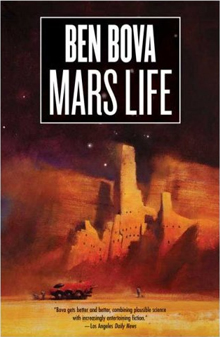 Ben Bova
Ben Bova’s whole “Grand Tour” series has a number of dealings with “fundamentalists.” He never really defines the term to be specifically Christian but one can tell when reading the books that it is pretty clear he is referencing hardcore fundamentalist evangelical Christianity.
I recently finished reading Mars Life
Bova’s treatment of extremist positions in religion is somewhat disingenuous in my opinion, particularly when one compares his portrayal with that of Weber. Bova tends to illustrate religious fundamentalists as a black and white issue. Basically, if you are a hardcore believer, you’re in it for power and control, you are willing to incite violence to achieve your ends, and you are incapable of reasoning. Again, note the contrasts with Weber’s depiction above. A few examples will help to draw this out.
On page 142 and following there is a discussion about putting together a panel to discuss the finding of a fossil on Mars. The interaction shows that no matter what, fundamentalists cannot accept scientific findings:
“Look,” said the bureau chief… “everybody’s calling it a fossil…. …”Call it an alleged fossil, then,” insisted the consultant (from the fundamentalists)… [The group then continues to suggest terms for the fossil:] “A probable fossil?” …”A possible fossil”… [Then, finally] “Say that the scientists believe it’s a fossil and until proven otherwise that’s what we’re going to call it.”
Here one can see that fundamentalism is intrinsically tied to an anti-science mentality. The key for them is to use words which deny absolutes, essentially skirting issues rather than discussing the truth. But that’s not all there is to it. Later on, one of the fundamentalists is engaged in a discussion about “requesting” that some lyrics in music they view as morally reprehensible be changed. The musician flat out refuses, angering the fundamentalist in the process. The section closes as follows:
[The musician] was shot to death at a Dog Dirt concert three months later. His killer surrendered easily to the police, smilingly explaining that he was doing God’s work.
What is interesting about this example is that it is illustrative of a number of such examples throughout the book. These are completely unrelated to the main plot. Rather, it seems what Bova is doing is very explicitly showing that fundamentalists are unafraid to use immoral tactics, censoring, and even incite violence in order to get their way. Theirs is an unquestioned and unquestionable faith. Those in power in fundamentalism are inherently evil and devious. They only want to control. Again, these asides are in no way tied to the plot of the book. It’s almost as though Bova is preaching a different worldview, one which views religiosity as inherently dangerous and violent, with few exceptions.
There is one positive example, however. A Roman Catholic, Monsignor Fulvio DiNardo, who is also a world-renowned geologist decides he wants to go to Mars to find the answer to a question about faith which is pressing on him. Namely, why God would exterminate an entire intelligent species. His thread in the story seems to show two things: first, that fundamentalism is inherently incapable of responding to reason; second, that it is possible to have reasoned faith and science together. The second point is illustrated very well when DiNardo is finally on Mars. He suffers from a likely stroke and is dying and begins a dialog with God:
Why did you kill them, Lord? They were intelligent. They must have worshipped You in some form or other. Why kill them? How could you–
And then DiNardo understood. Like a calming wave of love and peace, comprehension flowed through his soul at last… God had taken the Martians to Him! Of course. It was so simple, so pure. I should have seen it earlier. I should have known. My faith should have revealed the truth to me.
The good Lord took the Martians to Him. He ended their trial of tears in this world and brought them to eternal paradise. They must have fulfilled their mission. They must have shown their Creator the love and faith that He demands from us all. So He gave them their eternal reward…
The light was getting so bright… Glaring. Brilliant… Like staring into the sun. Like looking upon the face of… (297-298)
So Bova does offer a counterbalance to fundamentalism, and I appreciate that portrayal. Although DiNardo’s death and his revelation receives very little further comment (and no further comment at all on the revelation), it seems as though it is positively portrayed.
A reason for criticism is that Bova is uncompromising with fundamentalists. I’ve already drawn out his portrayal of them, and it seems to me to be a bit disingenuous. Although there are plenty on the “religious right” who would be all too happy to be able to legislate all morality, control the media, and deny well-attested scientific findings, I have hardly found that to be the majority. And certainly, fundamentalism is not a homogeneous entity filled with people who are trying to control everyone else. I’ll grant that this is a work of fiction, but in light of how Weber was able to handle a fairly similar issue with respectful portrayals of the ‘other side,’ I had hoped for more from Bova, whose work I enjoy greatly. For Bova, it seems, religious dialogue is not a real possibility, with few exceptions. Fundamentalists are incapable of reasoning and are barely even convinced believers; rather they are using their positions of authority within their organizations to consolidate power and execute their own prerogatives on their witless followers.
Fair Discussion
It seems pretty clear to me that David Weber provided a better model for utilizing science fiction in religious dialogue than Ben Bova did. The people representing the ‘bad guys’ in Weber’s book did have some who were truly evil and/or beyond reason, but also had many with whom reason resonated. When confronted with rival views, they were thoughtful and even receptive. On the other hand, the characters with whom Bova disagreed were a true black/white dichotomy with the “good guys.” Fundamentalists were bad. Period. He portrayed them as power-hungry, censor-happy maniacs. Although there was one notable exception (the Catholic priest, DiNardo), who showed a bright spot for “believers” at large, he was by far the exception.
It seems clear this study has applications for real-world dialogue about religion. When we interact with other worldviews, we should be capable of treating the other side with the same kind of dignity we would like to be treated. Although other worldviews may have their extremists who will not respond to reason, our attitude should be that of the humble friend trying to explore the beliefs of the “other.” The “other” is not that which must be demonized, but rather understood and with which to interact.
More Reading
I explore the theological implications of life on other planets.
I discuss a book which will change the way you think about about the notion that religion is violent. It also deals with the notion of the religious “other” as a construct.- William Cavanaugh’s The Myth of Religious Violence.
Sources
Ben Bova, Mars Life
David Weber, The Honor of the Queen
SDG.
——
The preceding post is the property of J.W. Wartick (apart from citations, which are the property of their respective owners, and works of art as credited) and should not be reproduced in part or in whole without the expressed consent of the author. All content on this site is the property of J.W. Wartick and is made available for individual and personal usage. If you cite from these documents, whether for personal or professional purposes, please give appropriate citation with both the name of the author (J.W. Wartick) and a link to the original URL. If you’d like to repost a post, you may do so, provided you show less than half of the original post on your own site and link to the original post for the rest. You must also appropriately cite the post as noted above. This blog is protected by Creative Commons licensing. By viewing any part of this site, you are agreeing to this usage policy.
Christian Reflection on The Hunger Games Trilogy
 I devoured the entire Hunger Games Trilogy
I’ll give my thoughts on the overall plot and what I take as the meaning in the books, from my own Christian perspective. I provide a brief look at things Christians can take from the books, as well as a discussion of the ethical theory one could see in the books.
This post focuses first on the reflections, and readers who don’t know the plot should read my summary before reading that section. Next, I briefly outline some content for parents. Third is my summary of the trilogy. Finally, I share a few interesting links, including one which I think will be very useful for Christian parents wondering if these are appropriate for their children.
WARNING: MAJOR SPOILERS INCLUDED BELOW
I’ll first present my reflections, and follow it with a brief note for parents. Those who haven’t read the books and aren’t planning to do so can read 3. Summary for a broad summary of the plot. There are spoilers in the reflections section, so readers who don’t want to have anything spoiled should abstain from reading this post and perhaps just read the one linked above.
1. Reflections
[I have had the wonderful pleasure of interacting with many thoughtful Christian on this trilogy and found that there is so much more to the books than I could delve into here. Please see the links at the end for more reflections.] Initially, as I reflected on The Hunger Games Trilogy, I felt that the biggest issue was that there didn’t seem to be a major point to it beyond entertainment. I asked to be corrected, and I was. Many people commenting on this post have shared incredible insights. For the Christian reflecting on the Hunger Games, one can see it as a commentary on the horrors done to children in our time (Audra Franz below brings up this excellent point), a stunning condemnation of relativistic ethical theories (see A.T. Ross’s link), a narrative of Christian martyrdom, a critique of poor moral decisions, a horrible look at a nihilistic worldview, and more. In other words, there are any number of things Christians reflecting on the Hunger Games Trilogy can take away from the series. As such, I’ve lengthened this post a bit to take more of this into account.
I’ve been perplexed by Katniss’ decision to vote to hold a Hunger Games for the children of the leaders of the Capitol. Now, upon further consideration, I have to agree with the astute reader whose idea I put forward below, but I’ve left my original view untouched here [see the last few sentences two paragraphs down]. Consider the following passage in which they are voting on this very issue (p. 370 of Mockingjay):
Was it like this then? Seventy-five years ago? Did a group of people sit around and cast their votes on initiating the Hunger Games? Was there dissent? Did someone make a case for mercy that was beaten down by the calls for the deaths of the districts’ children? …All those people I loved, dead, and we are discussing the next Hunger Games in an attempt to avoid wasting life. Nothing has changed. Nothing will ever change now…. I say, “I vote yes… for Prim.”
I’m just honestly confused by this passage and Katniss’ decision. The vote was, according to her and Coin, a way to avoid losing more life. Some want to kill everyone in the Capitol, while others think they should just integrate with them in order to help stabilize the population. These last Hunger Games were proposed as a solution–a middle ground. But it seems to me they don’t serve a middle ground, just another atrocity. And Katniss seemed to realize that, but voted yes anyway. It is unclear that these Hunger Games ever take place, however, because shortly after making this decision, Coin is killed by Katniss and it’s uncertain as to whether an announcement is ever made. One reader gave me an interest comment on this–that it seems Katniss’ vote for the Hunger Games was, in fact, a ruse to lure Coin into the open so she could take her down. This gains credence when one considers that she says “for Prim”–even though she knew it was not Capitol people, but rather Coin, who killed Prim. On such a view, her utterance of “for Prim” is ironic, and indeed may have been intended to show Haymitch what Katkniss was planning. This makes more sense to me. My thanks to the astute reader!
The world in the Hunger games is stark. It is real, and one can’t help but be drawn into it while simultaneously feeling repulsed. Perhaps that was Suzanne Collins’ point, however. There isn’t always a triumph. Sometimes it’s just bitter reality. The trilogy ends on a happy note, but the overall scheme is one which forces the reader to reflect.
So what do I take from the Hunger Games trilogy? I readily admit my worldview does permeate my thought, and the main thing I took from the trilogy is the sinful condition of humanity. Katniss acknowledges it, noting that it could be better to allow some less sadistic species take over. As I already said, there is a fairly happy ending, but looking at the state of Panem and the world–there has been war after war, there’s no clear idea that the totalitarian government hasn’t just been replaced by another under the guise of democracy, children are killed, and a “compromise” to prevent more death is to send the Capitol’s children to fight to the death once more. The sinfulness of the human race, it seems, is at the forefront. And I think that’s why I long for more in the Hunger Games–I long for that comfort of the Redeemer. There seems to be no hope in the books that things will be made right, only that eventually, the nightmares may get better. Having the comfort of redemption and hope, I can’t help but wish for that in the world of Panem–a Redeemer to come and wash away the tears. And so, because there is no such Redeemer, I see the stories as a reflection of the brutal reality of a world without God. In such a world the best that can be hoped for is that the nightmares may one day end; that children may have a better life than their parents. But ultimately, it is a hard reality, one in which there is no true hope, no way to atone for past wrongs. Perhaps that is the central message of the books, or perhaps I am reading my own worldview onto it. Either way, I find this central message compelling.
Some have expressed concern that the Hunger Games express moral relativism. A.T. Ross has an excellent discussion of this on his site. The books themselves never present a moral theory–obviously that is not their intent–but they certainly do not seem to espouse moral relativism. It is clear throughout that the government’s actions are quite evil and that killing, sexual exploitation, and the like are all wrong. Ross notes that some have complained that it seems all the actions are up to chance. The phrase used in Panem is “May the odds be ever in your favor.” But Ross has astutely pointed out that no fictional character ever survives by chance. There is an Author who guides and directs their destinies. As Ross says, “The world operates on grace whether we like it or not; what we see as luck is nothing more than a tiny slice of divine grace offered in the form of survival and the tensions of the story resolving.”
But the Hunger Games, as noted below in the comments, can also be seen as a critique of our own world and our abuse of our children. In our world, children are sold for sex, they are forced to fight, they are fearful for their next meal, just as they are in the Hunger Games. Collins has poignantly potrayed the reality of our own world in the fictional realm of Panem.
A final thought is that Christians can definitely see parallels between the Hunger Games and the plight of the first Christians as they were forced to battle wild animals in Rome. There are a great many parallels here, and I can’t help but think some of this may be intentional. I’m not suggesting Collins is Christian–indeed, I don’t know what faith (if any) she professes. But I do think that the Hunger Games trilogy brings in many concepts from Christianity–the hopelessness of life without God, the objective wrongness of certain actions (and one’s requirements to act against them [provided the alternative reading of Katkniss’ vote]), and even an allusion to the Christian’s martyrdom in the arena. These all provide significant talking points for Christians throughout the series. The books are not overtly Christian, but they can open up conversations about these topics, and that, in itself, makes them worth reading in my opinion.
Thus, it can be seen that even though the Hunger Games Trilogy is not explicitly Christian, Christians who are interested can take all kinds of talking points away from it. Parents will find much to discuss with their children, and readers who are simply interested in the series will be unable to keep themselves from earnestly reflecting on the series afterwards. My own thoughts have been wonderfully shaped by readers who have shared their comments, so please keep them coming. It is clear that the Hunger Games can captivate Christians and have us look at the world through the eyes of faith–observing what is wrong and praying for God’s aid as we turn to those problems highlighted in the series. Most of all, we have the message of redemption, which is notably absent in the series–a message which is necessary to avoid the nihilistic collapse of Panem.
2. Brief note for Parents
Parents interested in the Hunger Games should know the series is very violent and depicts the death of children in sometimes graphic detail. While not explicit, there is some sexual exploitation involved as well (again, it is never explicit, but it can easily be drawn out from the text that is there). These are not books for young children. Please see 3. Summary for more details about the plot itself to hopefully help decide whether it is for your children.
 3. Summary
Katniss Everdeen narrates the series from a first-person perspective. The Hunger Games is an annual tournament in which the Capitol collects 2 children from the 12 districts of Panem–the mini-country that has risen from the dust of several wars–and makes them battle to the death. Only one of the 24 children will survive. Why does the Capitol do this? Because about 74 years ago, the districts revolted against the Capitol. The Capitol won and the Hunger Games serve as an annual reminder of the Capitol’s might. The Hunger Games are aired on national television and everyone in Panem is required to watch their children die. There are interviews and extensive coverage of the event.
In the first book, The Hunger Games, Primrose, Katniss’ sister, is selected to compete in the Hunger Games. Katkniss almost immediately volunteers to take her place–she can’t watch her sister die. Gale, her friend and hunting partner for years, agrees to take care of her family. Peeta, a boy who had saved Katkniss’ life by giving her food some years ago, is the male selected from District 12, their home. They get shipped to the Capitol, where they begin to gain popularity due to their stylist, Cinna, and their story of hopeless lovers. Peeta told everyone at an interview that he loved Katniss and she plays that up in order to get gifts from “sponsors”–people who like certain children and pay to send food, weapons, medicine, and the like to them while they’re in the Hunger Games arena. As children die and are killed (including Katniss’ ally, Rue), it becomes apparent that Peeta and Katniss may be among the last few. The Capitol changes the rules to allow two to survive if they are the last ones and from the same district. Katniss finds Peeta and nurses him back to health, pretending to love him the whole time (and occasionally feeling very real about it). They end up barely surviving, but then the Capitol decides to change the rules back so they must fight to the death. They are about to kill themselves when the Capitol stops them and allows them both to win.
It turns out Peeta wasn’t pretending about his love, but Katniss was. The Capitol is furious that they were outwitted by the attempted suicide, and Peeta and Katniss are in danger. The book ends with Katniss in confusion about her interests in Peeta, and Peeta totally disappointed.
Catching Fire picks up a few months later and highlights the political drama playing out as President Snow and the Capitol are still furious that Peeta and Katniss both survived. The year is the 75th Hunger Games and in it, they select victors. Peeta and Katniss once more go to the Games. There is more to the Games than meets the eye, however, and Katniss and Peeta are part of a bigger scheme now to overthrow the Capitol. Katniss is confused about her feelings for Peeta and Gale. During the Games, Katniss is rescued and transported to the previously thought-destroyed District 13. District 12, her home, has been bombed to rubble. There are revolts happening across Panem.
In Mockingjay, Katniss must decide whether to help District 13 unite the Districts against the Capitol. Eventually she does and the revolution begins to take over district-by-district. District 13’s own motivations are unclear and it’s not certain they are any better than the Capitol in some ways. Their leader, Coin, is particularly unforgiving. Peeta has been tortured and tries to kill Katniss due to brainwashing, but through the course of the book he is rehabilitated and begins sorting his false memories from his true ones. It becomes apparent Coin doesn’t like the political clout Katkniss has as the “Mockingjay”–honorary leader of the rebellion. Katniss continues to go after President Snow, determined to kill him for his atrocities. Eventually, she reaches his estate and witnesses the killing of dozens of children with a secret weapon that only the Rebellion knows about. Snow is captured.
Katniss votes to put the Capitol’s leaders’ children in one final Hunger Games as retribution[? see more on this in my reflection] for their crimes. She and Coin had agreed to allow Katniss to kill Snow, and she is about to when she shoots Coin instead, due to Coin’s involvement in murdering other children. Katniss is pardoned for temporary insanity, and goes home to District 12. Eventually she and Peeta get together and the book ends with them having children despite Katniss’ fear that some great evil will come upon them.
4. Links
“Catching Fire”– A Christian reflection on the film. I review a number of themes found in the movie “Catching Fire” and tie them back to the message of Christianity and social justice.
Please check out my other writings on movies and books. For starters, if you liked The Hunger Games you may want to check out John Carter.
Christian Children’s Book Review- Check out this review of the series to get more specific information parents may want to consider as they think about getting these books for their children.
The Hunger Games, Ethics, and Christianity– A very interesting look at moral relativism and realism in The Hunger Games.
The Hunger Games: Focus on the Family– Essentially a book review of the first book, The Hunger Games, with an emphasis on issues Christian parents might have with it. I don’t agree withe everything here, but I think the talking points they’ve provided for parents are pretty interesting.
Hungering for Satisfaction– a poignant look into the Hunger games. “Real or unreal?”
Deeper Hungers and Darker Games– The Hunger Games reflects a world without God. What does it mean?
The Hunger Games: The Atheist’s Utopia– No God: Utopia?
SDG.
——
The preceding post is the property of J.W. Wartick (apart from citations, which are the property of their respective owners) and should not be reproduced in part or in whole without the expressed consent of the author. All content on this site is the property of J.W. Wartick and is made available for individual and personal usage. If you cite from these documents, whether for personal or professional purposes, please give appropriate citation with both the name of the author (J.W. Wartick) and a link to the original URL. If you’d like to repost a post, you may do so, provided you show less than half of the original post on your own site and link to the original post for the rest. You must also appropriately cite the post as noted above. This blog is protected by Creative Commons licensing. By viewing any part of this site, you are agreeing to this usage policy.
Harry Potter and the Deathly Hallows, Part 2: A Christian’s View, Redux
 I’ve made no secret of the fact that I’m a huge Harry Potter fan. I think the books are phenomenal, and the movies have often been just as great. What interests me, as usual, is how the Christian can relate to this extraordinarily popular series.
Harry Potter and the Deathly Hallows, Part 2 released on Blu-Ray and DVD today. I was at the midnight showing with my wife (then fiancee) when the movie came out in theaters. The best description I can give of our feelings when it ended is this: bittersweet. The series is over. The books and movies are no longer coming. This is the end! Or is it?
THERE ARE MAJOR PLOT SPOILERS BELOW
That is the feeling I got throughout the movie. Is death the end? The movie takes little time to get going. Soon, viewers are thrust into the epic final conflict in which Harry Potter rushes to destroy all the horcruxes (pieces of the evil Lord Voldemort’s soul) in order to finally defeat his enemy. Things get going fairly well. Harry shows up at Hogwarts again with resounding support. He quickly uses his allies to take back the school and set it up for a final showdown with evil. As his friends battle the forces of darkness closing in around them, Harry searches frantically for another horcrux while Hermione and Ron locate a basilisk fang–one of the only things capable of destroying these pieces of soul.
But once both Harry and Hermione/Ron have achieved their missions, the goal is still only close at hand. They must destroy Nagini, Voldemort’s snake (and another horcrux). They immediately set off to find the snake and witness the murder of Professor Snape–who turns out to be a double-agent after all. The fact that he killed Dumbledore turns out to not show his final betrayal, but the depth of his loyalty. But from Snape’s dying memories, Harry gleans the truth: Harry himself is an unintentional horcrux. When Voldemort killed Harry’s parents, he sealed part of his soul inside Harry. So Harry must die if evil is to be defeated.
Harry goes willingly to his death. He meets Voldemort among his followers, and allows himself to be killed. But it turns out that this is not the end. Dumbledore had sealed the Resurrection Stone inside a gift to Harry. This stone allows Harry to speak with his dead friends and family. Harry, once dead, is made alive once more after a discussion with Dumbledore. Harry awakens in a pivotal scene in which Voldemort is announcing his victory over all wizards, and he and Voldemort battle in a final, epic showdown in which Harry overcomes evil once and for all.
Christians reading this should be sensing some interesting underlying themes here. Harry Potter is innocent–he’s thrust into the events upon him. He willingly goes to his death, knowing it is literally the only way to defeat evil. And, once he’s died, he is resurrected, back to finally bring about his victory over Voldemort. Yeah, it seems Rowling might have borrowed a bit from the story of Jesus.
What explains the astounding popularity of the Harry Potter series? J.K. Rowling has weaved a series of books which tie together in sometimes amazing ways. What seem like random details and “fluff” in one book turn out to be of immense importance later in the series. Each book, mostly self-contained, features a different thrust. Yet they are all tied through broad overarching themes. But could it be that there is another theme, oft-ignored in discussions of Harry Potter? It seems so. The climax of the series occurs in the death and resurrection of Potter. The Christian story culminates in the same. Potter is fiction, but his tale, so wonderfully complex, leads us to the story of Christ. He had to die for the sake of all–Voldemort would have overcome. Jesus, similarly, had to die for the sake of all–lest sin and the devil overcome.
This parallelism with Christianity was not revealed until the final book, yet perhaps it can explain how Rowling was able to make the conclusion to her epic so satisfying. She was telling a story we all knew. She was telling us, in a very different way, what must happen for evil to be overcome. Her story is fiction, Christianity’s story is real. What we want to believe in (Harry Potter) is what many of us do believe (Christianity). Whether intentional or not (and I think it was intentional), Rowling wrote a story which resonates deeply with Christianity’s own. And her fiction points us towards the greater reality.
Christians, I encourage you to read and watch Harry Potter. The books and movies are just phenomenal pieces of literature and filmography. Think of the themes that are woven throughout the books. Think of the final showdown between good and evil. And think of Jesus while you do so. You’ll find that within Potter, we discover hidden truths of our own faith.
But hey, you don’t really have to think of all these themes. And it’s highly questionable whether these parallels are intentional or not. It’s okay to just enjoy the movies anyway. My point is that, as a Christian, I saw these themes. And I found it thrilling.
Links
I discuss a number of other popular movies and books. If you liked Harry Potter, check out The Hunger Games and John Carter.
SDG.
——
The preceding post is the property of J.W. Wartick (apart from citations, which are the property of their respective owners) and should not be reproduced in part or in whole without the expressed consent of the author. All content on this site is the property of J.W. Wartick and is made available for individual and personal usage. If you cite from these documents, whether for personal or professional purposes, please give appropriate citation with both the name of the author (J.W. Wartick) and a link to the original URL. This blog is protected by Creative Commons licensing. By viewing any part of this site, you are agreeing to this usage policy.
The Life Dialogue: Information and the Cell
 This is part of a series of posts on the “Life Dialogue” within Christianity. Check out other posts in the series here.
It is hard to underestimate the importance of the question: “Are we designed?” I’ve really started to realize the question’s reverberations even within the Christian community. Creationists definitely believe we are designed, as we were brought out of nothing by God into being. But theistic evolutionists often argue that the only design inherent in God’s creation was His plan to bring about sentience through evolution. Yet this evolution is blind and unguided. So on theistic evolutionism, we are not designed. Is there a middle ground? Can we say evolution mostly correct, but we are still designed?
Stephen Meyer argues that there is such a middle ground. In his enormously successful book, Signature in the Cell, he argues cogently for the position that there is more to life than “just matter and energy.” There is also information (85). If that is the case, then whence the information?
Essentially the argument goes as follows:
1) If there is information in our cells, its origin must be explained.
2) There is information in our cells.
3) Therefore, the origin of the information must be explained.
4) There are three possible explanations for information: chance, necessity, or design.
5) Chance and necessity are not sufficient explanations for information.
6) Therefore, the information is in our cell due to design.
In defense of premise 2, Meyer argues that there is information in the cell that we can detect because DNA isn’t simply random amalgamations of enzymes, rather, they are put in specific order so that they can regulate the production of proteins and RNA. Thus, they act as information which regulates activity of the cell.
3 follows from 1 and 2.
Chance doesn’t seem a sufficient explanation because not only is the generation of information highly improbable, it is also specified (it is information set in a certain way). Necessity won’t work because it presupposes information is already present. Therefore, the cell is designed.
To those Christians interested in the Intelligent Design, Theistic Evolution, Creationism debate, I highly recommend Stephen Meyer’s Signature in the Cell.
A response to an attack on this post found here (search “On Intelligent Design”)
SDG.
——
The preceding post is the property of J.W. Wartick (apart from citations, which are the property of their respective owners) and should not be reproduced in part or in whole without the expressed consent of the author. All content on this site is the property of J.W. Wartick and is made available for individual and personal usage. If you cite from these documents, whether for personal or professional purposes, please give appropriate citation with both the name of the author (J.W. Wartick) and a link to the original URL. This blog is protected by Creative Commons licensing. By viewing any part of this site, you are agreeing to this usage policy.
Harry Potter: A Christian Youth Perspective
 There Will be Spoilers Throughout This Post for the Harry Potter Series.
Alright, maybe I’m stretching it when I call myself a “youth” (I’m 23 now), but I grew up with Harry Potter. Harry was my age when the books came out, and I’ve followed them throughout.
The popularity of the Harry Potter books is undeniable. Few in my generation don’t at least know about the series. The movies are consistently blockbusters, and surprisingly well made.
Christian parents rightly wonder whether these books–which are filled with sorcery, witchcraft, curses, hexes, and the like–are suitable for their children. Let me preface the rest of my discussion with my conclusion: the Harry Potter books are enjoyable literature which will build vocabulary, expand minds, and get children excited about reading.
Synopsis
The series follows Harry Potter through 7 years of his life, starting when he is 11. It is set in modern day England. There are two worlds in the series: the world of “muggles”–those who can’t use magic–and the world of wizards. The wizards go to great lengths to keep their world a secret from any “muggles” who are unrelated to wizards (or in important positions like the Prime Minister). Thus, when the series starts, Harry Potter knows nothing of his wizarding past, having been raised by his aunt and uncle, who hate everything having to do with wizards.
Despite his lack of knowledge about the world of wizards, Harry Potter is himself hugely famous to wizards. He is known as the “Boy Who Lived” because when he was but a baby, an evil wizard known as Lord Voldemort (frequently referred to as “You-Know-Who” or “He-Who-Must-Not-Be-Named”) attempted to kill him and failed. Harry’s parents were killed in the scuffle, but when Voldemort tried to kill Harry, the killing curse rebounded and killed Voldemort instead. Thus, Harry is seen by many as the defeater of the greatest evil wizard of all time. Everyone knows his name; there is a monument to him at his old home; he has a lightning-bolt shaped scar which clearly identifies him, and he knows nothing about this.
Then his life changes when, at age 11, he is invited to attend Hogwarts, a school for wizards. Thereafter, the books follow Harry’s growth as a wizard with his friends, as well as the rumors of and eventual rise to power of Voldemort. It culminates in the final book, The Deathly Hallows, when Harry races against time with his friends to destroy Voldemort. (For a more in-depth synopsis, check out the page here. Check out the links for each book’s plot synopsis on the same page.)
Analysis
The question which has been asked repeatedly within the Christian community is “Are these books appropriate for my children?”
I started reading Harry Potter when I was 11 years old. As each book came out, I devoured it immediately (except for a brief hiatus before book 5). The books do have very scary, and even disturbing, moments. Voldemort is an evil wizard, and he is portrayed as such. He orchestrates murders and he and his cohorts murder with an attitude of nonchalance. The books also have many scenes of “kids being kids”. Harry and his best friend, Ron, often cheat off their mutual friend Hermione in order to complete their homework. Ron’s older brothers are pranksters of the highest level, whose very lives are dedicated to perfecting their antics. Rivalry between youths is also portrayed, as Hogwarts features four “Houses” which compete for top honors at the end of each year. The books also pull no punches in the realm of “magic”; the children are engaged in hexes, curses, charms, astrology, and the like.
Suggestions for Parents
So what should a Christian parent do with this series? It is impossible to issue a blanket statement that will apply to all parents. Instead, I want to offer several suggestions and comments.
First, there are few books which will keep children and youths reading as well as the Harry Potter Series. It has helped to increase literacy in a generation from which appreciation for books seems to be disappearing. (See the interesting article here for some insight on this phenomenon.)
Second, the Harry Potter books distinguish between good and evil to an extent that much other literature does not. There is no doubt that Voldemort is evil and that Harry and friends are the “good guys.” However, this leads me to the third point: the series acknowledges that no human is perfect. Everyone, from Harry’s father to Dumbledore (headmaster of Hogwarts) has things in their past they regret. I don’t think this is a fault of the series (though some people do–arguing that this diminishes the distinction between good and evil); rather, it brings to light something we–as Christian in particular–acknowledge is true: all people are sinners in need of salvation (this is not a theme developed in the books).
Fourth, despite the use of magic of all kinds, there remains a clear distinction between acceptable practice and unacceptable practice. Some have feared that Harry Potter would increase the interest in witchcraft and wizardry in youths. I personally think this is ludicrous. But that leads me to the fifth point.
Fifth, you as parents are responsible for teaching your children the difference between reality and fiction. My parents did a fantastic job on this. Reading Harry Potter never made me want to explore witchcraft, alchemy, or astrology. I knew such things were to be avoided. That is, I could distinguish between reality and unreality. I think that too often, Christian parents in particular underestimate the power of youths to make this distinction. Yet few parents would object to their children reading Star Wars. Perhaps it is the use of “witch” and “wizard” which makes parents leery. But, in my opinion as a Christian who grew up reading Harry Potter, there is no need to fear… unless children have not been taught to realize a difference between fact and fiction.
Sixth, parents need to be informed. When their children are interested in something like Harry Potter, it is too often that parents read only the negative sources. What better way to judge whether something is appropriate for your children than by reading the book yourself?
Questions
Kenneth Samples (cited below) argues that there are three major questions for parents to ask about Harry Potter (and other books). First: “How can Christian parents test their decisions in terms of Scripture, conscience, and reason?” Christian parents should always turn to these sources to figure out whether something is appropriate for their children.
Second: “Is it appropriate to use dark and occult images in fantasy literature to convey a narrative in fantasy literature?” Samples notes that C.S. Lewis and J.R.R. Tolkien both use these images to convey their message. Are these appropriate usages? (I think yes, but the key here is that there is no quick and easy answer for everyone.)
Third: “Does the book use these images at literary devices to propel the broader story, or, rather to promote occult involvement?” Samples argues this is a critical question. If the Harry Potter books simply use the occult images as a literary device, then it seems like there is no problem. The Harry Potter books do seem to be in the former category rather than the latter.
Fourth, “What is the overarching worldview reflected in the books and how does it compare or contrast with the Christian worldview?” This can spur discussion on books and series that aren’t even intended to convey the Christian worldview.
Conclusion
I said earlier that there is no fast and easy way to say “yea” or “nay” for all parents to a series like Harry Potter. I hope that my comments will help concerned parents figure out where to stand on the series. I want to make my own view absolutely clear, here at the close. I think the Harry Potter books are fantastic. They feature memorable characters and exciting plots. Not only that, but they get kids interested in reading. They build vocabulary (I remember personally grabbing a dictionary once in a while when I was younger and reading Harry Potter). The books distinguish between good and evil while maintaining the reality no one is perfect. They will spur discussion. Ultimately, I recommend Harry Potter to parents, but with the qualifier that parents have taught their children about fact and fiction and that they are willing to engage their children in discussion, which may (probably does) require reading the books themselves.
Source
Samples, Kenneth. “To Read or Not to Read: Harry Potter and the Philosopher’s Response.” Straight Thinking Podcast. 10/20/2009.
———
The preceding post is the property of J.W. Wartick (apart from citations, which are the property of their respective owners) and should not be reproduced in part or in whole without the expressed consent of the author. All content on this site is the property of J.W. Wartick and is made available for individual and personal usage. If you cite from these documents, whether for personal or professional purposes, please give appropriate citation and provide a link to the original URL. By viewing any part of this site, you are agreeing to this usage policy.

 J.W. Wartick - Reconstructing Faith