Dietrich Bonhoeffer
Book Review: “Dietrich Bonhoeffer: Theologian of Reality” by André Dumas
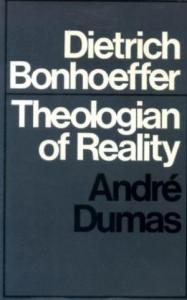 André Dumas’ Dietrich Bonhoeffer: Theologian of Reality is a deep look at the theology and philosophy of Dietrich Bonhoeffer, offering the thesis that Bonhoeffer’s primary aim was to show that God is reality and really interacts with the world. Though this may seem a rather mundane claim, Dumas’s point is that “reality” is rather strictly defined for Bonhoeffer, and, as he argues, this leads to some intriguing insights into Christian theology and philosophy.
One side note before reviewing the work: this book was originally published in French in 1968 and in English in 1971. Dumas is, in part, responding to the “death of God” movement that turned Bonhoeffer into a kind of secular saint Nevertheless, this work is highly relevant to today’s theological and philosophical inquiry as well, particularly due to the keen interest in Bonhoeffer’s life and work.
Central to Bonhoeffer’s thought, argues Dumas, is the struggle between objective revelation and existential interpretation. Alongside this is the question of reality, which, for Bonhoeffer, was this-worldly. Christianity is not to be reduced to a religion, in this case meant to denote a faith that points to the other-world or beyond this world to a different and disconnected reality. Instead, it is about this world, the very one we are in. Dumas notes that “Bonhoeffer was… drawn to the Old Testament, because the living God within it becomes known only in the here-and-now of human life. The absence in the Bible of any speculation about the beyond, about the abode of the dead, about inner feelings, or about the world of the soul, strongly differentiates the faith and anthropology of Israel from the various religions that surround it. For Israel [and Bonhoeffer], God can only be encountered in the reality of this world. To withdraw from it is to find oneself beyond his reach” (144). Alongside this is the need to avoid either total subjectivism about the word of God while also not falling into the danger of objectification.
In order to combat these difficulties, Dumas argues that Bonhoeffer sees Christ as the structure of the world, God entering reality to structure it around himself. Thus, for Bonhoeffer, Christ is “the one who structures the world by representing its true reality before God until the end” (32). This is important, because this means that Bonhoeffer is not encouraging a Christianity that sees the ultimate goal as “salvation” from the world. “When biblical words like ‘redemption’ and ‘salvation’… are used today, they imply that God saves us by extricating us from reality, blissfully removing us from any contact with it. This is both gnostic and anti-biblical” (ibid). Christ is the true center of all things, and the structure which upholds the true reality, one with Christ at the center.
These central aspects of Bonhoeffer’s thought are then the main force of Dumas’s arguments when it comes to “religionless Christianity” and the questions of realism and idealism. Regarding the latter, Nietzsche remains a major force in philosophy as one who also argued for a kind of realism. But Nietzsche and Bonhoeffer, though having similar influences, came to utterly different conclusions and interpretations of that “realism.” Nietzsche “cannot get beyond the terrible ambiguity of loneliness in the world, against which Bonhoeffer rightly affirms the reality of co-humanity, willed by God in his structuring of the world, and embodied by Christ in his life and death for others” (161). Thus, “Bonhoeffer… agrees with Nietzsche on the primacy of reality… But Bonhoeffer disagrees with Nietzsche about the nature of that reality” (ibid). And Bonhoeffer’s vision of reality is concrete as well, but one which avoids the stunning loneliness and hopelessness of Nietzsche.
The non-religious church is a major question in Bonhoeffer’s later thought, but one which must be viewed holistically with the rest of Bonhoeffer’s ideas, as Dumas argues. Thus, the non-religious church is not an atheistic one or a “secular Christian” one. Instead, it is one which “will then rediscover a langauge in speaking of God [that] will not release one from the earth… The resurrection will not re-establish the distance between God and man that was overcome by the cross… Instead, [the community of the church] will be nourished by its participation here on earth in the task of restructuring everyday life, just as Jesus Christ did earlier on its behalf” (209). This cannot be interpreted as a call to go against faith in Christ but rather as a radical call to make Christ the center once again. This is the linchpin of Bonhoeffer’s Ethics as well, for it calls to make Christ the center, a re-structuring and ordering of the world which will change everything, and an order which Bonhoeffer died following.
Dumas is an able interpreter of Bonhoeffer, and one who avoids entirely the danger of separating Bonhoeffer’s work into distinct eras or prioritizing some works over others. Dumas argues instead that Bonhoeffer’s thought is unified, though of course it does develop over time. Therefore, Dumas finds Sanctorum Communio just as important as Letters and Papers from Prison for understanding Bonhoeffer’s thought. His book demonstrates the ability of Bonhoeffer not simply as theologian or martyr but also as philosopher, drawing from Hegel and others to create a systematic view of the world with Christ as the center, as the structure of reality. Dietrich Bonhoeffer: Theologian of Reality is a fascinating work that ought to be read by any looking to understand the works of Bonhoeffer.
Disclaimer: I was provided with a copy of the book for review by the publisher. I was not required to give any specific kind of feedback whatsoever.
Links
Be sure to check out the page for this site on Facebook and Twitter for discussion of posts, links to other pages of interest, random talk about theology/philosophy/apologetics/movies and more!
Book Reviews– There are plenty more book reviews to read! Read like crazy! (Scroll down for more, and click at bottom for even more!)
SDG.
——
The preceding post is the property of J.W. Wartick (apart from quotations, which are the property of their respective owners, and works of art as credited; images are often freely available to the public and J.W. Wartick makes no claims of owning rights to the images unless he makes that explicit) and should not be reproduced in part or in whole without the expressed consent of the author. All content on this site is the property of J.W. Wartick and is made available for individual and personal usage. If you cite from these documents, whether for personal or professional purposes, please give appropriate citation with both the name of the author (J.W. Wartick) and a link to the original URL. If you’d like to repost a post, you may do so, provided you show less than half of the original post on your own site and link to the original post for the rest. You must also appropriately cite the post as noted above. This blog is protected by Creative Commons licensing. By viewing any part of this site, you are agreeing to this usage policy.
Dietrich Bonhoeffer’s Sermon Demands We Hear Him Today
 There is one sermon of Dietrich Bonhoeffer’s I can’t seem to shake. Sure, many of his writings stick with me, and I consider his influence absolutely formative in my own faith life. But in our time as people debate issues like immigration, welfare, and the like, Bonhoeffer’s sermon on Luke 16:19-31 delivered on May 29, 1932 in Berlin has spoken to me time and again. I’d like to share a few of Bonhoeffer’s own words. All are from Dietrich Bonhoeffer’s Works, Volume 11, Ecumenical, Academic, and Pastoral Work: 1931-1932 (Minneapolis: Fortress, 2012). The sermon begins on page 443.
One cannot understand and preach the gospel concretely enough. A real evangelical sermon must be like holding a pretty red apple in front of a child or a glass of cool water in front of a thirsty person and then asking: do you want it? …But it just isn’t that way–we all know that.
…We have spiritualized the gospel–that is, we have lightened it up, changed it. Take our gospel of the rich man and poor Lazarus. It has become common practice to see as the whole meaning of the story that the rich should help the poor. That is, it is turned into a story illustrating a moral. But this particular story especially, if one allows oneself to be affected fully by its original meaning, is something very different from that, namely, a very concrete proclamation of the good news itself. Admittedly so concretely, so powerfully worded, that we don’t even take it seriously anymore.
…Blessed are you Lazaruses of all the ages, for you shall be consoled in the bosom of Abraham. Blessed [are] you outcasts and outlaws, you victims of society, you men and women without work, you broken down and ruined, you lonely and abandoned, rape victims and those who suffer injustice, you who suffer in body and soul; blessed are you, for God’s joy will come over you and be over [your] head forever. That is the gospel, the good news of the dawning of the new world, the new order, which is God’s world and God’s order…
…Woe to you who are full now, for you will be hungry. Woe to you who are laughing now, for you will mourn and weep. Woe to you who dress in purple and live happily in luxury, for you shall suffer eternal thirst.
Blessed poor, outcast, leprous Lazarus yesterday and today, for you have a God. Woe [to you] who live happily in luxury and are respected yesterday and today. That [is] the most concretely preached good news of God for the poor.
…There are always those in our midst who know better than the New Testament itself what the New Testament may and may not say. What we have just said here is, of course, a rough interpretation of the New Testament intended for rough common people. It couldn’t be about that. If something in the New Testament really sounds as rough as what we just said, you have to take it and spiritualize it… It’s not just simply the physically poor who are blessed and the physically rich who would be damned. But the main thing is always what a person’s attitude is toward his poverty and towards his wealth…
…Now, I ask you, where in the story of the poor Lazarus does it say anything about his inner life? Who tells us that he was a man who within himself had the right attitude toward his poverty? Just the opposite, he may have been quite a pushy poor man, since he lay down in front of the rich man’s doorstep and did not go away. Who tells us anything about the soul of the rich man? That is precisely the frightening thing about this story–there is no moralizing here at all, but simply talk of poor and rich and of the promise and the threat given to the one and the other. …And where do we get the incredible presumption to spiritualize these things that Christ saw and did very concretely?
We must end this audacious, sanctimonious spiritualization of the gospel. Take it as it is, or hate it honestly!
What does the gospel that was brought to the weaklings, the common people, the poor, and the sick have to do with us? …We disdain the mass of Lazaruses. We disdain the gospel of the poor. It undermines our pride, our race, our strength. We are rich, but with pride… It is so easy to disdain these masses of Lazaruses. But if just one of these would really meet you face-to-face–the unemployed Lazarus, Lazarus the accident victim, Lazarus whose ruin you caused, your own begging child as Lazarus, the helpless and desperate mother, Lazarus who has become a criminal, the godless Lazarus–can you go up to him and say: I disdain you, Lazarus? …And if you can’t do that, why then do you first act as if it were something great to be able to do that?
With this sermon, Dietrich Bonhoeffer preached an incredible message of law–one that would resonate with his audience, largely of privileged people in Berlin. The line about “our pride, our race, our strength” was a direct attack on the Nazi propagandists and the integration of the same terminology into the German Christian church. But he didn’t leave his message with the Law. Like any good Lutheran, he followed it up with the salve of gospel. He went on:
Who is Lazarus? You know it yourself: your poorer brother who cannot cope with life’s outward or its spiritual aspects… suffering, who craves the crumbs from under your table. …here at the end, in all humility, the last possibility must [be] considered, at the limits of all human and divine possibilities: we are all Lazarus before God. The rich man, too, is Lazarus. He is the poor leper before God. Only when we know that we are all Lazarus, because we all live through the mercy of God, do we see Lazarus in our brother…
We should see–see poor Lazarus in his full frightening misery and behind him Christ–who invited him to his table and calls him blessed. Let us see you, poor Lazarus, let us see you, Christ, in poor Lazarus. Oh, that we might be able to see. Amen.
Amen.
Links
Be sure to check out the page for this site on Facebook and Twitter for discussion of posts, links to other pages of interest, random talk about theology/philosophy/apologetics/movies and more!
SDG.
——
The preceding post is the property of J.W. Wartick (apart from quotations, which are the property of their respective owners, and works of art as credited; images are often freely available to the public and J.W. Wartick makes no claims of owning rights to the images unless he makes that explicit) and should not be reproduced in part or in whole without the expressed consent of the author. All content on this site is the property of J.W. Wartick and is made available for individual and personal usage. If you cite from these documents, whether for personal or professional purposes, please give appropriate citation with both the name of the author (J.W. Wartick) and a link to the original URL. If you’d like to repost a post, you may do so, provided you show less than half of the original post on your own site and link to the original post for the rest. You must also appropriately cite the post as noted above. This blog is protected by Creative Commons licensing. By viewing any part of this site, you are agreeing to this usage policy.
Book Review: “The Battle for Bonhoeffer” by Stephen R. Haynes
 The Battle for Bonhoeffer by Stephen R. Haynes highlights the ways that people across theological, social, and political spectrums have played tug-of-war with Bonhoeffer’s thought, words, and legacy. As Charles Marsh puts it in his Foreword, “It is understandable… that readers with different theological and ideological perspectives would desire to claim Bonhoeffer as their own. ‘Excerpting Bonhoeffer’ has become a familiar exercise in each team’s effort to win…” (ix). Yet Bonhoeffer’s legacy is far more complex than a simple Google quote mine would allow. In my own reading of Bonhoeffer’s works, it is clear that it would be simple to find conflicting messages even within the same sermons at times. Like Martin Luther, for example, reading Bonhoeffer and interpreting him is like peeling away the layers of an onion, trying to get to the core. It takes care, precision, and thought. Unfortunately, as Haynes notes throughout this book, few people are concerned with doing so.
Though the subtitle is “Debating Discipleship in the Age of Trump,” there is far more to the book than dealing with the recent Trump phenomenon. Haynes notes how people on both the right and left have distorted or ignored aspects of Bonhoeffer’s legacy to turn in him into a supporter of their own positions. Marsh sets the table well, asking: “Have you heard progressive Christians cite the passage in Ethics calling abortion ‘nothing but murder’? Or recall Bonhoeffer’s preference for monarchy over democracy?” (xii). Haynes notes how Bonhoeffer was cited on one hand by Vietnam draft resisters, peace activists, liberation theologians, death-of-God thinkers on the left, and on the right by people who oppose abortion or same-sex marriage (and, regarding the latter, Haynes notes insights from both Charles Marsh’s Strange Glory and Diane Reynolds The Doubled Life of Dietrich Bonhoeffer [which I reviewed here] for reasons this may be quite inaccurate]). The baffling array of topics Bonhoeffer is alleged to have endorsed or condemned suggests that the quote mining being done through his legacy belies an inner complexity that is far deeper.
Haynes surveys the history of interpretation of Bonhoeffer, particularly in America, through the next several chapters. He places a special emphasis on seeing how evangelicals have viewed Dietrich Bonhoeffer. What is interesting in this latter topic is that, initially at least, Bonhoeffer was viewed positively but with some “warning flags” by American evangelicals who interacted with his works. Several appreciated his resistance to Nazi ideals, but were put off by his apparent lack of concern for things like “a high view of Scripture/inerrancy” and his being influenced by liberal German theologians. This portrait by the early evangelicals of Bonhoeffer is far more accurate than the one that has been passed into our own time, in part because it allowed for a multifaceted Bonhoeffer who was complex enough to resist being easily integrated into any one position.
Fairly early on, however, the complexities of Bonhoeffer’s thought and life began to be ignored in favor of seeing him as a figurehead for resistance to one’s own preferred ideas. Haynes demonstrates how Bonhoeffer was used to resist George W. Bush and the “war on terror,” and then ironically turned around to resist the “culture of death” under Barack Obama. The raising of the “Bonhoeffer flag” behind such opposed viewpoints should have served as a warning sign, but it unfortunately did not.
Enter Eric Metaxas. Metaxas’s biography, Bonhoeffer: Pastor, Martyr, Prophet, Spy was an extreme departure from Bonhoeffer scholarship generally. For one thing, Metaxas himself admitted to virtually ignoring or explicitly shunning the conclusions of 70 years of Bonhoeffer scholarship both at home and abroad. The cover flap for the book features a spurious quote from Bonhoeffer “Silence in the face of evil is evil itself…” that has since been passed all over the world and even “quoted” multiple times in Congress on record. To say that using an invented quote from Bonhoeffer on the cover of a biography of the man is a bad sign is an understatement. Haynes notes many, many problems with the biography, from a lack of engagement with Bonhoeffer’s actual works (and ignoring, for example, his Letters and Papers from Prison, which is one of the most important works for understanding his developed thought) to a recasting of Bonhoeffer into an American Evangelical. Yet it is Metaxas’s biography that has become the torch-bearer for the populist Bonhoeffer, making an image of the man that is incredibly distorted. For my own part, when I read Metaxas’s work, I was struck by how entirely de-Lutheranized Metaxas had made Bonhoeffer. Dietrich Bonhoeffer was a man who explicitly stated that, for example, without the Lord’s Supper there is no Christianity and who certainly supported infant baptism and regeneration, but Metaxas excised such details from his own dim look at Bonhoeffer’s theology, preferring to pull out those things which were more amenable to the typical American evangelical.
It was the populist view of Bonhoeffer which lead to notions of a “Bonhoeffer Moment” at various times before, during, and after the 2016 election cycle. Haynes spends some time noting how it was frequently said during the Obergefell v. Hodges Supreme Court case that American Christians were facing a “Bonhoeffer Moment” in which they would need to resist the government’s tyranny. Haynes notes how many evangelicals made comparisons to previous Supreme Court rulings, conveniently ignoring those unjust rulings they supported or the just ones they opposed. More decisively, Haynes notes that after Obergefell, evangelicals rallied around a woman who was part of an anti-Trinitarian sect to be their martyr for the cause. In the time since, though, very little has been done by evangelicals in their supposed “Bonhoeffer Moment.” This kind of co-option of the man’s legacy is a disservice to all involved.
Haynes doesn’t limit his analysis of the “battle for Bonhoeffer” to just the positives of Bonhoeffer’s life. Metaxas and others have argued Bonhoeffer is a “Righteous Gentile” (Metaxas even made “righteous gentile” part of his additional subtitle to his biography). But Bonhoeffer has explicitly been turned down for that technical categorization for a few reasons: 1) he wrote or supported some things that were seemingly anti-Semitic; and 2) though he did become a martyr, it wasn’t specifically due to his efforts to help the Jews during the Holocaust, which is a criterion for being deemed a “Righteous Gentile.” Bonhoeffer certainly opposed the Nazi treatment of the Jews and did help some Jews escape Germany (though at arm’s length for the most part–simply helping get proper papers from afar); but that was not his project or his main reason for opposing Nazi Germany. And that’s okay. It is important not to lionize Bonhoeffer for things he didn’t actually do, and Haynes is careful to help readers realize that.
The Battle for Bonhoeffer isn’t very long, but its length shouldn’t be taken for a lack of depth. It’s a thoughtful, critical, and sometimes convicting read. As one who is deeply indebted to Dietrich Bonhoeffer in my own theology and thought, I found ways in which I had been distorting him in this book as well. Haynes’ book provides an invaluable correction to distortions on the man’s life, times, and thought. I very highly recommend it.
Disclaimer: I was provided with a copy of the book for review by the publisher. I was not required to give any specific kind of feedback whatsoever.
Links
Be sure to check out the page for this site on Facebook and Twitter for discussion of posts, links to other pages of interest, random talk about theology/philosophy/apologetics/movies and more!
Book Reviews– There are plenty more book reviews to read! Read like crazy! (Scroll down for more, and click at bottom for even more!)
SDG.
——
The preceding post is the property of J.W. Wartick (apart from quotations, which are the property of their respective owners, and works of art as credited; images are often freely available to the public and J.W. Wartick makes no claims of owning rights to the images unless he makes that explicit) and should not be reproduced in part or in whole without the expressed consent of the author. All content on this site is the property of J.W. Wartick and is made available for individual and personal usage. If you cite from these documents, whether for personal or professional purposes, please give appropriate citation with both the name of the author (J.W. Wartick) and a link to the original URL. If you’d like to repost a post, you may do so, provided you show less than half of the original post on your own site and link to the original post for the rest. You must also appropriately cite the post as noted above. This blog is protected by Creative Commons licensing. By viewing any part of this site, you are agreeing to this usage policy.
Book Review: “Dietrich Bonhoeffer and the Ethical Self: Christology, Ethics, and Formation” by Clark J. Elliston
 Clark J. Elliston’s Dietrich Bonhoeffer and the Ethical Self is a fascinating look at Dietrich Bonhoeffer in conversation regarding the concept of oneself in relation to the other, as well as one’s commitments to oneself. It is also an exposure to some writings and engagement with them that I suspect most readers of Bonhoeffer have yet to engage. As complex as Bonhoeffer’s philosophical writings were, Elliston manages to connect them to the reader in ways that make sense and holistically bring together Bonhoeffer’s thoughts on the self.
Before diving into this deep work, it is worth asking the question of why it is important. Most simply put, it is nearly impossible to accurately interpret Dietrich Bonhoeffer without coming to some understanding of his concept of the self and how one relates to the “other.” To do so, however, requires engagement with the deepest and most difficult of Bonhoeffer’s writings. Elliston’s book is just such an endeavor.
Clark J. Elliston engages the topic of the “ethical self” in Dietrich Bonhoeffer’s body of work through the lens of Emmanuel Levinas and Simone Weil. Who? Yeah, that’s what I thought, too. But Elliston introduces these thinkers and summarizes their thoughts to the extent that it not only makes sense for them to be the dialogue partners with Bonhoeffer but that I as a reader enjoyed the engagement. With Levinas and Weil, Elliston is able to approach Bonhoeffer’s thought from a two-pronged approach.
Levinas’s approach to the self is largely focused on the self in relation to the other. Elliston notes that this may present a “challenge for both theology and philosophy” by noting the interplay between self-other and the way responsibility forms. Bonhoeffer, however, Elliston argues, is able to meet the challenge and provide a holistic self in ethical relations to the other, allowing for theology to remain coherent as well. While Levinas believes that theology neutralizes the “other,” Bonhoeffer provides a corrective that preserves “otherness” without reducing it to the self.
Weil’s perspective is interesting becuase it is so other-oriented. The self exists “for” the other (Kindle location 2568). Weil’s thought included the concept of “decreation” which sees people as obstacles to God’s becoming. Creation is a kind of “renunciation” for God to provide other “selves” outside of himself. Decreation, though, is the act of total orientation of the self towards God. Attention is another central theme for Weil, and the attention towards the other is a way to engage with decreation and God. While Levinas and Bonhoeffer would surely be at odds regarding theology, he and Weil would be much closer. Many points of intersection exist between the two on the self. They share the notion that the self must limit its ego in order to better engage with the other.
I was particularly surprised when I saw that Elliston had utilized Adolf Eichmann as an example in the last chapter. Yes, that Eichmann. But it made sense in that Eichmann was a contemporary of Bonhoeffer’s and Elliston makes it quite clear that Eichmann is not being used positively. Instead, Eichmann is, Elliston argues, a good example of irresponsibility regarding the personal self. Eichmann demonstrated a defective view of the self and this undercut greatly his capacity to engage in proper ethics.
From all of this, it should be clear Elliston’s work is deeply philosophical. Much like reading Bonhoeffer’s Act and Being, reading Elliston here is a deep engagement on tough issues which demand much reflection.
On a side note, it would be remiss to not mention how excellent Elliston’s notes are throughout the book. Often paragraph-length themselves, these notes direct the reader to many different and intriguing topics, as well as providing insight into the details of Elliston’s theses.
Elliston’s Dietrich Bonhoeffer and the Ethical Self is a deep, thoughtful, and sometimes surprising book. It takes a careful reading to fully engage with the topics here, and it warrants re-reading several sections. I recommend the book for those who are looking to go more deeply into their study of Dietrich Bonhoeffer.
Disclaimer: I was provided with a copy of the book for review by the publisher. I was not required to give any specific kind of feedback whatsoever.
Links
Be sure to check out the page for this site on Facebook and Twitter for discussion of posts, links to other pages of interest, random talk about theology/philosophy/apologetics/movies and more!
Book Reviews– There are plenty more book reviews to read! Read like crazy! (Scroll down for more, and click at bottom for even more!)
SDG.
——
The preceding post is the property of J.W. Wartick (apart from quotations, which are the property of their respective owners, and works of art as credited; images are often freely available to the public and J.W. Wartick makes no claims of owning rights to the images unless he makes that explicit) and should not be reproduced in part or in whole without the expressed consent of the author. All content on this site is the property of J.W. Wartick and is made available for individual and personal usage. If you cite from these documents, whether for personal or professional purposes, please give appropriate citation with both the name of the author (J.W. Wartick) and a link to the original URL. If you’d like to repost a post, you may do so, provided you show less than half of the original post on your own site and link to the original post for the rest. You must also appropriately cite the post as noted above. This blog is protected by Creative Commons licensing. By viewing any part of this site, you are agreeing to this usage policy.
Book Review: “The Doubled Life of Dietrich Bonhoeffer: Women, Sexuality, and Nazi Germany” by Diane Reynolds
 …Bonhoeffer reflects a prewar–what we might call a pre-postmodern–consciousness, a consciousness that no longer fully exists. We view him anachronistically, through our different set of lenses, and thus he shatters or refracts, like an abstract painting, into a dozen disparate images because he doesn’t fit conventional postwar paradigms. He remains, in some sense, untranslatable. (3)
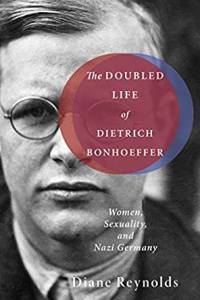
Diane Reynolds’ The Doubled Life of Dietrich Bonhoeffer offers a unique take on the life of that great German WW2 theologian, Dietrich Bonhoeffer. Her biography focuses largely on two topics: the women in Bonhoeffer’s life and questions of sexuality in both his theology and life. The book is a biography, then, that fills in a number of holes that are left by other biographies. It doesn’t provide an exhaustive look at where Bonhoeffer was at any given time in his life like Bethge’s biography, nor does it provide a broad overview while filling in theological details like the excellent work by Ferdinand Schlingensiepen. Its focus is even narrower than the interesting Strange Glory by Charles Marsh. Yet it is that narrowness of focus that allows Reynolds’ biography to stand out from among these other excellent works and show he areas that they missed.
Reynolds’ controversial theories about Bonhoeffer’s sexuality (see below) would likely be the biggest takeaway many have from the book, which is unfortunate because it is quite excellent in several other regards as well, no matter what one thinks of her arguments over his sexuality. Specifically, her emphasis on bringing women’s voices in Bonhoeffer’s life to the forefront offsets a rather lengthy time in which women have largely been ignored or set to the side when considering his theology and life. Reynolds aptly demonstrates women were absolutely central to his way of thinking and clearly shaped his thought and direction of his theology in a number of ways. Indeed, his inner circle towards the time of his death was made up of women (Sabine, his twin sister; Ruth von Kleist-Retzlow; and his fiancée, Maria von Wedemeyer) and Bethge. Though Bonhoeffer was raised with somewhat traditional German values, he rebelled against the Nazi insistence on ideals of women and men in utterly separate spheres of thought and took advice from several women regarding his theology. It would be impossible to paint Bonhoeffer as entirely egalitarian, but not outside of reality to see the way that he lived in an effectively egalitarian understanding while remaining in his traditions.
The most controversial aspect of Reynolds’ biography is that she takes Marsh’s hints about Bonhoeffer’s sexuality and states “I will openly argue… that Bonhoeffer went beyond emotional friendship with Bethge and was in love with him–and that Bonhoeffer’s fiancee knew it” (7). Indeed, Reynolds even goes so far as to argue that there are “seeds of a nascent queer theology in Bonhoeffer’s writing” (7). Regarding Bonhoeffer’s being in love with Bethge, it is true that Bethge himself left open the question of Bonhoeffer’s sexuality. Reynolds’ evidence for her strong claim starts with that, but continues by noting the specific language Bonhoeffer used of and to Bethge, which parallels some of that used by homosexuals in Germany at the time. Moreover, a mutual acquaintance of Bethge and Bonhoeffer (Gerhard Vibrans) used words for their special relationship that were “codes used for gay relationships in Weimar Germany” (141). Maria von Wedemeyer, Dietrich’s fiancée, seemed to question his feelings for her at multiple points in their letters back and forth, forcing the latter to reassure her that his feelings were genuine on multiple occasions. A final piece of evidence Reynolds notes is absences or excisions from letters to and from Bonhoeffer that seem to cluster around questions of sexuality. As she puts it, “We also have unexplained ellipses in at least one [of] the letters to Eberhard [Bethge], a censoring of texts deemed too ‘intimate’ to share” (429). Bonhoeffer’s engagement to von Wedemeyer is explained, in Reynolds view, by both an attempt to thwart Nazi suspicion (Bonhoeffer would have been seen as more “normal” if he were married) and as a kind of cover for Bonhoeffer’s sexuality.
If all of this seems a bit circumstantial, that would be because at least some of it is. Certainly, when taken altogether, the evidence rings of the possibility of Bonhoeffer having an attraction that goes beyond friendship for Bethge. The intimacy of his letters and exhortations to his friend to spend more time with him, the latter’s apparent moves to thwart the same intimacy, the excision of letters, the language used by mutual acquaintances, and the tepid relationship between Bonhoeffer and his fiancée may all be taken as evidence for Reynolds’ thesis. But her claim is quite strong, not just that there may have been something going on, but that their relationship went beyond friendship and that Bonhoeffer was explicitly in love with Bethge, with von Wedemeyer’s knowledge (7). Alternative explanations could be given for each of these lines of evidence Reynolds’ presents. Bonhoeffer’s apparently cold feelings towards von Wedemeyer could be explained simply by his seeing their relationship as a way to thwart the Nazi investigation; excisions in the letters could simply be quite personal rather than anything related to sexuality; a friend’s knowing taunts could be reduced to jealous teasing at being excluded from the same fraternal intimacy; and the like. The question, of course, is whether such explanations are better than those offered by Reynolds. As it stands, readers must judge for themselves. I do not think Reynolds’ strong thesis can be carried by the weight of her evidence. Insinuations are there, but nothing strong enough to conclude as she does with such certainty.
Regarding Reynolds’ claims for a “nascent queer theology,” I do not find the evidence convincing. Essentially, she turns his writings on friendship into thoughts on how homosexual relationships could be viewed with the same legitimacy as those of male-female ones. For example, she writes, “Both Bonhoeffer and Bethge acknowledged struggles due to the lack of formal recognition of their close companionship… Both men felt the frustration of the military’s indifference to their friendship. These sorts of assertions against invisibility have become the mainstay of the gay marriage movement… insisting on the beauty, necessity, and value of same-sex friendship existing as a cornflower between the rigid rows of more formal social organization offered a beginning vision” 419-420. But there seems to me a vast difference between two friends frustrated over not being able to communicate as they wished to and insisting that that is the formation of a theology of same-sex relationships that affirms marriage. We must be careful not to subsume same-sex friendship into same-sex attraction, and close friendships ought not to lead necessarily to speculations about sexuality. It seems to me that Reynolds’ thesis is once again stronger than the evidence supports.
None of these comments should be taken to suggest Reynolds is not careful in her survey of the evidence. Indeed, she provides correctives to some aspects of Bonhoeffer’s life as well, including on some things that could be seen to support her thesis had she let them stand. For example, she offers a brief comment in which she criticizes Charles Marsh for his “effete” Bonhoeffer, arguing that his style of dress was “from pride in his appearance rather than a ‘flamboyant abbot’ quality” (17). By contrast, Reynolds notes that Bonhoeffer would have been considered “masculine” in his own time. Reynolds here demonstrates that she is not grasping at straws to try to push a pet theory. Rather, her analysis of Bonhoeffer’s life is balanced and challenging.
Another aspect of this biography worth noting is its own. Reynolds’ writing style captures the reader and draws one into the narrative of Bonhoeffer’s life in a way that few biographies are able to grasp. The biography, again, necessarily misses large portions of Bonhoeffer’s life because of its different focus. But in having its focus upon aspects of his life that have been overlooked, Reynolds manages to make a compelling narrative that challenges readers to interact with it, possibly re-evaluating assumptions about Bonhoeffer’s life and theology in the process.
The Doubled Life of Dietrich Bonhoeffer is a fascinating work. It explores aspects of Bonhoeffer’s life that have largely received little treatment in the works on his life. Though I believe some of Reynolds’ theses are stronger than she was able to support with the evidence, it certainly got me thinking about the life of Bonhoeffer more deeply than I had before. Her demonstration of the impact of women on his life is a refreshing breath of air, showing the influence women had on his life and theology. Those interested in a deep exploration of Bonhoeffer’s life would do well to read this book, whether they agree or disagree with Reynolds’ ultimate conclusions. I recommend it.
Disclaimer: I was provided with a copy of the book for review by the publisher. I was not required to give any specific kind of feedback whatsoever.
Links
Be sure to check out the page for this site on Facebook and Twitter for discussion of posts, links to other pages of interest, random talk about theology/philosophy/apologetics/movies and more!
Book Reviews– There are plenty more book reviews to read! Read like crazy! (Scroll down for more, and click at bottom for even more!)
SDG.
——
The preceding post is the property of J.W. Wartick (apart from quotations, which are the property of their respective owners, and works of art as credited; images are often freely available to the public and J.W. Wartick makes no claims of owning rights to the images unless he makes that explicit) and should not be reproduced in part or in whole without the expressed consent of the author. All content on this site is the property of J.W. Wartick and is made available for individual and personal usage. If you cite from these documents, whether for personal or professional purposes, please give appropriate citation with both the name of the author (J.W. Wartick) and a link to the original URL. If you’d like to repost a post, you may do so, provided you show less than half of the original post on your own site and link to the original post for the rest. You must also appropriately cite the post as noted above. This blog is protected by Creative Commons licensing. By viewing any part of this site, you are agreeing to this usage policy.
Remembering Bonhoeffer, 2018: Bonhoeffer was Not an [American] Evangelical, but he was an Evangelical Lutheran
Today is the anniversary of the execution of Dietrich Bonhoeffer by the Nazis, April 9, 1945. As I hope to do each year, I’d like to share a brief thought on Bonhoeffer’s life and legacy on this date.
Bonhoeffer and Evangelicalism(s)
One of the ways that Bonhoeffer is most frequently abused is by the assumption or argument that he was an evangelical, particularly of the American variety (eg. inerrancy and the like). In honor of the day of his death, I’d like to continue to disabuse people of that notion and instead note that he was actually a 20th century German Lutheran influenced by (but not uncritically accepting of) Neo-Orthodoxy. Here are some of his words about the creation account, specifically Genesis 1:6-10, from “Creation and Fall”:
Here the ancient image of the world confronts us in all its scientific naivete [my fault for lack of correct letters]. To us today its ideas appear altogether absurd. In view of the rapid changes in our own knowledge of nature, a derisive attitude that is too sure of itself is not exactly advisable here; nevertheless in this passage the biblical author is exposed as one whose knowledge is bound by all the limitations of the author’s own time. Heaven and the sea were in any event not formed in the way the author says, and there is no way we could escape having a very bad conscience if we let ourselves be tied to assertions of that kind. The theory of verbal inspiration will not do. The writer of the first chapter of Genesis sees things here in a very human way. [DBW 3:47-48].
Of course, as always, Bonhoeffer’s words must be understood in a much wider context than they are presented here. It is almost never a good idea to read even whole paragraphs from Bonhoeffer in isolation, because his thought is so dense that it cannot adequately be presented in sound bites. Those quotes which often are used as sound bites are either fabrications (eg. the “Not to act is to act…” quote that has yet to have an actual source found) or the exceptions (and even then I’d be very careful). Bonhoeffer throughout this work demonstrates that the Genesis is God’s Word but he means it in a sense that is very aligned to Luther, though not necessarily Lutheranism: that it is God’s Word because it ultimately teaches us about God and Christ. He strongly argues that God remains God and that God’s Word creates and brings life, but he does not demand that the text of Scripture meet his own modern standards of scientific accuracy and even suggests that yes, it would be silly to think it could.
So no, Bonhoeffer is not a modern evangelical, though he certainly was evangelical in the sense that it was used before the modern use: that of the evangelical Lutheran church. Though many (conservative) Lutherans would reject much of his thought, I’ve yet to encounter a thinker as wholly Lutheran among modern thinkers to date. He was a wonderful–dare I say, beautiful–man who applied his incredibly deep theology to his life, even unto death.
I thank God for Dietrich Bonhoeffer.
(February 4, 1906- April 9, 1945)
-4/9/1945
-4/9/2018
Bonhoeffer on American Christianity
 Dietrich Bonhoeffer has been criticized by people from many angles. Some criticize him for being too liberal; others, for not being liberal enough. Yet it is interesting to read what the man himself had to say, and indeed his words make it clear that he was, in fact, in that rather lonely area in the middle where answers cannot so easily be given to “simple” questions.
I’ve been reading through Bonhoeffer’s collected works, and came across yet another quote that struck me. He studied in New York at Union Theological Seminary for a year, and in Volume 10 of his collected works, Barcelona, Berlin, New York 1928-1931, there exists his report on his time there. In that report (itself undated, though sometime in 1931), he noted that the seminary had many students and teachers entirely dedicated to socialization and thus secularizing Christianity. The problem was that they reduced Christianity to a message of social justice.
On the other hand, Bonhoeffer was also critical of several aspects of American Fundamentalism, and would certainly be critical of the same today.
In a particularly insightful section, he notes difficulties of both the religious “right” and “left” (however unhelpful those categories are. He wrote:
The theological spirit at Union Theological Seminary is accelerating the process of the secularization of Christianity in America. Its criticism is directed essentially at fundamentalism and to a certain extent also at the radical humanists in Chicago; such criticism is healthy and necessary. But the foundation on which one might rebuild after tearing down is not able to support the weight. The collapse destroys it as well. A seminary in which numerous students openly laugh during a public lecture because they find it amusing when a passage on sin and forgiveness from Luther’s de servo arbitrio [On the Bondage of the Will] is cited has obviously, despite its many advantages, forgotten what Christian theology in its very essence stands for. (DBW 10, 309-310).
Thus, Bonhoeffer can be seen here noting that both ends of the theological spectrum have difficulties. He expands on his issues with “fundamentalism” elsewhere (see, for example, Creation and Fall), but here he only hints at it needing some correction. On the other hand, he also notes that it is all too easy to fall into the trap of turning Christianity into a club of social programs, rather than getting the heart at Christian theology. And for Bonhoeffer, that heart is most certainly Christ and living our lives out in light of God’s work.
Links
Be sure to check out the page for this site on Facebook and Twitter for discussion of posts, links to other pages of interest, random talk about theology/philosophy/apologetics/movies and more!
Eclectic Theist– Check out my other blog for my writings on science fiction, history, fantasy movies, and more!
SDG.
——
The preceding post is the property of J.W. Wartick (apart from quotations, which are the property of their respective owners, and works of art as credited; images are often freely available to the public and J.W. Wartick makes no claims of owning rights to the images unless he makes that explicit) and should not be reproduced in part or in whole without the expressed consent of the author. All content on this site is the property of J.W. Wartick and is made available for individual and personal usage. If you cite from these documents, whether for personal or professional purposes, please give appropriate citation with both the name of the author (J.W. Wartick) and a link to the original URL. If you’d like to repost a post, you may do so, provided you show less than half of the original post on your own site and link to the original post for the rest. You must also appropriately cite the post as noted above. This blog is protected by Creative Commons licensing. By viewing any part of this site, you are agreeing to this usage policy.
Against the Idolatry of the State – Dietrich Bonhoeffer
There is virtually nothing so nefarious as putting our trust in the state or in patriotic hope that our nation will be our savior. Dietrich Bonhoeffer, a man executed by the Nazis for his religious opposition to their totalitarian regime, spoke frequently on the great danger of putting our hope in nations or organizations. One of the nefarious ways that patriotism or statism can become idolatry is when people put their hope in individual leaders:
If the leader tries to become the idol the led are looking for–something the led always hope from their leader–then the image of the leader shifts to one of a mis-leader, then the leader is acting improperly toward the led as well as toward himself. The true leader must always be able to disappoint. This, especially, is part of the leader’s responsibility and objectivity. (DBW 12, II/9 cited in Schlingensiepen, 117)
We have a way of rushing to put our hopes or trust in individuals. Bonhoeffer recognized this and even acknowledged that the leader-as-idol is not necessarily something the leader does unilaterally; often it is something that we people want ourselves. We want to be led–we want our leaders to be perfect. Such devotion can lead to our leaders mis-leading by taking up the praise we offer and becoming our idols. Woe to a church that is afraid to call out leaders for wrongdoing.
Individuals are not the only way we make idols of our nations. We can put our hope in nations rather than just in individual leaders. We may begin to speak of the righteousness of the nation, the honor of a people, or the holiness of the state. We may not use these words, but when we dismiss wrongdoing of our own nation, or when we argue that one nation is to be put above all others, we have effectively done just these things. Responding to the question asked in 1932 of why the church is afraid, Bonhoeffer said these convicting words:
Because it [the church] knows there is a commandment to peace, and yet with the clear vision that is given to the church, sees the reality that is full of hate, enmity, violence. It is as if all the powers on earth had conspired together against peace, as if money, the economy, the drive to power, even the love of one’s fatherland have been dragged into the service of hate…
How could it be anything but blasphemous mindlessness, if we were to declare ‘No more war!’ and think with that, and a new organization–even a Christian one–we could exorcise the devil? Such organizations are nothing…
Christ must be present among us in preaching and sacrament, the Crucified One who made peace between God and humankind. The Crucified One is our peace. (DBW 11, 354-355, cited in Schlingensiepen, cited below)
The message is clear: putting hope in any institution is itself idolatry and blasphemous. That institution may be a para-church group, a church, or even a nation-state. The only true hope–the only possibility of hope–is found in Christ alone. Whenever we cease to acknowledge that–whenever we put our hope in anything else–we have committed blasphemy and are called to repent.
Source
Ferdinand Schlingensiepen, Dietrich Bonhoeffer 1906-1945: Martyr, Thinker, Man of Resistance (New York: Continuum, 2010).
Links
Be sure to check out the page for this site on Facebook and Twitter for discussion of posts, links to other pages of interest, random talk about theology/philosophy/apologetics/movies and more!
Eclectic Theist– Check out my other blog for my writings on science fiction, history, fantasy movies, and more!
SDG.
——
The preceding post is the property of J.W. Wartick (apart from quotations, which are the property of their respective owners, and works of art as credited; images are often freely available to the public and J.W. Wartick makes no claims of owning rights to the images unless he makes that explicit) and should not be reproduced in part or in whole without the expressed consent of the author. All content on this site is the property of J.W. Wartick and is made available for individual and personal usage. If you cite from these documents, whether for personal or professional purposes, please give appropriate citation with both the name of the author (J.W. Wartick) and a link to the original URL. If you’d like to repost a post, you may do so, provided you show less than half of the original post on your own site and link to the original post for the rest. You must also appropriately cite the post as noted above. This blog is protected by Creative Commons licensing. By viewing any part of this site, you are agreeing to this usage policy.
Bonhoeffer As Reliable Guide?
I seem to have made it something of a pastime explaining to others things about Lutheran belief, and often this pertains to discussions of Bonhoeffer. Almost everyone is trying to make Bonhoeffer in their own image. Whether it is the notion of calling Bonhoeffer an evangelical, or recruiting him to various other schools of thought, Bonhoeffer is enduring a kind of celebrity right now. That celebrity comes with its share of difficulties, including pushback. Some evangelicals have labeled Bonhoeffer dangerous. A recent article by William Macleod questions whether Dietrich Bonhoeffer may be a “reliable guide” when it comes to Christianity: Bonhoeffer – A Reliable Guide? That blog post levels a number of criticisms at the Lutheran theologian, and I would like to respond to this article, which I think misrepresents Bonhoeffer in many ways. I’ll not respond to every point, because Macleod overlaps points I’ve responded to before.
Methodological Notes
At the outset, I must point out a major problem with the article is that there is a distinct lack of citation throughout. Indeed, the only footnote is a reference to an article about Bonhoeffer, not a reference to Bonhoeffer’s works at all. Moreover, though many assertions are made about what Bonhoeffer wrote–as well as a few quotations–no references are provided, which makes it at many points impossible to easily track down the reference and so provide a full response. It is disturbing to me to see such lack of citation in an article that purports to correct evangelical thought on this theologian. How are we to evaluate an article that makes it difficult to even double-check the facts?
Second, Macleod does not define evangelical in this article, or provide a clear reference to what he means. Because there is great difficulty with the definition of “evangelical” in its modern and historical usage. Indeed, Bonhoeffer’s German Lutheran church historically simply referred to itself as evangelical–a tradition carried on to this day in my church body, the Evangelical Lutheran Church in America. The problem is that the term “evangelical” often means different things to different people, a problem acknowledged in many circles. The article would have been helped had Macleod provided exactly his meaning of evangelical to compare his statements to.
Bonhoeffer as Liberal Theologian?
Macleod alleges, “Far from being an evangelical, Bonhoeffer was more liberal than Barth. He considered himself a ‘modern theologian who still carries the heritage of liberal theology within himself’.” Here we already see a difficulty with the methodology–where is this quote from Bonhoeffer to be found? A search online turned up other blog posts that give this same quote, but this one, for example, writes a citation [5] in brackets but then there is no referent for [5]. I finally managed to possibly track down a reference on a different article, but don’t have the book in front of me at this point so I can’t confirm it. However, even granting he said that, I’d love to see the context. After all, he could have been saying it in the sense of saying that he has been influenced by liberal theology, which was certainly found all around him in Germany. But of course Bonhoeffer himself, at the end of his life, explicitly argued against liberal theology at multiple points.
Bultmann seems to have somehow found Barth’s limitations, but he misconstrues them in the sense of liberal theology, and so goes off into the typical liberal process of reduction – the ‘mythological’ elements of Christianity are dropped… My view is that the full content, including the ‘mythological’ concepts, must be kept… this mythology (resurrection etc.) is the thing itself… (Bonhoeffer, Letters and Papers from Prison, 328-329)
Those are Bonhoeffer’s words, written in 1944 from prison. Does that look like an acceptance of liberal theology? Bonhoeffer does engage liberal theologians, of that there is no doubt, but he explicitly notes the deficiencies of their theology and argues the opposite position. Macleod’s attempt to poison the well here fails.
Bonhoeffer as Martyr
Macleod, amusingly, questions whether Bonhoeffer was a martyr:
When we think of Christian martyrs we think of the early Christians thrown to the lions for refusing to worship Caesar. We think of Reformers like Patrick Hamilton and William Tyndale burnt at the stake for preaching the gospel and for translating the Scriptures into the language of the people. In no sense were these men involved in conspiracies against the state. Bonhoeffer died for being involved in a plot to assassinate Hitler… his death was not because of his beliefs, but rather for his ‘crime’ of conspiracy to murder.
I actually found myself chuckling here. I don’t know Macleod, and I know nothing about him. What I do know, and have seen many times, is a lack of understanding of church history among those broadly identifying themselves as evangelicals (I’m not the only one who bemoans this, on a different end of the spectrum than me stands James White, who I’ve heard on his podcast multiple times speak of the lack of knowledge of church history in evangelical circles). I preface that remark because Macleod’s comment about martyrs shows a bit of ignorance. If he wants to say Bonhoeffer’s not a martyr because he died for political reasons, perhaps he should go back and see that the worship of Caesar for which Christians were killed was, itself, a political killing. Virtually every book I’ve ever read on this early period of Christianity confirms this. For just one reference, check out the interplay between pagan and Christian apologists found in Apologetics in the Roman Empire.
Moreover, Macleod’s comment is amusing because the separation of belief from action is a very modernist/postmodernist separation, and one that could just as easily be used to say “the early Christian martyrs weren’t killed for their beliefs, they were killed for refusing to worship Caesar, a political act.” But of course that refusal is based on belief, just as Bonhoeffer’s ethical stance regarding Hitler was based on belief. Belief put into practice remains belief. The attempt to tarnish Bonhoeffer’s legacy as, yes, Christian martyr here bespeaks both lack of historical awareness and the overall tone of the article.
The Cross
Macleod accuses Bonhoeffer of decentralizing the cross because, according to Macleod, he did not believe in substitutionary atonement. More damningly, Macleod charges Bonhoeffer with seeing the cross as “an example and an inspiration.” I was astonished to read this from Macleod. Aside from the fact that Bonhoeffer wrote an entire book about Jesus Christ being the center not just of our faith but as the center of human history (Christ the Center, 59ff), he also repeatedly emphasized this in his other writings. Macleod stated, “For evangelicals the cross is at the centre of their faith.” I’m not at all sure why he thinks he should disagree with Bonhoeffer here, unless he just hasn’t read Bonhoeffer’s body of work.
Conversion
I’ve responded to this elsewhere, but Macleod’s words about conversion regarding Bonhoeffer are deeply troubling to me:
As a Lutheran he embraced the doctrine of baptismal regeneration – you are automatically born again when you are baptised. Around 1931 Bonhoeffer experienced a ‘conversion’, when he, as he puts it, discovered the Bible… Yet it was not what evangelicals normally call conversion, or what the Scriptures describe as the new birth. He rarely referred to it… He wrote, ‘We must finally break away from the idea that the gospel deals with the salvation of an individual’s soul’.
A number of things are problematic here. First, Macleod blatantly misrepresented the Lutheran view of baptismal regeneration by couching it in terms borrowed from Baptist theology. Baptismal regeneration is not about “automatically” being born again; it is about the gift of God that has been promised through baptism, even to infants. I’m not going to debate this rather obvious point here, but the fact that Macleod effectively dismisses Bonhoeffer simply because he’s Lutheran says something disturbing about his view of what it takes to be evangelical–apparently a view that excludes Lutherans entirely.
Moreover, Macleod once again conforms to modern American evangelicalism (not even sure if he’s from the United States, but the ideas he has are) by emphasizing the individual over the community. Any number of theologians have shown time and again that the evangelical focus on individual salvation is something born, historically, from a rather American emphasis on the individual rather than being something directly derived from Scripture. Not saying that individual salvation is not there, but as the primary theme? N.T. Wright, among others, has done some correction in this regard, and Bonhoeffer himself did in works like Life Together.
Universalist Bonhoeffer?
Macleod writes:
Bonhoeffer was a universalist, believing in the eventual salvation of all. He wrote that there is no part of the world, no matter how godless, which is not accepted by God and reconciled with God in Jesus Christ. Whoever looks on the body of Jesus Christ in faith can no longer speak of the world as if it were lost, as if it were separated from Christ. Every individual will eventually be saved in Christ.
There’s no citation here, or even a quote, so it is very hard to track down what he is referencing in Bonhoeffer’s writings. Of course, what he’s written here is not universalism, but rather a denial of limited atonement and, actually, the Lutheran view of incarnation. Luther himself emphasized that Christ is present in all of creation. With the incarnation, God is present with us. Macleod, again, doesn’t give a reference to track down, but based on the rest of the article I think he is just misunderstanding Bonhoeffer again. The Lutheran perspective denies limited atonement, and whether that is correct are not is hardly a specific accusation against Bonhoeffer. Of course, without a citation, all we can do is trust Macleod not to have misrepresented Bonhoeffer–something that, at this point, I’m unwilling to do. I haven’t read everything Bonhoeffer wrote, though I’ve read about 75% of his collected works at this point, and some of his books twice, and I don’t know of any reference that could be shown to be universalism explicitly rather than a denial of limited atonement. I await a citation.
Sabbath
Macleod again reveals how much he is reliant upon his presuppositions when he writes:
The Sabbath was given to man at creation. The command to keep the one day in seven holy was reiterated on Mount Sinai and written with the finger of God on tables of stone. Jesus kept the Sabbath and said that the Son of man is Lord of the Sabbath. Bonhoeffer, however, is quite happy to play table tennis on Sunday or to attend the theatre.
So, again, we have Bonhoeffer critiqued for being Lutheran. This is a pretty clear example of Macleod showing his stripes. It’s not so much Bonhoeffer that’s the problem; it is anyone who isn’t some kind of Reformed Baptist that’s the problem. Bonhoeffer was just a convenient target because people know who he is. Besides all that, Macleod’s words show very clearly that according to him, humans were made for Sabbath, not the other way around. But of course that makes gospel into law–and the proper distinction of law and Gospel is one of the central teachings of Lutheranism. But again, this is a debate for a different place. It’s fair enough to point out that Macleod’s argument here relies on a very specific presupposition, one that certainly not all evangelicals share, let alone Lutherans.
Conclusion
I have already written about twice as much as I meant to, and more could be said. It is clear that Macleod’s article is little more than a hit piece. There are no explicit citations to Bonhoeffer’s works (even when he is directly quoted, allegedly!), Macleod constantly condemns Bonhoeffer for clearly Lutheran views, and the whole article is based upon Macleod’s theological convictions, many of which I doubt he could demonstrate all evangelicals share. The pot shot at Bonhoeffer alleging he’s not a martyr shows the overall attitude Macleod has towards those he disagrees with, but it also–like many other points in the post–demonstrates a lack of historical awareness that pervades much of the church. Perhaps we can use his article in one positive way: rather than as a warning against Bonhoeffer–a faith-filled, Lutheran, courageous–yes–martyr–we can see it as a warning of the dangers of not taking history seriously.
Links
Be sure to check out the page for this site on Facebook and Twitter for discussion of posts, links to other pages of interest, random talk about theology/philosophy/apologetics/movies and more!
Bonhoeffer’s Troubling Theology?- A response to an article on Dietrich Bonhoeffer’s theological perspectives– I respond to a different article on Dietrich Bonhoeffer. We again see numerous misrepresentations and misunderstandings of Bonhoeffer and Lutheranism.
Eclectic Theist– Check out my other blog for my writings on science fiction, history, fantasy movies, and more!
SDG.
——
The preceding post is the property of J.W. Wartick (apart from quotations, which are the property of their respective owners, and works of art as credited; images are often freely available to the public and J.W. Wartick makes no claims of owning rights to the images unless he makes that explicit) and should not be reproduced in part or in whole without the expressed consent of the author. All content on this site is the property of J.W. Wartick and is made available for individual and personal usage. If you cite from these documents, whether for personal or professional purposes, please give appropriate citation with both the name of the author (J.W. Wartick) and a link to the original URL. If you’d like to repost a post, you may do so, provided you show less than half of the original post on your own site and link to the original post for the rest. You must also appropriately cite the post as noted above. This blog is protected by Creative Commons licensing. By viewing any part of this site, you are agreeing to this usage policy.
Book Review: “Bonhoeffer on the Christian Life” by Stephen J. Nichols
 Bonhoeffer on the Christian Life by Stephen J. Nichols is part of the “Theologians on the Christian Life” series from Crossway. This volume focuses on Dietrich Bonhoeffer, a German Lutheran theologian who was murdered by the Nazis. What is remarkable about this book is the way it successfully shows the interplay between Bonhoeffer’s theology and his life lived, and then demonstrates this is something we, too, can comprehend.
Nichols balances discussion about Bonhoeffer’s theology with discussion of his life. This is more than simply combining biography with theology. Instead, Nichols demonstrates that Bonhoeffer’s theology of Christian life is acted out by Bonhoeffer. Thus, readers are able to read about Bonhoeffer while learning what it means to lead a Christian life. This is fitting, because Bonhoeffer did act out the core of his theology, which, as the subtitle of the book (“From the Cross, For the World”) suggests, is cruciform. For Bonhoeffer, Christian living is living as Christ to the world, and this includes living and dying with Christ.
The book has chapters on ecclesiology, prayer, confession, and more. The chapters noted are particularly insightful. Nichols draws much from Bonhoeffer’s Life Together to show his doctrine of the church, which itself is deeply connected to a life of spiritual discipline, confession to one another, and willingness to suffer for Christ. Nichols notes well, however, that we in the West are not likely to be asked to pay the same cost of discipleship that Bonhoeffer did: execution for his lived faith. But that, Nichols argues, does not mean that we cannot live Christ-like lives. Rather than making Bonhoeffer a hero–and Nichols notes that Bonhoeffer would have rejected that categorization–we ought see him as a Christian living out the life God called him to.
Nichols balances the excitement of learning about Bonhoeffer’s life with the unveiling of deeper thoughts on the way Bonhoeffer points to a Christian life lived. It makes the book quite readable, despite its often complex subject matter.
There is, however, one glaring hole in the treatment of Bonhoeffer’s theology of the Christian life. That is, Bonhoeffer’s Lutheranism, and specifically his view of the proper theology as one of Word and Sacrament. A search of the book reveals but one reference to baptism, and only two references to the Lord’s Supper. However, Bonhoeffer continually held to the importance of these sacraments throughout his theology. For example, in The Cost of Discipleship, he wrote:
How then do we come to participate in the Body of Christ, who did all this for us? …The answer is, through the two sacraments of his Body, baptism and the Lord’s Supper. (239, edition linked above)
From this and many other references, it is clear that sacraments are central to Bonhoeffer’s understanding of ecclesiology. Yet Nichols doesn’t even mention them in the section on ecclesiology, an otherwise richly rewarding section of the book. Only a passing reference is made to the sacraments, despite their centrality to Bonhoeffer’s Lutheran understanding of grace and Christian living. This is a significant difficulty, for it effectively removes Bonhoeffer’s theology from its context.
Bonhoeffer on the Christian Life is an excellent, practical read. It shows how integrated Bonhoeffer’s theology is with his life, and gives many practical examples for readers to apply to their own lives. The book does, however, de-contextualize his theology by ignoring key aspects of his Lutheranism and their impact on Christian living. Readers will get much good from the book, but perhaps not as much good as they could have had it allowed Bonhoeffer’s Lutheranism to shine through.
The Good
+Focused on Bonhoeffer’s practical theology
+Gives insight into Bonhoeffer’s life with applications
+Excellent annotations for further reading
The Bad
-Little attention paid to Bonhoeffer on the sacraments
Disclaimer: I received a copy of the book for review from the publisher. I was not obligated to write any specific kind of feedback whatsoever.
Source
Stephen Nichols, Bonhoeffer on the Christian Life (Wheaton, IL: Crossway, 2014).
Links
Be sure to check out the page for this site on Facebook and Twitter for discussion of posts, links to other pages of interest, random talk about theology/philosophy/apologetics/movies and more!
Bonhoeffer’s Troubling Theology?- A response to an article on Dietrich Bonhoeffer’s theological perspectives– I look at an argument that Bonhoeffer’s theology is “troubling” to evangelicals and point out how much of it is merely a product of his Lutheran background.
Book Reviews– There are plenty more book reviews to read! Read like crazy! (Scroll down for more, and click at bottom for even more!)
Eclectic Theist– Check out my other blog for my writings on science fiction, history, fantasy movies, and more!
SDG.
——
The preceding post is the property of J.W. Wartick (apart from quotations, which are the property of their respective owners, and works of art as credited; images are often freely available to the public and J.W. Wartick makes no claims of owning rights to the images unless he makes that explicit) and should not be reproduced in part or in whole without the expressed consent of the author. All content on this site is the property of J.W. Wartick and is made available for individual and personal usage. If you cite from these documents, whether for personal or professional purposes, please give appropriate citation with both the name of the author (J.W. Wartick) and a link to the original URL. If you’d like to repost a post, you may do so, provided you show less than half of the original post on your own site and link to the original post for the rest. You must also appropriately cite the post as noted above. This blog is protected by Creative Commons licensing. By viewing any part of this site, you are agreeing to this usage policy.

 J.W. Wartick - Reconstructing Faith