philosophy
Book Review: New Proofs for the Existence of God by Robert Spitzer
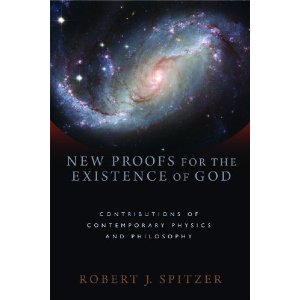
Robert Spitzer’s New Proofs for the Existence of God (hereafter NPEG) presents in rigorous detail, five arguments for the existence of God, a section discussing the plausibility of multiverse/string universe scenarios, and some philosophical discussion on methodology.
Before continuing the review, I should note that the “New” in NPEG is nuanced. Spitzer notes this himself (my guess is that it was a marketing technique. “New” refers to the evidence from cosmology and further research in philosophy which lend new power for these arguments.
Chapter 1 presents a cosmological argument. Spitzer cogently argues that “(1) If there is a reasonable likelihood of a beginning of the universe… and (2) if it is apriori true that ‘from nothing, only nothing comes,’ then it is reasonably likely that the universe came from something which is not physical reality” (Spitzer, 45). This conclusion is supported by explorations of current cosmological theories about the origins of the universe.
Chapter 2 presents the teleological argument, which Spitzer bases on the universal constants. The argument leads to the conclusion that “the odds against an anthropic condition occurring are astronomically high, making any life form… exceedingly improbable.” It is a probabilistic argument, the likes of which I defend in my article Past, Probability, and Teleology (Hope’s Reason 2011-1).
Following chapter 2 is a chapter which discusses the possibilities of inflationary cosmology and the string multiverse written by Bruce Gordon. It is extremely technical and will provide readers with cogent arguments against the possibility of a multiverse scenario circumventing the previous arguments.
Chapter 3 presents Spitzer’s metaphysical argument for the existence of God, which is full of sound argumentation along with some interesting Thomistic Philosophy wherein he discusses God’s simplicity in the most coherent way I have read. I greatly encourage readers to look into this chapter, if only for the discussion of this oft-neglected doctrine.
Spitzer follows this with Chapter 4’s metaphysical argument derived from Bernard Lonergan’s Insight, which is a subtle version of the argument from reason. This chapter was particularly good because it focuses on a little-used type of arguments for the existence of God–that if our universe is intelligible, that can only be explained by God’s existence.
Chapter 5 is an argument from contingency similar to the Leibnizian cosmological argument.
Chapter 6 engages the question of method in philosophy along with whether atheism is actually rational. I was intially put off by the title of this chapter (“Methodological Considerations and the Impossibility of Disproving God”), but happened throughout the book, I was pleasantly surprised by the rigorous arguments and enlightening conclusions Spitzer laid out.
Finally, the last two chapters outline some more considerations about the universe and the relation of humans and God.
NPEG was a surprising read for me. I went in with neutral expectations, and those were blown away. Spitzer’s knowledge of the topics in the work runs deep, and his writing style is clear and cohesive. It is genuinely exciting to read. Readers will be challenged by the arguments for the existence of God, and engaged in the details and philosophical explanations of these arguments. I highly recommend this work to those interested in advanced books on arguments for God’s existence.
——
The preceding post is the property of J.W. Wartick (apart from citations, which are the property of their respective owners) and should not be reproduced in part or in whole without the expressed consent of the author. All content on this site is the property of J.W. Wartick and is made available for individual and personal usage. If you cite from these documents, whether for personal or professional purposes, please give appropriate citation and provide a link to the original URL. By viewing any part of this site, you are agreeing to this usage policy.
The Ontological Argument: Question Begging?
 Is the ontological argument question begging? Short answer: some versions yes, others, no. For the long answer, read on:
Many versions of the ontological argument appear to beg the question. The Anselmian version of the argument seems invalid, but there are other formulations of it which avoid its invalidity (cf. Maydole’s chapter on the Ontological Argument in The Blackwell Companion to Natural Theology, eds. Craig + Moreland, 553ff). Then, Alvin Plantinga came along and introduced the modal ontological argument, which relies on S5 modal logic. I have discussed Plantinga’s argument elsewhere, as well as demonstrated its validity.
Therefore, we will focus on a new considerations. Consider the following very simple version of the modal ontological argument:
1) Possibly, God necessarily exists
2) Therefore, God necessarily exists
The argument seems, at first face, to be a very strange argument. However, the argument does not beg the question when viewed through modal logic. 1) does follow from 2) in a non-tautological way, but 1) must be established.
Symbolically, the argument is written as the following (Take “T” to be “God exists”):
1) ◊□T
2) □T
S5 modal logic is based upon this very axiom. Namely, ◊□x⊃□x or ◊□x iff □x (Hughes & Cressewell, A New Introduction to Modal Logic, 58). For in modal logic:
3) that which is “possible” exists in “some possible world.”
4) That which is necessary exists in all possible worlds
Therefore, if something is possibly necessary, then it must obtain in some possible world (3). however, if it is necessary, then it exists in all possible worlds (4). Therefore, if something is possibly (exists in some possible world) necessary (exists in all possible worlds), then it exists in all possible worlds.
Is this argument question begging? If it is, then it is not obviously so. Alexander Pruss has argued out that the argument is question begging only if it is directed at one who does not understand that 1) entails 2) (Pruss, The Principle of Sufficient Reason, 232). I’m not convinced that this is correct. Soundness of arguments don’t depend upon whether people understand them–they depend on whether they are valid or true. However, it seems Pruss has an intuitive point here, in that even if this argument isn’t question begging, it appears to be.
How might the theist respond? Well, Pruss argues that if the theist argues for the establishment of S5, then it is no longer question begging (232). Alvin Plantinga does just that in God, Freedom, and Evil, as Pruss points out. We’ve already established elsewhere that Plantinga’s argument doesn’t beg the question regardless (see here), but this symbolic proof is bolstered by providing an argument for S5.
Then, it seems to be the case that if S5 modality is valid, God necessarily exists.
Are there versions of the ontological argument that resist this reduction to the “simplistic” version offered here? Yes, there are. For example, Stephen Parrish’s ontological argument:
5) The concept of the GPB (Greatest Possible Being) is coherent (and thus broadly logically possible)
6) Necessarily, a being who is the GPB is necessarily existent, and would have (at least) omnipotence, omniscience, and moral perfection essentially.
7) If the concept of the GPB is coherent, then it exists in all possible worlds.
8 ) But if it exists in all possible worlds, then it exists in the actual world.
9) The GPB exists (Parrish, God and Necessity, 82)
This argument may initially seem to be susceptible to the same reduction, but it can avoid this reduction by lengthening it to:
10) the GPB is coherent (and logically possible)
11) the GPB’s coherence entails modal possibility
12) the GPB is necessary
13) modally, if something is possibly necessary, then it is necessary
14) the GPB exists necessarily
The key premise here is 10), because if it is true, then the rest of the argument follows necessarily. What reasons do we have for thinking 10) is true? Such a debate is beyond the scope of this post (good discussions can be found throughout theistic philosophy of religion–see, in particular, Craig and Moreland, Philosophical Foundations for a Christian Worldview and Swinburne, The Coherence of Theism; see also my brief discussion in the post on the argument here); but it seems to me that there is no incoherence in the concept. If that is the case, then I am justified in holding 14).
Therefore, it seems the modal ontological argument is not question begging, particularly if one argues first for the validity of S5 modality. Furthermore, there are other modal arguments which don’t rely on a reduction to a simple modal argument. For example, Parrish’s ontological argument relies instead upon the coherence of the GPB. Such arguments are successful if arguments against the GPB’s coherence are shown to be unsuccessful. In either case, God exists.
Ergo deus est.
SDG.
Sources:
Maydole, Robert E. “The Ontological Argument.” The Blackwell Companion to Natural Theology. Edited William Lane Craig and J.P. Moreland. Blackwell, 2009.
Parrish, Stephen E. God and Necessity. University Press of America. 1997.
Pruss, Alexander. The Principle of Sufficient Reason. Cambridge. 2006.
——
The preceding post is the property of J.W. Wartick (apart from citations, which are the property of their respective owners) and should not be reproduced in part or in whole without the expressed consent of the author. All content on this site is the property of J.W. Wartick and is made available for individual and personal usage. If you cite from these documents, whether for personal or professional purposes, please give appropriate citation and provide a link to the original URL. By viewing any part of this site, you are agreeing to this usage policy.
Atheism’s Universe is Meaningless and Valueless
 “‘Meaningless! Meaningless!’
says the Teacher.
‘Utterly meaningless!
Everything is meaningless.'” – Ecclesiastes 1:2
My most recent post on the problem of evil granting empirical atheism generated some thoughtful discussion. Most importantly, it lead me to the following argument:
1) On materialistic [I use materialism and physicalism interchangeably, as is common in philosophy today] atheism, all we are is matter in motion.
2) There is no objective reason to value matter moving in way A over matter moving in way B
3) Therefore, on materialistic atheism, there is no value or meaning
Premise 1 seems self-evident. Materialistic atheism, by definition, says that “everything is physical, or as contemporary philosophers sometimes put it, that everything supervenes on, or is necessitated by, the physical” (Stanford Encyclopedia of Philosophy). The physical world is matter.
Premise 2 also seems like it should need little defense, yet atheists continually come up with ideas to try to get around it. For example, one may argue that the subjective suffering of persons should matter. Yet I fail to see how this argument succeeds. Pain and suffering, on materialism, at most supervenes upon neurons firing in the brain (along with chemical reactions and other physical phenomenon). My question for the materialist is: What reason can be provided for favoring matter moving in way A (call it, the way neurons fire when someone is in a state of bliss) over matter moving in way B (neurons firing in the way which causes pain)?
One answer which may be forthcoming is that creatures and persons tend to try to get away from things which cause B. This argument fails to provide an answer to the question, because all it does is push the question back to a higher level. It would change to: Why should we favor physical observable phenomenon which don’t cause avoidance over those that do? Again, the avoidance of B would simply be matter moving in a different way. In order to make a judgment between them, one would have to reach beyond the material world and into the world of objective meaning and value; this is, necessarily, a world which is nonexistent on materialism. Even if one could provide an answer to this second question, say “We tend to not like B. Things we don’t like are bad”, then we would have a purely subjective reality. What of the serial killer who delights in torturing himself, causing things to B? What reason do we have for saying what he is doing is wrong, because, after all, he likes B?
Ultimately, on materialism, everything boils down to matter in motion. Making value judgments about matter in motion is meaningless.
But if everything is matter in motion, then there doesn’t seem to be any way to make value judgments. How does one value a rock over a stick? They’re both just stuff. But then, on materialism, people are just stuff too; albeit more complex. However, if you were to break us down into our ultimately realities, we are no different than the rock. We are matter organized in a different way. Why value us?
There is no objective reason to do so. Therefore, there is no objective meaning or value. Life is purposeless, meaningless, valueless. Atheistic materialism demands this bleak view of the universe. I’m not saying it’s a good reason to abandon that [un]belief. I’m merely saying that those who hold such a view must be consistent.
“Now all has been heard;
here is the conclusion of the matter:
Fear God and keep his commandments,
for this is the duty of all mankind.
For God will bring every deed into judgment,
including every hidden thing,
whether it is good or evil.” -Ecclesiastes 12:13-14
[In the comments, I have suggested that on materialism, there is no such thing as a subject. The claim has proven highly contentious, so I have created a post to clarify my position: https://jwwartick.com/2011/12/05/subjects-materialism/.]
Check out my post on the Ontology of Morality: Some Problems for Humanists and their friends
SDG
——
The preceding post is the property of J.W. Wartick (apart from citations, which are the property of their respective owners) and should not be reproduced in part or in whole without the expressed consent of the author. All content on this site is the property of J.W. Wartick and is made available for individual and personal usage. If you cite from these documents, whether for personal or professional purposes, please give appropriate citation and provide a link to the original URL. By viewing any part of this site, you are agreeing to this usage policy.
What Evil? (The Problem of Evil on Empiricism)
 The problem of evil is often seen to be the greatest philosophical challenge to theistic belief. The problem of evil is also most frequently raised by people who are ardent empiricists (which undergirds their atheism). There are many versions of empiricism, but the one we will investigate at the moment is naturalistic, atheistic empiricism, which holds both that there is nothing but the natural world in the sense of the world which can be directly accessed via the senses and only sensory, empirical evidence is sufficient evidence for holding a proposition to be true.
On this view, it seems extremely difficult to figure out what exactly evil is. Sam Harris is well known for trying to show that science is capable of dealing with moral issues (discussed here). The method basically involves finding out what makes people happy (which is “good”) and what makes them unhappy (which makes it “bad”) (see here). It remains totally unclear to me, however, how Harris makes the jump from “happy” to “objective good.” Measuring people’s happiness doesn’t mean measuring goodness. There are serial killers who are very happy to go about secretly killing as many people as possible. That doesn’t make their action “good”, unless you boil “good” down to a purely subjective basis, on which nothing can be decried as “evil” unless 100% of people agree it is indeed evil.
Returning to the problem of evil, then, it seems like theists can simply ask the atheists a question: “What evil?” Judging something as “evil” is necessarily a valuation of an action. How does one make an experiment which can make a value judgment? Certainly, one can try to argue, as does Harris, that values are just [scientific] facts (note that the theist agrees that moral values are facts… but facts centered on the nature of God, not on empirical grounds). But simply asserting something doesn’t make it so. I often say “God exists.” People don’t tend to take this as profound evidence that the statement is true. (Though, perhaps if I said “God exists is a fact.” I might win some over… at least those who take Harris seriously when he makes a similar claim about values in the video linked above.)
So the question remains: What evil? On an atheistic empirical standpoint, there doesn’t seem to be any way to judge actions or events as “evil” other than by saying “I don’t like that.” But perhaps I do like that same event/action. Who’s to judge between us? Bringing numbers into the mix won’t help either. Imagine a scenario in which 1,000,000 people thought some action (rape) was evil. On the other side there were 10,000 who thought the same action was perfectly reasonable, because, after all, that’s how our ancestors behaved. Who is right? Well, on empiricism, perhaps one could argue that the 1,000,000 are right, but then we’re making a judgment on values simply because of a majority vote. Science doesn’t work that way. We don’t just vote on what is empirically correct.
The only way to solve this problem would be to argue that in moral questions, the majority is correct. Yet I don’t see any way to argue in this matter other than metaphysically, which is exactly what the empiricist is trying to avoid. Therefore, on empiricism, there is no such thing as evil. Just good and bad feelings. And that’s not enough.
And so we get to my main argument.
1) One cannot rationally hold both to a proposition’s truth and falsehood.
2) On atheistic empiricism, there is no evil.
3) Atheistic empiricists argue that evil disproves (or challenges) the existence of God [implicit premise: evil exists].
4) Therefore, atheistic empiricists hold that both evil does not exist, and that it does exist (2, 3).
5) Therefore, atheistic empiricism is irrational (1, 4).
In order to avoid the argument, the atheistic empiricist can simply deny 3). However, this would disarm the strongest anti-theistic argument. I see no reason to feel threatened by the problem of evil when it is leveled by an empirical/naturalistic anti-theist. In fact, some have argued that:
1) If evil has meaning, then God exists.
2) Evil has meaning.
3) God exists (1, 2, modus ponens).
This argument is a kind of reverse moral argument, and I think it works, though I doubt one will find many anti-theists who will accept premise 1). As is the case with the moral argument [1) If objective morals exist, then God exists; 2) Objective morals exist; 3) therefore God exists], I believe atheists will vary between denying 1) and 2) as they find convenient.
I leave it to the naturalistic/empirical atheist to show that science can, in fact, test for objective morality, rather than just measuring feelings.
SDG.
——
The preceding post is the property of J.W. Wartick (apart from citations, which are the property of their respective owners) and should not be reproduced in part or in whole without the expressed consent of the author. All content on this site is the property of J.W. Wartick and is made available for individual and personal usage. If you cite from these documents, whether for personal or professional purposes, please give appropriate citation and provide a link to the original URL. By viewing any part of this site, you are agreeing to this usage policy.
Book Review: Theism and Ultimate Explanation by Timothy O’Connor
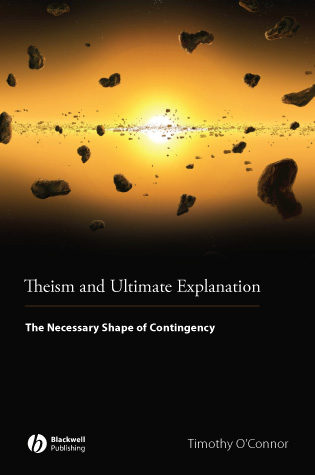 Timothy O’Connor’s brief Theism and Ultimate Explanation has already garnered much discussion since its publication in 2008. Notably, the most recent edition of Philosophia Christi features a book symposium on the work. What is all the fuss about?
Theism and Ultimate Explanation is broken into two parts. Part I addresses “The Explanatory Role of Necessity” while Part II addresses “The Necessary Shape of Contingency.”
Part I contains some fantastic arguments. O’Connor outlines various views on modality and seeks to defend modal realism, which takes modal truths to be actual truths about our world (and other worlds). Further, he defends the possibility of a priori truths against attacks from those who argue that all such truths need to be established empirically.
There are some who argue that empirical evidence (such as quantum mechanics) helps to undermine belief in some methods of reasoning, such as the law of non-contradiction, but O’Connor counters this by pointing out that those who make the argument that the “odd” data which may seem to contradict the method of reasoning against which their argument is directed are using the very methods of reasoning which they are trying to undermine. Another possibility is that the empiricist making this claim has switched to a different method of reasoning in order to critique that which holds to things like the law of non-contradiction, but O’Connor points out that a critique from such a method is “underwhelming” at best (46).
In Part II, O’Connor argues that it is coherent to ask the question, “Why is there anything (contingent) at all?” (65). He further argues that the only possible answer to this question is a termination in a necessary being. “If the universe truly is contingent, the obtaining of certain fundamental facts or other will be unexplained within empirical theory, whatever the topological structure of contingent reality… it will have to ground in some way… in a necessary being, something which has the reason for its existence within its own nature” (76).
He then turns to the question of what the nature of that necessary being may be, by examining two possibilities: “chaos” and “logos“. Logos is the view which calls the necessary being God, whilst chaos argues that it is a random being or a brute fact. O’Connor argues that logos is the most rational view to hold.
Finally, in chapter 6, O’Connor turns to theological reflections on the argument thus far. He argues that the concept of an immutable, timeless being seems contradictory to things like the trinity, but maintains that a less restricted of both of these views is plausible. He argues against molinism briefly, by stating that the counterfactuals involved would have no truthmakers.
O’Connor’s book weighs in at about 144 pages of text, but he makes use of every word. My biggest complaint about the book is how short it is. Often, it seems as though O’Connor simply doesn’t take the time to address the issues he is discussing in enough detail. Part I and the argument for the necessary being do seem to be adequately established, but chapter 6 in particular doesn’t do justice to opposing views. For example, the molinist could respond to O’Connor’s argument by saying that the “truthmaker” of such counterfactuals is simply existence in the mind of God. This could lead to an argument for determinism on molinism, but then the molinist could point to the distinction between de re and de dicto necessity. The arguments leveled against a timeless deity or an immutable one suffer similarly from limitations of space. I think O’Connor should have used the space of this chapter to expand the other ideas already present in his work.
As it stands, Theism and Ultimate Explanation is a fantastic work which is great reading for the philosopher of religion. It can be finished in one sitting, but the ideas therein will keep readers contemplating the work for quite a while afterwards. It comes recommended, but with the stipulation that readers may be left wanting more.
SDG.
——
The preceding post is the property of J.W. Wartick (apart from citations, which are the property of their respective owners) and should not be reproduced in part or in whole without the expressed consent of the author. All content on this site is the property of J.W. Wartick and is made available for individual and personal usage. If you cite from these documents, whether for personal or professional purposes, please give appropriate citation and provide a link to the original URL. By viewing any part of this site, you are agreeing to this usage policy.
Book Review: Abortion and Unborn Human Life by Patrick Lee
 There are few ethical topics more controversial than abortion.Finding books on the topic is not very difficult, one needs only to search “abortion” on Amazon to find more than 10,000 results in the books category. Patrick Lee’s Abortion & Unborn Human Life (hereafter AUHL) stands out as one of the better pro-life books I have read, despite one major flaw.
AUHL starts with a syllogism:
1) Intentionally killing an innocent person always is morally wrong
2) Abortion is the intentional killing of an innocent person
3) Therefore, abortion is always morally wrong.
The rest of the book (164 pages of content) serves to defend this syllogism.
Chapter one argues against the idea that unborn human beings become persons after birth. Lee’s arguments are very good until he starts to argue by going against substance dualism to make his case. I think that this is a major flaw of Patrick Lee’s book. Substance dualism serves as a powerful argument against abortion. Not only that, but to argue against substance dualism primarily for the sake of an ethical position doesn’t make a lot of sense. Lee does introduces several philosophical arguments against dualism, but they fail to make a sufficient case against the position. This makes the rest of his case seem weaker than it is, had it been bolstered by substance dualism rather than arguing against it. It is really unfortunate, because readers may walk away thinking that the case against humans becoming persons after birth is weaker than it is.
In chapter two, Lee argues against the idea that human beings become persons during gestation. This chapter is particularly strong, and Lee introduces many arguments I hadn’t thought about before. Particularly important to this argument is what it means to have “moral standing.” Often, pro-life advocates forget that we sometimes don’t share the same basic presuppositions as the pro-choice advocates. Lee helps to bring the focus back to the basics (I have focused on this elsewhere myself, see here).
Lee argues in chapter 3 that individual human beings come to be at the moment of fertilization. This is another very strong chapter in which Lee offers scientific and philosophical reasons to accept this position.
Chapters 4 and 5 address the particularly chilling (and more recent) arguments that abortion can be justified as non-intentional killing of human beings (4) or that preventing certain consequences permit the killing of human beings (5).
Overall, AUHL is a fantastic read. Lee produces a compelling and powerful case that abortion is morally wrong, no matter what. Despite the rather large flaw of arguing against substance dualism, the book is a must-read for those interested in a philosophical defense of the pro-life position.
Abortion and Unborn Human Life
——
The preceding post is the property of J.W. Wartick (apart from citations, which are the property of their respective owners) and should not be reproduced in part or in whole without the expressed consent of the author. All content on this site is the property of J.W. Wartick and is made available for individual and personal usage. If you cite from these documents, whether for personal or professional purposes, please give appropriate citation and provide a link to the original URL. By viewing any part of this site, you are agreeing to this usage policy.
Arguing for Deism?

One curious objection I have seen and heard to arguments for the existence of God is that these arguments apply to deism, not Christianity. For example, Michael, an atheist blogger, writes, “Note that these are effectively arguments for deism, not Christianity!” about the Moral Argument (here). Another example is found in the irrational and rather virulent attack on theistic argument (laughably, they use Dawkins as the primary source for saying that all arguments for God’s existence have been refuted) can be found here. The author, confused about the implications of the cosmological argument, writes, “YECers actually deny the Big Bang, but Craig appears to be a deist.”
I must confess at least a little confusion about these comment and others which I have seen and heard. The objection seems to be that an argument for the existence of God (such as the cosmological argument) that could be utilized for deism doesn’t help the epistemic justification for belief in the Christian God. This objection is completely misguided, however, for a number of reasons.
First, Michael objects in this way in his discussion of the Moral Argument. But deism is the belief in “a creator who has established the universe and its processes but does not respond to human prayer or need” (Honderich, 195 cited below). Clearly, then, this god of deism cannot be the God towards which the Moral Argument points. The moral argument places God as the objective standard of morality for the universe (note, it doesn’t place God as the arbitrary decision maker for what is right or wrong–but argues that God has objective goodness necessarily or essentially, thus avoiding the Euthyphro dilemma Michael presses). It is hard to see how a god which doesn’t care about or respond to human need could be the objective standard of morality.
Second, the classic arguments for the existence of God don’t each point specifically to the Christian God, but serve as a cumulative case to demonstrate His existence and attributes. The Moral Argument argues for omnibenevolence; the teleological argument demonstrates omniscience and omnipotence (along with omnibenevolence, to a lesser extent); the cosmological argument illustrates omnipotence, transcendence, and necessary existence; the transcendental argument shows God’s transcendence and necessity; the ontological argument combines all of the attributes into its first premise (usually); the argument from consciousness demonstrates God as mind; the argument from reason demonstrates the rationality of God; the list could continue. Furthermore, almost all of these arguments show that God is personal, and therefore, by definition, not deistic but theistic. The objection is specious already.
Furthermore, how is it an objection to these arguments to say that they don’t each individually demonstrate the Christian God is the one true God? This seems to be a confusion about how arguments work. Argumenst for the existence of a god, as long as they don’t contradict the God of Christianity, can be taken as evidence for the existence of the God, namely, the Christian God.
Take an example of a case in court. A man is accused of committing murder. The victim was found hung in his room. The prosecuting attorney argues that the accused had the means–he recently bought some rope. He then argues the accused had motive–the victim had recently gotten a promotion for which the accused was vying. He also shows that the accused has rope marks on his hand and scratch marks on his face, which show the struggle which occurred as the accused allegedly hung the victim. He argues, finally, the accused had opportunity–he was in the room at the time the victim died and he was also the only other person in the room.
Now imagine how ridiculous it would be if the defense attorney stood up and complained that these arguments don’t really apply to the case at hand, because none of them demonstrates the accused committed the murder! They just show, individually, that he had means, motive, and opportunity; not to mention the strong evidence for the accused being involved in a struggle with some rope and another person. But to demonstrate the guilt of the accused, the defense continues, the prosecution must come up with an argument that demonstrates all of these things at once! Otherwise, they just demonstrate the other things individually!
Obviously, the defense attorney has something wrong here. But then the atheistic objector also has something wrong. The Christian philosopher of religion has argued that God is omnipotent, omniscient, omnibenevolent, transcendent, necessary, etc.; the atheist responded by saying “those arguments individually only demonstrate a deistic God!” [Discounting, for the moment, that a deistic God wouldn’t share some of these attributes.] But that isn’t how the arguments work. Any argument which demonstrates that a God exists, as long as that God is not contradictory to the Christian God, can serve as evidence for the existence of the Christian God.
Source:
Ted Honderich, ed., The Oxford Guide to Philosophy (New York, NY: Oxford, 2005).
——
The preceding post is the property of J.W. Wartick (apart from citations, which are the property of their respective owners) and should not be reproduced in part or in whole without the expressed consent of the author. All content on this site is the property of J.W. Wartick and is made available for individual and personal usage. If you cite from these documents, whether for personal or professional purposes, please give appropriate citation and provide a link to the original URL. By viewing any part of this site, you are agreeing to this usage policy.
The Case for Dualism: Against Monism
.png "667px-Consciousness_phenomenal-functional_(en)") Substance dualism seems to be the most reasonable position when it comes to consciousness. I’m going to be exploring the reasons for this throughout several posts.
Substance dualism seems to be the most reasonable position when it comes to consciousness. I’m going to be exploring the reasons for this throughout several posts.
Substance dualism is the idea that our conscious self is a combination of both a physical and non-physical reality. That is, our consciousness is not just neurons firing in the brain, but also some kind of phenomenal self, which is separate from the physical realm.
One reason for holding to substance dualism is that it avoids the problems of monistic physicalism. Physicalism argues that our conscious self is literally the brain. There is nothing but neurons firing in the brain (okay, it’s a lot more complicated than that, but the general idea is that our brain is our “self”).
Physicalism, therefore, leads to a kind of monism–everything is matter. Depending on which physicalist philosopher one prefers, this can lead to all sorts of problems. We can see this when we examine what exactly composes a “thought.” On dualism, a “thought” is a non-physical, phenomenal experience of the “self”–which is generally referred to either as “mind” or “soul.” On physicalism, a “thought” is identical with a brain state.
In other words, on Physicalism:
Brain state A => Mental state A’
Brain state B => Mental state B’
And so on.
When I experience thought A’, it is because of a prior brain state, A. My mental states are either identical to, or supervenient upon, the physical state of my brain. The problem with this is that it relegates mental states to epiphenomenalism. That is, if a mental state is wholly dependent on a brain state, the mental state is superfluous. This is because the mental state is entirely dependent upon (or identical to) the brain state. On physicalism, a mental state does not occur without a brain state occurring prior to, or in conjunction with, it.
This, in turn, leads to epiphenomenalism because the mental state is, as I said, superfluous. If it is always the case that Brain state A=> Mental state A’, then Brain state A causes whatever actions we take, for the brain state entails the mental state, which itself is identical to or supervenient upon the brain state to exist. But then, if we cut mental state A’ out of the equation, we would still have Brain state A and the action. Thus, consciousness is entirely superfluous.
Another problem with this is that it also means consciousness doesn’t have to have any connection with the actual world. Our brain states could be causing all kinds of wild mental states which are completely unconnected to what is happening outside of our “self,” but we would never know it or act differently. I could be having the mental states of pigs flying and eating buffaloes as I write this, but it wouldn’t matter because the brain state is what is causative. The mental state is simply a byproduct of the brain state. Or, we could all be zombies, without any kind of phenomenal consciousness, and yet still be performing the same actions.
Yet another problem, on the physicalist perspective, is that there seems to be no reason for our mental states to line up with reality. Why is it that despite the fact that our brain state is causing all of our actions, or mental state seems to line up with those actions? There doesn’t seem to be any reason our mental states should line up with reality. One response could be that we have no reason to suppose they do line up with reality, but then we have no reason to trust anything we “think” and should give up whatever positions we do hold.
Of course, monistic physicalism actually argues that there is no mental state A’ generated by brain state A, but I don’t see any reason for believing this is true, for they are of two completely different kinds. One is gray mush, the other is a phenomenal image of a cat. One is composed of neurons shooting impulses to and fro, the other is the idea that “I wish I had eaten breakfast.” The law of identity states that A = A. But, according to monistic physicalism, my gray mush/neurons firing = image of cat. This is simply false.
So, I have no reason to accept physicalism on any of these formulations, and every reason to reject it. Physicalism is epiphenomenal, gives us reasons to doubt our basic intuitions, and makes any thoughts we have completely arbitrary.
——
The preceding post is the property of J.W. Wartick (apart from citations, which are the property of their respective owners) and should not be reproduced in part or in whole without the expressed consent of the author. All content on this site is the property of J.W. Wartick and is made available for individual and personal usage. If you cite from these documents, whether for personal or professional purposes, please give appropriate citation and provide a link to the original URL. By viewing any part of this site, you are agreeing to this usage policy.
The Myth of Atheism: Is it (epistemic) Neutral Ground?
 Is there such a thing as epistemic neutral ground? The question deserves serious consideration, for if there is epistemic neutral ground, surely we should all stand upon it in order to evaluate worldviews. The reason for this is because the ability to strip away all bias and preconceptions and simply evaluate a worldview “as is” without any pretensions would be highly invaluable. I’ve run into atheists who seem to think that atheism somehow counts as this epistemic neutral ground. I think there is good reason to doubt that there is such a thing as epistemic neutral ground; and if there is, atheism is surely not it.
What reason do we have for thinking atheism is neutral ground? Those who argue that it is tend to say that it is neutral ground because they reject all religions a priori, which allows them to evaluate religious truth more fairly. This seems clearly misguided; rejecting all alternative worldviews hardly means that one is on neutral ground. In fact, it is more like dogmatics than neutrality.
But is atheism really a worldview, properly formulated? If it is not, can it serve as our elusive neutral ground? There is no doubt that those who are nontheists share little in common other than the simple attribution of “not believing in God” or “believing there is no God”. There are atheists who are buddhists; atheists who believe in ghosts; atheists who are staunch secular humanists. There doesn’t seem to be any shared connection. Does this mean it is not a worldview? I think the answer is yes and no. Atheism, construed as some kind of singular entity, is not a worldview. Rather, each atheists has his or her own worldview–part of which is atheism. Analyzed in this light, then, atheism is a piece of the fabric weaving together a worldview, not the worldview itself.
Does this, then, allow for atheism to be epistemic neutral ground? Again, I don’t see why it would. What reasons are there for favoring atheism as a research program (borrowing the phrase from Michael Rea) over theism? Again, it seems the only answer could be that it rejects all gods, so it somehow must allow for equal evaluation of other views. This still seems totally misguided. Why does rejecting all things make one neutral? If I am presented with some event, e, and possible explanations for e, A, B, and C, and then I reject A, B, and C, does this somehow make me neutral towards A-C? No! It means I reject them as explanations for e! Perhaps this is because I have my own explanation for e, or believe that e cannot be explained, but that doesn’t mean I am neutral towards the explanations which have been offered.
It therefore seems as though atheism cannot serve as epistemic neutral ground, either as a worldview itself, or as a method for research. Can alternative views suffice? It seems as though logic could serve as a research method which can be epistemically neutral. The immediate objection to this could be that there are those who reject logic and claim that there can be contradictions, impossibilities, and the like. My answer to this is that even those who reject logic can only claim to do so for logical reasons. In other words, they formulate logical arguments in order to argue that logic is false. It seems as though if someone has to assume the truth of some proposition (in this case that logic is true) in order to argue against that same proposition, then their arguments can in no way undermine the truth of that proposition.
I’m happy to follow logic where it leads. It seems to me that it leads straight towards the existence of God. Why? I’ve discussed this elsewhere: the Liebnizian Cosmological Argument, the Ontological Argument, Purposively Available Evidence, and the Teleological Argument. I’ve written on this same subject here.
– – –
Image: Copyright CalistaZ. Accessed http://commons.wikimedia.org/wiki/File:Lavaux_Alpes_et_Lac_l%C3%A9man.jpg
——
The preceding post is the property of J.W. Wartick (apart from citations, which are the property of their respective owners) and should not be reproduced in part or in whole without the expressed consent of the author. All content on this site is the property of J.W. Wartick and is made available for individual and personal usage. If you cite from these documents, whether for personal or professional purposes, please give appropriate citation and provide a link to the original URL. By viewing any part of this site, you are agreeing to this usage policy.
Process Philosophy and Nonsensationalism
 This post is part of a series on Process Philosophy. View other posts in the series here.
Process Philosophy is meant to be appealing due to its integration of science and religion. This, in some ways, means concessions on both sides. Process Philosophy sacrifices some truths of religions in order to make it more appealing to science, while also denying some of the dogmatics of materialism in order to allow for religious truth.
One way it denies materialism is through its adherence to nonsensationalism. Nonsensationalism is the view that the kind of experience which is most basic to our human existence and knowledge is not that which we know through our 5 senses. Whitehead, for example, wrote that “science conceived as resting on mere sense perception, with no other source of observation, is bankrupt” (quoted in Griffin, 54). Furhtermore, philosophy “went wrong epistemologically… in holding that all… perception had to be sensory perception” (Griffin, 55).
Process Philosophy favors a “more fundamental mode of perception” (Griffin, 60). This form of perception is, to put it simply, experience or”prehension.” Part of this experience is being able to perceive causal links around us, despite not having sensory data to confirm the causal chain (60). One example of this nonsensory perception is the perception of one’s own body. There is a kind of immediacy to the awareness of one’s hands which does not involve any of the senses. Rather, one simply knows they are there and is able to experience them nonsensationally. We get sensations from the parts of our body, but this is not what grants us awareness; that which grants us awareness is more fundamental than, for example, touch (61-63).
Another example is the awareness of one’s own past. This is a continual problem with materialistic naturalism, and Process Philosophy presses this problem home. How does one use sensation to “remember” their past? The answer is that they don’t; rather, one is aware of the past with a kind of immediacy not provided by sensation. Yes, there are sensations which accompany memories, but they do not provide sense data to justify memories epistemically (64ff).
This doctrine of nonsensationalism is perhaps one of the most friendly parts of Process Philosophy to the Christian. While Process Philosophy explicitly denies substance dualism, I think its ideas about nonsensational awareness of things provides solid evidential basis for dualism. Furthermore, this doctrine of nonsensationalism as the more fundamental aspect of reality allows for religious experience to be a very real and evidential experience, for people perceive many of these religious experiences without sensation, but with the kind of immediacy that overcomes sensation totally (Griffin, 76ff). Therefore, it seems to me that at least this aspect of Process Philosophy is worth adopting by the classical theist. Next time, we’ll examine a doctrine which is not so friendly.
Source:
Griffin, David Ray. Reenchantment Without Supernaturalism: A Process Philosophy of Religion. Cornell University Press. 2001.
——
The preceding post is the property of J.W. Wartick (apart from citations, which are the property of their respective owners) and should not be reproduced in part or in whole without the expressed consent of the author. All content on this site is the property of J.W. Wartick and is made available for individual and personal usage. If you cite from these documents, whether for personal or professional purposes, please give appropriate citation and provide a link to the original URL. By viewing any part of this site, you are agreeing to this usage policy.

 J.W. Wartick - Reconstructing Faith