Egalitarianism
“Cross Roads” by Wm. Paul Young- An Evangelical’s Perspective
 One of the biggest publishing phenomena of late, The Shack

Free Will
The notion of crossroads is a major theme throughout the work, and Young utilizes the imagery to discuss free will metaphorically. Anthony Spencer (Tony), the main character, finds himself inside his mind, which is portrayed as a kind of land with various roads and places inside it. Initially, he begins exploring this land and finds himself coming to numerous forks in the road. He continues to find these forks and realizes that as he continues to make choices, “it occurred to Tony that the number of direction decisions was diminishing; options were significantly decreasing” (35). Young doesn’t expand on this much, but it seems like a vivid illustration of libertarian free will, wherein one’s choices in the past do indeed influence their choices in the future. As Tony makes choices on his path, he finds that the choices available to him decrease. The reason, it seems, is because his choices have started to form his world. It seems to me that this is a great way to show libertarian free will in literature.
Church
A robust theology of church and salvation is something that I think is necessary for an adequate theology. I find one reason for this illustrated well by Young:
Church, thought Tony. He hadn’t set foot inside one of those since his last foster family had been religious. He and Jake [Tony’s brother] had been required to sit silently for what seemed like hours… He smiled to himself, remembering how he and Jake had schemed together and ‘gone forward’ one night at church, thinking it would win them points with the family, which it did. The attention their conversions garnered was initially rewarding, but it soon became clear that ‘asking Jesus into your heart’ dramatically increased expectations for strict obedience to a host of rules they hadn’t anticipated. He soon became a ‘backslider,’ in a category, he discovered, that was profoundly worse than being pagan in the first place. (124)
It seems clear to me that here the act of conversion has itself become a work, rather than a gift of grace. Tony’s concept of conversion at this point in the book is that of “asking Jesus into your heart.” Unsurprisingly, when he fails to perform other adequate works–obeying a set of rules. The problem with this theology should become clear immediately. By suggesting that Christianity is about “going forward” and publicly affirming a faith, this form of theology puts the believer in the position of affirming faith, rather than receiving it as a gift. When faith becomes a public work, it becomes the Law instead of the Gospel. When demands for works are made on faith, then faith itself becomes a work. Unfortunately, this kind of works-righteousness sneaks into theology at all levels, ever seeking a place to grow.
The problems with this theology are portrayed vividly in this illustration. The notion that people need to make a public declaration of faith leads to its abuse, as Tony and Jake attempted to do, but it also leads to difficulties for those who believe their declaration was itself true (unlike Tony and Jake, who simply did it to glorify themselves in the eyes of their foster parents). When someone makes their “decision for Christ,” their faith life becomes wrapped up in that decision. Their walk with God is contingent upon their continuing to make this decision. Unfortunately, this type of theology makes faith all about one’s own decisions, rather than Christ’s justification and the free gift of faith.
Women
There are many church bodies who do not ordain women to the office of the ministry. That is, they hold beliefs that say women should not be spiritual leaders of men in the church. Young explores this issue when Pastor Skor shows up and challenges Maggie, one of the main characters, regarding her outburst during a church service. Pastor Skor takes Maggie’s outburst and disruptive behavior as a clue to him from God that he has been too lax in his instructing his congregation in the Bible. He makes an argument that women should not be leaders in church and should remain silent:
And we affirm the Word, which declares there is no longer male or female [Galatians 3:28], but… the Word is speaking of how God sees us, not about how we function in the church, and we must always remember that God is a God of order. It is vital that each person play their part, and as long as they stay within the roles that God has mandated, the church functions as it was meant to… (167)
The pastor goes on to quote 1 Corinthians 14:34-35 to support his position. Yet Young, through Clarence, an elder who is with the pastor to talk with Maggie, provides a counter-argument to this reasoning:
It is sarcasm… I believe that the apostle Paul was being sarcastic when he wrote what you read… He is quoting a letter that these folk sent him with questions, and he is in total disagreement with what they have written to him. (168-169)
Clarence defends this position by alluding to 1 Corinthians 14:36, apparently using the KJV: “What? came the word of God out from you? or came it unto you only?” Given the way this verse is worded, Clarence holds that verses 34-35 are a quote from a letter the Corinthians sent to Paul which Paul then responds to sarcastically by wondering whether the Corinthians think that God’s word came only to them.
Young’s offered interpretation seems possible, but perhaps not made explicit enough. It seems to me possible that Paul would have made it more clear that he was quoting another’s writing here. The KJV seems to support the interpretation given to 1 Cor 14:36 here, but other translations phrase it differently, in such a way that the verse seems to be more of a challenge to readers to dismiss what Paul is declaring in 34-35.
Of course, one could still argue that Young’s interpretation has great strength, noting that nowhere in the Bible do we see this command in the Scripture “as the law also says” and so we may infer that Paul is referencing an extra-biblical teaching and rebutting it. In fact, this seems to line up with Young’s argument perfectly because we can see that Paul would be citing a Judaizer’s teaching in the church in Corinth–who would hold that the silence of women is taught by the Law [Jewish extra-biblical law]–and then refuting this by noting that the word of God did not come from them alone (see Katharine Bushnell’s God’s Word to Women
Therefore, it seems to me that Young offers a fairly decent egalitarian interpretation of the passage, though he could have given other arguments which would take into account the passage’s cultural context, in which women were speaking out of turn in worship. The core of the statement seems to me to be that the women in this specific context needed to learn from their husbands at home and remain silent in church so that they did not cause disruption.
The way the scenario plays out in the book is also difficult to evaluate because Maggie definitely was disrupting the church service and would have appeared at least slightly crazy to those around her. She was screaming about a demon speaking to her and was, in fact, mistaken about that. I think she can be forgiven for her extreme reaction given the strange situation in which she found herself, but the Corinthians passage is in context all about order in worship in general, and certainly people bursting in screaming about demons would be disorderly worship.
Thus, it seems to me that Young offers a possible interpretation of 1 Corinthians 14:34-35, but he has made his case problematic by the narrative context in which he placed it. It is worth noting that this work will get people talking about the issue. Young has given a somewhat strong version of a lengthy egalitarian argument in the form of narrative.
Practical Ethics and Disability
Cabby, a boy with Down’s Syndrome, is featured prominently throughout the book. Young uses him as a foil to show that those with disabilities have much to contribute to modern society. Perhaps the most poignant way he does this is through the negative portrayal of Tony’s view of Cabby:
Tony had never known a ‘retarded’ person. He wasn’t sure if that is what you called them… His opinions on most nonbusiness matters may not have been founded on evidence or experience, but he was sure of them. People like Cabby were an unproductive drain on the resources of society; they were valuable only to their families. He believed they were tolerated because of liberal persuasions, not because such people had any intrinsic worth… It is easy to create a category of persons, like retarded or handicapped, and then pass judgment on the group as a whole. He wondered if that was not the heart of all prejudice. (108-109)
In contrast to Tony’s view, Cabby turns out to be insightful and delightful. He is shown to have positive value in a number of ways that go beyond his immediate family. He ultimately shows the practical usefulness of inherent human worth.
God
For Young, understanding God as relationship is central to the concept of deity. The concept of deity that is presented is that of Trinity. Much ink will be spilled, I feel certain, on whether or not Young portrays the persons of the Trinity correctly, just as there was in The Shack (see my own discussion here).
Young’s position seems to be largely unchanged from that in The Shack, and so much of the commentary will follow the same line. I think he does a very good job of exploring the inter-relational character of God and the temporal submission of Christ in the incarnation to God the Father. Some may see the primary difficulty with Young’s portrayal of God is that the Father makes very little appearance in the book, but near the end readers find out that is not the case. In fact, the Father is intricately involved in all aspects of God and the life portrayed in the novel.
Those who conceptualize God as inherently male will have a problem with the book, however. Unfortunately, some paganism has indeed hung on in the church, wherein some view God as a gendered being. In the Bible, however, we find that God is spirit and not a man. Thus, I think that Young’s use of gender with God may shock some but also underscores the fact that God is not a gendered being, and instead transcendent.
Historical Theology
Young offers a short discussion of historical theology and God that seems to me to at least partially miss the mark. It is very brief, but I think it is worth discussing. Young puts the following commentary in the mouth of Jesus himself:
The Greeks, with their love for isolation [of deity] influence Augustine and later Aquinas… and a nonrelational religious Christianity is born. Along come the Reformers, like Luther and Calvin, who do their best to send the Greeks back outside the Holy of Holies, but they are barely in the grave before the Greeks are resuscitated and invited back to teach in their schools of religion. The tenacity of bad ideas is rather remarkable, don’t you think? (73)
There are a number of problems with this small passage. First, Augustine heavily influenced both Calvin and Luther. In fact, Calvin’s theology is tied very intricately to Augustine’s view of free will and original sin. Similarly, Luther’s view of original sin derives directly from Augustine’s exposition in City of God. Second, it seems unfair to view Aquinas as a kind of anti-relationalist when it comes to God’s nature. Aquinas very much emphasized the triunity of God, which was (and is!) an extremely important topic. To thus accuse Aquinas of undermining God’s relational-ness seems unfair. Finally, the notion that the influence of Greek philosophy on Christianity is somehow inherently bad seems a bit shortsighted. There are innumerable positive contributions that reflection on Greek thought has brought into the fold of Christianity. Among these are the very concept of free will that Young pushes in his book, along with a number of aspects of Trinitarian and Incarnational theology that Young seems to support. This may seem to be a nitpick, but it seems to me that if Young is going to use his book to make comments about historical theology, it is vastly important to get that historical development right.
Conclusion
Cross Roads
SDG.
——
The preceding post is the property of J.W. Wartick (apart from citations, which are the property of their respective owners, and works of art as credited) and should not be reproduced in part or in whole without the expressed consent of the author. All content on this site is the property of J.W. Wartick and is made available for individual and personal usage. If you cite from these documents, whether for personal or professional purposes, please give appropriate citation with both the name of the author (J.W. Wartick) and a link to the original URL. If you’d like to repost a post, you may do so, provided you show less than half of the original post on your own site and link to the original post for the rest. You must also appropriately cite the post as noted above. This blog is protected by Creative Commons licensing. By viewing any part of this site, you are agreeing to this usage policy.
Book Review: “Good News for Women” by Rebecca Groothuis
 The debate over women’s roles in the home and in the church rages on. A large part of the debate has focused upon the Bible verses that either side raises in defense of their view. Little of the debate has focused on the philosophical implications of either position. Rebecca Groothuis’ Good News for Women
Groothuis first turns to a Biblical case for the equality of men and women. She bases this notion on several Biblical texts. She refers to God’s creation of both male and female in the image/likeness of God (21ff). Her argument also goes into Galatians 3:26-28 and notes how it again draws out the equality between male and female. Regarding the discussions of women’s silence in the churches, Groothuis parallels these passages to those about slaves submitting to their masters:
[T]he strategy of the New Testament church was to tolerate the social subordination of slaves and women so as not to risk alienating non-Christians from the gospel, and yet to modulate and moderate these customs, and ultimately to point beyond them to God’s original intention for human relations. Today, however, when non-Christians are not likely to be offended by an equalitarian gospel, but are likely to find a hierarchical gospel offensive, we have no reason to perpetuate the cultural practices that were intially intended for Christians living in patriarchal societies (25).
Groothuis concludes that throughout the Bible, there is a pattern in which male and female are equal in being. They are, in other words, ontologically equal. Neither is more valuable than the other.
It should be noted that most complementarians today are willing to grant this case. They agree that women and men are indeed created equal and should have equal rights. Groothuis then turns to a series of philosophical arguments which seek to demonstrate that the complementarian position cannot consistently hold that women are equal to men while holding that they are excluded from the ministry. Her argument, therefore, goes deeper than an exegetical challenge. Instead, her argument undermines the theological core groundings of complementarianism.
The very core of Groothuis’ argument is that complementarianism is grounded upon an ontological difference between male and female. The reason she holds that complementarinism must hold this position is “[b]ecause a woman’s traditionally inferior status follows necessarily from the single fact of her essential, female nature, her status is itself a function of her ‘being’ [ontology]; it is determined by what she is, not by what she can do” (53). Complementarians hold that women cannot hold certain offices of the church due only to the fact of her femininity. It is not based upon a functional subordination in which the female chooses to take up a role that is subordinate (62ff); instead, it must be grounded upon the female’s nature as a female. There is nothing about the female which limits her from being a pastor, on most contemporary complementarian positions (that is, those which no longer hold that women are excluded from the ministry simply because she is not as smart or gifted as men in general). Instead, it is exclusively her feminine nature which determines her role as subordinate. Therefore, it is part of her essential nature. I have argued this point myself elsewhere: “Women in the Ministry: The philosophy of equality and why complementarianism fails.”
Grothuis continues with extensive argument to rebut the notion of servant leadership (78ff). She also deals with various analogies complementarians use to attempt to ground equality and hierarchy, such as the Trinity (55ff–it should be noted that grounding subordination in the Trinity undermines the doctrine of the Godhead). It should become immediately apparent as to how this leads to a problem for complementarians. Biblically, they are forced to concede that women and men are, in fact, equal. However, their position undermines this Biblical position of the equality of men and women. Therefore, it seems their position fails.
Groothuis then turns to a number of strategies that complementarians have used in order to try to tie the subordination of women in to patterns of the Godhead. Unfortunately, many of these strategies end up making God into a gendered creature rather than a transcendent Creator. Some complementarians, such as C.S. Lewis, actually go so far as to make God male (93). Groothuis points out that this gendering of God cannot be affirmed based upon the Bible. One difficulty is that both male and female language is used of God (93-94). Yet she insists that the debate must not become a simple adding up of verses on either side to see how God illustrates either gender. That would turn God into a “God who suffers from some gender identity confusion” (93). Instead:
The view that God is both masculine and feminine confuses and distorts the image of God in humanity. It requires that the divine image be divided between women and men, such that women image God’s feminine aspects and men image God’s masculine aspects. This sexualizing of spiritual attributes renders men and women spiritual ‘opposites,’ creating a need to compartmentalize aspects of spiritual life and ministry into separate masculine and feminine quarters. (98)
Groothuis also spends some time dealing with some of the odd–and frankly, pagan–ideas used by some complementarians. For example, some argue that God must act as a male in the creation event: one who gives so much, while the created world merely receives. To be blunt, they describe God’s creative act as a sexual act, with no Biblical support. Groothuis rightly points out that this idea is little more than paganism dressed up in theism, but goes on to note that “It seems a good deal of imagination and determination is required in order to characterize the strenuous effort required of a woman’s body in nourishing, growing, and delivering a child as ‘overwhelmingly passive,’ while depicting the male role of standing around watching it happen as ‘active’!” (95). Another abuse of gender in the Godhead involves some complementarians arguing that because Jesus was a man, only men can be priests (109ff). Groothuis points out that “If we are to regard maleness as essential to who Christ is as Christ, not only must we question whether Jesus Christ can represent women as fully as he can men… we must also view women as essentially inferior to men. Women lack the Christlike attribute of maleness that renders men best qualified to represent Christ…” (113). Interestingly, then, complementarians who utilize this argument essentially undermine the doctrine of the atonement: for Christ’s maleness is emphasized to the point that Jesus is not an adequate representation of humanity. He is essentially male.
The second half of Good News for Women focuses upon an evaluation of the texts used to support complementarianism. These texts are examined in light of the theological points already established. Namely, women and men are created equally as imagers/likenesses of God; and that any attempt to ground hierarchy ultimate fails because it undermines this Biblical concept of equality. A full presentation of Groothuis’ analysis of these texts would probably triple the length of this review, and I don’t see any way to sum up these arguments adequately in a few sentences, so I unfortunately must leave it to those interested to read the book to see these analyses.
Finally, it would be remiss to go without mentioning the outstanding contribution Groothuis gives to the discussion of egalitarian marriage. Groothuis discusses marriage in detail for over 40 pages of the book. What is astonishing is how lucidly she lays out the principles of egalitarian marriage. She illustrates the nature of marriage and how it is a give-and-take with both persons involved as opposed to one ruling over the other. She also discusses in detail how such an egalitarian system can work without having anyone to have a vote to “trump” the other’s vote. Frankly, the book is worth reading just for her discussion on marriage.
Groothuis’ most important contribution here is in the first part of her book, which establishes a strong theological and philosophical case for the equality of men and women in teaching roles in the Church and equal roles in marriage. However, there are numerous important insights throughout the text, both into specific verses and into overarching themes in the debate from both the complementarian and egalitarian positions. Groothuis’ discussion of egalitarian marriage provides a way forward for discussion on the roles of men and women in marriage and also helps to give insight into the Biblical view of marriage. Overall Good News for Women
Links
See my other writings on egalitarianism on my theology page (scroll to the bottom).
I argue that certain complementarian arguments undermine the Trinity.
I review a book which focuses entirely upon exegetical issues related to egalitarianism: Man and Woman: One in Christ.
Source
Rebecca Groothuis, Good News for Women
SDG.
——
The preceding post is the property of J.W. Wartick (apart from citations, which are the property of their respective owners, and works of art as credited) and should not be reproduced in part or in whole without the expressed consent of the author. All content on this site is the property of J.W. Wartick and is made available for individual and personal usage. If you cite from these documents, whether for personal or professional purposes, please give appropriate citation with both the name of the author (J.W. Wartick) and a link to the original URL. If you’d like to repost a post, you may do so, provided you show less than half of the original post on your own site and link to the original post for the rest. You must also appropriately cite the post as noted above. This blog is protected by Creative Commons licensing. By viewing any part of this site, you are agreeing to this usage policy.
Religious Dialogue: A case study in science fiction with Bova and Weber
I love science fiction. One of the main reasons is because it provides a medium for authors to share their philosophical outlook for the world. Some authors portray their vision of what the world would like like if…. and what fills in that “if” is that which the author would like readers to be wary of our condemn. For example, distopian fiction often takes some aspect of society and shows how if we allow it to run rampant, we will create a world wherein we would not want to dwell. Other authors use science fiction to portray an ideal (or nearly ideal) society and show how the things they are promoting or believe fit into that ideal society.
Ben Bova and David Weber are two of my favorite science fiction authors. Bova blends hard science fiction (sci-fi which is largely focuses upon the applications of science that is at least seemingly possible) with great storytelling. His “Grand Tour” series of books is the story of humanity spreading across our solar system and even finding life on mars and founding a colony on the moon. David Weber writes military science fiction on an epic scale, complete with amazing battles in space (and who doesn’t like some big explosions in space?). I was fascinated to see both authors interact with Christianity, particularly on a fundamentalist level, and see how they took that discussion.
 David Weber
David Weber’s book, The Honor of the Queen
What really struck me is that David Weber fairly presented firm believers as a spectrum. He showed that believers can be reasoned with and even persuaded to believe differently based upon evidence. Furthermore, he showed that even those who may line up on the side with which he disagrees [presumably–I don’t know where he stands on the issue] are not all (or even mostly) blinded by faith or foolishness. Rather, although there are some truly evil and disillusioned people, Weber shows that many are capable of changing their position or at least acknowledging that rival views are worth consideration.
The most vivid portrayal of this theme is found in a conversation between Admiral Courvosier and Admiral Yakanov. Courvosier is from the same nation as Honor Harrington and wholly endorses his female officer in a position of command. They discuss Captain Honor Harrington:
[Yanakov responds to Courvosier’s question about his society’s reaction to Honor]: “If Captain Harrington is as outstanding an officer as you believe–asI believe–she invalidates all our concepts of womanhood. She means we’re wrong, that our religion is wrong. She means we’ve spent nine centuries being wrong… I think we can admit our error, in time. Not easily… but I believe we can do it.”
“Yet if we do[” Yanakov continues, “]what happens to Grayson [their world]? You’ve met two of my wives. I love all three of them dearly… but your Captain Harrington, just by existing, tells me I’ve made them less than they could have been… Less capable of her independence, her ability to accept responsibility and risk… How do I know where my doubts over their capability stop being genuine love and concern?”
The exchange is characteristic of the way Grayson’s people are treated throughout the book. They are real people, capable of interacting with other views in honest ways. They feel challenged by a view contrary to their own. Some react poorly, and there are extremists who are blinded by hatred and anger. Yet all of them are treated as people with real concerns shaped by their upbringing and backgrounds.
Honor Harrington ends up saving Grayson, and at the end of the book, she is commended by the rulers of that planet. She talks to the “Protector” [read: king/president]:
“You see,” [said the Protector] “we need you.”
“Need me, Sir?” [Responded Honor]
“Yes, Grayson faces tremendous changes… You’ll be the first woman in our history to hold land… and we need you as a model–and a challenge–as we bring our women fully into our society.”
Weber thus allows for even ardent supporters of specific religious backgrounds to respond to reasoned argument and to change. They are capable of interacting on a human level and deserve every bit of respect as those who disagree with them. Again, there are those who are radicals and will not be reasoned with, but they are the minority and they do not win out.
Weber therefore presents religious dialogue in The Honor of the Queen as a genuine interaction between real people from differing backgrounds. Those who are “fundamentalist” are capable of changing their views when challenged with a rival view which out-reasons their own. Religious dialogue is possible and fruitful.
 Ben Bova
Ben Bova’s whole “Grand Tour” series has a number of dealings with “fundamentalists.” He never really defines the term to be specifically Christian but one can tell when reading the books that it is pretty clear he is referencing hardcore fundamentalist evangelical Christianity.
I recently finished reading Mars Life
Bova’s treatment of extremist positions in religion is somewhat disingenuous in my opinion, particularly when one compares his portrayal with that of Weber. Bova tends to illustrate religious fundamentalists as a black and white issue. Basically, if you are a hardcore believer, you’re in it for power and control, you are willing to incite violence to achieve your ends, and you are incapable of reasoning. Again, note the contrasts with Weber’s depiction above. A few examples will help to draw this out.
On page 142 and following there is a discussion about putting together a panel to discuss the finding of a fossil on Mars. The interaction shows that no matter what, fundamentalists cannot accept scientific findings:
“Look,” said the bureau chief… “everybody’s calling it a fossil…. …”Call it an alleged fossil, then,” insisted the consultant (from the fundamentalists)… [The group then continues to suggest terms for the fossil:] “A probable fossil?” …”A possible fossil”… [Then, finally] “Say that the scientists believe it’s a fossil and until proven otherwise that’s what we’re going to call it.”
Here one can see that fundamentalism is intrinsically tied to an anti-science mentality. The key for them is to use words which deny absolutes, essentially skirting issues rather than discussing the truth. But that’s not all there is to it. Later on, one of the fundamentalists is engaged in a discussion about “requesting” that some lyrics in music they view as morally reprehensible be changed. The musician flat out refuses, angering the fundamentalist in the process. The section closes as follows:
[The musician] was shot to death at a Dog Dirt concert three months later. His killer surrendered easily to the police, smilingly explaining that he was doing God’s work.
What is interesting about this example is that it is illustrative of a number of such examples throughout the book. These are completely unrelated to the main plot. Rather, it seems what Bova is doing is very explicitly showing that fundamentalists are unafraid to use immoral tactics, censoring, and even incite violence in order to get their way. Theirs is an unquestioned and unquestionable faith. Those in power in fundamentalism are inherently evil and devious. They only want to control. Again, these asides are in no way tied to the plot of the book. It’s almost as though Bova is preaching a different worldview, one which views religiosity as inherently dangerous and violent, with few exceptions.
There is one positive example, however. A Roman Catholic, Monsignor Fulvio DiNardo, who is also a world-renowned geologist decides he wants to go to Mars to find the answer to a question about faith which is pressing on him. Namely, why God would exterminate an entire intelligent species. His thread in the story seems to show two things: first, that fundamentalism is inherently incapable of responding to reason; second, that it is possible to have reasoned faith and science together. The second point is illustrated very well when DiNardo is finally on Mars. He suffers from a likely stroke and is dying and begins a dialog with God:
Why did you kill them, Lord? They were intelligent. They must have worshipped You in some form or other. Why kill them? How could you–
And then DiNardo understood. Like a calming wave of love and peace, comprehension flowed through his soul at last… God had taken the Martians to Him! Of course. It was so simple, so pure. I should have seen it earlier. I should have known. My faith should have revealed the truth to me.
The good Lord took the Martians to Him. He ended their trial of tears in this world and brought them to eternal paradise. They must have fulfilled their mission. They must have shown their Creator the love and faith that He demands from us all. So He gave them their eternal reward…
The light was getting so bright… Glaring. Brilliant… Like staring into the sun. Like looking upon the face of… (297-298)
So Bova does offer a counterbalance to fundamentalism, and I appreciate that portrayal. Although DiNardo’s death and his revelation receives very little further comment (and no further comment at all on the revelation), it seems as though it is positively portrayed.
A reason for criticism is that Bova is uncompromising with fundamentalists. I’ve already drawn out his portrayal of them, and it seems to me to be a bit disingenuous. Although there are plenty on the “religious right” who would be all too happy to be able to legislate all morality, control the media, and deny well-attested scientific findings, I have hardly found that to be the majority. And certainly, fundamentalism is not a homogeneous entity filled with people who are trying to control everyone else. I’ll grant that this is a work of fiction, but in light of how Weber was able to handle a fairly similar issue with respectful portrayals of the ‘other side,’ I had hoped for more from Bova, whose work I enjoy greatly. For Bova, it seems, religious dialogue is not a real possibility, with few exceptions. Fundamentalists are incapable of reasoning and are barely even convinced believers; rather they are using their positions of authority within their organizations to consolidate power and execute their own prerogatives on their witless followers.
Fair Discussion
It seems pretty clear to me that David Weber provided a better model for utilizing science fiction in religious dialogue than Ben Bova did. The people representing the ‘bad guys’ in Weber’s book did have some who were truly evil and/or beyond reason, but also had many with whom reason resonated. When confronted with rival views, they were thoughtful and even receptive. On the other hand, the characters with whom Bova disagreed were a true black/white dichotomy with the “good guys.” Fundamentalists were bad. Period. He portrayed them as power-hungry, censor-happy maniacs. Although there was one notable exception (the Catholic priest, DiNardo), who showed a bright spot for “believers” at large, he was by far the exception.
It seems clear this study has applications for real-world dialogue about religion. When we interact with other worldviews, we should be capable of treating the other side with the same kind of dignity we would like to be treated. Although other worldviews may have their extremists who will not respond to reason, our attitude should be that of the humble friend trying to explore the beliefs of the “other.” The “other” is not that which must be demonized, but rather understood and with which to interact.
More Reading
I explore the theological implications of life on other planets.
I discuss a book which will change the way you think about about the notion that religion is violent. It also deals with the notion of the religious “other” as a construct.- William Cavanaugh’s The Myth of Religious Violence.
Sources
Ben Bova, Mars Life
David Weber, The Honor of the Queen
SDG.
——
The preceding post is the property of J.W. Wartick (apart from citations, which are the property of their respective owners, and works of art as credited) and should not be reproduced in part or in whole without the expressed consent of the author. All content on this site is the property of J.W. Wartick and is made available for individual and personal usage. If you cite from these documents, whether for personal or professional purposes, please give appropriate citation with both the name of the author (J.W. Wartick) and a link to the original URL. If you’d like to repost a post, you may do so, provided you show less than half of the original post on your own site and link to the original post for the rest. You must also appropriately cite the post as noted above. This blog is protected by Creative Commons licensing. By viewing any part of this site, you are agreeing to this usage policy.
Women, Complementarianism, and the Trinity- How getting subordination wrong has undermined the Trinity

[Please see note at end of this post for some qualifications added 2/1/15.]
Even though [God the Son] is in all ways equal to the Father and in no way inferior to the Father, he is nevertheless utterly subordinate to the Father… Christ’s relation as Son to his Father is therefore characterized by his subordination to the headship of the Father. (John Kleinig, 222-223 cited below)
In opposition to the above:
The subordination of Jesus Christ is this: it is his freely chosen submission ‘for us and for our salvation.’ The person of the Son is truly subordinate only for ‘economic’ reasons, and only insofar as these reasons entail being subordinate (and even thus far only contingently)–even while his full divinity, equality, and communion with the Father and Holy Spirit continues unabated, world without end. (Thomas McCall and Keith Yandell, 358, cited below)
The doctrine of the Trinity is a subject of enormous theological debate. One of the major debates of our time is social trinitarianism as opposed to substance views of the Trinity or other classical positions. However, another important area to explore is the nature of Christ’s submission to the Father. Paul writes in 1 Corinthians 15:28 “When he [God the Father] has done this [put all things under Christ’s feet], then the Son himself will be made subject to him who put everything under him, so that God may be all in all.” Some have argued that this means that Jesus Christ is eternally into the future, and even from eternity past, subordinate to God the Father (see Wayne Grudem and Bruce Ware for two examples of scholars who hold to this view–in fairness to John Kleinig, cited above, I do not include him as one of those who assert these positions because his view of the Trinity was not fully developed in the material from him to which I have access). We shall refer to this position as “necessary role subordination,” following McCall and Yandell.
What does such a position entail about the Trinity? First, if the functional subordination of the Son (and, very often, the Spirit is also said to be subordinate) is indeed necessary, then “it is necessarily true that the Father is authoritative over the Son, and the Son subordinate to the Father” (McCall and Yandell, 354). Why? Because the modal implications of this necessary subordination entails that the Father has, as an essential property, “being authoritative over the Son” (Ibid). Now, this in turn entails that the Father has an essential property the Son (and perhaps the Spirit) do not have. Then, by simple evaluation of the law of identity, the Father has different being than the Son and Spirit. Indeed, the Son would then be “heteroousios rather than homoousios.”
The error can be understood by viewing the Trinity within the substance based metaphysics from which the doctrine has been classically analyzed. As William Alston notes in his study of substance metaphysics and the Trinity, the formulation of the Trinity has been placed squarely within a substance metaphysics, and this provides a grounds for viewing the Trinity as three persons in one being (Alston, 183ff, cited below). Tying this into the laws of identity, one finds that in order for the Trinity of persons to be one being, none of them can lack essential properties of the others. But, as noted, once one asserts that the Son (and/or the Spirit) are necessarily subordinate to the Father, one has separated their essential properties and therefore confounded the Triune nature of God.
The Biblical arguments for such a position are fairly weak. For example, Ware and Grudem (and Kleinig, who does make this argument) argue that 1 Cor. 15:25ff entails the eternal subordination of the Son. But these verses explicitly state that “God may be in all in all.” It does not state “God the Father alone may be all in all” (I owe this point to McCall and Yandell, 342-344).
It may be that these theologians are not drawing this necessary role subordination from Scripture so much as allowing their other theological dispositions to color their trinitarianism. Grudem, Ware, and Kleinig are all explicit complementarians–that is, they restrict women from the ministry. Now please understand I absolutely do not think that complementarianism entails this position on the Trinity. However, I am asserting that complementarianism can color one’s perception of the doctrine of God.
Why think that the correlation between those who hold to necessary role subordination and complementarianism is interesting? First, because necessary role subordination, if true, would give some philosophical bolster to complementarianism; second, because at least one complementarian makes the connection himself.
Regarding the first point, complementarianism has been struggling with a major philosophical challenge presented by Rebecca Groothuis (among others). Namely, the problem of how to ground the subordination of women. Groothuis argues, essentially, as follows: If the permanent, comprehensive, and ontologically grounded subordination of women is justified, then women are inferior persons; Women are not inferior persons; Therefore, women’s subordination is not justified (Groothuis, cited below, 317). Now I’ve defended this argument elsewhere, and I think that some complementarians actually agree with the general argument. Instead of rejecting complementarianism, however, they choose to model their doctrine of the Trinity in order to try to preserve their position. How? By grounding subordination analogously in the submission of God the Son to God the Father. Here, Kleinig is an explicit example of this position. Following the quote at the beginning of this post, he writes, “Those who serve in [the pastoral ministry] pass on what they have received from God the Father through Christ… The exercise of the public ministry depends on this pattern of subordination within the church…” (Kleinig, 223). Now, the subordination of Christ, it is claimed, “has nothing to do with the dominance and power of the Father. It involves and expresses the harmony of the Son with the Father and his love for the Father” (Ibid). Thus, according to Kleinig, the model for women and men in the church is grounded in the Trinity, and because, according to him, the Son is subordinate to the Father yet remains equal, so too should women be subordinate to men and yet remain equal.
Does this complementarian view entail necessary role subordination? It seems so. For what is woman’s role subordinate upon? It seems it must be because of her being (for an argument to that end, see my post linked above and here). Yet her being is, of course, her essential nature. It is necessarily the case, therefore, that she is subordinate.
Finally, it is interesting to note that even were the egalitarian to grant to Ware, Grudem, and Kleinig their points about the Son’s subordination to the Father, it would not follow that the Trinity is an adequate model for women in the church. Why not? Kleinig essentially says it himself, “Now this call to subordination in the divinely instituted order of the church is based on the willing subordination of the Son to the Father” (Kleinig 223, emphasis mine). Well that’s exactly the point egalitarians make! Egalitarians argue that the roles of subordination in the church are taken willingly by those who serve at various levels. The laity has not been called to the ministry, and therefore willingly cede the authority of the office of the ministry to their ministers. It is a bit stunning to see Kleinig make this remark, for it also undermines his own case. Women, unlike Christ, are not [all] willingly subordinate. Rather, some very much would like to be ordained. Thus, if Christ’s subordination is grounded in his “willing subordination” then it seems that Kleinig’s case has completely evaporated. So too, of course, has the case of other complementarians who make this argument.
Do I think that those who make these arguments are heterodox? I wanted to explicate that I think that Ware, Kleinig, and Grudem are more likely victims of misuse of philosophical theology and their own presuppositions than they are actually trying to claim that the Trinity is not of one being. Certainly, I think, were they to examine their position on the subject, they would distance themselves from such a claim. Instead, as I’ve pressed, I think they’ve allowed their presuppositions–that women cannot be pastors and that they must ground this in the Trinity–to cause philosophical confusion on the topic. Kleinig, for example, almost so much as admits this point when he favorably cites Willliam Oddie, making the claim “that the ordination of women would involve a radical changing in the teaching of the church about the fatherhood of God” (224). It seems that it is not so much egalitarians who are guilty of misconstruing the Trinity, but rather over-eager complementarians who are shaping the Trinity to match their own preconceived notions of subordination and roles. Perhaps it should serve as a warning to take more care when doing philosophical theology and systematics. In any case, I sincerely hope these Christian brothers do not reject the doctrine of the Trinity as one being.
The theological implications of this discussion can now be brought to light. Some complementarians, in their eagerness to support their philosophically vacuous position, have read eternal subordination into the doctrine of the Trinity. I agree that complementarians are correct to worry about the implications of women’s ordination for the doctrine of the Trinity, but I disagree with their conclusions. In their zeal to exclude women from the ministry, they have undermined the doctrine of God. By confusing the willing, economic, salvific role of Christ submitting to the Father in a contingent manner with the eternal, ontological “subordination” of women, complementarians have mounted an attack on the Godhead. Indeed, as has been shown above, their position entails the that the Trinity is not “of one being.” Thus, it is a position that must be rejected. Again, I do not think that all or even most complementarians hold this position in relation to the Trinity, but those who do must consider the theological implications of their position: it entails that God the Son lacks at least one essential property of God the Father and therefore is of a different being; it fails to adequately account for the Scripture related to the Trinity; and finally, it doesn’t even make their case because the subordination is grounded in Christ’s willingness to do so.
In light of these major problems, it seems complementarianism, when tied to necessary role subordination, must be rejected. Should it be rejected outright, even with such ties severed? I certainly think so. Complementarianism is philosophically tenuous and can’t account for all the Scriptural evidence (see Philip Payne’s book, reviewed here). It is time to stop allowing preconceptions to shape all doctrine. Rather than reforming God in the image of complementarianism, we should allow God to shape our image of humanity. God is coequal, with no essential properties split among His being. Similarly, human kind is equal, sharing the image of God. Man and woman: one in Christ.
[It has come to my attention that there is a newer edition of Kleinig’s essay which was published in the 2009 version of the book from which I quoted. A message sent to me on the topic informed me that Kleinig’s essay is substantially different–to the extent that the first four quotes I present from him are not present in the newer edition, which is also a page shorter. I am pleased to note that perhaps this means Kleinig has dropped his original view, which seemed to entail necessary role subordination. Regardless, my points would still stand for any who do hold such a position.]
[NOTE: I complementarians do not necessarily have to hold to eternal subordination; nor do those who argue for eternal subordination have to be complementarian. One can be an egalitarian with gender roles but argue for the Son’s subordination and vice versa.]
Sources
William Alston, “Substance and the Trinity” in The Trinity ed. Stephen Davis et al. (New York, NY: 1999), 179-201.
Rebecca Groothuis, “‘Equal in Being, Unequal in Role’: Exploring the Logic of Woman’s Subordination” in Discovering Biblical Equalityed. Ronald Pierce and Rebecca Groothuis, 301-333 (Downers Grove, IL: InterVarsity Academic, 2005).
John Kleinig, “The Ordination of Women and the Doctrine of the Holy Trinity” in Women Pastors? The Ordination of Women in Biblical Lutheran Perspective (St. Louis, MO: Concordia, 2008), p. 217-225.
Thomas McCall and Keith Yandell, “On Trinitarian Subordinationism”Philosophia Christi 11-2, 2009, p. 339-358.
SDG.
——
The preceding post is the property of J.W. Wartick (apart from citations, which are the property of their respective owners) and should not be reproduced in part or in whole without the expressed consent of the author. All content on this site is the property of J.W. Wartick and is made available for individual and personal usage. If you cite from these documents, whether for personal or professional purposes, please give appropriate citation with both the name of the author (J.W. Wartick) and a link to the original URL. If you’d like to repost a post, you may do so, provided you show less than half of the original post on your own site and link to the original post for the rest. You must also appropriately cite the post as noted above. This blog is protected by Creative Commons licensing. By viewing any part of this site, you are agreeing to this usage policy.
Women in the Ministry: The philosophy of equality and why complementarianism fails
 The argument advanced in this post will make the following claim:
If women are excluded from the ministry solely due to their nature as women, then women are ontologically inferior.
The argument entails:
If complementarianism (the position that women should not be in the ministry) is true, then women are ontologically inferior to men.
Some may note that this doesn’t necessarily imply that complementarianism is false, but astute readers will note that there is one further implication, namely:
If complementarianism holds that women are ontologically equal to men, but the position entails that women are inferior to men, then complementarianism holds contradictory propositions to be true.
And this would entail that complementarianism is false.
The Argument
Argument 1:
The argument is directly from Rebecca Groothuis, “Equal in Being, Unequal in Role,” 317 (full citation below). She writes,
P1: If the permanent, comprehensive, and ontologically grounded subordination of women is justified, then women are inferior persons.
P2: Women are not inferior persons.
Conclusion: Therefore, women’s subordination is not justified.
Premise one is contentious. Complementarians often anticipate such arguments and counter by asserting that women are “equal in being, unequal in role.” Groothuis has cogently argued that this is merely a semantics game. First, she notes that “functional differences often are compatible with personal equality…” (“Equal in Being…” 315). The problem for those who wish to exclude women from the ministry is that the role of women is not simply functional. Rather, it “differs from functional subordination in its scope, duration, and criterion” (316). Women’s subordination is permanent, because women are subordinate throughout their life, and it applies to all women at all times (Ibid). The subordination is comprehensive in scope because everything a woman does must be done in submission to males (if one disputes this they need only browse complementarian literature: see John Piper, cited below, 50ff). Finally, the criterion for women being subordinate is not analogous to functional subordination (wherein the subordinate member enters the functional relationship either willingly or through need) because the subordination is based merely on the woman’s unalterable female being (Groothuis, 317).
P2 is almost universally acknowledged as true. Unless the complementarian is willing to swallow the pill and affirm that women are inferior persons, they must grant P2.
The conclusion follows from P1 and P2. Therefore, it seems that women should not be made subordinate to men. There are, of course, many objections to this argument. We shall turn to these below.
Objections
Objection 1: The argument above is all well and good, but it is a philosophical argument. We all know that it is Sola Scriptura, and your argument assumes that philosophy can trump the Bible, which it doesn’t.
There are a number of clarifications required to respond to this objection. First, those who assert Sola Scriptura are themselves making a philosophical claim: that Scripture alone is the basis for our faith. Second, if one wishes to jettison philosophy because they hold a position which is philosophically untenable, then they cannot coherently assert “My position is true.” Why? Because when one throws philosophy out the window, one throws logic out the window. Thus, the principle of non-contradiction would also be false. If that is true, then when one says “My position is true” they could be both right and wrong, and therefore their position could also be false. This is absurd, and it undermines every single truth claim. Those who reject philosophy must also reject truth.
Finally, even those who argue that philosophy and logic must have a “ministerial role” implicitly accept that their claims are governed by logic. I can think of at least two extremely plausible reasons for this to be true. First, those who want philosophy to occupy a “ministerial” place argue that because they have come to the logical conclusion that the Bible must govern reality. Here’s the problem: they also seek to reconcile contradictions in the Bible and draw out its claims–and this is a philosophical endeavor. Thus, those who argue in this fashion are, themselves, doing philosophy and logic. Second, those who argue that philosophy must be “ministerial” often do so because a position they hold is logically untenable. But if philosophy (and, by implication, logic) must function underneath Biblical truth, why reject logic to begin with? If philosophy and logic don’t apply to Biblical teaching, then there’s no reason to reject it, because things can be true and false! Yet those who argue this way realize that their claims are philosophical (without using that word), and so reject the counterarguments by trying to make the logical move of throwing philosophy out the window. It’s incoherent.
Objection 2: P1 is false because ontologically grounded subordination does not imply inferiority.
Clearly, this objection is more thought out than objection 1. Those who object in this way accept that logic governs these disputes, and instead set on rejecting a premise of the argument so that the conclusion will not follow.
I cannot answer this objection without a bit of philosophical development, so my readers will have to forgive me.
Adam Omelianchuk addresses this objection head on in his article “Ontologically Grounded Subordination” (full citation below). He writes that “the central metaphysical concern is over whether subordination is essential to the personal identity of woman” (169). He goes on to introduce the notion of “proper function” (well known in philosophy due to Alvin Plantinga’s series on “Warrant”). Proper function “means something is functioning properly if it is doing what it is supposed to do” (170). Now, on complementarianism, women are designed in such a way as to be subordinate to men, while men are designed to be the leader. Thus, the woman’s proper function is to be subordinate by nature, while the man’s function is to be leader by nature. When a woman tries to become a minister, she is violating her proper function. She is, by nature, only functioning properly when subordinate. Now, we’ve already addressed the notion of unequal roles, but here we are trying to establish that a woman is, in fact, ontologically inferior if complementarianism is true. Omelianchuk writes:
[I]t is not plausible to believe that men and women are ontologically equal, because manhood and womanhood are not ontologically equal. Obviously, manhood and womanhood are “different,” so they are not equal in the sense that they are not identical. But if we differentiate manhood and womanhood by hierarchical features essential to manhood and womanhood themselves, and if we maintain that God designed men and women to fulfill these functions of manhood and womanhood, then we have a prima facie reason to believe that women are essentially inferior to men. Hence, complementarianism fails. (174).
In other words, the very nature of manhood and womanhood is such that man is at a greater position on the hierarchy of authority than woman. They are not equal. Again, as Omelianchuk writes, “[Women] simply are not equal in being, and their ‘role’ obtains just because their being is fit for subordination” (176-177).
Finally, those who continue to object may assert that I have not yet made explicit how women are inferior to men. It seems to me to have already been made fairly explicit–men, by nature, are higher in authority than women–but some persist in this objection. Perhaps a thought experiment may help illustrate my point. Complementarians hold that women should also be subordinate in the home to their husbands. Consider Jackie and Jim. Jim gets a job offer in Alaska which pays about the same as Jackie’s current job, but is something he would enjoy (as opposed to the job he currently has, which he hates and pays much less). Jackie loves her current job, but would have to work at a job she didn’t like were they to move to Alaska. They argue about whether or not to move to Alaska. Finally, they get to the point where they are at an impasse, and neither is willing to budge. Jim, on complementarianism, is the leader of the home, and Jackie is subordinate. So, when push finally comes to shove, Jim decides they will move, and Jackie, on complementarianism, should submit with all due respect and go to Alaska without further debate. Jim has asserted his role as the leader of the home, and therefore they must move.
It seems clear to me that this story may not make explicit how subordination entails inferiority, but it does seem to show that the woman has a clearly inferior position. If an argument comes to the point where neither side will go one way or the other, the man always gets his way. Now I realize that complementarians often argue that men should be loving leaders, should not use their leadership role to trump their wife all the time, etc., but when it comes down to the nitty-gritty details, Jim in the above story was acting in his role as the leader in the home. His decision is the one which must be followed. Perhaps Jim later grants Jackie’s requests to visit friends and family “back home” and does all sorts of other things for her to make her comfortable in Alaska, but that doesn’t change the fact that her position is inferior to his–at least in the sense that whenever a decision is made about which they are split, his choice wins out.
Conclusion
[Thanks to one reader who was kind enough to point out I hadn’t properly drawn my points together, I have added this conclusion a few hours after this post originally went up.]
The argument I have written above shows that on complementarianism, women are ontologically inferior. Why should that entail that complementarianism is false, as noted in the introduction? Well, there are few (if any) who actually assert that women are inferior. In fact, the Biblical teaching on this topic is extremely clear. God, throughout His Word, affirms the equality of man and woman. Galatians 3:28 is one oft-cited example, but one can also look at Genesis 1:26-28, wherein male and female are created equally in God’s image. Groothuis addresses the notion of Biblical equality more in her chapter, so I won’t expand much more.
We therefore have issued a major challenge to complementarians: Women, according to Scripture (and essentially universal affirmation of all involved), are equal to men in being. Yet complementarianism entails that women are inequal in being–they are, in fact, inferior. If that’s true, then complementarianism affirms contradictory truths: women are equal and inequal, equal and inferior. Thus, complementarianism is false.
Sources
Adam Omelianchuk, “Ontologically Grounded Subordination,” Philosophia Christi 13-1, 2011, p. 169-180.
John Piper, “A Vision of Biblical Comlementarity: Manhood and Womanhood Defined According to the Bible” in Recovering Biblical Manhood and Womanhood ed. John Piper and Wayne Grudem, 31-59 (Wheaton, IL: Crossway, 2006).
Rebecca Groothuis, “‘Equal in Being, Unequal in Role’: Exploring the Logic of Woman’s Subordination” in Discovering Biblical Equality ed. Ronald Pierce and Rebecca Groothuis, 301-333 (Downers Grove, IL: InterVarsity Academic, 2005).
SDG.
——
The preceding post is the property of J.W. Wartick (apart from citations, which are the property of their respective owners) and should not be reproduced in part or in whole without the expressed consent of the author. All content on this site is the property of J.W. Wartick and is made available for individual and personal usage. If you cite from these documents, whether for personal or professional purposes, please give appropriate citation with both the name of the author (J.W. Wartick) and a link to the original URL. If you’d like to repost a post, you may do so, provided you show less than half of the original post on your own site and link to the original post for the rest. You must also appropriately cite the post as noted above. This blog is protected by Creative Commons licensing. By viewing any part of this site, you are agreeing to this usage policy.
Book Review: “Man and Woman: One in Christ” by Philip Payne
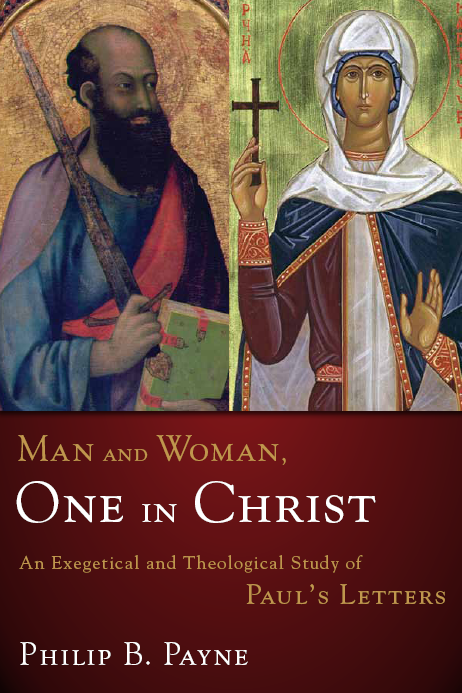 Philip Payne’s book Man and Woman, One in Christ
Summary of Contents
Paul’s Background
Payne notes that Paul was taught by Gamaliel, who was far more egalitarian than his contemporaries. Given this background, it is implausible that Paul had a low view of women (37).
Galatians 3:28
Those opposed to egalitarians (basically, egalitarians are people for women pastors, complementarians are those opposed to women pastors) often portray the position as having its only support in Galatians 3:28. Philip Payne does not base the egalitarian position on this verse alone, but he does argue that the passage provides a strong basis for the egalitarian position. Payne writes, “The natural implication of the equality of male and female in Paul’s teaching is that the gifts of women for ministry in the church should be recognized, welcomed and exercised in all areas of church life, including… church leadership” (104).
1 Corinthians 7- the equal rights of men and women in marriage
In 1 Corinthians 7, Paul explicitly parallels the obligations, rights, and conditions of men and women in marriage. Payne notes a large number of verses in which Paul uses the same language for both men and women (105-106). Not only that, but Paul specifically challenges the concept that men should be the spiritual leaders in the home in 1 Cor. 7:14 (107).
1 Corinthians 11
Payne’s book quickly turns to an extremely in-depth exegesis of the core verses related to the debate over women in church leadership. To put this into concrete terms, Payne’s analysis of 1 Timothy 2:8-15 covers eight chapters and 142 pages; 1 Corinthians 14 has nearly 50 pages dedicated to it, 1 Corinthians 11 is covered by over 100 pages. Payne does not set theology or exegesis to the side in favor of emotional appeals, as some complementarians tend to accuse egalitarians of doing. Rather, he centralizes the Bible as the inerrant Word of God and unswervingly demands that all sides conform to what the Bible teaches, no matter how difficult that teaching may be.
Regarding 1 Corinthians 11, Payne notes that the analogy regarding the “head” of woman does not imply authority, as complementarians must hold. Rather, “source” is a better exegetical and philological fit (113ff, see especially 131, 133). Payne further argues that the proper application of 1 Corinthians 11 would draw out the respect and honor men and women should have for each other as equals (214-215).
1 Corinthians 14:34-35
Rather than mincing words, I’ll jump right to the point: Payne argues that these verses are an interpolation. I’ll cover my own thoughts in the section below “Analysis/Critique,” but for now, I’ll focus on Payne’s argument.
Payne notes that there are a number of ways offered to interpret the passage, but he argues that the only plausible interpretation of the text is that women must be silent, no matter what, in every circumstance. The reasoning is lengthy, but the primary rationale behind this interpretation as most plausible is the it reiterates the prohibition three times, which, in the 1st Century, would have been seen as an absolute prohibition (218-219). Complementarians who allow women to sing in worship, therefore, are inconsistent in their interpretation of this passage, because they add a qualification which is not in the text (221).
Payne, however, argues the text is an interpolation. The evidence is both internal and external. First, the external evidence. The movement of the text itself hints that it was an interpolation which was placed in different parts of 1 Corinthians depending on the textual lineage (227ff). There is also a distigme which is used elsewhere to mark interpolations that is in the last line of 14:33, the correct place to mark 14:34-35 as an interpolation (232ff). Bishop Victor, between AD 541-544, corrected the text to omit 14:34-35 as an interpolation (246ff). Victor’s acumen for detecting interpolations is noteworthy, because he also omits the Trinitarian interpolation in 1 John 5:7-8 (246). MS88 omits the text, likely because it was copied from a manuscript which lacked the interpolation (249). Clement reflects a text without the verses (250-251). He notes other evidence as well (251ff). Payne also notes 9 lines of internal evidence for the text being an interpolation (253ff).
1 Timothy 2:8-15
These verses occupy the largest treatment in MWOC. The key to properly interpreting this passage, argues Payne, is the context and the church situation to which it is addressed. Context is always important in properly interpreting the Bible, but with letters it is even more important. Payne approvingly quotes Raymond Collins on this point, “…it is the epistolary genre that is most conditioned by the coordinates of time and space, historical and relational circumstances… They are ad hoc compositions whose essential import relates immediately and directly only to the situation that dictated their composition” (291).
Payne asserts that scholars know the situation in Ephesus–there was a preponderance of false teaching (296ff). Because of this, it is important to read the letter as a letter designed to put a stop to these teachings. Paul’s prohibition of women’s teachings is tied directly to the fact that false teachers had been praying upon women (299ff). The phrase Paul uses, “I am not permitting” “indicat[es] a new, case-specific injunction in response to a problem in Ephesus that does not carry the weight of church tradition” (321).
Payne also highlights the importance of the Greek word oude as conjoining the prohibitions Paul makes in this passage. The word is used throughout the Pauline corpus to “join together expressions that reinforce or make more specific a single idea” (338). Because of this, it is important to note that the word is used to conjoin the prohibitions in 1 Timothy 2:12. The prohibitions are “to teach” and “to assume authority.” Thus the prohibition is not Paul saying women cannot teach or assume authority over man… rather it is “Women should not teach in conjunction with assumed authority” (348-356).
But does authenteo mean “assume authority”? Complementarians generally must argue that it means simply “have authority.” Payne destroys such arguments, citing etymological (363-365) and document (365-373) evidence to demonstrate the word means “assume authority [to oneself-385ff].” Payne also deconstructs the complementarian argument to the contrary, showing that Paul used other words to refer to authority in a basic sense (373-380).
Importantly, Payne draws out the implications of Paul’s exhortations to women to learn quietly. This was the proper position of students. Paul is not telling women they have no place in the church, he’s calling them to learn in a proper fashion before teaching (see 316-317 for an example of this argument).
Thus, Payne concludes that Paul is not prohibiting women from teaching in the church. In the face of the counter-evidence of Paul’s affirmation of women teachers (61-68), the specific context of 1 Timothy, and the proper translation of the Greek words, the text should be read as a temporal restriction on teaching by women in a church struggling with false teachings being spread by women.
…And More
I have not even begun to draw out all of Payne’s arguments in MWOC. There are many more lines of reasoning including Paul’s affirmation of women in positions of ministry, Paul’s theological axioms which imply equality of man and woman, “salvation through childbirth,” Ephesians 5:21-33 and Colossians 3:18-19 with husband-wife relationships, Titus 1:5-9 and 1 Timothy 3:1-13 and the requirements for deacons and overseers, etc., etc. I cannot emphasize how broad Payne’s line of argument is, and how lucidly he explains his points. The book simply must be read by anyone interested in the topic.
Analysis/Critique
There are so many points Payne makes in MWOC that it would be impossible to cover them all. I found Payne’s arguments largely persuasive. That said, I have a few minor notes.
First, I am not convinced that 1 Corinthians 14:34-35 is an interpolation. I also think Payne dismisses the possible egalitarian readings of the passage too quickly (219ff). That said, Payne’s arguments are extremely powerful. I would have dismissed such arguments before reading this book, but now I’d say I’m very close to agreeing with Payne that these verses are an interpolation.
However, I wish that Payne had did a bit more work on the text to at least investigate the exegetical possibilities. I believe very few complementarians would be willing to accept that these verses are an interpolation, so if Payne had offered other possible interpretations, complementarians might find his case stronger. However, it is the case that complementarians who desire to use this passage to exclude women from the ministry now have the burden of proof upon them to demonstrate that it is not an interpolation, and they must do so with the same careful attention to the internal and external evidence which Payne utilized.
Initially I thought Payne might be overstating the case from Galatians 3:28, but he drew out enough parallel passages that it seems pretty convincing that egalitarians can interpret other passages in light of the Galatians verse (Payne does not use this method–he deals directly with the texts said to undermine egalitarianism… I’m merely suggesting that Payne’s work on Galatians 3:28 would allow egalitarians to be justified in utilizing it as a kind of “proof text” by which others must be judged).
Conclusion
Payne’s sustained positive argument for the equality of man and woman essentially convinced me of the egalitarian position over a year and a half ago. I have only recently finished the book, but when I first got it and skimmed through the arguments, I realized every argument I’d been using as a complementarian had an egalitarian answer. Not only that, but Payne’s critique of the complementarian position undermined the theological position which I’d held my entire life. I think it takes a great deal of intellectual integrity to read books which challenge one’s fundamental beliefs, and I have experienced it firsthand. I challenge readers on both sides of the issue to read this book.
Man and Woman, One in Christ provides an insurmountable challenge to the complementarian position. Any scholar working on the topic in the future must interact with this magnificent work. I simply must recommend it over and over again. I am thoroughly convinced that egalitarianism has a much stronger Scriptural and theological basis than the complementarian position, and MWOC is one of the works which lead me to that position. Payne’s thorough and thought-provoking analysis of the texts themselves demonstrates the Biblical accuracy of the egalitarian position. His work is one with which all must contend. The issue of women in the ministry is one we [the church] cannot get wrong. A thoughtful, open-minded approach to the Biblical issues is necessary. Let us make men and women one again.
Source
Philip B. Payne, Man and Woman, One in Christ
SDG.
——
The preceding post is the property of J.W. Wartick (apart from citations, which are the property of their respective owners) and should not be reproduced in part or in whole without the expressed consent of the author. All content on this site is the property of J.W. Wartick and is made available for individual and personal usage. If you cite from these documents, whether for personal or professional purposes, please give appropriate citation with both the name of the author (J.W. Wartick) and a link to the original URL. This blog is protected by Creative Commons licensing. By viewing any part of this site, you are agreeing to this usage policy.
Quick Link: N.T. Wright on Women in the Ministry
Eminent New Testament scholar N.T. Wright, former Bishop of Durham, is an egalitarian. Yes, he knows Pauline writing, and he believes women can (and should) be pastors. Check out his wonderfully lucid article on the topic: here.
Here are some choice quotes:
Mary Magdalene and the others are the apostles to the apostles. We should not be surprised that Paul calls a woman named Junia an apostle in Romans 16.7. If an apostle is a witness to the resurrection, there were women who deserved that title before any of the men.
In regards to 1 Timothy 2:
The key to the present passage, then, is to recognise that it is commanding that women, too, should be allowed to study and learn, and should not be restrained from doing so (verse 11). They are to be ‘in full submission’; this is often taken to mean ‘to the men’, or ‘to their husbands’, but it is equally likely that it refers to their attitude, as learners, of submission to God or to the gospel – which of course would be true for men as well. Then the crucial verse 12 need not be read as ‘I do not allow a woman to teach or hold authority over a man’ – the translation which has caused so much difficulty in recent years. It can equally mean (and in context this makes much more sense): ‘I don’t mean to imply that I’m now setting up women as the new authority over men in the same way that previously men held authority over women.’ Why might Paul need to say this?
Now if you were writing a letter to someone in a small, new religious movement with a base in Ephesus, and wanted to say that because of the gospel of Jesus the old ways of organising male and female roles had to be rethought from top to bottom, with one feature of that being that the women were to be encouraged to study and learn and take a leadership role, you might well want to avoid giving the wrong impression. Was the apostle saying, people might wonder, that women should be trained up so that Christianity would gradually become a cult like that of Artemis, where women did the leading and kept the men in line? That, it seems to me, is what verse 12 is denying. The word I’ve translated ‘try to dictate to them’ is unusual, but seems to have the overtones of ‘being bossy’ or ‘seizing control’. Paul is saying, like Jesus in Luke 10, that women must have the space and leisure to study and learn in their own way, not in order that they may muscle in and take over the leadership as in the Artemis-cult, but so that men and women alike can develop whatever gifts of learning, teaching and leadership God is giving them.
Really, check out the rest of his article.
Check out my argument for women pastors: here.
The Unacknowledged Teachers: an argument for women pastors.
 An argument for the position of egalitarianism (the position that women are not to be restricted from certain offices in the church):
1) Women say things in Scripture which are not condemned (cf. Deborah’s song, Mary’s Magnificat which is used in liturgical worship, Ruth’s words which are used in wedding ceremonies, Esther’s story and her actions, etc., etc.). [Edit: this premise must be made more clear. The things women say in Scripture are not simply not condemned, but are often explicitly centralized. The Song of Deborah; Ruth’s words to Naomi; the magnificat; etc. These words are made into liturgies and used for teaching. Yet they are the words of women. Thanks to Adam at Unworthy Yet Redeemed for pointing out this flaw in the argument. Consider P1 to be modified to “Women say things in Scripture which are centralized and utilized for church liturgies and teaching.”]
2) All Scripture is useful for teaching, rebuking, correcting, and training in righteousness (1 Timothy 3:14-17).
3) Those things which women say in Scripture teach us truths useful for teaching, rebuking, correcting, and training in righteousness (1, 2).
4) If we use truths women teach us in Scripture to teach doctrine/righteousness/etc., we should not exclude women from the ministry. (Premise)
5) We use truths women teach us in Scripture to teach doctrine/righteousness/etc. (1-3)
6) Therefore, we should not exclude women from the ministry (4, 5, modus ponens).
Defense of premise 1: I cited examples in the argument itself. See Judges 4-5; Luke 1:46-56; Ruth 1:16-17 (and the rest of the book); the book of Esther; these are just a few examples.
Defense of premise 2: Again, directly from Scripture: 1 Timothy 3:14-17.
3 follows from 1 and 2.
Premise 4 is likely to be the most controversial of these premises. The position of those who hold that women should not be ordained into the office of the ministry (complementarianism) is generally based upon the suggestion that women should not teach doctrine in a public setting (see more on this below). Therefore, I think that premise 4 must be accepted by complementarians because a denial of this premise would undermine their position. In other words, if one wants to hold that premise 4 is false, they would have to provide a different reason to exclude women from the ministry. Premise 4 simply states that which the sides agree upon. Ultimately, the strength of premise 4 will depend upon one’s definition of “the office of the ministry.” However, if one’s definition of “office of the ministry” includes “teaching”; “teaching doctrine”; “rebuking” [those who need correction]; etc., then premise 4 is correct.
Further, premise 4 could be weakened so that its conclusion would be not quite as strong. Instead, one could reword it as:
4′) If we use truths women teach us in Scripture to teach doctrine/righteousness/etc., we should not exclude women from teaching doctrine/righteousness/etc. to others.
This modified premise will not yield the conclusion that women should not be excluded from the “office of the ministry” but it would yield the conclusion that women should be allowed to teach doctrine, righteousness, and other things no matter who the audience happens to be.
Premise 5 follows from 1-3. 6 follows via modus ponens from 4 and 5. The same could be said for 4′ and the perceived 5′ and 6′.
The language used by those who are against women preaching must be very carefully selected because they do not wish to say women cannot be teachers at the university, or that they cannot teach elsewhere–rather, it is restricted to the church. Yet the argument above would be specifically useful for permitting women to teach in the church. After all, their words are used to teach continually. Whenever the Magnificat is sung or spoken, we use the words of Mary to teach us truths about Jesus. Whenever we read the story of Ruth or use her words in our wedding vows, we use them authoritatively.
Another way we could put this argument would be “If it is okay for women to compose sections of the Bible, perhaps we should let them teach it?” (quoted from Lamb, 64, citation below). I think the answer to the question is eminently obvious: yes
Therefore, women are already acting as a kind of “unacknowledged teacher” in the church: their very words are being used to tell us about God. I conclude that women should not be excluded from the ministry.
Note on terminology: by “teach” I am explicating the role of “teacher” in the church–the pastor.
Part of this argument was developed from a reading of God Behaving Badly by David Lamb (Downers Grove, IL: InterVarsity Press, 2011), 64-65, wherein he states “If it is okay for women to compose sections of the Bible, perhaps we should let them teach it?” (64).
SDG.
——
The preceding post is the property of J.W. Wartick (apart from citations, which are the property of their respective owners) and should not be reproduced in part or in whole without the expressed consent of the author. All content on this site is the property of J.W. Wartick and is made available for individual and personal usage. If you cite from these documents, whether for personal or professional purposes, please give appropriate citation with both the name of the author (J.W. Wartick) and a link to the original URL. This blog is protected by Creative Commons licensing. By viewing any part of this site, you are agreeing to this usage policy.

 J.W. Wartick - Reconstructing Faith