theology
Reformation Review: A look at the origins of the European Reformations
 The Reformation [I am going to use the term “Reformation” to refer to the European Reformations and the Roman Catholic counter-Reformation] is a period of extreme importance for those who seek to understand Christian theology. Many of the debates that are happening now can trace their roots to this period of history.
One of the most important aspects to understanding the Reformation–and, by extension, much of the development of theology after the Reformation–involves looking into the origins of the movements. How is it that the Reformation started? What brought about the notion that it was necessary to reform the Church?
In his Reformation Thought: An Introduction
Social Factors in the Reformation
The organization of cities was one factor that led to the success of the reformation. McGrath notes that individual cities during this period had come to regard itself as a kind of individual state. However, due to the failures of many of these cities to provide for their citizens and their growth over time, there were calls for a broader and representative government (McGrath, 16, cited below).
Cities had become centers of power and experienced “remarkable growth” due to the various agrarian crises and plagues that had taken place in earlier years (Carter Lindberg, The European Reformations
Furthermore, the control of the city council over the general practices and laws of the cities often led to a “symbiotic relationship” between a reformer and the city council. “The reformer, by presenting a coherent vision of the Christian gospel and its implications for the religious, social, and political structures and practices of a city, was able to prevent a potentially revolutionary situation from degenerating into chaos” (McGrath, 19).
Some reformers were very tied to the social aspects of the reformation. For these reformers, “the Reformation involved the identification of ‘citizen’ with ‘Christian’… Thus Zwingli laid great emphasis upon the need to reform and redeem a community, whereas Luther tended to concentrate upon the need to reform and redeem the individual” (McGrath, 20).
Doctrinal and Moral Concerns and the Reformation
One of the primary concerns of the reformers was that the Church could “best be reformed and renewed by returning to the beliefs and practices of the early church” (McGrath, 20). The reformers observed many problems with the Church of their time and felt that it was important to return to the “golden age” of Christianity, which they interpreted largely as the patristic period.
There had been a growth in popular religion which was largely disconnected from that of the Church. “Folk religion” focused upon the “needs of rural communities–such as haymaking and harvesting” (McGrath, 24). A lack of confidence in the pope and the clerical system contributed to the need for reform. Furthermore, the laity was becoming more educated, which led to a problem for the Church. Due to the Roman Catholic church’s system at the time in which positions of authority would be given often to the highest bidder, there were many in the Church who never visited their parishes or had little interest in or understanding of that which they were supposed to preach. The educated laity became increasingly aware of the many errors even parish preachers would make in their renditions of the Latin in the Mass (some of these priests had merely memorized the service without understanding it themselves!) (24ff).
Furthermore, throughout the Scholastic era, the Church had tolerated a kind of doctrinal pluralism. The Church recognized the need for allowing the academics to debate various issues, but this led to a serious question: “[W]hich of these schools of thought [theological schools of thought like Thomism or Scotists] was right?” (McGrath, 28). Yet the Church had suffered from a kind of schizophrenia about centralized authority. Was the authority in the Church found in Councils or in the Pope (Lindberg, 44ff)? Questions like these led to the need for reform. The reformers focused on who had the right to decide doctrine and the need for God’s word in the vernacular of the populace.
Two Primary Movers
There were two primary focuses for the individual reformers: the moral sphere and the doctrinal sphere. While it is necessary to avoid drawing a false either-or dichotomy between these, it is equally important to note that the various reformers focused largely one way or the other. Broadly speaking, several reformers in the Wittenburg/Swiss tradition focused upon the need to reform the very teachings and doctrines of the church, while those in the humanist (not to be confused with modern notions of humanism as atheism, but rather as a system of thought and practice) tradition focused upon the need to reform the moral practice of the church.
Again, neither of these should be seen as exclusive of the other. Moral reform often involved doctrinal reform and vice versa. What must be emphasized, however, is that the reformers differed at points on whether it was more important to have right belief or right practice. Surely both thought both were necessary, but the question was how to integrate these into the Church and furthermore which should come first as important. Such differing emphases can be observed, for example, in the doctrine of Scripture. The humanistic reformers tended to see the Bible as a guide for morals, while the Wittenberg and Swiss reformers tended to see it as a “record of God’s gracious promises of salvation to those who believed” (see discussion in McGrath, 55-57).
More to Come!
Thus, the stage was set for reform of the church. Societal and doctrinal pressures were in place that would lead to the need for reflection on the spheres of belief and practice. The debates that raged through the reformation continue to rage today.
Throughout October and into the next few months (and perhaps beyond, depending on the feedback/readership I get here), I will be exploring various aspects of the Reformation. I will look at some important thinkers of the Reformation period and will also focus on some modern theology which can trace its roots back to the reformation. Why October [and beyond]? Well, Reformation Day is October 31st! Be ready to learn with me, and please ask questions and leave some comments!
Alister McGrath’s book was a gift from an anonymous donor. I was blown away when I saw it show up at my door and I have to say Thank you so much for being such a blessing! Whoever you are, you made my day. Well, more than just one day actually. This series of posts is a direct result of your donation. Thank you!
Links
The Church Universal: Reformation Review– What makes a church part of the Church Universal? What makes a church part of the true church? I write on these topics (and more!) and their origins in the Reformation.
Who Interprets Scripture? Sola Scriptura, the Reformation, and the modern era: Reformation Review– I investigate the notion of “sola scriptura” and its different applications in interpreting Scripture. I particularly emphasize the problem of doctrinal unity and the various ways church bodies have dealt with these difficulties from the Reformation into today.
Sources
Alister McGrath, Reformation Thought: An Introduction
Carter Lindberg, The European Reformations
SDG.
——
The preceding post is the property of J.W. Wartick (apart from citations, which are the property of their respective owners, and works of art as credited) and should not be reproduced in part or in whole without the expressed consent of the author. All content on this site is the property of J.W. Wartick and is made available for individual and personal usage. If you cite from these documents, whether for personal or professional purposes, please give appropriate citation with both the name of the author (J.W. Wartick) and a link to the original URL. If you’d like to repost a post, you may do so, provided you show less than half of the original post on your own site and link to the original post for the rest. You must also appropriately cite the post as noted above. This blog is protected by Creative Commons licensing. By viewing any part of this site, you are agreeing to this usage policy.
The Myth of “Religion”: Constructing the Other as an enemy
The myth of religious violence should finally be seen for what it is: an important part of the folklore of Western societies. It does not identify any facts about the world, but rather authorizes certain arrangements of power in the modern West… The myth also helps identify Others and enemies, both internal and external, who threaten the social order and who provide the requisite villains against which the nation-state is said to protect us. (William Cavanaugh, 226, cited below)

I recently discussed a phenomenal work by William Cavanaugh, The Myth of Religious Violence
The Myth Played Out
The religious other is said to be violent. Religions cause violence due to their scary propensity to link with irrationality, absolutism, and divisive. Religion caused wars and chaos. Religious persons engaged in wars for God over nothing but minute doctrinal differences raged across the time of the reformation and at other times as well. The rise of the secular nation-state and the squelching of religion in the public square allowed for the cessation of violence and for man to live in peace. Such goes the myth of religious violence. Cavanaugh refers to this myth as a “creation myth” of the nation-state (123).
Notice the themes that run through any discussion of religion and violence. The general theme is that religion causes division through doctrinal matters. Because person A believes x and person B believes y, they argue, Furthermore, because neither x nor y has sufficient rational grounds for A and B to resolve the issue, they must fight in order to determine is right. After all, religion deals with absolutes. A and B square off about salvation–their eternal souls are at stake!
Often, religious persons are tempted to come back and counter that those who are non-religious are often violent too. However, this is itself a reaction to the same factors that drive the notion of religious violence. Namely, the myth of religious violence is used to stigmatize the Other. It constructs temporary categories of “religious” and “secular,” groups people based upon that, and then delegates the worst types of violence to that which is called religious. The myth is part of the justification for the nation-state and nationalism. The Nation is that which protects us from the Others in our own society. Without the protection of the State, we would turn to violence to try to subjugate others for our own purposes. Therefore, the State becomes a sacred object. Its symbols become cultic objects, and we ritualize specific aspects of the State. After all, the Nation is our savior from violence of religion. People will willingly lay their lives down in the name of their country, but for their religion? Certainly not! The State is worth dying for because it defends all people, but a religion is an internalized, personal object.
Thus, those things deemed religious are stigmatized and forced into the personal sphere, while those deemed secular are allowed for public debate. As such, specific aspects of a person’s worldview are forcibly separated and parsed. The religious person is expected to act “secular” when it comes to the public sphere, but is allowed to do whatever he wishes in the private realm. The problems quickly become clear.
Religion as a Myth
Religion itself is a social construct. I have seen this personally in a number of works dealing with “religion.” Rarely do authors attempt anything more than a working definition, and even then the definitions do little to outline real differences between that which is “secular” and that which is “religion.” The definitions are either extremely vague or too specific.
A survey of literature on religion shows that this problem is pervasive. The problem is with the notion of religion itself as a category that can somehow cordon off that which is secular. It may be much more useful to speak simply of ideologies or worldviews. Thus, a side-by-side comparison of differing worldviews can indeed be made. There is no fast and hard distinction between secular and religious, for such a distinction is nothing but arbitrary.
How does one define religion in such a way that Taoism, Confucianism, Christianity, Buddhism, Hinduism, and Islam all somehow fit while Marxism, Communism, Nationalism, and the like do not? It seems an impossible task. Some who read my site may notice that I frequently file things under “philosophy of religion” [including this post!]. I’m not suggesting that “religion” is an entirely useless word. What I’m suggesting here is that we must admit that the category is a construction, pure and simple. When I use “religion,” I use it pragmatically to review to an arbitrarily dilineated set of worldviews. Ultimately, “philosophy of religion” is a philosophy of worldviews: putting them side by side for comparison.
By challenging the reigning paradigm of religion as a real, transcultural, category we may thus turn to the question of violence, rationality, and the like as an empirical, philosophical, and existential study. By stripping away the prejudices that come up when someone uses the word “religious” or “secular,” we may focus upon the actual data at hand. Regarding the question of violence, we can ask questions like: “In what circumstances will worldview U turn to violence?” or “Is worldview U more prone to violence than others?” As such, extremism like that of Marxism which has killed untold millions with an atheistic paradigm can be set up alongside extremism like that of Islamicism. Thus, categories outside of “religion” can be used to analyze these cases. Surely divisiveness, absolutism, and irrationality are involved in both cases? What causes them to arise? How do we slow that tide? How do we reason with the Other?
The category “religion” is a construct of the person utilizing it. As such, it can be wielded as a weapon. And, I charge, that is exactly what the category “religion” has been used for.
Controlling the Other
Those who argue that religion causes violence are, in particular, wielding the phrase as a weapon. The religious Other is irrational, violent, and to be feared. It is “us” or “them.” One can observe this in the literature. Some endorse violence against specific religions just because they assume that the myth of religious violence will apply to the view at large.
It is this kind of mentality that the construct of religion perpetuates. It is the Other which we must fear. We, who are rational, need to fear the irrational Other. The Other causes violence, they cannot be reasoned with, and they want absolutist control over society.
The key to this discussion is that the notion of a hard line between “secular” and “religious” is a social construct. The notion of religion is indeed a construction.
The myth of religion is therefore one step towards the myth of religious violence. The key is to construct a “religious other” who is irrational, divisive, and dangerous. Thus, we can feel free to stigmatize and fear this Other. We need to make sure that the Other does not threaten us, and indeed part of this may be to use violence against the Other. After all, they are incapable of reasoning and will not listen to our sound arguments. The only thing they are capable of understanding is violence, which they have used to try to subjugate us to their views.
It is in this way that the myth is used most dangerously. The religious other is a fearsome enemy, one who must be avoided and perhaps even destroyed in order to prevent one’s own destruction. By perpetuating the notion of religion as a transcultural, transhistorical, real entity distinct from that which is secular, the possibility is made to make the religious other the enemy, while glorifying those categories which one decides are not religious. It undermines the empirical study of the way violence comes about on particular worldviews.
An Alternative Way Forward
Rather than using the category of “religion” in order to stigmatize, I suggest that we instead discuss “worldviews.” In this way, all worldviews are on the same plain. Violence may arise in certain worldviews more easily than others, whether it is nationalism or a particular worldview which is deemed “religious.” It may be extremely difficult to avoid using the term “religion” so I will not even attempt to do so. The category is a construction, so it can be used as a useful fiction. Because it is indeed a temporal, cultural distinction, I can use “religion” in a meaningful sense so far as when I say it people will tend to think of Islam, Christianity, Hinduism, and the like.
However, it is just as important to focus upon all worldviews, not those which are somewhat arbitrarily deemed “religious,” when discussing truth claims. As such, it is important to avoid the secular/religious distinction and instead focus upon factual debate and discussion over the coherence of particular views. By doing so, we can advance the discussion about worldviews while avoiding the use of the myth of “religion” to stigmatize the other.
Links
Book Review: “The Myth of Religious Violence” by William T. Cavanaugh– I review the book which has led me to discuss the ways the category of religion is used to stigmatize the other and also forced me to rethink a number of issues. I highly recommend this book.
Source
William T. Cavanaugh, The Myth of Religious Violence
SDG.
——
The preceding post is the property of J.W. Wartick (apart from citations, which are the property of their respective owners, and works of art as credited) and should not be reproduced in part or in whole without the expressed consent of the author. All content on this site is the property of J.W. Wartick and is made available for individual and personal usage. If you cite from these documents, whether for personal or professional purposes, please give appropriate citation with both the name of the author (J.W. Wartick) and a link to the original URL. If you’d like to repost a post, you may do so, provided you show less than half of the original post on your own site and link to the original post for the rest. You must also appropriately cite the post as noted above. This blog is protected by Creative Commons licensing. By viewing any part of this site, you are agreeing to this usage policy.
The Presumption of Pluralism: How religious pluralism devalues all religious persons
Everyone has their own truth.
What’s true for you is true for you, what’s true for me is true for me.
All religious backgrounds have a piece of the puzzle.
All roads lead to the same goal.

Pluralism is rampant in our society. People want to affirm everyone’s belief. Tolerance is the buzzword. Few want to talk about the differences in worldviews. It’s easier to affirm everyone’s beliefs as having a place in the interchange of ideas.
Pluralism is the position that all religions are true. This can be qualified in a number of ways. Often, the views are not well-thought out and amount to little more than saying that all ways get to heaven. However, there are thoughtful pluralists with highly developed structures for affirming their professed pluralism. For example, John Hick, a well known proponent of pluralism, writes:
[T]he Transcendent in ‘its’ inner nature is beyond human description or comprehension… it is ineffable or, as I would rather say, transcategorical, beyond the scope of our human concepts. It is to this ultimate transcategorical reality that the religions are oriented and to which they are human responses. (Hick, 163, cited below)
Thus, for Hick and most other pluralists, all religions are oriented towards some kind of Ultimate or Transcendent, from which they derive all of their beliefs. Thus, these pluralists can affirm the notion that all religions are “true” in a qualified sense.
The problem with pluralistic claims is that in their gusto to affirm all religions as true, what they’ve actually done is said that all religions are false. Again, Hick realizes a problem inherent in qualifying religions–and specifically Christianity–such that they can all be true. The problem is that some claim to have stated actual truths about transcendent reality. In other words, when a theologian claims that God is Triune, they are making a claim about objective reality. But Hick’s proposed solution is to simply place such theological claims into the reports of experiences about the “Real”: “according to our hypothesis, the different traditions are not reporting experiences of the Real in itself, but of its different manifestations within human consciousness” (171, cited below). Unfortunately for pluralists, what this has done is create what I find to be the real problem for pluralists.
The problem is that the pluralist is the only one whose claims about the Real/Transcendent are true.
The presumption of pluralism is that it assumes the invalidity of all religious claims. Only the pluralist can see that all religious claims to exclusivity are false. The exclusive claims of individual religions are dismissed offhand. After all, if all ways are true, then none can be exclusive.
Again, look at the reasoning from Hick: the claims of theologians are not actually claims about the Real itself. Rather, the claims of the theologian apply only to the Real-as-experienced in human consciousness. In other words, those making truth claims about individual religions are only expressing claims about their own subjective experience of an objective reality: the Real.
Thus, the pluralist undermines the truth claims of all religions, while simultaneously trying to affirm them. Only the pluralist is able to look beyond the truth claims of religion and see that when the Muslim claims that Allah is the only God, he is mistakenly reporting his experience as opposed to a claim about reality. Only the pluralist can see that the Christian who claims that Jesus is the only savior, she is only reporting her conscious experience of the Real. The Buddhist who says there is no God is similarly mistaken: perhaps there is? Who knows? Only the pluralist can see that all of these contradictory claims about religious reality are in fact merely the reports of conscious experience of a supra-reality: one which stands above all religions and is the true religion.
The bottom line is that the pluralist has become the exclusivist. Only the pluralist knows the true way. Thus, their system must collapse in on itself. It either relegates all religious claims to become mere reports of human consciousness and thus affirms itself as the only true religion, or it must affirm blatantly contradictory claims like “God exists” and “There is no God” or “Shiva is a god, Vishnu is a god, etc.” and “There is no God but Allah.” The pluralist has presumed much.
If all ways are true, then none are. Pluralism has failed.
Links
Can we evaluate worldviews?– I discuss how to evaluate rival worldviews and outline some criteria by which to do it.
A Vision for Christian Apologetics to World Religions– I outline a vision for Christians interacting with believers of other faiths. Integral to this approach is understanding others’ beliefs.
Source
John Hick, The New Frontier of Science and Religion (New York: Palgrave Macmillan, 2010).
SDG.
——
The preceding post is the property of J.W. Wartick (apart from citations, which are the property of their respective owners, and works of art as credited) and should not be reproduced in part or in whole without the expressed consent of the author. All content on this site is the property of J.W. Wartick and is made available for individual and personal usage. If you cite from these documents, whether for personal or professional purposes, please give appropriate citation with both the name of the author (J.W. Wartick) and a link to the original URL. If you’d like to repost a post, you may do so, provided you show less than half of the original post on your own site and link to the original post for the rest. You must also appropriately cite the post as noted above. This blog is protected by Creative Commons licensing. By viewing any part of this site, you are agreeing to this usage policy.
Religious Dialogue: A case study in science fiction with Bova and Weber
I love science fiction. One of the main reasons is because it provides a medium for authors to share their philosophical outlook for the world. Some authors portray their vision of what the world would like like if…. and what fills in that “if” is that which the author would like readers to be wary of our condemn. For example, distopian fiction often takes some aspect of society and shows how if we allow it to run rampant, we will create a world wherein we would not want to dwell. Other authors use science fiction to portray an ideal (or nearly ideal) society and show how the things they are promoting or believe fit into that ideal society.
Ben Bova and David Weber are two of my favorite science fiction authors. Bova blends hard science fiction (sci-fi which is largely focuses upon the applications of science that is at least seemingly possible) with great storytelling. His “Grand Tour” series of books is the story of humanity spreading across our solar system and even finding life on mars and founding a colony on the moon. David Weber writes military science fiction on an epic scale, complete with amazing battles in space (and who doesn’t like some big explosions in space?). I was fascinated to see both authors interact with Christianity, particularly on a fundamentalist level, and see how they took that discussion.
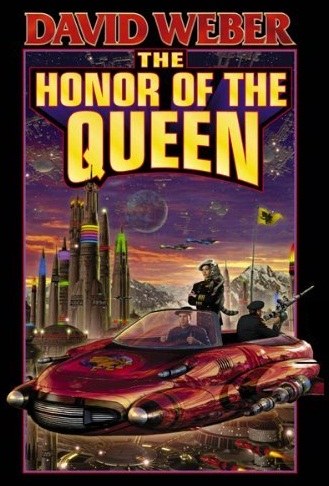 David Weber
David Weber’s book, The Honor of the Queen
What really struck me is that David Weber fairly presented firm believers as a spectrum. He showed that believers can be reasoned with and even persuaded to believe differently based upon evidence. Furthermore, he showed that even those who may line up on the side with which he disagrees [presumably–I don’t know where he stands on the issue] are not all (or even mostly) blinded by faith or foolishness. Rather, although there are some truly evil and disillusioned people, Weber shows that many are capable of changing their position or at least acknowledging that rival views are worth consideration.
The most vivid portrayal of this theme is found in a conversation between Admiral Courvosier and Admiral Yakanov. Courvosier is from the same nation as Honor Harrington and wholly endorses his female officer in a position of command. They discuss Captain Honor Harrington:
[Yanakov responds to Courvosier’s question about his society’s reaction to Honor]: “If Captain Harrington is as outstanding an officer as you believe–asI believe–she invalidates all our concepts of womanhood. She means we’re wrong, that our religion is wrong. She means we’ve spent nine centuries being wrong… I think we can admit our error, in time. Not easily… but I believe we can do it.”
“Yet if we do[” Yanakov continues, “]what happens to Grayson [their world]? You’ve met two of my wives. I love all three of them dearly… but your Captain Harrington, just by existing, tells me I’ve made them less than they could have been… Less capable of her independence, her ability to accept responsibility and risk… How do I know where my doubts over their capability stop being genuine love and concern?”
The exchange is characteristic of the way Grayson’s people are treated throughout the book. They are real people, capable of interacting with other views in honest ways. They feel challenged by a view contrary to their own. Some react poorly, and there are extremists who are blinded by hatred and anger. Yet all of them are treated as people with real concerns shaped by their upbringing and backgrounds.
Honor Harrington ends up saving Grayson, and at the end of the book, she is commended by the rulers of that planet. She talks to the “Protector” [read: king/president]:
“You see,” [said the Protector] “we need you.”
“Need me, Sir?” [Responded Honor]
“Yes, Grayson faces tremendous changes… You’ll be the first woman in our history to hold land… and we need you as a model–and a challenge–as we bring our women fully into our society.”
Weber thus allows for even ardent supporters of specific religious backgrounds to respond to reasoned argument and to change. They are capable of interacting on a human level and deserve every bit of respect as those who disagree with them. Again, there are those who are radicals and will not be reasoned with, but they are the minority and they do not win out.
Weber therefore presents religious dialogue in The Honor of the Queen as a genuine interaction between real people from differing backgrounds. Those who are “fundamentalist” are capable of changing their views when challenged with a rival view which out-reasons their own. Religious dialogue is possible and fruitful.
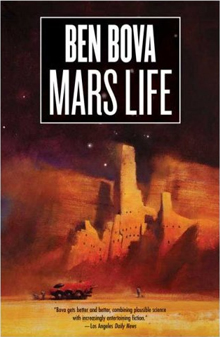 Ben Bova
Ben Bova’s whole “Grand Tour” series has a number of dealings with “fundamentalists.” He never really defines the term to be specifically Christian but one can tell when reading the books that it is pretty clear he is referencing hardcore fundamentalist evangelical Christianity.
I recently finished reading Mars Life
Bova’s treatment of extremist positions in religion is somewhat disingenuous in my opinion, particularly when one compares his portrayal with that of Weber. Bova tends to illustrate religious fundamentalists as a black and white issue. Basically, if you are a hardcore believer, you’re in it for power and control, you are willing to incite violence to achieve your ends, and you are incapable of reasoning. Again, note the contrasts with Weber’s depiction above. A few examples will help to draw this out.
On page 142 and following there is a discussion about putting together a panel to discuss the finding of a fossil on Mars. The interaction shows that no matter what, fundamentalists cannot accept scientific findings:
“Look,” said the bureau chief… “everybody’s calling it a fossil…. …”Call it an alleged fossil, then,” insisted the consultant (from the fundamentalists)… [The group then continues to suggest terms for the fossil:] “A probable fossil?” …”A possible fossil”… [Then, finally] “Say that the scientists believe it’s a fossil and until proven otherwise that’s what we’re going to call it.”
Here one can see that fundamentalism is intrinsically tied to an anti-science mentality. The key for them is to use words which deny absolutes, essentially skirting issues rather than discussing the truth. But that’s not all there is to it. Later on, one of the fundamentalists is engaged in a discussion about “requesting” that some lyrics in music they view as morally reprehensible be changed. The musician flat out refuses, angering the fundamentalist in the process. The section closes as follows:
[The musician] was shot to death at a Dog Dirt concert three months later. His killer surrendered easily to the police, smilingly explaining that he was doing God’s work.
What is interesting about this example is that it is illustrative of a number of such examples throughout the book. These are completely unrelated to the main plot. Rather, it seems what Bova is doing is very explicitly showing that fundamentalists are unafraid to use immoral tactics, censoring, and even incite violence in order to get their way. Theirs is an unquestioned and unquestionable faith. Those in power in fundamentalism are inherently evil and devious. They only want to control. Again, these asides are in no way tied to the plot of the book. It’s almost as though Bova is preaching a different worldview, one which views religiosity as inherently dangerous and violent, with few exceptions.
There is one positive example, however. A Roman Catholic, Monsignor Fulvio DiNardo, who is also a world-renowned geologist decides he wants to go to Mars to find the answer to a question about faith which is pressing on him. Namely, why God would exterminate an entire intelligent species. His thread in the story seems to show two things: first, that fundamentalism is inherently incapable of responding to reason; second, that it is possible to have reasoned faith and science together. The second point is illustrated very well when DiNardo is finally on Mars. He suffers from a likely stroke and is dying and begins a dialog with God:
Why did you kill them, Lord? They were intelligent. They must have worshipped You in some form or other. Why kill them? How could you–
And then DiNardo understood. Like a calming wave of love and peace, comprehension flowed through his soul at last… God had taken the Martians to Him! Of course. It was so simple, so pure. I should have seen it earlier. I should have known. My faith should have revealed the truth to me.
The good Lord took the Martians to Him. He ended their trial of tears in this world and brought them to eternal paradise. They must have fulfilled their mission. They must have shown their Creator the love and faith that He demands from us all. So He gave them their eternal reward…
The light was getting so bright… Glaring. Brilliant… Like staring into the sun. Like looking upon the face of… (297-298)
So Bova does offer a counterbalance to fundamentalism, and I appreciate that portrayal. Although DiNardo’s death and his revelation receives very little further comment (and no further comment at all on the revelation), it seems as though it is positively portrayed.
A reason for criticism is that Bova is uncompromising with fundamentalists. I’ve already drawn out his portrayal of them, and it seems to me to be a bit disingenuous. Although there are plenty on the “religious right” who would be all too happy to be able to legislate all morality, control the media, and deny well-attested scientific findings, I have hardly found that to be the majority. And certainly, fundamentalism is not a homogeneous entity filled with people who are trying to control everyone else. I’ll grant that this is a work of fiction, but in light of how Weber was able to handle a fairly similar issue with respectful portrayals of the ‘other side,’ I had hoped for more from Bova, whose work I enjoy greatly. For Bova, it seems, religious dialogue is not a real possibility, with few exceptions. Fundamentalists are incapable of reasoning and are barely even convinced believers; rather they are using their positions of authority within their organizations to consolidate power and execute their own prerogatives on their witless followers.
Fair Discussion
It seems pretty clear to me that David Weber provided a better model for utilizing science fiction in religious dialogue than Ben Bova did. The people representing the ‘bad guys’ in Weber’s book did have some who were truly evil and/or beyond reason, but also had many with whom reason resonated. When confronted with rival views, they were thoughtful and even receptive. On the other hand, the characters with whom Bova disagreed were a true black/white dichotomy with the “good guys.” Fundamentalists were bad. Period. He portrayed them as power-hungry, censor-happy maniacs. Although there was one notable exception (the Catholic priest, DiNardo), who showed a bright spot for “believers” at large, he was by far the exception.
It seems clear this study has applications for real-world dialogue about religion. When we interact with other worldviews, we should be capable of treating the other side with the same kind of dignity we would like to be treated. Although other worldviews may have their extremists who will not respond to reason, our attitude should be that of the humble friend trying to explore the beliefs of the “other.” The “other” is not that which must be demonized, but rather understood and with which to interact.
More Reading
I explore the theological implications of life on other planets.
I discuss a book which will change the way you think about about the notion that religion is violent. It also deals with the notion of the religious “other” as a construct.- William Cavanaugh’s The Myth of Religious Violence.
Sources
Ben Bova, Mars Life
David Weber, The Honor of the Queen
SDG.
——
The preceding post is the property of J.W. Wartick (apart from citations, which are the property of their respective owners, and works of art as credited) and should not be reproduced in part or in whole without the expressed consent of the author. All content on this site is the property of J.W. Wartick and is made available for individual and personal usage. If you cite from these documents, whether for personal or professional purposes, please give appropriate citation with both the name of the author (J.W. Wartick) and a link to the original URL. If you’d like to repost a post, you may do so, provided you show less than half of the original post on your own site and link to the original post for the rest. You must also appropriately cite the post as noted above. This blog is protected by Creative Commons licensing. By viewing any part of this site, you are agreeing to this usage policy.
Stephen Law, his evil god, and radical skepticism
 My contention is that Stephen Law’s epistemological approach to his “evil god challenge” to Christianity entails radical skepticism. Because his challenge entails radical skepticism, Law has forced his cohorts to choose between the seeming irrationality of that position or a denial of the power of the “evil God challenge.”
Entailment of Skepticism
Stephen Law’s “evil God challenge” presents the following:
Suppose the universe has a creator. Suppose also that this being is omnipotent and omniscient. But suppose he is not maximally good. Rather, imagine that he is maximally evil. His depravity is without limit. His cruelty knows no bounds. There is no other god or gods – just this supremely wicked being. Call this the evil-god hypothesis. (Law, “The Evil God Challenge,” 4, cited below)
Now, the point of this challenge is:
the challenge of explaining why the good-god hypothesis should be considered significantly
more reasonable than the evil-god hypothesis.
Law argues in his paper that any theodicy used for the “good god” can be equally used for the “evil god.” Therefore, the theist has yet to show why one should favor the good god over the evil god, and so cannot rationally hold to belief in the good god over the evil god.
Law’s primary support for this supposition is his symmetry thesis:
I shall call the suggestion that, in terms of reasonableness, there is indeed such a rough symmetry between the good-god and evil-god hypotheses, the symmetry thesis.
Nowhere does Law explain what “rough symmetry” means or how balanced the evidence really is between the good god and evil god. Rather, he just uses the phrase “rough symmetry” and argues as though this is enough to discredit the good god hypothesis.
Now notice that the very heart of Law’s argument is something similar to this:
1) If one has no reason to believe that hypothesis a is “significantly more reasonable” than hypothesis b, one cannot rationally hold a over b
It is exactly at this point that Law’s entire epistemology must collapse into radical skepticism. Why? Simply because I can construct parallel but contradictory accounts for nearly any object of knowledge that is not a necessary truth. Just because Law is able to [unsuccessfully, in my opinion] construct a “parallel” system of explanation to that of the ‘good god’ hypothesis does not mean that his parallel is on the same level or even a challenge to that hypothesis.
To see why constructing parallel explanation of reality does not somehow undermine reality, consider two scenarios I constructed to outline this exact point.
The 5 minutes ago challenge
Scenario 1: Our universe was created 5 minutes ago with all our memories and experiences implanted into us.
Those who are familiar with epistemology and philosophy of mind will recognize this as a very pervasive scenario throughout the literature. But how does one go about solving a problem like this? Consider a defense of what seems to be everyday experience.
a) it does not seem to me as though the universe was created 5 minutes ago. I have vivid memories of ten years ago and can interact with others about some of those memories.
The problem with a), of course, is that it exactly lines up with the notion that the universe was created 5 minutes ago with our memories and experiences implanted inside our heads.
Unless I’m very much mistaken, I think I could construct a similarly parallel account for any possible defense of experience of more than 5 minutes ago.
Therefore, I conclude with Law that because the “5 minutes ago” hypothesis is has “rough symmetry” with the hypothesis that our universe is 16 billion years old and the like, it is unreasonable to embrace either proposition. After all, the 5 minutes ago thesis seems extremely improbable, and it is roughly symmetric to the ‘everyday experience’ hypothesis. Law’s symmetry principle applies and undermines all of our experience.
 The Cartesian Demon Hypothesis
Scenario 2: A Cartesian Demon (again, those familiar with philosophical literature will likely recognize this one) has us all under some kind of magic Matrix-like spell where we live our whole lives in our minds even though in reality our bodies are being tortured. The demon delights in our blissful ignorance of the horrible state of our souls and so he continues to implant memories as our lives continue on.
Again, I can’t think of any defense of everyday experience I can’t parallel. Therefore, we should not believe that our everyday experience is correct, according to Law.
I could continue with examples. The problem of other minds is another that immediately jumps out: how do we know there are actually minds in those walking people we see around us. They could just as easily be [philosophical, not pop-fiction] zombies walking around mechanically acting as though they have minds inside them. Again, parallels=>skepticism about whether other minds exist.
Ultimately, Law’s “symmetry thesis” leads us into radical skepticism and even solipsism. That seems to me enough to reject it.
Challenge to Christianity?
So how exactly does Law’s evil god challenge present any difficulties for Christianity? Honestly, I’m not sure. Unless one is convinced of the solipsistic scenarios outlined above, one should not be convinced of Law’s evil god challenge. His symmetry thesis is the only way he can press this challenge, and that same thesis undermines all knowledge of experience and induction. It doesn’t seem like much of a challenge to me.
Law’s Odd Conclusion and My Conclusion all at once
Law’s conclusion states that:
The problem facing defenders of classical monotheism is this: until they can provide good grounds for supposing the symmetry thesis is false,
they lack good grounds for supposing that the good-god hypothesis is any more reasonable than the evil-god hypothesis – the latter hypothesis being something that surely even they will admit is very unreasonable indeed.
Now, one again must see exactly where this is leading. Suppose, as a theist, I find the evidence for the existence of a god to be very convincing. Suppose further that I find the theodicies Law parodies to be sound. Suppose that I think that Law’s evil god hypothesis meets these theodicies equally. Now, according to Law, I am in the state of “symmetry”; I have no reason to prefer the good god over the evil. Law maintains that this means not just that I can’t rationally hold to either, but rather that because the evil god hypothesis is “very unreasonable indeed” I should also reject the good god.
But of course the theist we are supposing to exist believes that the good good hypothesis is extraordinarily reasonable. And because Law’s thesis works, according to them, following Law, they have no reason to believe the evil god is any less probable than the good god. Thus, according to this theist, the evil god hypothesis is not improbable but rather extraordinarily probable.
What Law has done is pretty simple. He’s argued that the good and evil gods must be on the same level of rationality. Because he (apparently) and others reject the evil god out-of-hand, he argues that they are on equal footing and so one should reject the good god. But again, what if the theist agrees that these hypotheses must be on equal footing and that it’s not that both are improbable but rather that both are extraordinarily probable?
All Law has said in response to such a person is that the evil god is “very unreasonable indeed” but why? Law has just spent over 20 pages arguing that the evil god is actually reasonable. Suddenly, the evil god is worthy of rejecting a priori? How does that work out? Law hasn’t done anything to dissuade the convinced believer. The only way his argument works is if one thinks that the good god hypothesis is barely rational. If one follows his conclusion and thinks god’s existence is very likely, then they must follow it all the way through: the evil god’s existence is very likely too. Law just imports this unreasonableness from his own a priori denial of the existence of God.
So what, at this point, does the believer do? Well, it seems we’re back to my first point. One can either believe the symmetry thesis and thus devolve into radical skepticism, or one can reject it and thus throw Law’s argument out the window where it belongs.
Finally, it’s worth noting that there are other reasons to reject the “evil god challenge.” First, it doesn’t take into account the whole range of theistic argument. For example, the ontological argument is based upon the notion of God as maximally great. Law would have to argue that an evil being could be maximally great. Good luck.
Links
William Lane Craig and Stephen Law debated some time back. I wrote a review summarizing and analyzing the arguments.
Glenn Andrew Peoples presents Law with a formidable challenge on the Unbelievable? Podcast.
Edward Feser weighs in on the evil God challenge.
Glenn Andrew Peoples’ podcast on the evil God challenge is phenomenal.
Max Andrews weighs in, arguing that even though Law’s argument is much like the Cartesian demon, we should take it seriously.
Luke Nix at Faithful Thinker comments on the same argument from a different angle.
Source:
[Cited as directed here:] STEPHEN LAW The evil god challenge. Religious Studies, Available on CJO doi:10.1017/S0034412509990369
SDG.
——
The preceding post is the property of J.W. Wartick (apart from citations, which are the property of their respective owners, and works of art as credited) and should not be reproduced in part or in whole without the expressed consent of the author. All content on this site is the property of J.W. Wartick and is made available for individual and personal usage. If you cite from these documents, whether for personal or professional purposes, please give appropriate citation with both the name of the author (J.W. Wartick) and a link to the original URL. If you’d like to repost a post, you may do so, provided you show less than half of the original post on your own site and link to the original post for the rest. You must also appropriately cite the post as noted above. This blog is protected by Creative Commons licensing. By viewing any part of this site, you are agreeing to this usage policy.
Alien Life: Theological reflections on life on other planets
 I have two general beliefs/feelings when it comes to life on other planets which are in conflict. Part of me is extremely skeptical. The probability of their being life on other planets given the extremely precise conditions needed to sustain life is exceedingly, vanishingly, absurdly low. Sure, there are unimaginably numerous planets in our universe, any number of which may be earthlike, but I just do not see why we should think that life is inevitable or even likely. On the other hand another part of me thinks that God could just as easily have brought life forth in various places throughout the universe, utilizing it much like an artist uses a tapestry. Our universe could be teeming with life, just waiting to be discovered.
Reading a couple books recently, along with the recent exploration of Mars, have turned me to reflect on the implications of life on other planets for Christian theology. One book, Vast Universe [link at bottom of post], was on Christian theology of life on other planets. Here, I shall be setting aside my extreme skepticism about life “out there.” Instead, I shall consider the following statement: “If there is other life in the universe, what does that mean for Christian theology?”
Science and Christianity
The topic is so oft-discussed that I will not dedicate too much time to it. What would the discovery of life ‘out there’ do for science and Christianity?
I think that Christian theology already has the resources built in it to adapt itself to life on other planets. Although some would be disturbed by such a possibility or reality, I do not see how such a discovery would be damaging to Christianity as a whole. The real problem would lie with those willing to abuse the text of the Bible in order to try to make it say there is no possibility of life outside of Earth or that our planet is the focal point of all creation. Theologies which take such a path those would indeed suffer greatly.
Humanity’s Place in the Universe
The discovery of life on other planets would almost certainly remove the notion that humanity is some kind of privileged being in this universe. It was not all created by God for us. What would that mean for Christian theology?
Again, I do not think this would be very damaging. Although the notion that humanity has a special place in the universe has a traceable line throughout the history of Christian theology, it is hardly a necessary component. In fact, life on other planets would be a great illustration of another thread of Christian theology: the notion of God as a cosmic artist who delights in creation. On this view, God takes such pleasure in the creation of and interaction with various living species that He caused them to arise across the universe. Furthermore, our discovery of these other living creatures could be a reflection of His providence, having set up the world in such a way that we could discover other life and marvel at His creation.
Salvation
What about salvation on other planets? Did Jesus go to other planets in His incarnate form and save them as a human? Was there more than one crucifixion? Thomas O’Meara, in the book I mentioned above, reflects upon questions just like these. He argues that “All three persons can become incarnate because incarnation is one aspect of boundless divine power… The divine motive for fashioning a universe of galaxies is God’s goodness; the same motive brings incarnation” (47, cited below). He establishes the notion of more than one incarnation as a live option throughout Christian history (63ff).
It therefore seems as though other life in the universe would not destroy God’s salvation plan. The Bible tells us about God’s salvation history for humanity. We know God is good, and we therefore know that God would providentially interact with other beings at their own levels and needs.
Finally, one thoughtful reader pointed out to me one area I had forgotten to add in here. There is the possibility that if there are aliens, then they have not fallen. Perhaps they have lived in communion with God instead of in rebellion against God. The possibility is very real, and must be considered in this kind of speculative theology. Such aliens would possibly be corrupted by meeting humanity; but they may also have much to teach us. As O’Meara notes, they may be some kind of “Star Mentors” with spiritual insights we may miss in our fallen state.
 The Sentient Alien and other faiths
What kind of challenge would a sentient alien present to Christianity? What of their faith, their religion?
As far as other sentient species’ religions, I think that Christianity could interact with them in the same way that Christian theology has considered other human faiths. Seek truth where truth exists, and critique where it is untrue. (For my fuller vision of world religions, check out my post on A Vision for Christian Apologetics to World Religions.)
Some could even argue that a Christian interaction with other sentient races should be open to their own incarnations and truth in their religion as revealed by God. What of an alien Bible? Again, it seems that a good God, as we know God is, would interact with all life in a way that reflects His omnibenevolent nature. God’s providence would extend to life across the whole universe.
Alleged Disproofs
Would life on other planets somehow discredit Christianity? What of panspermia? How should we treat the discovery of life in the universe, were it to happen?
The Bible does not seem to make any kind of statement about life outside of our planet. However, it does make it clear that there is a spiritual realm of angels and demons. Thus, there is at least life outside of our easily accessible realm. No verse in the Bible states that there is no life elsewhere in the universe. It seems that the possibility is certainly open.
Furthermore, I don’t see any reason to think that life on other planets would somehow justify belief in panspermia or some other pseudo-scientific explanation of the spread and origins of life. We would have to deal with the same questions about life on other planets that we must deal with on our own.
Created life and the universe
Overall, I think that as a purely rational standpoint there is reason for immense skepticism about life on other planets. Although many express optimism and point to the sheer volume of planets in our universe as somehow necessitating life elsewhere, I am not convinced that sheer numbers somehow increase the likelihood of life on other planets. To put it plainly, it is my opinion that the only rational way to hope for life elsewhere in our universe is to conjoin that hope with belief in a God who loves creating and interacting with created life.
A final disclaimer
I realize that many of the points I wrote about in this post are likely to be extremely contentious. What I want to say is that this has been an exercise in speculative theology. I have been writing about something which is a mere possibility and offering possible answers to a number of questions from a perspective which takes this possibility seriously. I am quite possibly wrong on any of these. What I have tried to do here is offer a number of things for Christians to think about when they consider life on other planets. For a great post on the possibility of life on other planets, check out this guest post by Greg Reeves on that very topic.
Source
Thomas O’Meara, Vast Universe
SDG.
——
The preceding post is the property of J.W. Wartick (apart from citations, which are the property of their respective owners, and works of art as credited) and should not be reproduced in part or in whole without the expressed consent of the author. All content on this site is the property of J.W. Wartick and is made available for individual and personal usage. If you cite from these documents, whether for personal or professional purposes, please give appropriate citation with both the name of the author (J.W. Wartick) and a link to the original URL. If you’d like to repost a post, you may do so, provided you show less than half of the original post on your own site and link to the original post for the rest. You must also appropriately cite the post as noted above. This blog is protected by Creative Commons licensing. By viewing any part of this site, you are agreeing to this usage policy.
The Consolation of Counterfactuals: The Molinism of Boethius
Whence comes this powerful understanding
That all things sees and all discerns?
…This is a cause more powerful
More forceful and effectual
Than that which passively awaits… (Boethius, The Consolation of Philosophy, Book V, section IV)

Molinism is holds that God has counterfactual knowledge of every situation. What this boils down to is that God knows conditional statements for every possible situation, such that God knows statements like “If J.W. has free time, then he will read.”
One prominent challenge to molinism is the notion that such counterfactuals about future choices cannot exist or that God simply couldn’t know them. I was startled as I read Boethius’ (480-525 AD) work, The Consolation of Philosophy, to see that he had anticipated this objection and provided the outline of an answer to it about 1500 years ago.
Boethius wrote the work as a dialog between himself and Philosophy, a woman who represented, well, philosophy. The last book focuses upon God’s foreknowledge and human freedom.
Writing as philosophy, Boethius states
All those things which happen without happening of necessity are, before they happen, future events about to happen, but not about to happen of necessity… But this, you will say, is the very point in question–whether there can be any foreknowledge of things whose occurrence is not inevitable. (Book V, section IV)
Again, it was amazing to see that Boethius had anticipated an objection to molinism–a system of theological thought which hadn’t been conceived fully yet (and wouldn’t be for about 1100 years!)–and provided an answer. The objection was seen above: many modern philosophers and theologians contend that God could not know that which is not necessitated to happen.
Yet Boethius answers the problem in a unique way:
The cause of this mistake [believing that God couldn’t know things that will not happen by necessity] is that people think that the totality of their knowledge depends on the nature and capacity to be known of the objects of knowledge. But this is all wrong. Everything that is known is comprehended not according to its own nature, but according to the ability to know of those who do the knowing. (Book V, section IV)
Before developing this argument, it is important to note that it rests squarely within Boethius’ later reflection upon the eternity of God–a being who has “the complete, simultaneous, and perfect possession of everlasting life” (Book V, section VI). Because Boethius holds that God is eternal in this sense–timeless–he can reasonably hold that God’s capacity to know is not limited by temporal constrictions.
Thus, we get back to the nature of his response to the counterfactual objection to molinism. Boethius, holding that God is eternal and therefore not limited by time, grounds the knowledge of counterfactuals not in their own inherent ability to be known or not known, but rather in the ability of the knower to know them.
It is worth emphasizing how radical and powerful this response is to the modern argument against molinism. If God is indeed timeless in the sense Boethius presses, then God would have access to the entirety of time as far as knowledge and action are concerned. Thus, by grounding knowledge not in the objects of knowledge themselves but in the capacity of the knower, Boethius grounded counterfactual knowledge.
Objection
Now, modern opponents of molinism would take this in stride and argue either against the contention that God is timeless or against the contention that knowledge is based in the capacity of the knower rather than the known. Exploring either of these objections is beyond the scope of this post, but it is worth noting that Boethius’ rebuttal to the problem of counterfactual knowledge works if both of his contentions are true. The question is, of course, whether they are.
A Final Objection and Response
Another way to attack Boethius’ defense of God’s knowledge of counterfactuals is to argue that even if it is the case that God is eternal and that His knowledge is grounded in the knower rather than the known, then it still would only mean that God knows what will happen, not what would happen if something were to happen. In other words, one could hold that Boethius’ answer doesn’t actually apply to counterfactual knowledge.
It seems possible, however, to modify Boethius’ defense to counter this argument as well. One could note that because God is eternal, any event that would happen, God would know about it. In other words, if x were z instead, then God’s knowledge would simply be z instead of x. This response turns the counterfactual into a counterfactual about God’s knowledge rather than about freedom. The response offered turns the question from whether God could know that “If x, then y” about John Smith into a question of “If z instead of x, then God knows z.”
Conclusion
It seems clear to me that there is much to develop yet in the objections and responses offered above. The last critique offered and my response certainly opens a number of areas of inquiry. However, for now it seems clear that Boethius has offered a unique way to look at the problem of counterfactual knowledge. Whether his perspective is correct remains a matter for further inquiry.
Boethius offered a unique and stirring defense of molinism over a thousand years before it was fully articulated by Luis de Molina. It is worth looking into his answer, even if it fails, simply for the foresight it provided. But Boethius’ work is known as an astounding discussion of divine eternity as well, among other things. Thus, I encourage readers to look into his short work, The Consolation of Philosophy. Who knows, you may even find the consolation of counterfactuals therein.
Edition Used: For this post I used the Penguin Classics edition of The Consolation of Philosophy (New York: Penguin, 1999).
SDG.
——
The preceding post is the property of J.W. Wartick (apart from citations, which are the property of their respective owners) and should not be reproduced in part or in whole without the expressed consent of the author. All content on this site is the property of J.W. Wartick and is made available for individual and personal usage. If you cite from these documents, whether for personal or professional purposes, please give appropriate citation with both the name of the author (J.W. Wartick) and a link to the original URL. If you’d like to repost a post, you may do so, provided you show less than half of the original post on your own site and link to the original post for the rest. You must also appropriately cite the post as noted above. This blog is protected by Creative Commons licensing. By viewing any part of this site, you are agreeing to this usage policy.
Book Review: “The Closing of the Muslim Mind” by Robert Reilly
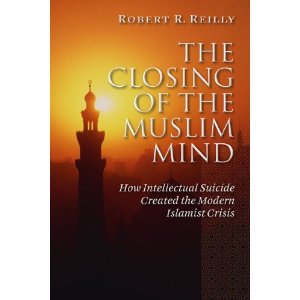 One can tell from the outset that Robert Reilly’s The Closing of the Muslim Mind
The central point of the book is “the story of how Islam grappled with the role of reason after its conquests exposed it to Hellenic thought and how the side of reason ultimately lost in the ensuing, deadly struggle” (1). Reilly contrasts this with how the West dealt with some of the same issues: “The radical voluntaraism (God as pure will) and occasionalism (no cause and effect in the natural order) found in them [Muslim theologians in the 9th-12th centuries] were not seen to any significant extent in the West until… David Hume began writing in the eighteenth century. By that time the recognition of reality had become firmly enough established to withstand the assault… Unfortunately, this was not true in Sunni Islam, where these views arrived much earlier” (7).
Reilly maps out the history of the development of Muslim thought. Initially, once Islam came into contact with western philosophy, there was a great amount of interplay (11ff). One early struggle was between man’s free will and fate. This struggle was over the meaning of key verses in the Qur’an as well as a debate over whether the Qur’an is temporal or eternal and uncreated. The notion that the Qur’an is eternal and uncreated, in turn, restricted rationality from evaluating the meaning therein (19).
The development of Muslim reflection on the Qur’an and Allah’s will led to the replacement of reason with rationality (45-46). Similarly, because the Qur’an was Allah’s will, and it did not explicitly endorse kalam (a branch of Muslim philosophy and theology), this rational discourse was to be abandoned (47). Furthermore, this entailed the destruction of the notion of the “autonomy of reason.” Only within the structures of revelation could reason operate effectively (48).
Furthermore, creation itself has no inherent reason. Each moment is merely a “second-to-second manifestation of God’s will” (51). While one may be tempted to say Christianity is exactly like this (and some branches may indeed hold to this teaching), there is an important distinction between the two views, for on the Christian view of God, God’s action is driven by His nature, and so He will operate within His promises as well as within the boundaries He has set for himself. God, on most Christian views, is inherently rational and so will operate in rational ways. So while creation indeed subsists moment-by-moment because of the will of God, God does not arbitrarily change His will (56ff). On the Muslim view, Reilly argues, God’s will is absolute (as opposed to His nature) and so there is absolute voluntarism. At any time, Allah could will that which before Allah did not will (51-53). Furthermore, one cannot say one “knows” God because God is pure will. As pure will, there is no reason for any particular action, and so God is inherently unknowable (54ff).
Another consequence of viewing God as pure will is that good and evil are essentially vacuous terms. “If Allah is pure will, good and evil are only conventions of Allah’s–some things are halal (permitted/lawful) and others are haram (forbidden/unlawful), simply because He says so and for no reasons in themselves” (70). Allah is therefore above morality and the problem of evil is made meaningless, for evil is merely that which God forbids. Essentially, the system is voluntaristic theism (71ff).
Reilly argues that these theological positions have had dire consequences for Islam in the political realm as well. These positions undermine the inherent worth of human beings and posit the primacy of power over reason (128); democracy is the answer to a question the Muslim world has not asked (130), for if God is pure will, then His regents on earth are operating merely under his whims, and can be just as arbitrary in their decisions (131); “Man’s only responsibility is to obey” (131); finally, “there is no ontological foundation for equal human rights in Islam, which formally divides men and women, believer and unbeliever, freeman and slave” (133).
The consequences reach farther, however, and touch the sciences as well. For if Allah’s will is that which causes all things, then to say that there are “natural” explanations is to insult Allah. Instead of saying that hydrogen and oxygen yield water, people are instructed to say “when you bring hydrogen and oxygen together… by the will of Allah water was created…” (142). Of course, the denial of secondary causation touches upon more pragmatic areas of life as well. After all, if Allah wants something to happen, then it will; if not, then it won’t.
Reilly presents a number of contemporary sources demonstrating how these aspects have been radically undermined in the Muslim world, where often anything can pass as a news story and anything can be stated as true (147ff). Furthermore, the Muslim world trends towards underdevelopment and illiteracy. Reilly maintains that some of this is due to the consequences of the theological views outlined above.
Historically, the dilemma within Islam over reason vs. voluntarism came to a head when the Muslim conquests began to be turned back. When defeats happened, Muslims had to ask why it was that they were losing when, presumably, Allah desired them to win (165ff). Some viewed it as a consequence of the stagnation of science and intellectual development in the Muslim world. Others, however, viewed it as a need to go back to the roots of Islam and become even more radical. The world, therefore, according to Reilly, is faced with a crisis: can reason be re-introduced into the Muslim theology and trickle down into every aspect of life, thus freeing the Muslim world from the shackles of voluntarism? Or, will Islam continue down its path and overemphasize the radical occasionalism of nature and God, while undermining reason? Such is the crisis.
It is striking how well Reilly has supported his theses with quotes from the writings of various Muslim theologians and philosophers. Throughout the work, he quotes numerous scholars from both modern and ancient sources. What these quotes reveal is that his points are not found in a vaccuum–rather, the notion that the absolute, determinating, arbitrary will of Allah underlies everything that happens does indeed undermine rationality.
It is interesting here to reflect briefly upon the notion that some of these same themes are found within certain branches of Christianity. Whenever God’s will is placed as the ultimate source of all activity on earth (voluntarism/occasionalism) rather than as a providential will which guides such activity, reason and rationality can be jettisoned just as easily as they were in the development of Muslim thought. Similarly, if Scripture is seen as above any kind of rational inquiry to determine its meaning, one can replace man’s cognitive abilities with blind faith. Reilly’s book can therefore serve as much a warning for Christians engaging in doctrinal reflection as it is a call to Muslims to restore rationality to their faith.
Reilly’s work, The Closing of the Muslim Mind should be seen as required reading for those interested in interfacing with the Muslim faith. Reilly ties together compelling chains of thought which have led to the current Muslim crisis and demonstrates how current thinking is a result of the past. It is a thoroughly researched book and those opposed to his conclusions will be hard-pressed to show the cracks in his theses. I highly recommend this work. Once one gets past the title, which may be seen as inflammatory by some, Reilly presents well-reasoned, compelling, historically grounded argument about how the theology of Islam has led to the destruction of its intellectual capacity.
Robert Reilly, The Closing of the Muslim Mind
SDG.
——
The preceding post is the property of J.W. Wartick (apart from citations, which are the property of their respective owners) and should not be reproduced in part or in whole without the expressed consent of the author. All content on this site is the property of J.W. Wartick and is made available for individual and personal usage. If you cite from these documents, whether for personal or professional purposes, please give appropriate citation with both the name of the author (J.W. Wartick) and a link to the original URL. If you’d like to repost a post, you may do so, provided you show less than half of the original post on your own site and link to the original post for the rest. You must also appropriately cite the post as noted above. This blog is protected by Creative Commons licensing. By viewing any part of this site, you are agreeing to this usage policy.
On the Shoulders of Giants: Rediscovering the lost defenses of Christianity
 There is something missing from our arsenal as Christian apologists. I came upon this truth about a year and a half ago, but have only begun to realize how much we have been missing. Let me begin with an illustration:
It was a short, scenic drive down Interstate-94 to meet with Dr. Timothy McGrew, a professor of philosophy at Western Michigan University. At the time I was living in Ann Arbor, and I had only conversed with Tim on Facebook. He told me, with ill-concealed glee, about a folder on his computer that was filled with PDF scans of copyright-free (public domain) books by forgotten Christian apologists and theologians. The arguments in them, he told me, were not often used by modern apologists and could but increase my knowledge.
We met at a restaurant along the highway and talked for about an hour and a half while Tim uploaded files on my computer. Tim described to me a number of the items in this collection, but what struck me was how many arguments he referenced which are simply forgotten in current apologetics discussions. For example, he described the argument from “undesigned coincidences,” which basically goes through the Bible and shows how interrelated texts confirm each other’s historical veracity. I was shocked that I had not run into such a profound argument for the Christian faith. I was tremendously excited to find out that there were many such treasures waiting to be discovered.
Despite our continued interactions, I only very slowly began to read through this fantastic set of resources with which Tim had provided me. Once I got my Kindle, however, I began to tear through them. I have discovered so many delightful discussions, wonderful arguments, thought-provoking works that I could hardly begin to list them here. But I will try at least provide a few avenues for study.
I want you, and yes, especially you–the spirited apologist who has your Kalam argument memorized, your Leibnizian argument polished, and the like–to consider this fact: there are scores more arguments for the veracity of Christianity just waiting to be accessed. These arguments have little-to-no discussion in the apologetic blogosphere, they very rarely appear in modern books (if ever), and many of them are quite strong. What is your reaction to that knowledge?
I suspect it is a salivating, whetting of the appetite; it is a yearning desire to learn more. Fear not! These books, and the arguments within them, are, as I said, at your fingertips. The following is my brief, annotated list of fantastic free resources to help you, my fellow Christian apologists, broaden your knowledge.
Repositories of Resources
Library of Historical Apologetics (Currently DOWN)- Here is where I got started, with Tim McGrew’s phenomenal collection of works. In particular, the “annotated bibliography” will set you up with some fine works. The site features a “spotlight” on the main page for various fantastic reads. Browse and download at will. Also check out their Facebook page.
Open Library– Open Library has a number of the books listed at the Library of Historical Apologetics available in a more Kindle-friendly format, if that’s your reading method of choice. I highly recommend using it to send books to your Kindle for free (when you select wi-fi delivery). See below for some specifics.
 Getting Started
Yes, it can be daunting once you realize the voluminous nature of the study ahead of you. So I’ve made it easy by providing links to a few books–again, for free–to get you started, along with some comments. Oh, and I’ll be running a series shortly which outlines and examines several of these arguments.
Forgotten Arguments for Christianity: Undesigned Coincidences- The argument stated– I outline one of the many forgotten arguments for the truth of Christianity.
The Four Gospels from a Lawyer’s Standpoint– Edmund Bennett. Short and sweet, this book presents an argument I find extremely compelling: undesigned coincidences. Essentially, what Bennett argues is that the authors of the Gospels, writing individual histories, incidentally confirmed each other’s histories. I can’t recommend this highly enough. [To download, click the [G] or [A]; or if you want it for kindle, click here and on the right select “send to Kindle.”
A View of the Evidences of Christianity– by William Paley. It would be hard to describe the impact this book will have on your apologetic. Paley is simply masterful. In his first section alone he tears apart Humean arguments against miracles. This book is of extreme import for anyone interested in apologetics. Again, Kindle users.
Undesigned Coincidences– by J.J. Blunt. Once you’ve read Bennett, this book takes you through the entire Bible pointing out more historical arguments of great import throughout. I find this argument stunningly powerful, and I think as apologists we must incorporate it. Kindle [warning-lots of typos in this one due to the transition from PDF to Kindle. If you find a better version for Kindle, let me know].
Historic Doubts Relative to Napoleon Bonaparte– I’ll let Tim McGrew describe it: ” In this delightful spoof, published while Napoleon was still alive, Whately turns Hume’s skeptical doubts regarding miracles against reports of the career of Napoleon—with devastating results.” One can’t help but think of those who deny the historical Jesus today and how one might apply this to Abraham Lincoln, JFK, or (as I have), the Titanic. Kindle users.
The Bridge of History over the Gulf of Time– Thomas Cooper’s exhortation to apologetics and a general introduction to a number of arguments against Christianity. Check out this essay on Cooper.
A Dissertation on Miracles– by George Campbell. A devastating critique of Hume’s argument against miracles.
The Voyage and Shipwreck of St. Paul– by James Smith [click the link in the article]. This work is an argument for the historical accuracy of Luke in Acts constructed by a sailor who also knew numerous languages and was intimately familiar with the documents with which he worked for this account.
There is now a fire within me that seeks after these forgotten or little-known arguments–a burning that is only quenched by finding more early writings–and I can’t help but hope that you, too, will be delighted to delve into these lost treasures. We can’t let the past escape us. One thing I always tell the apologetics class I teach is this: “If you have a doubt or a question about the Christian faith, I can guarantee you that someone smarter than me has already thought about it and written on it. Don’t go at it alone.” Christian brothers and sisters, don’t let this knowledge escape you. We must spread it to this generation and beyond.
Final Thoughts
My thanks to Tim McGrew for his guidance in this study. May we all strive for Christ as he has.
I leave you with something he told me about these historical apologetics books:
I know …
… a music theory professor who read Thomas Cooper’s _Bridge of History_ and phoned me up screaming violently for more …
… a seminary graduate who confessed that he had never been taught the evidences of Christianity that he was discovering in the old, forgotten works …
… a marathon runner and stay-at-home mom who fell in love with George Campbell’s _Dissertation on Miracles_ …
… a construction worker who was captivated by the argument from undesigned coincidences …
… a daycare worker who has educated himself by reading dozens of old works of apologetics …
… a civil service worker in Chicago who set out to refute the arguments in Thomas Chalmers’s _Evidence and Authority of the Christian Revelation_ and ended up becoming a Christian …
… the list goes on and on …
SDG.
——
The preceding post is the property of J.W. Wartick (apart from citations, which are the property of their respective owners) and should not be reproduced in part or in whole without the expressed consent of the author. All content on this site is the property of J.W. Wartick and is made available for individual and personal usage. If you cite from these documents, whether for personal or professional purposes, please give appropriate citation with both the name of the author (J.W. Wartick) and a link to the original URL. If you’d like to repost a post, you may do so, provided you show less than half of the original post on your own site and link to the original post for the rest. You must also appropriately cite the post as noted above. This blog is protected by Creative Commons licensing. By viewing any part of this site, you are agreeing to this usage policy.
Really Recommended Posts 5/25/12
 I found some really diverse posts this go-round. Check out some thoughts on archaeology, marriage, logic, cultic churches, volcanic eruptions, logic, and the rule of secularism. I highly recommend these posts! (Owl Post edition 2–if you get it, you’re awesome!)
The Story of Ian & Larissa -Really beautiful video about a couple demonstrating Christian marriage and love. Although I don’t agree with everything in the video (women being emotional, needing to be reeled back by a man?), I think it’s amazing overall.
Avoiding Crackpot Archaeology– It’s easy to fall into the trap of thinking some extraordinary, worldview-shattering discovery has been found in archaeology. Too often, that trap is founded upon poor research and scholarship. Reasons to Believe shares some great ways to avoid “crackpot” archaeology.
The Mass Cult of Big -Again, not sure I agree with everything here, but I think the author raises some good points. Not discussed, however, is the notion of what exactly is “big” and is “big” necessarily bad? I don’t think it is.
Marvel Comics and Logical Fallacies– A creative look at logical fallacies and how easily we can fall into them.
The Toba Super Eruption: A Non-Flood Catastrophe–The Artifacts Say Yes!– Another serious challenge to a young earth is presented by super eruptions of volcanoes. Check out this very interesting post.
That the Name of God Should be Forgotten– It is easy to forget that what one believes can easily come under attack. The Soviet Union tried to eliminate all religion in the name of secularism. Let us not forget.

 J.W. Wartick - Reconstructing Faith