theology
Christian Disagreement About Doctrines
 Christians disagree about things. There, now that I’ve made the understatement of the century, I want to explore how Christians disagree about things. These usually aren’t just “things” but are rather doctrines–teachings that we believe and confess as the truth about reality itself. Not only that, but we believe that these are the things which God taught us in God’s very word revealed to us. That is not a recipe for thinking kindly of others when disagreement occurs. After all, they aren’t just wrong, they are in violation of God’s own word!
Some Personal Examples
Too often, the tenor we have in disagreement is something that reflects an extraordinarily un-Christlike manner. Several personal experiences have led me to writing this post.
I was once accosted by someone who had been directed my way by a mutual acquaintance. After summarily consigning me to hell and taunting me for being unwilling to engage in a debate with him, he asked me to direct him to some exegetical case for my position. I mentioned a book. His response was that he’d read the book and knew it was all wrong. Later in that same conversation he admitted that he’d lied about reading the book. I said I forgave him, but asked him to consider the fact that he was willing to lie about reading a book just because he was so convinced it would be so utterly worthless to him that he could just dismiss it without even having heard of it before. When I continued to refuse to respond to his insults (including his attacks on my wife) and his accusations of blasphemy, he finally stated that he was convinced that the reason I wouldn’t respond was because the Holy Spirit had shut my mouth and wouldn’t let me type responses to him because I was so blatantly wrong.
Was there any acknowledgement of how he was verbally abusing me and my wife on social media? No. Instead, his self-righteous assumption was that God had deigned to prevent me from typing responses to an angry man made blind by hatred.
Another time, I received a comment (not approved) on a post about engaging culture from a Christian perspective. The interlocutor suggested that I was a pagan promoting evil to fellow Christians. When I noted that this person had never even met or talked to me before, he responded, “I have spent a ton of time in cult and street ministry… If you’ve talked to one, you’ve talked to em all. Same lingo same, same pagan book reviews, same plastic cordiality, on and on on. Just switch the faces around. I have read and heard EVERY conceivable argument that will ever be possible regarding what you say… I am thoroughly versed in that unbiblical, antichristian garbage they taught you at Biola. Your fellow drones are roaming about the online countryside in hordes.”
These are extreme examples, yes, but they are just a few among the many, many examples that I and I’m sure countless others could cite of Christians acting without any semblance of charity or obedience to Christ to “Do unto others as you would have them do unto you.” I’m not here throwing a pity party–though I admit sometimes that would be nice!–nor am I attempting to promote my own views which were being criticized in these and other comments. After all, I’m sad to say that I’m convinced people who hold my view act the same way towards those with whom I disagree. The point is that this is completely unacceptable in any context, let alone one in which Christians are interacting with fellow Christians, who are going to inherit the earth.
Some Reflection
I’ve already hinted at an approach, which is to remember Christ’s commandment to “Do unto others as you would have them do unto you.” It is easy to say that, but how often do we actually think about what that means? I am fairly confident the hate-filled man who insulted my wife and I on social media while telling us to repent or go to hell didn’t much consider how he would have felt if someone did the same thing to he and his wife. Nor, I suspect, would the writer of the other example have been pleased to see me assuming that I had already conceived of every possible argument that would “ever be possible regarding” what he had to say… and dismissed them.
But again, these are extreme examples. I’m using them to highlight something, however, which is that we do this kind of thing all the time, just not on the same level. Any time we come along and refuse to listen to one with whom we’re disagreeing, or even simply wait for them to stop talking so we can jump in to show them how wrong they are–any of these times, we have disobeyed our calling to be Christ to others. Recently, I had a discussion with a fellow Christian with whom I had disagreement and they said they’d look into a source I showed them. But they followed that comment up by saying, effectively, “and I know that source is completely wrong.” This kind of theological hubris demands a cure.
A Way Forward
First, we need to note it is perfectly okay to think you’re right about something. That’s not what is at issue here. What is our concern is how we express disagreement. Second, I think it is important to not only focus on what I’d like others to change about their attitude, but also on how I might change to understand others better.
One thing I have found helpful is to try to remember the spectrum of theological humility and theological unity. Theological humility is an approach which we can take to admit that we may be wrong. I am a fallible human, so my interpretation of God’s words could be mistaken. Theological unity is an emphasis on the importance of agreement. People will fall along a spectrum of positions between extreme humility (I might or even probably am wrong about most things) and extreme unity (if you disagree with me about anything you must be an idiot). When in dialogue, we should try to explore where the other person falls along this spectrum. It is likely that if they fall on either extreme, a dialogue will be difficult to move forward. Sometimes it is best to stop a dialogue before it becomes heated.
Another thing to think about is our own need to be at least somewhat humble theologically. Yes, I believe I have rightly discerned what God has taught in the Bible, but it is possible that I am mistaken. That is because, shock of all shocks, I am not God. Thus, it is always possible for me to be wrong. We ought to reflect on the fact that we are all sinners who have fallen short of God’s glory, and sin impacts our mind, among other things. This does not mean we aren’t allowed to believe we are correct. What it does mean is that we should never be so certain that we are right that we won’t even give ear to someone who disagrees. Why? Well, apart from the fact that we would like them to listen to us (going back to Jesus’ words about doing to others…), we should also remember that our attitude towards others will likely determine how willing they are to hear what we have to say. Moreover, it is true that we could always be possibly mistaken, no matter what the one commentator quoted above said. We may think we’ve run into every possible permutation of arguments for the other side, but we are limited beings with finite imagination.
Concluding Thoughts
I think it is a good exercise to once in a while re-examine my beliefs about various doctrines. Why? Because I want to make sure I am always in pursuit of truth. This re-examination means not just reading sources which agree with me, but also sources on the other side.
Christians should be open to being wrong. We remain sinners, though we have been justified by faith in Christ. That doesn’t mean we will always be right about everything. We need to remember to be humble, that we are finite beings, and that God has called us to listen to others and respond to them with the same respect and dignity we would like to receive.
Links
Be sure to check out the page for this site on Facebook and Twitter for discussion of posts, links to other pages of interest, random talk about theology/philosophy/apologetics/movies and more!
Eclectic Theist– Check out my other blog for discussions about all kinds of topics including science fiction, history, fantasy movies, and more!
SDG.
Who is Worthy?- A reflection on closed communion in Lutheran churches

I do not claim rights to this image and was unable to find original source. Possibly here: http://thehandsomehansons.blogspot.com/2010/11/lutheran-seal.html
My wife and I have been refused communion on more than one occasion. In each instance it was in a Lutheran church that we were turned away. We are, ourselves, Lutherans, but the church bodies that did not commune us were different groups of Lutherans, and held that the divisions between us justified not giving us the gifts of the sacrament that Christ promised.
Here, I’d like to examine this practice of some Lutheran churches, often referred to as “closed communion.”[1] What do the actual Lutheran Confessions say about who may receive the Lord’s Supper? That is the question which must be asked by any claiming to be Lutheran.
We believe, teach, and confess that the entire worthiness of the guests at the table of his heavenly meal is and consists alone in the most holy obedience and perfect merit of Christ. We make his obedience and merit our own through true faith, concerning which we receive assurance through the sacrament. Worthiness consists in no way in our own virtues, or in internal or external preparations. (The Formula of Concord, Epitome, Article VII, Section 20)
The Lutheran Confessions leave no wiggle room here. What makes one worthy to receive the sacrament? Is it one’s preparation? No. Is it one’s denominational commitment? No. It is explicitly and clearly stated here: “the most holy obedience and perfect merit of Christ” which is itself made our own “through true faith.” Indeed, what does it mean to add the requirement of complete doctrinal agreement onto these words? Would not such a teaching be to make one’s “own virtues”–here of the doctrinal variety–what makes one worthy? It seems so. The teaching here, however, is that it is only faith in Christ’s words and works that make one worthy.
Just in case one wants to persist and allege that there may be some difficulty interpreting these words, Martin Luther himself states, in the Large Catechism:
Now we must also consider who the person is who receives such power and benefit [from the Lord’s Supper]… It is the one who believes what the words say and what they give, for they are not spoken or preached to stone and wood but to those who hear them, to those whom he says, “Take and eat”…All those who let these words be addressed to them and believe that they are true have what the words declare…
Now this is the sum total of a Christian’s preparation to receive this sacrament worthily. (The Large Catechism, The Sacrament of the Altar, section 33-36)
What does Luther himself teach here? “[T]his is the sum total of a Christian’s preparation…” (emphasis mine). And what is that sum total? Simply being one who “let these words be addressed to them and believe that they are true…” Once again, we see no mention of further conditions. There is no place here for refusing communion to those who believe the words are for them. The Christian must simply take hold of the words of Christ, which promise his body and blood to them. They need not be part of a specific denomination (which would have been historically impossible or at least unlikely at this point). It is the faith of the individual that makes them worthy, not their adherence to a set of doctrinal truths apart from those affirmed about the Lord’s Supper.
What do Lutherans who turn away other Lutherans from the sacrament say about their reasoning? Here is one example, from the Lutheran Church – Missouri Synod:
Because the Bible teaches that this Sacrament may also be spiritually harmful if misused, and that participation in the Lord’s Supper is an act of confession of faith, the LCMS ordinarily communes only those who have been instructed in the teachings of our church and who have confessed their faith in these teachings. (LCMS FAQ, cited below)
Here we see an unwarranted limit being placed on the sacrament of communion. What makes one worthy to receive this sacrament? The Lutheran Confessions make it explicit that that which makes one worthy is faith in the words of Christ. Here, however, an addition is made: “only those who have been instructed in the teachings of our church [the LCMS] and who have confessed their faith in these teachings” are “ordinarily” communed. Yet this limit is nowhere taught in the Book of Concord.
Counter-Argument
A possible counter-argument to the above is that there were no divergent Lutherans or Lutheran groups at the time the Lutheran Confessions were written, so they couldn’t have even addressed the issue. Apart from the fact that this is historically false (for parts of the Book of Concord were written to correct others within the folds of Lutheranism), it doesn’t change the Book of Concord’s teaching on the topic. The Lutheran Confessions make very strong statements. Phrases like “the sum total” and “alone” are used accompanying what the Confessions teach in regards to worthiness for the Lord’s Supper. These phrases are exclusive. That is, they affirm explicitly that no other expectations may be added. For what else might saying “sum total” or “alone” mean?
Conclusion
Those Lutheran groups who have added requirements for worthily receiving the Lord’s Supper stand against the Book of Concord’s own teaching on the topic. Time and again Luther and other confessors state that the only requirement for worthiness is to affirm the words of Christ and take hold of them by faith. Any who add requirements to receiving this sacrament have made their own words supersede those of the Confessions.
[1] Closed communion may also refer to simply keeping communion closed to those who affirm what the Book of Concord teaches regarding the Lord’s Supper. There is a fine line between this practice and making the additions to the Book of Concord’s teaching as noted in this post. I am not addressing this less stringent variety here.
Sources
LCMS Frequently Asked Questions Doctrinal Issues- The Lord’s Supper/Holy Communion (accessible here).
Robert Kolb and Timothy J. Wengert, eds. The Book of Concord: The Confessions of the Evangelical Lutheran Church (Minneapolis, MN: Fortress, 2000).
Links
Be sure to check out the page for this site on Facebook and Twitter for discussion of posts, links to other pages of interest, random talk about theology/philosophy/apologetics/movies and more!
Adhering to the Book of Concord “In So Far As” or “Because” it Agrees with Scripture?– I argue that Lutherans must hold the position that we adhere to the Book of Concord In So Far As it Agrees with Scripture.
Eclectic Theist– Check out my other blog for posts on Star Trek, science fiction, fantasy, books, sports, food, and more!
SDG.
——
The preceding post is the property of J.W. Wartick (apart from quotations, which are the property of their respective owners, and works of art as credited; images are often freely available to the public and J.W. Wartick makes no claims of owning rights to the images unless he makes that explicit) and should not be reproduced in part or in whole without the expressed consent of the author. All content on this site is the property of J.W. Wartick and is made available for individual and personal usage. If you cite from these documents, whether for personal or professional purposes, please give appropriate citation with both the name of the author (J.W. Wartick) and a link to the original URL. If you’d like to repost a post, you may do so, provided you show less than half of the original post on your own site and link to the original post for the rest. You must also appropriately cite the post as noted above. This blog is protected by Creative Commons licensing. By viewing any part of this site, you are agreeing to this usage policy.
Made Perfect in this Life? – A Lutheran reflection on Methodist sanctification

I was visiting a United Methodist Church and the pastor preached on the doctrine of sanctification. She referenced the affirmation within the Methodist church that Christians can receive perfection in this life.
I’ve been curious about this assertion for some time, and I decided to explore some more. On the United Methodist Church’s website, in the section entitled “Our Wesleyan Heritage,” sanctification is defined, in part:
We’re to press on, with God’s help, in the path of sanctification toward perfection. By perfection, Wesley did not mean that we would not make mistakes or have weaknesses. Rather, he understood it to be a continual process of being made perfect in our love of God and each other and of removing our desire to sin. (accessed here)
The embedded link sends readers to a sermon from John Wesley. In that sermon, he talks about what he means by being made perfect in this life. He distinguishes between what, in his view, is not attainable in this life regarding perfection, as well as what is attainable. Christians, he argues, are not made perfect in knowledge in this life, nor will they become free from making mistakes, nor from illness, nor from temptations. Instead, Christian perfection in this life will lead to various blessings:
First, not to commit sin… Secondly, to be freed from evil thoughts and evil tempers…
Wesley, of course, goes into much more detail than that, and defends his positions from various objections. The length of the sermon makes it prohibitive for a detailed interaction, so I just want to focus on these aspects of Wesleyan/Methodist sanctification.
Sanctification Over Time?
The notion of achieving perfection over time is something that causes difficulty because it makes sanctification a biographical account. To clarify, a quote from Oliver O’Donovan in his chapter in the book Sanctification: Explorations in Theology and Practice entitled “Sanctification and Ethics,”- “Sanctification understood biographically [as occurring over the span of a life] has given encouragement to a belief in progressive and incremental moral improvement, to be attained with maturity and age” (155, cited below).
The implication of a view of continual sanctification that is progressive leads to the assumption that a more mature Christian ought to also be more sanctified. Yet this may lead to failed expectations related to the Christian life. If one is led to expect perfection in this life, and they continue to find themselves simul iustus et peccator (to borrow a very Lutheran phrase: simultaneously justified and a sinner [or a sinner and a saint, as it has come to be said]), they may lose their assurance of hope not just in sanctification but also in salvation. After all, their expectations of the Christian life are undercut.
It may be answered that the proper interpretation of Wesley is, rather, that he argued for instantaneous perfection. But this is a debate for a different time. (See the book Sanctification: Explorations in Theology and Practice for chapters related to this topic.)
A Lutheran Interaction
The Lutheran Confessions make it clear that sanctification is the work of the Holy Spirit (Formula of Concord, Article III, paragraph 41). In the Large Catechism, Luther refers to the basics of what could be considered a Lutheran view of sanctification:
…because holiness has begun and is growing daily, we await the time when our flesh will be put to death, will be buried with all its uncleanness, and will come forth gloriously and arise to complete and perfect holiness in a new, eternal life. Now, however, we remain only halfway pure and holy. The Holy Spirit must always work in us through the Word, granting us daily forgiveness until we attain to that life where… there will be only perfectly pure and holy people… (The Large Catechism, Second Part, section 57-58)
Thus, a Lutheran perspective of sanctification sees humans as part holy and part sinful. But what are we to make of this? Here, perhaps, is where the Methodist and Lutheran view of sanctification may split most sharply, for the Lutheran will note that what makes us holy is the Spirit through Word and Sacrament. That is, through the taking of Holy Communion and the receiving of absolution, we are daily made holy by the Spirit of God. Thus, holiness is, yes, in part works driven and completed by the Spirit, but it is also and perhaps mostly that which we gain through participation in the community of Christ, the church. For Lutherans, Word and Sacrament stand paramount.
Some object to this Lutheran position, charging Lutherans with a kind of antinomianism. After all, it can’t be that easy, right? Yet on the Lutheran view, sanctification is ongoing, but not in the sense that we discussed above. Instead, it is something that the Spirit works continually for us. Moreover, though the topic is hotly debated in Lutheran circles, the notion of the “third use of the law”–as a guide for Christian life–helps curb antinomianism and turn the Christian back to Christ for forgiveness.
Conclusion
I believe I have more to learn in this area, and I am interested to read on the topic further. I have a book on the topic I’m currently reading, so I’m hoping this will give me some more insight into the fascinating topic. For now, it seems to me that the primary division between the Lutheran and Methodist view here is centered not so much on the concept of perfection now (though that is an intriguing topic to explore), but rather on a view of sanctification through the Sacraments.
Sources
Robert Kolb and Timothy J. Wengert, eds. The Book of Concord: The Confessions of the Evangelical Lutheran Church (Minneapolis, MN: Fortress, 2000).
Oliver O’Donovan, “Sanctification and Ethics” in Sanctification: Explorations in Theology and Practice edited by Kelly M. Kapic (Downers Grove, IL: InterVarsity, 2014).
Other sources are linked above.
Links
Be sure to check out the page for this site on Facebook and Twitter for discussion of posts, links to other pages of interest, random talk about theology/philosophy/apologetics/movies and more!
Eclectic Theist– Check out my other blog for posts on Star Trek, science fiction, fantasy, books, sports, food, and more!
SDG.
——
The preceding post is the property of J.W. Wartick (apart from quotations, which are the property of their respective owners, and works of art as credited; images are often freely available to the public and J.W. Wartick makes no claims of owning rights to the images unless he makes that explicit) and should not be reproduced in part or in whole without the expressed consent of the author. All content on this site is the property of J.W. Wartick and is made available for individual and personal usage. If you cite from these documents, whether for personal or professional purposes, please give appropriate citation with both the name of the author (J.W. Wartick) and a link to the original URL. If you’d like to repost a post, you may do so, provided you show less than half of the original post on your own site and link to the original post for the rest. You must also appropriately cite the post as noted above. This blog is protected by Creative Commons licensing. By viewing any part of this site, you are agreeing to this usage policy.
What about those who haven’t heard? – Part 1 of a Case Study on Religious Pluralism from Lew Wallace’s “Ben Hur”

A beautiful cover for an edition of Ben Hur- I was unable to locate the exact copyright information.
Ben Hur is one of my all-time favorite novels. There are many issues related to worldview raised throughout the novel. I have started a series which outlines some of the ways it interacts with
Selection from the Book
Each post in this series will begin with a segment from the book itself. Here, we jump into a scene in which one of the wise men is telling the story of how he came to be in a desert, meeting up with the others. He is Greek. I have abridged the segment to focus on the areas in which this series is most interested, namely, the ways God interacts with humanity.
“I am Gaspar, son of Cleanthes the Athenian…
…”It happens that two of our [Greece’s] philosophers, the very greatest of the many [reference to Plato and Aristotle, presumably], teach, one the doctrine of a Soul in every man, and its Immortality; the other the doctrine of One God, infinitely just. From the multitude of subjects about which the schools were disputing, I separated them, as alone worth the labor of solution; for I thought there was a relation between God and the soul as yet unknown…
“In the northern part of my country–in Thessaly… there is a mountain famous as the home of the gods… Olympus is its name. Thither I betook myself. I found a cave [nearby]… there I dwelt, giving myself up to meditation–no, I gave myself up to waiting for what every breath was a prayer–for revelation. Believing in God, invisible yet supreme, I also believed it possible so to yearn for him with all my soul that he would take compassion and give me answer.
“…One day I saw a man flung overboard from a ship sailing by. He swam ashore. I received and took care of him. He was a Jew, learned in the history and laws of his people; and from him I came to know that the God of my prayers did indeed exist; and had been for ages their lawmaker, ruler, and king. What was that but the Revelation I dreamed of? My faith had not been fruitless; God answered me!”
“As he does all who cry to him with such faith,” said the [Hindu].
“But, alas!” the Egyptian added, “how few are there wise enough to know when he answers them!”
“That was not all,” the Greek continued. “The man so sent to me told me more. He said the prophets who, in the ages which followed the first revelation, walked and talked with God, declared he would come again…
“It is true… the man told me that as God and the revelation of which he spoke had been for the Jews alone, so it would be again… ‘Had he nothing for the rest of the world?’ I asked. ‘No,’ was the answer, given in a proud voice–‘No, we are his chosen people.’ The answer did not crush my hope. Why should such a God limit his love and benefaction to one land, and, as it were, to one family? …When the Jew was gone, and I was alone again, I chastened my soul with a new prayer–that I might be permitted to see the King when he was come, and worship him. One night I sat by the door of my cave trying to get nearer the mysteries of my existence, knowing which is to know God; suddenly, on the sea below me, or rather in the darkness that covered its face, I saw a star begin to burn; slowly it arose and drew nigh, and stood over the hill and above my door, so that its light shone full upon me. I fell down, and slept, and in my dream I heard a voice say:
“‘O Gaspar! Thy faith hath conquered! Blessed art thou! With two others, come from the uttermost parts of the earth, thou shalt see Him that is promised, and be a witness for him, and the occasion of testimony in his behalf. In the morning arise, and go meet them, and keep trust in the Spirit that shall guide thee.’
“And in the morning I awoke with the Spirit as a light within me surpassing that of the sun…”
This passage can be found in Ben Hur, Book I, Chapter III. It may be read in its entirety online here (it is public domain due to expired copyright).

An illustration from the Ben Hur novel. I was unable to find a specific copyright.
Notes on Religion from the Selection
Christians have proposed many different answers to one of the most pressing questions, itself having been pondered for centuries: “What about those who have never heard?” The question is regarding salvation–can those who have never heard be saved? But it isn’t only that. It might be nuanced in many ways. For example, are there any who have not heard what is required to be saved who would respond if they did hear it? Though the answer initially may seem obvious, it must be thought over carefully before one simply says yes or no.
In this passage from Lew Wallace, we find not one, but two separate answers to this question combined into one account. The answers are: direct divine revelation, and sending a witness. (I have dubbed them this, but the titles summarize common proposals–see below.)
Sending a Witness
One of the answers Christians have given to the question of those who have not heard and their salvific status is pretty straightforward: there simply are none who have not heard. The claim seems rather extraordinary, for, after all, entire swathes of humanity never had contact with any Christian missionary for vast periods of time. Yet, this answer to the question suggests that God sends a witness to anyone who would respond. Thus, if there is someone in a place where Christianity had not yet reached who would have responded to a missionary, God somehow sets it up such that that person hears from someone about Christ.
In the example from Ben Hur above, we see that the Greek was looking for the divine–hoping for a response. Thus, through providential act, a Jew washed up on shore to instruct him about the truth.
It seems this solution to the problem of religious pluralism and those who have not heard is unsatisfactory. There are many reasons for this. First, it supports a rather dim view of other cultures through a system that is ultimately culturally imperialist. Second, it seems to stretch credulity, for it would follow from this position that either there have only been very few outside of the parts of the world where Christianity is dominant who would have responded to the Gospel anyway (see previous point) or that there are innumerable instances of shipwrecks washing missionaries on shore in far off places all over the world to wherever someone might respond to the Gospel. Either of these seems unsatisfactory.
However, it is possible that the “Sending a Witness” answer could be part of an answer to the questions posed here. It just does not seem capable of carrying all the weight on its own.
Direct Divine Revelation
Like the previous answer, the “direct divine revelation” solution to the problem of religious pluralism and specifically those who have not heard is one which ultimately results in the answer: None have not heard. For, if someone would respond to the Gospel, God simply reveals Christ through direct revelation. In the selection above, we see that a dream reveals the Holy Spirit to Gaspar.
This answer to the questions raised above is perhaps more satisfactory than the previous one, but difficulties remain. The primary one is that although several firsthand instances of this type of thing happening are found, they do not seem to be as ubiquitous as they might need to be in order to adequately account for all those who have not heard. Again, this may be part of a larger multi-level response, but I don’t think it can stand on its own.
Conclusion
Wallace provides here an overview of two of the traditional answers to the question of those who have not heard about Jesus Christ. Neither solution seems entirely satisfactory, though either or both might be integrated into a holistic view of witnessing and missions. We will explore other aspects of Wallace’s exploration of religious pluralism
Although I don’t agree with all of his conclusions, I think that John Sanders’ book, No Other Name is perhaps the best work I have read for providing background into the different proposed solutions for the question of those who have not heard about Christ. It would be a good read for those wishing to explore the topic further.
Links
Be sure to check out the page for this site on Facebook and Twitter for discussion of posts, links to other pages of interest, random talk about theology/philosophy/apologetics/movies and more!
Religious Pluralism- A case study from “Ben Hur” by Lew Wallace– The post introducing this entire series on “Ben Hur.” It has links to all the posts in the series.
Ben Hur- The Great Christian Epic– I look at the 1959 epic film from a worldview perspective. How does the movie reflect the deeply Christian worldview of the book?
SDG.
——
The preceding post is the property of J.W. Wartick (apart from quotations, which are the property of their respective owners, and works of art as credited; images are often freely available to the public and J.W. Wartick makes no claims of owning rights to the images unless he makes that explicit) and should not be reproduced in part or in whole without the expressed consent of the author. All content on this site is the property of J.W. Wartick and is made available for individual and personal usage. If you cite from these documents, whether for personal or professional purposes, please give appropriate citation with both the name of the author (J.W. Wartick) and a link to the original URL. If you’d like to repost a post, you may do so, provided you show less than half of the original post on your own site and link to the original post for the rest. You must also appropriately cite the post as noted above. This blog is protected by Creative Commons licensing. By viewing any part of this site, you are agreeing to this usage policy.
Women in Combat? “Sending” women, women pastors, and feminism- a response to Issues Etc. on Women in Combat and Selective Service

Image is public domain and accessible here: https://commons.wikimedia.org/wiki/File:Women_in_Combat_130125-F-DM566-016.jpg
As a Lutheran, a podcast I frequently enjoy is “Issues, Etc.” It continually offers a Lutheran perspective on current events, theological issues, and more. However, there are times where its approach to theology or current events reflects less a Lutheran understanding than a specific brand of theological conservatism. The recent podcast (2/11/16) featured Pastor Hans Fiene discussing “Women in Combat and Selective Service.” I found it to be deeply mistaken on a number of issues, and would like to address just a few of those here.
“Sending” your daughter or wife?
One comment made in the episode labeled any man who would “send” his wife or daughter to investigate a noise downstairs to see if it might be a burglar as a “coward.” There are a number of problems with this statement. First, anyone who “sends” anyone else into a potentially dangerous situation because they don’t want to go themselves might be labeled as cowardly. The way the phrase was said already begs the question. If the situation were reversed, would Fiene say that the wife is “sending” her husband to investigate, or is the husband simply investigating?
Second, suppose that a man is married to a woman who has extensive martial arts training, is a weapons specialist, sleeps with a pistol under her pillow, and immediately leaps into action to investigate such a noise, while the man works a desk job, is of average build and has never used a weapon before. Is it really reasonable to think that the man is cowardly if he allows his wife to investigate the noise? Well, absurdly, others who share Fiene’s view argue that yes, that man has shirked his duty, is cowardly, and probably a wimp. In other words, men are to be shamed and emasculated if a woman is stronger or better at fighting than they are.
The absurdity of such a position knows no bounds. Men are stripped of their manhood if women are perceived as better at things we arbitrarily label “manly.” It gets curiouser and curiouser, as assertions are made that a man ought to intentionally die even if a woman could save him. A reductio ad absurdum is not even required for this kind of position: it demonstrates for itself that it flies in the face of reason.
Women Pastors?
Fiene could not resist the urge to take a jab at those who are for women in the ministry in this discussion, either. He drew a comparison between woeful ignorance of the horrors of war and ignorance of the spiritual warfare that pastors must engage in. In a stunning non sequitor, he stated that “If we lived in a world where pastors were routinely murdered by Pagans who were storming into churches and putting them to death or… where pastors were having to stay behind while everyone was getting the Plague and dying while everyone who was healthy fled… I don’t really think we’d be having an argument over whether or not women should be pastors.”
It is hard to take this kind of statement seriously, and the statement itself is clearly condescension. Fiene assumes that he knows more about his opponents’ sincerity of believe than they do. After all, if only those silly egalitarians really knew what war was like or really believed in spiritual warfare, then they’d clearly change their minds. This leaves no room for sincerity of belief on the part of the egalitarian, and that is extremely problematic. Frankly, I don’t know of anyone who calls themselves an egalitarian who would recant their stance if women pastors were being killed by Pagans or had to deal with Plague. No one wants women to have those things happen to them; indeed, I hope no one wants men to have them happen to them either! The same applies to combat–no one wants soldiers to have to go kill people, I hope. But if difficult spiritual warfare, even death, is what pastors are to endure, and someone genuinely believes women ought to be allowed to be in the ministry, then those are the types of risks that must be taken. And to assume that egalitarians didn’t even think about that possibility or are too timid to even consider it is offensive, to say the least. The only way Fiene can make such a statement is by assuming without any argument that his opponents are insincere.
As an aside, does Fiene completely discount the work of women like Mother Theresa, or Mother Maria Skobtsova (who was murdered by the Nazis), or the countless other women who have done exactly what he thinks egalitarians are silly to think women can do? A lack of integrating church history into an overall worldview might be shown here.
Feminism?
Complementarian (and other conservative) commentators continue to equivocate on the term “feminism.” Instead of acknowledging that there can be any diversity within the group who self identify as feminists, the label is assumed to mean any number of things that many feminists do not put forward. For example, it was not just implied but implicitly stated that “feminism” demanded equality for women by arguing for abortion rights in order to free women from having to deal with childcare. This, of course, ignores the fact that the feminist movement started as strongly pro-life, not to mention the continued existence of groups like Feminists for Life who are out there making a real difference for the pro-life movement.
The use of the term “feminist” as a clobber-word to induce fear is a straw man of the worst kind. It demonstrates either ignorance–a complete lack of knowledge about the breadth of views held by those who call themselves “feminist”–or intentional deceit. Moreover, to lump egalitarianism–the Christian movement for equality of women in the church and home–with this blanket statement of “feminist” as pro-choice, etc. is to obfuscate the issue even further.
Natural Law
I wanted to add a brief note about natural law as well. Fiene and others continue to just throw out “natural law” in an undefined way as though it unequivocally supports their position. Yet one could just as easily appeal to “natural law” to support women in combat roles, for a natural law might just be a threshold of strength and mental endurance that could be seen as suitable for combat roles, and then anyone who meets that threshold is permitted to do so. I don’t want to delve into the deep waters surrounding natural law theory, but the point is that a bald appeal to “natural law” doesn’t do much to support Fiene’s position.
Conclusion
I believe the discussion here has broader application to the discussion over so-called gender roles as well as the debate between egalitarians and complementarians. Fiene’s arguments are the same kind of arguments that are continually trumpeted by opponents of egalitarianism. But, as we have seen here, those arguments are fallacious, they fail to take the opposition seriously, and they rely on ill-defined terms and obfuscation. There is are no reasons provided by Fiene to support his position. Bare assertions, jabs at opponents, and absurdly irrational statements are put in the place of argument.
Source
Hans Fiene, “Women in Combat and Selective Service,” 2/11/16 available at http://issuesetc.org/2016/02/11/1-women-in-combat-and-selective-service-pr-hans-fiene-21116/ accessed 2/13/16.
Links
Be sure to check out the page for this site on Facebook and Twitter for discussion of posts, links to other pages of interest, random talk about theology/philosophy/apologetics/movies and more!
Eclectic Theist– Check out my other blog for posts on Star Trek, science fiction, fantasy, books, sports, food, and more!
SDG.
——
The preceding post is the property of J.W. Wartick (apart from quotations, which are the property of their respective owners, and works of art as credited; images are often freely available to the public and J.W. Wartick makes no claims of owning rights to the images unless he makes that explicit) and should not be reproduced in part or in whole without the expressed consent of the author. All content on this site is the property of J.W. Wartick and is made available for individual and personal usage. If you cite from these documents, whether for personal or professional purposes, please give appropriate citation with both the name of the author (J.W. Wartick) and a link to the original URL. If you’d like to repost a post, you may do so, provided you show less than half of the original post on your own site and link to the original post for the rest. You must also appropriately cite the post as noted above. This blog is protected by Creative Commons licensing. By viewing any part of this site, you are agreeing to this usage policy.
Practical Lutheranism: Luther on the 5th Commandment and Refugees

A Public Domain image of Syrian Refugees. Accessible: https://commons.wikimedia.org/wiki/File:Syrian_refugee_of_the_Syrian_civil_war.jpg
I have been reading through the Book of Concord, which is a collection of the Lutheran Confessions. I think it is vitally important for one who, like me, claiming to be Lutheran to be familiar with these documents. They are, after all, what we believe and confess. I decided to start a series of posts as I’m reading through the Book of Concord to highlight various areas I think are important.
The Fifth Commandment and Refugees
There is much fear in the world today over the question of Syrian Refugees. I’ve been reading through the Book of Concord and I ran into the section on the Fifth Commandment. I was taken back by how lucid Luther’s interpretation is there, and it has some serious application for today:
Therefore it is God’s ultimate purpose that we suffer harm to befall no [hu]man, but show [them] all good and love; and, as we have said, it is specially directed toward those who are our enemies. For to do good to our friends is but an ordinary heathen virtue, as Christ says Matt. 5:46.
One can see these same thoughts echoed in the discussion of the seventh commandment:
…we are commanded to promote and further our neighbors’ interests, and when they suffer any want, we are to help, share, and lend to both friends and foes (251-252)
What is particularly uncomfortable about these words is the word of law that is contained within them: “both friends and foes” are included in these commands. We ought to further their interests, “help, share, and lend to” them “when they suffer any want,” and show them “all good and love.” Luther is abundantly clear on this point: “it is specially directed toward those who are our enemies.”
Could more prophetic words have been written by Luther? Surely, the times in which we fear our enemies and wish to do nothing but avoid them are legion. Today is but one example of human injustice to fellow humans. But the words of the Commandments brook no argument, and Luther’s interpretation makes this abundantly clear: “to do good to our friends is but an ordinary heathen virtue…” and we are given a higher calling.
Those objections that would point to individual instances of violence, those who would alleged terrorists sneaking into our borders, and the like: the word of the law is spoken, and it is a powerful one: Christ’s calling is higher. When they suffer–even when our enemies suffer–we ought help them. If that means letting in the Syrian refugee fleeing from the violence in their homeland, if that means the “illegal immigrant” running from poverty and destitution, then so be it. There is no question here. There is no exception for fear that they will “steal our jobs” or that they speak a different language or have a different skin color or a different religion or anything of the sort. The words Luther writes here are clear: “it is God’s ultimate purpose that we suffer harm to befall no” one.
Source
Robert Kolb and Timothy J. Wengert, eds. The Book of Concord: The Confessions of the Evangelical Lutheran Church (Minneapolis, MN: Fortress, 2000).
Links
Be sure to check out the page for this site on Facebook and Twitter for discussion of posts, links to other pages of interest, random talk about theology/philosophy/apologetics/movies and more!
Adhering to the Book of Concord “In So Far As” or “Because” it Agrees with Scripture?– I argue that Lutherans must hold the position that we adhere to the Book of Concord In So Far As it Agrees with Scripture.
Eclectic Theist– Check out my other blog for posts on Star Trek, science fiction, fantasy, books, sports, food, and more!
SDG.
——
The preceding post is the property of J.W. Wartick (apart from quotations, which are the property of their respective owners, and works of art as credited; images are often freely available to the public and J.W. Wartick makes no claims of owning rights to the images unless he makes that explicit) and should not be reproduced in part or in whole without the expressed consent of the author. All content on this site is the property of J.W. Wartick and is made available for individual and personal usage. If you cite from these documents, whether for personal or professional purposes, please give appropriate citation with both the name of the author (J.W. Wartick) and a link to the original URL. If you’d like to repost a post, you may do so, provided you show less than half of the original post on your own site and link to the original post for the rest. You must also appropriately cite the post as noted above. This blog is protected by Creative Commons licensing. By viewing any part of this site, you are agreeing to this usage policy.
Bonhoeffer’s Troubling Theology? – A response to an article on Dietrich Bonhoeffer’s theological perspectives

Recently, Richard Weikart wrote an article entitled “The Troubling Truth About Bonhoeffer’s Theology.” Not surprisingly, this article called attention to some aspects of Dietrich Bonhoeffer’s theology which would be considered, well, troubling to evangelicals.
The article has much to commend it: it shows that we ought not to make any theologian into an idol or endorse everything anyone writes. Indeed, the conclusion of the article has little to question in it: “What then should we make of Bonhoeffer? While recognizing his many admirable traits—compassion, courage, commitment, and integrity—we should be wary of many elements of his theology.” I think this kind of critical perspective is something evangelicals–and Christians generally–ought to take to heart. We should always test theologians by what Scripture teaches us.
All of that said, there are some aspects I wanted to respond to in the article, particularly to give some more context for Bonhoeffer as well as his Lutheran theology. I’m sure Weikart is more studied on Bonhoeffer than I am, and I don’t claim to be an expert on Bonhoeffer’s thought. What I do know, however, is a good amount about Lutheran theology, and what I have read of and about Bonhoeffer. And all of that, I think, is enough to allow me to offer some areas of criticism regarding the article.
The Bible and Apologetics
There is no question that Bonhoeffer’s view of the Bible was heavily influenced by Karl Barth. Weikart is correct to note that this means that, for Bonhoeffer, Scripture is not inerrant. Indeed, he believes the Bible scientifically silly at points (see his Creation and Fall, for example). Scripture was, for both Barth and Bonhoeffer, important more for conveying truths about Christ than it is for being verbally inspired. Scripture conveys the revelation of Christ, rather than itself being revelation, according to both. This is, indeed, a weakness in their theology.
Later, Weikart critiques Bonhoeffer for his view of apologetics: “[Bonhoeffer] thought that the historical accuracy of Scripture was irrelevant. Barth (and Bonhoeffer) considered apologetics misguided, because it transgressed the boundaries separating the empirical and religious realms.”
I’m not sure about the first part of this claim. If, by “historical accuracy,” Weikart means the individual details of how events happened, or specific views of creationism and the like, then the statement is true. But the brush seems to be a bit too broad here; given Bonhoeffer’s view of the importance of Christ, the cross, and the Resurrection, to broadly say that none of these were seen as historical or were in fact irrelevant is to speak too strongly. Did Bonhoeffer think things like the length of creation days, the exact words spoken by the serpent at the Fall, and the like were historically irrelevant? Yes, pretty much. But that doesn’t mean he thought there was nothing of historical value therein, nor does it mean he rejected the usefulness of Scripture. This is a common error evangelicals make regarding the views of Christians who do not affirm inerrancy. Admittedly, it’s one I have made at times. Just because someone doesn’t affirm a form of verbal inspiration does not entail they think everything in the Bible is false or questionable.
Regarding the second part of the claim, it is easy to assume someone like Barth or Bonhoeffer completely rejected apologetics, and indeed each makes statements to that effect; but what they mean by apologetics largely means a kind of apologetics that puts humanity in judgment of God. Barth and Bonhoeffer would not completely reject any form of defense of the faith, but they would reject those that rely on natural theology and the like. Bowman and Boa’s book, Faith Has Its Reasons categorizes Barth as a “fideist” apologist. Delving into those issues would take too long, but it is safe to say that Bonhoeffer would not have been completely against any form of apologetics whatsoever. His own apologetic would have been personal and existential, and apologists ought not to dismiss this aspect of a holistic view of Christianity.
“Conversion Experience”?
Weikart writes, “Though he experienced some kind of conversion around 1931, he hardly ever mentioned it. Later he expressed distaste for Christians talking or writing about their conversions.” Later, he makes his aversion to Bonhoeffer’s Lutheranism plain: “Aside from his faulty view of Scripture, Bonhoeffer’s doctrine of salvation was also problematic. As a Lutheran he embraced baptismal regeneration.”
The multiple mentions about Bonhoeffer’s “conversion” reveal more about the author of the article than about Dietrich Bonhoeffer. Bonhoeffer was, like myself, a Lutheran and ought to be evaluated as such. Unless Weikart wants to dismiss all Lutherans as unsaved heretics–or at least as affirming “troubling” theology–he cannot simply dismiss Bonhoeffer’s view because he didn’t talk about his “conversion experience.”
The fact that Weikart continues to emphasize this makes me wonder just how inclusive his definition of “evangelical” is supposed to be. Lutherans do not have an emphasis on finding some specific event, date, or time that signify we converted to Christianity. Because of the emphasis in Lutheran theology on predestination and baptism, such language seems to us to imply a kind of work of conversion being done by the individual rather than by God. Indeed, for many Lutherans, if pressed to pick a moment of conversion, that would be whatever time they were baptized as an infant. This is not the place to delve into the debate over baptism, infant baptism, and the like. Instead, I’m giving context to Bonhoeffer’s theology and experience. Martin Luther himself affirmed vehemently that infants can have faith, and however absurd this might seem to many non-Lutherans, the reason is because faith is the act of the Holy Spirit–it is pure grace, not tied to some specific synergistic act or affirmation by a human. To critique Bonhoeffer because he wasn’t speaking to the expectations of whatever brand of evangelicalism Weikart subscribes to is to decontextualize his theology and, indeed, to effectively dismiss Lutheran confessions of faith.
Weikart most likely does disagree with much of the Lutheran Confessions, but this does not mean it is acceptable to critique someone like Bonhoeffer as though he is some kind of mainstream evangelical instead of being a Lutheran.
“Religionless Christianity”
Weikart quotes the somewhat infamous passage Bonhoeffer wrote of his resistance to “everything ‘religious.'” Such words tend to rile those who adhere to a narrative of a “culture war” between Christianity and… everything else. But, like Kierkegaard, who gets lumped in by Weikart along with other apparently “troubling” theologians, Bonhoeffer’s comments on religion must be read contextually. Eric Metaxas writes about this very same quote in his lengthy biography (and sometimes controversial) on Bonhoeffer, Bonhoeffer: Pastor, Martyr, Prophet, Spy:
The most tortured interpretations [of Bonhoeffer] have fixed on his reference to “religionless Christianity”… [Bonhoeffer] saw a situation so bleak… that he was rethinking some basic things and wondered whether modern man had moved beyond religion. What Bonhoeffer meant by “religion” was not true Christianity, but the ersatz and abbreviated Christianity that he spent his life working against. This “religious” Christianity had failed Germany and the West during this great time of crisis…. and he wondered whether it wasn’t finally time for the lordship of Jesus Christ to move past Sunday mornings and churches and into the whole world. (466-467, cited below)
The crisis, of course, was Germany in World War II–the same Nazi Germany which executed Bonhoeffer shortly before the end of the war. Weikart’s warnings about Bonhoeffer’s comments on “religion,” it seems, fall into the same trap that many fall into when discussing Kierkegaard–failing to take the historical context and particular usage of the term seriously. Though some have objected to Metaxas’ portrayal of Bonhoeffer, the historical context provided here can hardly be questioned, because it is exactly what Bonhoeffer was rejecting against.
Evangelical Lutheran Hero?
Did Bonhoeffer have some aspects of his theology that evangelicals will find troubling? Absolutely, and Weikart does a good job highlighting some of these. But the point I’m trying to make is that none of this means that Bonhoeffer needs to be rejected or thrown out as an evangelical (and/or Lutheran) hero. Indeed, for the Lutheran in particular, Bonhoeffer’s theology shows us how true it is that we are all but sinner-saints. Though chosen by God and saved by grace alone, that does not mean we will be perfect now, and it means that we may have ideas that will be mistaken throughout our lives.
Many of the greatest theologians of all time have aspects of their theology that evangelicals will find troubling. Obvious examples would include Calvin (who would be troubling to Arminians) and Arminius (whose theology is troubling to Calvinists). But, alas, no human is perfect, and even greats like Augustine, Aquinas, Mother Theresa, and the like will not withstand scrutiny to determine whether they were perfect or affirmed a perfect theology.
Conclusion
Go ahead, enjoy Bonhoeffer’s works, note how he was a hero, and talk about his legacy. But read his works as you would any others: with a critical eye. As far as this article is concerned, as a Lutheran I found it somewhat troubling myself. Does Weikart genuinely mean to imply that all Lutherans must be excluded from the fold of evangelicalism? I’m not sure, but at least some of his criticism leveled at Bonhoeffer would just as easily be applied to Lutheran theology, generally speaking. And that, as I said above, seems to reveal more about the author than about Bonhoeffer.
Sources
Richard Weikart, The Troubling Truth about Bonhoeffer’s Theology (http://www.equip.org/article/troubling-truth-bonhoeffers-theology/) accessed 1/24/16.
Eric Metaxas, Bonhoeffer: Pastor, Martyrd, Prophet, Spy (Nashville: Thomas Nelson, 2010).
Links
Be sure to check out the page for this site on Facebook and Twitter for discussion of posts, links to other pages of interest, random talk about theology/philosophy/apologetics/movies and more!
Eclectic Theist– Check out my other blog for my writings on science fiction, history, fantasy movies, and more!
SDG.
——
The preceding post is the property of J.W. Wartick (apart from quotations, which are the property of their respective owners, and works of art as credited; images are often freely available to the public and J.W. Wartick makes no claims of owning rights to the images unless he makes that explicit) and should not be reproduced in part or in whole without the expressed consent of the author. All content on this site is the property of J.W. Wartick and is made available for individual and personal usage. If you cite from these documents, whether for personal or professional purposes, please give appropriate citation with both the name of the author (J.W. Wartick) and a link to the original URL. If you’d like to repost a post, you may do so, provided you show less than half of the original post on your own site and link to the original post for the rest. You must also appropriately cite the post as noted above. This blog is protected by Creative Commons licensing. By viewing any part of this site, you are agreeing to this usage policy.
Another Problem for Book of Concord Inerrantists
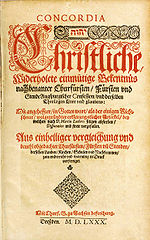
A title page of the Book of Concord
I have argued before that the stance of “confessional” Lutherans of having 100% agreement with the book of concord is unable to be maintained in the face of the evidence within the Book of Concord itself. That is, I believe that one must adhere to the Book of Concord “in so far as” it agrees with the Bible as opposed to “because” it agrees with the Bible. See my post on the topic for in-depth discussion of this distinction and its importance. I argued there, also, that the “because” position largely leads to a kind of inerrancy of the Book of Concord. After all, if the Book of Concord is to be agreed with because it agrees with the Bible, and the Bible is inerrant, it follows that anything that agrees with Scriptures 100% of the time will be without error.
Another example of defining Lutheranism according to strict adherence to the Book of Concord may be found in a recent post by Christopher Maronde entitled “What does the name ‘Lutheran’ mean?”:
Its meaning is simple: The name Lutheran refers to a person, congregation, or church body who unconditionally holds to the teachings contained within the Book of Concord, first published in 1580. A Lutheran is someone who declares that these specific documents rightly confess the truth of the Scriptures. It’s that simple; if you want to know what a Lutheran believes, if you want to know what that label means, you go to the Book of Concord. If you want to know if someone is using the label properly, you evaluate what they believe, teach, and confess according to the Book of Concord. (here)
These positions are generally considered to have a monopoly on the term “Confessional Lutheran” because they teach 100% affirmation of the Book of Concord and restrict any notion of Lutheran to that same adherence. My position, however, is that such a position cannot be maintained, nor should it have a monopoly on the term “Confessional Lutheran.”
Maronde’s definition above seems to provide a small loophole: it states that the Lutheran is to “unconditionally [hold] to the teachings contained within the book of Concord.” The key term here is “teachings.” At this point, if we grant this definition, one could argue that some purported errors in the Book of Concord may not be what the Book of Concord is teaching. However, later in the same quote, we see Maronde writes, “[I]f you want to know what that label means, you go to the Book of Concord…” which once again implies adherence to the totality, word-for-word truth of the Book of Concord. Yet the fact is the Book of Concord is not 100% true in every word-for-word instance.
I ran across another example of this in my readings the other day. In the Large Catechism, Martin Luther wrote,
This, I think, is why we Germans from ancient times have called God by a name more elegant and worthy than found in any other language, a name derived from the word ‘good,’ because he is an eternal fountain who overflows with pure goodness… [The Large Catechism, Part I, 25]
As Kolb and Wengert, editors of the critical edition of the Book of Concord published by Fortress Press note, the words for God and good in German (Gott and gut) are not derived from the same etymological root after all- “German: gut. This derivation is etymologically incorrect. The words for ‘God’… and ‘good’.. are not related in either Gothic or in Middle High German” (footnote 41 on page 389, cited below). Thus, within the very text of the Book of Concord, we have a clear error. Indeed, one that cannot be skirted around by arguing it is not something being taught therein; instead, it is clear that Luther is trying to teach about the meaning of God from an etymological derivation which is non-existent.
Therefore, it seems to me that the position of so-called “Confessional Lutheranism” and those who, like them, define Lutheranism narrowly to mean 100% adherence to the Book of Concord is clearly and demonstrably mistaken. The burden falls upon them to demonstrate that their position is actually viable in light of real, taught errors within the Book of Concord itself.
What does this mean for Lutherans–and indeed, Lutheranism? It certainly doesn’t mean we should all go chuck our Book of Concord editions in the trash. What it means is that, like any book, we should read the Book of Concord with a critical eye, checking it against God’s Word as found in the Scriptures and against the facts that we can discover in other studies as well. The Book of Concord is not inerrant, but that doesn’t mean a Lutheran cannot confess agreement with it so far as it agrees with Scripture, and, in doing so, remain a Confessional Lutheran.
Source
Robert Kolb and Timothy J. Wengert, eds. The Book of Concord: The Confessions of the Evangelical Lutheran Church (Minneapolis, MN: Fortress, 2000).
Links
Be sure to check out the page for this site on Facebook and Twitter for discussion of posts, links to other pages of interest, random talk about theology/philosophy/apologetics/movies and more!
Adhering to the Book of Concord “In So Far As” or “Because” it Agrees with Scripture?– I argue that Lutherans must hold the position that we adhere to the Book of Concord In So Far As it Agrees with Scripture.
Eclectic Theist– Check out my other blog for posts on Star Trek, science fiction, fantasy, books, sports, food, and more!
SDG.
——
The preceding post is the property of J.W. Wartick (apart from quotations, which are the property of their respective owners, and works of art as credited; images are often freely available to the public and J.W. Wartick makes no claims of owning rights to the images unless he makes that explicit) and should not be reproduced in part or in whole without the expressed consent of the author. All content on this site is the property of J.W. Wartick and is made available for individual and personal usage. If you cite from these documents, whether for personal or professional purposes, please give appropriate citation with both the name of the author (J.W. Wartick) and a link to the original URL. If you’d like to repost a post, you may do so, provided you show less than half of the original post on your own site and link to the original post for the rest. You must also appropriately cite the post as noted above. This blog is protected by Creative Commons licensing. By viewing any part of this site, you are agreeing to this usage policy.
Problems with the “Slippery Slope” argument for Inerrancy
 I believe the Bible is true in all that it teaches, and that this is what is meant by inerrancy. The Bible teaches no error. There is much debate over the meaning of inerrancy, and I’m not going to enter into that debate now (though I have written on it, if you’d like to see my opinion). What is important is that I want to start by saying that I affirm inerrancy, but I think one common argument in favor of the doctrine is mistaken.
The Slippery Slope Argument for Inerrancy
The argument I’m referring to is what I shall dub the “Slippery Slope” argument. Basically, it asserts that if someone doubts that one part of the Bible is true, doubt about the rest of the Bible unerringly follows [see what I did there?]. One example of this can be found in a recent webcomic from Adam Ford. We might write out the argument in syllogistic form as something like:
1. If one part of the Bible is in thought to be an error, other parts are thrown into doubt
2. Person A believes the Bible has an error.
3. Therefore, person A has reason to believe other parts are thrown into doubt.
The syllogism as I have written it is surely not the only way to put this argument. I am providing it largely as an illustration of how the argument might be stated. The core of the argument, however, is that if one thinks part of the Bible is an error, the rest of it is made at least possibly dubious.
Analyzing the Argument
There are several difficulties that immediately come up, ranging from concrete to obscure. On the obscure end, we might question what is meant by “an error” and whether that error is said to be theological, scientific, medical, or something else. We could then debate whether an alleged scientific error in the Bible is grounds for stating that there is “an error” in the Bible to begin with, by debating different views Christians hold about the Bible’s relationship with science (or medicine, or whatever). I’m not going to delve into obscurities here, however interesting they may be (and, in my opinion, they are very interesting).
Instead, I want to focus on some major difficulties with the argument. For one, it assumes that the interlocutor, person A, views the entirety of the Bible as on the same evidential plain. That is, for the argument to hold any weight, person A would have to believe that the Bible is linked together so intricately that a belief that Genesis 34:17 [I arbitrarily chose this verse] is an error (however defined) would entail that John 3:16 is possibly an error as well. Clearly, for the argument to be sound, Premise 1 must be correct, and it seems to be obviously false.
The reason I say this is because the possible errancy of John 3:16 does not follow from belief that there is an error in Genesis 34:17. Suppose you are reading a history textbook and you see that it states the date of General Lee’s surrender at Appomattox to be April 9, 1864. You, being a proud history buff, know that the date was actually April 9, 1865. However, the year is only off by one. You may proceed more carefully through the rest of the book, but you would not have any reason to think that the book was mistaken when it said that General Patton was a United States general in World War II.
The argument therefore assumes a unity of the text such that the entire Bible stands or falls together. Now, that might be a perfectly correct position to hold–and I do hold to the unity of Scripture myself–but that is not an obligatory or necessary view. That is, someone might deny that the Bible is a unified text and therefore need not ascribe to the view that if one part is in error, another must be.
But this is not the only difficulty with the argument. Another problem is that it assumes person A has no more reason to believe the portions of the Bible they believe are true than they do for the portions they believe might be errors. Yet this is mistaken, and demonstrably so. Person A may believe there is overwhelming evidence for the truth of the resurrection of Jesus Christ, such that they affirm that without question, while also thinking that the evidence against Israel having been in Egypt is quite weighty as well. Thus, they believe the Bible is perhaps mistaken on the status of Israel in relation to Egypt in Exodus, but they also affirm that it is clearly correct on Jesus’ resurrection. But the slippery slope argument presumes that they cannot hold these beliefs together without at least significant tension. But why? Again, the reason appears to be because the slippery slope argument relies on the assumption that the evidence for one part of the Bible must be exactly on par with the evidence for another. However, that in itself is clearly wrong.
Conclusion
Again, I affirm the doctrine of inerrancy. I just think we should not rely on this as one of our arguments. I have used the slippery slope argument myself in the past, but I believe the above analysis shows I was mistaken to do so. I think that others should avoid the argument as well so that we can present the best possible arguments for the truth of the Bible without error.
I suspect many will take issue with the analysis above. I’m not saying that I believe any portion of the Bible is an error. Nor am I denying the unity of Scripture. What I am saying is that it is not logically fallacious to deny that unity. I’m saying that I believe it is logically consistent to believe that the Bible may have an error while still affirming, for example, the death and resurrection of Jesus Christ. Is that something I would recommend? No, but neither is it something I would say is necessarily contradictory. Those who do want to take issue with my analysis must demonstrate how it is mistaken, and thus provide reason to think that the assumptions the slippery slope argument is based upon are sound.
Again, a final note is that I have taken the place of the interlocutor in several instances in this post. My point is simply that someone who did deny these things could come up with effective counters to the slippery-slope argument for inerrancy. Therefore, it seems to me that the argument is ineffective at best and faulty or fallacious at worst. It relies on presupposing that the opponent operates in the same sphere of presuppositions as the one offering the argument, but they need not do so.
Links
Be sure to check out the page for this site on Facebook and Twitter for discussion of posts, links to other pages of interest, random talk about theology/philosophy/apologetics/movies and more!
On the “Fuzzification” of Inerrancy– I argue that we have qualified the term “inerrancy” unnecessarily and to the extent that it has become difficult to pin down its actual meaning. I advocate a return to a simple definition of the term.
SDG.
——
The preceding post is the property of J.W. Wartick (apart from citations, which are the property of their respective owners, and works of art as credited) and should not be reproduced in part or in whole without the expressed consent of the author. All content on this site is the property of J.W. Wartick and is made available for individual and personal usage. If you cite from these documents, whether for personal or professional purposes, please give appropriate citation with both the name of the author (J.W. Wartick) and a link to the original URL. If you’d like to repost a post, you may do so, provided you show less than half of the original post on your own site and link to the original post for the rest. You must also appropriately cite the post as noted above. This blog is protected by Creative Commons licensing. By viewing any part of this site, you are agreeing to this usage policy.
Adhering to the Book of Concord: “In So Far As” or “Because” it agrees with Scripture?
A title page of the Book of Concord
Lutheran theology is derived from and reflective upon not just Martin Luther but also the Lutheran Confessions, as found in the Book of Concord. Within Lutheranism, there is much debate over exactly how tightly one must adhere to the Book of Concord. On one side, there are those who insist we must affirm the Book of Concord “because” it agrees with the Bible. On the other side, others maintain we should affirm it “in so far as” it agrees with the Bible.
Because it Agrees
Representative of the view that one must agree with the Book of Concord because it teaches what the Bible teaches is the following:
Authentically Lutheran churches insist on a subscription to the Confessions [The Lutheran Confessions/Book of Concord are used interchangeably] because they agree with the Bible, not merely in so far as they agree with Scripture. Otherwise, there would be no objective way to make sure that there is faithful teaching and preaching of God’s Word. Everything would depend on each pastor’s private opinions, subjective interpretations, and personal feelings, rather than on objective truth as set forth in the Lutheran Confessions. (Book of Concord (.org) FAQ)
Note some important aspects in this quote. First, the Book of Concord just does agree with the Bible. That is insisted upon. Second, the Book of Concord is said to be “objective truth” as opposed to the “subjective interpretations” of the individual. These considerations frame what I’d like to comment on regarding those who hold to the view that we must agree with the book of Concord “because…”
Because?
I’ll start with the second aspect noted above. There are, of course, all kinds of increasingly detailed issues people on either side of the debate might raise here. For example, how are “objective” and “subjective” being here defined? I’m going to set that kind of issue mostly aside and focus on a few difficulties I see.
The first is that one cannot simply read the words off the pages of the Book of Concord without going through the necessary step of interpreting them. That is, I as a reader of the Book of Concord must try to make sense of the words I am reading, and thus I am participating in the act of interpreting the Book of Concord. If, as the quote above states, the problem is the individual’s subjective nature, then the problem is completely unavoidable. Indeed, even if we grant that the Book of Concord is “objective truth” in its entirety, all we’ve done is moved the problem of subjective interpretation one step back. Now the reader must interpret the Book of Concord in order to get to the objective truth about Scripture found therein.
Another difficulty with this objective/subjective distinction is that it assumes the writers of the Lutheran Confessions were themselves either not subjective (which seems impossible) or explicitly guided by the Spirit to write out objective truth only. I would not dispute that the Holy Spirit could bring about a completely faultless writing, but the question is whether those who affirm the “because” position would like to argue this. The first thing we should do if they do want to argue this would be to see whether the writers of the Book of Concord assert the Holy Spirit did bring about such a completely objective, 100% correct work.
In the Preface to the Book of Concord, we can read:
Finally, with invocation of God Almighty and to his praise and glory and with careful deliberation and meticulous diligence through the particular grace of the Holy Spirit, they wrote down in good order and brought together into one book everything that pertains to and is necessary for this purpose. (Preface, 12)
Later, the Preface makes clear (15) that this Book was “the correct, Christian understanding of the Augsburg Confession…” In the closing of the Preface, we read (23) that those who signed on to it that they “are minded not to manufacture anything new… nor to depart in either substance or expression… from the divine truth… by the grace of the Holy Spirit we intend to persist and remain unanimously in this truth and regulate all religious controversies and their explanations according to it.”
These are all strong statements, and they clearly called upon God the Holy Spirit for guidance in the composition of the various works that make up the Book of Concord. But does it follow that they were explicitly, inerrantly inspired and guided by the Spirit to never once get a single thing wrong in this book? Those who affirm the “because” position must answer yes. There is no wiggle room.
But a close reading of the Preface seems to suggest that although the writers certainly believed everything in the Book of Concord to be without theological error (otherwise they would not have it regulate all controversies, etc.), I have yet to find anywhere that a claim could be made that the book is explicitly inerrant. It would have to be, however, for the “because” position to be true. This human composition would have to be 100% correct in every single minute detail down to the last proof text cited in order for it to be acceptable to affirm that we must agree with it “because” it agrees with Scripture.
Among other things, what follows from that is that anyone who subscribes to the Book of Concord “because” position must have read the entirety, looked up every citation, and assured themselves that every single interpretation, doctrinal position, and the like is 100% correct, lest they be saying that it is a human-made book without error on God’s Word without actually knowing every detail it contains.
The first issue raised above will be addressed in the section named “A Case Study,” below.
In So Far As
A supporting argument for the “In So Far As” position is that we should always only affirm that which is true. If we can agree that the Bible is true in all it teaches, then we should only agree with other writings about the Bible so far as they agree with the Bible. This seems like an obvious conclusion, but the whole debate centers on whether this argument is sound. It is difficult for me to figure out how to support this argument, not because I think it is a poor argument, but because it seems just intuitively clear.
It may help to use an analogy. Historians have debated how to write history and whether writers of history can ever fully get at the “true” history as it happened. Yet very few would deny that there is such a thing as a “true” history. There must be some absolutely correct sequence in which events occurred such that if we had a complete set of writings that simply reported those events, that would be the “true” history. Thus, there is an objectively true history, against which historians can be measured. Granting some of the hand waving involved in this thought experiment, suppose we had a book, The True History of the World, and we looked up the John F. Kennedy assassination therein. We would then have the objectively true report of that hotly-debated historical event as it really did happen. Now suppose I wanted to write a book about the JFK assassination based upon The True History of the World. However careful a historian I am, however excellent and detailed my mind is, however much guidance I may have had, would it be reasonable to say that you agree with my book, The Objective JFK Assassination “because” it agrees with The True History of the World or “in so far as” it does? It seems that the reasonable conclusion would be “in so far as” it does, because we know that The True History of the World is objectively true.
Though imperfect, this analogy gets at the argument written above. We can agree the Bible is inerrant. Thus, if I were to write a book entitled The Objective Bible, I think we can agree that we should only agree with my book so far as it agrees with the Bible, right? No matter how detailed I am, no matter how meticulous, no matter how large a group of thoughtful interpreters I got together to vet my work, it would be entirely reasonable to only affirm agreement with my book so far as it is biblical. Then why would such a standard not also apply to the Book of Concord? I see no reason why that standard would not.
Indeed, to argue against those who affirm the Book of Concord only “in so far as” it agrees with the Bible would mean that one would have to assert that the caution and respect for God’s word implicit in that position–that I would not want to affirm anything, even by mistake, as biblical if it is even possibly in error anywhere–are mistaken. That the care and caution necessary to say “I will only agree with any book in so far as it agrees with the Word of God” is mistaken, and that that the Book of Concord must also be included under the umbrella of books against which all others must be judged.
For the “because” position ultimately, unswervingly leads to the conclusion that we should only affirm any other book “in so far as” it agrees with the Book of Concord. After all, if it is true that the Book of Concord is affirmed because it agrees with Scripture, then it follows that the authority of the Bible is effectively equivalent to the authority of the Book of Concord. The Bible is God’s word, and the Book of Concord is the objective teaching of God’s word without even possible error. That is not simply rhetoric; it is what must follow from the “because” position. Any interpretation of the Bible must be judged against the Book of Concord; hence, any reading of the Bible must also be judged against it.
A Case Study
Finally, we are in position to ask whether the Book of Concord does indeed have any error therein. That is a crucial question, of course, and one not easily resolved by those who remain faithful Lutherans. If, however, there is even one incorrect use of a proof text in the Book of Concord, the “because” position fails.
In the Apology of the Augsburg Confession, Article XXIII (XI) on the Marriage of Priests, section 25, we read:
Therefore this law concerning perpetual celibacy is peculiar to this new pontifical despotism. Nor is it without a reason. For Daniel 11:37, ascribes to the kingdom of Antichrist this mark, namely, the contempt of women.
Daniel 11:37 reads (ESV) “He shall pay no attention to the gods of his fathers, or to the one beloved by women. He shall not pay attention to any other god, for he shall magnify himself above all.”
The whole passage is difficult to interpret given its prophetic message about the Kings of the North and the South. I’m not going to enter into whether this is specifically referencing “Antichrist” or “the kingdom of Antichrist” or anything of the sort. Instead, the issue is with the reading as “contempt of women.” The Reformers were obviously not using the ESV or anything in English. But older English editions like the KJV might support this text as a proof for contempt of women: “Neither shall he regard the God of his fathers, nor the desire of women, nor regard any god: for he shall magnify himself above all.”
But the problem is that critical editions of the Old Testament don’t support a reading as contempt of women. Without going into depths of detail, and because I’m not a Hebrew scholar by any measure, I would just point out that the Hebrew does seem to clearly state “the one desired by women.” So if we are to read 11:37 as a proof text for contempt of women, it doesn’t seem to be a right reading. It’s a minor difficulty, but one nevertheless. Did the citation above from the Book of Concord properly exegete the Bible? I would assert that the use of this proof text is mistaken. If we are to take “paying no attention” as “contempt”–itself a move that could be disputed, then the subject remains “the one desired by women” not “women.”
Now, if the Book of Concord should be agreed with because it agrees with the Bible, then how are we to take this? I don’t know. It seems to me that this is more an example of the way people read the Bible at the time and used proof texts–often stripped of context–in defense of their positions. A single dispute over a citation is not a paradigm shift; indeed, I think that the authors of the Apology were correct on this notion about the marriage of priests. But that doesn’t mean everything they wrote is correct.
Conclusion
I agree with and affirm the Book of Concord in so far as it agrees with Scripture. I think it is correct on a huge amount of the things it teaches. I am currently re-reading it (slowly) and checking citations as I go. I have found it to be edifying and a source of profound theological insight. But it is not the Bible, and I do not think that to be Lutheran–or even a confessing Lutheran–I need to affirm that the Book of Concord is without possible error.
Source
Robert Kolb and Timothy J. Wengert, eds. with Charles P. Arand, translator, The Book of Concord.
Links
Be sure to check out the page for this site on Facebook and Twitter for discussion of posts, links to other pages of interest, random talk about theology/philosophy/apologetics/movies and more!
SDG.
——
The preceding post is the property of J.W. Wartick (apart from quotations, which are the property of their respective owners, and works of art as credited; images are often freely available to the public and J.W. Wartick makes no claims of owning rights to the images unless he makes that explicit) and should not be reproduced in part or in whole without the expressed consent of the author. All content on this site is the property of J.W. Wartick and is made available for individual and personal usage. If you cite from these documents, whether for personal or professional purposes, please give appropriate citation with both the name of the author (J.W. Wartick) and a link to the original URL. If you’d like to repost a post, you may do so, provided you show less than half of the original post on your own site and link to the original post for the rest. You must also appropriately cite the post as noted above. This blog is protected by Creative Commons licensing. By viewing any part of this site, you are agreeing to this usage policy.

 J.W. Wartick - Reconstructing Faith

