A Matter of Days
Book Review: “A Matter of Days” by Hugh Ross, Second Expanded Edition
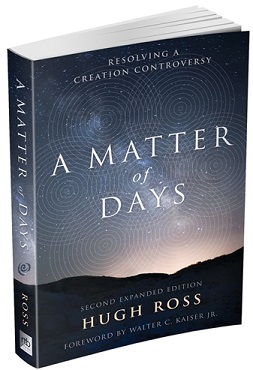
Hugh Ross is one of the most influential Old Earth Creationists alive. The founder of Reasons to Believe, he has had a profound influence on putting forth Old Earth Creationism from a concordist–that is, the notion that the Bible and science will agree where they overlap [often including the notion that the Bible explicitly speaks on scientific issues]–perspective. A Matter of Days
The book provides a huge amount of material for those wanting to interact with topics of creationism. Ross begins by surveying the contentious way the issue is often argued and noting that we as Christians ought to strive for more tolerant attitudes towards each other. Alongside this, he notes various statements by evangelicals allowing for some openness on the topic.
The book covers a massive range of arguments for and against young earth creationism, but the real meat of the text is dealing with various scientific arguments on either side. These are surveyed in a kind of question and answer or objection and rejoinder format in which Ross clearly explains a huge amount of scientific data for an ancient universe and deals with the major objections to such a position from the young earth creationist perspective.
Ross also confronts textual issues in a number of places, including much discussion on the concept of “day” and its meaning in Genesis 1. This, he covers from different perspectives including historic theology, exegesis, and science. He also puts forward a canonical view of how to see Creation in the Bible rather than limiting it simply to Genesis 1-2. There are a number of other texts that he argues also teach on creation.
Although he is an “Old Earth” believer, Ross is also clearly a creationist and puts forward several brief arguments about the faultiness of evolution. This is not a focus of the work, but through such arguments he establishes a clearer picture of his own position related to origins of both life and speciation.
One issue that might be raised with the book is whether the seemingly strict concordism Ross advocates is necessary. For example, rather than arguing that entropy and decay are spoken about in the Bible (100-102), could one not simply note that the human biblical author almost certainly had no concept of entropy and therefore was not addressing it? That is to say, a concept of divine condescension might be easier to hold to than one of future scientific knowledge revealed in the Bible.
The new edition is expanded and has noticeably featured references to some recent works as well as more arguments. It is a rather large re-write with much new information. Readers considering purchase should get this edition.
The Good
+Major point-by-point explorations of evidence for and against an old earth
+Strong defense of the Old Earth Creationist/Concordist position
+Many technical issues explained in understandable ways
+Charitable tone
+Excellent index
+Expanded arguments and new information for the new edition
+Really cool cover
The Bad
-Some questions about concordism remain
-Perhaps too brief on some objections
Conclusion
A Matter of Days
Disclaimer: I was provided with a review copy by the publisher. I was not required to write any sort of review whatsoever thereby.
Links
Be sure to check out the page for this site on Facebook and Twitter for discussion of posts, links to other pages of interest, random talk about theology/philosophy/apologetics/movies and more!
Origins Debate– Read a whole bunch more on different views within Christianity of the “origins debate.” Here I have posts on young and old earth creationism, intelligent design, theistic evolutionism, and more!
Source
Hugh Ross, A Matter of Days
SDG.
——
The preceding post is the property of J.W. Wartick (apart from quotations, which are the property of their respective owners, and works of art as credited; images are often freely available to the public and J.W. Wartick makes no claims of owning rights to the images unless he makes that explicit) and should not be reproduced in part or in whole without the expressed consent of the author. All content on this site is the property of J.W. Wartick and is made available for individual and personal usage. If you cite from these documents, whether for personal or professional purposes, please give appropriate citation with both the name of the author (J.W. Wartick) and a link to the original URL. If you’d like to repost a post, you may do so, provided you show less than half of the original post on your own site and link to the original post for the rest. You must also appropriately cite the post as noted above. This blog is protected by Creative Commons licensing. By viewing any part of this site, you are agreeing to this usage policy.
The Life Dialogue: Old Earth Creationism 4
 This is part of a series of posts on the “Life Dialogue/Origins Debate” within Christianity. View other posts in the series here.
The obvious point of contention between Old and Young Earth Creationism (hereafter OEC and YEC) is the age of the Earth/Universe. Hugh Ross argues powerfully for an old universe from both a theological and scientific perspective in A Matter of Days: Resolving a Creation Controversy.
The argument against the YEC position (derived from A Matter of Days) runs as follows:
1) The most coherent YEC position to explain the appearance of age in the universe is to hold that the universe appears to be old, but is not old in fact. (YECs often hold that God created light already traveling to earth, created Earth already to the point it could sustain life, etc.)
2) Scripture states that God does not lie. God is not a deceiver.
3) Scripture states that nature provides an accurate record of reality, though not a complete record.
4) 1) Scientific evidence (nature) demonstrates the universe is about 14 billion years old, as opposed to the 10,000(ish) years YECs grant.
5) Therefore, the universe is actually old. This follows from the accurate evidence of nature combined with 2) that God doesn’t deceive. If the universe is, in fact, 10,000 years (or so) old, then God has deceived humanity by making it in such a way that it appears to be much older than it is.
Premise 1) seems to definitely be the case. First, because the universe, according to the most modern science, is anywhere between 13-16 billion years old. Second, while YEC potentially has theories to explain why earth looks so old without relying on it being created already aged to a certain point (i.e. hydroplate theory), this does nothing to explain the background cosmic radiation; how we can see light from stars that are too far away to be seen yet were the universe 10,000 years old, etc. It therefore seems as though the only way to explain the apparent age of the universe is to argue that it is just that: apparent only. On this theory, God created the earth universe enough to support life, about 10,000 years ago.
Premise 2) doesn’t really need a defense (but if desired: Romans 3:4; Numbers 23:19; Deuteronomy 32:4; 1 Samuel 15:29; Titus 1:1-2).
Premise 3) can be seen in things like Psalm 19:1-4a:
“The heavens declare the glory of God;
the skies proclaim the work of his hands.
Day after day they pour forth speech;
night after night they reveal knowledge.
They have no speech, they use no words;
no sound is heard from them.
Yet their voice goes out into all the earth,
their words to the ends of the world.”
Premise 4) is at least implicitly accepted by YECs because they argue that even though science shows the universe is very old, it is not actually that old. It is worth noting that some YECs would claim that “real” and “unbiased” science would not lead to the conclusion that the universe is very old. There is little one can do to counter this claim other than argue that were that true, the YEC account would be able to present a fully testable, verifiable scientific model that shows that things like the background cosmic radiation are false.
Finally, the conclusion seems to follow from the preceding argument. God told us nature is an accurate record; He also created the universe (on YEC) in such a way that it appears to be billions of years old, but is not actually that old. Therefore, He created a universe that would deceive us into thinking, falsely, that the universe is old. But, God does not lie, so this cannot be true. Therefore, the universe is old.
I find this argument very convincing. It underscores my main problem with the YEC position: namely, that the best evidence does show the universe is old, and so God would be a deceiver were He to make it thusly.
SDG.
——
The preceding post is the property of J.W. Wartick (apart from citations, which are the property of their respective owners) and should not be reproduced in part or in whole without the expressed consent of the author. All content on this site is the property of J.W. Wartick and is made available for individual and personal usage. If you cite from these documents, whether for personal or professional purposes, please give appropriate citation and provide a link to the original URL. By viewing any part of this site, you are agreeing to this usage policy.

 J.W. Wartick - Reconstructing Faith