abortion
Really Recommended Posts 4/24/15- abortion and evangelicals, apologetics, and more!
 Winter is back, apparently, here in Minnesota. It’s COLD! And it snowed on Monday and Tuesday. Anyway, here we have some reading to keep you entertained on chilly nights. The topics are abortion and evangelicals, raising kids, apologetic methods, science fiction, and a debate over the Reformation.
Evangelicals Opposed Abortion Much Earlier than You Think– It has been said that evangelicalism wasn’t originally pro-life or oriented against abortion. Is that true? Moreover, does it even matter? Here’s an article examining the historical claim. My own thoughts are that it doesn’t matter when evangelicals began working against abortion. The question is whether abortion is morally permissible (or not). Whether a group historically opposed it or not doesn’t do much to the current debate other than provide a rhetorical flair. This post takes away some of that rhetorical flair.
4 Reasons the Internet May Influence Your Kids’ Faith More Than You– What influence does the internet have on kids exploring questions about the faith? How might awareness of this influence help us to confront worldview issues?
Comparing Apologetics Systems: Methodology and Practice– How should we do apologetics? Here is a post outlining some different approaches to apologetics and how they might be applied.
Spec[ulative]-Fic[tion] Subgenres: Superheroes & Fairy Tales– Christian publisher (of science fiction and fantasy) Enclave has an interesting post comparing the genres of superhero writing to fairy tales. They’re the same publisher who is re-releasing Kathy Tyers’ works. I had an interview with this awesome sci-fi author regarding worldview questions and science fiction here.
Revelation TV Debate: Church would have been better off without the Reformation?– Here’s an interesting debate about whether the Reformation was a good development in church history. The debaters are James White and Rev. Dr. Thomas Norris.
Really Recommended Posts 4/17/15- Aquinas, Creationism, Abortion, and more!
 Spring is here for real this time (maybe?). That means that my family gets to go on long walks outside, which is wonderful. What else is wonderful? Sharing some awesome posts with you, dear readers! Here’s another round of RRP that includes posts on Aquinas, science fiction, creationism, men and women, and arguments for abortion (debunked). Check them out, and let me know what you think!
Soft Tissue in Mollusk Fossils and the Case for a Young Earth– Does soft tissue prove that the earth is, in fact, only a few thousand years old? Here is an analysis of an argument put forward for some for the position of young earth creationism.
Bad Pro-Choice Arguments– There are some really poor arguments out there for all kinds of positions. Here is an analysis of some bad arguments for the pro-choice position.
Three Reasons I believe Men and Women are Equal Co-Laborers in God’s Kingdom– Why believe that men and women should work side-by-side in pastoral (and other) ministry? Here are three reasons.
Spec[ulative]-Fic[tion] Subgenres: Paranormal & Supernatural– Christian speculative fiction [read= fantasy/sci-fi] publisher Enclave has put out this post on the genres of paranormal and supernaturalism in fiction. It’s worth a read to see some interesting distinctions.
Was Aquinas a Materialist?– Edward Feser analyzes the claim that Thomas Aquinas was a materialist when it comes to human nature.
The “Dependency” Argument for Abortion: A Dilemma
 One common argument for the pro-choice position is what I shall call the “dependency” argument for abortion. This argument suggests that because the unborn is dependent in a unique way upon the mother, abortion is permissible. For example, one might argue that because a fetus cannot survive without the direct use of the mother’s body, the unborn does not have a right to life. The status of dependency upon another being in such an intimate and unique fashion means that abortion is permissible, according to this argument.
One way to respond to this argument is to show that the dependency of the unborn upon the mother is not relevantly unique. For example, one may cite the dependency of a newborn upon his or her parents, of a person hooked up to an artificial heart or some other dependency-creating situation. However, here we will consider what I think is a more direct and intractable problem for the abortion advocate. Namely, that the dependency argument yields an inescapable dilemma for their position.
The Thought Experiment
Suppose we were able to create artificial wombs–something which doesn’t seem all that preposterous given that it’s being worked on right now–to which we were able to move the unborn at any point up to birth and allow to grow there. In this case, the growing being is not dependent upon its mother or even any woman or person. We may cut out the people doing maintenance on the artificial wombs by having some kind of automated maintenance system.
The Dilemma
Would it be permissible to terminate the unborn within the artificial womb?
If so, then the grounding for abortion on the notion that the unborn is in a relevantly dependent situation related to the mother cannot be correct. For in this case the unborn is not in that dependent situation, yet the pro-choice advocate still maintains a right to abort. If it is not permissible, then there must be some reason why it is not permissible to abort once the unborn is no longer within the mother, and this reason would have to be one that could, in a way that is not ad hoc, not apply to the unborn when inside the mother.
I think this is a serious dilemma for those who use the “dependency” argument in order to ground objections to abortion.
Answering the Dilemma
Perhaps one might try to answer the dilemma by embracing the second horn of the dilemma and suggesting that once the dependency situation is removed, then the right to abort is also removed. However, the same type of dependency which the unborn is in with the mother has simply been transferred to an artificial womb. Perhaps, however, one cannot be relevantly (morally) dependent upon a machine. But this is to effectively beg the question, for the very grounds of the pro-choice argument is that it is dependency which creates a state of permissive abortion. Perhaps they could modify their stance and say that it is actually dependency upon the mother alone. But here is where the danger of an “ad hoc” stance rears its ugly head, because the relevant criterion–dependency–is maintained while it is the location of the unborn which has shifted. If dependency is alleged to be enough to ground abortion rights, then smuggling in additional premises alongside dependency defeats the initial argument.
The point needs to be emphasized: I think this is the best route for the pro-choice advocate to try to go to avoid the conclusions of the dilemma, but if they do go down this route it raises even more questions for their position. First, if we suppose that dependency must be on a person to be morally relevant, than it undermines the notion of dependency as the reasoning for allowing abortion to begin with. For, in this case, it would be the person grounding the moral status, not the dependency. Second, to embrace this horn means that the pro-choice advocate is effectively granting that the unborn has some right to live, so long as it is not in this relevant state of dependency. This is a startling admission, and it must be emphasized that this means, frankly, that according to the pro-choice advocate a being with a right to live has that right suspended so long as a valid “dependency criterion” can be met. The implications of this would be enormous.
Moreover, if we grant that the second horn may be embraced by means of saying that if dependency is removed, then it follows that any possible way to remove the dependency situation, if such a way could become reality, makes abortion impermissible.
Free Wombs?
Now, suppose further there were a foundation that was willing and able to pay for anyone (anywhere and anytime) to move their unborn into an artificial womb rather than abort the fetus. For the sake of argument, we will assume this is a risk-free type of procedure, with relevant clinical test results, etc., etc. This strengthens the dilemma posed above because at this point, there is effectively no dependency upon mothers beyond conception. For, the moment a woman finds she is pregnant, she could phone this foundation and transfer the unborn to an artificial womb, relinquish any claim to parental rights, and be done. But if this were the case, then dependency would in a sense no longer exist. The unwanted pregnancy could immediately be ended without the termination of the fetus.
Once again, it seems that in this situation only the location of the unborn remains relevant, should the pro-choice advocate wish to maintain the right to abort. The mother could choose to end her pregnancy by transferring the unborn and all rights/knowledge of/etc. thereof elsewhere at any point.
I realize that some may object and say that having a surgical procedure is an inconvenience, no matter how safe, quick, successful, secret, etc. it might be. But at that point I must wonder where the line is drawn for abortion. After all, if the scenario envisioned above really did exist, and someone really did want to maintain the right to abort, what they would have to be saying is that something thought to be inconvenient alone is enough to abort. Setting aside the fact that abortion is also a procedure–and one with risks–at this point I think I would point out that the dependency argument has been shown to be mistaken, because the pro-choice advocate must now base his or her argument upon the “convenience” of the mother.
Conclusion
It appears to me that the only recourse the pro-choice advocate has with regard to the dependency argument is to argue that location really is a relevant criterion for allowing for abortion. But in that case, dependency ceases to be the factor which grounds the right to abort, and thus the dependency argument fails.
I’m fairly sure I’ve read a similar argument to the one I present here somewhere. However, I do not remember where I may have read it and regret to omit a reference to it here.
Links
Be sure to check out the page for this site on Facebook and Twitter for discussion of posts, links to other pages of interest, random talk about theology/philosophy/apologetics/movies and more!
Pro-life– I have written a number of posts advocating the pro-life position. See, in particular, “From conception, a human” and “The issue at the heart of the abortion debate.”
The image is courtesy of Wikipedia Commons.
SDG.
——
The preceding post is the property of J.W. Wartick (apart from quotations, which are the property of their respective owners, and works of art as credited; images are often freely available to the public and J.W. Wartick makes no claims of owning rights to the images unless he makes that explicit) and should not be reproduced in part or in whole without the expressed consent of the author. All content on this site is the property of J.W. Wartick and is made available for individual and personal usage. If you cite from these documents, whether for personal or professional purposes, please give appropriate citation with both the name of the author (J.W. Wartick) and a link to the original URL. If you’d like to repost a post, you may do so, provided you show less than half of the original post on your own site and link to the original post for the rest. You must also appropriately cite the post as noted above. This blog is protected by Creative Commons licensing. By viewing any part of this site, you are agreeing to this usage policy.
Another Pro-Choice Meme – Does it Succeed?
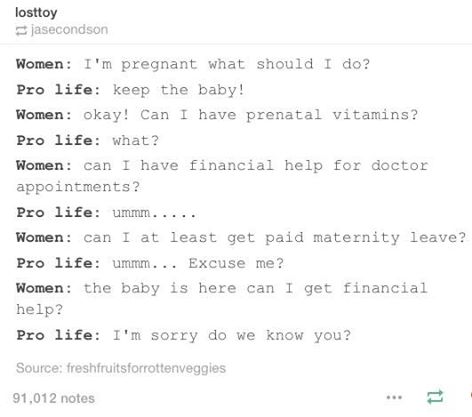
Recently, I saw a few people on Facebook posting this image. It’s a bit hard to see on here so here’s a transcript (skip this if you already read it and go to the “Analyzing the Meme” section [I typed it as it is without correcting punctuation):
Women: I’m pregnant what should I do?
Pro life: keep the baby!
Women: okay! Can I have prenatal vitamins?
Pro life: what?
Women: can I have financial help for doctor appointments?
Pro life: ummm…..
Women: can I at least get paid maternity leave?
Pro life: ummm… Excuse me?
Women: the baby is here can I get financial help?
Pro life: I’m sorry do we know you?
Analyzing the Meme
The meme is clearly aimed at the notion that pro-life advocates are inconsistent. They claim to be “pro-life” but when it comes down to the details of life, they jump ship.
I am not speaking for all who are pro-life (that would be impossible), but I do think it is extremely important to be consistently pro-life. That is, an argument like this can show that a position like pro-life is inconsistent, and that does discredit the pro-life position. We need to be consistently pro-life if we are to consider ourselves pro-life at all. But–and this is a really big “but”–the meme completely misses the point.
Missing the Point
It should be clear, however, that the argument presented in this meme is a bit off target. The point is that the real question at issue is whether the unborn is a person.
Think about the meme this way:
Women: I have a toddler what should I do?
Pro life: keep the toddler!
Women: okay! Can I have health care?
Pro life: what?
Women: can I have financial help for doctor appointments?
Pro life: ummm…..
Women: can I at least get paid leave if he/she is sick?
Pro life: ummm… Excuse me?
Women: the toddler is here can I get financial help?
Pro life: I’m sorry do we know you?
What conclusion could be drawn from this? That women (or men) have the right to kill the toddler if they don’t receive those things? I should hope the answer is obvious: no, that does not follow at all. Whether one thinks the answers to the questions the women ask in this scenario should be affirmative or not, suppose it was no to all of them: does that mean we’d go ahead and green light the parents killing the toddler?*
Thus, the argument begs the question. No one should take seriously the notion that if someone can’t pay for supporting a human being they should kill him or her. The only way the argument makes any sense is if one has already assumed that the unborn is not a human being/person. And that is an issue that should be discussed more thoroughly. I have written numerous articles in defense of the pro-life position, so I won’t repeat my arguments here.
Conclusion
One of the comments on Facebook a user posted from the group that put up this image was “How true..
They are not pro life…they are pro birth…then wash their hands afterwards..”
I think this comment demonstrates how much of an emotional impact a meme like this can have. We as pro-life individuals need to be consistently pro-life, lest people reject our reasoning because they see us as “hypocrites.”
However, the ultimate point–the one at the heart of the debate–is whether the unborn is a person. And a meme like this does nothing to discredit the pro-life position whatsoever. It does not follow that if I can’t pay to support my son, I should be allowed to kill him. Neither does it follow that the interlocutor of the meme has demonstrated the pro-life position is mistaken.
Links
Be sure to check out the page for this site on Facebook and Twitter for discussion of posts, links to other pages of interest, random talk about theology/philosophy/apologetics/movies and more!
Pro-life– I have written a number of posts advocating the pro-life position. Particularly relevant to the present discussion are “From conception, a human” and “The issue at the heart of the abortion debate.”
*This is an example of the “trot out the toddler” defense of the pro-life position. It was coined by (I believe) Scott Klusendorf.
I am not sure who was the original user that put the image up, so I can’t cite it appropriately. I make no claim to owning the image and use it under fair use.
SDG.
——
The preceding post is the property of J.W. Wartick (apart from quotations, which are the property of their respective owners, and works of art as credited; images are often freely available to the public and J.W. Wartick makes no claims of owning rights to the images unless he makes that explicit) and should not be reproduced in part or in whole without the expressed consent of the author. All content on this site is the property of J.W. Wartick and is made available for individual and personal usage. If you cite from these documents, whether for personal or professional purposes, please give appropriate citation with both the name of the author (J.W. Wartick) and a link to the original URL. If you’d like to repost a post, you may do so, provided you show less than half of the original post on your own site and link to the original post for the rest. You must also appropriately cite the post as noted above. This blog is protected by Creative Commons licensing. By viewing any part of this site, you are agreeing to this usage policy.
Really Recommended Posts 1/16/15- Abortion, Jesus, Science Fiction, and More!
I am really proud of this lineup today, folks. I feel like it’s gotta be one of the broadest ranges of topics I’ve had in a while and they are all very interesting reads, at least in my opinion! Several of them are not just about what the title implies, but about something interesting related to that topic (like the one on pro-life being not just about the pro-life position but about how it might relate to evangelism). I’m pumped to share these posts. Let me know what you think in the comments here, and be sure to let the authors know you enjoyed their posts as well!
How Pro-Life Apologetics Helps Strengthen Your Evangelism– The case for the pro-life position is, in my opinion, absolutely philosophically and scientifically insurmountable. Here, Wintery Knight shares some thoughts on how learning the ins-and-outs of pro-life apologetics can also help evangelism.
Ehrmann Errors on Jesus’ Authority to Forgive– Noted skeptic Bart Ehrmann has argued that the notion that Jesus is divine was a later development in Christianity. What might the Bible itself–the earliest documents we have on the topic–reveal?
Observations About Commenting on Young Earth Creationist Facebook Pages– Let’s clear the water: commenting on Facebook pages is almost always going to get into some random fight about something… probably something completely unrelated to the original comment. The greater the importance of the topic, the more off the rail it often gets. That happens everywhere. However, here, the “Geochristian” shares some insights specific to discussing young earth creationism.
In the Image of Man they Created God; Male They Created Him– God is not male. God is Spirit. It is not inappropriate to use biblical pronouns for God like “He”; however, the danger is that we begin to think of God as a kind of Grandpa in the sky. Here’s some insight into the problems with assigning gender to God.
Scientific Mythologies: How Science and Science Fiction Forge New Religious Beliefs– Here, Anthony Weber shares a brief book review along with some insights related to this wonderful work by James Herrick. I do highly recommend the book to my readers. I shared a Sunday Quote about it some time ago.
Really Recommended Posts 10/10/14- Game of Thrones, Abortion, Joshua, and more!
Another week, another look at some of the most interesting posts on the web. Here we have posts on the Game of Thrones and Philosophy, Joshua 10 and the meaning of the sun standing still, creationist Ken Ham, abortion, and ways your kid might be learning an oversimplified faith. As always, I’d love to read what you think of the posts! Be sure you leave a comment when you go visit to let the authors know your own insights. We have an owl post edition today because it’s cold.
6 Ways You May Be Raising Your Kids with an Oversimplified Faith– We are charged with raising our children in the faith. That doesn’t apply only to parents, but to the entire Christian community. How might we combat the simplistic image of faith that many children have? Check out this great post (and site) from Natasha Crain, and be sure to follow the site for some awesome posts on Christian teaching for children.
Biblical Credibility and Joshua 10: What does the text really claim?– Joshua 10–the passage about the sun ‘standing still’ in the sky has long drawn criticism from non-Christians for various reasons, primarily scientific inaccuracy. Here, eminent scholar John Walton (seriously one of my favorites) explains the text of Joshua 10 in light of other Ancient Near Eastern literature and the way it would have been understood in its time.
Scott Klusendorf Defends the Pro-Life View on the Unbelievable? Radio Show– Recently, Scott Klusendorf–a wonderful pro-life teacher and advocate–debated Mara Clarke on the subject of abortion. It was interesting to listen to this debate and see how the sides played out their arguments. Check out this post to get summary and commentary on the debate.
“You Win or You Die” (from Game of Thrones and Philosophy)– Whatever your view of the appropriateness of “Game of Thrones” (and we must note there is much objectionable content in it), there is no denying its current popularity. Check out this post from Anthony Weber which discusses some issues related to the philosophy of the series.
The Never-ending Debate: Ken Ham’s Obsession with Bill Nye– Some time ago, Ken Ham debated Bill Nye on evolution, the age of the earth, and more (see my summary and commentary on the debate here). Ken Ham has not let this public debate sit, and continues to utilize it to produce creationist material and muster the troops, so to speak. Is this a bad thing? Is it helpful? Let’s here your thoughts. Here is a post analyzing some recent trends in his organization regarding Bill Nye.
Really Recommended Posts 5/23/14- Handel, Asteroids, Alcohol, and more!
I read all kinds of awesome posts this week and have gathered them here for your reading pleasure. Let me know what you think in the comments, and be sure to tell them too! This week we have alcohol, Handel, asteroids, embryology, and young adult fiction. How’s that for an assortment of topics!?
How Evangelicals Lost Their Way on Alcohol– How should Christians think about alcohol? Here, Thomas S. Kidd argues that some have lost their way in the debate over Christianity and alcohol. What are your thoughts on this topic?
George Frideric Handel- Things you may not know– Handel is one of the most amazing composers of all time. I know I have benefited greatly from his “Messiah.” But there are some things you may not know about the man himself. Read this post to test your knowledge, and maybe learn something new.
Rewinding the Clock: An Asteroid Family History– Interestingly, asteroids give us a lot more information than one might think. Some of this information is a challenge to a young-earth paradigm. Check out this post to see how the development of asteroids shows that our universe is very old.
Did Washington Post Check the Science?– Clinton Wilcox comments on a recent opp ed over at the Washington Post which claimed to check the science to see if life begins at conception. Wilcox’s commentary is enlightening. Check it out.
The Knife of Never Letting Go (Chaos Walking)– Anthony Weber’s site, Empires and Mangers, provides readers with numerous reviews of YA literature and movies from a genuinely insightful Christian perspective. Check out this post to see his look at a recent (and popular) piece of YA lit, and follow his site to see much more where this one came from.
Abortion Clinics, Pro-Life Activism, and “Abolish Human Abortion”
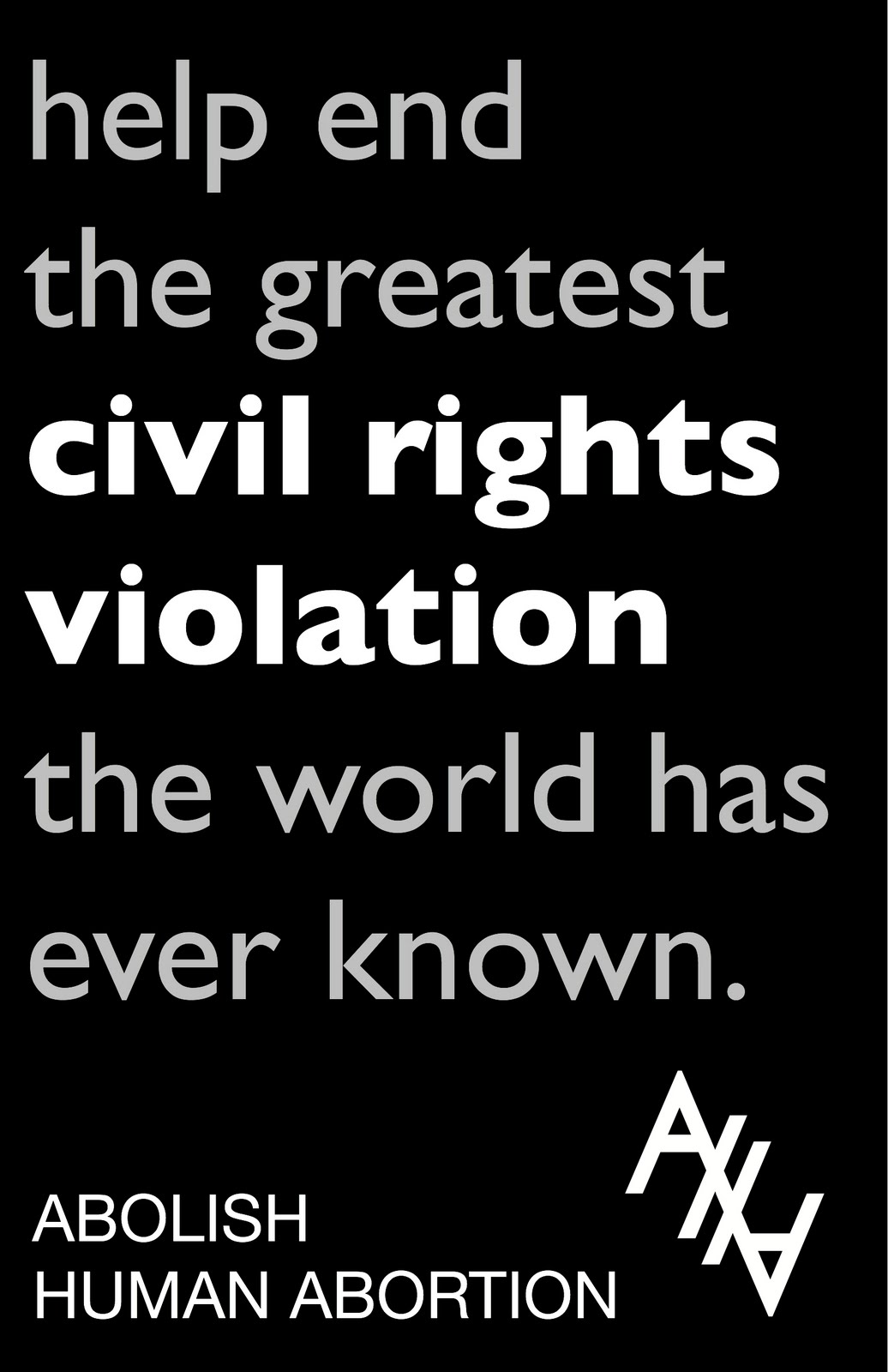 Recently, the Facebook group for the activist group known as “Abolish Human Abortion” shared a note to fellow pro-life activists providing critique and advice. Here, we’ll analyze that post to see how accurately it represents their opponents and what we can take away from how to argue the abortion issue.
I’ll link to the entire post (see above; see it also reproduced in the comments below) so that you can read it for yourself and see if I unfairly represented anything. I’ve also kept a copy of it on file to reproduce it in the comments. I welcome comments so long as they follow my comment policy.
Tone
First, I want to say that I do appreciate some of what AHA has done and continued to do. Many of their posters are helpful (such as the one featured in this post or in my post on Bonhoeffer’s view of abortion), and they provide some solid analysis of the abortion issue from a worldview perspective. No one reading this post should think that everything I think about AHA is negative. I have had positive interactions with AHA in the past and hope, as they do, that one day we can end abortion. I also favor the immediate end of abortion to gradually ending it. My contention is that gradual legislation is actually effective (this claim will be borne out below).
Second, note that any response to me should operate under a fairly similar tone. I have actively worked to end abortion through protest, prayer, writing, and other avenues. I hope that one day we can end abortion. Attacks on me as a person because I disagree with the method of another pro-life group should be seen for what they are: obfuscation.
Third, I will not respond to anything not in the comments here. I simply don’t have time to go actively seeking responses to my posts, so if you have something to say, write it here and please be brief.
Analysis
The author of the note, T. Russell Hunter, begins with a claim: “When hospitals all across America start paying doctors to perform abortions within their walls, it will be the triumphs of pro-life legislation which drove them there.” This claim is that which Hunter contends to support. Let us analyze the rest of the note to see if this claim is borne out therein.
The first piece of allegedly supporting evidence is this: “Passing laws that temporarily shut down abortion clinics because they are not close enough to hospitals only strengthens the abortion industry…”
Think about that claim for a second. First, does it support the claim that hospitals “all across America” will start performing abortions? Second, does it provide any evidence whatsoever? Finally, let’s put this claim in perspective with some facts. Planned Parenthood has said, of the closure of several clinics in Texas [paraphrasing], “…the requirement could leave the state of 26 million people with as few as six abortion centers.” That same article notes how many abortion providers have failed to meet the new requirements put in place by laws in Texas. Think about that: if there are only 6 abortion centers in a state the size of Texas, do you think that the number of abortions will increase or decrease?
Another claim made by Hunter: “Abortion is not health care and we should not be fighting it by passing health-code rules and regulations.”
Given how much AHA likes to parallel ending abortion with the abolition movement, I think it is fitting to point to the way William Wilberforce–who effectively ended slavery in Great Britain–worked against slavery. For some time he tried to get votes passed to outright abolish slavery. Ultimately, however, abolition was assured when a bill was passed forbidding military aid to be provided to slave ships due to the war with France. The move was effectively a sleight of hand because several British ships operated under neutral flags, so the slave trade was crippled and slavery was abolished not long after that. You can see this story beautifully dramatized in the film Amazing Grace.
What does this bit of history tell us? It tells us that such means actually are effective. Thus, when a state like Texas passes new legislation to ensure the heath and safety of women who are at abortion clinics, and those new regulations cause a state with 26 million people to shut down abortion clinics, the pro-life cause does benefit.
Two claims of supporting evidence provided are: “4. Some ‘clinics’ will close, but those remaining will pick up the slack; 5. Shutting down clinics doesn’t halt abortion, it just makes people who choose to sacrifice their children drive further.”
I’d like to ask AHA to provide statistics to back up these claims. Rather than just throwing out speculation that women who choose abortion will just “drive further” (remember, Planned Parenthood is concerned a state like Texas [look at its size on the map!] will go down to just six clinics), back it up. Yet AHA expects us to believe through mere speculation that these women will “drive further.” I wonder what evidence they have to support that. Moreover, the evidence actually counters this claim. (From the article:) “Kansas is one state that is an example of how closing abortion clinics saves lives. Since 2001, every time an abortion clinic closed in Kansas, the number of abortions significantly dropped the following year.” That’s a fact. What has AHA provided to support their claim that closing clinics is not effective?
Unfortunately, the rest of the note essentially follows this same theme. There are a number of claims thrown out there with no evidence. Consider this tidbit: “Do you not see that the abortion industry only gets stronger as they build bigger and better clinics to meet your pro life standards. Do you not see that they (like you) just raise money from their so-called defeats? Have you not come to realized that no matter how many clinics you shut down, millions of babies are still being aborted every year. Do you not see that the devil himself would allow you to take a few pieces off the board so long as he constantly has you in check mate?”
Again, facts speak louder than empty leading questions. The number of clinics closed has not been offset by the number opened. The number is, in fact, down 74% since 1991. And, when clinics close, the number of abortions decreases.
Consequentialism or Pragmatism- Getting it Done?
The main problem with AHA’s reasoning is that they take an all-or-nothing mentality. You can observe that in the leading questions noted above. In particular, “Have you not come to realized [sic] that no matter how many clinics you shut down, millions of babies are still being aborted every year[?]” Yes, it is true that millions are being aborted. However, when pro-life legislation continues to reduce the number of those being aborted, that is cause to say that pro-life views are being furthered. I don’t know of any pro-life organization that’s saying “Hey, we got some clinics to close! Let’s stop working to end abortion!” That’s not how pro-life groups are approaching the issue. However, many of these groups are happy that when clinics close–as they are–the number of abortions decreases.
The fact that AHA is not happy about this says something, I think, about their own mentality when it comes to the issue. AHA demands only legislation which will immediately end abortion. They are seemingly unaware of how historically (as noted above with Wilberforce) working through other means can actually be more effective.
It is this seeming historical illiteracy (see also here) of AHA which worries me enough to make me want to respond to a note like the one I wrote on here. By failing to acknowledge the success of gradualism and, in fact, working against gradualist approaches, AHA is working against facts. Lives are being saved when abortion clinics closed. That’s something anyone who labels themselves “pro life” should celebrate.
Conclusion
AHA has not provided evidence to support the claims made in the note I analyzed. Moreover, several of the assertions made therein are actually contrary to observed facts. AHA seems to be either historically ignorant or willfully obfuscating the way in which abolition was brought about. Although I would also far prefer the immediate end of abortion, I think any who are pro-life should agree that when legislation closes abortion clinics–which lowers the number of abortions and therefore saves lives–it is cause for celebration rather than chastising those who worked to pass the legislation.
I reiterate that I know of no pro-life organization which is saying that the work is done once legislation which may close abortion clinics passes. The work will continue until we have brought an end to abortion. Groups like AHA should stop trying to muzzle those who have actively worked to save lives.
Finally, I admit I wrote this post with a heavy heart and only because I’m deeply concerned with the way that AHA has continued to aim criticism at pro-life individuals or groups which are actively saving lives. I was very excited when I learned about AHA over a year ago but have, unfortunately, felt burdened to caution others away from the group because of the way it continually fails to provide facts to support their attacks on other pro-life persons. We must learn from history and we should celebrate when lives are saved. I long to return to a point where I and AHA could stand together as we work side-by-side to end abortion. Unfortunately, as long as AHA fails to recognize that gradual steps actually do save lives, that day will not come.
Links
Be sure to check out the page for this site on Facebook and Twitter for discussion of posts, links to other pages of interest, random talk about theology/philosophy/apologetics/movies and more!
How Abolish Human Abortion Gets History Wrong– Here, a pro-life individual notes some of the historical errors in evaluating abolition and abortion AHA has put forth. It is worth seeing the response to some counter arguments made by AHA as well.
Abolish Human Abortion’s Revisionist History– Clinton Wilcox provides a more thorough analysis of the use of the term “abolition” and how abolitionists themselves actually worked incrementally to bring about the abolition of slavery.
SDG.
——
The preceding post is the property of J.W. Wartick (apart from quotations, which are the property of their respective owners, and works of art as credited; images are often freely available to the public and J.W. Wartick makes no claims of owning rights to the images unless he makes that explicit) and should not be reproduced in part or in whole without the expressed consent of the author. All content on this site is the property of J.W. Wartick and is made available for individual and personal usage. If you cite from these documents, whether for personal or professional purposes, please give appropriate citation with both the name of the author (J.W. Wartick) and a link to the original URL. If you’d like to repost a post, you may do so, provided you show less than half of the original post on your own site and link to the original post for the rest. You must also appropriately cite the post as noted above. This blog is protected by Creative Commons licensing. By viewing any part of this site, you are agreeing to this usage policy.
Sunday Quote! – Does location determine personhood?
 Every Sunday, I will share a quote from something I’ve been reading. The hope is for you, dear reader, to share your thoughts on the quote and related issues and perhaps pick up some reading material along the way!
Does location determine personhood?
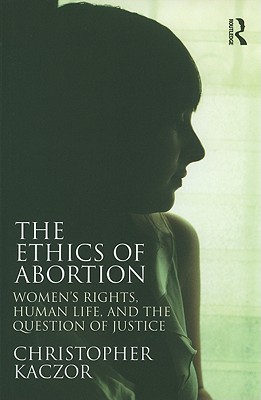
I have been reading through The Ethics of Abortion: Women’s Rights, Human Life, and the Question of Justice by Christopher Kaczor. It is a philosophical defense of the pro-life position and the notion that the unborn is a human person. In his discussion of partial-birth abortion, Kaczor makes the following point:
In Sternberg v. Carhart, later reversed in Gonzalez v. Carhart, the United States Supreme Court affirmed a constitutional right to… partial-birth abortion, and with it affirmed the legality of the conventional pro-choice view that abortion ought to be legally permissible through all nine months of pregnancy, until the human being has been entirely removed from the mother’s body. The court gave no justification why moving the head of the child just a few inches marks the crucial distinction between non-personhood and personhood… (52, cited below)
Frankly, I think this is something that any pro-choice individual must deal with: what is it about the location of the unborn which conveys personhood or prevents the unborn from being a person? What is it, that is, which transforms the unborn from non-person to person as the unborn is birthed?
Links
Be sure to check out the page for this site on Facebook and Twitter for discussion of posts, links to other pages of interest, random talk about theology/philosophy/apologetics/movies and more!
Check out my other posts on the debate over abortion.
Source
Christopher Kaczor, The Ethics of Abortion: Women’s Rights, Human Life, and the Question of Justice (New York: Routledge, 2011).
Downton Saturday: Season IV, Episode 6- a Christian worldview perspective
 I will be analyzing each episode of the fourth season of Downton Abbey from a worldview perspective. There will, of course be SPOILERS for each episode, and I will assume readers know about each previous season and episode’s content as well. It will be assumed that readers are familiar with the characters and circumstances. I will not be summarizing the plot of the episode; I will merely interact with the content from a perspective of worldview. BE COURTEOUS AND DO NOT BRING UP LATER EPISODES THAN THE ONE DISCUSSED HERE IN YOUR COMMENTS.
The Decision
The most momentous part of this episode was when Lady Edith was very close to getting an abortion. The scene was extremely emotional: Edith’s sharing of her pregnancy with her Aunt Rosamund and the fact that she had scheduled an abortion. Rosamund insisted on going with and as they were in the waiting room, Edith shared her reasoning: she would be shunned by society, and she wasn’t sure she would be strong enough to deal with that.
Interestingly, the language used about the pregnancy affirmed several points: the baby was “wanted”–the issue was Edith’s own strength; the unborn was considered a baby, as opposed to a part of the mother. I’m hesitant to get as excited as some have gotten regarding possible commentary on “pro-life” or “pro-choice” categories in this episode for a few reasons: although the child was acknowledged as such, the issue was presented as a great danger to Edith. It was, essentially, the myth of the “back alley” abortions tied in with some bones thrown to pro-life people as well. Essentially, the episode offered a kind of please everyone approach to the issue, which, on the one hand, showed the complexity on the issue, but the other made it seem quite contrived.
The issue, of course, is extremely complex, and I did appreciate the emotional turmoil that Edith confronted when it came to the decision one way or the other. However, in light of the language used–killing a baby–one has to wonder, and I emphasize this: at the level of objective truth, what the debate is about.
The Bates Family
The guilt that Anna deals with continues to tear at my heartstrings. She is the victim and the fact that she is dealing with so much guilt–as though she thinks she is somehow to blame or stained because of it–is simply awful. I want to reach through the screen and hug her. Bates’ own take on it is to find whoever did it and destroy them. I get his motivation, but I wonder at his own treatment of Anna as a porcelain doll. He also seems to have shifted his view of her, and that seems to be another way in which the victim is having more wrongs piled atop each other. I do hope they manage to heal as a family.
Prediction
I predict that Bates has figured out who violated Anna and he’s going to kill him, resulting in Bates’ execution and a reaffirmation that British people must want everyone else on Earth to be as depressed as they are. (Yes, this is a bit tongue-in-cheek.)
Links
Be sure to check out the page for this site on Facebook and Twitter for discussion of posts, links to other pages of interest, random talk about theology/philosophy/apologetics/movies and more!
The image is copyright BBC and I do not claim any rights to it. To my knowledge it is freely available for purposes of promotion/critique and I use it under fair use.
SDG.
——
The preceding post is the property of J.W. Wartick (apart from quotations, which are the property of their respective owners, and works of art as credited; images are often freely available to the public and J.W. Wartick makes no claims of owning rights to the images unless he makes that explicit) and should not be reproduced in part or in whole without the expressed consent of the author. All content on this site is the property of J.W. Wartick and is made available for individual and personal usage. If you cite from these documents, whether for personal or professional purposes, please give appropriate citation with both the name of the author (J.W. Wartick) and a link to the original URL. If you’d like to repost a post, you may do so, provided you show less than half of the original post on your own site and link to the original post for the rest. You must also appropriately cite the post as noted above. This blog is protected by Creative Commons licensing. By viewing any part of this site, you are agreeing to this usage policy.

 J.W. Wartick - Reconstructing Faith