abortion
Really Recommended Posts 1/17/14- Gospels, Abolish Human Abortion, the Kalam, and more!
 Here we have another round of really recommended posts. This one features a couple posts directed inwards at fellow Christians or people with whom we agree alongside a range of interesting topics. It is important to maintain a high standard, so sometimes it is necessary to give criticism where it is due. Drop a comment, let me know what you thought.
A Fundamental Flaw Behind Abolish Human Abortion– A group which I came out strongly in support of some time ago has really started to take a few turns with which I cannot agree. The group is known as Abolish Human Abortion. I think a lot of what they were doing is quite excellent, but I cannot abide by a few of their primary beliefs. Check out this great analysis of one of the major issues with the group.
The kalam cosmological argument defended in a peer-reviewed science journal– The title says it all, though the post does have some nice quotes and bits of information. The kalam cosmological argument is an extremely powerful argument for the existence of God. I have a few posts on it myself.
Dear Parents with Young Children– The importance of bringing your children to church is inestimable. Moreover, choosing a church where Law and Gospel are clearly proclaimed, and a basis for belief is preached is essential. Thank you to those parents who bring their children to church! Check out this great post about the topic.
The Case for the Eyewitness Status of the Gospel Authors– Are there any reasons to think those who wrote the Gospels knew what they were talking about? Here, J. Warner Wallace–who, as a homicide detective, has some experience with eyewitness accounts–argues that the Gospels show good evidence for thinking they are eyewitness accounts.
A Review of 5 Views of Biblical Inerrancy– I do not agree with everything Norman Geisler has to say, but I think portions of this review are of critical importance. I haven’t quite finished the whole article, and I’ve only just started reading the book, but I thought this post was worth passing along for others who find the topic of interest.
Really Recommended Posts 1/10/14- Divergent, marriage, Boghossian, and more!
 Dear readers: As a thank you for stopping by, check out my latest “Really Recommended Posts.” Here, we’ll look at the Young Adult book Divergent (coming to theaters soon!), marriage, Augustine, abortion, Boghossian’s atheist propaganda, and some great free Bible inserts for apologetics. Check ’em out. As always, feel free to drop your own Really Recommended Posts by leaving a comment with your recommendation (and why). Also, feel free to leave a comment on your thoughts on any of these posts.
Free E-Book Download: Peter Boghossian, Atheist Tactician– Let me tell you right now, you should immediately download and start reading this free e-book. It is a response to Peter Boghossian’s A Manual For Creating Atheists. Boghossian is intentionally trying to destroy Christianity and proselytize for atheism. I have not finished the book yet, but what I have read has been excellent. It comes with my recommendation.
Divergent– Anthony Weber over at Empires and Mangers, one of my favorite sites (and one you should follow!), reviewed the YA Book Divergent. He examined it from a worldview perspective. The book is being made into a major motion picture and has been hailed by some as the “next Hunger Games.” That means we’re going to run into it everywhere. What questions can we bring to the table? There are SPOILERS in this linked post.
Modern Marriage Concerns– How might egalitarianism play out in marriage? Here, a brief post explores the nature and possible concerns regarding marriage in an egalitarian system.
A Free Bible Insert to Say Thanks for a Great 2013– Check out this link to get some great printable Bible inserts related to apologetics to tuck into the pages for quick access. I highly recommend checking them out.
Augustine’s Confessions: Some Lessons for apologetics– Augustine’s work, Confessions, is an autobiographical account of parts of his life. In it, he provides some insights into what is needed for an apologetic approach even in our church today.
‘He killed my baby !’: The day I lost my daughter to the Culture of Death– A powerful story about awakening to the wrongness of abortion.
Really Recommended Posts 1/3/14- Dinosaurs, Evangelists, Down Syndrome, and more!
Every week I search to find the best the web has to offer to you, dear reader. Check out my Really Recommended Posts this week, which feature everyone’s favorite topic: dinosaurs. Also featured are egalitarianism, Down Syndrome and abortion, creationism, a comic (and who doesn’t love comics!), and the worship wars. If you see something you like, let me know! Also, feel free to share your own recommendations here. I’d be happy to look into them. If you do share a link, be sure to drop a comment to let me know what it’s all about.
Rapid Burial Allows Preservation of a Hadrosaur Fleshy Head Comb– There have been a few finds of late with soft tissue preservation of dinosaurs. This allegedly presents a problem for the time scales proposed by contemporary science, according to some young earth creationists. Here, the author explores the preservation of soft tissue and argues that it actually presents a difficulty for young earth creationists.
‘If I don’t protect them, I am nothing’: The man who discovered Down syndrome– Down syndrome is a reason that many children are aborted today. It’s horrifying. The story of the man who discovered Down syndrome is a powerful testament to the need to protect and preserve life.
Women Evangelists in Acts– A brief but compelling argument that those who dismiss the notion of women in the ministry may not be taking the entire biblical witness into account. For example, what of those women who evangelized?
How Young-Earth Creationism Became a Core Tenet of American Fundamentalism, Part 1– It is often assumed that young earth creationism is simply a product of the Bible. The history of the movement is informative in correcting this misconception. Get informed yourself and check out this article.
Humans in Light of Biblical Revelation– A comic which shares an uncomfortable truth.
Worship Wars–faulty (and hurtful) logic– Does contemporary Christian music, by necessity, entail a lack of depth and wanton emotionalism? Check out this article exploring some issues related to a recent critique of CCM in general.
Really Recommended Posts 11/22/13- Miraculous Gifts, Concordism, Archaeology, and more!
I have to admit, I think this is one of the most engaging “Really Recommended Posts” I’ve put together. There are multiple views presented on two of these posts, and the others give some good food for thought. Check out opposing views on charismatic/miraculous gifts; delve into the notion of concordism from different sides. Leave comments to share your own thoughts on these issues. Then, archaeology, abortion, the Noah movie, and Hume round out the discussion. I hope you’ll drop some comments to let me know your thoughts.
Debate: Have the New Testament Charismatic Gifts Ceased?– The “Strange Fire” book and conference have caused a huge amount of discussion to arise within evangelical circles regarding miraculous/charismatic gifts. Do these gifts continue past the New Testament times? Here, Michael Brown debates Sam Waldron on this topic. I have also written presenting four major views on this topic should you like to explore the topic more deeply. Which side do you think is correct? Why? Leave a comment!
Defending Concordism: Response to The Lost World of Genesis One– Concordism is the view that science will line up with biblical teaching about origins and other scientific aspects of reality. One major challenge to the position is the notion that the Bible simply doesn’t address such things. Here, Reasons to Believe, a major concordist group, answers several objections posed against concordism. William Lane Craig has recently answered a question about concordism himself, in which he raises a few objections to the position and explains why he is not a concordist. What are your thoughts on this debate? Leave a comment!
A Brief Sample of Old Testament Archaeological Corroboration– The Old Testament clearly makes a number of claims about the actual historical events of the Bible. Here, J. Warner Wallace addresses some of these claims and notes how we have archaeological research to back them up.
How the ADF kept nurses who wouldn’t perform abortions from being fired– The ADF–Alliance Defending Freedom–successfully reached a settlement regarding a hospital that was going to force nurses with moral objections to abortion to perform them. I find this a particularly stunning case, because so often the pro-choice side says things like “Don’t want an abortion, don’t get one!” But this is shown to be mere lip service, because now the attempt is being made to force even those with moral objections not to get abortions, but to actually carry them out. I am very pleased to see that sound reasoning prevailed and the nurses were not forced to do this or lose their jobs. It remains troubling to me that anyone would even think this could be okay. Check out the post.
How Should Christians Respond to Noah the Movie?– Greg West over at The Poached Egg (an amazing site you should follow if you don’t already!) found this gem of a post regarding the “Noah” movie. Check out my own thoughts on the trailer and upcoming film.
David Hume’s Genuine Theism– A provocative title, to be sure! In this brief post, the author argues that one of Hume’s aims was to restore “genuine theism” over and against rationalistic deism. It’s a quick read, but very thought-provoking.
Does the child have a choice?
Recently, I saw a very powerful ad discussing the dangers of secondhand smoking. Check it out:
I want to be clear on this: I think tobacco is a very horrible problem. My grandpa died of lung cancer even after not smoking for many years. The damage had been done. I know others who have also died from cancer and the correlation to smoking is high. I do not at all want to minimize the dangers of smoking and the enormous health problems it may cause.
However, this ad was extremely poignant to me because of its language. “The tobacco companies say that smoking is a choice… What choice does she have?”
Think about that for a moment. The power behind this ad is the fact that the word “choice” has been used dishonestly: it has been used to deceive people into thinking that something is a choice made in the abstract, with an effect that only applies to the person making the choice.
Who else uses this kind of rhetoric?
I’ll give you a hint: what group calls themselves pro-choice?
That’s right: people who are pro-choice tend to give the same message as the tobacco companies called out in this video. The reasoning is similar: Tell women that abortion is a choice. It is an intellectually dishonest way to hide the real issue: that abortion impacts more than just the woman. What about the unborn child inside of the woman? Do they have a choice? Obviously they do not. The difference between the unborn child and the one in this ad is that we can see one. It is a difference of size, level of development, environment, and degree of dependency. None of these should be used to make the unborn ontologically different from the crying baby in the car seat in the ad.
I do not think we need to co-opt every argument or discussion to talk about pro-life issues. In fact, I am generally hesitant to do so, because I think it may take away from the power of the pro-life message. However, I do think that this ad could just as easily be about abortion as it is about the dangers of secondhand smoke. The only difference is the location of the child outside the womb. Does the baby inside the womb have a choice?
Back-Alley Abortions, Apologetics, Male Hierarchy, and more! – Really Recommended Posts 10/18/13
 I have given you, dear reader, this edition of “Really Recommended Posts” which is simply bulging at the seams with great content. Herein, you shall discover the myth of the back alley abortion, an analysis of male rule, sociology and religion’s impact on society, Augustine and the creation/evolution debate, and more! Check ’em out. Let me know what you think!
Is Male Rule a Biblical Ideal?– Here, Mimi Haddad confronts some of the common arguments for male rule in the church and home. These arguments include the fact that Jesus was male, that the 12 disciples were male, etc.
Sociologist Rodney Stark discusses whether religion is good for society– A highly interesting post in which a sociologist takes on claims that religion could be bad for society. Looking into the actual statistics and facts of the matter makes an extraordinary difference to one’s perception.
Pro-Choice “Facts”: Illegal Abortion Deaths– One of the very common arguments for abortion is that we need to keep such things safe. After all, if women will get abortions anyway, we should try to keep them safe. This article examines the myth of the back-alley abortion and exposes it for what it is: a fraud.
The dangers of apologetics– My wife linked me to this article which I think makes some extremely valuable points regarding the nature and practice of apologetics. I particularly liked that the author did not throw apologetics out the window but rather offered pieces of advice for apologists and what to avoid as an apologist. What are your thoughts?
Augustine’s Origin of Species– Within the creation/evolution debate, many continue to allege that one cannot consistently be a Christian and hold to certain views of the age of the universe or the origin of species. Here, Alister McGrath analyzes these claims alongside the wonderful Christian theologian, Augustine.
Signs that the New Atheist Movement May be Collapsing– A post which examines the intellectual collapse of the New Atheism. I think the most fascinating point is the third, that New Atheists are suppressing intellectual dialogue.
John Loftus Exits in Infamy– Speaking of the New Atheists, David Marshall analyzes his own recent dialogue with John Loftus, a[n] [in]famous atheist. The way the dialogue proceeded is highly telling.
The Epistemic Argument Against Abortion
 Epistemology is the study of knowing. That is, it is the study of how we know something is true. Here, I will offer an argument against abortion which concerns the question: what do we know about the unborn?
An Analogy*
Suppose you are a demolition expert. You’re sitting outside a building you are to blow and you are about to hit the button. The area has been declared clear and so you have flipped the cover of the button up and you’re about to blow the building. Suddenly, someone cries out–a little red tricycle has been discovered outside the building. Fortunately, however, the people who spotted the tricycle tell you there is only a 20% chance that the child made his or her way inside the building. The equipment being used is expensive and your company is paying more Shrugging while thinking “Time is money,” you go ahead and press the button, blowing up the building. After all, you’re 80% sure there is no one inside.
…Wait a second. That’s horrible! Shouldn’t you check and be sure that there is no one inside the building? After all, that person’s life is worth so much more than the extra money your company will have to spend as the child is searched for.
The question then must be asked: what percent is low enough for you to press the button? Suppose you were 90% sure the child was not inside the building, would you pull the button then, confident that you gave your best effort? How about 95%? 98%? It seems to me the only morally permissible situation would be certainty. The building has been swept entirely from top to bottom and cordoned off, you are positive no one is inside. Then, you may press the button without moral culpability: you are certain you are not killing anyone whether directly or indirectly.
*I should note this example is from Kevin A. Lewis. I modified the scenario slightly.
The Argument Stated and Defended
The argument is actually very simple:
1) If it is possible that the unborn is a human person, we should not kill the unborn.
2) It is possible that the unborn is a human person.
3) Therefore, we should not kill the unborn.
Premise one seems obviously true to me. In order to deny premise one, the advocate for abortion must claim that we may destroy “fetuses” even if it is possible that they are human persons. That is, the pro-choice position must hold that it is permissible to blow the building at 80%; or perhaps even at 98%. Given a similar situation: the doctor with the tools for abortion goes and destroys the fetus with the possibility that, like the red tricycle sitting outside the building, they may not know whether they are killing a child; instead, they go forward with the procedure, even though they may be murdering a baby.
Note that what I’m claiming here is a very small claim: it may be even a .5% chance that the fetus is a baby (of course, I am convinced that from conception, we have a human being, but for the sake of argument I will grant even .01% chance), but then the doctor, like the demolition expert, goes ahead and “blows the building” anyway.
Premise 2 also seems to be obviously true. In order to show me that it is wrong, the pro-choice party must make an argument towards the claim that the unborn is not a human person. Why must they try to prove a universal negative? Well, my claim is very broad: It is possible the unborn is a human person. I have argued towards this end multiple times, and would be willing to engage someone on those points. But the bottom line is, even if my arguments fail, I still think that it is possible the unborn is a human person. I just need reasonable doubt here, not epistemic certainty. Unfortunately for those who are pro-choice, their position must yield epistemic certainty, but it cannot.
The conclusion follows from the premises via modus ponens. Thus, the argument succeeds.
Objections
We can never be sure about anything
Perhaps the most thoughtful answer a pro-choice advocate might make for this argument is that we can never be sure of anything. After all, we cannot be certain that when we drive somewhere, a child might run in front of our car and get hit and killed. Indeed, in the case of a demolition expert, one could always have a helicopter drop a small child onto the building at the last second, or a child could tunnel underneath and get in, etc.
My response to this argument is fairly straightforward. In abortion, we are intentionally going in and killing the fetus (or dismantling it; however you want to put it). The analogy with driving simply doesn’t work. In order for it to be even close to accurate, the driver isn’t driving safely. Instead, it would be like driving drunk along a sidewalk in Chicago. You shouldn’t do it.
The problem with the ‘certainty’ objection is that while it is true we cannot be 100% of just about anything, it is also true that there are some steps we should take in order to give ourselves epistemic certainty. That is, there is a line between saying something is broadly logically possible and saying that it actually reduces one’s epistemic certainty of a proposition. Certainly, it is possible for a helicopter to parachute a child onto the building in the seconds before it explodes, but does that reduce one’s epistemic certainty pertaining to the situation? I do not think so.
You’re A Man
Unfortunately, I run into this argument far more often than one might think. It should be pretty obvious that this argument is completely fallacious. Whatever my gender happens to be, I am capable of reasoning.
Sometimes, the argument is put forth as “get out of my womb” or something similar. Well again, if the unborn is a human being, then I am attempting to protect a distinct human being. Thus, this objection not only begs the question, but it is also insulting. It is nothing more than a rhetorical device.
We can never be certain that the fetus is not a human being
A response like this basically grants my argument. As I have argued, if this is the case abortions should be impermissible. We shouldn’t just bank on uncertainty to gamble with lives. Of course, I am not going to merely appeal to uncertainty, I have positively argued that the unborn are human beings. Period.
Links
Like this page on Facebook: J.W. Wartick – “Always Have a Reason.”
Be sure to check out my other posts in which I argue for the pro-life position. Particularly relevant to the present discussion are “From conception, a human” and “The issue at the heart of the abortion debate.”
Image Credit: Wikimedia Commons Chixoy.
SDG.
——
The preceding post is the property of J.W. Wartick (apart from citations, which are the property of their respective owners, and works of art as credited) and should not be reproduced in part or in whole without the expressed consent of the author. All content on this site is the property of J.W. Wartick and is made available for individual and personal usage. If you cite from these documents, whether for personal or professional purposes, please give appropriate citation with both the name of the author (J.W. Wartick) and a link to the original URL. If you’d like to repost a post, you may do so, provided you show less than half of the original post on your own site and link to the original post for the rest. You must also appropriately cite the post as noted above. This blog is protected by Creative Commons licensing. By viewing any part of this site, you are agreeing to this usage policy.
“Star Trek: Into Darkness” – A Christian Perspective
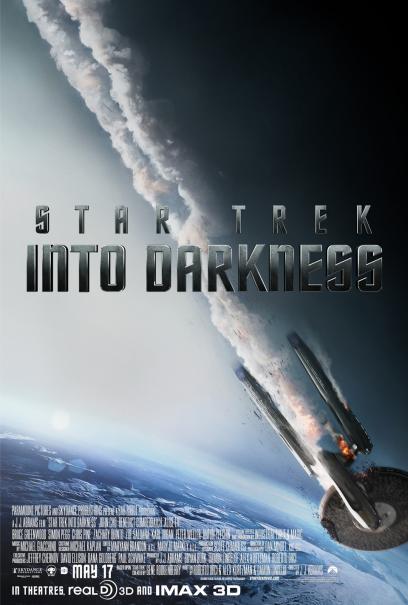 I had the chance to go see “Star Trek: Into Darkness” recently. As a big Trekkie (and Star Wars Fan–I cover all the bases of nerdom), I was extremely excited to see the film. Here, I will survey a number of worldview-level issues in the film. There will, of course, be SPOILERS in what follows.
Primitive Religion
I was a bit taken aback by the portrayal of primitive religion in the movie. At the very beginning, the crew of the Enterprise is engaged in an effort to save a primitive indigenous population. Kirk steals a scroll, to which the natives were giving obeisance. It is apparently something they worship, and when he finally unrolls the scroll to slow them down, which causes them to stop and worship, the situation is shown to be absurd. Once the Enterprise reveals itself, however, the natives immediately forsake this scroll and worship an image they draw in the dirt of the ship.
I may be a bit hyper-critical here, but I can’t help but think that this picture of primitive religion is a bit off. Sure, it’s science fiction, but the people are clearly human-like and it is easy to uncritically imagine the scene as a facsimile for how human religion may have played out. I cannot help but be extremely skeptical of this scenario. First, the notion of a bunch of simplistic idiots whose faith can shift from one moment to the next was odd. Second, the notion that primitive persons automatically worship whatever they see or cannot explain seems inaccurate. I admit that I have not studied the formation of religion as much as I hope to one day, but even what reading I have done reveals an enormous amount of debate on how religions formed and developed. No work I have read, apart from that of those with clear agendas (and little interaction with the archaeological, sociological, and anthropological evidence), has suggested that religion developed just by people seeing a bird and immediately worshiping it. Granted, the Enterprise is more than a bird, but it still seemed odd. Third, I can’t help but think that rather than immediately forsaking their holy scroll, the people would have turned to it to find guidance to discern the meaning of the events they had witnessed.
Again, I realize I am here being extremely critical, but I feel that if a movie is going to engage with religion, it should attempt to do so in an honest fashion. Trek‘s portrayal was, I think, a bit disingenuous.
The Prime Dire… wha?
Star Trek’s metaethical system essentially centers around the “Prime Directive.” The Prime Directive is complex, but essentially boils down to the notion that people should not interfere with lesser-developed cultures. Those who have seen “Into Darkness” know that in no way did the main characters follow this. But as Maureen Moser at Reasons to Believe pointed out, the Prime Directive essentially entails a kind of moral relativism wherein no one is capable of judging other cultures as morally evil. But of course this seems absurd. If, for example, one ran into a lesser-developed society which was exterminating certain groups, it seems obvious that this is a morally wrong action.
In the case of the film, one is forced to wonder–as it seems Kirk did–whether it really is morally satisfactory to allow an entire society to be destroyed simply for the sake of not being seen by that society. Is it morally right to ignore the fates of other societies?
Looking more broadly at the Trek universe one sees again and again that the characters cannot operate within the constrictions of ignoring the ills of other societies. Should we?
 Evil
Evil
Admiral Marcus seemed to lack any kind of motivation other than a desire for militarizing the Federation. I thought this was particularly hard to believe, especially when that motivation made him not even hesitate to carry out atrocities in front of his daughter. Frankly, I saw no real reason for him to go as insane as he did, which made this part of the film harder to believe.
Khan, of course, was the big “secret” going into the movie. I called it back when the character was first shown. Of course it would be Khan. But why did Khan do what he did? He was fairly clearly motivated by revenge, but there was more to his character behind the scenes.
It was revealed that Khan was a war criminal who was conducting a genocide against any whom he found to be “imperfect.” I can’t help but think that this line, was was basically incidental to the plot, is one of the better talking points from the movie. After all, is the destruction of the “imperfect” is exactly what is taking place within our society with issues such as abortion and euthanasia. On the other side, we see the unwillingness to “give a handout” to those who are hungry or in need. Our culture is steeped in a notion where we do not value the “imperfect,” whether they be elderly, unborn, mentally disabled, or poor. Moreover, one must wonder: who defines perfection? I can’t help but think that a character like Khan is not that different from the evils which are occurring each day within our society.
Miracles
When Kirk has given his life to save the crew of the Enterprise, one crew member comments that “It was a miracle.” Spock responds simply, “There are no such things.” I admit that I was baffled by this comment. After all, the series of events which had just occurred in the space of the previous 5 minutes of the film were so over-the-top that the only reasonable explanations were either Hollywood meddling (of course, this was the case) or the hand of the divine.
I vividly remember someone a few rows down in the theater audibly scoffing when Spock said this. Why would this be a reaction to a line like this? Well, simply put, some things are so beyond probability, luck, and circumstance that they cry out for explanation.
Conclusion
Overall, I enjoyed the film. But I realize that I enjoyed it more as a Trekkie than I did at a worldview level. It seems as though the writers attempted to raise some tough questions, but never got around to providing satisfactory answers. When answers were easy to see (as in the case of miracles), a main character like Spock flatly contradicted it. Those who watch the film with worldview-glasses on will find much to discuss. I think the film is worth seeing simply to start up discussions about miracles, relativism, and even some specific ethical issues. I could see the clip at the beginning used as part of a larger discussion on the history of religion. Of course, as a Trekkie, I also think it is worth seeing for the sake of its place in the Star Trek canon. Let me know what you think.
Links
Like this page on Facebook: J.W. Wartick – “Always Have a Reason.” I often ask questions for readers and give links related to interests on this site.
Be sure to check out my other posts on movies (scroll down for more).
Star Trek’s Prime Directive and Moral Relativism– I found this post fascinating. It explores the Trek universe to discuss the metaethical view of relativism.
Engaging Culture: A Brief Guide for movies– I reflect on how Christians can engage with popular movies in order to have meaningful conversations with those around them.
SDG.
——
The preceding post is the property of J.W. Wartick (apart from citations, which are the property of their respective owners, and works of art as credited) and should not be reproduced in part or in whole without the expressed consent of the author. All content on this site is the property of J.W. Wartick and is made available for individual and personal usage. If you cite from these documents, whether for personal or professional purposes, please give appropriate citation with both the name of the author (J.W. Wartick) and a link to the original URL. If you’d like to repost a post, you may do so, provided you show less than half of the original post on your own site and link to the original post for the rest. You must also appropriately cite the post as noted above. This blog is protected by Creative Commons licensing. By viewing any part of this site, you are agreeing to this usage policy.
Really Recommended Posts 4/19/13
Here we have another excellent round of posts from across the net. Please, if you look at nothing else, look into the Gosnell case. The link I have here really puts the matter well. The other posts this week are just as important and interesting, however. We have posts on the divinity of Jesus, the “King James Only” debate [what’s that? check out the link!], Rob Bell and spiritual reality, the dominion of nature in Genesis, and Sam Harris on morality. As always, pass this post to your friends and let me know what you enjoyed!
The Gosnell Trial and Destroying the Image of God– Who is Gosnell? The horrific details of this trial confirm that the image of God is under assault. But that assault goes beyond the obviously criminal actions of this man. They extend to the fact that we have undermined the image of God in humanity by devaluing human life, period.
Did the divinity of Jesus emerge slowly after many years of embellishments?– Wintery Knight presents a fantastic summary of the evidence that the divinity of Christ was a belief tied to the earliest years of Christianity.
King James Only Debate (VIDEO)– It is depressing to admit that this is a debate, but there are in fact Christians who believe the King James Bible is the only Bible we should use because… well, watch this debate and find out. I think that James White did an excellent job refuting this position.
Rob Bell’s Recipe for Spiritual Disaster– Rob Bell has seemingly prided himself in asking the tough questions that no one is asking. But what about the answers? Are there answers? Check out this thoughtful post on Bell’s theological system. Be sure to also check out my study guide of his book, “Love Wins” which comes with links to a chapter-by-chapter review I did as well.
Does Genesis 1:27-28 authorize exploiting nature?– Dan Story has written a fantastic overview of the issues related to interpreting Genesis 1:27-28 (dominion over the earth) as a command to exploit nature. Be sure to also check out his further analysis. For more on that issue, check out my Caring for Creation: A discussion among evangelicals.
Sam Harris’ Equivocation on “The Good”– Max Andrews offers a brief yet poignant look at how Sam Harris has erred on his attempts to ground objective morality in a non-theistic system.
Abortion, fundamentalists, physicalism, and evolution: Sawyer’s “Calculating God” and some contentious issues
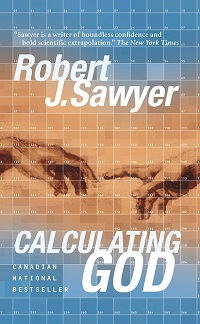 I have already written on Sawyer’s Calculating God
Fundamentalism, Religion, and Abortion
Sawyer lumps fundamentalism in with the discussions about abortion. Unfortunately, fundamentalism is portrayed in the worst possible light, not unlike in the work of Ben Bova. The religious fundamentalists here are extremists bent on destroying anything that counts as evidence against their worldview. As such, they are first introduced as blowing up an abortion clinic (86-87). Frequent readers of my site know that I write often from a pro-life perspective but also that I am very much opposed to violence in this opposition. Unfortunately, such principled opposition is not portrayed as an option in Sawyer’s work.
Interestingly the discussion of abortion in the book–intentionally or not–reveals some important details about the abortion debate. The alien, Hollus, notes the irony in being “pro-life” while also killing people who perform abortions. Yet in this discussion, Hollus reveals something of note:
Hollus looked at me [Tom Jericho, the main character] for the longest time. “These–what did you call them? Fundamentalist extremists? These fundamentalist extremists believe it is wrong to kill even an unborn child?”
“Yes” [Tom responded].
It may take a moment, but think about it: Sawyer expresses incredulity at this notion through the alien Hollus, yet in what may have been a Freudian slip, calls the unborn “children.” Yes, of course I’m opposed to killing an unborn child! In fact, this dialogue reveals exactly what is at stake in the abortion debate: if the unborn is not a human person, then who cares what you do with it? But if it is, then what relevant status difference is there between a child who is located inside the mother as opposed to outside the mother? Again, I’ve written more on this issue elsewhere, but it is important to note that even in expressing incredulity about this, there is a revealing phrase: child. It is an unborn child killed in abortion.
Disturbingly, the book touches on an issue very relevant to the personhood debate: children who are screened for disabilities. In one scene, Hollus is confronted by a child with Down’s Syndrome. He notes nonchalantly that a similar disease is almost always “screened for” in the wombs of the alien mothers (115-116). Unfortunately, this exact thing is happening right now. Unborn children who are shown as having Down’s Syndrome are being aborted inside their mothers at an alarming rate. I can’t help but see this as a modern eugenics movement: killing those we deem unworthy of life for a genetic reason. The logic that this entails is even more disturbing.
Of course the same fundamentalists who bombed the abortion clinic were also out to destroy any evidence for evolution. They sought to destroy a fossil exhibit which they saw as an affront to God. Thus, I can’t help but think that the way Sawyer presents fundamentalists is a bit disingenuous. Not all fundamentalists are incapable of reason and violent. Indeed, almost no fundamentalists are like this! Thankfully, there are positive examples of religious persons in Calculating God, including Tom’s wife.
In one poignant scene, Tom–who is dying from cancer–struggles with the fact that he has been confronted with evidence for the existence of a god. He considers famous atheists who purportedly went to death, all the while denying God’s existence to the end. Yet Tom himself gets down on his knees to pray. When he does so, though, he considers the words of someone from his past: “The Lord works in mysterious ways.” He can’t help but react violently against this:
Such bull. Such unmitigated crap. I felt my stomach knotting. Cancer didn’t happen for any purpose. It tore people apart; if a god did create life, then he’s a shoddy workman, churning out flawed, self-destructing products. “God,” [he prayed] “I wish–I wish you had decided to do some things differently.” (230-231)
Interestingly, in the book, cancer turns out to actually have a purpose… in the sense of being a side-effect of something great: the ability to fuse genetic codes with other intelligently designed species. Here it seems Sawyer has employed a great deal of imaginative techno-babble to explore the notion of a physical god, but it also has hints of a greater good theodicy akin to that of Swinburne.
Physicalism
The discussion of physicalism in Sawyer’s work is very brief, but enlightening. There is a variety of substance dualism here in the sense of emergence. That is, in Sawyer’s fictional world, intelligence and “mind” emerges from matter once complexity reaches a certain threshold. This is similar to the theories of emergence theorists like William Hasker. I can’t help but find this a bit strange. The people who argue for this type of theory are frequently the same who are very hostile to the notion of anything beyond the physical realm, yet they argue that something aphysical can indeed “emerge” from matter itself. Surely this is a leap of the imagination! That matter has creative force simply because it can reach a certain level of complexity seems to me patently absurd.
Not only that, emergence suffers from a second major problem. Namely, if our “mind” is simply a product of complexity in matter, then our “intelligence” is entirely supervenient upon physical complexity. Indeed, our intelligence is a product of that complexity and therefore cannot operate independently of that matter. Therefore, it is hard to see any kind of properties that our minds would have that would be capable of maintaining free will or even rational thought on this theory. Indeed, I have trouble seeing how this theory would be any different from physicalistic monism.
Evolution
The simple notion of evolution is a given in the book. No, it is not friendly to any who are unwilling to accept the notion of “macroevolution,” as the term is used in relevant literature. All the intelligent beings depicted in the book had evolved from a (potentially distinct) distant ancestor.
Darwinian evolution is simply assumed as truth in Calculating God. Or is it? The deity presented in the book is not very conducive to undirected evolution via natural selection and chance. It is portrayed as hurling asteroids at the planets where life was developing in order to press a “reset” button on the creatures that were currently dominant there. It also shown that this deity prevented other catastrophes from happening on these planets, thus interfering with natural selection. Indeed, the evolution depicted here is eerily similar to intelligent design, wherein the process is guided by a deity with a specific aim.
Indeed, one could argue that the entire book is an argument for intelligent design, albeit divorced from much of the theological framework that many of that movement’s frameworks operate within. Yet I can’t help but find this part of Sawyer’s argument (if, indeed, the intention is to make the argument that theists have it all wrong) is completely off. After all, the “god” of Sawyer’s universe is imperfect and concrete in the sense of physically existing. But this works against his concept of deity as being capable of coordinating the events it brings about. Granted, he could perhaps continue to increase the power of this deity beyond what is clearly outlined in the book, but there are hints that the deity is capable of knowing what is happening on places where it is not present, that it is capable of knowing what will happen with certain directions for evolution, and what will happen at the end of the universe. These work against the notion of God as a kind of blundering physical entity that just happens to be supremely powerful. Indeed, the god of calculating God may not be as hostile to Christianity as it initially seems. It serves as a pointer towards the true God of spacetime.
Links
Like this page on Facebook: J.W. Wartick – “Always Have a Reason”
Check out my other post on this book: Aliens that believe in God: The theological speculations of Robert Sawyer’s “Calculating God”
I have discussed the use of science fiction in showing how religious persons act. Check out Religious Dialogue: A case study in science fiction with Bova and Weber.
What would it mean if we discovered life? I have reflected on the possibility: Alien Life: Theological reflections on life on other planets.
Our Spooky Universe– I make the case for the intelligent design argument for the existence of God, which is heavily used throughout Calculating God.
Check out my other looks at popular level books. (Scroll down to see more!)
Source
Robert Sawyer, Calculating God
SDG.
——
The preceding post is the property of J.W. Wartick (apart from citations, which are the property of their respective owners, and works of art as credited) and should not be reproduced in part or in whole without the expressed consent of the author. All content on this site is the property of J.W. Wartick and is made available for individual and personal usage. If you cite from these documents, whether for personal or professional purposes, please give appropriate citation with both the name of the author (J.W. Wartick) and a link to the original URL. If you’d like to repost a post, you may do so, provided you show less than half of the original post on your own site and link to the original post for the rest. You must also appropriately cite the post as noted above. This blog is protected by Creative Commons licensing. By viewing any part of this site, you are agreeing to this usage policy.

 J.W. Wartick - Reconstructing Faith
